Problems
Filters
298 problems found
2002 Paper 1 Q3
Show that \((a+b)^2\le 2a^2+2b^2\,\). Find the stationary points on the curve $y=\big(a^2\cos^2\theta +b^2\sin^2\theta\big)^{\frac12} + \big(a^2\sin^2\theta +b^2\cos^2\theta\big)^{\frac12}\,$, where \(a\) and \(b\) are constants. State, with brief reasons, which points are maxima and which are minima. Hence prove that \[ \vert a\vert +\vert b \vert \le \big(a^2\cos^2\theta +b^2\sin^2\theta\big)^{\frac12} + \big(a^2\sin^2\theta +b^2\cos^2\theta\big)^{\frac12} \le \big(2a^2+2b^2\big)^{\frac12} \;. \]
Solution: \begin{align*} && 2a^2+2b^2 &= a^2 + b^2 + (a^2+b^2) \\ &&&\underbrace{\geq}_{AM-GM} a^2+b^2+2\sqrt{a^2b^2} \\ &&&= a^2+b^2 + 2|a||b| \\ &&&\geq a^2+b^2 + 2ab \\ &&&= (a+b)^2 \end{align*} Assume \(a^2 \neq b^2\), otherwise the curve is a constant. \begin{align*} && y & = \big(a^2\cos^2\theta +b^2\sin^2\theta\big)^{\frac12} + \big(a^2\sin^2\theta +b^2\cos^2\theta\big)^{\frac12}\\ && \frac{\d y}{\d \theta} &= \tfrac12 \left (a^2\cos^2\theta +b^2\sin^2\theta \right)^{-\frac12} \cdot (2 \sin \theta \cos \theta (b^2 - a^2)) + \tfrac12 (a^2\sin^2\theta +b^2\cos^2\theta)^{-\frac12} \cdot (2 \sin \theta \cos \theta (a^2 - b^2) \\ &&&= \tfrac12\sin2 \theta (b^2 - a^2) \left ( \left (a^2\cos^2\theta +b^2\sin^2\theta \right)^{-\frac12} - (a^2\sin^2\theta +b^2\cos^2\theta)^{-\frac12}\right) \\ \therefore \frac{\d y}{\d x} = 0 \Rightarrow && \sin 2\theta = 0 & \text{ or } a^2\cos^2\theta +b^2\sin^2\theta = a^2\sin^2\theta +b^2\cos^2\theta \\ \Rightarrow && \theta &= 0, \frac{\pi}{2}, \pi, \frac{3\pi}{2}, 2\pi \\ && (a^2-b^2) \cos ^2\theta &= (a^2-b^2) \sin^2 \theta \\ \Rightarrow && \theta &= \frac{\pi}{4}, \frac{3\pi}{4}, \frac{5\pi}{4}, \frac{7\pi}{4} \end{align*} WLOG \(b^2 - a^2 > 0\), then the two parts of the derivative look like:

2002 Paper 1 Q4
Give a sketch of the curve \( \;\displaystyle y= \frac1 {1+x^2}\;\), for \(x\ge0\). Find the equation of the line that intersects the curve at \(x=0\) and is tangent to the curve at some point with \(x>0\,\). Prove that there are no further intersections between the line and the curve. Draw the line on your sketch. By considering the area under the curve for \(0\le x\le1\), show that \(\pi>3\,\). Show also, by considering the volume formed by rotating the curve about the \(y\) axis, that \(\ln 2 >2/3\,\). [Note: \(\displaystyle \int_0^ 1 \frac1 {1+x^2}\, \d x = \frac\pi 4\,.\;\)]
Solution:

2002 Paper 1 Q9
\(\,\) \vspace*{-0.5in}
- If the normal reactions on the lower and higher wheels of the lorry are equal, show that the sum of the frictional forces between the wheels and the ground is zero.
- If \(P\) is such that the lorry does not tip over (but the normal reactions on the lower and higher wheels of the lorry need not be equal), show that \[ W\tan(\alpha - \beta) \le P \le W\tan(\alpha+\beta)\;, \] where \(\tan\beta = d/h\,\).
2002 Paper 2 Q4
Give a sketch to show that, if \(\f(x) > 0\) for \(p < x < q\,\), then \(\displaystyle \int_p^{q} \f(x) \d x > 0\,\).
- By considering \(\f(x) = ax^2-bx+c\,\) show that, if \(a > 0\) and \(b^2 < 4ac\), then \(3b < 2a+6c\,\).
- By considering \(\f(x)= a\sin^2x - b\sin x + c\,\) show that, if \(a > 0\) and \(b^2< 4ac\), then \(4b < (a+2c)\pi\)
- Show that, if \(a > 0\), \(b^2 < 4ac\) and \(q > p > 0\,\), then $$ b\ln(q/p) < a\left(\frac1p -\frac1q\right) +c(q-p)\;. $$
Solution:
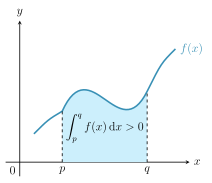
- If \(a > 0\) and \(b^2 < 4ac \Rightarrow \Delta < 0\) then \(f(x) = ax^2-bx+c > 0\) for all \(x\). Therefore \begin{align*} && 0 & < \int_0^1 (ax^2-bx+c) \d x\\ &&&= \frac13 a-\frac12b+c \\ \Rightarrow && 3b &< 2a+6c \end{align*}
- Similar logic tells us this must also be always positive, therefore \begin{align*} && 0 &< \int_0^{\pi} (a \sin^2 x - b \sin x +c ) \d x\\ &&&= \frac{\pi}{2}a - 2b+\pi c \\ \Rightarrow && 4b &< (a+2c)\pi \end{align*}
- Similar logic shows that \(f(x) = \frac{a}{x^2}-\frac{b}{x} +c>0\), therefore \begin{align*} && 0 &< \int_p^q \left (\frac{a}{x^2} - \frac{b}{x} + c\right) \d x \\ &&&=a\left (\frac{1}{p} - \frac{1}{q} \right) - b(\ln q - \ln p)+c(q-p) \\ \Rightarrow && b \ln (q/p) &,< a\left (\frac{1}{p} - \frac{1}{q} \right) +c(q-p) \end{align*}
2002 Paper 2 Q5
The numbers \(x_n\), where \(n=0\), \(1\), \(2\), \(\ldots\) , satisfy \[ x_{n+1} = kx_n(1-x_n) \;. \]
- Prove that, if \(0 < k < 4\) and \(0 < x_0 < 1\), then \(0 < x_n < 1\) for all \(n\,\).
- Given that \(x_0=x_1=x_2 = \cdots =a\,\), with \(a\ne0\) and \(a\ne1\), find \(k\) in terms of \(a\,\).
- Given instead that \(x_0=x_2=x_4 = \cdots = a\,\), with \(a\ne0\) and \(a\ne1\), show that \(ab^3 -b^2 +(1-a)=0\), where \(b=k(1-a)\,\). Given, in addition, that \(x_1 \ne a\), find the possible values of \(k\) in terms of \(a\,\).
Solution:
- Consider \(f(x) = x(1-x) = x - x^2 = \tfrac14 - (x - \tfrac12)^2\) which is clearly in \((0,\tfrac14)\) when \(x \in (0,1)\), therefore if \(0 < k < 4\) then \(f(x) \in (0, 1)\) and so by induction \(x_n \in (0,1)\).
- Suppose \(a = g(a)\) then \(a = ka(1-a) \Rightarrow 1 = k(1-a) \Rightarrow k = \frac{1}{1-a}\) (since \(a \neq 0, 1\))
- If \(g(g(a)) = a\) then \begin{align*} && a &= kg(a)(1-g(a)) \\ &&&= k^2a(1-a)(1-ka(1-a)) \\ &&&= -k^3a^2(1-a)^2 + k^2a(1-a) \\ \Rightarrow && 1 &= -k^3a(1-a)^2 + k^2(1-a) \\ \Rightarrow && 1-a &= -k^3a(1-a)^3+k^2(1-a)^2 \\ \Rightarrow && 1-a &= -ab^3+b^2 \\ \Rightarrow && 0 &= ab^3-b^2+(1-a) \end{align*} Note that \begin{align*} && 0 &= ab^3-b^2+(1-a) \\ &&&= (b-1)(ab^2-(1-a)b - (1-a)) \end{align*} and since \(b \neq 1\) (otherwise \(x_2 =0\) which is a contradiction) we must have \(b = \frac{1-a \pm \sqrt{(1-a)^2+4a(1-a)}}{2a} = \frac{1-a\pm \sqrt{1+2a-3a^2}}{2a}\) and so \(k = \frac{b}{1-a} = \frac{1-a \pm \sqrt{1+2a-3a^2}}{2a(1-a)}\)
2002 Paper 2 Q9
A particle is projected from a point \(O\) on a horizontal plane
with speed \(V\) and at an angle
of elevation \(\alpha\). The vertical plane in which the motion takes place
is perpendicular to two vertical walls, both of height \(h\), at distances
\(a\) and \(b\) from \(O\). Given that the particle just passes over the
walls, find \(\tan\alpha\) in terms of \(a\), \(b\) and \(h\) and
show that
\[
\frac{2V^2} g = \frac {ab} h +\frac{ (a+b)^2 h}{ab} \;.
\]
The heights of the walls are now increased by the same small positive
amount \(\delta h\,\).
A second particle is projected so that it just passes over
both walls, and the new angle and speed of projection
are \(\alpha +\delta \alpha \) and \(V+\delta V\), respectively.
Show that
\[
\sec^2 \alpha \, \delta \alpha \approx \frac {a+b}{ab}\,\delta h \;,
\]
and deduce that \(\delta \alpha >0\,\). Show also that
\(\delta V\) is positive if \(h> ab/(a+b)\) and negative if \(h
2002 Paper 2 Q13
Let \(\F(x)\) be the cumulative distribution function of a random variable \(X\), which satisfies \(\F(a)=0\) and \(\F(b)=1\), where \(a>0\). Let \[ \G(y) = \frac{\F(y)}{2-\F(y)}\;. \] Show that \(\G(a)=0\,\), \(\G(b)=1\,\) and that \(\G'(y)\ge0\,\). Show also that \[ \frac12 \le \frac2{(2-\F(y))^2} \le 2\;. \] The random variable \(Y\) has cumulative distribution function \(\G(y)\,\). Show that \[ { \tfrac12} \,\E(X) \le \E(Y) \le 2 \E(X) \;, \] and that \[ \var(Y) \le 2\var(X) +\tfrac 74 \big(\E(X)\big)^2\;. \]
Solution: \begin{align*} && G(a) &= \frac{F(a)}{2-F(a)}\\ &&&= 0 \tag{\(F(a)= 0\)}\\ \\ && G(b) &= \frac{F(b)}{2-F(b)} \\ &&&= \frac{1}{2-1} = 1 \tag{\(F(b)=1\)}\\ \\ && G'(y) &= \frac{F'(y)(2-F(y))+F(y)F'(y)}{(2-F(y))^2} \\ &&&= \frac{2F'(y)}{(2-F(y))^2} \geq 0 \tag{\(F'(y) \geq 0\)} \end{align*} \begin{align*} && 0 \leq F(y)\leq1\\ \Leftrightarrow&& 1\leq 2-F(y) \leq 2\\ \Leftrightarrow &&1 \leq (2-F(y))^2 \leq 4\\ \Leftrightarrow && 1 \geq \frac{1}{(2-F(y))^2} \geq \frac14 \\ \Leftrightarrow && 2 \geq \frac{2}{(2-F(y))^2} \geq\frac12 \end{align*} \begin{align*} && \mathbb{E}(Y) &= \int_a^b y G'(y) \d y \\ &&&= \int_a^b y F'(y) \underbrace{\frac{2}{(2-F(y))^2}}_{\in [\frac12, 2]} \d y \\ &&&\leq 2 \E[X] \\ &&&\geq \frac12 \E[X]\\ \\ && \E[Y^2] &\leq 2\E[X^2] \\ && \E[Y^2] &\geq \frac12\E[X^2] \\ \\ \Rightarrow && \var[Y] &= \E[Y^2]-\E[Y]^2 \\ &&& \leq 2 \E[X^2] - (\tfrac12\E[X])^2 \\ &&&= 2 \var[X] + \tfrac74(\E[X])^2 \end{align*}
2002 Paper 3 Q4
Show that if \(x\) and \(y\) are positive and \(x^3 + x^2 = y^3 - y^2\) then \(x < y\,\). Show further that if \(0 < x \le y - 1\), then \(x^3 + x^2 < y^3 - y^2\). Prove that there does not exist a pair of {\sl positive} integers such that the difference of their cubes is equal to the sum of their squares. Find all the pairs of integers such that the difference of their cubes is equal to the sum of their squares.
2002 Paper 3 Q7
Given that \(\alpha\) and \(\beta\) are acute angles, show that \(\alpha + \beta = \tfrac{1}{2}\pi\) if and only if \(\cos^2 \alpha + \cos^2 \beta = 1\). In the \(x\)--\(y\) plane, the point \(A\) has coordinates \((0,s)\) and the point \(C\) has coordinates \((s,0)\), where \(s>0\). The point \(B\) lies in the first quadrant (\(x>0\), \(y>0\)). The lengths of \(AB\), \(OB\) and \(CB\) are respectively \(a\), \(b\) and \(c\). Show that \[ (s^2 +b^2 - a^2)^2 + (s^2 +b^2 -c^2)^2 = 4s^2b^2 \] and hence that \[ (2s^2 -a^2-c^2)^2 + (2b^2 -a^2-c^2)^2 =4a^2c^2\;. \] Deduce that $$ \l a - c \r^2 \le 2b^2 \le \l a + c \r^2\;. $$ %Show, %by considering the case \(a=1+\surd2\,\), \(b=c=1\,\), % that the condition \(\l \ast \r\,\) %is not sufficient to ensure that \(B\) lies in the first quadrant.
2001 Paper 1 Q1
The points \(A\), \(B\) and \(C\) lie on the sides of a square of side 1 cm and no two points lie on the same side. Show that the length of at least one side of the triangle \(ABC\) must be less than or equal to \((\sqrt6 -\sqrt2)\) cm.
2001 Paper 1 Q3
Sketch, without calculating the stationary points, the graph of the function \(\f(x)\) given by \[ \f(x) = (x-p)(x-q)(x-r)\;, \] where \(p < q < r\). By considering the quadratic equation \(\f'(x)=0\), or otherwise, show that \[ (p+q+r)^2 > 3(qr+rp+pq)\;. \] By considering \((x^2+gx+h)(x-k)\), or otherwise, show that \(g^2>4h\,\) is a sufficient condition but not a necessary condition for the inequality \[ (g-k)^2>3(h-gk) \] to hold.
Solution:

2001 Paper 1 Q6
A spherical loaf of bread is cut into parallel slices of equal thickness. Show that, after any number of the slices have been eaten, the area of crust remaining is proportional to the number of slices remaining. A European ruling decrees that a parallel-sliced spherical loaf can only be referred to as `crusty' if the ratio of volume \(V\) (in cubic metres) of bread remaining to area \(A\) (in square metres) of crust remaining after any number of slices have been eaten satisfies \(V/A<1\). Show that the radius of a crusty parallel-sliced spherical loaf must be less than \(2\frac23\) metres. [{\sl The area \(A\) and volume \(V\) formed by rotating a curve in the \(x\)--\(y\) plane round the \(x\)-axis from \(x=-a\) to \(x=-a+t\) are given by \[ A= 2\pi\int_{-a}^{-a+t} { y}\left( 1+ \Big(\frac{\d {y}}{\d x}\Big)^2\right)^{\frac12} \d x\;, \ \ \ \ \ \ \ \ \ \ \ V= \pi \int_{-a}^{-a+t} {y}^2 \d x \;. \ \ ] \] }
2001 Paper 1 Q7
In a cosmological model, the radius \(\rm R\) of the universe is a function of the age \(t\) of the universe. The function \(\rm R\) satisfies the three conditions: $$ \mbox{\({\rm R}(0)=0\)}, \ \ \ \ \ \ \ \ \ \mbox{\({\rm R'}(t)>0\) for \(t>0\)}, \ \ \ \ \ \ \ \ \ \ \mbox{\({\rm R''}(t)<0\) for \(t>0\)}, \tag{*} $$ where \({\rm R''}\) denotes the second derivative of \(\rm R\). The function \({\rm H}\) is defined by \[ {\rm H} (t)= \frac{{\rm R}'(t)}{{\rm R}( t)}\;. \]
- Sketch a graph of \({\rm R} (t)\). By considering a tangent to the graph, show that \(t<1/{\rm H}(t)\).
- Observations reveal that \({\rm H}(t) = a/t\), where \(a\) is constant. Derive an expression for \({\rm R}(t)\). What range of values of \(a\) is consistent with the three conditions \((*)\)?
- Suppose, instead, that observations reveal that \({\rm H}(t)= b t^{-2}\), where \(b\) is constant. Show that this is not consistent with conditions \((*)\) for any value of \(b\).
Solution:
- \(\,\)
Notice the tangent must hit the \(y\)-axis above the origin, ie \begin{align*} && 0 &< R'(t)(0-t) + R(t) \\ \Rightarrow && R'(t) t &< R(t) \\ \Rightarrow && t &< \frac{R(t)}{R'(t)} = \frac{1}{H(t)} \end{align*}

- Suppose \(H(t) = a/t\) then \begin{align*} && \frac{R'}{R} &= \frac{a}{t} \\ \Rightarrow && \int \frac{1}{R} \d R &= \int \frac{a}{t} \d t \\ \Rightarrow && \ln R &= a \ln t + C \tag{t, R > 0} \\ \Rightarrow && R &= Kt^a \end{align*} Since we need \(R(t) > 0\), \(K > 0\), since \(R'(t) > 0\) we need \(a > 0\), since \(R''(t) < 0\) we need \(a(a-1) < 0\) ie \(0 < a < 1\)
- Suppose instead \(H(t) = bt^{-2}\) then \begin{align*} && \frac{R'}{R} &= \frac{b}{t^2} \\ \Rightarrow && \int \frac{1}{R} \d R &= \int \frac{b}{t^2} \d t \\ \Rightarrow && \ln R &= -bt^{-1} + C \tag{R > 0} \\ \Rightarrow && R &= Ke^{-b/t} \end{align*} Since \(R > 0\) we must have \(K > 0\). \begin{align*} R' > 0: && R' &= K(b/t^2)e^{-b/t} > 0 \\ \Rightarrow && b &> 0 \\ R'' < 0: && R'' &= K(b^2/t^4)e^{-b/t} -K2b/t^3 e^{-b/t} \\ &&&= Kb/t^4 (b-2t)e^{-b/t} < 0 \\ \Rightarrow && b &< 2t\\ \Rightarrow && b &< 2t \end{align*} which cannot be true for all \(t\), ie there is no \(b\) which satisfies this.
2001 Paper 2 Q3
The cuboid \(ABCDEFGH\) is such \(AE\), \(BF\), \(CG\), \(DH\) are perpendicular to the opposite faces \(ABCD\) and \(EFGH\), and \(AB =2, BC=1, AE={\lambda}\). Show that if \(\alpha\) is the acute angle between the diagonals \(AG\) and \(BH\) then $$\cos {\alpha} = |\frac {3-{\lambda}^2} {5+{\lambda}^2} |$$ Let \(R\) be the ratio of the volume of the cuboid to its surface area. Show that \(R<\frac{1}{3}\) for all possible values of \(\lambda\). Prove that, if \(R\ge \frac{1}{4}\), then \(\alpha \le \arccos \frac{1}{9}\).
Solution:

2001 Paper 2 Q5
The curve \(C_1\) passes through the origin in the \(x\)--\(y\) plane and its gradient is given by $$ \frac{\d y}{\d x} =x(1-x^2)\e^{-x^2}. $$ Show that \(C_1\) has a minimum point at the origin and a maximum point at \(\left(1,{\frac12\, \e^{-1}} \right)\). Find the coordinates of the other stationary point. Give a rough sketch of \(C_1\). The curve \(C_2\) passes through the origin and its gradient is given by $$ \frac{\d y}{\d x}= x(1-x^2)\e^{-x^3}. $$ Show that \(C_2\) has a minimum point at the origin and a maximum point at \((1,k)\), where \phantom{} \(k > \frac12 \,\e^{-1}.\) (You need not find \(k\).)