Problems
Filters
24 problems found
2025 Paper 2 Q1
The function \(\mathrm{Min}\) is defined as \[ \mathrm{Min}(a, b) = \begin{cases} a & \text{if } a \leq b \\ b & \text{if } a > b \end{cases} \]
- Sketch the graph \(y = \mathrm{Min}(x^2, 2x)\).
- Solve the equation \(2\mathrm{Min}(x^2, 2x) = 5x - 3\).
- Solve the equation \(\mathrm{Min}(x^2, 2x) + \mathrm{Min}(x^3, 4x) = mx\) in the cases \(m = 2\) and \(m = 6\).
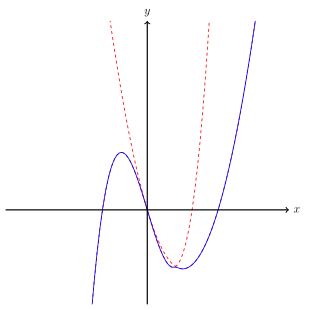
- Show that \((1, -3)\) is a local maximum point on the curve \(y = 2\mathrm{Min}(x^2, x^3) - 5x\) and find the other three local maxima and minima on this curve. Sketch the curve.
Solution:
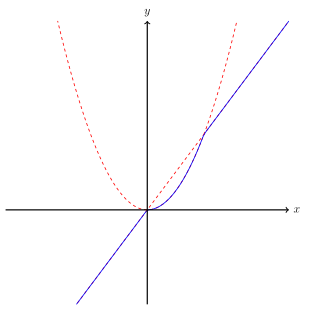
- \(2 \textrm{Min}(x^2,2x) = 5x-3\) tells us either \(2x^2 = 5x-3 \Rightarrow 2x^2 - 5x +3 = 0 \Rightarrow (2x-3)(x-1) \Rightarrow x = 1, \frac32\) and \(0 \leq x \leq 2\) or \(4x = 5x-3 \Rightarrow x= 3\) and \(x < 0\) or \(2 > x\), therefore our solutions are \(x = 1, \frac32, 3\)
- We have different cases based on \(x\) vs \(-2, 0, 2\), ie Case \(x \leq -2\): \begin{align*} && mx &= \mathrm{Min}(x^2, 2x) + \mathrm{Min}(x^3, 4x) \\ &&&= 2x + x^3 \end{align*} So \(2x = 2x + x^3 \Rightarrow x^3 = 0\), but \(x \leq -2\) so no solutions. or \(6x = 2x + x^3 \Rightarrow 0 = x(x^2-4) \Rightarrow x = 0, 2, -2\) so \(x = -2\). Case \(-2 < x \leq 0\): \begin{align*} && mx &= \mathrm{Min}(x^2, 2x) + \mathrm{Min}(x^3, 4x) \\ &&&= 2x + 4x \end{align*} So \(2x = 2x + 4x\) ie \(x = 0\) which is valid. Or \(6x = 2x + 4x\) ie valid for all values in \(-2 \leq x \leq 0\) Case \(0 < x \leq 2\): \begin{align*} && mx &= \mathrm{Min}(x^2, 2x) + \mathrm{Min}(x^3, 4x) \\ &&&= x^2 + x^3 \end{align*} So \(2x = x^2 + x^3 \Rightarrow 0 = x(x^2+x-2) = x(x-1)(x+2)\) so \(x = 0, 1, -2\), but the range means \(x = 0\) or \(x = 1\) Or \(6x = x^2 + x^3 \Rightarrow 0 = x(x^2+x-6) = x(x-2)(x+3)\) so \(x = 0, 2, -3\), but the range means \(x = 0\) or \(x = 2\) Case \(2 \leq x \): \begin{align*} && mx &= \mathrm{Min}(x^2, 2x) + \mathrm{Min}(x^3, 4x) \\ &&&=2x + 4x \end{align*} So \(2x = 2x + 4x \Rightarrow x = 0\) so no solutions. Or \(6x = 2x + 4x\) so a range of solutions. Therefore the final solutions for \(m = 2\) are \(x = 0, x = 1\) and for \(m = 2\) are \(x \in [-2,0] \cup [2, \infty)\)
- \(\mathrm{Min}(x^2, x^3)\) switches when \(x = 1\), so we must consider both limits:
\begin{align*}
&& \frac{\d y}{\d x}\vert_{x > 1} &= 4x - 5 \\
\\
&& \frac{\d y}{\d x}\vert_{x < 1} &= 6x^2 - 5 \\
\end{align*}
so when \(x = 1\) the sign of the derivative changes from positive to negative, hence a local maximum.
The other local maxima and minima will be when \(x = \frac54\) or \(x = \pm \sqrt{5/6}\)
2025 Paper 2 Q2
- Show that if the complex number \(z\) satisfies the equation \[z^2 + |z + b| = a,\] where \(a\) and \(b\) are real numbers, then \(z\) must be either purely real or purely imaginary.
- Show that the equation \[z^2 + \left|z + \frac{5}{2}\right| = \frac{7}{2}\] has no purely imaginary roots.
- Show that the equation \[z^2 + \left|z + \frac{7}{2}\right| = \frac{5}{2}\] has no purely real roots.
- Show that, when \(\frac{1}{2} < b < \frac{3}{4}\), the equation \[z^2 + |z + b| = \frac{1}{2}\] will have at least one purely imaginary root and at least one purely real root.
- Solve the equation \[z^3 + |z + 2|^2 = 4.\]
Solution:
- Suppose \(z^2 + |z + b| = a\), then \(z^2 = a- |z + b| \in \mathbb{R}\), since \(a \in \mathbb{R}\). Since the square root of a real number is either purely real or purely imaginary, \(z\) is purely real or purely imaginary.
- Suppose \(z = it\) for some \(t \in \mathbb{R}\), then \begin{align*} && \frac72 &= -t^2 +\sqrt{t^2 + \frac{25}{4}} \\ \Rightarrow && \left ( \frac72 + t^2\right)^2 &= t^2 + \frac{25}{4} \\ \Rightarrow && t^4 + 7t^2 + \frac{49}{4} &= t^2 + \frac{25}{4} \\ \Rightarrow && t^4 + 6t^2 + 6 &= 0 \end{align*} but since \(\Delta = 6^2 - 4 \cdot 1 \cdot 6 < 0\) there are no real solutions.
- Suppose \(z = t\) for some \(t \in \mathbb{R}\), then either \(t^2 + t + \frac72 = \frac52 \Rightarrow t^2 + t + 1 = 0\) (no solutions) or \(t^2 - t - \frac72 = \frac52 \Rightarrow t^2 - t - 6 = (t-3)(t+2) = 0\). When \(t = 3\) then we must take the positive part for \(|z + \frac72|\) so this cannot work. When \(t = -2\) we also have \(\frac72-2 > 0\) so we are still taking the positive part. Hence no solutions
- Suppose \(\frac{1}{2} < b < \frac{3}{4}\), the equation then consider \(z^2 + |z + b| = \frac{1}{2}\). Case 1: \(z = t \in \mathbb{R}\), then we have two cases: Case 1a: \(z+b > 0\). \(z^2 + z + b = \frac12 \Rightarrow z = \frac{-1 \pm \sqrt{1-4b+2}}{2}\) which clearly is a valid real number an \(z + b > 0\). Case 1b: \(z+b < 0\) \(z^2 - z - b = \frac12 \Rightarrow z = \frac{1 \pm \sqrt{1+4b-2}}{2}\)
- Let \(\omega\) be a (primitive) cube root of unity. \begin{align*} && z^3 &= 4 - |z+2|^2 \\ \Rightarrow && z &\in \mathbb{R} \cup \omega \mathbb{R} \cup \omega^2 \mathbb{R} \end{align*} Case 1:
2025 Paper 2 Q3
- Sketch a graph of \(y = \frac{\ln x}{x}\) for \(x > 0\).
- Use your graph to show the following.
- \(3^{\pi} > \pi^3\)
- \(\left(\frac{9}{4}\right)^{\sqrt{5}} > \sqrt{5}^{\frac{9}{4}}\)
- Given that \(1 < x < 2\), decide, with justification, which is the larger of \(x^{x+2}\) or \((x+2)^x\).
- Show that the inequalities \(9^{\sqrt{2}} > \sqrt{2}^9\) and \(3^{2\sqrt{2}} > (2\sqrt{2})^3\) are equivalent. Given that \(e^2 < 8\), decide, with justification, which is the larger of \(9^{\sqrt{2}}\) and \(\sqrt{2}^9\).
- Decide, with justification, which is the larger of \(8^{\sqrt[4]{3}}\) and \(\sqrt[3]{8}\).
Solution:

- \begin{enumerate}
- since \(\frac{\ln x}{x}\) is decreasing on \((e, \infty)\) we must have that \(\frac{\ln 3}{3} > \frac{\ln \pi}{\pi} \Rightarrow e^\pi > \pi^3\)
- similarly, since \(\frac{\ln x}{x}\) is increasing on \((0, e)\) we must have that \(\frac{\ln \sqrt{5}}{\sqrt{5}} < \frac{\ln 9/4}{9/4} \Rightarrow \left(\frac{9}{4}\right)^{\sqrt{5}} > \sqrt{5}^{\frac{9}{4}}\)
- Since \(2^4 = 4^2\) notice also that:
from the graph we must have the green area between \(1\) and \(2\) mapping to the (higher) green area between \(3\) and \(4\). Therefore \((x+2)^x > x^{x+2}\) for \(1 < x < 2\)

- \begin{align*} && 9^{\sqrt 2} & \stackrel{?}{>} \sqrt{2}^9 \\ \Leftrightarrow && (3^2)^{\sqrt2} &\stackrel{?}{>} (\sqrt{2}^3)^3 \\ \Leftrightarrow && 3^{2 \sqrt2} &\stackrel{?}{>} (2\sqrt2)^3 \end{align*} Since \(e^2 < 8 < 9\Rightarrow e < 2\sqrt2 < 3\) therefore: \begin{align*} && \frac{\ln 2 \sqrt2}{2 \sqrt 2} &> \frac{\ln 3}{3} \\ \Leftrightarrow && (2 \sqrt{2})^3 &> 3^{2 \sqrt{2}} \\ \Leftrightarrow && \sqrt{2}^9 &> 9^{\sqrt 2} \\ \end{align*}
- \begin{align*} && 8^{\sqrt[3]{3}} & \stackrel{?}{>} \sqrt[3]{3}^8 \\ \Leftrightarrow && 2^{3 \sqrt[3] 3} & \stackrel{?}{>} (\sqrt[3]{3}^4)^2 \\ \Leftrightarrow && 2^{3 \sqrt[3] 3} & \stackrel{?}{>} (3\sqrt[3]{3})^2 \\ \end{align*} Since \(3\sqrt[3]{3} > 4\) we have \begin{align*} && \frac{\ln (3 \sqrt[3]3)}{3 \sqrt[3]3} &< \frac{\ln 4}{4} \\ &&&= \frac{\ln 2}{2}\\ \Rightarrow && (3 \sqrt[3]{3})^2 &< 2^{3 \sqrt[3]{3}} \\ \Rightarrow && \sqrt[3]3^8 &< 8^{\sqrt[3]3} \end{align*}
2025 Paper 2 Q4
Let \(\lfloor x \rfloor\) denote the largest integer that satisfies \(\lfloor x \rfloor \leq x\). For example, if \(x = -4.2\), then \(\lfloor x \rfloor = -5\).
- Show that, if \(n\) is an integer, then \(\lfloor x + n \rfloor = \lfloor x \rfloor + n\).
- Let \(n\) be a positive integer and define function \(f_n\) by
\[f_n(x) = \lfloor x \rfloor + \left\lfloor x + \frac{1}{n} \right\rfloor + \left\lfloor x + \frac{2}{n} \right\rfloor + \ldots + \left\lfloor x + \frac{n-1}{n} \right\rfloor - \lfloor nx \rfloor\]
- Show that \(f_n\left(x + \frac{1}{n}\right) = f_n(x)\).
- Evaluate \(f_n(t)\) for \(0 \leq t < \frac{1}{n}\).
- Hence show that \(f_n(x) \equiv 0\).
- Show that \(\left\lfloor \frac{x}{2} \right\rfloor + \left\lfloor \frac{x+1}{2} \right\rfloor = \lfloor x \rfloor\).
- Hence, or otherwise, simplify \[\left\lfloor \frac{x+1}{2} \right\rfloor + \left\lfloor \frac{x+2}{2^2} \right\rfloor + \ldots + \left\lfloor \frac{x+2^k}{2^{k+1}} \right\rfloor + \ldots\]
Solution:
- Claim: If \(n \in \mathbb{Z}\) then \(\lfloor x + n \rfloor = \lfloor x \rfloor + n\) Proof: Since \(\lfloor x \rfloor \leq x\) then \(\lfloor x \rfloor + n \leq x + n\) and \(\lfloor x \rfloor + n \in \mathbb{Z}\) we must have that \(\lfloor x \rfloor +n \leq \lfloor x + n \rfloor\). However, since \(\lfloor x \rfloor + 1 > x\) we must also have that \(\lfloor x \rfloor + 1 + n > x + n\), therefore \(\lfloor x \rfloor + n\) is the largest integer less than \(x + n\) as required.
- Claim: \(f_n\left(x + \frac{1}{n}\right) = f_n(x)\) Proof: \begin{align*} f_n\left(x + \frac{1}{n}\right) &=\left \lfloor x+ \frac{1}{n} \right \rfloor + \left\lfloor x + \frac{1}{n}+ \frac{1}{n} \right\rfloor + \left\lfloor x+ \frac{1}{n} + \frac{2}{n} \right\rfloor + \ldots + \left\lfloor x+ \frac{1}{n} + \frac{n-1}{n} \right\rfloor - \left \lfloor n\left ( x + \frac{1}{n} \right) \right \rfloor \\ &= \left \lfloor x+ \frac{1}{n} \right \rfloor + \left\lfloor x + \frac{2}{n}\right\rfloor + \left\lfloor x+ \frac{3}{n} \right\rfloor + \ldots + \left\lfloor x+ \frac{n}{n} \right\rfloor - \left \lfloor nx + 1 \right \rfloor \\ &= \left \lfloor x+ \frac{1}{n} \right \rfloor + \left\lfloor x + \frac{2}{n}\right\rfloor + \left\lfloor x+ \frac{3}{n} \right\rfloor + \ldots + \left\lfloor x+ 1 \right\rfloor - \left \lfloor nx + 1 \right \rfloor \\ &= \left \lfloor x+ \frac{1}{n} \right \rfloor + \left\lfloor x + \frac{2}{n}\right\rfloor + \left\lfloor x+ \frac{3}{n} \right\rfloor + \ldots + \lfloor x \rfloor + 1 - \left ( \lfloor nx \rfloor + 1 \right) \\ &= \lfloor x \rfloor + \left\lfloor x + \frac{1}{n} \right\rfloor + \left\lfloor x + \frac{2}{n} \right\rfloor + \ldots + \left\lfloor x + \frac{n-1}{n} \right\rfloor - \lfloor nx \rfloor \\ &= f_n(x) \end{align*}
- Suppose \(0 \leq t < \frac1n\), then note that \(\left \lfloor t + \frac{k}{n} \right \rfloor = 0\) for \(0 \leq k \leq n - 1\) and \(\lfloor n t \rfloor = 0\) since \(nt < 1\)
- Since \(f_n(x)\) is zero on \([0, \tfrac1n)\) and periodic with period \(\tfrac1n\) it must be constantly zero
- Claim: \(\left\lfloor \frac{x}{2} \right\rfloor + \left\lfloor \frac{x+1}{2} \right\rfloor = \lfloor x \rfloor\) Proof: Suppose \(x = n + \epsilon\) where \(0 \leq \epsilon < 1\), ie \(n = \lfloor x \rfloor\), then consider two cases: Case 1: \(n = 2k\) \begin{align*} \left\lfloor \frac{x}{2} \right\rfloor + \left\lfloor \frac{x+1}{2} \right\rfloor &= \left\lfloor \frac{n + \epsilon}{2} \right\rfloor + \left\lfloor \frac{n + \epsilon+1}{2} \right\rfloor \\ &= \left\lfloor \frac{2k + \epsilon}{2} \right\rfloor + \left\lfloor \frac{2k + \epsilon+1}{2} \right\rfloor \\ &= k + \left\lfloor \frac{\epsilon}{2} \right\rfloor + k + \left\lfloor \frac{\epsilon+1}{2} \right\rfloor \\ &= 2k \\ &= n \end{align*} Case 2: \(n = 2k + 1\) \begin{align*} \left\lfloor \frac{x}{2} \right\rfloor + \left\lfloor \frac{x+1}{2} \right\rfloor &= \left\lfloor \frac{n + \epsilon}{2} \right\rfloor + \left\lfloor \frac{n + \epsilon+1}{2} \right\rfloor \\ &= \left\lfloor \frac{2k +1+ \epsilon}{2} \right\rfloor + \left\lfloor \frac{2k +1+ \epsilon+1}{2} \right\rfloor \\ &= k + \left\lfloor \frac{\epsilon+1}{2} \right\rfloor + k +1+ \left\lfloor \frac{\epsilon}{2} \right\rfloor \\ &= 2k +1\\ &= n \end{align*} as required.
- Since \(\left \lfloor \frac{x+1}{2} \right \rfloor = \lfloor x \rfloor - \lfloor \frac{x}{2} \rfloor\) and in general, \(\left \lfloor \frac{x+2^k}{2^{k+1}} \right \rfloor = \lfloor \frac{x}{2^k} \rfloor - \lfloor \frac{x}{2^{k+1}} \rfloor\) and so in general: \begin{align*} \sum_{k=0}^\infty \left \lfloor \frac{x+2^k}{2^{k+1}} \right \rfloor &= \sum_{k=0}^\infty \left ( \left \lfloor \frac{x}{2^k} \right \rfloor -\left \lfloor \frac{x}{2^{k+1}} \right \rfloor \right) \\ &= \lfloor x \rfloor \end{align*}
2025 Paper 2 Q5
You need not consider the convergence of the improper integrals in this question.
- Use the substitution \(x = u^{-1}\) to show that \[\int_0^{\infty} \frac{\sqrt{x}-1}{\sqrt{x(x^3+1)}} \, dx = 0.\]
- Use the substitution \(x = u^{-2}\) to show that \[\int_0^{\infty} \frac{1}{\sqrt{x^3+1}} \, dx = 2\int_0^{\infty} \frac{1}{\sqrt{x^6+1}} \, dx.\]
- Find, in terms of \(p\) and \(s\), a value of \(r\) for which \[\int_0^{\infty} \frac{x^r - 1}{\sqrt{x^s(x^p+1)}} \, dx = 0,\] given that \(p\) and \(s\) are fixed values for which the required integrals converge.
- Show that, for any positive value of \(k\), it is possible to find values of \(p\) and \(q\) for which \[\int_0^{\infty} \frac{1}{\sqrt{x^p+1}} \, dx = k\int_0^{\infty} \frac{1}{\sqrt{x^q+1}} \, dx.\]
Solution:
- \begin{align*} && I &= \int_0^{\infty} \frac{\sqrt{x}-1}{\sqrt{x(x^3+1)}} \, dx \\ x = u^{-1}, \d x = -u^{-2} \d u: && &= \int_{u=\infty}^{u = 0} \frac{u^{-1/2} - 1}{\sqrt{u^{-1}(u^{-3}+1)}} (-u^{-2}) \d u \\ &&&= \int_0^\infty \frac{u^{-1/2} -1}{\sqrt{1+u^3}} \d u \\ &&&= \int_0^\infty \frac{1-\sqrt{u}}{\sqrt{u(u^3+1)}} \d u \\ &&&= -I \\ \Rightarrow && I &= 0 \end{align*}
- \begin{align*} && I &= \int_0^{\infty} \frac{1}{\sqrt{x^3+1}} \, dx \\ x = u^{-2}, \d x = -2u^{-3} \d u: && &= \int_{u = \infty}^{u = 0} \frac{1}{\sqrt{u^{-6}+1}} (-2u^{-3}) \d u \\ &&&= \int_0^\infty \frac{2}{\sqrt{1+u^6}} \d u \\ &&&= 2\int_0^{\infty} \frac{1}{\sqrt{x^6+1}} \, \d x \end{align*}
- \begin{align*} && I &= \int_0^{\infty} \frac{x^r - 1}{\sqrt{x^s(x^p+1)}} \, dx \\ x = u^{-1}, \d x = - u^{-2} \d t: &&&= \int_{u=\infty}^{u = 0} \frac{u^{-r}-1}{\sqrt{u^{-s}(u^{-p}+1)}} (- u^{-2}) \d u \\ &&&= \int_0^\infty \frac{u^{-r}-1}{\sqrt{u^{4-s}(u^{-p}+1)}} \d u \\ &&&= \int_0^\infty \frac{1-u^{r}}{\sqrt{u^{4-s+2r}(u^{-p}+1)}} \d u \\ &&&= \int_0^\infty \frac{1-u^{r}}{\sqrt{u^{4-s+2r-p}(1+u^p)}} \d u \\ \end{align*} Therefore if \(4-s+2r-p = s\) or \(r = \frac{p}2+s-2\) we have \(I = -I\), ie \(I = 0\).
- \begin{align*} && I &= \int_0^{\infty} \frac{1}{\sqrt{x^p+1}} \, dx \\ x = u^{-t}, \d x = -t u^{-t-1}:&&&= \int_{u = -\infty}^{u = 0} \frac{1}{\sqrt{u^{-pt}+1}} (-t u^{-t-1}) \d u \\ &&&= t \int_0^\infty \frac1{\sqrt{u^{-pt+2t+2}+u^{2t+2}}} \d u \end{align*} Therefore if \(\begin{cases} 2t+2 &= q \\ 2t+2 -pt &= 0 \end{cases}\), ie \(q = 2t+2, p = 2 + 2/t\) we will have found the \(p, q\) desired for any \(t\) (or \(k\)). [Alternatively] Let \(\displaystyle I(p) =\int_0^{\infty} \frac{1}{\sqrt{x^p+1}} \, dx\), then clearly \(I(p)\) is decreasing and as \(p \to \infty\) \(I(p) \to 1\), so our integral can take any values on \((1, \infty)\) and so for any positive value we can find two values with a given ratio. In particular given \(k\) and \(p\) we can find a suitable \(q\).
2025 Paper 2 Q6
- The circle \(x^2 + (y-a)^2 = r^2\) touches the parabola \(2ky = x^2\), where \(k > 0\), tangentially at two points. Show that \(r^2 = k(2a - k)\). Show further that if \(r^2 = k(2a - k)\) and \(a > k > 0\), then the circle \(x^2 + (y-a)^2 = r^2\) touches the parabola \(2ky = x^2\) tangentially at two points.
- The lines \(y = c \pm x\) are tangents to the circle \(x^2 + (y-a)^2 = r^2\). Find \(r^2\), and the coordinates of the points of contact, in terms of \(a\) and \(c\).
- \(C_1\) and \(C_2\) are circles with equations \(x^2 + (y-a_1)^2 = r_1^2\) and \(x^2 + (y-a_2)^2 = r_2^2\) respectively, where \(a_1 \neq a_2\) and \(r_1 \neq r_2\).
Each circle touches the parabola \(2ky = x^2\) tangentially at two points and the lines \(y = c \pm x\) are tangents to both circles.
- Show that \(a_1 + a_2 = 2c + 4k\) and that \(a_1^2 + a_2^2 = 2c^2 + 16kc + 12k^2\).
- The circle \(x^2 + (y-d)^2 = p^2\) passes through the four points of tangency of the lines \(y = c \pm x\) to the two circles, \(C_1\) and \(C_2\). Find \(d\) and \(p^2\) in terms of \(k\) and \(c\).
- Show that the circle \(x^2 + (y-d)^2 = p^2\) also touches the parabola \(2ky = x^2\) tangentially at two points.
Solution:
- By symmetry we can observe that the parabola and circle will intersect \(0, 1\) (at the base), \(2, 4\) times. So setting up our system of equations we have: \begin{align*} &&& \begin{cases} x^2 + (y-a)^2 &= r^2 \\ 2ky &= x^2 \end{cases} \\ \Rightarrow && r^2 &= x^2 + \left (\frac{x^2}{2k} - a \right )^2 \\ \Rightarrow &&r^2 &= x^2 + a^2 - \frac{ax^2}{k} + \frac{x^4}{4k^2} \\ \Rightarrow &&0 &= \frac{1}{4k^2} x^4 + \left ( 1 - \frac{a}{k} \right) x^2 + a^2 - r^2 \\ \Rightarrow && \Delta &= \left ( 1 - \frac{a}{k} \right)^2-4 \cdot \frac{1}{4k^2} (a^2 - r^2) \\ &&&= 1 - \frac{2a}{k} + \frac{a^2}{k^2} - \frac{a^2}{k^2} + \frac{r^2}{k^2} \\ &&&= \frac{k^2-2ka+r^2}{k^2} \end{align*} Since there will be (at most) two solutions if \(\Delta = 0\) we must have if the circle and parabola are tangent \(r^2 - 2ka + k^2 = 0 \Rightarrow r^2 = k(2a-k)\). So long as there is a solution \(x^2 > 0\) there will be two tangent points, so if \(-\left(1 - \frac{a}{k}\right) > 0\) or \(a > k > 0\)

- Since \(y = c \pm x\) are tangent to the circle with radius \(r\) and centre \((0,a)\) we have the following equations: \begin{align*} &&& \begin{cases} x^2 + (y-a)^2 &= r^2 \\ c \pm x &= y \end{cases} \\ \Rightarrow && r^2 &= x^2 + (c -a\pm x)^2 \\ &&&= 2x^2+(c-a)^2 \pm 2x(c-a) \\ \Rightarrow && \Delta &= 4(c-a)^2 -4 \cdot 2 \left ( (c-a)^2 -r^2 \right)\\ &&&= 8r^2-4(c-a)^2 \\ \Rightarrow && x &= \frac{\mp 2(c-a) \pm \sqrt{\Delta}}{4} \\ &&&= \mp \frac12 (c-a) \\ && y &= \pm \frac12 (c+a) \\ && (x,y) &= \left (\frac12 (c-a), \frac12 (c+a)\right), \left (-\frac12 (c-a), -\frac12 (c+a)\right) \end{align*}
2025 Paper 2 Q7
The differential equation \[\frac{d^2x}{dt^2} = 2x\frac{dx}{dt}\] describes the motion of a particle with position \(x(t)\) at time \(t\). At \(t = 0\), \(x = a\), where \(a > 0\).
- Solve the differential equation in the case where \(\frac{dx}{dt} = a^2\) when \(t = 0\). What happens to the particle as \(t\) increases from 0?
- Solve the differential equation in the case where \(\frac{dx}{dt} = a^2 + p\) when \(t = 0\), where \(p > 0\). What happens to the particle as \(t\) increases from 0?
- Solve the differential equation in the case where \(\frac{dx}{dt} = a^2 - q^2\) when \(t = 0\), where \(q > 0\). What happens to the particle as \(t\) increases from 0? Give conditions on \(a\) and \(q\) for the different cases which arise.
Solution: Let \(v = \frac{\d x}{\d t}\) and notice that \(\frac{\d}{\d t} \left ( \frac{\d x}{\d t} \right) = \frac{\d }{\d x} \left ( v \right) \frac{\d x}{\d t} = v \frac{\d v}{\d x}\). Also notice that: \begin{align*} && v \frac{\d v}{\d x} &= 2x v \\ \Rightarrow && \frac{\d v}{\d x} &= 2x \\ \Rightarrow && v &= x^2 + C \\ \Rightarrow && \frac{\d x}{\d t} &= x^2 + C \\ \end{align*}
- When \(t = 0, \frac{\d x}{\d t} = a^2\) so \(C = 0\), therefore \(\frac{\d x}{\d t} = x^2 \Rightarrow t = -x^{-1} + k\) and so \(k = a^{-1}\) and \(x = \frac{a}{1-at}\). As \(t\) increases from \(0\) the particle heads to infinity at an increasing rate, `reaching' infinity around \(t=\frac{1}{a}\)
- When \(t = 0, \frac{\d x}{\d t} = a^2 + p\) so \(C = p\). Therefore \(\frac{\d x}{\d t} = x^2 + p \Rightarrow t = \frac{1}{\sqrt{p}} \tan^{-1} \left ( \frac{x}{\sqrt{p}} \right) + c\). When \(c = - \frac{1}{\sqrt{p}} \tan^{-1} \left ( \frac{a}{\sqrt{p}} \right)\), so \begin{align*} && t &= \frac{1}{\sqrt{p}} \tan^{-1} \left ( \frac{x}{\sqrt{p}} \right) - \frac{1}{\sqrt{p}} \tan^{-1} \left ( \frac{a}{\sqrt{p}} \right) \\ &&&= \frac{1}{\sqrt{p}} \tan^{-1} \left ( \frac{\sqrt{p}(x-a)}{\sqrt{p}-ax} \right) \\ \Rightarrow && \frac{\sqrt{p}(x-a)}{\sqrt{p}-ax} &= \tan (\sqrt{p} t) \\ \Leftrightarrow && \sqrt{p}(x-a) &= \tan (\sqrt{p} t)(\sqrt{p}-ax) \\ \Leftrightarrow && x(\sqrt{p}+a\tan (\sqrt{p} t)) &= \sqrt{p} (\tan(\sqrt{p}t) + a) \\ \Leftrightarrow && x &= \frac{\sqrt{p} (\tan(\sqrt{p}t) + a)}{\sqrt{p}+a\tan (\sqrt{p} t)} \end{align*} The particle heads to \(\frac{\sqrt{p}}{a}\).
- When \(t = 0, \frac{\d x}{\d t} = a^2-q^2\) so \(C = -q^2\). Therefore \begin{align*} && \frac{\d x}{\d t} &= x^2 -q^2 \\ \Rightarrow && \int \d t &= \int \frac{1}{(x-q)(x+q)} \d x \\ &&&= \frac{1}{2q} \int \left ( \frac{1}{x-q}- \frac{1}{x+q} \right )\d x \\ &&&= \frac{1}{2q} \left ( \ln (x-q) - \ln(x+q) \right) \\ &&&= \frac{1}{2q} \ln \left ( \frac{x-q}{x+q} \right)\\ \Rightarrow && \frac{x-q}{x+q} &= Ae^{2qt} \\ \underbrace{\Rightarrow}_{t= 0} && A &= \frac{a-q}{a+q} \\ \Rightarrow && x-q &= \frac{a-q}{a+q}e^{2qt}(x+q) \\ \Leftrightarrow && x\left (1-\frac{a-q}{a+q}e^{2qt} \right) &= q\left (1 + \frac{a-q}{a+q}e^{2qt} \right) \\ \Leftrightarrow && x &= q \frac{1 + \frac{a-q}{a+q}e^{2qt}}{1-\frac{a-q}{a+q}e^{2qt}} \end{align*}
2025 Paper 2 Q8
If we split a set \(S\) of integers into two subsets \(A\) and \(B\) whose intersection is empty and whose union is the whole of \(S\), and such that
- the sum of the elements of \(A\) is equal to the sum of the elements of \(B\)
- and the sum of the squares of the elements of \(A\) is equal to the sum of the squares of the elements of \(B\),
- Find a balanced partition of the set \(\{1, 2, 3, 4, 5, 6, 7, 8\}\) into two subsets \(A\) and \(B\), each of size 4.
- Given that \(a_1, a_2, \ldots, a_m\) and \(b_1, b_2, \ldots, b_m\) are sequences with \[\sum_{k=1}^m a_k = \sum_{k=1}^m b_k \quad \text{and} \quad \sum_{k=1}^m a_k^2 = \sum_{k=1}^m b_k^2,\] show that \[\sum_{k=1}^m a_k^3 + \sum_{k=1}^m (c + b_k)^3 = \sum_{k=1}^m b_k^3 + \sum_{k=1}^m (c + a_k)^3\] for any real number \(c\).
- Find, with justification, a balanced partition of the set \(\{1, 2, 3, \ldots, 16\}\) into two subsets \(A\) and \(B\), each of size 8, which also has the property that
- the sum of the cubes of the elements of \(A\) is equal to the sum of the cubes of the elements of \(B\).
- You are given that the sets \(A = \{1, 3, 4, 5, 9, 11\}\) and \(B = \{2, 6, 7, 8, 10\}\) form a balanced partition of the set \(\{1, 2, 3, \ldots, 11\}\).
Let \(S = \{n^2, (n+1)^2, (n+2)^2, \ldots, (n+11)^2\}\), where \(n\) is any positive integer. Find, with justification, two subsets \(C\) and \(D\) of \(S\) whose intersection is empty and whose union is the whole of \(S\), and such that
- the sum of the elements of \(C\) is equal to the sum of the elements of \(D\).
Solution:
- \(A = \{1,4,6,7 \}, B = \{2,3,5,8 \}\)
- \begin{align*} && \sum_{k=1}^m a_k^3 + \sum_{k=1}^m (c + b_k)^3 &= \sum_{k=1}^m a_k^3 + mc^3 + 3c^2 \sum_{k=1}^m b_k + 3c \sum_{k=1}^m b_k^2 + \sum_{k=1}^m b_k^3 \\ &&&= \sum_{k=1}^m a_k^3 + mc^3 + 3c^2 \sum_{k=1}^m a_k + 3c \sum_{k=1}^m a_k^2 + \sum_{k=1}^m b_k^3 \\ &&&= \sum_{k=1}^m a_k^3 + 3c \sum_{k=1}^m a_k^2+ 3c^2 \sum_{k=1}^m a_k + mc^3 + \sum_{k=1}^m b_k^3 \\ &&&= \sum_{k=1}^m (a_k+c)^3 + \sum_{k=1}^m b_k^3 \end{align*}
- Note that \begin{align*} && \sum_{k=1}^m a_k^2 + \sum_{k=1}^m (c + b_k)^2 &= \sum_{k=1}^m a_k^2 + mc^2 + 2c \sum_{k=1}^m b_k +\sum_{k=1}^m b_k^2 \\ &&&= \sum_{k=1}^m (a_k+c)^2 + \sum_{k=1}^m b_k^2 \end{align*} Therefore if we take our balanced subsets of \(\{1,2,3,4,5,6,7,8\}\) and take \(A \cup (B+8)\) and \(B \cup (A+8)\) they will be balanced (including the cubes) so: \(A = \{1,4,6,7,10,11,13,16\}, B = \{2,3,5,8,9,12,14,15\}\)
- Notice that: \begin{align*} \sum_{a \in A} (n+a)^2 &= |A|n^2 + 2n \sum_{a \in A} a + \sum_{a \in A} a^2 \\ &= 6 n^2 + 2n \sum_{b \in B}b + \sum_{b \in B} b^2 \\ &= n^2 + \sum_{b \in B}(n+b)^2 \\ \end{align*} Therefore consider the sets \(C = \{(n+i)^2 : i \in A\}, D = \{n^2\} \cup \{(n+i)^2 : i \in B\}\)
2025 Paper 2 Q9
Points \(A\) and \(B\) are at the same height and a distance \(\sqrt{2}r\) apart. Two small, spherical particles of equal mass, \(P\) and \(Q\), are suspended from \(A\) and \(B\), respectively, by light inextensible strings of length \(r\). Each particle individually may move freely around and inside a circle centred at the point of suspension. The particles are projected simultaneously from points which are a distance \(r\) vertically below their points of suspension, directly towards each other and each with speed \(u\). When the particles collide, the coefficient of restitution in the collision is \(e\).
- Show that, immediately after the collision, the horizontal component of each particle's velocity has magnitude \(\frac{1}{2}ev\sqrt{2}\), where \(v^2 = u^2 - gr(2 - \sqrt{2})\) and write down the vertical component in terms of \(v\).
- Show that the strings will become taut again at a time \(t\) after the collision, where \(t\) is a non-zero root of the equation \[(r - evt)^2 + \left(-r + vt - \frac{1}{2}\sqrt{2}gt^2\right)^2 = 2r^2.\]
- Show that, in terms of the dimensionless variables \[z = \frac{vt}{r} \quad \text{and} \quad c = \frac{\sqrt{2}v^2}{rg}\] this equation becomes \[\left(\frac{z}{c}\right)^3 - 2\left(\frac{z}{c}\right)^2 + \left(\frac{2}{c} + 1 + e^2\right)\left(\frac{z}{c}\right) - \frac{2}{c}(1 + e) = 0.\]
- Show that, if this equation has three equal non-zero roots, \(e = \frac{1}{3}\) and \(v^2 = \frac{9}{2}\sqrt{2}rg\). Explain briefly why, in this case, no energy is lost when the string becomes taut.
- In the case described in (iv), the particles have speed \(U\) when they again reach the points of their motion vertically below their points of suspension. Find \(U^2\) in terms of \(r\) and \(g\).
Solution:

- Assuming the particles have mass \(m\), and speed \(v\) just before collision, then \begin{align*} \text{COE}: && \underbrace{\frac12 m u^2}_{\text{initial kinetic energy}} + \underbrace{0}_{\text{initial GPE}} &= \underbrace{\frac12m v^2}_{\text{kinetic energy just before collision}} + \underbrace{mgr\left(1-\frac1{\sqrt{2}}\right)}_{\text{GPE just before collision}} \\ \Rightarrow && v^2 &= u^2 - gr(2-\sqrt{2}) \end{align*} Therefore the particles has velocity \(\frac{\sqrt{2}}2v \binom{\pm 1}{1}\) before the collision. By symmetry, the impulse between the particles will be horizontal, so the vertical velocities will be unchanged at \(\frac{\sqrt{2}}{2}v\). By conservation of momentum (or symmetry) the particles will have equal but opposite velocities after the collision (say \(w\)) satisfying: \[ e = \frac{2w}{2\frac{\sqrt{2}}{2}v} \] ie \(w = \frac{\sqrt{2}}2 e v\) as required.
- Once the particles have rebounded, they will be projectiles whilst the strings are slack. If we consider the left-most point \(A = (0,0)\) then the particles colide at \(\left ( \frac{\sqrt{2}}{2}, -\frac{\sqrt{2}}{2} \right)\) and the position at time \(t\) after the collision (before the string goes slack) will be: \begin{align*} \mathbf{x}_t &= \frac{\sqrt{2}}{2}r\binom{1}{-1} + \frac{\sqrt{2}}{2} vt \binom{-e}{1} + \frac12 gt^2 \binom{0}{-1} \end{align*} The string will go taught when \(|\mathbf{x}_t|^2 = r^2\), ie \begin{align*} && r^2 &= \left ( \frac{\sqrt{2}}{2} r - \frac{\sqrt{2}}{2}evt \right)^2 + \left (-\frac{\sqrt{2}}{2} r + \frac{\sqrt{2}}{2}vt -\frac12 gt^2 \right)^2 \\ \Rightarrow && r^2 &= \frac12 \left (r - evt \right)^2 + \frac12 \left (-r+vt - \frac{\sqrt{2}}{2}gt^2 \right)^2 \\ \Rightarrow && 2r^2 &= \left (r - evt \right)^2 + \left (-r+vt - \frac{\sqrt{2}}{2}gt^2 \right)^2 \\ \end{align*} as required.
- Suppose \(z = \frac{vt}{r}\), \(c = \frac{\sqrt{2}v^2}{rg}\), then \begin{align*} && 2r^2 &= \left (r - evt \right)^2 + \left (-r+vt - \frac{\sqrt{2}}{2}gt^2 \right)^2 \\ \Leftrightarrow && 2 &= \left (1 - e\frac{vt}{r} \right)^2 + \left (-1 + \frac{vt}{r}- \frac{\sqrt{2}}{2} \frac{gt^2}{r} \right)^2 \\ \Leftrightarrow && 2 &= \left (1 - ez \right)^2 + \left (-1 +z- \frac{v^2t^2}{r^2} \frac{gr}{\sqrt{2}v^2}\right)^2 \\ \Leftrightarrow && 2 &= \left (1 - ez \right)^2 + \left (-1 +z- \frac{z^2}{c} \right)^2 \\ \Leftrightarrow && 2 &= 1-2ez + e^2z^2 + 1 + z^2 +\frac{z^4}{c^2} - 2z-2\frac{z^3}{c}+2\frac{z^2}{c} \\ \Leftrightarrow && 0 &= z(-2e-2) + z^2(e^2+1 + \frac{2}{c}) + z^3(-\frac{2}{c}) + z^4 \frac{1}{c^2} \\ \underbrace{\Leftrightarrow}_{z \neq 0} && 0 &= \left ( \frac{z}{c} \right)^3 - 2\left ( \frac{z}{c} \right)^2 + \left ( \frac{z}{c} \right) (1 + e^2 + \frac{2}{c} ) - \frac{2}{c}(1+e) \end{align*} as required, (where on the last step we divide by \(z/c\)).
- If a cubic has \(3\) equal, non-zero roots then it must have the form \((z-a)^3 = z^3 -3az^2 + 3a^2 z -a^3 = 0\), so \(3a = 2\), and so the expansion must be \(\left ( \frac{z}{c} \right)^3 - 2\left ( \frac{z}{c} \right)^2 + \frac{4}{3}\left ( \frac{z}{c} \right) - \frac{8}{27} = 0\) \begin{align*} && \frac{2}{c}(1+e) &= \frac{8}{27} \\ \Rightarrow && \frac{2}{c} &= \frac{8}{27} \frac{1}{1+e} \\ && 1 + e^2 + \frac{2}{c} &= \frac43 \\ \Rightarrow && e^2 + \frac{8}{27(1+e)} &= \frac{1}{3} \\ \Rightarrow && 27(1+e)e^2+8 &= 9(1+e) \\ \Rightarrow && 27e^3 + 27e^2-9e-1 &= 0 \\ \Rightarrow && (3e-1)(9e^2+12e+1) &= 0 \end{align*} The only (positive) root is \(e = \frac13\), therefore \(e = \frac13\). We must also have \begin{align*} && \frac{2}{c} \frac43 &= \frac{8}{27} \\ \Rightarrow && c &= 9 \\ \Rightarrow && \frac{\sqrt{2}v^2}{rg} &= 9 \\ \Rightarrow && v^2 &= \frac{9\sqrt{2}rg}{2} \end{align*} as required. If we consider the path of the particle acting as a projectile, iff the path is tangent to the circle then there will be exactly one solution for \(z/c\) and (importantly) it will be a repeated root. Therefore the particle rejoins the circle at a tangent and the tension is acting perpendicularly to the direction of motion (ie no energy loss).
- Since the only energy lost is lost in the collision, we can apply conservation of energy again: \begin{align*} \text{COE:} && \frac12 m U^2 &= \frac12 m \frac12v^2(1+e^2) + mgr\left (1 - \frac1{\sqrt{2}} \right) \\ \Rightarrow && U^2 &= \frac12 \frac{9 \sqrt{2}}{2}gr(1+\frac19) + gr(2 - \sqrt{2}) \\ &&&= \left (\frac{5\sqrt{2}}{2}+2 - \sqrt{2} \right)gr \\ &&&= \left (\frac{4+3\sqrt{2}}{2} \right)gr \end{align*}
2025 Paper 2 Q10
The lower end of a rigid uniform rod of mass \(m\) and length \(a\) rests at point \(M\) on rough horizontal ground. Each of two elastic strings, of natural length \(\ell\) and modulus of elasticity \(\lambda\), is attached at one end to the top of the rod. Their lower ends are attached to points \(A\) and \(B\) on the ground, which are a distance \(2a\) apart. \(M\) is the midpoint of \(AB\). \(P\) is the point at the top of the rod and lies in the vertical plane through \(AMB\). Suppose that the rod is in equilibrium with angle \(PMB = 2\theta\), where \(\theta < 45°\) and \(\theta\) is such that both strings are in tension.
- Show that angle \(APB\) is a right angle.
Show that the force exerted on the rod by the elastic strings can be written as the sum of
- a force of magnitude \(\frac{2a\lambda}{\ell}\) parallel to the rod
- and a force of magnitude \(\sqrt{2}\lambda\) acting along the bisector of angle \(APB\).
- By taking moments about point \(M\), or otherwise, show that \(\cos\theta + \sin\theta = \frac{2\lambda}{mg}\). Deduce that it is necessary that \(\frac{1}{2}mg < \lambda < \frac{1}{2}\sqrt{2}mg\).
- \(N\) and \(F\) are the magnitudes of the normal and frictional forces, respectively, exerted on the rod by the ground at \(M\). Show, by taking moments about an appropriate point, or otherwise, that \[N - F\tan 2\theta = \frac{1}{2}mg.\]
Solution:

- Notice that \(AM = MB = MP\) in particular \(P\) lies on a semi-circle of radius \(a\) and therefore by Thales' theorem \(\angle APB = 90^{\circ}\). Notice that by angles in a triangle and the angles adding to \(90^{\circ}\), \(\angle APM = \theta\). Therefore, \begin{align*} && |PB| &= 2a \sin \theta \\ && |PA| &= 2a \cos \theta \\ && T_A &= \frac{\lambda}{l} \left (2a \cos \theta -l \right) \\ && T_B &= \frac{\lambda}{l} \left (2a \sin\theta -l \right) \\ \end{align*} Since \(T_A\) and \(T_B\) are perpendicular, we can consider the forces as having vector \(\frac{\lambda}{l}\binom{2a\cos \theta-l}{2a\sin \theta - l}\) in this coordinate system, ie the sum of a vector \(\frac{2\lambda a}{l}\binom{\cos \theta}{\sin \theta}\) and \(\displaystyle -\sqrt{2}\lambda \binom{\frac1{\sqrt{2}}}{\frac1{\sqrt{2}}}\) which are unit vectors parallel to the rod and along the bisector of \(APB\) respectively.
- \begin{align*} \overset{\curvearrowright}{M}: && 0 &= \frac{a}{2} \cdot mg \cos 2 \theta - a\cdot \sqrt{2}\lambda \cos (90-(45-\theta))\\ \Rightarrow && \cos 2 \theta &= \frac{\lambda}{mg} 2 \sqrt{2} \cos (45 + \theta) \\ \Rightarrow && \cos^2 \theta - \sin^2 \theta &= \frac{2\lambda}{mg} (\cos \theta - \sin \theta) \\ \underbrace{\Rightarrow}_{\theta < 45^{\circ}} && \cos \theta + \sin \theta &= \frac{2\lambda}{mg} \end{align*} Over \((0, 45^{\circ})\), \(\cos \theta + \sin \theta\) ranges from \(1\) to \(\sqrt{2}\), therefore \(1 < \frac{2 \lambda}{mg} < \sqrt{2} \Rightarrow \frac12 mg < \lambda < \frac12 \sqrt{2} mg\) as required.
- \begin{align*} \overset{\curvearrowright}{P}: && 0 &=- \frac{a}{2} \cdot \left ( mg \cos 2\theta \right) - a \cdot F \sin 2 \theta + a \cdot N \cos 2 \theta \\ \Rightarrow && \frac12 mg &= N - F \tan 2 \theta \end{align*} as required.
2025 Paper 2 Q11
- By considering the sum of a geometric series, or otherwise, show that \[\sum_{r=1}^{\infty} rx^{r-1} = \frac{1}{(1-x)^2} \quad \text{for } |x| < 1.\]
- Ali plays a game with a fair \(2k\)-sided die. He rolls the die until the first \(2k\) appears. Ali wins if all the numbers he rolls are even.
- Find the probability that Ali wins the game. If Ali wins the game, he earns £1 for each roll, including the final one. If he loses, he earns nothing.
- Find Ali's expected earnings from playing the game.
- Find a simplified expression for \[1 + 2\binom{n}{1}x + 3\binom{n}{2}x^2 + \ldots + (n+1)x^n,\] where \(n\) is a positive integer.
- Zen plays a different game with a fair \(2k\)-sided die. She rolls the die until the first \(2k\) appears, and wins if the numbers rolled are strictly increasing in size. For example, if \(k = 3\), she wins if she rolls 2, 6 or 1, 4, 5, 6, but not if she rolls 1, 4, 2, 6 or 1, 3, 3, 6. If Zen wins the game, she earns £1 for each roll, including the final one. If she loses, she earns nothing. Find Zen's expected earnings from playing the game.
- Using the approximation \[\left(1 + \frac{1}{n}\right)^n \approx e \quad \text{for large } n,\] show that, when \(k\) is large, Zen's expected earnings are a little over 35\% more than Ali's expected earnings.
Solution:
- Note that, \begin{align*} && \sum_{r = 0}^\infty x^r &= \frac{1}{1-x} && |x| < 1\\ \underbrace{\Rightarrow}_{\frac{\d}{\d x}} && \sum_{r = 0}^\infty rx^{r-1} &= \frac{1}{(1-x)^2} && |x| < 1\\ && \sum_{r = 1}^\infty rx^{r-1} &= \frac{1}{(1-x)^2} && |x| < 1\\ \end{align*}
- \begin{align*} && \mathbb{P}(\text{Ali wins in }s\text{ rounds}) &= \left ( \frac{k-1}{2k} \right)^{s-1} \frac{1}{2k} \\ \Rightarrow && \mathbb{P}(\text{Ali wins}) &= \sum_{s=1}^\infty \mathbb{P}(\text{Ali wins in }s\text{ rounds}) \\ &&&=\sum_{s=1}^\infty \left ( \frac{k-1}{2k} \right)^{s-1} \frac{1}{2k} \\ &&&= \frac{1}{2k} \sum_{s=0}^\infty \left ( \frac{k-1}{2k} \right)^{s} \\ &&&= \frac{1}{2k} \frac{1}{1 - \frac{k-1}{2k}} \\ &&&= \frac{1}{2k - (k-1)} \\ &&&= \frac{1}{k+1} \end{align*}
- \begin{align*} \mathbb{E}(\text{Ali score}) &= \sum_{s=1}^{\infty} s \mathbb{P}(\text{Ali wins in }s\text{ rounds}) \\ &= \sum_{s=1}^{\infty} s \left ( \frac{k-1}{2k} \right)^{s-1} \frac{1}{2k} \\ &= \frac{1}{2k} \frac{1}{\left (1 - \frac{k-1}{2k} \right)^2} \\ &= \frac{2k}{(k+1)^2} \end{align*}
- \begin{align*} && (1+x)^{n} &= \sum_{k=0}^n \binom{n}{k} x^k \\ \Rightarrow && x(1+x)^n &= \sum_{k=0}^n \binom{n}{k} x^{k+1} \\ \Rightarrow && (1+x)^n + nx(1+x)^{n-1} &= \sum_{k=0}^n (k+1)\binom{n}{k} x^k \\ \Rightarrow && (1+x)^{n-1}(1+(n+1)x) &= 1 + 2\binom{n}{1}x + 3\binom{n}{2}x^2 + \ldots + (n+1)x^n \end{align*}
- \begin{align*} \mathbb{E}(\text{Zen score}) &= \sum_{s=1}^{2k} s \mathbb{P} \left ( \text{Zen gets }s\text{ numbers in increasing order ending with }2k \right) \\ &= \sum_{s=1}^{2k} s \binom{2k-1}{s-1} \frac{1}{(2k)^s} \\ &= \frac{1}{2k}\sum_{s=0}^{2k-1} (s+1) \binom{2k-1}{s} \frac{1}{(2k)^s} \\ &= \frac{1}{2k} \left ( 1 + \frac{1}{2k} \right)^{2k-2} \left ( 1 + (2k-1+1) \frac{1}{2k} \right) \\ &= \frac{1}{k}\left ( 1 + \frac{1}{2k} \right)^{2k-2} \end{align*}
- Therefore as \(k \to \infty\) \begin{align*} \frac{\mathbb{E}(\text{Zen score})}{\mathbb{E}(\text{Ali score}) } &= \frac{1}{k}\left ( 1 + \frac{1}{2k} \right)^{2k-2} \big / \frac{2k}{(k+1)^2} \\ &= \frac{(k+1)^2}{2k^2} \cdot \left ( 1 + \frac{1}{2k} \right)^{2k} \cdot \left ( 1 + \frac{1}{2k} \right)^{-2} \\ &\to \frac12 e \approx 2.7/2 = 1.35 \end{align*} ie Zen's expected earnings are \(\approx 35\%\) more.
2025 Paper 2 Q12
Let \(X\) be a Poisson random variable with mean \(\lambda\) and let \(p_r = P(X = r)\), for \(r = 0, 1, 2, \ldots\). Neither \(\lambda\) nor \(\lambda + \frac{1}{2} + \sqrt{\lambda + \frac{1}{4}}\) is an integer.
- Show, by considering the sequence \(d_r \equiv p_r - p_{r-1}\) for \(r = 1, 2, \ldots\), that there is a unique integer \(m\) such that \(P(X = r) \leq P(X = m)\) for all \(r = 0, 1, 2, \ldots\), and that \[\lambda - 1 < m < \lambda.\]
- Show that the minimum value of \(d_r\) occurs at \(r = k\), where \(k\) is such that \[k < \lambda + \frac{1}{2} + \sqrt{\lambda + \frac{1}{4}} < k + 1.\]
- Show that the condition for the maximum value of \(d_r\) to occur at \(r = 1\) is \[1 < \lambda < 2 + \sqrt{2}.\]
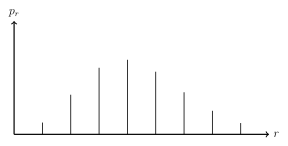
- In the case \(\lambda = 3.36\), sketch a graph of \(p_r\) against \(r\) for \(r = 0, 1, 2, \ldots, 6, 7\).
Solution:
- Suppose \(d_r = p_r - p_{r-1}\) then \begin{align*} d_r &= p_r - p_{r-1} \\ &= \mathbb{P}(X = r) - \mathbb{P}(X = r-1) \\ &= e^{-\lambda} \left ( \frac{\lambda^r}{r!} - \frac{\lambda^{r-1}}{(r-1)!} \right) \\ &= e^{-\lambda} \frac{\lambda^{r-1}}{(r-1)!} \left ( \frac{\lambda}{r} - 1\right) \end{align*} Therefore \(d_r > 0 \Leftrightarrow \lambda > r\)ie, \(p_r\) is increasing while \(r < \lambda\) and reaches a (unique) maximum when \(r = \lfloor \lambda \rfloor\).
- Let \(dd_r = d_r - d_{r-1}\), so: \begin{align*} dd_r &= d_r - d_{r-1} \\ &= p_r - 2p_{r-1} + p_{r-2} \\ &= e^{-\lambda} \frac{\lambda^{r-2}}{r!} \left ( \lambda^2 - 2 \lambda r + r(r-1)\right ) \end{align*} Therefore \(dd_r < 0 \Leftrightarrow \lambda^2 - 2\lambda r +r(r-1) < 0 \Leftrightarrow r^2 -(1+2\lambda)r + \lambda^2 < 0\), but this has roots \(r = \frac{(1+2\lambda) \pm \sqrt{(1+2\lambda)^2-4\lambda^2}}{2} = \lambda + \frac12 \pm \sqrt{\lambda + \frac14}\). Therefore \(d_r\) is decreasing when \(r \in \left (\lambda + \frac12 -\sqrt{\lambda + \frac14},\lambda + \frac12 + \sqrt{\lambda + \frac14} \right)\), therefore the possible minimums are \(d_1\) and \(d_k\) where \(k < \lambda + \frac{1}{2} + \sqrt{\lambda + \frac{1}{4}} < k + 1\). \(d_1 = e^{-\lambda}(\lambda - 1)\), \(d_k = e^{-\lambda} \frac{\lambda^{k-1}}{(k-1)!}(\frac{\lambda}{k}-1)\)
- If the maximum value of \(d_r\) is \(r = 1\) then \(d_r\) must be decreasing, ie considering \(dd_2\) we have \(\lambda^2 -4\lambda + 2< 0 \Leftrightarrow 2 - \sqrt{2} < \lambda < 2 + \sqrt{2}\). It must also be the case that it doesn't get beaten as \(\lambda \to \infty\). In this case \(d_r \to 0\), so we need \(d_1 > 0\), ie \(\lambda > 1\). Therefore \(1 < \lambda < 2 + \sqrt{2}\)
2025 Paper 3 Q1
You need not consider the convergence of the improper integrals in this question. For \(p, q > 0\), define $$b(p,q) = \int_0^1 x^{p-1}(1-x)^{q-1} \, dx$$
- Show that \(b(p,q) = b(q,p)\).
- Show that \(b(p+1,q) = b(p,q) - b(p,q+1)\) and hence that \(b(p+1,p) = \frac{1}{2}b(p,p)\).
- Show that $$b(p,q) = 2\int_0^{\pi/2} (\sin\theta)^{2p-1}(\cos\theta)^{2q-1} \, d\theta$$ Hence show that \(b(p,p) = \frac{1}{2^{2p-1}}b(p,\frac{1}{2})\).
- Show that $$b(p,q) = \int_0^\infty \frac{t^{p-1}}{(1+t)^{p+q}} \, dt$$
- Evaluate $$\int_0^\infty \frac{t^{3/2}}{(1+t)^6} \, dt$$
Solution:
- \begin{align*} && b(p,q) &= \int_0^1 x^{p-1}(1-x)^{q-1}\, \d x \\ u = 1-x, \d u = -\d x && &= \int_{u=1}^{u = 0} (1-u)^{p-1}u^{q-1} (-1) \, \d u \\ &&&= \int_0^1 (1-u)^{p-1}u^{q-1} \d u \\ &&&= \int_0^1 u^{q-1}(1-u)^{p-1} \d u \\ &&&= b(q,p) \end{align*}
- \begin{align*} b(p+1,q) + b(p,q+1) &= \int_0^1 x^p(1-x)^{q-1} \d x + \int_0^1 x^{p-1}(1-x)^{q} \d x \\ &= \int_0^1 \left (x^p(1-x)^{q-1} + x^{p-1}(1-x)^{q}\right) \d x \\ &= \int_0^1 x^{p-1}(1-x)^{q-1} \left (x + (1-x) \right) \d x \\ &= \int_0^1 x^{p-1}(1-x)^{q-1} \d x \\ &= b(p,q) \end{align*} Therefore \(b(p+1,q) = b(p,q) - b(p,q+1)\), in particular \(2b(p+1,p) = b(p+1,p)+b(p,p+1) = b(p,p) \Rightarrow b(p+1,p) = \frac12 b(p,p)\) as required.
- \begin{align*} && b(p,q) &= \int_0^1 x^{p-1} (1-x)^{q-1} \d x \\ x = \sin^2 \theta, \d x = 2 \sin \theta \cos \theta \d \theta && &= \int_{u=0}^{u = \pi/2} \sin^{2p-2} \theta (1-\sin^2 \theta)^{q-1} \cdot 2 \sin \theta \cos \theta \d \theta \\ &&&= 2 \int_0^{\pi/2} \sin^{2p-1} \theta \cos^{2q-2} \cos \theta \d \theta \\ &&&= 2 \int_0^{\pi/2} \sin^{2p-1} \theta \cos^{2q-1} \theta \d \theta \end{align*} \begin{align*} b(p,p) &= 2\int_0^{\pi/2} (\sin \theta)^{2p-1}(\cos \theta)^{2p-1} \d \theta \\ &= 2 \int_0^{\pi/2} \left (\frac12 \sin 2\theta \right)^{2p-1} \d \theta \\ &= \frac1{2^{2p-1}} 2 \int_0^{\pi/2} (\sin 2 \theta)^{2p-1} \d \theta \\ &= \frac1{2^{2p-1}} 2 \int_{x=0}^{x=\pi} (\sin x)^{2p-1} 2 \d x\\ &= \frac1{2^{2p-1}} 2 \int_{x=0}^{x=\pi/2} (\sin x)^{2p-1} \d x\\ &= \frac1{2^{2p-1}} 2 \int_{0}^{\pi/2} (\sin x)^{2p-1} (\cos x)^{0} \d x\\ &= \frac1{2^{2p-1}} b(p,\tfrac12) \end{align*}
- \begin{align*} &&b(p,q) &= \int_0^1 x^{p-1}(1-x)^{q-1} \d x \\ t = \frac{x}{1-x}, \d t = (1-x)^{-2} \d x &&&= \int_{t=0}^{t = \infty} \left ( \frac{t}{1+t} \right)^{p-1} \left ( 1-\frac{t}{1+t} \right)^{q+1} \d t\\ x = \frac{t}{1+t} && &=\int_0^\infty t^{p-1} (1+t)^{-(p-1)-(q+1)} \d t \\ &&&= \int_0^{\infty} \frac{t^{p-1}}{(1+t)^{p+q}} \d t \end{align*}
- \begin{align*} I &= \int_0^\infty \frac{t^{3/2}}{(1+t)^6} \, dt \\ &= b( \tfrac52, \tfrac72) \\ &= b( \tfrac52, \tfrac52+1) \\ &= \tfrac12 b( \tfrac52, \tfrac52) \\ &= \frac12 \cdot \frac1{2^{4}} b(\tfrac52, \tfrac12) \\ &= \frac{1}{2^5} \cdot 2 \int_0^{\pi/2} (\sin \theta)^{4} \d \theta \\ &= \frac1{2^4} \int_0^{\pi/2}\left (\frac{1-\cos 2 \theta}{2} \right)^2 \d \theta \\ &= \frac1{2^6} \int_0^{\pi/2}\left (1 - 2 \cos 2 \theta + \cos^{2} 2 \theta \right) \d \theta \\ &= \frac1{2^6} \int_0^{\pi/2}\left (1 - 2 \cos 2 \theta + \frac{\cos 4 \theta + 1}{2} \right) \d \theta \\ &= \frac1{2^6} \left [\frac32 \theta - \sin 2 \theta + \frac18 \sin 4 \theta \right]_0^{\pi/2} \\ &= \frac1{2^6} \frac{3 \pi}{4} \\ &= \frac{3 \pi}{2^8} \end{align*}
2025 Paper 3 Q2
Let \(f(x) = 7 - 2|x|\). A sequence \(u_0, u_1, u_2, \ldots\) is defined by \(u_0 = a\) and \(u_n = f(u_{n-1})\) for \(n > 0\).
- Sketch, on the same axes, the graphs with equations \(y = f(x)\) and \(y = f(f(x))\).
- Find all solutions of the equation \(f(f(x)) = x\).
- Find the values of \(a\) for which the sequence \(u_0, u_1, u_2, \ldots\) has period 2.
- Show that, if \(a = \frac{28}{5}\), then the sequence \(u_2, u_3, u_4, \ldots\) has period 2, but neither \(u_0\) or \(u_1\) is equal to either of \(u_2\) or \(u_3\).
- Sketch, on the same axes, the graphs with equations \(y = f(x)\) and \(y = f(f(f(x)))\).
- Consider the sequence \(u_0, u_1, u_2, \ldots\) in the cases \(a = 1\) and \(a = -\tfrac79\). Hence find all the solutions of the equation \(f(f(f(x))) = x\).
- Find a value of \(a\) such that the sequence \(u_3, u_4, u_5, \ldots\) has period 3, but where none of \(u_0, u_1\) or \(u_2\) is equal to any of \(u_3, u_4\) or \(u_5\).
Solution:

- If \(a = 1\) then \(u_1 = f(a) = 7-2 = 5\), \(u_2 = f(5) = -3\), \(u_3 = f(-3) = 7-6 = 1\). Therefore it must be the case that \(f(f(f(x))) = x\) for \(x = 1, 5, -3\). Similarly, if \(a = -\tfrac79\) then \(u_1 = f(-\tfrac79) = \tfrac{49}{9}\), \(u_2 = f(\tfrac{49}{9}) = -\tfrac{35}{9}\) and \(u_3 = f(-\tfrac{35}{9}) = -\tfrac79\). Therefore we must also have roots \(x = -\tfrac79, \tfrac{49}{9}, -\tfrac{35}9\). We also have the roots \(x = -7, \tfrac73\) from the first part so we have found all \(8\) roots.
- We need \(f(f(f(x))) = 1\) but \(f(f(x)) \neq -3, f(x) \neq 5, x \neq 1\). Suppose \(f(y) = 1 \Rightarrow 7-2|y| = 1 \Rightarrow y = \pm 3\). So \(y = 3\), ie \(f(f(x)) = 3\). Suppose \(f(z) = 3 \Rightarrow 7-2|z| = 3 \Rightarrow z = \pm 2\). Finally we need \(f(x) = \pm 2\), so say \(7-2|x| = 2 \Rightarrow x = \tfrac52\), so we have the sequence \(\tfrac52, 2, 3, 1, 5, -3, 1, \cdots\)as required.
2025 Paper 3 Q3
Let \(f(x)\) be defined and positive for \(x > 0\). Let \(a\) and \(b\) be real numbers with \(0 < a < b\) and define the points \(A = (a, f(a))\) and \(B = (b, -f(b))\). Let \(X = (m,0)\) be the point of intersection of line \(AB\) with the \(x\)-axis.
- Find an expression for \(m\) in terms of \(a\), \(b\), \(f(a)\) and \(f(b)\).
- Show that, if \(f(x) = \sqrt{x}\), then \(m = \sqrt{ab}\). Find, in terms of \(n\), \(a\) function \(f(x)\) such that \(m = \frac{a^{n+1} + b^{n+1}}{a^n + b^n}\).
- Let \(g_1(x)\) and \(g_2(x)\) be defined and positive for \(x > 0\). Let \(m = M_1\) when \(f(x) = g_1(x)\) and let \(m = M_2\) when \(f(x) = g_2(x)\). Show that if \(\frac{g_1(x)}{g_2(x)}\) is a decreasing function then \(M_1 > M_2\). Hence show that $$\frac{a+b}{2} > \sqrt{ab} > \frac{2ab}{a+b}$$
- Let \(p\) and \(c\) be chosen so that the curve \(y = p(c-x)^3\) passes through both \(A\) and \(B\). Show that $$\frac{c-a}{b-c} = \left(\frac{f(a)}{f(b)}\right)^{1/3}$$ and hence determine \(c\) in terms of \(a\), \(b\), \(f(a)\) and \(f(b)\). Show that if \(f\) is a decreasing function, then \(c < m\).
Solution:
- The line \(AB\) has equation: \begin{align*} && \frac{y+f(b)}{x-b} &= \frac{f(a)+f(b)}{a-b} \\ \Rightarrow && \frac{f(b)}{m-b} &= \frac{f(a)+f(b)}{a-b} \\ \Rightarrow && m &= \frac{a-b}{f(a)+f(b)}f(b) + b \\ &&&= \frac{af(b)+bf(a)}{f(a)+f(b)} \end{align*}
- Suppose \(f(x) = \sqrt{x}\) then \begin{align*} m &= \frac{a\sqrt{b}+b\sqrt{a}}{\sqrt{a}+\sqrt{b}} \\ &= \frac{\sqrt{ab}(\sqrt{a}+\sqrt{b})}{\sqrt{a}+\sqrt{b}} \\ &= \sqrt{ab} \end{align*} Suppose \(f(x) = x^{-n}\) then \begin{align*} m &= \frac{a b^{-n}+ba^{-n}}{a^{-n}+b^{-n}} \\ &= \frac{a^{n+1}+b^{n+1}}{b^n + a^n} \\ \end{align*}
- Without loss of generality, we can scale \(g_1(x)\) and \(g_2(x)\) so that \(g_1(a) = g_2(a)\) and \(m\) won't change for either of them. Then since \(\frac{g_1(b)}{g_2(b)} < 1\) (this function is decreasing) our line connecting \((a,g_i(a))\) and \((b,-g_i(b))\) must interect the axis first for \(g_2\), in particular \(M_1 > M_2\). Suppose \(g_1(x) =1, g_2(x) = \sqrt{x}, g_3(x) = x^{-1}\), the notice that \(\frac{g_1(x)}{g_2(x)} =\frac{g_2(x)}{g_3(x)}= x^{-1/2}\) are decreasing, therefore: \begin{align*} \frac{a+b}{1+1} &> \sqrt{ab} > \frac{1+1}{a^{-1}+b^{-1}} \\ \frac{a+b}{2} &> \sqrt{ab} > \frac{2ab}{a+b} \\ \end{align*}
- We must have: \begin{align*} && p(c-a)^3 &= f(a) \\ && p(c-b)^3 &= -f(b) \\ \Rightarrow &&\left ( \frac{c-a}{c-b} \right)^3 &= -\frac{f(a)}{f(b)} \\ \Rightarrow && \frac{c-a}{b-c} &= \left (\frac{f(a)}{f(b)} \right)^{\tfrac13} \\ \Rightarrow && c-a &= \left (\frac{f(a)}{f(b)} \right)^{\tfrac13}(b-c)\\ \Rightarrow && c \left (1 + \left (\frac{f(a)}{f(b)} \right)^{\tfrac13} \right) &= \left (\frac{f(a)}{f(b)} \right)^{\tfrac13}b + a \\ \Rightarrow && c &= \frac{\left (\frac{f(a)}{f(b)} \right)^{\tfrac13}b + a}{1 + \left (\frac{f(a)}{f(b)} \right)^{\tfrac13}} \\ &&&= \frac{b[f(a)]^\tfrac13+a[f(b)]^\tfrac13}{[f(a)]^\tfrac13+[f(b)]^\tfrac13} \end{align*} We have that \(\frac{c-a}{b-c} = \left (\frac{f(a)}{f(b)} \right)^{\tfrac13} \) and \(\frac{m-a}{b-c} = \frac{f(a)}{f(b)}\). Since \(f\) is decreasing, \(\frac{f(a)}{f(b)} > 1\) and so \(\left (\frac{f(a)}{f(b)} \right)^{\tfrac13} < \frac{f(a)}{f(b)}\), therefore \(m > c\).