Problems
Filters
39 problems found
2012 Paper 1 Q1
The line \(L\) has equation \(y=c-mx\), with \(m>0\) and \(c>0\). It passes through the point \(R(a,b)\) and cuts the axes at the points \(P(p,0)\) and \(Q(0,q)\), where \(a\), \(b\), \(p\) and \(q\) are all positive. Find \(p\) and \(q\) in terms of \(a\), \(b\) and \(m\). As \(L\) varies with \(R\) remaining fixed, show that the minimum value of the sum of the distances of \(P\) and \(Q\) from the origin is \((a^{\frac12} + b^{\frac12})^2\), and find in a similar form the minimum distance between \(P\) and \(Q\). (You may assume that any stationary values of these distances are minima.)
Solution: \begin{align*} && b &= c - ma \\ \Rightarrow && c &= b+ma \\ \Rightarrow && y &= m(a-x)+b \\ \Rightarrow && q &= ma+b \\ && p &= \frac{ma+b}{m} \\ \\ && d &= p+q \\ &&&= a + \frac{b}{m} + ma + b \\ \Rightarrow && d' &= -bm^{-2}+a \\ \Rightarrow && m &= \sqrt{b/a} \\ \\ \Rightarrow &&d &= a + \sqrt{ba}+\sqrt{ba} + b \\ &&&= (\sqrt{a}+\sqrt{b})^2 \\ \\ && |PQ|^2 &= p^2 + q^2 \\ &&&= a^2 + \frac{2ab}{m} + \frac{b^2}{m^2} + m^2a^2 + 2mab + b^2 \\ &&&= a^2+b^2 + \frac{b^2}{m^2} + \frac{2ab}{m}+ 2abm + a^2m^2 \\ && \frac{\d}{\d m}&= -2b^2m^{-3}-2abm^{-2}+2ab + 2a^2m \\ && 0 &=2a^2m^4+2abm^3-2abm-2b^2 \\ &&&= 2(am^3-b)(am+b) \\ \Rightarrow && m &= \sqrt[3]{\frac{b}{a}} \\ \\ &&|PQ|^2 &= \left[ a^{1/3}(a^{2/3} + b^{2/3}) \right]^2 + \left[ b^{1/3}(a^{2/3} + b^{2/3}) \right]^2 \\ &&&= a^{2/3}(a^{2/3} + b^{2/3})^2 + b^{2/3}(a^{2/3} + b^{2/3})^2 \\ &&&= (a^{2/3} + b^{2/3})^2 \cdot (a^{2/3} + b^{2/3}) \\ &&&= (a^{2/3} + b^{2/3})^3 \\ \Rightarrow && |PQ| &= (a^{2/3} + b^{2/3})^{3/2} \end{align*} We can also do this with AM-GM instead: \begin{align*} && d &= a + b + \frac{b}{m} + am \\ &&&\geq a+b + 2 \sqrt{\frac{b}{m} \cdot am} \\ &&&= a+2\sqrt{ab}+b \\ \\ && |PQ|^2 &= a^2+b^2 + \frac{b^2}{m^2} + \frac{2ab}{m}+ 2abm + a^2m^2 \\ &&&= a^2+b^2 + \frac{b^2}{m} + abm + abm + a^2m^2 + \frac{ab}{m} + \frac{ab}{m} \\ &&&= a^2+b^2 + 3\sqrt[3]{ \frac{b^2}{m} \cdot abm \cdot abm} + 3 \sqrt[3]{ a^2m^2 \cdot \frac{ab}{m} \cdot \frac{ab}{m} } \\ &&&= a^2 + 3b^{4/3}a^{2/3}+3b^{2/3}a^{4/3}+b^2 \\ &&&= (a^{2/3}+b^{2/3})^3 \end{align*}
2012 Paper 1 Q2
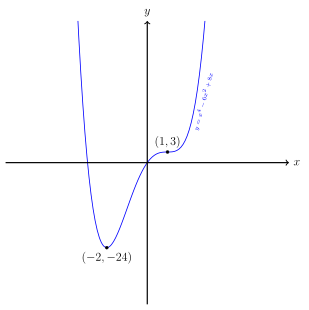
- Sketch the curve \(y= x^4-6x^2+9\) giving the coordinates of the stationary points. Let \(n\) be the number of distinct real values of \(x\) for which
\[
x^4-6x^2 +b=0.
\]
State the values of \(b\), if any, for which
- \(n=0\,\);
- \(n=1\,\);
- \(n=2\,\);
- \(n=3\,\);
- \(n=4\,\).
- For which values of \(a\) does the curve \(y= x^4-6x^2 +ax +b\) have a point at which both \(\dfrac{\d y}{\d x}=0\) and \(\dfrac{\d^2y}{\d x^2}=0\,\)? For these values of \(a\), find the number of distinct real values of \(x\) for which \(\vphantom{\dfrac{A}{B}}\) \[ x^4-6x^2 +ax +b=0\,, \] in the different cases that arise according to the value of \(b\).
- Sketch the curve \(y= x^4-6x^2 +ax\) in the case \(a>8\,\).
Solution:
- \(\,\)

- \(n = 0\) if \(b > 9\)
- \(n = 1\) is not possible, since by symmetry if \(x\) is a root, so is \(-x\), and \(0\) can never be the only root.
- \(n = 2\) if \(b < 0\) or \(b = 9\)
- \(n = 3\) if \(b = 0\)
- \(n = 4\) if \(0 < b < 9\)
- \(\,\) \begin{align*}
&& y' &= 4x^3-12x+a \\
&& y'' &= 12x^2-12 \\
\Rightarrow && x &= \pm 1 \\
\Rightarrow && 0 &= 4(\pm 1) - 12 (\pm 1) + a \\
&&&= a \mp 8 \\
\Rightarrow && a &= \pm 8
\end{align*}
When \(a = 8\), we have \(y = x^4-6x^2+8x\) and
\begin{align*}
&&y' &= 4x^3-12x+8 \\
&&&= 4(x^3-3x+2) \\
&&&= 4(x-1)^2(x+2) \\
\Rightarrow && y(1) &= 3\\
&& y(-2) &= -24
\end{align*}
Therefore there are no solutions if \(b > 24\), one solution if \(b = 24\) and two solutions otherwise. Similarly, if \(a = -8\), we have \(y = x^4 - 6x^2-8x\) \begin{align*} && y' &= 4x^3-12x-8 \\ &&&= 4(x^3-3x-2) \\ &&&= 4(x-2)(x+1)^2 \end{align*} So we have stationary points at \(x = 2\) and \(x = -1\) (which is also a inflection point) and at \(x = 2\) \(y = -24\), so we have the same story: there are no solutions if \(b > 24\), one solution if \(b = 24\) and two solutions otherwise.
- \(\,\)

2012 Paper 1 Q3
- Sketch the curve \(y=\sin x\) for \(0\le x \le \tfrac12 \pi\) and add to your diagram the tangent to the curve at the origin and the chord joining the origin to the point \((b, \sin b)\), where \(0 < b < \frac12\pi\). By considering areas, show that \[ 1-\tfrac12 b^2 <\cos b < 1-\tfrac 12 b \sin b\,. \]
- By considering the curve \(y=a^x\), where \(a>1\), show that \[ \frac{2(a-1)}{a+1} < \ln a < -1 + \sqrt{2a-1\,}\,. \] [Hint: You may wish to write \(a^x\) as \(\e^{x\ln a}\).]
Solution:
- \(\,\)
The area under the blue curve is \(1-\cos b\). The area under the green line is \(\frac12 b \sin b\) The area under the red line is \(\frac12 b^2\) Therefore \(\frac12 b \sin b < 1- \cos b < \frac12 b^2 \Rightarrow 1- \frac12 b^2 < \cos b < 1 - \frac12 b \sin b\)

- \(\,\)
\begin{align*} &&\text{Area under blue curve}: &= \int_0^1 a^x \d x\\ &&&= \left [ \frac{1}{\ln a}e^{x \ln a} \right]_0^1 \\ &&&= \frac{a-1}{\ln a} \\ \\ &&\text{Area under green line}: &=\frac12 \cdot 1 \cdot (a + 1)\\ &&&= \frac{a+1}{2} \\ \\ &&\text{Area under tangent}: &=\frac12 \cdot 1 \cdot (1+\ln a + 1)\\ &&&= \frac{\ln a+2}{2} \\ \\ \Rightarrow && \frac{a+1}{2} & > \frac{a-1}{\ln a} \\ \Rightarrow && \ln a& > \frac{2(a-1)}{a+1} \\ \\ \Rightarrow && \frac{a-1}{\ln a} &> \frac{\ln a +2}{2} \\ \Rightarrow && 2(a-1) -2\ln a - (\ln a)^2 &> 0 \\ \Rightarrow && \ln a & < -1 + \sqrt{2a-1} \end{align*}

2012 Paper 1 Q4
The curve \(C\) has equation \(xy = \frac12\). The tangents to \(C\) at the distinct points \(P\big(p, \frac1{2p}\big)\) and \(Q\big(q, \frac1{2q}\big)\) where \(p\) and \(q\) are positive, intersect at \(T\) and the normals to \(C\) at these points intersect at \(N\). Show that \(T\) is the point \[ \left( \frac{2pq}{p+q}\,,\, \frac 1 {p+q}\right)\!. \] In the case \(pq=\frac12\), find the coordinates of \(N\). Show (in this case) that \(T\) and \(N\) lie on the line \(y=x\) and are such that the product of their distances from the origin is constant.
Solution: \begin{align*} && \frac{\d y}{\d x} &= -\frac1{2x^2} \\ \Rightarrow && \frac{y - \frac{1}{2p}}{x - p} &= - \frac{1}{2p^2} \\ \Rightarrow && y - \frac1{2p} &= -\frac{1}{2p^2}x +\frac1{2p} \\ \Rightarrow && y +\frac{1}{2p^2}x &= \frac1p \\ \Rightarrow && 2p^2 y + x &= 2p\\ \Rightarrow && 2q^2 y + x &= 2q \\ \Rightarrow && (p^2-q^2)y &= p-q \\ \Rightarrow && y &= \frac{1}{p+q} \\ && x &= \frac{2pq}{p+q} \end{align*} \begin{align*} \text{normal}: && \frac{y-\frac1{2p}}{x-p} &= 2p^2 \\ \Rightarrow && y - \frac1{2p} &= 2p^2x - 2p^3 \\ \Rightarrow && 2py -4p^3x &= 1-4p^4 \\ \Rightarrow && 2qy -4q^3x &= 1-4q^4 \\ pq = \tfrac12: && y - 2p^2 x &= q-2p^3 \\ && y - 2q^2 x &= p-2q^3 \\ \Rightarrow && (2q^2-2p^2)x &= q-p +2q^3-2p^3 \\ &&&= (q-p)(q+p+2q^2+1+2p^2) \\ \Rightarrow && x &= \frac{1+2(p^2+q^2)+1}{2(p+q)} \\ &&&= \frac{1+2(p^2+q^2+2pq-1)+1}{2(p+q)} \\ &&&= p+q\\ && y &= 2p^2 \left ( p+q \right) + q - 2p^3 \\ &&&= p+q \end{align*} So \(N(p+q, p+q)\) and \(T\left (\frac{1}{p+q}, \frac{1}{p+q} \right)\), so both points lie on \(y = x\). \[ OT \cdot ON = \frac{\sqrt{2}}{p+q} \cdot (p+q)\sqrt{2} = 2 \] which is clearly constant.
2012 Paper 1 Q5
Show that \[ \int_0^{\frac14\pi} \sin (2x) \ln(\cos x)\, \d x = \frac14(\ln 2 -1)\,, \] and that \[ \int_0^{\frac14\pi} \cos (2x) \ln(\cos x)\, \d x = \frac18(\pi -\ln 4-2)\,. \] Hence evaluate \[ \int_{\frac14\pi}^{\frac12\pi} \big ( \cos(2x) + \sin (2x)\big) \, \ln \big( \cos x + \sin x\big)\, \d x\,. \]
Solution: \begin{align*} &&\int_0^{\frac14\pi} \sin (2x) \ln(\cos x)\, \d x &= \int_0^{\frac14 \pi} 2 \sin x \cos x \ln (\cos x) \d x \\ u = \cos \theta :&&&= \int_{u=1}^{u=\frac1{\sqrt2}} -2u \ln u \d u \\ &&&= \int_{\frac1{\sqrt{2}}}^1 2u \ln u \d u \\ &&&= \left [u^2 \ln u \right]_{\frac1{\sqrt{2}}}^1-\int_{\frac1{\sqrt{2}}}^1 u \d u \\ &&&= -\frac12 \ln \frac{1}{\sqrt{2}} - \l\frac12 - \frac14 \r \\ &&&= \frac14 (\ln 2 - 1) \end{align*} \begin{align*} && \int_0^{\frac14\pi} \cos (2x) \ln(\cos x)\, \d x &= \left [ \frac12 \sin 2x \ln (\cos x) \right]_0^{\frac14\pi}- \int_0^{\frac14\pi} \frac12 \sin 2x \frac{-\sin x}{\cos x} \d x \\ &&&=\frac12 \ln \frac{1}{\sqrt{2}}+\int_0^{\frac14\pi} \sin^2 x \d x \\ &&&= -\frac14 \ln 2 + \int_0^{\frac14\pi} \frac{1-\cos 2x }{2} \d x \\ &&&= -\frac14 \ln 2 +\frac{\pi}{8} -\frac{1}{4} \\ &&&= \frac18 (\pi - 2\ln 2 - 2) \\ &&&= \frac18 (\pi - \ln 4 - 2) \\ \end{align*} Notice that \(\cos x + \sin x = \sqrt{2} \cos (x -\frac{\pi}{4})\), so: \begin{align*} &&\int_{\frac14\pi}^{\frac12\pi} \big ( \cos(2x) + \sin (2x)\big) \ln \big( \cos x + \sin x\big)\d x &= \int_{\frac14\pi}^{\frac12\pi} \big ( \cos(2x) + \sin (2x)\big) \ln (\sqrt{2} \cos ( x - \frac{\pi}{4}) ) \d x \\ &&&= \int_{u=0}^{u=\frac{\pi}{4}} \l \cos(2u+\frac{\pi}{2})+\sin(2u+\frac{\pi}{2}) \r \cdot \l \frac12 \ln 2 +\ln (\cos u) \r \d x \\ &&&= \int_{0}^{\frac{\pi}{4}} \l -\sin 2u+\cos 2u \r \cdot \l \frac12 \ln 2 +\ln (\cos u) \r \d x \\ &&&= \frac14 \ln 2\left [ \cos 2u + \sin 2u \ \right]_{0}^{\frac{\pi}{4}} - \frac14(\ln2 - 1) + \frac18\pi - \frac14(\ln 2 +1) \\ &&&= \frac{\pi}{8}-\frac12 \ln 2 \end{align*}
2012 Paper 1 Q6
A thin circular path with diameter \(AB\) is laid on horizontal ground. A vertical flagpole is erected with its base at a point \(D\) on the diameter \(AB\). The angles of elevation of the top of the flagpole from \(A\) and \(B\) are \(\alpha\) and \(\beta\) respectively (both are acute). The point \(C\) lies on the circular path with \(DC\) perpendicular to \(AB\) and the angle of elevation of the top of the flagpole from \(C\) is \(\phi\). Show that \(\cot\alpha\cot \beta = \cot^2\phi\). Show that, for any \(p\) and \(q\), \[ \cos p \cos q \sin^2\tfrac12(p+q) - \sin p\sin q \cos^2 \tfrac12 (p+q) = \tfrac12 \cos(p+q) -\tfrac12 \cos(p+q)\cos(p-q) .\] Deduce that, if \(p\) and \(q\) are positive and \( p+q \le \tfrac12 \pi\), then \[ \cot p\cot q\, \ge \cot^2 \tfrac12(p+q) \, \] and hence show that \(\phi \le \tfrac12(\alpha+\beta)\) when \( \alpha +\beta \le \tfrac12 \pi\,\).
Solution:

2012 Paper 1 Q7
A sequence of numbers \(t_0\), \(t_1\), \(t_2\), \(\ldots\,\) satisfies \[ \ \ \ \ \ \ \ \ \ \ \ \ \ \ \ \ \ \ \ \ \ \ \ \ t_{n+2} = p t_{n+1}+qt_{n} \ \ \ \ \ \ \ \ \ \ (n\ge0), \] where \(p\) and \(q\) are real. Throughout this question, \(x\), \(y\) and \(z\) are non-zero real numbers.
- Show that, if \(t_n=x\) for all values of \(n\), then \(p+q=1\) and \(x\) can be any (non-zero) real number.
- Show that, if \(t_{2n} = x\) and \(t_{2n+1}=y\) for all values of \(n\), then \(q\pm p=1\). Deduce that either \(x=y\) or \(x=-y\), unless \(p\) and \(q\) take certain values that you should identify.
- Show that, if \(t_{3n} = x\), \(t_{3n+1}=y\) and \(t_{3n+2}=z\) for all values of \(n\), then \[ p^3+q^3 +3pq-1=0\,. \] Deduce that either \(p+q=1\) or \((p-q)^2 +(p+1)^2+(q+1)^2=0\). Hence show that either \(x=y=z\) or \(x+y+z=0\).
Solution:
- Suppose \(t_n = x\) for all \(n\), then we must have \begin{align*} && x &= p x + q x \\ \Leftrightarrow && 1 &= p+q \end{align*} and this clearly works for any value of \(x\).
- Suppose \(t_{2n} = x, t_{2n+1} = y\) for all \(n\), then \begin{align*} && x &= py + q x \\ && y &= px + q y \\ \Rightarrow && 0 &= py + (q-1) x \\ && 0 &= px + (q-1) y \\ \Rightarrow && p &= (q-1) \frac{x}{y} = (q-1) \frac{y}{x} \\ \Rightarrow && \frac{y}{x} = \pm 1 & \text{ or } q = 1, p = 0 \\ \Rightarrow && y = \pm x & \text{ or } (p,q) = (0,1) \\ \end{align*}
- Suppose \(t_{3n} = x\), \(t_{3n+1}=y\) and \(t_{3n+2}=z\) , so \begin{align*} && x &= pz + qy \\ && y & = px + qz \\ && z &= py + qx \\ \\ && z &= p(px+qz) + q(pz + qy) \\ &&&= p^2x + 2pqz + q^2 y \\ &&&= p^2(pz+qy) + 2pqz + q^2(px+qz) \\ &&&= p^3 z + p^2qy + 2pqz + q^2p x + q^3 z \\ &&&= (p^3+q^3+2pq)z + pq(py+qx) \\ &&&= (p^3 + q^3 + 2pq)z + pq z \\ &&&= (p^3 + q^3 + 3pq)z \\ \Rightarrow && 0 &= p^3 + q^3 + 3pq- 1 \\ &&&= (p+q-1)(p^2+q^2+1+p+q-pq) \\ &&&= \tfrac12(p+q-1)((p-q)^2+(p+1)^2+(q+1)^2) \end{align*} Therefore \(p+q = 1\) or \((p-q)^2+(p+1)^2+(q+1)^2 = 0 \Rightarrow p = q = -1\). If \(p+q = 1\), then \(z = py + (1-p)x\) and \(x = p(py+(1-p)x) + (1-p)y \Rightarrow (1-p+p^2)x = (1-p+p^2)y \Rightarrow x = y \Rightarrow x= y = z\). If \(p = q = -1\) then adding all the equations we get \(x + y + z = -2(x+y+z) \Rightarrow x + y + z = 0\)
2012 Paper 1 Q8
- Show that substituting \(y=xv\), where \(v\) is a function of \(x\), in the differential equation \[ xy \frac{\d y}{\d x} +y^2- 2x^2 =0 \quad (x\ne0) \] leads to the differential equation \[ xv\frac{\d v}{\d x} +2v^2 -2=0\,. \] Hence show that the general solution can be written in the form \[ x^2(y^2 -x^2) = C \,,\] where \(C\) is a constant.
- Find the general solution of the differential equation \[ y \frac{\d y}{\d x} +6x +5y=0\, \quad (x\ne0). \]
Solution:
- \(\,\) \begin{align*} && y &= xv \\ && y' &= v + xv' \\ \Rightarrow && 0 &= x^2 v \left ( v + x\frac{\d v}{\d x} \right) +(x^2v^2) - 2x^2 \\ &&&= 2x^2v^2 + x^3 v \frac{\d v}{\d x} - 2x^2 \\ \Rightarrow && 0 &= xv \frac{\d v}{\d x} + 2v^2-2 \\ \\ \Rightarrow && \frac{v}{1-v^2} \frac{\d v}{\d x} &= \frac{2}{x} \\ \Rightarrow && \int \frac{v}{1-v^2} \d v &=2 \ln |x| \\ \Rightarrow && -\frac12\ln |1-v^2| &= 2\ln |x| + C \\ \Rightarrow && 4\ln |x| + \ln |1-v^2| &= K \\ \Rightarrow && x^4(1-v^2) &= K \\ \Rightarrow && x^2(x^2-y^2) &= K \end{align*}
- \(\,\) \begin{align*} && 0 &= xv \left (v +x \frac{\d v}{\d x} \right) + 6x + 5xv \\ &&&= x^2 v \frac{\d v}{\d x} +xv^2 + 6x+5xv \\ \Rightarrow && 0 &= xv\frac{\d v}{\d x} +v^2 +5v+6 \\ \Rightarrow && -\int \frac{1}{x} \d x &=\int \frac{v}{v^2+5v+6} \d v \\ \Rightarrow && -\ln |x| &= \int \frac{v}{(v+2)(v+3)} \d v \\ &&&= \int \left (\frac{3}{v+3} - \frac{2}{v+2} \right) \d v \\ \Rightarrow && -\ln |x| &= 3\ln |v+3| - 2 \ln |v+2| + C\\ \Rightarrow && -\ln |x| &= \ln \frac{|v+3|^3}{|v+2|^2} + C \\ \Rightarrow && \frac{1}{|x|}|v+2|^2 &= A|v+3|^3 \\ \Rightarrow && \frac{1}{|x|}|\frac{y}{x} + 2|^2&= A|\frac{y}{x} + 3|^3 \\ \Rightarrow && \frac{1}{|x|^3} |y +2x|^2 &= \frac{A}{|x|^3}|y + 3x|^3 \\ \Rightarrow && (y+2x)^2 &= A|y+3x|^3 \end{align*}
2012 Paper 1 Q9
A tall shot-putter projects a small shot from a point \(2.5\,\)m above the ground, which is horizontal. The speed of projection is \(10\,\text{ms}^{- 1}\) and the angle of projection is \(\theta\) above the horizontal. Taking the acceleration due to gravity to be \(10\,\text{ms}^{-2}\), show that the time, in seconds, that elapses before the shot hits the ground is \[ \frac1{\sqrt2}\left ( \sqrt{1-c}+ \sqrt{2-c}\right), \] where \(c = \cos2\theta\). Find an expression for the range in terms of \(c\) and show that it is greatest when \(c= \frac15\,\). Show that the extra distance attained by projecting the shot at this angle rather than at an angle of \(45^\circ\) is \(5(\sqrt6 -\sqrt2 -1)\,\)m.
Solution: \begin{align*} && s &= ut + \frac12 gt^2 \\ \Rightarrow && -2.5 &= 10 \sin \theta \, T - 5 T^2 \\ \Rightarrow && T &= \frac{10\sin \theta \pm \sqrt{100\sin^2 \theta - 4 \cdot 5 \cdot (-2.5)}}{10} \\ &&&= \sin \theta +\sqrt{\sin^2 \theta + \frac12} \\ &&&= \frac1{\sqrt{2}} \left ( \sqrt{2} \sin \theta +\sqrt{2 \sin^2 \theta +1} \right) \\ &&&= \frac1{\sqrt{2}} \left ( \sqrt{2 (1-\cos^2 \theta)} + \sqrt{2-\cos 2\theta} \right) \\ &&&= \frac1{\sqrt{2}} \left ( \sqrt{1-\cos2 \theta} + \sqrt{2-\cos 2\theta} \right) \\ &&&= \frac{1}{\sqrt{2}}\left ( \sqrt{1-c}+\sqrt{2-c} \right)\\ \\ && s &= 10 \cos \theta T \\ &&&= 10 \sqrt{\frac{\cos 2 \theta +1}{2}}\frac{1}{\sqrt{2}}\left ( \sqrt{1-c}+\sqrt{2-c} \right) \\ &&&= 5 \sqrt{c+1}\left ( \sqrt{1-c}+\sqrt{2-c} \right) \\ \\ && \frac15\frac{\d s}{\d c} &= \frac12(c+1)^{-1/2}((1-c)^{1/2} + (2-c)^{1/2}) - \frac12(c+1)^{1/2}\left ((1-c)^{-1/2}+(2-c)^{-1/2} \right) \\ &&&= \frac{((1-c)(2-c)^{1/2}+(2-c)(1-c)^{1/2})-((c+1)(2-c)^{1/2}+(c+1)(1-c)^{1/2})}{2\sqrt{c+1}\sqrt{1-c}\sqrt{2-c}} \\ &&&= \frac{\sqrt{2-c}\left (1-c-c-1 \right)+\sqrt{1-c}\left(2-c-c-1) \right)}{2\sqrt{c+1}\sqrt{1-c}\sqrt{2-c}} \\ &&&= \frac{\sqrt{1-c}\left(1-2c\right)-2c\sqrt{2-c}}{2\sqrt{c+1}\sqrt{1-c}\sqrt{2-c}} \\ \\ \frac{\d s}{\d c} =0: && \sqrt{1-c}\left(1-2c\right)&=2c\sqrt{2-c} \\ \Rightarrow && (1-c)(1-2c)^2&=4c^2(2-c) \\ \Rightarrow && 1-5c+8c^2-4c^3 &= 8c^2-4c^3 \\ \Rightarrow && 0 &= -5c+1 \\ \Rightarrow && c &= \frac15 \end{align*} When \(\theta = 45^{\circ}, c = 0\), so \(s_{45^{\circ}} = 5(1+\sqrt{2})\) When \(c = \frac15\), \begin{align*} s &= 5 \sqrt{\frac15+1}\left ( \sqrt{1-\frac15}+\sqrt{2-\frac15} \right) \\ &= 5 \sqrt{\frac65} \left ( \sqrt{\frac45} + \sqrt{\frac95} \right) \\ &= 2\sqrt{6}+3\sqrt{6} = 5\sqrt{6} \end{align*} Therefore the additional distance is \(5(\sqrt{6}-\sqrt{2}-1)\)
2012 Paper 1 Q10
I stand at the top of a vertical well. The depth of the well, from the top to the surface of the water, is \(D\). I drop a stone from the top of the well and measure the time that elapses between the release of the stone and the moment when I hear the splash of the stone entering the water. In order to gauge the depth of the well, I climb a distance \(\delta\) down into the well and drop a stone from my new position. The time until I hear the splash is \(t\) less than the previous time. Show that \[ t = \sqrt{\frac{2D}g} - \sqrt{\frac{2(D-\delta)}g} + \frac \delta u\,, \] where \(u\) is the (constant) speed of sound. Hence show that \[ D = \tfrac12 gT^2\,, \] where \(T= \dfrac12 \beta + \dfrac \delta{\beta g}\) and \(\beta = t - \dfrac \delta u\,\). Taking \(u=300\,\)m\,s\(^{-1}\) and \(g=10\,\)m\,s\(^{-2}\), show that if \(t= \frac 15\,\)s and \(\delta=10\,\)m, the well is approximately \(185\,\)m deep.
Solution: \begin{align*} && s &= ut + \frac12at^2 \\ && D &= \frac12gt_D^2 \\ \Rightarrow && t_D &= \sqrt{\frac{2D}{g}} \\ \Rightarrow && t_{D-\delta} &= \sqrt{\frac{2(D-\delta}{g}} \end{align*} Therefore the difference in times of what I hear will be: \begin{align*} t &= \underbrace{\sqrt{\frac{2D}{g}}}_{\text{time for first stone to hit water}} + \underbrace{\frac{D}{u}}_{\text{time to hear about it}} - \left (\underbrace{\sqrt{\frac{2(D-\delta)}{g}}}_{\text{time for second stone to hit water}} + \underbrace{\frac{D-\delta}{u}}_{\text{time to hear about it}} \right) \\ &= \sqrt{\frac{2D}g} - \sqrt{\frac{2(D-\delta)}g} + \frac \delta u \end{align*} \begin{align*} && t &= \sqrt{\frac{2D}g} - \sqrt{\frac{2(D-\delta)}g} + \frac \delta u \\ \Rightarrow && \beta &= \sqrt{\frac{2D}g} - \sqrt{\frac{2(D-\delta)}g} \\ && \beta^2 &= \frac{2D}{g} + \frac{2(D-\delta)}{g} - \frac{4}{g}\sqrt{D(D-g)} \\ &&&= \frac{4D}{g} - \frac{2\delta}{g} - \frac{4}{g} \sqrt{D(D-\delta)}\\ \Rightarrow && g\beta^2 &= 4D-2\delta -4\sqrt{D(D-\delta)}\\ \Rightarrow && (g \beta^2-4D+2\delta)^2 &= 16D(D-\delta) \\ \Rightarrow && g^2\beta^4 + 16D^2 + 4\delta^2 -8g\beta^2D+4g\beta^2 \delta -16D\delta &= 16D^2-16D\delta \\ \Rightarrow && 8g\beta^2D &= g\beta^4 +4\delta^2 +4g\beta^2 \delta \\ \Rightarrow && D &= \frac1{8g\beta^2} \left ( g^2\beta^4 +4\delta^2 +4g\beta^2 \delta\right) \\ &&&= \frac1{8g\beta^2} \left ( g\beta^2 +2\delta \right)^2 \\ &&&= \frac12g \left ( \frac{\beta}{2} + \frac{\delta}{g\beta} \right)^2 \end{align*} If \(u = 300, g = 10, t = \frac15, \delta = 10\), then \begin{align*} && \beta &= \frac15-\frac{10}{300}\\ &&&= \frac15 - \frac1{30} \\ &&&= \frac{1}{6}\\ && D &= \frac12 \cdot 10 \left ( \frac1{12} + 6 \right)^2 \\ &&&= 5\cdot (36 + 1 + \frac{1}{12^2}) \\ &&&\approx 37 \cdot 5 = 185 \end{align*}
2012 Paper 1 Q11
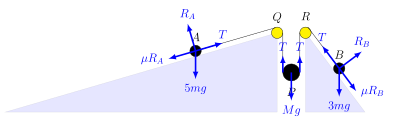
The diagram shows two particles, \(A\) of mass \(5m\) and \(B\) of mass \(3m\), connected by a light inextensible string which passes over two smooth, light, fixed pulleys, \(Q\) and \(R\), and under a smooth pulley \(P\) which has mass \(M\) and is free to move vertically. Particles \(A\) and \(B\) lie on fixed rough planes inclined to the horizontal at angles of \(\arctan \frac 7{24}\) and \(\arctan\frac43\) respectively. The segments \(AQ\) and \(RB\) of the string are parallel to their respective planes, and segments \(QP\) and \(PR\) are vertical. The coefficient of friction between each particle and its plane is \(\mu\).

- Given that the system is in equilibrium, with both \(A\) and \(B\) on the point of moving up their planes, determine the value of \(\mu\) and show that \(M = 6m\).
- In the case when \(M = 9m\), determine the initial accelerations of \(A\), \(B\) and \(P\) in terms of \(g\).
Solution:
2012 Paper 1 Q12
Fire extinguishers may become faulty at any time after manufacture and are tested annually on the anniversary of manufacture. The time \(T\) years after manufacture until a fire extinguisher becomes faulty is modelled by the continuous probability density function \[ f(t) = \begin{cases} \frac{2t}{(1+t^2)^2}& \text{for \(t\ge0\)}\,,\\[4mm] \ \ \ \ 0& \text{otherwise}. \end{cases} \] A faulty fire extinguisher will fail an annual test with probability \(p\), in which case it is destroyed immediately. A non-faulty fire extinguisher will always pass the test. All of the annual tests are independent. Show that the probability that a randomly chosen fire extinguisher will be destroyed exactly three years after its manufacture is \(p(5p^2-13p +9)/10\). Find the probability that a randomly chosen fire extinguisher that was destroyed exactly three years after its manufacture was faulty 18 months after its manufacture.
Solution: The probability it becomes faulty in each year is: \begin{align*} \mathbb{P}(\text{faulty in Y}1) &= \int_0^1 \frac{2t}{(1+t^2)^2} \, dt \\ &= \left [ -\frac{1}{(1+t^2)} \right]_0^1 \\ &= 1 - \frac{1}{2} = \frac{1}{2} \\ \mathbb{P}(\text{faulty in Y}2) &= \frac{1}{2} - \frac{1}{5} = \frac{3}{10} \\ \mathbb{P}(\text{faulty in Y}3) &= \frac{1}{5} - \frac{1}{10} = \frac{1}{10} \end{align*} The probability of failing for the first time after exactly \(3\) years is: \begin{align*} \mathbb{P}(\text{faulty in Y1, }PPF) &+ \mathbb{P}(\text{faulty in Y2, }PF) + + \mathbb{P}(\text{faulty in Y3, }F) \\ &= \frac12 (1-p)^2p + \frac3{10}(1-p)p + \frac1{10}p \\ &= \frac{p}{10} \l 5(1-p)^2 + 3(1-p) + 1 \r \\ &= \frac{p}{10} \l 5 - 10p + 5p^2 + 3 -3p +1 \r \\ &= \frac{p}{10} \l 9 - 13p + 5p^2 \r \end{align*} as required. The probability that a randomly chosen fire extinguisher that was destroyed exactly three years after its manufacture was faulty 18 months after its manufacture is: \begin{align*} \mathbb{P}(\text{faulty 18 months after} | \text{fails after 3 tries}) &= \frac{\mathbb{P}(\text{faulty 18 months after and fails after 3 tries})}{\mathbb{P}(\text{fails after exactly 3 tries})} \end{align*} We can compute \(\mathbb{P}(\text{faulty 18 months after and fails after 3 tries})\) by looking at \(2\) cases, fails between \(12\) months and \(18\) years, and between \(0\) years and \(1\) year. \begin{align*} \mathbb{P}(\text{faulty between 1y and 18m}) &= \int_{1}^{\frac32} \frac{2t}{(1+t^2)^2} \, dt \\ &= \left [ -\frac{1}{(1+t^2)} \right]_{1}^{\frac32} \\ &= \frac12 - \frac{4}{13} = \frac{5}{26} \\ \end{align*} So the probability is: \begin{align*} \mathbb{P} &= \frac{\frac{5}{26}(1-p)p + \frac12(1-p)^2p}{\frac{p}{10} \l 9 - 13p + 5p^2 \r} \\ &= \frac{\frac{25}{13}(1-p) + 5(1-p)^2}{9 - 13p + 5p^2} \\ &= \frac{5}{13} \frac{(1-p)\l 5 + 13(1-p) \r}{9 - 13p + 5p^2} \\ &= \frac{5}{13} \frac{(1-p)\l 18 - 13p \r}{9 - 13p + 5p^2} \\ \end{align*}
2012 Paper 1 Q13
I choose at random an integer in the range 10000 to 99999, all choices being equally likely. Given that my choice does not contain the digits 0, 6, 7, 8 or 9, show that the expected number of different digits in my choice is 3.3616.
Solution: We are choosing any \(5\) digit number from \(\{1,2,3,4,5\}\). There are \(5^5\) such numbers. \begin{align*} && \mathbb{E}(\text{different digits}) &= \frac1{5^5} \left (1 \cdot 5 + 2 \cdot \binom{5}{2}(2^5-2)+3 \cdot \binom{5}{3}(3^5-3 \cdot 2^5+3)+4 \cdot \binom{5}{4}(4^5 - 4 \cdot 3^5+6 \cdot 2^5-4) + 5 \cdot 5! \right) \\ &&&= \frac{2101}{625} = 3.3616 \end{align*}
2012 Paper 2 Q1
Write down the general term in the expansion in powers of \(x\) of \((1-x^6)^{-2}\,\).
- Find the coefficient of \(x^{24}\) in the expansion in powers of \(x\) of \[ (1-x^6)^{-2} (1-x^3)^{-1}\,.\] Obtain also, and simplify, formulae for the coefficient of \(x^n\) in the different cases that arise.
- Show that the coefficient of \(x^{24}\) in the expansion in powers of \(x\) of \[ (1-x^6)^{-2} (1-x^3)^{-1} (1-x)^{-1}\,\] is \(55\), and find the coefficients of \(x^{25}\) and \(x^{66}\).
Solution: \(\displaystyle (1-x^6)^{-2} = \sum_{n=0}^{\infty} (n+1)x^{6n}\)
- \(\,\) \begin{align*} && f(x) &= (1-x^6)^{-2}(1-x^3)^{-1} \\ &&&= \left ( \sum_{n=0}^{\infty} (n+1)x^{6n} \right) \left ( \sum_{n=0}^{\infty} x^{3n} \right) \\ [x^{24}]: && c_{24} &= 1 + 2+ 3+4+5 = 15 \end{align*} Clearly \(n\) must be a multiple of \(3\). If \(n = 6k\) then we have \(1 + 2 + \cdots + (k+1) = \frac{(k+1)(k+2)}{2}\) If \(n = 6k+3\) then we have \(1 + 2 + \cdots + (k+1) = \frac{(k+1)(k+2)}{2}\) the same way, we just must always get one extra \(x^3\) term from the second expansion.
- We can obtain \(x^{24}\) from the product of \((1-x^6)^{-2}(1-x^3)^{-1}\) and \((1-x)^{-1}\) in the following ways: \begin{array}{c|c|c} (1-x^6)^{-2}(1-x^3)^{-1} & (1-x)^{-1} & \text{product} \\ \hline 15x^{24} & x^0 & 15x^{24} \\ 10x^{21} & x^3 & 10x^{24} \\ 10x^{18} & x^6 & 10x^{24} \\ 6x^{15} & x^9 & 6x^{24} \\ 6x^{12} & x^{12} & 6x^{24} \\ 3x^{9} & x^{15} & 3x^{24} \\ 3x^{6} & x^{18} & 3x^{24} \\ x^{3} & x^{21} & x^{24} \\ x^{0} & x^{24}& x^{24} \end{array} So the total is \(55\). Similarly for \(25\) we can only obtain this in the same ways but also taking an extra power of \(x\) from the geometric series, ie \(55\) For \(66\) we obtain by similar reasoning that it is: \(\frac{13\cdot12}{2} + 2 \left (1 + 3 + \cdots + \frac{13 \cdot 12}{2} \right) = \frac{13\cdot12}{2} + 2 \binom{14}{3} = \frac{13 \cdot 12}2 ( 1 + \frac{30}{3}) = 11 \cdot 6 \cdot 13 = 858\)
2012 Paper 2 Q2
If \(\p(x)\) and \(\q(x)\) are polynomials of degree \(m\) and \(n\), respectively, what is the degree of \(\p(\q(x))\)?
- The polynomial \(\p(x)\) satisfies \[ \p(\p(\p(x)))- 3 \p(x)= -2x\, \] for all \(x\). Explain carefully why \(\p(x)\) must be of degree 1, and find all polynomials that satisfy this equation.
- Find all polynomials that satisfy \[ 2\p(\p(x)) +3 [\p(x)]^2 -4\p(x) =x^4 \] for all \(x\).
Solution: If \(\p(x)\) and \(\q(x)\) are polynomials of degree \(m\) and \(n\), \(\p(\q(x))\) has degree \(mn\).
- Suppose \(\p(\p(\p(x)))- 3 \p(x)= -2x\), and suppose \(p(x)\) has degree \(n = \geq 2\), then \(\p(\p(\p(x)))\) has degree \(n^3\) and so the left hand side has degree higher than \(1\) and the right hand side is degree \(1\). Therefore \(\p(x)\) is degree \(1\) or \(0\). If \(p(x) = c\) then \(c^3-3c = -2x\) but the LHS doesn't depend on \(x\) which is also a contradiction. Therefore \(\p(x)\) is degree \(1\). Suppose \(\p(x) = ax+b\) then: \begin{align*} && -2x &= \p(\p(\p(x))) - 3\p(x) \\ &&&= \p(\p(ax+b)) - 3(ax+b) \\ &&&= \p(a(ax+b)+b) - 3ax -3b \\ &&&= a(a^2x+ab+b) + b - 3ax - 3b \\ &&&= (a^3-3a)x + b(a^2+a-2) \\ \Rightarrow &&& \begin{cases} a^3-3a&=-2 \\ b(a^2+a-2) &= 0\end{cases} \\ \Rightarrow &&& \begin{cases} a^3-3a+2 = 0 \\ b = 0, a = 1, a = -2\end{cases} \\ \Rightarrow &&& \begin{cases} (a-1)(a^2+a-2) = 0 \\ b = 0, a = 1, a = -2\end{cases} \\ \Rightarrow && (a,b) &= (1, b), (-2,b) \end{align*}
- Suppose \(2\p(\p(x)) +3 [\p(x)]^2 -4\p(x) =x^4\) and let \(\deg \p(x) = n\), then LHS has degree \(\max(n^2,2n,n)\) and the right hand side has degree \(4\). Therefore \(\p(x)\) must have degree \(2\). Let \(\p(x) = ax^2 + bx + c\), then, considering the coefficient of \(x^4\) in \(2\p(\p(x)) + 3[\p(x)]^2 -4\p(x)\) we will have \(2a^3+3a^2=1 \Rightarrow 2a^3+3a^2-1 = (a+1)^2(2a-1) \Rightarrow a = -1, a=\frac12\). Consider the coefficient of \(x^3\) in \(2\p(\p(x)) + 3[\p(x)]^2 -4\p(x)\) we have \(4a^2b+6ab = 0 \Rightarrow 2ab(2a+3) = 0\) Since \(a = -1, \frac12\) this means \(b = 0\). Consider the constant coefficient in \(2\p(\p(x)) + 3[\p(x)]^2 -4\p(x)\) (using \(b = 0\)). \(2ac^2+c+3c^2-4c = 0 \Rightarrow c(2ac+3c-3) = 0\). Therefore \(c = 0\) or \(a = -1, c = 3, a = \frac12, c = \frac34\), so our possible polynomials are: \(\p(x) = -x^2, \frac12x^2, -x^2+3, \frac12x^2+\frac34\)