Problems
Filters
5 problems found
2017 Paper 1 Q11
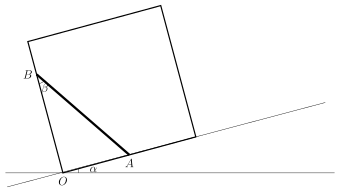
A plane makes an acute angle \(\alpha\) with the horizontal. A box in the shape of a cube is fixed onto the plane in such a way that four of its edges are horizontal and two of its sides are vertical. A uniform rod of length \(2L\) and weight \(W\) rests with its lower end at \(A\) on the bottom of the box and its upper end at \(B\) on a side of the box, as shown in the diagram below. The vertical plane containing the rod is parallel to the vertical sides of the box and cuts the lowest edge of the box at \(O\). The rod makes an acute angle~\(\beta\) with the side of the box at \(B\). The coefficients of friction between the rod and the box at the two points of contact are both \(\tan \gamma\), where \(0 < \gamma < \frac12\pi\). %The frictional force on the rod at \(A\) acts toward \(O\), %and the frictional force on the rod at~\(B\) %acts away from \(O\). The rod is in limiting equilibrium, with the end at \(A\) on the point of slipping in the direction away from \(O\) and the end at \(B\) on the point of slipping towards \(O\). Given that \(\alpha < \beta\), show that \(\beta = \alpha + 2\gamma\). [\(Hint\): You may find it helpful to take moments about the midpoint of the rod.]
Solution:

2006 Paper 2 Q9
A painter of weight \(kW\) uses a ladder to reach the guttering on the outside wall of a house. The wall is vertical and the ground is horizontal. The ladder is modelled as a uniform rod of weight \(W\) and length \(6a\). The ladder is not long enough, so the painter stands the ladder on a uniform table. The table has weight \(2W\) and a square top of side \(\frac12 a\) with a leg of length \(a\) at each corner. The foot of the ladder is at the centre of the table top and the ladder is inclined at an angle \(\arctan 2\) to the horizontal. The edge of the table nearest the wall is parallel to the wall. The coefficient of friction between the foot of the ladder and the table top is \(\frac12\). The contact between the ladder and the wall is sufficiently smooth for the effects of friction to be ignored.
- Show that, if the legs of the table are fixed to the ground, the ladder does not slip on the table however high the painter stands on the ladder.
- It is given that \(k=9\) and that the coefficient of friction between each table leg and the ground is \(\frac13\). If the legs of the table are not fixed to the ground, so that the table can tilt or slip, determine which occurs first when the painter slowly climbs the ladder.
1997 Paper 3 Q9
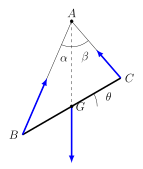
A uniform rigid rod \(BC\) is suspended from a fixed point \(A\) by light stretched springs \(AB,AC\). The springs are of different natural lengths but the ratio of tension to extension is the same constant \(\kappa\) for each. The rod is not hanging vertically. Show that the ratio of the lengths of the stretched springs is equal to the ratio of the natural lengths of the unstretched springs.
Solution:
1989 Paper 2 Q13
A body of mass \(m\) and centre of mass \(O\) is said to be dynamically equivalent to a system of particles of total mass \(m\) and centre of mass \(O\) if the moment of inertia of the system of particles is the same as the moment of inertia of the body, about any axis through \(O\). Show that this implies that the moment of inertia of the system of particles is the same as that of the body about any axis. Show that a uniform rod of length \(2a\) and mass \(m\) is dynamically equivalent to a suitable system of three particles, one at each end of the rod, and one at the midpoint. Use this result to deduce that a uniform rectangular lamina of mass \(M\) is dynamically equivalent to a system consisting of particles each of mass \(\frac{1}{36}M\) at the corners, particles each of mass \(\frac{1}{9}M\) at the midpoint of each side, and a particle of mass \(\frac{4}{9}M\) at the centre. Hence find the moment of inertia of a square lamina, of side \(2a\) and mass \(M,\) about one of its diagonals. The mass per unit length of a thin rod of mass \(m\) is proportional to the distance from one end of the rod, and a dynamically equivalent system consists of one particle at each end of the rod and one at the midpoint. Write down a set of equations which determines these masses, and show that, in fact, only two particles are required.
Solution: This follows from the parallel axis theorem. The moment of inertia of both the system and the body will be equal to the moment of inertia about the axis through the centre of mass plus the distance from the axis. Suppose we have an axis through the centre of the rod, then consider the coordinate frame with the axis and as the \(y\) axis and the intersection between rod and axis at the origin. Suppose the angle between the rod and the \(x\) axis is \(\theta\) Then the moment of inertia for the rod will be: \begin{align*} \int_{-a}^a\frac{M}{2a} x^2 \cos^2 \theta \d x &= \frac{M}{2a}\frac23 a^3 \cos^2 \theta \\ &= \frac13 M \cos^2 \theta a^2 \end{align*} Suppose we put a weights of mass \(\frac16\) at where the end of the rod would be, and a weight of mass \(\frac23\) at the centre, then the moment of inertial would be: \begin{align*} I &= \frac23M \cdot 0^2 + \frac16M (a \cos \theta)^2+\frac16 (a \cos \theta)^2 \\ &= \frac13 M \cos^2 \theta a^2 \end{align*} Therefore it has the same mass (\(M\)), centre of mass (\(O\)) and moment of inertia for any axis through the COM so the two systems are dynamically equivalent. A uniform lamina can be broken down into a system with a rod of mass \(\frac23 M\) through the middle parallel to one side and rods of mass \(\frac16 M\) on each of those parallel sides. Those rods are then equivalent to a particle at the centre mass \(\frac23 \cdot \frac23 M = \frac49 M\) a mass at the centre of those sides of mass \(\frac23 \cdot \frac 16 M = \frac19 M\), a mass at the centre of the parallel sides of mass \(\frac16 \cdot \frac23 M = \frac 19 M\) and masses at the corners of mass \(\frac16 \cdot \frac16 M = \frac1{36} M\) The moment of inertia of a square lamina side length \(2a\) mass \(M\) about a diagonal through the centre will be: \begin{align*} I &= \sum_{\text{points}} md^2 \\ &= 2 \cdot \frac1{36}M \cdot \frac12 (2a)^2 \\ &= \frac19 Ma^2 \end{align*} Suppose the rod is on \([0, 1]\), then we must have: \(\displaystyle \int_0^1 \rho x \d x = m \Rightarrow \rho = 2m\). The centre of mass will be at: \begin{align*} \overline{x} &= \frac1m \int_0^1 2m x^2 \d x \\ &= \frac23 \end{align*} The moment of inertial for a line through \((\frac23, 0)\) with angle \(\theta\) will be: \begin{align*} I &= \int_0^12mx \l\frac23 - x \r^2\cos^2 \theta \d x \\ &= 2m\cos^2 \theta \cdot \frac1{36} \\ &= \frac1{18}m \cos^2 \theta \end{align*} Therefore if the particles have mass \(m_0, m_{1/2}, m_1\) we must have: \begin{align*} &&m &= m_0 + m_{1/2} + m_1 \\ &&\frac23m &= \frac12 m_{1/2} + m_1 \\ &&\frac1{18}m \cos^2 \theta &= m_0\frac49 \cos^2 \theta + m_{1/2}\frac1{36} \cos^2 \theta + m_1 \frac1{9} \cos^2 \theta \\ \Rightarrow && m &= 8 m_0 +\frac12 m_{1/2}+2m_1 \\ \Rightarrow && m_0 &= 0 \\ && m_{1/2} &= \frac23 \\ && m_1 &= \frac13 \end{align*} Since \(m_0 = 0\) the particle at the "thin" end of the rod could be ignored.
1988 Paper 1 Q11
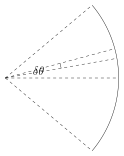
Derive a formula for the position of the centre of mass of a uniform circular arc of radius \(r\) which subtends an angle \(2\theta\) at the centre.

Solution: