Problems
Filters
15 problems found
2019 Paper 2 Q1
Let \(f(x) = (x-p)g(x)\), where g is a polynomial. Show that the tangent to the curve \(y = f(x)\) at the point with \(x = a\), where \(a \neq p\), passes through the point \((p, 0)\) if and only if \(g'(a) = 0\). The curve \(C\) has equation $$y = A(x - p)(x - q)(x - r),$$ where \(p\), \(q\) and \(r\) are constants with \(p < q < r\), and \(A\) is a non-zero constant.
- The tangent to \(C\) at the point with \(x = a\), where \(a \neq p\), passes through the point \((p, 0)\). Show that \(2a = q + r\) and find an expression for the gradient of this tangent in terms of \(A\), \(q\) and \(r\).
- The tangent to \(C\) at the point with \(x = c\), where \(c \neq r\), passes through the point \((r, 0)\). Show that this tangent is parallel to the tangent in part (i) if and only if the tangent to \(C\) at the point with \(x = q\) does not meet the curve again.
Solution: The tangent to the curve \(y = f(x)\) at \(x = a\) has the equation \(\frac{y-f(a)}{x-a} = f'(a) = g(a)+(a-p)g'(a)\). This passes through \((p,0)\) iff \begin{align*} && \frac{-f(a)}{p-a} &= g(a)+(a-p)g'(a) \\ \Leftrightarrow && -f(a) &= (p-a)g(a) -(a-p)^2g'(a) \\ \Leftrightarrow && -f(a) &= -f(a) -(a-p)^2g'(a) \\ \Leftrightarrow && 0 &= g'(a) \\ \end{align*}
- In this case \(g(x) = A(x-q)(x-r) = A(x^2-(q+r)x+qr)\) and so we must have that \(g'(a) = 0\), ie \(A(2a-(q+r)) = 0 \Rightarrow 2a = q+r\) The gradient is \(g(a) +(a-p)g'(a) = g(a) = A(a-q)(a-r)\)
- By the same reasoning, but with \(g(x) = A(x-p)(x-q)\) we have the gradient is \(A(c-p)(c-r)\). This is parallel iff \begin{align*} && (c-p)(c-r) &= (a-q)(a-r) \end{align*} The tangent at \(x = q\) is \(\frac{y-0}{x-q} = A(q-p)(q-r)\) or \( y = A(q-p)(q-r)(x-q)\)
2016 Paper 1 Q5
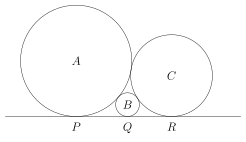
- The diagram shows three touching circles \(A\), \(B\) and \(C\), with a common tangent \(PQR\). The radii of the circles are \(a\), \(b\) and \(c\), respectively. Show that \[ \frac 1 {\sqrt b} = \frac 1 {\sqrt{a}} + \frac1{\sqrt{c}} \tag{\(*\)} \] and deduce that \[ 2\left(\frac1{a^2} + \frac1 {b^2} + \frac1 {c^2} \right) = \left(\frac1 a + \frac1 {b} + \frac1 {c} \right)^{\!2} . \tag{\(**\)} \]
- Instead, let \(a\), \(b\) and \(c\) be positive numbers, with \(b < c < a\), which satisfy \((**)\). Show that they also satisfy \((*)\).
Solution:
- \(\,\)
Notice that \begin{align*} && (a+b)^2 &= PQ^2 + (a-b)^2 \\ \Rightarrow && PQ^2 &= 4ab \\ && (b+c)^2 &= QR^2 + (c-b)^2 \\ \Rightarrow && QR^2 &= 4bc \\ && (a+c)^2 &= PR^2 + (a-c)^2 \\ \Rightarrow && PR^2 &= 4ac \\ \Rightarrow && 2\sqrt{ac} &= 2\sqrt{ab}+2\sqrt{bc} \\ \Rightarrow && \frac{1}{\sqrt{b}} &= \frac{1}{\sqrt{c}} + \frac1{\sqrt{a}} \\ \end{align*} Let \(x, y, z = \frac{1}{\sqrt{a}}, \frac1{\sqrt{b}}, \frac{1}{\sqrt{z}}\) so we would like to prove that \(2(x^4+y^4+z^4) = (x^2+y^2+z^2)^2\) or \(x^4+y^4+z^4 = 2x^2y^2+2y^2z^2+2z^2x^2\). We also have \begin{align*} && y &= x+z \\ \Rightarrow &&y^2 &= x^2+z^2+2xz \\ \Rightarrow && (y^2-x^2-z^2)^2 &= 4x^2z^2 \\ \Rightarrow && y^4+x^4+z^4 - 2x^2y^2-2y^2z^2+2x^2z^2 &= 4x^2z^2\\ \Rightarrow && y^4+x^4+z^4 &= 2x^2y^2+2y^2z^2+2z^2x^2 \end{align*}
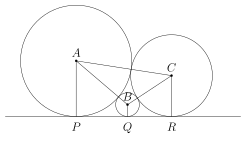
- Notice that subject to \(y > z > x\) all these steps are reversible, so we must have the equality we desire
2015 Paper 1 Q4
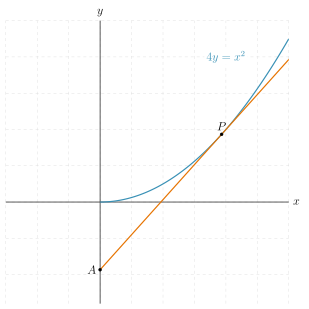
The midpoint of a rod of length \(2b\) slides on the curve \(y =\frac14 x^2\), \(x\ge0\), in such a way that the rod is always tangent, at its midpoint, to the curve. Show that the curve traced out by one end of the rod can be written in the form \begin{align*} x& = 2 \tan\theta - b \cos\theta \\ y& = \tan^2\theta - b \sin\theta \end{align*} for some suitably chosen angle \(\theta\) which satisfies \(0\le \theta < \frac12\pi\,\). When one end of the rod is at a point \(A\) on the \(y\)-axis, the midpoint is at point \(P\) and \(\theta = \alpha\). Let \(R\) be the region bounded by the following:
- the curve \(y=\frac14x^2\) between the origin and \(P\);
- the \(y\)-axis between \(A\) and the origin;
- the half-rod \(AP\).
Solution: At the point \((2t, t^2)\) the gradient is \(t\). Suppose \(\tan \theta = t\), then the point \(b\) away in each direction is \(\binom{2t}{t^2} \pm b \binom{\cos \theta}{\sin \theta}\), ie one end can be written in the form \((x,y) = (2\tan \theta - b \cos \theta, \tan^2 \theta - b \sin \theta)\). Notice we must have \(2\tan \alpha- b \cos \alpha= 0 \Rightarrow b = 2 \frac{\sin \alpha}{\cos ^2 \alpha}\), therefore the coordinates are \((2 \tan \alpha - 2 \tan \alpha, \tan^2 \alpha - 2\tan^2 \alpha) = (0, -\tan^2 \alpha)\) and \((4 \tan \alpha, 3\tan^2 \alpha)\)
2015 Paper 2 Q8
\noindent
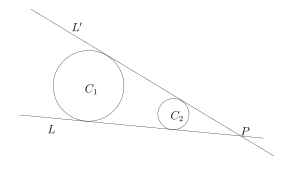
- Let \(\mathbf{x}_1\) and \(\mathbf{x}_2\) be the position vectors of the centres of \(C_1\) and \(C_2\), respectively. Show that the position vector of \(P\) is \[ \frac{r_1 \mathbf{x}_2- r_2 \mathbf{x}_1}{r_1-r_2} \,, \] where \(r_1\) and \(r_2\) are the radii of \(C_1\) and \(C_2\), respectively.
- The circle \(C_3\) does not overlap either \(C_1\) or \(C_2\) and its radius, \(r_3\), satisfies \(r_1 \ne r_3 \ne r_2\). The focus of \(C_1\) and \(C_3\) is \(Q\), and the focus of \(C_2\) and \(C_3\) is \(R\). Show that \(P\), \(Q\) and \(R\) lie on the same straight line.
- Find a condition on \(r_1\), \(r_2\) and \(r_3\) for \(Q\) to lie half-way between \(P\) and \(R\).
Solution:
- Notice that \(P\) lies on \(C_1C_2\), and that the triangles formed from \(C_iPT_i\) where \(T_i\) are the tangent points are similar, with ratios \(\frac{r_1}{r_2}\). Therefore \(\frac{C_1P}{r_1} = \frac{C_2P}{r_2}\), and hence \(\frac{C_1P}{C_1C_2} = \frac{C_1P}{C_1P-C_2P} = \frac{1}{1-\frac{r_2}{r_1}} = \frac{r_1}{r_1-r_2}\) So we have \(\mathbf{p} = \mathbf{x_1} + (\mathbf{x}_2 - \mathbf{x}_1)\cdot\frac{r_1}{r_1-r_2} = \frac{r_1\mathbf{x}_2 - r_2\mathbf{x}_1}{r_1-r_2}\)
- Suppose \(\mathbf{x}_3 = \binom{\alpha}{\beta}\) in the basis of \(\{ \mathbf{x}_1, \mathbf{x}_2 \}\), then we can see that \begin{align*} && \mathbf{p} &= \frac{1}{r_1-r_2}\binom{-r_2}{r_1} \\ && \mathbf{q} &= \frac{r_1(\alpha \mathbf{x}_1 +\beta \mathbf{x}_2) - r_3\mathbf{x}_1}{r_1-r_3} \\ &&&= \frac{1}{r_1-r_3} \binom{r_1\alpha -r_3}{r_1\beta} \\ && \mathbf{r} &=\frac{1}{r_2-r_3} \binom{r_2\alpha}{r_2\beta - r_3} \\ && \mathbf{p}-\mathbf{q} &= \frac{1}{r_1-r_2}\binom{-r_2}{r_1} - \frac{1}{r_1-r_3} \binom{r_1\alpha -r_3}{r_1\beta} \\ &&&= \frac{1}{(r_1-r_2)(r_1-r_3)} \binom{(r_1-r_3)(-r_2)-(r_1-r_2)(r_1\alpha-r_3)}{(r_1-r_3)r_1 - (r_1-r_2)r_1\beta} \\ &&&= \frac{r_1}{(r_1-r_2)(r_1-r_3)} \binom{(r_3-r_2)-\alpha(r_1-r_2)}{(r_1-r_3)-\beta(r_1-r_2)} \\ && \mathbf{q} - \mathbf{r} &= \frac{1}{r_1-r_3} \binom{r_1\alpha -r_3}{r_1\beta} - \frac{1}{r_2-r_3} \binom{r_2\alpha}{r_2\beta - r_3} \\ &&&= \frac{1}{(r_1-r_3)(r_2-r_3)}\binom{(r_2-r_3)(r_1\alpha-r_3) - (r_1-r_3)r_2\alpha)}{(r_2-r_3)r_1\beta - (r_1-r_3)(r_2\beta - r_3)} \\ &&&= \frac{1}{(r_1-r_3)(r_2-r_3)}\binom{(-r_2r_3+r_3^2) - \alpha(r_1r_3-r_3r_2)}{r_3(r_1-r_3)-\beta(r_1-r_2)} \\ &&&= \frac{r_3}{(r_1-r_3)(r_2-r_3)}\binom{(r_3-r_2)-\alpha(r_1-r_2)}{(r_1-r_3)-\beta(r_1-r_2)} \end{align*} Therefore they are clearly parallel, and hence lie on a line.
- \(Q\) is halfway between \(P\) and \(R\) if \begin{align*} && \frac{r_1}{(r_1-r_2)(r_1-r_3)} &= \frac{r_3}{(r_1-r_3)(r_2-r_3)} \\ \Leftrightarrow && r_1(r_2-r_3) &= r_3(r_1-r_2) \\ \Leftrightarrow && r_1r_2 - r_1r_3 &= r_1r_3 - r_2r_3 \\ \Leftrightarrow && r_2 &= \frac{2r_1r_3}{r_1+r_3} \end{align*}
2013 Paper 2 Q1
- Find the value of \(m\) for which the line \(y = mx\) touches the curve \(y = \ln x\,\). If instead the line intersects the curve when \(x = a\) and \(x = b\), where \(a < b\), show that \(a^b = b^a\). Show by means of a sketch that \(a < \e < b\).
- The line \(y=mx+c\), where \(c>0\), intersects the curve \(y=\ln x\) when \(x=p\) and \(x=q\), where \(p < q\). Show by means of a sketch, or otherwise, that \(p^q > q^p\).
- Show by means of a sketch that the straight line through the points \((p, \ln p)\) and \((q, \ln q)\), where \(\e\le p < q\,\), intersects the \(y\)-axis at a positive value of \(y\). Which is greater, \(\pi^\e\) or \(\e^\pi\)?
- Show, using a sketch or otherwise, that if \(0 < p < q\) and \(\dfrac{\ln q - \ln p}{q-p} = \e^{-1}\), then \(q^p > p^q\).
Solution: \begin{questionparts} \item The tangent to \(y = \ln x\) is \begin{align*} && \frac{y - \ln x_1}{x - x_1} &= \frac{1}{x_1} \\ \Rightarrow && \frac{x_1y -x_1 \ln x_1}{ x- x_1} &= 1 \\ \Rightarrow && x_1 y - x_1 \ln x_1 &= x - x_1 \end{align*} So to run through the origin, we need \(\ln x_1 = 1 \Rightarrow x_1 = e\) so the line will be \(y = \frac1{e} x\) If \(ma = \ln a \Rightarrow m = \frac{\ln a}{a} = \frac{\ln b}{b} \Rightarrow b \ln a = a \ln b \Rightarrow a^b = b^a\). \item
2010 Paper 2 Q1
Let \(P\) be a given point on a given curve \(C\). The \textit{osculating circle} to \(C\) at \(P\) is defined to be the circle that satisfies the following two conditions at \(P\): it touches \(C\); and the rate of change of its gradient is equal to the rate of change of the gradient of \(C\). Find the centre and radius of the osculating circle to the curve \(y=1-x+\tan x\) at the point on the curve with \(x\)-coordinate \(\frac14 \pi\).
Solution: The condition is that we match the first and second derivative (as well as passing through the point in question, which is \((\frac{\pi}{4}, 2 - \frac{\pi}{4})\) The gradient is \(y' = -1 + \sec^2 x\), so the value is \(1\). The second derivative is \(y'' = 2 \sec^2 x \tan x\), which is \(4\) If we have a circle, radius \(r\), so \((x-a)^2 + (y-b)^2 = r^2\) then \(2(x-a) + 2(y-b) \frac{\d y}{\d x} = 0\) and \(2 + 2 \left ( \frac{\d y}{\d x} \right)^2 + 2(y-b) \frac{\d^2y}{\d x^2} = 0\). Therefore we must have \(1+1+(2-\frac{\pi}{4}-b)4 = 0 \Rightarrow b =\frac52-\frac{\pi}{4}\) We know that the centre lies on the line \(y = 2-x\), so we must have \(a = \frac{\pi}{4}-\frac12\) and so the centre is \(( \frac{\pi}{4} - \frac12,\frac52 - \frac{\pi}{4})\) and the radius is \(\sqrt{\frac14 + \frac14} = \frac{\sqrt{2}}{2}\)
2009 Paper 1 Q8
- The equation of the circle \(C\) is \[ (x-2t)^2 +(y-t)^2 =t^2, \] where \(t\) is a positive number. Show that \(C\) touches the line \(y=0\,\). Let \(\alpha\) be the acute angle between the \(x\)-axis and the line joining the origin to the centre of \(C\). Show that \(\tan2\alpha=\frac43\) and deduce that \(C\) touches the line \(3y=4x\,\).
- Find the equation of the incircle of the triangle formed by the lines \(y=0\), \(3y=4x\) and \(4y+3x=15\,\). Note: The incircle of a triangle is the circle, lying totally inside the triangle, that touches all three sides.
Solution:
- This is a circle centre \((2t,t)\) with radius \(t\). Therefore it is exactly \(t\) away from the line \(y = 0\) so just touches that line. Not that \(\tan \alpha = \frac{t}{2t} = \frac12\) so \(\tan 2\alpha = \frac{2\tan \alpha}{1-\tan^2\alpha} = \frac{1}{1-\frac14} = \frac43\). Therefore the line \(y = \frac43x\) or \(3y = 4x\) is tangent to \(C\).
- Note that \(3y=4x\) and \(4y+3x=15\) are perpendicular, so this is a right-angled triangle with incenter \((2t,t)\) for some \(t\) and hypotenuse \(15\) We can find the third coordinate when \(3y-4x = 0\) and \(4y+3x = 15\) meet, ie \((\frac{9}{5}, \frac{12}5)\) The incentre lies on the bisector of the right angle at this point, which is the line through \((\frac{9}{5}, \frac{12}5)\) and \((\frac{15}{2}, 0)\), so \begin{align*} && \frac{2t-\frac{12}{5}}{t - \frac{9}{5}} &= \frac{-\frac{12}{5}}{\frac{15}2-\frac95} \\ \Rightarrow && \frac{10t-12}{5t-9} &= \frac{-24}{57} = -\frac{8}{19} \\ \Rightarrow && 190t - 12 \cdot 19 &= -40t + 72 \\ \Rightarrow && t &= 2 \end{align*} Therefore the center is \((4, 2)\) and the equation is \((x-4)^2+(y-2)^2=2^2\)
2005 Paper 2 Q5
The angle \(A\) of triangle \(ABC\) is a right angle and the sides \(BC\), \(CA\) and \(AB\) are of lengths \(a\), \(b\) and \(c\), respectively. Each side of the triangle is tangent to the circle \(S_1\) which is of radius \(r\). Show that \(2r = b+c-a\). Each vertex of the triangle lies on the circle~\(S_2\). The ratio of the area of the region between~\(S_1\) and the triangle to the area of \(S_2\) is denoted by \(R\,\). Show that $$ \pi R = -(\pi-1)q^2 + 2\pi q -(\pi+1) \;, $$ where \(q=\dfrac{b+c}a\,\). Deduce that $$ R\le \frac1 {\pi( \pi - 1)} \;. $$
2005 Paper 3 Q8
In this question, \(a\) and \(c\) are distinct non-zero complex numbers. The complex conjugate of any complex number \(z\) is denoted by \(z^*\). Show that \[ |a - c|^2 = aa^* + cc^* -ac^* - ca^* \] and hence prove that the triangle \(OAC\) in the Argand diagram, whose vertices are represented by \(0\), \(a\) and \(c\) respectively, is right angled at \(A\) if and only if \(2aa^* = ac^*+ca^*\,\). Points \(P\) and \(P'\) in the Argand diagram are represented by the complex numbers \(ab\) and \(\ds \frac{a}{b^*}\,\), where \(b\) is a non-zero complex number. A circle in the Argand diagram has centre \(C\) and passes through the point \(A\), and is such that \(OA\) is a tangent to the circle. Show that the point \(P\) lies on the circle if and only if the point \(P'\) lies on the circle. Conversely, show that if the points represented by the complex numbers \(ab\) and \(\ds \frac{a}{b^*}\), for some non-zero complex number \(b\) with \(bb^* \ne 1\,\), both lie on a circle centre \(C\) in the Argand diagram which passes through \(A\), then \(OA\) is a tangent to the circle.
2004 Paper 3 Q2
The equation of a curve is \(y=\f ( x )\) where \[ \f ( x ) = x-4-\frac{16 \l 2x+1 \r^2}{x^2 \l x - 4 \r} \;. \]
- Write down the equations of the vertical and oblique asymptotes to the curve and show that the oblique asymptote is a tangent to the curve.
- Show that the equation \(\f ( x ) =0\) has a double root.
- Sketch the curve.
Solution:
- Clearly \(x = 0\) and \(x = 4\) are vertical asymptotes. Notice that \(\frac{16 \l 2x+1 \r^2}{x^2 \l x - 4 \r}\) tends to \(0\) as \(x \to \infty\). Therefore the oblique asymptote is \(y = x-4\).
- \begin{align*} && 0 &= \frac{x^2(x-4)^2-4^2(2x+1)^2}{x^2(x-4)} \\ &&&= \frac{(x(x-4)-4(2x+1))(x(x-4)+4(2x+1))}{x^2(x-4)} \\ &&&= \frac{(x^2-12x-4)(x^2+4x+4)}{x^2(x-4)}\\ &&&= \frac{(x^2-12x-4)(x+2)^2}{x^2(x-4)} \end{align*} Therefore \(f(x) = 0\) has a double root at \(x = -2\). Notice it also has roots at \(6 \pm 2\sqrt{10}\)

2003 Paper 3 Q4
A curve is defined parametrically by \[ x=t^2 \;, \ \ \ y=t (1 + t^2 ) \;. \] The tangent at the point with parameter \(t\), where \(t\ne0\,\), meets the curve again at the point with parameter \(T\), where \(T\ne t\,\). Show that \[ T = \frac{1 - t^2 }{2t} \mbox { \ \ \ and \ \ \ } 3t^2\ne 1\;. \] Given a point \(P_0\,\) on the curve, with parameter \(t_0\,\), a sequence of points \(P_0 \, , \; P_1 \, , \; P_2 \, , \ldots\) on the curve is constructed such that the tangent at \(P_i\) meets the curve again at \(P_{i+1}\). If \(t_0 = \tan \frac{ 7 } {18}\pi\,\), show that \(P_3 = P_0\) but \(P_1\ne P_0\,\). Find a second value of \(t_0\,\), with \(t_0>0\,\), for which \(P_3 = P_0\) but \(P_1\ne P_0\,\).
2001 Paper 1 Q7
In a cosmological model, the radius \(\rm R\) of the universe is a function of the age \(t\) of the universe. The function \(\rm R\) satisfies the three conditions: $$ \mbox{\({\rm R}(0)=0\)}, \ \ \ \ \ \ \ \ \ \mbox{\({\rm R'}(t)>0\) for \(t>0\)}, \ \ \ \ \ \ \ \ \ \ \mbox{\({\rm R''}(t)<0\) for \(t>0\)}, \tag{*} $$ where \({\rm R''}\) denotes the second derivative of \(\rm R\). The function \({\rm H}\) is defined by \[ {\rm H} (t)= \frac{{\rm R}'(t)}{{\rm R}( t)}\;. \]
- Sketch a graph of \({\rm R} (t)\). By considering a tangent to the graph, show that \(t<1/{\rm H}(t)\).
- Observations reveal that \({\rm H}(t) = a/t\), where \(a\) is constant. Derive an expression for \({\rm R}(t)\). What range of values of \(a\) is consistent with the three conditions \((*)\)?
- Suppose, instead, that observations reveal that \({\rm H}(t)= b t^{-2}\), where \(b\) is constant. Show that this is not consistent with conditions \((*)\) for any value of \(b\).
Solution:
- \(\,\)
Notice the tangent must hit the \(y\)-axis above the origin, ie \begin{align*} && 0 &< R'(t)(0-t) + R(t) \\ \Rightarrow && R'(t) t &< R(t) \\ \Rightarrow && t &< \frac{R(t)}{R'(t)} = \frac{1}{H(t)} \end{align*}

- Suppose \(H(t) = a/t\) then \begin{align*} && \frac{R'}{R} &= \frac{a}{t} \\ \Rightarrow && \int \frac{1}{R} \d R &= \int \frac{a}{t} \d t \\ \Rightarrow && \ln R &= a \ln t + C \tag{t, R > 0} \\ \Rightarrow && R &= Kt^a \end{align*} Since we need \(R(t) > 0\), \(K > 0\), since \(R'(t) > 0\) we need \(a > 0\), since \(R''(t) < 0\) we need \(a(a-1) < 0\) ie \(0 < a < 1\)
- Suppose instead \(H(t) = bt^{-2}\) then \begin{align*} && \frac{R'}{R} &= \frac{b}{t^2} \\ \Rightarrow && \int \frac{1}{R} \d R &= \int \frac{b}{t^2} \d t \\ \Rightarrow && \ln R &= -bt^{-1} + C \tag{R > 0} \\ \Rightarrow && R &= Ke^{-b/t} \end{align*} Since \(R > 0\) we must have \(K > 0\). \begin{align*} R' > 0: && R' &= K(b/t^2)e^{-b/t} > 0 \\ \Rightarrow && b &> 0 \\ R'' < 0: && R'' &= K(b^2/t^4)e^{-b/t} -K2b/t^3 e^{-b/t} \\ &&&= Kb/t^4 (b-2t)e^{-b/t} < 0 \\ \Rightarrow && b &< 2t\\ \Rightarrow && b &< 2t \end{align*} which cannot be true for all \(t\), ie there is no \(b\) which satisfies this.
1994 Paper 1 Q5
A parabola has the equation \(y=x^{2}.\) The points \(P\) and \(Q\) with coordinates \((p,p^{2})\) and \((q,q^{2})\) respectively move on the parabola in such a way that \(\angle POQ\) is always a right angle.
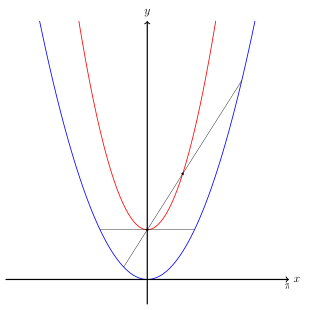
- Find and sketch the locus of the midpoint \(R\) of the chord \(PQ.\)
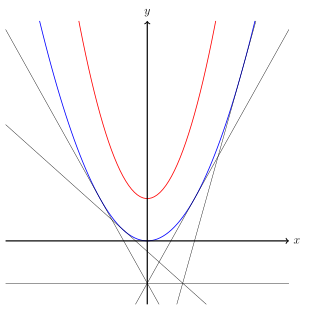
- Find and sketch the locus of the point \(T\) where the tangents to the parabola at \(P\) and \(Q\) intersect.
Solution:
- The line \(PO\) has gradient \(\frac{p^2}{p} = p\) and teh line \(QO\) has gradient \(q\), therefore we must have that \(pq = -1\). Therefore, \(R\) is the point
\begin{align*}
&& R &= \left ( \frac{p-\frac{1}{p}}{2}, \frac{p^2+\frac{1}{p^2}}{2} \right) \\
&&&= \left ( \frac12\left ( p - \frac{1}{p} \right),2\left (\frac12 \left(p-\frac{1}{p}\right) \right)^2+1 \right) \\
&&&= \left ( t, 2t^2+1\right)
\end{align*}
So we are looking at another parabola.
- The tangents are \(y = 2px+c\), ie \(p^2 = 2p^2+c\), ie \(y = 2px -p^2\) so we have
\begin{align*}
&& y - 2px &= -p^2 \\
&& y - 2qx &= -q^2 \\
\Rightarrow && (2p-2q)x &= p^2-q^2 \\
\Rightarrow && x &= \frac12 (p+q)\\
&& y &= p(p+q)-p^2 \\
&& y &= pq = -1
\end{align*}
Therefore \(x = \frac12(p - \frac1p), y= -1\), so we have the line \(y = -1\) (the directrix)
1989 Paper 2 Q2
Let \begin{alignat*}{2} \tan x & =\ \ \, \quad{\displaystyle \sum_{n=0}^{\infty}a_{n}x^{n}} & & \text{ for small }x,\\ x\cot x & =1+\sum_{n=1}^{\infty}b_{n}x^{n}\quad & & \text{ for small }x\text{ and not zero}. \end{alignat*} Using the relation \[ \cot x-\tan x=2\cot2x,\tag{*} \] or otherwise, prove that \(a_{n-1}=(1-2^{n})b_{n}\), for \(n\geqslant1\). Let \[ x\mathrm{cosec}x=1+{\displaystyle \sum_{n=1}^{\infty}c_{n}x^{n}\quad\text{ for small }x\neq0. \qquad \qquad \, } \] Using a relation similar to \((*)\) involving \(2\mathrm{cosec}2x\), or otherwise, prove that \[ c_{n}=\frac{2^{n-1}-1}{2^{n}-1}\frac{1}{2^{n-1}}a_{n-1}\qquad(n\geqslant1). \]
Solution: \begin{align*} && \cot x - \tan x &= 2 \cot 2x \\ \Rightarrow && x\cot x - x\tan x &= 2x\cot 2x \\ \Rightarrow && 1 + \sum_{n=1}^{\infty} b_n x^n - \sum_{n=0}^{\infty}a_n x^{n+1} &= 1 + \sum_{n=1}^{\infty} b_n (2x)^n \\ \Rightarrow && \sum_{n=1}^{\infty}(1-2^n)b_nx^n &= \sum_{n=1}^{\infty} a_{n-1}x^n \\ \Rightarrow && a_{n-1} &= (1-2^n)b_n \quad \text{if }n \geq 1 \end{align*} \begin{align*} \cot x + \tan x &= 2 \cosec 2x \end{align*} So \begin{align*} && \cot x + \tan x &= 2 \cosec 2x \\ \Rightarrow && x \cot x + x\tan x &= 2x \cosec 2x \\ \Rightarrow && 1 + \sum_{n=1}^{\infty} b_n x^n + \sum_{n=0}^{\infty} a_n x^{n+1} &= 1+\sum_{n=1}^\infty c_n (2x)^n \\ \Rightarrow && \sum_{n=1}^{\infty} \frac{1}{1-2^n}a_{n-1} +\sum_{n=1}^{\infty}a_{n-1}x^n &= \sum_{n=1}^{\infty} 2^nc_n x^n \\ \Rightarrow && c_n &= \frac{1}{2^n} \left ( 1 + \frac{1}{1-2^n} \right)a_{n-1} \\ &&&= \frac1{2^n} \frac{2^n-2}{2^n-1} a_{n-1}\\ &&&= \frac1{2^{n-1}}\frac{2^{n-1}-1}{2^n-1} a_{n-1} \end{align*}
1987 Paper 1 Q7
Sum each of the series \[ \sin\left(\frac{2\pi}{23}\right)+\sin\left(\frac{6\pi}{23}\right)+\sin\left(\frac{10\pi}{23}\right)+\cdots+\sin\left(\frac{38\pi}{23}\right)+\sin\left(\frac{42\pi}{23}\right) \] and \[ \sin\left(\frac{2\pi}{23}\right)-\sin\left(\frac{6\pi}{23}\right)+\sin\left(\frac{10\pi}{23}\right)-\cdots-\sin\left(\frac{38\pi}{23}\right)+\sin\left(\frac{42\pi}{23}\right), \] giving each answer in terms of the tangent of a single angle. {[}No credit will be given for a numerical answer obtained purely by use of a calculator.{]}
Solution: \(\sin x = \frac{e^{ix} - e^{-ix}}{2i}\). Also let \(z = e^{ \frac{2\pi i}{23}}\) \begin{align*} \sum_{k=0}^{10} \sin \l \frac{(4k +2)\pi}{23} \r &= \sum_{k=0}^{10} \textrm{Im} \l \exp\l \frac{(4k +2)\pi i}{23} \r \r \\ &= \textrm{Im} \l \sum_{k=0}^{10} \exp\l \frac{(4k +2)\pi i}{23} \r \r \\ &= \textrm{Im} \l e^{ \frac{2\pi i}{23}} \sum_{k=0}^{10} z^{2k} \r \\ &= \textrm{Im} \l z \l \frac{z^{22}-1}{z^2-1} \r \r \\ &= \textrm{Im} \l z \l \frac{z^{11}(z^{11}-z^{-11})}{z(z-z^{-1})} \r \r \\ &= \textrm{Im} \l \frac{z^{11}2i \sin \frac{22 \pi}{23} }{2i \sin \frac{2 \pi}{23}} \r \r \\ &= \frac{\sin \frac{22 \pi}{23}}{\sin \frac{2 \pi}{23}} \textrm{Im} ( z^{11}) \\ &= \frac{\sin^2 \frac{22 \pi}{23}}{\sin \frac{2 \pi}{23}} \\ &= \frac{\sin^2 \frac{\pi}{23}}{2\sin \frac{\pi}{23}\cos \frac{\pi}{23}} \\ &= \frac12 \tan \frac{\pi}{23} \end{align*} Similarly, \begin{align*} \sum_{k=0}^{10} (-1)^k\sin \l \frac{(4k +2)\pi}{23} \r &= \sum_{k=0}^{10} \textrm{Im} \l (-1)^k\exp\l \frac{(4k +2)\pi i}{23} \r \r \\ &= \textrm{Im} \l \sum_{k=0}^{10} (-1)^k\exp\l \frac{(4k +2)\pi i}{23} \r \r \\ &= \textrm{Im} \l e^{ \frac{2\pi i}{23}} \sum_{k=0}^{10} (-1)^kz^{2k} \r \\ &= \textrm{Im} \l z \l \frac{z^{22}+1}{z^2+1} \r \r \\ &= \textrm{Im} \l z \l \frac{z^{11}(z^{11}+z^{-11})}{z(z+z^{-1})} \r \r \\ &= \textrm{Im} \l \frac{z^{11}2 \cos \frac{22 \pi}{23} }{2 \cos\frac{2 \pi}{23}} \r \r \\ &= \frac{\cos\frac{22 \pi}{23}}{\cos \frac{2 \pi}{23}} \textrm{Im} ( z^{11}) \\ &= \frac{\cos \frac{22 \pi}{23}\sin \frac{22 \pi}{23}}{\cos\frac{2 \pi}{23}} \\ &= \frac12 \frac{\sin \frac{44 \pi}{23}}{\cos\frac{2 \pi}{23}} \\ &= \frac12 \frac{-\sin \frac{2\pi}{23}}{\cos\frac{2 \pi}{23}} \\ &= -\frac12 \tan \frac{2\pi}{23} \end{align*}