Problems
Filters
9 problems found
2015 Paper 2 Q4
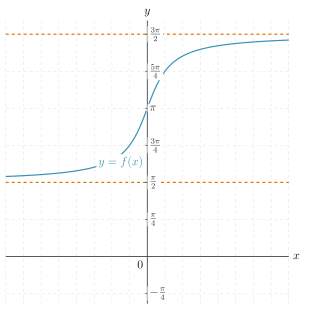
- The continuous function \(\f\) is defined by \[ \tan \f(x) = x \ \ \ \ \ (-\infty < x <\infty) \] and \(\f(0)=\pi\). Sketch the curve \(y=\f(x)\).
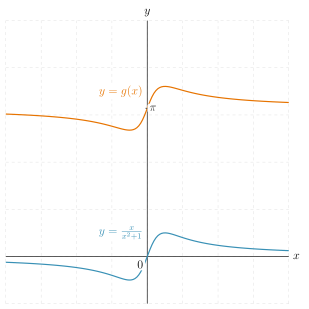
- The continuous function \(\g\) is defined by \[ \tan \g(x) = \frac x {1+x^2} \ \ \ \ \ \ (-\infty < x <\infty) \] and \(\g(0)=\pi\). Sketch the curves \(y= \dfrac x {1+x^2} \ \) and \(y=\g(x)\).
- The continuous function \(\h \) is defined by \(\h (0)=\pi\) and \[ \tan \h (x)= \frac x {1-x^2}\, \ \ \ \ \ (x \ne \pm 1) \,. \] (The values of \(\h (x)\) at \(x=\pm1\) are such that \(\h (x)\) is continuous at these points.) Sketch the curves \(y= \dfrac x {1-x^2} \ \) and \(y=\h (x)\).
- [Not on original exam] The continuous functions \(\h_1\) and \(\h_2\) are defined by: \(\h_1(0)=\h_2(0)=\pi \), \[ \tan \h_1(x) = \frac {x+x^4} {1+x^2+x^4} \ \ \ \ \ \text{and} \ \ \ \ \ \ \tan \h_2(x) = \frac {4x-x^3} {1-x^4} \,. \] for values of \(x\) at which the right hand sides are defined. Find \(\lim\limits_{x\to\infty}\h_1(x)\) and \(\lim\limits_{x\to\infty}\h_2(x)\,\).
Solution:
- \(\,\)
- \(\,\)
- \(\,\)
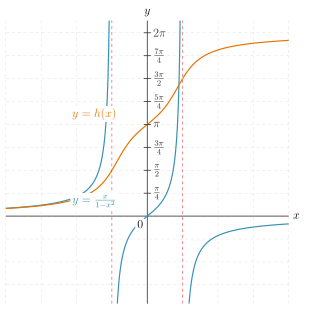
- Note that \(\frac{x+x^4}{1+x^2+x^4}\) is continuous, and nicely behaved on \((-\infty, \infty)\) so we can see that \(\lim_{x \to \infty} h_1(x) = \pi + \frac{\pi}{4} = \frac{5\pi}{4}\). \(\frac{4x-x^3}{1-x^4}\) on the other hand has asymptotes at \(\pm 1\). So as as \(x \to 1\), \(h_1(x) \to \pi + \frac{\pi}{2} = \frac{3\pi}{2}\). Then as \(x \to \infty\) we increase by another \(\frac{\pi}{2}\), so \(\lim_{x \to \infty} h_2(x) = 2\pi\)
2015 Paper 2 Q5
In this question, the \(\mathrm{arctan}\) function satisfies \(0\le \arctan x <\frac12 \pi\) for \(x\ge0\,\).
- Let \[ S_n= \sum_{m=1}^n \arctan \left(\frac1 {2m^2}\right) \,, \] for \(n=1, 2, 3, \ldots\) . Prove by induction that \[ \tan S_n = \frac n {n+1} \,. \] Prove also that \[ S_n = \arctan \frac n {n+1} \,. \]
- In a triangle \(ABC\), the lengths of the sides \(AB\) and \(BC\) are \(4n^2\) and \(4n^4-1\), respectively, and the angle at \(B\) is a right angle. Let \(\angle BCA = 2\alpha_n\). Show that \[ \sum_{n=1}^\infty \alpha_n = \tfrac14\pi \,. \]
Solution:
- Claim: \(\tan S_n = \frac n {n+1}\) Proof: (By Induction) Base case: (\(n=1\)): \begin{align*} && \tan \left ( \sum_{m=1}^1 \arctan \left ( \frac{1}{2m^2} \right) \right) &= \tan \left ( \arctan \left ( \frac{1}{2} \right) \right) \\ &&&= \frac12 = \frac{1}{1+1} \end{align*} Therefore the base case is true. Inductive step: Suppose our statement is true for some \(n = k\), ie \begin{align*} && \frac{k}{k+1} &= \tan \left ( \sum_{m=1}^k \arctan \left ( \frac{1}{2m^2} \right) \right) \\ \Rightarrow && \tan S_{k+1} &= \tan \left ( \sum_{m=1}^k \arctan \left ( \frac{1}{2m^2} \right) + \arctan \left ( \frac{1}{2 (k+1)^2} \right) \right) \\ &&&= \frac{\tan S_k + \tan \left ( \arctan \left ( \frac{1}{2 (k+1)^2} \right) \right)}{1-\tan S_k \tan \left ( \arctan \left ( \frac{1}{2 (k+1)^2} \right) \right)} \\ &&&= \frac{\frac{k}{k+1} + \frac{1}{2(k+1)^2}}{1-\frac{k}{k+1} \frac{1}{2(k+1)^2}} \\ &&&= \frac{2k(k+1)^2+(k+1)}{2(k+1)^3-k} \\ &&&= \frac{k+1}{(k+1)+1} \end{align*} Therefore it is true for \(n=k+1\). Conclusion: Therefore by the principle of mathematical induction since our statement is true for \(n=1\) and if it is true for \(n=k\) it is true for \(n=k+1\) it is true for all \(n\geq1\) Since \(S_n < \frac12 \pi\) for all \(n\), we must have \(\arctan \frac{n}{n+1} = S_n\)
- \(\tan (2\alpha_n) = \frac{4n^2}{4n^4-1} = \frac{2n^2+2n^2}{(2n^2)(2n^2)-1} = \frac{\frac{1}{2n^2}+\frac{1}{2n^2}}{1-\frac{1}{2n^2}\frac{1}{2n^2}} \Rightarrow \tan (\alpha_n) = \arctan \frac{1}{2n^2}\). In particular \(\displaystyle \sum_{n=1}^{N} \alpha_n = \arctan \frac{n}{n+1} \Rightarrow \sum_{n=1}^{\infty} \alpha_n \to \arctan 1 = \frac{\pi}{4} \)
2009 Paper 3 Q9
A particle is projected under gravity from a point \(P\) and passes through a point \(Q\). The angles of the trajectory with the positive horizontal direction at \(P\) and at \(Q\) are \(\theta\) and \(\phi\), respectively. The angle of elevation of \(Q\) from \(P\) is \(\alpha\).
- Show that \(\tan\theta +\tan\phi = 2\tan\alpha\).
- It is given that there is a second trajectory from \(P\) to \(Q\) with the same speed of projection. The angles of this trajectory with the positive horizontal direction at \(P\) and at \(Q\) are \(\theta'\) and \(\phi'\), respectively. By considering a quadratic equation satisfied by \(\tan\theta\), show that \(\tan(\theta+\theta') = -\cot\alpha\). Show also that \(\theta+\theta'=\pi+\phi+\phi'\,\).
2007 Paper 1 Q2
- Given that \(A = \arctan \frac12\) and that \(B = \arctan\frac13\,\) (where \(A\) and \(B\) are acute) show, by considering \(\tan \left( A + B \right)\), that \(A + B = {\frac{1}{4}\pi }\). The non-zero integers \(p\) and \(q\) satisfy \[ \displaystyle \arctan {\frac1 p} + \arctan {\frac1 q} = {\frac\pi 4}\,. \] Show that \( \left ( p-1 \right) \left(q-1 \right) = 2\) and hence determine \(p\) and \(q\).
- Let \(r\), \(s\) and \(t\) be positive integers such that the highest common factor of \(s\) and \(t\) is \(1\). Show that, if \[ \arctan {\frac1 r} + \arctan \frac s {s+t} = {\frac\pi 4}\,, \] then there are only two possible values for \(t\), and give \(r\) in terms of \(s\) in each case.
Solution:
- \begin{align*} && \tan (A+B) &= \frac{\tan A + \tan B}{1-\tan A \tan B}\\ &&&= \frac{\tan \arctan \frac12 + \tan \arctan \frac13}{1-\tan \arctan \frac12 \tan \arctan \frac13}\\ &&&= \frac{\frac12+\frac13}{1-\frac16} \\ &&&= \frac{3+2}{5} \\ &&&= 1 \\ \Rightarrow && A+B &= \frac{\pi}{4} + n \pi \end{align*} but since \(A,B\) are acute \(0 < A+B < \pi\), so \(A+B = \frac{\pi}{4}\) \begin{align*} && 1 &= \tan \frac{\pi}{4} \\ &&&= \tan \left ( \arctan {\frac1 p} + \arctan {\frac1 q}\right) \\ &&&= \frac{\frac1p + \frac1q}{1-\frac1{pq}} \\ &&&= \frac{q+p}{pq-1} \\ \Rightarrow && pq-1 &= q+p \\ \Rightarrow && 0 &= pq-q-p-q \\ &&&= (p-1)(q-1)-2 \\ \Rightarrow && 2 &= (p-1)(q-1) \end{align*} But \(p\),\(q\) are integers, so \(p-1 \in \{-2,-1,1,1\} \Rightarrow p \in \{-1,0,2,3\}\) but we cannot have \(p= 0\), so we must have \((p,q) = (2,3), (3,2)\)
- \begin{align*} && 1 &= \tan \frac{\pi}{4} \\ &&&= \tan \left ( \arctan {\frac1 r} + \arctan \frac s {s+t} \right) \\ &&&= \frac{\frac1r + \frac{s}{s+t}}{1-\frac{s}{r(s+t)}} \\ &&&= \frac{s+t+sr}{r(s+t)-s} \\ \Rightarrow && rs+rt-s &= s+t + sr \\ \Rightarrow && 0 &= rt-2s-t \\ &&2s&= t(r-1) \end{align*} Since \((s,t) =1\), we must have \(t \mid 2\), so \( t = 1,2\) and \(r = 2s+1\) or \(r=s+1\) respectively.
2007 Paper 2 Q5
In this question, \(\f^2(x)\) denotes \(\f(\f(x))\), \(\f^3(x)\) denotes \(\f( \f (\f(x)))\,\), and so on.
- The function \(\f\) is defined, for \(x\ne \pm 1/ \sqrt3\,\), by $$ \f(x) = \ds \frac{x+\sqrt3} {1-\sqrt3\, x }\,. $$ Find by direct calculation \(\f^2(x) \) and \(\f^3(x)\), and determine \(\f^{2007}(x)\,\).
- Show that \(\f^n(x) = \tan(\theta + \frac 13 n\pi)\), where \(x=\tan\theta\) and \(n\) is any positive integer.
- The function \(\g(t)\) is defined, for \(\vert t\vert\le1\) by \(\g(t) = \frac {\sqrt3}2 t + \frac 12 \sqrt {1-t^2}\,\). Find an expression for \(\g^n(t)\) for any positive integer \(n\).
Solution:
- \(\,\) \begin{align*} && f(x) &= \frac{x+\sqrt3}{1-\sqrt3x} \\ \Rightarrow && f(f(x)) &= \frac{f(x)+\sqrt3}{1-\sqrt3f(x)} \\ &&&= \frac{\frac{x+\sqrt3}{1-\sqrt3x}+\sqrt3}{1-\sqrt3 \frac{x+\sqrt3}{1-\sqrt3x}} \\ &&&= \frac{x+\sqrt{3}+\sqrt3(1-\sqrt3x)}{1-\sqrt3x-\sqrt3(x+\sqrt3)} \\ &&&= \frac{-2x+2\sqrt3}{-2-2\sqrt3x} \\ &&&= \frac{x-\sqrt3}{1+\sqrt3 x} \\ \\ && f^3(x) &= f^2(f(x)) \\ &&&= \frac{f(x)-\sqrt3}{1+\sqrt3 f(x)} \\ &&&=\frac{\frac{x+\sqrt3}{1-\sqrt3x}-\sqrt3}{1+\sqrt3 \frac{x+\sqrt3}{1-\sqrt3x}} \\ &&&= \frac{(x+\sqrt3)-\sqrt3(1-\sqrt3 x)}{(1-\sqrt3x)+\sqrt3 (x+\sqrt3)} \\ &&&= \frac{-2x}{-2} = x \\ \\ && f^{2007}(x) &= x \end{align*}
- If \(x = \tan \theta\) then \(f(x) = \frac{\tan \theta + \tan \frac{\pi}{3}}{1 - \tan \frac{\pi}{3} \tan \theta} = \tan (\theta + \frac{\pi}{3})\) and hence \(f^n(x) = \tan (\theta + \frac{n \pi}{3})\)
- Note that if \(t = \sin \theta\) then \(g(t) = \cos \frac{\pi}{6} t\sin \theta + \frac12 \cos \theta = \sin(\theta + \frac{\pi}6)\) therefore \(g^n(t) = \sin(\sin^{-1}(t) + \frac{n\pi}{6})\)
2007 Paper 3 Q1
In this question, do not consider the special cases in which the denominators of any of your expressions are zero. Express \(\tan(\theta_1+\theta_2+\theta_3+\theta_4)\) in terms of \(t_i\), where \(t_1=\tan\theta_1\,\), etc. Given that \(\tan\theta_1\), \(\tan\theta_2\), \(\tan\theta_3\) and \(\tan\theta_4\) are the four roots of the equation \[at^4+bt^3+ct^2+dt+e=0 \] (where \(a\ne0\)), find an expression in terms of \(a\), \(b\), \(c\), \(d\) and \(e\) for \(\tan(\theta_1+\theta_2+\theta_3+\theta_4)\). The four real numbers \(\theta_1\), \(\theta_2\), \(\theta_3\) and \(\theta_4\) lie in the range \(0\le \theta_i<2\pi\) and satisfy the equation \[ p\cos2\theta+\cos(\theta-\alpha)+p=0\,,\] where \(p\) and \(\alpha\) are independent of \(\theta\). Show that \(\theta_1+\theta_2+\theta_3+\theta_4=n\pi\) for some integer \(n\).
Solution: \begin{align*} \tan(\theta_1 + \theta_2 + \theta_3 + \theta_4) &= \frac{\tan(\theta_1 + \theta_2) + \tan(\theta_3 + \theta_4)}{1 - \tan(\theta_1 +\theta_2)\tan(\theta_3+\theta_4)} \\ &= \frac{\frac{t_1+t_2}{1-t_1t_2}+\frac{t_3+t_4}{1-t_3t_4}}{1-\frac{t_1+t_2}{1-t_1t_2}\frac{t_3+t_4}{1-t_3t_4}} \\ &= \frac{(t_1+t_2)(1-t_3t_4)+(t_3+t_4)(1-t_1t_2)}{(1-t_1t_2)(1-t_3t_4)-(t_1+t_2)(t_3+t_4)} \\ &= \frac{t_1 +t_2+t_3+t_4 - (t_1t_2t_3+t_1t_2t_4+t_1t_3t_4+t_2t_3t_4)}{1-t_1t_2-t_1t_3-t_1t_4-t_2t_3-t_2t_4-t_3t_4} \end{align*} If \(t_1, t_2, t_3, t_4\) are the roots of \(at^4+bt^3+ct^2+dt+e = 0\), then \(t_1+t_2+t_3+t_4 = -\frac{b}{a}, t_1t_2+t_1t_3+t_1t_4+t_2t_3+t_2t_4+t_3t_4 = \frac{c}{a}, t_1t_2t_3+t_1t_2t_4+t_1t_3t_4+t_2t_3t_4 = -\frac{d}{a}\), therefore the expression is: \begin{align*} \tan(\theta_1 + \theta_2 + \theta_3 + \theta_4) &= \frac{-\frac{b}{a}+\frac{d}{a}}{1 - \frac{c}{a}} \\ &= \frac{d-b}{a-c} \end{align*} \begin{align*} &&0 &= p \cos 2\theta + \cos (\theta - \alpha) + p \\ &&&= p (2\cos^2 \theta -1) + \cos \theta \cos \alpha - \sin \theta \sin \alpha + p \\ &&&= 2p \cos^2 \theta + \cos \theta \cos \alpha - \sin \theta \sin \alpha\\ \Rightarrow && 0 &=2p \cos \theta + \cos \alpha - \tan \theta \sin \alpha \\ \Rightarrow && -2p \cos \theta&= \cos \alpha - \tan \theta \sin \alpha \\ \Rightarrow && 4p^2 \cos^2 \theta &= \cos^2 \alpha - 2 \sin \alpha \cos \alpha \tan \theta + \sin^2 \alpha \tan^2 \theta \\ && 4p^2 \frac{1}{1 + \tan^2 \theta} &= \cos^2 \alpha - \sin 2\alpha \tan \theta + \sin^2 \alpha \tan^2 \theta \\ \Rightarrow && 4p^2 &= \cos^2 \alpha - \sin 2\alpha t+t^2-\sin2\alpha t^3+\sin^2 \alpha t^4 \\ \Rightarrow && \tan (\theta_1+\theta_2 + \theta_3+ \theta_4) &= \frac{0}{\sin^2 \alpha - 1} \\ &&&= 0 \\ \Rightarrow && \theta_1 + \theta_2 + \theta_3 + \theta_4 &= n\pi \end{align*}
2004 Paper 2 Q9
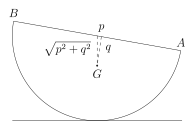
The base of a non-uniform solid hemisphere, of mass \(M,\) has radius \(r.\) The distance of the centre of gravity, \(G\), of the hemisphere from the base is \(p\) and from the centre of the base is \(\sqrt{p^2 + q^2} \,\). The hemisphere rests in equilibrium with its curved surface on a horizontal plane. A particle of mass \(m,\,\) where \(m\) is small, is attached to \(A\,\), the lowest point of the circumference of the base. In the new position of equilibrium, find the angle, \(\alpha\), that the base makes with the horizontal. The particle is removed and attached to the point \(B\) of the base which is at the other end of the diameter through \(A\,\). In the new position of equilibrium the base makes an angle \({\beta}\) with the horizontal. Show that $$\tan(\alpha-\beta)= \frac{2mMrp} {M^2\left(p^2+q^2\right)-m^2r^2}\;.$$
Solution:
2004 Paper 3 Q5
Show that if \(\, \cos(x - \alpha) = \cos \beta \,\) then either \(\, \tan x = \tan ( \alpha + \beta)\,\) or \(\; \tan x = \tan ( \alpha - \beta)\,\). By choosing suitable values of \(x\), \(\alpha\) and \(\beta\,\), give an example to show that if \(\,\tan x = \tan ( \alpha + \beta)\,\), then \(\,\cos(x - \alpha) \, \) need not equal \( \cos \beta \,\). Let \(\omega\) be the acute angle such that \(\tan \omega = \frac 43\,\).
- For \(0 \le x \le 2 \pi\), solve the equation \[ \cos x -7 \sin x = 5 \] giving both solutions in terms of \(\omega\,\).
- For \(0 \le x \le 2 \pi\), solve the equation \[ 2\cos x + 11 \sin x = 10 \] showing that one solution is twice the other and giving both in terms of \(\omega\,\).
1994 Paper 1 Q8
By means of the change of variable \(\theta=\frac{1}{4}\pi-\phi,\) or otherwise, show that \[ \int_{0}^{\frac{1}{4}\pi}\ln(1+\tan\theta)\,\mathrm{d}\theta=\tfrac{1}{8}\pi\ln2. \] Evaluate \[ {\displaystyle \int_{0}^{1}\frac{\ln(1+x)}{1+x^{2}}\,\mathrm{d}x}\qquad\mbox{ and }\qquad{\displaystyle \int_{0}^{\frac{1}{2}\pi}\ln\left(\frac{1+\sin x}{1+\cos x}\right)\,\mathrm{d}x}. \]
Solution: \begin{align*} && I &= \int_0^{\frac14\pi} \ln (1 + \tan \theta) \d \theta \\ \theta = \tfrac14\pi - \phi, \d \theta = -\d\phi: &&&= \int_0^{\frac14 \pi} \ln ( 1 + \tan (\tfrac14\pi - \phi)) \d \phi \\ &&&= \int_0^{\frac14 \pi} \ln \left ( 1 + \frac{1 - \tan \phi}{1+\tan \phi} \right) \d \phi \\ &&&= \int_0^{\frac14 \pi} \ln \left ( \frac{2}{1+\tan \phi} \right) \d \phi \\ &&&= \tfrac14 \pi \ln 2 - I \\ \Rightarrow && I &= \tfrac18\pi \ln 2 \end{align*} \begin{align*} && J &= \int_0^1 \frac{\ln(1+x)}{1+x^2} \d x \\ x= \tan \theta \d \theta, \d \theta = \frac{\d x}{1+x^2} &&&= \int_0^{\frac14 \pi} \ln(1 + \tan \theta) \d \theta \\ &&&= \tfrac18 \pi \ln 2 \end{align*} \begin{align*} && K &= \int_0^{\frac12 \pi} \ln \left ( \frac{1 + \sin x}{1 + \cos x} \right) \d x \\ y = \tfrac12\pi - x, \d y = -\d x: &&&= \int_0^{\frac12\pi} \ln \left ( \frac{1+\cos y}{1+\sin y}\right) \d y \\ &&&= -K \\ \Rightarrow && K &= 0 \end{align*}