Problems
Filters
6 problems found
2019 Paper 2 Q10
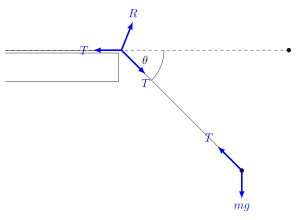
A small light ring is attached to the end \(A\) of a uniform rod \(AB\) of weight \(W\) and length \(2a\). The ring can slide on a rough horizontal rail. One end of a light inextensible string of length \(2a\) is attached to the rod at \(B\) and the other end is attached to a point \(C\) on the rail so that the rod makes an angle of \(\theta\) with the rail, where \(0 < \theta < 90^{\circ}\). The rod hangs in the same vertical plane as the rail. A force of \(kW\) acts vertically downwards on the rod at \(B\) and the rod is in equilibrium.
- You are given that the string will break if the tension \(T\) is greater than \(W\). Show that (assuming that the ring does not slip) the string will break if $$2k + 1 > 4 \sin \theta.$$
- Show that (assuming that the string does not break) the ring will slip if $$2k + 1 > (2k + 3)\mu \tan \theta,$$ where \(\mu\) is the coefficient of friction between the rail and the ring.
- You are now given that \(\mu \tan \theta < 1\). Show that, when \(k\) is increased gradually from zero, the ring will slip before the string breaks if $$\mu < \frac{2 \cos \theta}{1 + 2 \sin \theta}.$$
Solution:

- \(\,\) \begin{align*} \overset{\curvearrowright}{A}:&& W \cos \theta \cdot a + kW \cos \theta \cdot 2a - T \cos \theta \sin \theta \cdot 2a - T \sin \theta \cos \theta \cdot 2a &= 0 \\ && (2k+1) \cos \theta W &= T \cos \theta \cdot 4 \sin \theta \\ \Rightarrow && T &= \frac{2k+1}{4 \sin \theta} W \\ \Rightarrow && \text{breaks if }\quad \quad 2k+1 &> 4 \sin \theta \end{align*}
- \(\,\) \begin{align*} \text{N2}(\uparrow): && R - W - kW - T \sin \theta &= 0 \\ \Rightarrow && R &= (k+1)W - T \sin \theta \\ &&&= (k+1)W - \frac{2k+1}{4} W \\ &&&= \frac{2k+3}{4}W \\ \text{N2}(\leftarrow): && F_A - T \cos \theta &= 0 \\ \Rightarrow && F_A &= \frac{2k+1}{4 }\cot \theta \\ \Rightarrow && \text{slips if }\quad \quad\quad \quad\quad \quad F_A &> \mu R \\ \Rightarrow && \text{slips if }\quad \quad \frac{2k+1}{4 }\cot \theta &> \mu \frac{2k+3}{4}W \\ \Rightarrow && 2k+1 &> (2k+3) \mu \tan \theta \end{align*}
- The condition for breaking is \(k > 2\sin \theta -\frac12\). The condition for slipping is equivalent to: \begin{align*} && 2k+1 &> (2k+3) \mu \tan \theta \\ \Leftrightarrow && 2k(1- \mu \tan \theta) &> 3 \mu \tan \theta-1 \\ \Leftrightarrow && k &> \frac{3 \mu \tan \theta-1}{2(1- \mu \tan \theta)} \end{align*} Therefore we will slip first if: \begin{align*} && \frac{3 \mu \tan \theta-1}{2(1- \mu \tan \theta)} &< 2 \sin \theta - \frac12 \\ \Leftrightarrow && 3 \mu \tan \theta-1 &< 4 \sin \theta (1- \mu \tan \theta) - (1- \mu \tan \theta) \\ &&&=4 \sin \theta - 1 + \mu \tan \theta (1-4 \sin \theta) \\ \Leftrightarrow && 3 \mu \tan \theta &< 4 \sin \theta + \mu \tan \theta (1- 4 \sin \theta) \\ \Leftrightarrow && \mu \tan \theta(3-1+4\sin \theta) &< 4 \sin \theta \\ \Leftrightarrow && \mu &< \frac{2 \cos \theta}{1+2 \sin \theta} \end{align*}
2016 Paper 3 Q10
A smooth plane is inclined at an angle \(\alpha\) to the horizontal. A particle \(P\) of mass \(m\) is attached to a fixed point \(A\) above the plane by a light inextensible string of length \(a\). The particle rests in equilibrium on the plane, and the string makes an angle \(\beta\) with the plane. The particle is given a horizontal impulse parallel to the plane so that it has an initial speed of \(u\). Show that the particle will not immediately leave the plane if \(ag\cos(\alpha + \beta)> u^2 \tan\beta\). Show further that a necessary condition for the particle to perform a complete circle whilst in contact with the plane is \(6\tan\alpha \tan \beta < 1\).
2014 Paper 2 Q9
A uniform rectangular lamina \(ABCD\) rests in equilibrium in a vertical plane with the \(A\) in contact with a rough vertical wall. The plane of the lamina is perpendicular to the wall. It is supported by a light inextensible string attached to the side \(AB\) at a distance \(d\) from \(A\). The other end of the string is attached to a point on the wall above \(A\) where it makes an acute angle \(\theta\) with the downwards vertical. The side \(AB\) makes an acute angle \(\phi\) with the upwards vertical at \(A\). The sides \(BC\) and \(AB\) have lengths \(2a\) and \(2b\) respectively. The coefficient of friction between the lamina and the wall is \(\mu\).
- Show that, when the lamina is in limiting equilibrium with the frictional force acting upwards, \begin{equation} d\sin(\theta +\phi) = (\cos\theta +\mu \sin\theta)(a\cos\phi +b\sin\phi)\,. \tag{\(*\)} \end{equation}
- How should \((*)\) be modified if the lamina is in limiting equilibrium with the frictional force acting downwards?
- Find a condition on \(d\), in terms of \(a\), \(b\), \(\tan\theta\) and \(\tan\phi\), which is necessary and sufficient for the frictional force to act upwards. Show that this condition cannot be satisfied if \(b(2\tan\theta+ \tan \phi) < a\).
Solution:
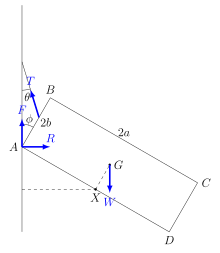
- \begin{align*} \text{N2}(\uparrow): && T \cos \theta + F -W &= 0 \\ && W &= T\cos \theta + \mu R \tag{1} \\ \text{N2}(\rightarrow): && R-T\sin \theta &= 0 \\ && R &= T \sin \theta \tag{2}\\ \\ (1)+(2): && W&=(\cos \theta + \mu \sin \theta)T \tag{3} \\ \overset{\curvearrowright}{A}: && 0 &= W(b\sin \phi + a \cos \phi) - Td\sin(\phi+\theta) \tag{4} \\ \\ (3)+(4): && 0 &= (\cos \theta + \mu \sin \theta)(b\sin \phi + a \cos \phi)-d\sin(\phi+\theta) \\ \Rightarrow && d\sin(\phi+\theta) &= (\cos \theta + \mu \sin \theta)(b\sin \phi + a \cos \phi) \end{align*} as required.
- If \(F\) is operating downwards, it's equivalent to \(-\mu\), ie: \[d\sin(\phi+\theta) = (\cos \theta - \mu \sin \theta)(b\sin \phi + a \cos \phi)\]
- For the frictional force to be acting upwards, we need \begin{align*} && d\sin(\phi+\theta) &\geq \cos \theta(b\sin \phi + a \cos \phi) \\ \Rightarrow && d &\geq \frac{\cos \theta(b\sin \phi + a \cos \phi)}{\sin(\phi + \theta)} \\ &&&= \frac{\cos \theta(b\sin \phi + a \cos \phi)}{\sin\phi \cos\theta+\cos\phi\sin \theta)}\\ &&&= \frac{(b\sin \phi + a \cos \phi)}{\sin\phi+\cos \phi \tan \theta)}\\ &&&= \frac{a+b\tan \phi}{\tan\theta+\tan\phi }\\ \end{align*} We know that \(d < 2b\), so \begin{align*} && 2b &>\frac{a+b\tan \phi}{\tan\theta+\tan\phi }\\ \Rightarrow && 2b \tan \theta + 2b \tan \phi &> a + b \tan \phi \\ \Rightarrow &&b(2 \tan \theta + \tan \phi) &> a\\ \end{align*} Therefore we will have problems if the inequality is reversed!
2010 Paper 2 Q11
A uniform rod \(AB\) of length \(4L \) and weight \(W\) is inclined at an angle \(\theta\) to the horizontal. Its lower end \(A\) rests on a fixed support and the rod is held in equilibrium by a string attached to the rod at a point \(C\) which is \(3L \) from \(A\). The reaction of the support on the rod acts in a direction \(\alpha\) to \(AC\) and the string is inclined at an angle \(\beta\) to \(CA\). Show that \[ \cot\alpha = 3\tan \theta + 2 \cot \beta\,. \] Given that \(\theta =30^\circ\) and \(\beta = 45^\circ\), show that \(\alpha= 15^\circ\).
1997 Paper 1 Q10
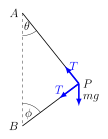
The point \(A\) is vertically above the point \(B\). A light inextensible string, with a smooth ring \(P\) of mass \(m\) threaded onto it, has its ends attached at \(A\) and \(B\). The plane \(APB\) rotates about \(AB\) with constant angular velocity \(\omega\) so that \(P\) describes a horizontal circle of radius \(r\) and the string is taut. The angle \(BAP\) has value \(\theta\) and the angle \(ABP\) has value \(\phi\). Show that \[\tan\frac{\phi-\theta}{2}=\frac{g}{r\omega^{2}}.\] Find the tension in the string in terms of \(m\), \(g\), \(r\), \(\omega\) and \(\sin\frac{1}{2}(\theta+\phi)\). Deduce from your results that if \(r\omega^2\) is small compared with \(g\), then the tension is approximately \(\frac{mg}{2}\)
Solution: None \begin{multicols}{2}
1989 Paper 2 Q14
One end of a light inextrnsible string of length \(l\) is fixed to a point on the upper surface of a thin, smooth, horizontal table-top, at a distance \((l-a)\) from one edge of the table-top. A particle of mass \(m\) is fixed to the other end of the string, and held a distance \(a\) away from this edge of the table-top, so that the string is horizontal and taut. The particle is then released. Find the tension in the string after the string has rotated through an angle \(\theta,\) and show that the largest magnitude of the force on the edge of the table top is \(8mg/\sqrt{3}.\)
Solution: