Problems
Filters
4 problems found
2025 Paper 3 Q10
A plank \(AB\) of length \(L\) initially lies horizontally at rest along the \(x\)-axis on a flat surface, with \(A\) at the origin. Point \(C\) on the plank is such that \(AC\) has length \(sL\), where \(0 < s < 1\). End \(A\) is then raised vertically along the \(y\)-axis so that its height above the horizontal surface at time \(t\) is \(h(t)\), while end \(B\) remains in contact with the flat surface and on the \(x\)-axis. The function \(h(t)\) satisfies the differential equation $$\frac{d^2h}{dt^2} = -\omega^2 h, \text{ with } h(0) = 0 \text{ and } \frac{dh}{dt} = \omega L \text{ at } t = 0$$ where \(\omega\) is a positive constant. A particle \(P\) of mass \(m\) remains in contact with the plank at point \(C\).
- Show that the \(x\)-coordinate of \(P\) is \(sL\cos\omega t\), and find a similar expression for its \(y\)-coordinate.
- Find expressions for the \(x\)- and \(y\)-components of the acceleration of the particle.
- \(N\) and \(F\) are the upward normal and frictional components, respectively, of the force of the plank on the particle. Show that $$N = mg(1 - k\sin\omega t)\cos\omega t$$ and that $$F = mgsk\frac{\omega^2}{g}\tan\omega t$$ where \(k = \frac{L\omega^2}{g}\).
- The coefficient of friction between the particle and the plank is \(\tan\alpha\), where \(\alpha\) is an acute angle.
Show that the particle will not slip initially, provided \(sk < \tan\alpha\).
Show further that, in this case, the particle will slip
- while \(N\) is still positive,
- when the plank makes an angle less than \(\alpha\) to the horizontal.
Solution:
- Since we have \(h'' + \omega^2 h = 0\) we must have that \(h(t) = A \cos \omega t + B \sin \omega t\). The initial conditions tell us that \(A = 0\) and \(B = L\), so \(h(t) = L \sin \omega t\).
Therefore we can see the angle at \(B\) is \(\omega t\) and so \(P\) has \(y\)-coordinate \((1-s)L \sin \omega t\) and \(x\)-coordinate \(sL \cos \omega t\)
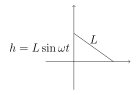
- If the position is \(\binom{sL \cos \omega t}{(1-s) L \sin \omega t}\) then the acceleration is \(-\omega^2 \binom{sL \cos \omega t}{(1-s) L \sin \omega t}\)
- \begin{align*} \text{N2}(\rightarrow): && - F\cos \omega t + N \sin \omega t &= -m\omega^2 sL \cos \omega t\\ \text{N2}(\uparrow): && -mg + F\sin \omega t + N \cos \omega t &= -m\omega^2 (1-s) L \sin \omega t \\ \Rightarrow && \begin{pmatrix} \cos \omega t & -\sin \omega t \\ \sin \omega t & \cos \omega t \end{pmatrix} \begin{pmatrix} F \\ N \end{pmatrix} &= \begin{pmatrix} m\omega^2 s L \cos \omega t \\ mg - m\omega^2(1-s)L \sin \omega t \end{pmatrix} \\ \Rightarrow && \begin{pmatrix}F \\ N \end{pmatrix} &= \begin{pmatrix} \cos \omega t & \sin \omega t \\ -\sin \omega t & \cos \omega t \end{pmatrix} \begin{pmatrix} m\omega^2 s L \cos \omega t \\ mg - m\omega^2(1-s)L \sin \omega t \end{pmatrix} \\ \Rightarrow && N &= m \omega^2 s L (-\sin \omega t \cos \omega t) + mg \cos \omega t - m \omega^2 (1-s)L \sin \omega t \cos \omega t \\ &&&=mg \cos \omega t - m \omega^2 L \sin \omega t \cos \omega t \\ &&&= mg \cos \omega t \left (1 - \frac{L \omega^2}{g} \sin \omega t \right) \\ &&&= mg (1 - k \sin \omega t) \cos \omega t \\ \Rightarrow && F &= m \omega^2 s L \cos^2 \omega t + mg \sin \omega t - m \omega^2 (1-s) L \sin ^2 \omega t \\ &&&= m \omega^2 s L + mg \sin \omega t - m \omega^2 L \sin^2 \omega t \\ &&&= mg \frac{\omega^2 L}{g} s + mg(1-\frac{\omega^2 L}{g} \sin \omega t)\sin \omega t \\ &&&= mg sk + mg(1-k \sin \omega t) \cos \omega t \tan \omega t \\ &&&= mgsk + N \tan \omega t \end{align*}
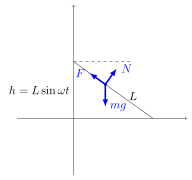
- The particle will not slip if \(F < \tan \alpha N\). When \(t = 0\), \(N = mg, F = mgsk\), but clearly \(sk < \tan \alpha \Rightarrow mgsk = F < \tan \alpha mg = \tan \alpha N\). The particle will slip when: \(F > \tan \alpha N\), but we have \(F = mgsk + N \tan \omega t\). Clearly when \(\omega t = \alpha\) we have reached a point where \(F > \tan \alpha N\). Therefore we must slip before we reach this point, ie at a point where the plank makes an angle of less than \(\alpha\) to the horizontal. Notice also that \(N\) changes sign when \(1-k \sin \omega t = 0\), however, to do this \(N\) must become very small, smaller than \(mgsk\), therefore we must slip before this point too. Since we slip before either condition occurs, we must be in a position when \(N\) is positive AND the plank still makes a shallow angle.
2018 Paper 2 Q11
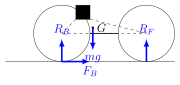
The axles of the wheels of a motorbike of mass \(m\) are a distance \(b\) apart. Its centre of mass is a horizontal distance of \(d\) from the front axle, where \(d < b\), and a vertical distance \(h\) above the road, which is horizontal and straight. The engine is connected to the rear wheel. The coefficient of friction between the ground and the rear wheel is \(\mu\), where \(\mu < b/h\), and the front wheel is smooth. You may assume that the sum of the moments of the forces acting on the motorbike about the centre of mass is zero. By taking moments about the centre of mass show that, as the acceleration of the motorbike increases from zero, the rear wheel will slip before the front wheel loses contact with the road if \[ \mu < \frac {b-d}h\,. \tag{*} \] If the inequality \((*)\) holds and the rear wheel does not slip, show that the maximum acceleration is \[ \frac{ \mu dg}{b-\mu h} \,. \] If the inequality \((*)\) does not hold, find the maximum acceleration given that the front wheel remains in contact with the road.
Solution:
2017 Paper 3 Q10
A uniform rod \(PQ\) of mass \(m\) and length \(3a\) is freely hinged at \(P\). The rod is held horizontally and a particle of mass \(m\) is placed on top of the rod at a distance~\(\ell\) from \(P\), where \(\ell <2a\). The coefficient of friction between the rod and the particle is \(\mu\). The rod is then released. Show that, while the particle does not slip along the rod, \[ (3a^2+\ell^2)\dot \theta^2 = g(3a+2\ell)\sin\theta \,, \] where \(\theta\) is the angle through which the rod has turned, and the dot denotes the time derivative. Hence, or otherwise, find an expression for \(\ddot \theta\) and show that the normal reaction of the rod on the particle is non-zero when~\(\theta\) is acute. Show further that, when the particle is on the point of slipping, \[ \tan\theta = \frac{\mu a (2a-\ell)}{2(\ell^2 + a\ell +a^2)} \,. \] What happens at the moment the rod is released if, instead, \(\ell>2a\)?
Solution:

| Inital | \@ \(\theta\) | |
| Rotational KE of rod | \(0\) | \(\frac{1}{2}I\dot{\theta}^2 = \frac{1}{2} \frac{1}{3} m (3a)^2 \dot{\theta}^2 = \frac32 m a^2 \dot{\theta}^2\) |
| KE of particle | \(0\) | \(\frac12 m \ell^2\dot{\theta}^2\) |
| GPE of rod | \(0\) | \(-\frac{3}{2}mga \sin \theta\) |
| GPE of particle | \(0\) | \(-mg \ell \sin \theta\) |
| Total | \(0\) | \(\frac12m \l \l 3a^2 + \ell^2\r \dot{\theta}^2 - \l 3a + 2\ell \r g \sin \theta \r\) |
2002 Paper 3 Q10
A light hollow cylinder of radius \(a\) can rotate freely about its axis of symmetry, which is fixed and horizontal. A particle of mass \(m\) is fixed to the cylinder, and a second particle, also of mass \(m\), moves on the rough inside surface of the cylinder. Initially, the cylinder is at rest, with the fixed particle on the same horizontal level as its axis and the second particle at rest vertically below this axis. The system is then released. Show that, if \(\theta\) is the angle through which the cylinder has rotated, then \[ \ddot{\theta} = {g \over 2a} \l \cos \theta - \sin \theta \r \,, \] provided that the second particle does not slip. Given that the coefficient of friction is \( (3 + \sqrt{3})/6\), show that the second particle starts to slip when the cylinder has rotated through \(60^\circ\).