Problems
Filters
55 problems found
2025 Paper 2 Q6
- The circle \(x^2 + (y-a)^2 = r^2\) touches the parabola \(2ky = x^2\), where \(k > 0\), tangentially at two points. Show that \(r^2 = k(2a - k)\). Show further that if \(r^2 = k(2a - k)\) and \(a > k > 0\), then the circle \(x^2 + (y-a)^2 = r^2\) touches the parabola \(2ky = x^2\) tangentially at two points.
- The lines \(y = c \pm x\) are tangents to the circle \(x^2 + (y-a)^2 = r^2\). Find \(r^2\), and the coordinates of the points of contact, in terms of \(a\) and \(c\).
- \(C_1\) and \(C_2\) are circles with equations \(x^2 + (y-a_1)^2 = r_1^2\) and \(x^2 + (y-a_2)^2 = r_2^2\) respectively, where \(a_1 \neq a_2\) and \(r_1 \neq r_2\).
Each circle touches the parabola \(2ky = x^2\) tangentially at two points and the lines \(y = c \pm x\) are tangents to both circles.
- Show that \(a_1 + a_2 = 2c + 4k\) and that \(a_1^2 + a_2^2 = 2c^2 + 16kc + 12k^2\).
- The circle \(x^2 + (y-d)^2 = p^2\) passes through the four points of tangency of the lines \(y = c \pm x\) to the two circles, \(C_1\) and \(C_2\). Find \(d\) and \(p^2\) in terms of \(k\) and \(c\).
- Show that the circle \(x^2 + (y-d)^2 = p^2\) also touches the parabola \(2ky = x^2\) tangentially at two points.
Solution:
- By symmetry we can observe that the parabola and circle will intersect \(0, 1\) (at the base), \(2, 4\) times. So setting up our system of equations we have: \begin{align*} &&& \begin{cases} x^2 + (y-a)^2 &= r^2 \\ 2ky &= x^2 \end{cases} \\ \Rightarrow && r^2 &= x^2 + \left (\frac{x^2}{2k} - a \right )^2 \\ \Rightarrow &&r^2 &= x^2 + a^2 - \frac{ax^2}{k} + \frac{x^4}{4k^2} \\ \Rightarrow &&0 &= \frac{1}{4k^2} x^4 + \left ( 1 - \frac{a}{k} \right) x^2 + a^2 - r^2 \\ \Rightarrow && \Delta &= \left ( 1 - \frac{a}{k} \right)^2-4 \cdot \frac{1}{4k^2} (a^2 - r^2) \\ &&&= 1 - \frac{2a}{k} + \frac{a^2}{k^2} - \frac{a^2}{k^2} + \frac{r^2}{k^2} \\ &&&= \frac{k^2-2ka+r^2}{k^2} \end{align*} Since there will be (at most) two solutions if \(\Delta = 0\) we must have if the circle and parabola are tangent \(r^2 - 2ka + k^2 = 0 \Rightarrow r^2 = k(2a-k)\). So long as there is a solution \(x^2 > 0\) there will be two tangent points, so if \(-\left(1 - \frac{a}{k}\right) > 0\) or \(a > k > 0\)

- Since \(y = c \pm x\) are tangent to the circle with radius \(r\) and centre \((0,a)\) we have the following equations: \begin{align*} &&& \begin{cases} x^2 + (y-a)^2 &= r^2 \\ c \pm x &= y \end{cases} \\ \Rightarrow && r^2 &= x^2 + (c -a\pm x)^2 \\ &&&= 2x^2+(c-a)^2 \pm 2x(c-a) \\ \Rightarrow && \Delta &= 4(c-a)^2 -4 \cdot 2 \left ( (c-a)^2 -r^2 \right)\\ &&&= 8r^2-4(c-a)^2 \\ \Rightarrow && x &= \frac{\mp 2(c-a) \pm \sqrt{\Delta}}{4} \\ &&&= \mp \frac12 (c-a) \\ && y &= \pm \frac12 (c+a) \\ && (x,y) &= \left (\frac12 (c-a), \frac12 (c+a)\right), \left (-\frac12 (c-a), -\frac12 (c+a)\right) \end{align*}
2024 Paper 3 Q8
- Explain why the equation \((y - x + 3)(y + x - 5) = 0\) represents a pair of straight lines with gradients \(1\) and \(-1\). Show further that the equation \[y^2 - x^2 + py + qx + r = 0\] represents a pair of straight lines with gradients \(1\) and \(-1\) if and only if \(p^2 - q^2 = 4r\).
- Explain why the coordinates of any point which lies on both of the curves \(C_1\) and \(C_2\) also satisfy the equation \[y^2 + 2sy + s(s+1) - x + k(y - x^2) = 0\] for any real number \(k\). Given that \(s\) is such that \(C_1\) and \(C_2\) intersect at four distinct points, show that choosing \(k = 1\) gives an equation representing a pair of straight lines, with gradients \(1\) and \(-1\), on which all four points of intersection lie.
- Show that if \(C_1\) and \(C_2\) intersect at four distinct points, then \(s < -\frac{3}{4}\).
- Show that if \(s < -\frac{3}{4}\), then \(C_1\) and \(C_2\) intersect at four distinct points.
2023 Paper 2 Q2
- The real numbers \(x\), \(y\) and \(z\) satisfy the equations \[y = \frac{2x}{1-x^2}\,,\qquad z = \frac{2y}{1-y^2}\,,\qquad x = \frac{2z}{1-z^2}\,.\] Let \(x = \tan\alpha\). Deduce that \(y = \tan 2\alpha\) and show that \(\tan\alpha = \tan 8\alpha\). Find all solutions of the equations, giving each value of \(x\), \(y\) and \(z\) in the form \(\tan\theta\) where \(-\frac{1}{2}\pi < \theta < \frac{1}{2}\pi\).
- Determine the number of real solutions of the simultaneous equations \[y = \frac{3x - x^3}{1-3x^2}\,,\qquad z = \frac{3y - y^3}{1-3y^2}\,,\qquad x = \frac{3z - z^3}{1-3z^2}\,.\]
- Consider the simultaneous equations
\[y = 2x^2 - 1\,,\qquad z = 2y^2 - 1\,,\qquad x = 2z^2 - 1\,.\]
- Determine the number of real solutions of these simultaneous equations with \(|x| \leqslant 1\), \(|y| \leqslant 1\), \(|z| \leqslant 1\).
- By finding the degree of a single polynomial equation which is satisfied by \(x\), show that all solutions of these simultaneous equations have \(|x| \leqslant 1\), \(|y| \leqslant 1\), \(|z| \leqslant 1\).
2022 Paper 3 Q3
- The curve \(C_1\) has equation \[ ax^2 + bxy + cy^2 = 1 \] where \(abc \neq 0\) and \(a > 0\). Show that, if the curve has two stationary points, then \(b^2 < 4ac\).
- The curve \(C_2\) has equation \[ ay^3 + bx^2y + cx = 1 \] where \(abc \neq 0\) and \(b > 0\). Show that the \(x\)-coordinates of stationary points on this curve satisfy \[ 4cb^3 x^4 - 8b^3 x^3 - ac^3 = 0\,. \] Show that, if the curve has two stationary points, then \(4ac^6 + 27b^3 > 0\).
- Consider the simultaneous equations \begin{align*} ay^3 + bx^2 y + cx &= 1 \\ 2bxy + c &= 0 \\ 3ay^2 + bx^2 &= 0 \end{align*} where \(abc \neq 0\) and \(b > 0\). Show that, if these simultaneous equations have a solution, then \(4ac^6 + 27b^3 = 0\).
2022 Paper 3 Q9
- Two particles \(A\) and \(B\), of masses \(m\) and \(km\) respectively, lie at rest on a smooth horizontal surface. The coefficient of restitution between the particles is \(e\), where \(0 < e < 1\). Particle \(A\) is then projected directly towards particle \(B\) with speed \(u\). Let \(v_1\) and \(v_2\) be the velocities of particles \(A\) and \(B\), respectively, after the collision, in the direction of the initial velocity of \(A\). Show that \(v_1 = \alpha u\) and \(v_2 = \beta u\), where \(\alpha = \dfrac{1 - ke}{k+1}\) and \(\beta = \dfrac{1+e}{k+1}\). Particle \(B\) strikes a vertical wall which is perpendicular to its direction of motion and a distance \(D\) from the point of collision with \(A\), and rebounds. The coefficient of restitution between particle \(B\) and the wall is also \(e\). Show that, if \(A\) and \(B\) collide for a second time at a point \(\frac{1}{2}D\) from the wall, then \[ k = \frac{1+e-e^2}{e(2e+1)}\,. \]
- Three particles \(A\), \(B\) and \(C\), of masses \(m\), \(km\) and \(k^2m\) respectively, lie at rest on a smooth horizontal surface in a straight line, with \(B\) between \(A\) and \(C\). A vertical wall is perpendicular to this line and lies on the side of \(C\) away from \(A\) and \(B\). The distance between \(B\) and \(C\) is equal to \(d\) and the distance between \(C\) and the wall is equal to \(3d\). The coefficient of restitution between each pair of particles, and between particle \(C\) and the wall, is \(e\), where \(0 < e < 1\). Particle \(A\) is then projected directly towards particle \(B\) with speed \(u\). Show that, if all three particles collide simultaneously at a point \(\frac{3}{2}d\) from the wall, then \(e = \frac{1}{2}\).
2021 Paper 2 Q3
In this question, \(x\), \(y\) and \(z\) are real numbers. Let \(\lfloor x \rfloor\) denote the largest integer that satisfies \(\lfloor x \rfloor \leqslant x\) and let \(\{x\}\) denote the fractional part of~\(x\), so that \(x = \lfloor x \rfloor + \{x\}\) and \(0 \leqslant \{x\} < 1\). For example, if \(x = 4.2\), then \(\lfloor x \rfloor = 4\) and \(\{x\} = 0.2\) and if \(x = -4.2\), then \(\lfloor x \rfloor = -5\) and \(\{x\} = 0.8\).
- Solve the simultaneous equations \begin{align*} \lfloor x \rfloor + \{y\} &= 4.9, \\ \{x\} + \lfloor y \rfloor &= -1.4. \end{align*}
- Given that \(x\), \(y\) and \(z\) satisfy the simultaneous equations \begin{align*} \lfloor x \rfloor + y + \{z\} &= 3.9, \\ \{x\} + \lfloor y \rfloor + z &= 5.3, \\ x + \{y\} + \lfloor z \rfloor &= 5, \end{align*} show that \(\{y\} + z = 3.2\) and solve the equations.
- Solve the simultaneous equations \begin{align*} \lfloor x \rfloor + 2y + \{z\} &= 3.9, \\ \{x\} + 2\lfloor y \rfloor + z &= 5.3, \\ x + 2\{y\} + \lfloor z \rfloor &= 5. \end{align*}
2019 Paper 1 Q4
- Find integers \(m\) and \(n\) such that $$\sqrt{3+2\sqrt{2}} = m + n\sqrt{2}.$$
- Let \(f(x) = x^4 - 10x^2 + 12x - 2\). Given that the equation \(f(x) = 0\) has four real roots, explain why \(f(x)\) can be written in the form $$f(x)=(x^2 + sx + p)(x^2 - sx + q)$$ for some real constants \(s\), \(p\) and \(q\), and find three equations for \(s\), \(p\) and \(q\). Show that $$s^2(s^2 - 10)^2 + 8s^2 - 144 = 0$$ and find the three possible values of \(s^2\). Use the smallest of these values of \(s^2\) to solve completely the equation \(f(x) = 0\), simplifying your answers as far as you can.
Solution:
- \((1+\sqrt{2})^2 = 3 + 2\sqrt{2}\) so \(\sqrt{3 + 2\sqrt{2}} = 1 + \sqrt{2}\)
- We can always factorise any quartic in the form \((x^2+ax+b)(x^2+cx+d)\), since \(x^3\) has a coefficient of \(a+b\) we must have \(a = -b\), ie the form in the question. \begin{align*} && 0 &= (x^2+sx+p)(x^2-sx+q) \\ &&&= x^4+(p+q-s^2)x^2+s(q-p)x+pq \\ \Rightarrow && pq &= -2 \\ && s(q-p) &= 12 \\ && p+q-s^2 &= -10 \\ \\ && p+q &= s^2-10 \\ && (p+q)^2 &= (s^2-10)^2 \\ && (q-p)^2 &= \frac{12}{s^2} \\ \Rightarrow && (s^2-10)^2 &= \frac{12}{s^2} + 4pq \\ && (s^2-10)^2 &= \frac{144}{s^2} -8 \\ && 0 &= s^2(s^2-10)^2+8s^2-144 \\ &&&= s^6-20s^4+108s^2-144 \\ &&&= (s^2-2)(s^2-6)(s^2-12) \end{align*} Suppose \(s = \sqrt{2}\), and we have \begin{align*} && q-p &= 6\sqrt{2} \\ && p+q &= -8 \\ \Rightarrow && q &= 3\sqrt{2}-4 \\ && p &= -4-3\sqrt{2} \end{align*} Solving our quadratic equations, we have \begin{align*} && 0 &= x^2-\sqrt{2}x-4+3\sqrt{2} \\ \Rightarrow && x &= \frac{\sqrt{2}\pm \sqrt{2-4\cdot(-4+3\sqrt{2})}}{2} \\ &&&= \frac{\sqrt{2}\pm \sqrt{18-12\sqrt{2}}}{2} \\ &&&= \frac{\sqrt{2}\pm (2\sqrt{3}-\sqrt{6})}{2} \\ \\ && 0 &= x^2+\sqrt{2}x-3\sqrt{2}-4 \\ && x &= \frac{-\sqrt{2} \pm \sqrt{2-4\cdot(3\sqrt{3}-4)}}{2}\\ && &= \frac{-\sqrt{2} \pm \sqrt{18+12\sqrt{2}}}{2}\\ && &= \frac{-\sqrt{2} \pm (\sqrt{6}+2\sqrt{3})}{2}\\ \end{align*}
2019 Paper 1 Q6
In both parts of this question, \(x\) is real and \(0 < \theta < \pi\).
- By completing the square, find in terms of \(\theta\) the minimum value as \(x\) varies of $$9x^2 - 12x \cos \theta + 4.$$ Find also the maximum value as \(x\) varies of \(12x^2 \sin \theta - 9x^4\). Hence determine the values of \(x\) and \(\theta\) that satisfy the equation $$9x^4 + (9 - 12 \sin \theta)x^2 - 12x \cos \theta + 4 = 0.$$
- Sketch the curve $$y = \frac{x^2}{x - \theta},$$ where \(\theta\) is a constant. Deduce that either \(\frac{x^2}{x - \theta} \leq 0\) or \(\frac{x^2}{x - \theta} \geq 4\theta\). By considering the numerator and denominator separately, or otherwise, show that $$\frac{\sin^2 \theta \cos^2 x}{1 + \cos^2 \theta \sin^2 x} \leq 1.$$ Hence determine the values of \(x\) and \(\theta\) that satisfy the equation $$\frac{x^2}{4\theta(x - \theta)} = \frac{\sin^2 \theta \cos^2 x}{1 + \cos^2 \theta \sin^2 x}.$$
Solution:
- \(\,\) \begin{align*} && y &= 9x^2 - 12x \cos \theta + 4 \\ &&&= (3x-2\cos \theta)^2+4-4\cos^2 \theta \\ &&&= (3x-2\cos \theta)^2 + 4 \sin^2 \theta \end{align*} Therefore the minimum is \(4\sin^2 \theta\) when \(x = \frac23 \cos \theta\). \begin{align*} && y &= 12x^2 \sin \theta - 9x^4 \\ &&&=4\sin^2 \theta -(3x^2-2\sin\theta)^2 \end{align*} Therefore the maximum is \(4\sin^2 \theta\) when \(x^2 = \frac23\sin \theta\) Therefore \begin{align*} && 0 &= 9x^4 + (9 - 12 \sin \theta)x^2 - 12x \cos \theta + 4 \\ && \underbrace{-9x^4+12x^2\sin \theta}_{\leq 4\sin^2 \theta } &= \underbrace{9x^2 - 12x \cos \theta + 4 }_{\geq 4 \sin^2 \theta} \end{align*} Therefore the equality cases must be achieved in both cases, ie \(x = \frac23 \cos \theta\) and \(x^2 = \frac23 \sin \theta\) \begin{align*} && x^2 &= \frac49\cos^2 \theta \\ &&&= \frac49(1-\sin^2 \theta) \\ &&&= \frac49(1-\frac94 x^2) \\ \Rightarrow && 2x^2 &= \frac49 \\ \Rightarrow && x &= \pm \frac{\sqrt{2}}3\\ \Rightarrow && \cos \theta &=\pm \frac32 \frac{\sqrt{2}}3 \\ &&&= \pm \frac{1}{\sqrt{2}} \\ \Rightarrow && \theta &= \frac{\pi}{4}, \frac{3\pi}{4} \\ \Rightarrow && (x, \theta) &= \left (\frac{\sqrt{2}}{3}, \frac{\pi}{4} \right), \left (-\frac{\sqrt{2}}{3}, \frac{3\pi}{4} \right) \end{align*}
- Sketching we obtain, noticing we can find the turning point by:
\begin{align*}
&& \frac{x^2}{x-\theta} &= \lambda \\
\Leftrightarrow && x^2 - \lambda x +\theta \lambda &= 0 \\
\Leftrightarrow && 0 &\leq \Delta = \lambda^2 -4\lambda \theta \\
\Leftrightarrow && \lambda &\geq 4 \theta, \lambda \leq 0
\end{align*}
Notice that \(\sin^2 \theta \cos^2 x \leq 1\) and \(1 + cos^2 \theta \sin^2 x \geq 1\) and therefore we must have the inequality desired. \begin{align*} && \underbrace{\frac{x^2}{4\theta(x - \theta)}}_{\geq 1 \text{ or } \leq 0} &= \underbrace{\frac{\sin^2 \theta \cos^2 x}{1 + \cos^2 \theta \sin^2 x}}_{\in [0,1]} \\ \text{both}=0: && x = 0 &, \sin \theta = 0 \\ \text{both}=1: && x = 2\theta &, \sin^2 \theta = 1,\cos^2 x = 1 \\ && 1 &= \cos^2 2 \theta \\ &&&= (1-2 \sin^2 \theta)^2 \\ &&&= 1 \\ \Rightarrow && (x, \theta) &= \left(\frac{\pi}{2}, \pi\right) \end{align*}

2019 Paper 3 Q3
The matrix A is given by $$\mathbf{A} = \begin{pmatrix} a & b \\ c & d \end{pmatrix}.$$
- You are given that the transformation represented by A has a line \(L_1\) of invariant points (so that each point on \(L_1\) is transformed to itself). Let \((x, y)\) be a point on \(L_1\). Show that \(((a - 1)(d - 1) - bc)xy = 0\). Show further that \((a - 1)(d - 1) = bc\). What can be said about A if \(L_1\) does not pass through the origin?
- By considering the cases \(b \neq 0\) and \(b = 0\) separately, show that if \((a - 1)(d - 1) = bc\) then the transformation represented by A has a line of invariant points. You should identify the line in the different cases that arise.
- You are given instead that the transformation represented by A has an invariant line \(L_2\) (so that each point on \(L_2\) is transformed to a point on \(L_2\)) and that \(L_2\) does not pass through the origin. If \(L_2\) has the form \(y = mx + k\), show that \((a - 1)(d - 1) = bc\).
Solution:
- Suppose \((x,y)\) is on the line of invariant points, then \begin{align*} &&\begin{pmatrix} x \\ y \end{pmatrix} &= \begin{pmatrix} a & b \\ c & d \end{pmatrix} \begin{pmatrix} x \\ y \end{pmatrix} \\ &&&= \begin{pmatrix} ax + by \\ cx + dy \end{pmatrix} \\ \Rightarrow && \begin{cases} (a-1)x + by = 0 \\ (cx + (d-1)y = 0 \end{cases} \tag{*} \end{align*} Therefore either \(x = 0, y = 0\) or \((a-1)(d-1)-bc = 0\) \(\Rightarrow ((a-1)(d-1)-bc)xy = 0\). We also know this is true for all values \(x,y\) on the line of invariant points. If there is one where both \(x \neq 0, y \neq 0\) we are done, otherwise the line of invariant points must be one of the axes. ie but then one of \(\begin{pmatrix} a \\ c \end{pmatrix} = \begin{pmatrix} 1 \\ 0 \end{pmatrix}\) or \(\begin{pmatrix} b \\ d \end{pmatrix} = \begin{pmatrix} 0 \\ 1 \end{pmatrix}\) is true and we'd also be done. If the line doesn't go through the origin then there are points on every line, not equal to the origin which are fixed. But then every point on those lines is fixed (since \(\mathbf{A}\) is a linear operator) and so every point is fixed. ie \(\mathbf{A} = \mathbf{I}\).
- Suppose \((a-1)(d-1) -bc = 0\) and \(b \neq 0\) then I claim that \(y = \frac{1-a}{b}x\) is a line of invariant points. It's clear that the first equation will be satisfied in \((*)\) so it suffices to check the second, but the first condition is equivalent to the equations being linearly dependent, ie both equations are satisfied. If \(b = 0\) then \((a-1)(d-1) = 0\), so our matrix must look like \(\begin{pmatrix} 1 & 0 \\ c & d\end{pmatrix}\) (if \(d \neq 1\))or \(\begin{pmatrix} * & 0 \\ * & 1\end{pmatrix}\). In the first case, the line \(y = \frac{c}{1-d}x\) and in the second \(x = 0\) is an invariant line.
- Suppose the invariant line is \(y = mx+k\) then we must have that \begin{align*} \begin{pmatrix} a & b \\ c & d \end{pmatrix} \begin{pmatrix} x \\ mx + k \end{pmatrix} &= \begin{pmatrix} (a + mb)x + bk \\ (c+dm)x + dk \end{pmatrix} \end{align*} and \((c+dm)x + dk = m((a + mb)x + bk) +k \Rightarrow k(d-mb-1) = x(-c+(a-d)m+m^2b)\) Since this equation must be true for all values of \(x\), and \(k \neq 0\) we can say that \(mb = d-1\) and \(-c+(a-d)m+m^2b = 0\), ie \(-c + (a-d)m + m(d-1) = 0 \Rightarrow (a-1)m-c = 0\) if \(m \neq 0\) then \((a-1)\frac{(d-1)}{b} - c = 0\) ie our desired relation is true. If \(m = 0\) then we must have that \(y = k\) is an invariant line, ie \(d-1=0\) and \(c=0\) which also satisfies our relation.
2018 Paper 2 Q4
In this question, you may use the following identity without proof: \[ \cos A + \cos B = 2\cos\tfrac12(A+B) \, \cos \tfrac12(A-B) \;. \]
- Given that \(0\le x \le 2\pi\), find all the values of \(x\) that satisfy the equation \[ \cos x + 3\cos 2x + 3\cos 3 x + \cos 4x= 0 \,. \]
- Given that \(0\le x \le \pi\) and \(0\le y \le \pi\) and that \[ \cos (x+y) + \cos (x-y) -\cos2x = 1 \,, \] show that either \(x=y\) or \(x\) takes one specific value which you should find.
- Given that \(0\le x \le \pi\) and \(0\le y \le \pi\,\), find the values of \(x\) and \(y\) that satisfy the equation \[ \cos x + \cos y -\cos (x+y) = \tfrac32 \,. \]
Solution:
- \(\,\) \begin{align*} && 0 &= \cos x + 3 \cos 2x + 3 \cos 3x + \cos 4 x \\ &&&= \cos x + \cos 4x + 3 \left (\cos 2x + \cos 3 x \right) \\ &&&= 2 \cos \frac{5x}{2} \cos \frac{3x}{2} + 6 \cos \frac{x}{2}\cos\frac{5x}{2} \\ &&&= 2 \cos \frac{5x}{2} \left (\cos \frac{3x}{2} + 3 \cos \frac{x}{2} \right)\\ &&&= 2 \cos \frac{5x}{2} \left ( \cos \frac{2x}{2}\cos \frac{x}{2} - \sin \frac{2x}{2} \sin \frac{x}{2}+3 \cos \frac{x}{2} \right) \\ &&&= 2 \cos \frac{5x}{2} \left ( \left (2\cos^2 \frac{x}{2} - 1 \right)\cos \frac{x}{2} - 2\sin \frac{x}{2} \cos \frac{x}{2} \sin \frac{x}{2}+3 \cos \frac{x}{2} \right) \\ &&&= 2 \cos \frac{5x}{2} \left ( 4\cos^3 \frac{x}{2} \right) \\ &&&= 8 \cos \frac{5x}{2} \cos^3 \frac{x}{2} \\ \Rightarrow && \frac{x}{2} &= \frac{\pi}{2}, \frac{3\pi}{2}, \cdots \\ && \frac{5x}{2} &= \frac{\pi}{2}, \frac{3\pi}{2}, \cdots \\ \Rightarrow && x &= \frac{\pi}{5}, \frac{3\pi}{5}, \pi, \frac{7\pi}{5}, \frac{9\pi}{5} \end{align*}
- \(\,\) \begin{align*} && 1 &= \cos (x + y) + \cos(x-y) - \cos 2x \\ &&&= 2 \cos x \cos y - 2\cos^2 x + 1 \\ \Rightarrow && 0 &= \cos x (\cos y - \cos x) \\ \Rightarrow && 0 &=\cos x \left ( \cos y + \cos (\pi - x) \right) \\ &&&= 2\cos x \cos \frac{y+x-\pi}{2} \cos \frac{y-x+\pi}{2} \\ \Rightarrow && x &= \frac{\pi}{2} \\ && y+x - \pi&= \pi ,3\pi, \cdots \\ && y-x + \pi&=\pi, 3 \pi, \cdots \\ \Rightarrow && x &= \frac{\pi}{2} \\ && y+x &= 2\pi \Rightarrow x = y = \pi \\ && y&= x \end{align*} So the only solutions are \(x =y\) and \(x = \frac{\pi}{2}\)
- \(\,\) \begin{align*} && \frac32 &= \cos x + \cos y - \cos (x+y) \\ &&&= 2 \cos \frac{x+y}{2} \cos \frac{x-y}{2} - 2 \cos^2 \frac{x+y}{2} + 1 \\ \Rightarrow && \frac14 &= \cos \frac{x+y}{2} \left ( \cos \frac{x-y}{2} - \cos \frac{x+y}{2} \right) \\ \Rightarrow && 0 &= \cos^2 \frac{x+y}{2} - \cos \frac{x-y}{2}\cos \frac{x+y}{2} + \frac14 \\ \Rightarrow && \cos \frac{x+y}{2} &= \frac{\cos \frac{x-y}{2} \pm \sqrt{\cos^2 \frac{x-y}{2}-1}}{2} \\ \Rightarrow && \cos \frac{x-y}{2} &= \pm 1\\ && \cos \frac{x+y}{2} &= \pm \frac12 \\ \Rightarrow && x-y &= -4\pi, 0, 4\pi, \cdots \\ \Rightarrow && x &= y \\ \Rightarrow && \cos x &= \frac12 \\ \Rightarrow && x &= \frac{\pi}{3} \\ \Rightarrow && (x, y) &= \left ( \frac{\pi}{3}, \frac{\pi}{3}\right) \end{align*}
2018 Paper 2 Q9
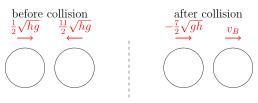
Two small beads, \(A\) and \(B\), of the same mass, are threaded onto a vertical wire on which they slide without friction, and which is fixed to the ground at \(P\). They are released simultaneously from rest, \(A\) from a height of \(8h\) above \(P\) and \(B\) from a height of \(17h\) above \(P\). When \(A\) reaches the ground for the first time, it is moving with speed \( V\). It then rebounds with coefficient of restitution \(\frac{1}{2}\) and subsequently collides with \(B\) at height \(H\) above \(P\). Show that \(H= \frac{15}8h\) and find, in terms of \(g\) and \(h\), the speeds \(u_A\) and \(u_B\) of the two beads just before the collision. When \(A\) reaches the ground for the second time, it is again moving with speed \( V\). Determine the coefficient of restitution between the two beads.
Solution: \begin{align*} && v^2 &= u^2 +2as \\ \Rightarrow && V^2 &= 2 g \cdot (8h)\\ \Rightarrow && V &=4\sqrt{hg}\\ \end{align*} When the first particle collides with the ground, the second particle is at \(9h\) traveling with speed \(V\), the first particle is at \(0\) traveling (upwards) with speed \(\tfrac12 V\). For a collision we need: \begin{align*} && \underbrace{\frac12 V t- \frac12 g t^2}_{\text{position of A}} &= \underbrace{9h - Vt - \frac12 gt^2}_{\text{position of B}} \\ \Rightarrow && \frac32Vt &= 9h \\ \Rightarrow && t &= \frac{6h}{V} \\ \\ && \underbrace{\frac12 V t- \frac12 g t^2}_{\text{position of A}} &= \frac12 V \frac{6h}{V} - \frac12 g t^2 \\ &&&= 3h - \frac12 g\frac{36h^2}{16hg} \\ &&&= 3h - \frac{9}{8}h \\ &&&= \frac{15}{8}h \end{align*} Just before the collision, \(A\) will be moving with velocity (taking upwards as positive) \begin{align*} && u_A &= \frac12 V-gt \\ &&&= 2\sqrt{hg}-g \frac{6h}{V} \\ &&&= 2\sqrt{hg} - g \frac{6h}{4\sqrt{hg}} \\ &&&= 2\sqrt{hg}-\frac32\sqrt{hg} \\ &&&= \frac12 \sqrt{hg} \end{align*} Similarly, for \(B\). \begin{align*} && u_B &= -V -gt \\ &&&= -4\sqrt{hg} - \frac32\sqrt{hg} \\ &&&= -\frac{11}{2}\sqrt{hg} \end{align*} Considering \(A\), to figure out \(v_A\). \begin{align*} && v^2 &= u^2 + 2as \\ && V^2 &= v_A^2 + 2g\frac{15}{8}h \\ && 16hg &= v_A^2 + \frac{15}{4}gh \\ \Rightarrow && v_A^2 &= \frac{49}{4}gh \\ \Rightarrow && v_A &= -\frac{7}{2}\sqrt{gh} \end{align*}
2016 Paper 2 Q11
- Two particles move on a smooth horizontal surface. The positions, in Cartesian coordinates, of the particles at time \(t\) are \((a+ut\cos\alpha \,,\, ut\sin\alpha)\) and \((vt\cos\beta\,,\, b+vt\sin\beta )\), where \(a\), \(b\), \(u\) and \(v\) are positive constants, \(\alpha\) and \(\beta\) are constant acute angles, and \(t\ge0\). Given that the two particles collide, show that \[ u \sin(\theta+\alpha) = v\sin(\theta +\beta)\,, \] where \(\theta \) is the acute angle satisfying \(\tan\theta = \dfrac b a\).
- A gun is placed on the top of a vertical tower of height \(b\) which stands on horizontal ground. The gun fires a bullet with speed \(v\) and (acute) angle of elevation \(\beta\). Simultaneously, a target is projected from a point on the ground a horizontal distance \(a\) from the foot of the tower. The target is projected with speed \(u\) and (acute) angle of elevation \(\alpha\), in a direction directly away from the tower. Given that the target is hit before it reaches the ground, show that \[ 2u\sin\alpha (u\sin\alpha - v\sin\beta) > bg\,. \] Explain, with reference to part (i), why the target can only be hit if \(\alpha > \beta\).
Solution:
- The particles collide if there exists a time when \begin{align*} && a + ut \cos \alpha &= vt \cos \beta \\ \Rightarrow && t (v \cos \beta-u \cos \alpha) &= a\\ && ut \sin \alpha &= b + vt \sin \beta \\ \Rightarrow && t(u \sin \alpha - v \sin \beta) &= b\\ \Rightarrow && a(u\sin \alpha - v \sin \beta) &= b(v \cos \beta - u \cos \alpha) \\ \Rightarrow && u(a \sin \alpha + b \cos \alpha) &= v (b \cos \beta + a \sin \beta) \\ \Rightarrow && u \sin (\alpha + \theta) &= v \sin (\beta + \theta) \end{align*}
- The path of the bullet is \((vt \cos \beta, b + vt \sin \beta -\frac12 g t^2)\). The path of the target is \((a+ut \cos \alpha, ut \sin \alpha - \frac12 g t^2)\). By comparing components as in part (i) and noting the acceleration doesn't change the story, we can see that \(t(u \sin \alpha - v \sin \beta) = b\) and we also need \(u t \sin \alpha - \frac12 gt^2 >0\) or \(u \sin \alpha - \frac12 gt > 0\) \begin{align*} && u \sin \alpha & > \frac12 gt \\ && 2u \sin \alpha & > g \frac{b}{(u \sin \alpha - v \sin \beta)} \\ \Rightarrow && 2u \sin \alpha( u \sin \alpha - v \sin \beta) & > gb \end{align*} Notice we must have \(u \sin \alpha > v \sin \beta\) and \(u \sin (\alpha + \theta) = v \sin (\beta + \theta)\) so \( \frac{\sin \alpha}{\sin (\alpha + \theta)} > \frac{\sin \beta}{\sin (\beta + \theta)}\), but if we consider \(f(t) = \frac{\sin t}{\sin(t+x)}\) we can see \(f'(t) = \frac{\cos t \sin(t + x) - \sin t \cos(t+x)}{\sin^2(t+x)} = \frac{\sin x}{\sin^2(t+x)} > 0\) is increasing, therefore \(\alpha > \beta\).
2016 Paper 3 Q8
- The function f satisfies, for all \(x\), the equation \[ \f(x) + (1- x)\f(-x) = x^2\, . \] Show that \(\f(-x) + (1 + x)\f(x) = x^2\,\). Hence find \(\f(x)\) in terms of \(x\). You should verify that your function satisfies the original equation.
- The function \({\rm K}\) is defined, for \(x\ne 1\), by \[{\rm K}(x) = \dfrac{x+1}{x-1}\,.\] Show that, for \(x\ne1\), \({\rm K(K(}x)) =x\,\). The function g satisfies the equation \[ \g(x)+ x\, \g\Big(\frac{ x+1 }{x-1}\Big) = x \ \ \ \ \ \ \ \ \ \ \ ( x\ne 1) \,. \] Show that, for \(x\ne1\), \(\g(x)= \dfrac{2x}{x^2+1}\,\).
- Find \(\h(x)\), for \(x\ne0\), \(x\ne1\), given that \[ \h(x)+ \h\Big(\frac 1 {1-x}\Big)= 1-x -\frac1{1-x} \ \ \ \ \ \ ( x\ne0, \ \ x\ne1 ) \,. \]
Solution:
- \(\,\) Let \(P(x)\) mean the proposition that \(f(x) + (1-x)f(-x) = x^2\) so \begin{align*} P(x): && f(x) + (1-x)f(-x) &= x^2 \\ P(-x): && f(-x)+(1+x)f(x) &= (-x)^2 = x^2 \\ \Rightarrow && f(x)+(1-x)\left (x^2-(1+x)f(x) \right) &= x^2 \\ \Rightarrow && f(x) \left (1 -(1-x^2) \right) &= x^2 + (x-1)x^2 \\ \Rightarrow && f(x)x^2 &= x^3 \\ \Rightarrow && f(x) &= x \end{align*} Notice that \(x + (1-x)(-x) = x^2\) so it does satisfy the functional equation.
- Let \(K(x) = \frac{x+1}{x-1}\) if \(x \neq 1\) so \begin{align*} && K(K(x)) &= \frac{K(x)+1}{K(x)-1} \\ &&&= \frac{\frac{x+1}{x-1}+1}{\frac{x+1}{x-1}-1} \\ &&&= \frac{\frac{2x}{x-1}}{\frac{2}{x-1}} \\ &&&= x \end{align*} Let \(Q(x)\) denote the proposition that \(g(x) + xg(K(x)) = x\) so \begin{align*} Q(x): && g(x) + xg(K(x)) &= x \\ Q(K(x)): && g(K(x)) + K(x)g(x) &= K(x) \\ \Rightarrow && g(x) +xK(x)[1-g(x)] &= x \\ \Rightarrow && g(x)[1-xK(x)] &= x(1-K(x)) \\ \Rightarrow && g(x) \frac{x-1-x^2-x}{x-1} &= \frac{-2x}{x-1} \\ \Rightarrow && g(x) &= \frac{2x}{x^2+1} \end{align*}. And notice that \(\frac{2x}{x^2+1} + x \frac{2\frac{x+1}{x-1}}{\left( \frac{x+1}{x-1}\right)^2+1} = \frac{2x}{x^2+1} + \frac{2x(x^2-1)}{2x^2+2} = x\)
- Consider \(H(x) = \frac{1}{1-x}\) then notice that \(H(H(x)) = \frac{1}{1-\frac{1}{1-x}} = \frac{x-1}{x}\) and \(H^3(x) = \frac{\frac{1}{1-x}-1}{\frac{1}{1-x}} = 1-(1-x) = x\). So So letting \(S(x)\) be the statement that \(h(x) + h(H(x)) = 1 - x - \frac{1}{1-x}\) we have \begin{align*} S(x): && h(x) + h(H(x)) &= 1 - x - H(x) \\ S(H(x)): && h(H(x)) + h(H^2(x)) &= 1 - H(x) - H^2(x) \\ S(H^2(x)): && h(H^2(x)) + h(x) &= 1 - H^2(x) - x \\ S(x) - S(H(x)) + S(H^2(x)): && 2h(x) &= 1 - 2x \\ \Rightarrow && h(x)& = \frac12 - x \end{align*} and notice that \(\frac12 -x +\frac12 - \frac{1}{1-x} = 1 - x - \frac{1}{1-x}\) so it does satisfy the equation.
2015 Paper 2 Q7
A circle \(C\) is said to be bisected by a curve \(X\) if \(X\) meets \(C\) in exactly two points and these points are diametrically opposite each other on \(C\).
- Let \(C\) be the circle of radius \(a\) in the \(x\)-\(y\) plane with centre at the origin. Show, by giving its equation, that it is possible to find a circle of given radius \(r\) that bisects \(C\) provided \(r > a\). Show that no circle of radius \(r\) bisects \(C\) if \(r\le a\,\).
- Let \(C_1\) and \(C_2\) be circles with centres at \((-d,0)\) and \((d,0)\) and radii \(a_1\) and \(a_2\), respectively, where \(d > a_1\) and \(d > a_2\). Let \(D\) be a circle of radius \(r\) that bisects both \(C_1\) and \(C_2\). Show that the \(x\)-coordinate of the centre of \(D\) is \(\dfrac{a_2^2 - a_1^2}{4d}\). Obtain an expression in terms of \(d\), \(r\), \(a_1\) and \(a_2\) for the \(y\)-coordinate of the centre of \(D\), and deduce that \(r\) must satisfy \[ 16r^2d^2 \ge \big (4d^2 +(a_2-a_1)^2\big) \, \big (4d^2 +(a_2+a_1)^2\big) \,. \]
Solution:
- \(C\) has the equation \(x^2 + y^2 = a^2\). One suitable circle would ideally pass through \((0,a)\) and \((0,-a)\) have a centre on the positive \(x\)-axis, so we would need \(a^2+c^2 = r^2\) so \(c = \sqrt{r^2-a^2}\) and the equation would be \((x-\sqrt{r^2-a^2})^2 + y^2 = r^2\). Clearly a circle with radius \(r < a\) cannot pass through two diametrically opposed points of a circle radius \(a\), since the furthest two points can be on a circle is \(2r\), and diametrically opposed points are \(2a\) apart. Similarly if they are exactly the same radii, then if they pass through diametrically opposed points they must be the same circle.
- Let the centre of \(D\) be at \((x,y)\), then it must be a distance of \(\sqrt{r^2-a_i}\) from each circle centre, ie \begin{align*} && (x-d)^2+y^2 &= r^2-a_2^2 \\ && (x+d)^2 + y^2 &= r^2-a_1^2 \\ \Rightarrow && 4dx &= a_2^2 - a_1^2 \\ \Rightarrow && x &= \frac{a_2^2-a_1^2}{4d} \\ \Rightarrow && y^2 &= r^2-a_1^2 - \left (\frac{a_2^2-a_1^2}{4d}+d \right)^2 \\ &&&= r^2 - a_1^2 - \frac{(a_2^2-a_1^2+4d^2)^2}{16d^2} \\ &&&= \frac{16d^2r^2-16d^2a_1^2 - a_2^4-a_1^4-16d^4+2a_1^2a_2^2+8a_1^2d^2-8a_2^2d^2}{16d^2} \\ &&&= \frac{16d^2r^2-8d^2a_1^2 - a_2^4-a_1^4-16d^4+2a_1^2a_2^2-8a_2^2d^2}{16d^2} \\ \Rightarrow && y &= \pm \sqrt{ \frac{16d^2r^2-8d^2a_1^2 - a_2^4-a_1^4-16d^4+2a_1^2a_2^2-8a_2^2d^2}{16d^2}} \end{align*} and we need \begin{align*} && 0 &\leq 16d^2r^2-8d^2a_1^2 - a_2^4-a_1^4-16d^4+2a_1^2a_2^2-8a_2^2d^2 \\ \Rightarrow && 16d^2 d^2 &\geq 8d^2a_1^2 + a_2^4+a_1^4+16d^4+2a_1^2a_2^2+8a_2^2d^2 \\ &&&= (4d^2+(a_2-a_1)^2)(4d^2+(a_2+a_1)^2) \end{align*}
2015 Paper 3 Q10
A light rod of length \(2a\) has a particle of mass \(m\) attached to each end and it moves in a vertical plane. The midpoint of the rod has coordinates \((x,y)\), where the \(x\)-axis is horizontal (within the plane of motion) and \(y\) is the height above a horizontal table. Initially, the rod is vertical, and at time \(t\) later it is inclined at an angle \(\theta\) to the vertical. Show that the velocity of one particle can be written in the form \[ \begin{pmatrix} \dot x + a \dot\theta \cos\theta \\ \dot y - a \dot\theta \sin\theta \end{pmatrix} \] and that \[ m\begin{pmatrix} \ddot x + a\ddot\theta \cos\theta - a \dot\theta^2 \sin\theta \\ \ddot y- a\ddot\theta \sin\theta - a \dot\theta^2 \cos\theta \end{pmatrix} =-T\begin{pmatrix} \sin\theta \\ \cos\theta \end{pmatrix} -mg \begin{pmatrix} 0 \\ 1 \end{pmatrix} \] where the dots denote differentiation with respect to time \(t\) and \(T\) is the tension in the rod. Obtain the corresponding equations for the other particle. Deduce that \(\ddot x =0\), \(\ddot y = -g\) and \(\ddot\theta =0\). Initially, the midpoint of the rod is a height \(h\) above the table, the velocity of the higher particle is \(\Big(\begin{matrix} \, u \, \\ v \end{matrix}\Big)\), and the velocity of the lower particle is \(\Big(\begin{matrix}\, 0 \, \\ v\end{matrix}\Big)\). Given that the two particles hit the table for the first time simultaneously, when the rod has rotated by \(\frac12\pi\), show that \[ 2hu^2 = \pi^2a^2 g - 2\pi uva \,. \]