Problems
Filters
7 problems found
2017 Paper 1 Q10
Particles \(P_1\), \(P_2\), \(\ldots\) are at rest on the \(x\)-axis, and the \(x\)-coordinate of \(P_n\) is \(n\). The mass of \(P_n\) is \(\lambda^nm\). Particle \(P\), of mass \(m\), is projected from the origin at speed \(u\) towards \(P_1\). A series of collisions takes place, and the coefficient of restitution at each collision is \(e\), where \(0 < e <1\). The speed of \(P_n\) immediately after its first collision is \(u_n\) and the speed of \(P_n\) immediately after its second collision is \(v_n\). No external forces act on the particles.
- Show that \(u_1=\dfrac{1+e}{1+\lambda}\, u\) and find expressions for \(u_n\) and \(v_n\) in terms of \(e\), \(\lambda\), \(u\) and \(n\).
- Show that, if \(e > \lambda\), then each particle (except \(P\)) is involved in exactly two collisions.
- Describe what happens if \(e=\lambda\) and show that, in this case, the fraction of the initial kinetic energy lost approaches \(e\) as the number of collisions increases.
- Describe what happens if \(\lambda e=1\). What fraction of the initial kinetic energy is \mbox{eventually} lost in this case?
Solution:
- \begin{align*} \text{COM}: && mu &= mv + \lambda m u_1 \\ \Rightarrow && u &= v + \lambda u_1 \tag{1} \\ \text{NEL}: && e &= \frac{u_1-v}{u} \\ \Rightarrow && eu &= u_1 - v \tag{2} \\ (1)+(2) && (1+e)u &= (1+\lambda) u_1 \\ \Rightarrow && u_1 &= \frac{1+e}{1+\lambda}u \\ && v &= u_1 - eu \\ &&&= \frac{1+e - (1+\lambda)e}{1+\lambda} u \\ &&&= \frac{1-\lambda e}{1+\lambda}u \end{align*} Note that subsequent (first (and second)) are the same as these, therefore: \begin{align*} u_n &= \left ( \frac{1+e}{1+\lambda} \right)^n u \\ v_n &= \frac{1-\lambda e}{1+\lambda } u_n \\ &= \frac{1-\lambda e}{1+\lambda } \left ( \frac{1+e}{1+\lambda} \right)^n u \end{align*}

- If \(e > \lambda\) then \((1-\lambda e) > 1-e^2 > 0\) and \begin{align*} \frac{v_{n+1}}{v_n} &= \frac{1+e}{1+\lambda} > 1 \end{align*} So the particles are moving away from each other - hence no more collisions.
- If \(e = \lambda\) then \(u_n = u\) and \(v_n = (1-\lambda)u\) so all the particles end up moving at the same speed. \begin{align*} \text{initial k.e.} &= \frac12 m u^2 \\ \text{final k.e.} &= \frac12 m((1-e)u)^2 + \sum_{n = 1}^{\infty} \frac12 \lambda^n m ((1-e)u)^2 \\ &= \frac12mu^2(1-e)^2 \left ( \sum_{n=0}^{\infty} e^n \right) \tag{\(e = \lambda\)} \\ &= \frac12 mu^2(1-e)^2 \frac{1}{1-e} \\ &= \frac12m u^2 (1-e) \\ \text{change in k.e.} &= \frac12 m u^2 - \frac12m u^2 (1-e) \\ &= e\frac12m u^2 \end{align*} Ie the total energy lost approaches a fraction of \(e\).
- If \(\lambda e = 1\), after the second collision the particle will be stationary. ie \begin{align*} \text{initial k.e.} &= \frac12 m u^2 \\ \text{k.e. after }n\text{ collisions} &= \frac12 \lambda^n m \left (\left ( \frac{1+e}{1+\lambda} \right)^n u \right)^2\\ &= \frac12 \lambda^n m \left ( \frac{1+\frac1{\lambda}}{1+\lambda} \right)^{2n} u&2\\ &= \frac12 \lambda^n m \left ( \frac{1+\frac1{\lambda}}{1+\lambda} \right)^{2n} u\\ &= \frac12 \lambda^n m \left ( \frac{1}{\lambda} \right)^{2n} u\\ &= \frac12 m \lambda^{-n} u\\ &\to 0 \end{align*} Eventually we lose all the kinetic energy.
2016 Paper 1 Q10
Four particles \(A\), \(B\), \(C\) and \(D\) are initially at rest on a smooth horizontal table. They lie equally spaced a small distance apart, in the order \(ABCD\), in a straight line. Their masses are \(\lambda m\), \(m\), \(m\) and \(m\), respectively, where \(\lambda>1\). Particles \(A\) and \(D\) are simultaneously projected, both at speed \(u\), so that they collide with \(B\) and \(C\) (respectively). In the following collision between \(B\) and \(C\), particle \(B\) is brought to rest. The coefficient of restitution in each collision is \(e\).
- Show that \(e = \dfrac {\lambda-1}{3\lambda+1}\) and deduce that \(e < \frac 13\,\).
- Given also that \(C\) and \(D\) move towards each other with the same speed, find the value of \(\lambda\) and of \(e\).
Solution:


- \begin{align*} \text{NEL}: && w_C &= e(v_B - v_C) \\ \text{COM}: && mv_B+ mv_C &= m w_C \\ \Rightarrow && w_C &= v_B + v_C\\ \Rightarrow && e(v_B - v_C) &= (v_B + v_C) \\ \Rightarrow && (1-e)v_B &= -(1+e)v_C \\ \Rightarrow && (1-e) \frac{\lambda(1+ e)}{1+\lambda} &= (1+e) \frac{1+e}{2} \\ \Rightarrow && 2\lambda - 2\lambda e &= 1+\lambda + e + \lambda e \\ \Rightarrow && (3\lambda +1)e &= \lambda - 1 \\ \Rightarrow && e &= \frac{\lambda -1}{3\lambda + 1} \\ &&&< \frac{\lambda - 1 + \frac{4}{3}}{3\lambda + 1} \\ &&& = \frac13 \end{align*}

- Since they move towards each other at the same speed \(w_C = - v_D\) \begin{align*} && w_C &= - v_D \\ \Rightarrow && v_B + v_C &= -(v_C+eu) \\ \Rightarrow && -eu &= v_B +2v_C \\ &&&= \frac{\lambda(1+ e)}{1+\lambda} u -(1+e)u \\ \Rightarrow && 1 &= \frac{\lambda(1+e)}{1+\lambda} \\ \Rightarrow && 1+\lambda &= \lambda \left ( 1 + \frac{\lambda -1}{3\lambda+1} \right) \\ &&&= \lambda \frac{4\lambda}{3\lambda +1} \\ \Rightarrow && 1+4\lambda + 3\lambda^2 &= 4\lambda^2 \\ \Rightarrow && 0 &= \lambda^2 - 4\lambda - 1 \\ \Rightarrow && \lambda &= \frac{4 \pm \sqrt{20}}{2} \\ &&&= 2\pm \sqrt{5} \\ \Rightarrow && \lambda &= 2 + \sqrt{5} \\ && e &= \frac{1+\sqrt{5}}{7+3\sqrt{5}} \\ &&&=\sqrt{5}-2 \end{align*}
2013 Paper 2 Q11
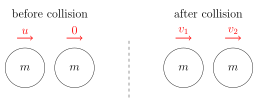
Three identical particles lie, not touching one another, in a straight line on a smooth horizontal surface. One particle is projected with speed \(u\) directly towards the other two which are at rest. The coefficient of restitution in all collisions is \(e\), where \(0 < e < 1\,\).
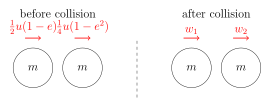
- Show that, after the second collision, the speeds of the particles are \(\frac12u(1-e)\), \(\frac14u (1-e^2)\) and \(\frac14u(1+e)^2\). Deduce that there will be a third collision whatever the value of \(e\).
- Show that there will be a fourth collision if and only if \(e\) is less than a particular value which you should determine.
Solution:
- First Collision:
By NEL, \(v_2 = v_1 + eu\), so \begin{align*} \text{COM}: && mu &= mv_1 + m(v_1 + eu) \\ \Rightarrow && 2mv_1 &= mu(1-e) \\ \Rightarrow && v_1 &= \frac12 u(1-e) \\ && v_2 &= \frac12 u(1-e) + eu \\ &&&= \frac12 u(1+e) \end{align*} The second collision is identical to the first except replacing \(u\) with \(\frac12u(1+e)\), therefore after that collision: \begin{align*} && \text{first particle} &= \frac12 u(1-e) \\ && \text{second particle} &= \frac12 \left (\frac12 u(1+e) \right)(1-e) \\ &&&= \frac14 u(1-e^2) \\ && \text{third particle} &= \frac12 \left (\frac12 u(1+e) \right)(1+e) \\ &&&= \frac14 u(1+e)^2 \end{align*} After all these collisions, all particles are moving in the same direction (since they all have positive velocity), but the first particle is now travelling faster than the second particle (as \(\frac12(1-e) < 1\)). Therefore they will collide again.
- The third collision:
The speed of approach will be \(\frac12u(1-e) - \frac14u(1-e^2) = \frac14u(1-e)(2 - (1+e)) = \frac14 u(1-e)^2\), therefore by NEL, \(w_2 = w_1 + \frac14ue(1-e)^2\) \begin{align*} \text{COM}: && m\frac12u(1-e) + m \frac14u(1-e^2) &= mw_1 + m\left (w_1 + \frac14ue(1-e)^2 \right) \\ \Rightarrow && \frac14u(1-e)(2+(1+e)) &= 2w_1 + \frac14ue(1-e)^2 \\ \Rightarrow && 2w_1 &= \frac14u(1-e)(3+e)-\frac14ue(1-e)^2 \\ &&&= \frac14u(1-e)(3+e-e(1-e)) \\ &&&= \frac14u(1-e)(3+e^2) \\ \Rightarrow && w_1 &= \frac18 u(1-e)(3+e^2) \\ && w_2 &= \frac18 u(1-e)(3+e^2) + \frac14ue(1-e)^2 \\ &&&= \frac18u(1-e)(3+e^2+2e(1-e)) \\ &&&= \frac18u(1-e)(3+2e-e^2) \\ &&&= \frac18u(1-e)(1+e)(3-e) \\ \end{align*} A fourth collision is possible, iff \begin{align*} && \frac18u(1-e)(1+e)(3-e)&> \frac14 u(1+e)^2 \\ \Leftrightarrow && (1-e)(3-e)&> 2 (1+e) \\ \Leftrightarrow &&3-4e-e^2&> 2+2e \\ \Leftrightarrow &&1-5e-e^2&>0 \\ \Leftrightarrow && e &< 3-\sqrt{2} \end{align*}
2012 Paper 2 Q11
A small block of mass \(km\) is initially at rest on a smooth horizontal surface. Particles \(P_1\), \(P_2\), \(P_3\), \(\ldots\) are fired, in order, along the surface from a fixed point towards the block. The mass of the \(i\)th particle is \(im\) (\(i = 1, 2, \ldots\))and the speed at which it is fired is \(u/i\,\). Each particle that collides with the block is embedded in it. Show that, if the \(n\)th particle collides with the block, the speed of the block after the collision is \[ \frac{2nu}{2k +n(n+1)}\,. \] In the case \(2k = N(N+1)\), where \(N\) is a positive integer, determine the number of collisions that occur. Show that the total kinetic energy lost in all the collisions is \[ \tfrac12 mu^2\bigg( \sum_{n=2}^{N+1} \frac 1 n \bigg)\,. \]
Solution: \begin{align*} \text{COM}: && \sum_{i=1}^n im \cdot \frac{u}{i} &= \left ( km + \sum_{i=1}^n im \right) v \\ \Rightarrow && nu &= \left ( k + \frac{n(n+1)}{2} \right) v \\ \Rightarrow && v &= \frac{2nu}{2k + n(n+1)} \end{align*} If \(2k = N(N+1)\), there will be no more collisions when \(v_n > \frac{u}{n+1}\), ie \begin{align*} && \frac{u}{n+1} &<\frac{2nu}{2k + n(n+1)} \\ \Leftrightarrow && N(N+1) + n(n+1) &< 2n(n+1) \\ \Leftrightarrow && N(N+1) &< n(n+1) \\ \end{align*} Therefore \(n = N+1\) and there will be \(N+1\) collisions. The loss of kinetic energy is: \begin{align*} && \text{initial k.e.} &= \sum_{k=1}^{N+1} \frac12 im \cdot \frac{u^2}{i^2} \\ &&&= \frac12 m u^2 \left ( \sum_{k=1}^{N+1} \frac{1}{i}\right) \\ && \text{final k.e.} &= \frac12 \left ( k + \frac{(N+1)(N+2)}{2}\right)m \left ( \frac{2(N+1)u}{N(N+1)+(N+1)(N+2)} \right)^2 \\ &&&= \frac12 m u^2 \frac{2(N+1)^2}{(N+1)(2N+2)} \\ &&&= \frac12 mu^2 \\ \Rightarrow && \Delta \text{ k.e.} &= \frac12 m u^2 \left ( \sum_{k=2}^{N+1} \frac{1}{i}\right) \end{align*}
2011 Paper 2 Q9
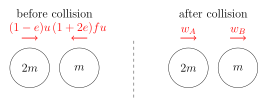
Two particles, \(A\) of mass \(2m\) and \(B\) of mass \(m\), are moving towards each other in a straight line on a smooth horizontal plane, with speeds \(2u\) and \(u\) respectively. They collide directly. Given that the coefficient of restitution between the particles is \(e\), where \(0 < e \le 1\), determine the speeds of the particles after the collision. After the collision, \(B\) collides directly with a smooth vertical wall, rebounding and then colliding directly with \(A\) for a second time. The coefficient of restitution between \(B\) and the wall is \(f\), where \(0 < f \le 1\). Show that the velocity of \(B\) after its second collision with \(A\) is \[ \tfrac23 (1-e^2)u - \tfrac13(1-4e^2)fu \] towards the wall and that \(B\) moves towards (not away from) the wall for all values of \(e\) and \(f\).
Solution:

2005 Paper 1 Q10
Three collinear, non-touching particles \(A\), \(B\) and \(C\) have masses \(a\), \(b\) and \(c\), respectively, and are at rest on a smooth horizontal surface. The particle \(A\) is given an initial velocity \(u\) towards~\(B\). These particles collide, giving \(B\) a velocity \(v\) towards \(C\). These two particles then collide, giving \(C\) a velocity \(w\). The coefficient of restitution is \(e\) in both collisions. Determine an expression for \(v\), and show that \[ \displaystyle w = \frac {abu \l 1+e \r^2}{\l a + b \r \l b+c \r}\;. \] Determine the final velocities of each of the three particles in the cases:
- \(\displaystyle \frac ab = \frac bc = e\,\);
- \(\displaystyle \frac ba = \frac cb = e\,\).
1995 Paper 2 Q10
Three small spheres of masses \(m_{1},m_{2}\) and \(m_{3},\) move in a straight line on a smooth horizontal table. (Their order on the straight line is the order given.) The coefficient of restitution between any two spheres is \(e\). The first moves with velocity \(u\) towards the second whilst the second and third are at rest. After the first collision the second sphere hits the third after which the velocity of the second sphere is \(u.\) Find \(m_{1}\) in terms of \(m_{2},m_{3}\) and \(e\). deduce that \[ m_{2}e>m_{3}(1+e+e^{2}). \] Suppose that the relation between \(m_{1},m_{2}\) and \(m_{3}\) is that in the formula you found above, but that now the first sphere initially moves with velocity \(u\) and the other two spheres with velocity \(v\), all in the same direction along the line. If \(u>v>0\) use the first part to find the velocity of the second sphere after two collisions have taken place. (You should not need to make any substantial computations but you should state your argument clearly.)