Problems
Filters
5 problems found
2006 Paper 3 Q13
Two points are chosen independently at random on the perimeter (including the diameter) of a semicircle of unit radius. The area of the triangle whose vertices are these two points and the midpoint of the diameter is denoted by the random variable \(A\). Show that the expected value of \(A\) is \((2+\pi)^{-1}\).
Solution: There are \(3\) possible numbers of points on the curved part of the perimeter. \(0\): The area is \(0\) \(1\):


1990 Paper 1 Q1
\(\,\)
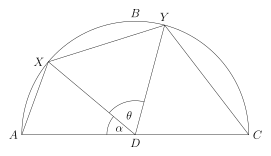
Solution: The area for \(\alpha\) fixed is \(\frac12 r^2 \sin \alpha + \frac12 r^2 \sin \theta + \frac12 r^2 \sin (\pi - \theta - \alpha)\) So we wish to maximise \(V = \sin \theta + \sin(\pi - \theta-\alpha)\) \begin{align*} && V &= \sin \theta + \sin(\pi - \theta-\alpha)\\ &&&= 2\sin \l \frac{\pi-\alpha}2\r\cos \l \frac{2\theta + \alpha - \pi}{2}\r \end{align*} The largest \(\cos\) can be is \(1\) when \(\displaystyle 2\theta + \alpha - \pi = 0 \Rightarrow \theta = \frac{\pi-\alpha}2\). (ie we split the remaining area exactly in half). We are now trying to maximise \(W = \sin \alpha + 2 \sin \frac{\pi - \alpha}2\) ie \begin{align*} && W &= \sin \alpha + 2 \cos \frac{\alpha}{2} \\ \Rightarrow && \frac{\d W}{\d \alpha} &= \cos \alpha-\sin \frac{\alpha}{2} \\ &&&= 1-2 \sin^2 \frac{\alpha}{2} - \sin \frac{\alpha}{2} \\ &&&= (1+\sin \frac{\alpha}{2})(1-2\sin \frac{\alpha}{2}) \end{align*} Therefore \(\frac{\alpha}{2} = -\frac{3\pi}{2}, \frac{\alpha}{2} = \frac{\pi}{6}, \frac{5\pi}{6} \Rightarrow \alpha = -3\pi, \frac{\pi}{3}, \frac{5\pi}{3}\). The only turning point in our range is \(\frac{\pi}{3}\). This is obvious a a maximum by symmetry or checking the end points, but we could also check the second derivative \(\frac{\d^2 W}{\d \alpha^2} = -\sin \frac{\pi}{3}-\cos \frac{\pi}{3} < 0\) so we have a maximum. Therefore the largest possible area is: \(\displaystyle \frac{3\sqrt{3}}{4}r^2\)
1989 Paper 1 Q1

Solution: \(AG = r\), therefore the area is: \begin{align*} A &= [AHG] - 2*[ABC] + [CDE] \\ &= \frac12 \pi r^2 - \pi h^2 + \frac12 \pi (r-2h)^2 \\ &= \frac12 \pi \l r^2 - 2h^2 + r^2 -4rh+4h^2 \r \\ &= \frac12 \pi \l 2r^2 -4rh + 2h^2\r \\ &= \pi (r-h)^2 \end{align*} This is the same area as a circle radius \(r-h\) But \(HD = r + (r-2d) = 2(r-d)\), ie the circle with diameter \(HD\) has radius \(r-h\) as required. Suppose \(A = (-h, 0), C = (h, 0), B = (0, h)\) then our parabola is \(y = \frac1{h}(h^2-x^2)\)

1989 Paper 2 Q15
Two points are chosen independently at random on the perimeter (including the diameter) of a semicircle of unit radius. What is the probability that exactly one of them lies on the diameter? Let the area of the triangle formed by the two points and the midpoint of the diameter be denoted by the random variable \(A\).
- Given that exactly one point lies on the diameter, show that the expected value of \(A\) is \(\left(2\pi\right)^{-1}\).
- Given that neither point lies on the diameter, show that the expected value of \(A\) is \(\pi^{-1}\). [You may assume that if two points are chosen at random on a line of length \(\pi\) units, the probability density function for the distance \(X\) between the two points is \(2\left(\pi-x\right)/\pi^{2}\) for \(0\leqslant x\leqslant\pi.\)]
Solution:
- \begin{align*} \mathbb{E}(A \mid \text{exactly one point on diameter}) &= \int_{-1}^1\int_0^\pi \frac12 (x-0)\cdot 1 \cdot \sin(\pi - \theta) \frac{1}{\pi} \d \theta \frac{1}{2} \d x \\ &= \int_{-1}^1\frac1{2\pi} x \d x \cdot \left [ -\cos \theta \right]_0^\pi \\ &= \frac{1}{2\pi} \end{align*}

- \begin{align*} \mathbb{E}(A \mid \text{no point on diameter}) &= \int_0^{\pi} \frac12 \cdot 1 \cdot 1 \cdot \sin x \cdot 2(\pi - x)/\pi^2 \d x \\ &= \frac1{\pi^2} \int_0^\pi \sin x (\pi - x) \d x \\ &= \frac1{\pi^2} \int_0^\pi x\sin x \d x \\ &= \frac1{\pi^2} \left [ \sin x - x \cos x \right]_0^{\pi} \\ &= \frac{1}{\pi} \end{align*}

1988 Paper 1 Q11
Derive a formula for the position of the centre of mass of a uniform circular arc of radius \(r\) which subtends an angle \(2\theta\) at the centre.

Solution: