Problems
Filters
11 problems found
2017 Paper 3 Q10
A uniform rod \(PQ\) of mass \(m\) and length \(3a\) is freely hinged at \(P\). The rod is held horizontally and a particle of mass \(m\) is placed on top of the rod at a distance~\(\ell\) from \(P\), where \(\ell <2a\). The coefficient of friction between the rod and the particle is \(\mu\). The rod is then released. Show that, while the particle does not slip along the rod, \[ (3a^2+\ell^2)\dot \theta^2 = g(3a+2\ell)\sin\theta \,, \] where \(\theta\) is the angle through which the rod has turned, and the dot denotes the time derivative. Hence, or otherwise, find an expression for \(\ddot \theta\) and show that the normal reaction of the rod on the particle is non-zero when~\(\theta\) is acute. Show further that, when the particle is on the point of slipping, \[ \tan\theta = \frac{\mu a (2a-\ell)}{2(\ell^2 + a\ell +a^2)} \,. \] What happens at the moment the rod is released if, instead, \(\ell>2a\)?
Solution:

| Inital | \@ \(\theta\) | |
| Rotational KE of rod | \(0\) | \(\frac{1}{2}I\dot{\theta}^2 = \frac{1}{2} \frac{1}{3} m (3a)^2 \dot{\theta}^2 = \frac32 m a^2 \dot{\theta}^2\) |
| KE of particle | \(0\) | \(\frac12 m \ell^2\dot{\theta}^2\) |
| GPE of rod | \(0\) | \(-\frac{3}{2}mga \sin \theta\) |
| GPE of particle | \(0\) | \(-mg \ell \sin \theta\) |
| Total | \(0\) | \(\frac12m \l \l 3a^2 + \ell^2\r \dot{\theta}^2 - \l 3a + 2\ell \r g \sin \theta \r\) |
2012 Paper 3 Q9
A pulley consists of a disc of radius \(r\) with centre \(O\) and a light thin axle through \(O\) perpendicular to the plane of the disc. The disc is non-uniform, its mass is \(M\) and its centre of mass is at \(O\). The axle is fixed and horizontal. Two particles, of masses \(m_1\) and \(m_2\) where \(m_1>m_2\), are connected by a light inextensible string which passes over the pulley. The contact between the string and the pulley is rough enough to prevent the string sliding. The pulley turns and the vertical force on the axle is found, by measurement, to be~\(P+Mg\).
- The moment of inertia of the pulley about its axle is calculated assuming that the pulley rotates without friction about its axle. Show that the calculated value is \[ \frac{((m_1 + m_2)P - 4m_1m_2g)r^2} {(m_1 + m_2)g - P}\,. \tag{\(*\)}\]
- Instead, the moment of inertia of the pulley about its axle is calculated assuming that a couple of magnitude \(C\) due to friction acts on the axle of the pulley. Determine whether this calculated value is greater or smaller than \((*)\). Show that \(C<(m_1-m_2)rg\).
2008 Paper 3 Q11
A circular wheel of radius \(r\) has moment of inertia \(I\) about its axle, which is fixed in a horizontal position. A light string is wrapped around the circumference of the wheel and a particle of mass \(m\) hangs from the free end. The system is released from rest and the particle descends. The string does not slip on the wheel. As the particle descends, the wheel turns through \(n_1\) revolutions, and the string then detaches from the wheel. At this moment, the angular speed of the wheel is \(\omega_0\). The wheel then turns through a further \(n_2\) revolutions, in time \(T\), before coming to rest. The couple on the wheel due to resistance is constant. Show that \[ \frac12 \omega_0 T = 2 \pi n_2\] and \[ I =\dfrac {mgrn_1T^2 -4\pi mr^2n_2^2}{4\pi n_2(n_1+n_2)}\;. \]
2002 Paper 3 Q10
A light hollow cylinder of radius \(a\) can rotate freely about its axis of symmetry, which is fixed and horizontal. A particle of mass \(m\) is fixed to the cylinder, and a second particle, also of mass \(m\), moves on the rough inside surface of the cylinder. Initially, the cylinder is at rest, with the fixed particle on the same horizontal level as its axis and the second particle at rest vertically below this axis. The system is then released. Show that, if \(\theta\) is the angle through which the cylinder has rotated, then \[ \ddot{\theta} = {g \over 2a} \l \cos \theta - \sin \theta \r \,, \] provided that the second particle does not slip. Given that the coefficient of friction is \( (3 + \sqrt{3})/6\), show that the second particle starts to slip when the cylinder has rotated through \(60^\circ\).
2001 Paper 3 Q11
A uniform cylinder of radius \(a\) rotates freely about its axis, which is fixed and horizontal. The moment of inertia of the cylinder about its axis is \(I\,\). A light string is wrapped around the cylinder and supports a mass \(m\) which hangs freely. A particle of mass \(M\) is fixed to the surface of the cylinder. The system is held at rest with the particle vertically below the axis of the cylinder, and then released. Find, in terms of \(I\), \(a\), \(M\), \(m\), \(g\) and \(\theta\), the angular velocity of the cylinder when it has rotated through angle \(\theta\,\). Show that the cylinder will rotate without coming to a halt if \(m/M>\sin\alpha\,\), where \(\alpha\) satisifes \(\alpha=\tan \frac12\alpha\) and \(0<\alpha<\pi\,\).
1995 Paper 3 Q9
A thin circular disc of mass \(m\), radius \(r\) and with its centre of mass at its centre \(C\) can rotate freely in a vertical plane about a fixed horizontal axis through a point \(O\) of its circumference. A particle \(P\), also of mass \(m,\) is attached to the circumference of the disc so that the angle \(OCP\) is \(2\alpha,\) where \(\alpha\leqslant\pi/2\).
- In the position of stable equilibrium \(OC\) makes an angle \(\beta\) with the vertical. Prove that \[ \tan\beta=\frac{\sin2\alpha}{2-\cos2\alpha}. \]
- The density of the disc at a point distant \(x\) from \(C\) is \(\rho x/r.\) Show that its moment of inertia about the horizontal axis through \(O\) is \(8mr^{2}/5\).
- The mid-point of \(CP\) is \(Q\). The disc is held at rest with \(OQ\) horizontal and \(C\) lower than \(P\) and it is then released. Show that the speed \(v\) with which \(C\) is moving when \(P\) passes vertically below \(O\) is given by \[ v^{2}=\frac{15gr\sin\alpha}{2(2+5\sin^{2}\alpha)}. \] Find the maximum value of \(v^{2}\) as \(\alpha\) is varied.
1993 Paper 3 Q13
\(\ \)\vspace{-1cm} \noindent
1992 Paper 3 Q13
\(\,\)
1991 Paper 2 Q13
A non-uniform rod \(AB\) of mass \(m\) is pivoted at one end \(A\) so that it can swing freely in a vertical plane. Its centre of mass is a distance \(d\) from \(A\) and its moment of inertia about any axis perpendicular to the rod through \(A\) is \(mk^{2}.\) A small ring of mass \(\alpha m\) is free to slide along the rod and the coefficient of friction between the ring and rod is \(\mu.\) The rod is initially held in a horizontal position with the ring a distance \(x\) from \(A\). If \(k^{2} > xd\), show that when the rod is released, the ring will start to slide when the rod makes an angle \(\theta\) with the downward vertical, where \[ \mu\tan\theta=\frac{3\alpha x^{2}+k^{2}+2xd}{k^{2}-xd}. \] Explain what will happen if (i) \(k^{2}=xd\) and (ii) \(k^{2} < xd\).
1990 Paper 2 Q11
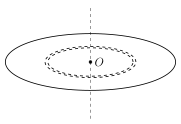
A disc is free to rotate in a horizontal plane about a vertical axis through its centre. The moment of inertia of the disc about this axis is \(mk^{2}.\) Along one diameter is a narrow groove in which a particle of mass \(m\) slides freely. At time \(t=0,\) the disc is rotating with angular speed \(\Omega,\) and the particle is at a distance \(a\) from the axis and is moving towards the axis with speed \(V\), where \(k^{2}V^{2}=\Omega^{2}a^{2}(k^{2}+a^{2}).\) Show that, at a later time \(t,\) while the particle is still moving towards the axis, the angular speed \(\omega\) of the disc and the distance \(r\) of the particle from the axis are related by \[ \omega=\frac{\Omega(k^{2}+a^{2})}{k^{2}+r^{2}}\qquad\mbox{ and }\qquad\frac{\mathrm{d}r}{\mathrm{d}t}=-\frac{\Omega r(k^{2}+a^{2})}{k(k^{2}+r^{2})^{\frac{1}{2}}}. \] Deduce that \[ k\frac{\mathrm{d}r}{\mathrm{d}\theta}=-r(k^{2}+r^{2})^{\frac{1}{2}}, \] where \(\theta\) is the angle through which the disc has turned at time \(t\). By making the substitution \(u=1/r\), or otherwise, show that \(r\sinh(\theta+\alpha)=k,\) where \(\sinh\alpha=k/a.\) Hence, or otherwise, show that the particle never reaches the axis.
1989 Paper 3 Q14
- A solid circular disc has radius \(a\) and mass \(m.\) The density is proportional to the distance from the centre \(O\). Show that the moment of inertia about an axis through \(C\) perpendicular to the plane of the disc is \(\frac{3}{5}ma^{2}.\)
- A light inelastic string has one end fixed at \(A\). It passes under and supports a smooth pulley \(B\) of mass \(m.\) It then passes over a rough pulley \(C\) which is a disc of the type described in (i), free to turn about its axis which is fixed and horizontal. The string carries a particle \(D\) of mass \(M\) at its other end. The sections of the string which are not in contact with the pulleys are vertical. The system is released from rest and moves under gravity for \(t\) seconds. At the end of this interval the pulley \(B\) is suddenly stopped. Given that \(m<2M\), find the resulting impulse on \(D\) in terms of \(m,M,g\) and \(t\). {[}You may assume that the string is long enough for there to be no collisions between the elements of the system, and that the pulley \(C\) is rough enough to prevent slipping throughout.{]}
Solution:
- \begin{align*} m &= \int_0^a \underbrace{(\rho r)}_{\text{mass per area}} \underbrace{\pi r^2}_{\text{area}} \d r \\ &= \rho \pi \frac{a^3}{3} \\ \\ I &= \sum m r^2 \\ &= \sum (\rho r) \pi r^2 \cdot r^2 \\ &\to \int_0^a \rho \pi r^4 \\ &= \frac15 \rho \pi a^5 \\ &= \frac35 m a^2 \end{align*}
- \begin{align*} \text{N2}(\downarrow, D): && Mg -T_C &= Mf \\ \overset{\curvearrowright}{C} && (T_C - T_B)a &= I \frac{f}{a} \\ &&&= \frac35 m a f \\ \text{N2}(\uparrow, B): && 2T_B-mg &= \frac12 m f \\ \\ \Rightarrow && Mg-T_B &= \left (M + \frac35 m \right)f \\ \Rightarrow && Mg - \frac12 mg &= \left (M + \frac35 m + \frac14 m \right)f \\ \Rightarrow && f &= \frac{(M-\frac12 m)g}{M + \frac{17}{20} m} \\ &&&= \frac{(2M-m)g}{2M +\frac{17}{10}m} \end{align*} Therefore the speed after a time \(t\) is \(\displaystyle \frac{(2M-m)g}{2M +\frac{17}{10}m} t\) and the impulse will be the change in momentum, ie \(\displaystyle \frac{(2M-m)g}{2M +\frac{17}{10}m} Mt\)
