1989 Paper 3 Q14
Year: 1989
Paper: 3
Question Number: 14
Course: zNo longer examinable
Section: Moments of inertia
Difficulty: 1700.0
Banger: 1472.2
moments of inertia
variable density
disc
pulley system
impulse
rough pulley
rotational dynamics
inelastic string
Atwood machine
Problem
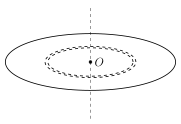
- A solid circular disc has radius \(a\) and mass \(m.\) The density is proportional to the distance from the centre \(O\). Show that the moment of inertia about an axis through \(C\) perpendicular to the plane of the disc is \(\frac{3}{5}ma^{2}.\)
- A light inelastic string has one end fixed at \(A\). It passes under and supports a smooth pulley \(B\) of mass \(m.\) It then passes over a rough pulley \(C\) which is a disc of the type described in (i), free to turn about its axis which is fixed and horizontal. The string carries a particle \(D\) of mass \(M\) at its other end. The sections of the string which are not in contact with the pulleys are vertical. The system is released from rest and moves under gravity for \(t\) seconds. At the end of this interval the pulley \(B\) is suddenly stopped. Given that \(m<2M\), find the resulting impulse on \(D\) in terms of \(m,M,g\) and \(t\). {[}You may assume that the string is long enough for there to be no collisions between the elements of the system, and that the pulley \(C\) is rough enough to prevent slipping throughout.{]}
Solution
- \begin{align*} m &= \int_0^a \underbrace{(\rho r)}_{\text{mass per area}} \underbrace{\pi r^2}_{\text{area}} \d r \\ &= \rho \pi \frac{a^3}{3} \\ \\ I &= \sum m r^2 \\ &= \sum (\rho r) \pi r^2 \cdot r^2 \\ &\to \int_0^a \rho \pi r^4 \\ &= \frac15 \rho \pi a^5 \\ &= \frac35 m a^2 \end{align*}
- \begin{align*} \text{N2}(\downarrow, D): && Mg -T_C &= Mf \\ \overset{\curvearrowright}{C} && (T_C - T_B)a &= I \frac{f}{a} \\ &&&= \frac35 m a f \\ \text{N2}(\uparrow, B): && 2T_B-mg &= \frac12 m f \\ \\ \Rightarrow && Mg-T_B &= \left (M + \frac35 m \right)f \\ \Rightarrow && Mg - \frac12 mg &= \left (M + \frac35 m + \frac14 m \right)f \\ \Rightarrow && f &= \frac{(M-\frac12 m)g}{M + \frac{17}{20} m} \\ &&&= \frac{(2M-m)g}{2M +\frac{17}{10}m} \end{align*} Therefore the speed after a time \(t\) is \(\displaystyle \frac{(2M-m)g}{2M +\frac{17}{10}m} t\) and the impulse will be the change in momentum, ie \(\displaystyle \frac{(2M-m)g}{2M +\frac{17}{10}m} Mt\)

Rating Information
Difficulty Rating: 1700.0
Difficulty Comparisons: 0
Banger Rating: 1472.2
Banger Comparisons: 2
Show LaTeX source
Problem source
\begin{questionparts} \item A solid circular disc has radius $a$ and mass $m.$ The density is proportional to the distance from the centre $O$. Show that the moment of inertia about an axis through $C$ perpendicular to the plane of the disc is $\frac{3}{5}ma^{2}.$
\item A light inelastic string has one end fixed at $A$. It passes under and supports a smooth pulley $B$ of mass $m.$ It then passes over a rough pulley $C$ which is a disc of the type described in \textbf{(i)}, free to turn about its axis which is fixed and horizontal. The string carries a particle $D$ of mass $M$ at its other end. The sections of the string which are not in contact with the pulleys are vertical. The system is released from rest and moves under gravity for $t$ seconds. At the end of this interval the pulley $B$ is suddenly stopped. Given that $m<2M$, find the resulting impulse on $D$ in terms of $m,M,g$ and $t$.
{[}You may assume that the string is long enough for there to be no collisions between the elements of the system, and that the pulley $C$ is rough enough to prevent slipping throughout.{]} \end{questionparts}
Solution source
\begin{questionparts}
\item
\begin{center}
    \begin{tikzpicture}
        \def\r{3};
        \coordinate (O) at (0,0);

        \draw[thick, black, solid, domain=0:360, samples=100]
            plot ({3*cos(\x)},{sin(\x)});
        \draw[thick, black, dashed, domain=0:360, samples=100]
            plot ({1.5*cos(\x)},{0.5*sin(\x)});
        \draw[thick, black, dashed, domain=0:360, samples=100]
            plot ({1.6*cos(\x)},{0.55*sin(\x)});

        \draw[dashed] (0,-2) -- (0, 2);
        \filldraw (O) circle (1.5pt) node[right] {$O$};
    \end{tikzpicture}
\end{center}

\begin{align*}
m &= \int_0^a \underbrace{(\rho r)}_{\text{mass per area}} \underbrace{\pi r^2}_{\text{area}} \d r \\
&= \rho \pi \frac{a^3}{3} \\
\\
I &= \sum m r^2 \\
&= \sum (\rho r) \pi r^2 \cdot r^2 \\
&\to \int_0^a \rho \pi r^4 \\
&=  \frac15 \rho \pi a^5 \\
&= \frac35 m a^2
\end{align*}

\item
\begin{center}
    \begin{tikzpicture}
        \draw (0, 5) -- (5,5);

        \draw (1,5) -- (1,1);
        \draw (1.5, 1) circle (0.5);
        \draw (2,1) -- (2,3);
        \draw (3, 3) circle (1);
        \draw (4,3) -- (4,-1);

        \node[above] at (1,5) {$A$};
        \node at (1.5,1) {$B$};
        \node at (3,3) {$C$};
        \node[right] at (4,-1) {$D$};

        \filldraw (4,-1) circle (1.5pt);

        \draw[-latex, blue, ultra thick] (4,-1) -- ++(0,-1.25) node[right] {$Mg$};
        \draw[-latex, blue, ultra thick] (1.5,1) -- ++(0,-.6) node[right] {$mg$};
        \draw[-latex, blue, ultra thick] (4,-1) -- ++(0,1) node[right] {$T_C$};
        \draw[-latex, blue, ultra thick] (4,3) -- ++(0,-1) node[right] {$T_C$};
        \draw[-latex, blue, ultra thick] (2,3) -- ++(0,-0.75) node[left] {$T_B$};
        \draw[-latex, blue, ultra thick] (2,1) -- ++(0,0.75) node[left] {$T_B$};
        \draw[-latex, blue, ultra thick] (1,1) -- ++(0,0.75) node[left] {$T_B$};
    \end{tikzpicture}
\end{center}

\begin{align*}
\text{N2}(\downarrow, D): &&  Mg -T_C &= Mf \\
\overset{\curvearrowright}{C} && (T_C - T_B)a &= I \frac{f}{a} \\
&&&= \frac35 m a f \\
\text{N2}(\uparrow, B): && 2T_B-mg &= \frac12 m f \\
\\
\Rightarrow && Mg-T_B &= \left (M + \frac35 m \right)f \\
\Rightarrow && Mg - \frac12 mg &= \left (M + \frac35 m + \frac14 m \right)f \\
\Rightarrow && f &= \frac{(M-\frac12 m)g}{M + \frac{17}{20} m} \\
&&&= \frac{(2M-m)g}{2M +\frac{17}{10}m}
\end{align*}

Therefore the speed after a time $t$ is $\displaystyle \frac{(2M-m)g}{2M +\frac{17}{10}m} t$ and the impulse will be the change in momentum, ie $\displaystyle \frac{(2M-m)g}{2M +\frac{17}{10}m} Mt$

\end{questionparts}