Problems
Filters
12 problems found
2015 Paper 1 Q10
A bus has the shape of a cuboid of length \(a\) and height \(h\). It is travelling northwards on a journey of fixed distance at constant speed \(u\) (chosen by the driver). The maximum speed of the bus is \(w\). Rain is falling from the southerly direction at speed \(v\) in straight lines inclined to the horizontal at angle \(\theta\), where \(0<\theta<\frac12\pi\). By considering first the case \(u=0\), show that for \(u>0\) the total amount of rain that hits the roof and the back or front of the bus in unit time is proportional to \[ h\big \vert v\cos\theta - u \big\vert + av\sin\theta \,. \] Show that, in order to encounter as little rain as possible on the journey, the driver should choose \( u=w\) if either \(w< v\cos\theta\) or \( a\sin\theta > h\cos\theta\). How should the speed be chosen if \(w>v\cos\theta\) and \( a\sin\theta < h\cos\theta\)? Comment on the case \( a\sin\theta = h\cos\theta\). How should the driver choose \(u\) on the return journey?
2002 Paper 1 Q10
A bicycle pump consists of a cylinder and a piston. The piston is pushed in with steady speed~\(u\). A particle of air moves to and fro between the piston and the end of the cylinder, colliding perfectly elastically with the piston and the end of the cylinder, and always moving parallel with the axis of the cylinder. Initially, the particle is moving towards the piston at speed \(v\). Show that the speed, \(v_n\), of the particle just after the \(n\)th collision with the piston is given by \(v_n=v+2nu\). Let \(d_n\) be the distance between the piston and the end of the cylinder at the \(n\)th collision, and let \(t_n\) be the time between the \(n\)th and \((n+1)\)th collisions. Express \(d_n - d_{n+1}\) in terms of \(u\) and \(t_n\), and show that \[ d_{n+1} = \frac{v+(2n-1)u}{v+(2n+1)u} \, d_n \;. \] Express \(d_n\) in terms of \(d_1\), \(u\), \(v\) and \(n\). In the case \(v=u\), show that \(ut_n = \displaystyle \frac {d_1} {n(n+1)}\). %%%%%Verify that \(\sum\limits_1^\infty t_n = d/u\).
2001 Paper 1 Q9
A ship sails at \(20\) kilometres/hour in a straight line which is, at its closest, 1 kilometre from a port. A tug-boat with maximum speed 12 kilometres/hour leaves the port and intercepts the ship, leaving the port at the latest possible time for which the interception is still possible. How far does the tug-boat travel?
Solution: The position of the ship is \(\mathbf{s} = \binom{20t}{1}\). Suppose the interception is at \(T\), then the ship leaves at \(T-\frac1{12}\underbrace{\sqrt{400T^2+1}}_{\text{distance to intercept}}\). We wish to maximise this, ie \begin{align*} && \frac{\d}{\d T} \left ( T - \frac1{12}\sqrt{400T^2+1}\right) &= 1 - \frac{1}{12} \cdot \frac12 \cdot 400 \cdot 2T \cdot \left (400T^2+1 \right)^{-1/2} \\ &&&= 1 - \frac{100}3 T(400T^2+1)^{-1/2} \\ \Rightarrow && \frac{T}{\sqrt{400T^2+1}} &= \frac{3}{100} \\ \Rightarrow && \frac{T^2}{400T^2+1} &= \frac{9}{10000} \\ \Rightarrow && 10000T^2 &= 3600T^2+9 \\ \Rightarrow && 6400T^2 &= 9 \\ \Rightarrow && T &= \pm \frac{3}{80} \quad \text{(T > 0)} \end{align*} Therefore the distance is \(\sqrt{400 \frac{9}{6400} + 1} = \sqrt{\frac{9}{16}+1} = \frac{5}{4} = 1.25 \text{ km}\)
2001 Paper 3 Q10
Three ships \(A\), \(B\) and \(C\) move with velocities \({\bf v}_1\), \({\bf v}_2\) and \(\bf u\) respectively. The velocities of \(A\) and \(B\) relative to \(C\) are equal in magnitude and perpendicular. Write down conditions that \(\bf u\), \({\bf v}_1\) and \({\bf v}_2\) must satisfy and show that \[ \left| {\bf u} -{\textstyle\frac12} \l {\bf v}_1 + {\bf v}_2 \r \right|^2 = \left|{\textstyle\frac12} \l {\bf v}_1 - {\bf v}_2 \r \right|^2 \] and \[ \l {\bf u} -{\textstyle\frac12} \l {\bf v}_1 + {\bf v}_2 \r \r \cdot \l {\bf v}_1 - {\bf v}_2 \r = 0 \;. \] Explain why these equations determine, for given \({\bf v}_1\) and \({\bf v}_2\), two possible velocities for \(C\,\), provided \({\bf v}_1 \ne {\bf v}_2 \,\). If \({\bf v}_1\) and \({\bf v}_2\) are equal in magnitude and perpendicular, show that if \({\bf u} \ne {\bf 0}\) then \({\bf u} = {\bf v}_1 + {\bf v}_2\,\).
1997 Paper 1 Q9
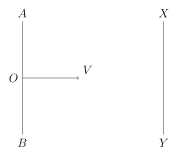
A single stream of cars, each of width \(a\) and exactly in line, is passing along a straight road of breadth \(b\) with speed \(V\). The distance between the successive cars is \(c\).
1997 Paper 2 Q14
Traffic enters a tunnel which is 9600 metres long, and in which overtaking is impossible. The number of vehicles which enter in any given time is governed by the Poisson distribution with mean 6 cars per minute. All vehicles travel at a constant speed until forced to slow down on catching up with a slower vehicle ahead. I enter the tunnel travelling at 30 m\(\,\)s\(^{-1}\) and all the other traffic is travelling at 32 m\(\,\)s\(^{-1}\). What is the expected number of vehicles in the queue behind me when I leave the tunnel? Assuming again that I travel at 30 m\(\,\)s\(^{-1}\), but that all the other vehicles are independently equally likely to be travelling at 30 m\(\,\)s\(^{-1}\) or 32 m\(\,\)s\(^{-1}\), find the probability that exactly two vehicles enter the tunnel within 20 seconds of my doing so and catch me up before I leave it. Find also the probability that there are exactly two vehicles queuing behind me when I leave the tunnel. \noindent [Ignore the lengths of the vehicles.]
1995 Paper 3 Q11
A ship is sailing due west at \(V\) knots while a plane, with an airspeed of \(kV\) knots, where \(k>\sqrt{2},\) patrols so that it is always to the north west of the ship. If the wind in the area is blowing from north to south at \(V\) knots and the pilot is instructed to return to the ship every thirty minutes, how long will her outward flight last? Assume that the maximum distance of the plane from the ship during the above patrol was \(d_{w}\) miles. If the air now becomes dead calm, and the pilot's orders are maintained, show that the ratio \(d_{w}/d_{c}\) of \(d_{w}\) to the new maximum distance, \(d_{c}\) miles, of the plane from the ship is \[ \frac{k^{2}-2}{2k(k^{2}-1)}\sqrt{4k^{2}-2}. \]
1994 Paper 3 Q10
The island of Gammaland is totally flat and subject to a constant wind of \(w\) kh\(^{-1},\) blowing from the West. Its southernmost shore stretches almost indefinitely, due east and west, from the coastal city of Alphabet. A novice pilot is making her first solo flight from Alphaport to the town of Betaville which lies north-east of Alphaport. Her instructor has given her the correct heading to reach Betaville, flying at the plane's recommended airspeed of \(v\) kh\(^{-1},\) where \(v>w.\) On reaching Betaport the pilot returns with the opposite heading to that of the outward flight and, so featureless is Gammaland, that she only realises her error as she crosses the coast with Alphaport nowhere in sight. Assuming that she then turns West along the coast, and that her outward flight took \(t\) hours, show that her return flight takes \[ \left(\frac{v+w}{v-w}\right)t\ \text{hours.} \] If Betaville is \(d\) kilometres from Alphaport, show that, with the correct heading, the return flight should have taken \[ t+\frac{\sqrt{2}wd}{v^{2}-w^{2}}\ \text{hours.} \]
1992 Paper 3 Q11
\(\,\)
1990 Paper 1 Q10
In a certain race, runners run 5\(\,\)km in a straight line to a fixed point and then turn and run back to the starting point. A steady wind of 3\(\,\text{ms}^{-1}\) is blowing from the start to the turning point. At steady racing pace, a certain runner expends energy at a constant rate of 300\(\,\)W. Two resistive forces act. One is of constant magnitude \(50\,\text{N}\). The other, arising from air resistance, is of magnitude \(2w\,\mathrm{N}\), where \(w\,\text{ms}^{-1}\) is the runner's speed relative to the air. Give a careful argument to derive formulae from which the runner's steady speed in each half of the race may be found. Calculate, to the nearest second, the time the runner will take for the whole race. \textit{Effects due to acceleration and deceleration at the start and turn may be ignored.} The runner may use alternative tactics, expending the same total energy during the race as a whole, but applying different constant powers, \(x_{1}\,\)W in the outward trip, and \(x_{2}\,\)W on the return trip. Prove that, with the wind as above, if the outward and return speeds are \(v_{1}\,\)ms\(^{-1}\) and \(v_{2}\,\)ms\(^{-1}\) respectively, then \(v_{1}+v_{2}\) is independent of the choices for \(x_{1}\) and \(x_{2}\). Hence show that these alternative tactics allow the runner to run the whole race approximately 15 seconds faster.
Solution: Note that \(P = Fv\). Since he is running at a steady pace, we can say that \(F\) must be equal to the resistive forces (as net force is \(0\)). Therefore \(F = 50 + 2(v+3)\) on the way out. ie, \(300 = (2v + 56)v \Rightarrow 150 = v^2 + 28v \Rightarrow v = \sqrt{346}-14\) On the way back, \(F = 50 + 2(v-3)\), ie \(300 = (2v+44)v \Rightarrow 150 = v^2 +22v \Rightarrow v = \sqrt{271}-11\) Therefore the total time will be \(\frac{5000}{\sqrt{346}-150} + \frac{5000}{\sqrt{271}-11} \approx 2002\), or 33 minutes, 22 seconds. Very respectable! The total energy in this first run is \(E = Pt = 2002 \cdot 300\). Now suppose we apply two different powers as in the question, then we must have: \begin{align*} && x_1 &= 2v_1^2 + 56v_1 \\ && x_2 &= 2v_2^2 + 44v_2 \\ && E &= x_1 \frac{5000}{v_1} + x_2 \frac{5000}{v_2} \\ &&&= 5000 \left ( \frac{x_1}{v_1} + \frac{x_2}{v_2} \right) \\ \Rightarrow && \frac{x_1}{v_1} &= 2v_1 + 56 \\ && \frac{x_2}{v_2} &= 2v_2 + 44 \\ \Rightarrow && \frac{E}{5000} &= 2(v_1+v_2) + 100 \\ \Rightarrow && v_1+v_2 &\text{ is independent of the choices for }x_i \end{align*} We wish to minimize \begin{align*} && \frac{5000}{v_1} + \frac{5000}{v_2} &\underbrace{\geq}_{AM-HM} 10\,000 \cdot \frac{2}{v_1+v_2} \\ &&&= 10\,000 \cdot \frac{2}{\sqrt{346}-14+\sqrt{271}-11} \\ &&&\approx 1987 \end{align*} ie they can go 15 seconds quicker with better strategy.
1988 Paper 3 Q13
A goalkeeper stands on the goal-line and kicks the football directly into the wind, at an angle \(\alpha\) to the horizontal. The ball has mass \(m\) and is kicked with velocity \(\mathbf{v}_{0}.\) The wind blows horizontally with constant velocity \(\mathbf{w}\) and the air resistance on the ball is \(mk\) times its velocity relative to the wind velocity, where \(k\) is a positive constant. Show that the equation of motion of the ball can be written in the form \[ \frac{\mathrm{d}\mathbf{v}}{\mathrm{d}t}+k\mathbf{v}=\mathbf{g}+k\mathbf{w}, \] where \(\mathbf{v}\) is the ball's velocity relative to the ground, and \(\mathbf{g}\) is the acceleration due to gravity. By writing down horizontal and vertical equations of motion for the ball, or otherwise, find its position at time \(t\) after it was kicked. On the assumption that the goalkeeper moves out of the way, show that if \(\tan\alpha=\left|\mathbf{g}\right|/(k\left|\mathbf{w}\right|),\) then the goalkeeper scores an own goal.
Solution: Applying \(\mathbf{F} = m\mathbf{a} = m \frac{\d \mathbf{v}}{dt}\) we have: \begin{align*} && m \frac{\d \mathbf{v}}{d t} &= m\mathbf{g} - mk(\mathbf{v} - \mathbf{w}) \\ \Rightarrow && \frac{\d \mathbf{v}}{d t} +k \mathbf{v} &= \mathbf{g} + k \mathbf{w} \\ \\ \Rightarrow && e^{k t} \l \frac{\d \mathbf{v}}{d t} +k \mathbf{v} \r &= e^{kt} ( \mathbf{g} + k \mathbf{w}) \\ \Rightarrow && \frac{\d}{\d t} \l e^{kt} \mathbf{v} \r &= e^{kt}( \mathbf{g} + k \mathbf{w}) \\ \Rightarrow && e^{kt} \mathbf{v} &= \frac{1}ke^{kt}( \mathbf{g} + k \mathbf{w}) + c \\ \Rightarrow && \mathbf{v}_0 &= \frac{1}{k} ( \mathbf{g} + k \mathbf{w})+c \\ \Rightarrow && \mathbf{v} &= e^{-kt} \l \mathbf{v_0} - \frac{1}{k}\mathbf{g} - \mathbf{w} \r + \frac{1}{k} \mathbf{g} + \mathbf{w} \\ \Rightarrow && \mathbf{x} &= -\frac{1}{k}e^{-kt} \l \mathbf{v_0} - \frac{1}{k}\mathbf{g} - \mathbf{w} \r + \frac{1}{k} \mathbf{g}t + \mathbf{w}t+C \\ \Rightarrow && \mathbf{0} &= -\frac{1}{k} \l \mathbf{v_0} - \frac{1}{k}\mathbf{g} - \mathbf{w} \r + C \\ \Rightarrow && \mathbf{x} &= \frac1{k}\l 1- e^{-kt} \r\l \mathbf{v_0} - \frac{1}{k}\mathbf{g} - \mathbf{w} \r + \frac{1}{k} \mathbf{g}t + \mathbf{w}t \end{align*} Position at time \(t\) is: \begin{align*} && x_x &= \frac1{k} ( 1-e^{-kt})(u_x - w)+wt \\ && x_y &= \frac1{k} ( 1-e^{-kt})(u_x \frac{g}{kw} - \frac{g}{k})+\frac{1}{k}gt \\ &&&= \frac{g}{kw} \left ( ( 1-e^{-kt})(u_x - w)+wt \right) \\ &&&= \frac{g}{kw} x_x \end{align*} Therefore if \(x_x\) is ever \(0\) then \(x_y\) will also be zero. But the ball must eventually hit the ground, and when it does, it will be in the process of scoring an own goal.
1987 Paper 3 Q11
A woman stands in a field at a distance of \(a\,\mathrm{m}\) from the straight bank of a river which flows with negligible speed. She sees her frightened child clinging to a tree stump standing in the river \(b\,\mathrm{m}\) downstream from where she stands and \(c\,\mathrm{m}\) from the bank. She runs at a speed of \(u\,\mathrm{ms}^{-1}\) and swims at \(v\,\mathrm{ms}^{-1}\) in straight lines. Find an equation to be satisfied by \(x,\) where \(x\,\mathrm{m}\) is the distance upstream from the stump at which she should enter the river if she is to reach the child in the shortest possible time. Suppose now that the river flows with speed \(v\) ms\(^{-1}\) and the stump remains fixed. Show that, in this case, \(x\) must satisfy the equation \[ 2vx^{2}(b-x)=u(x^{2}-c^{2})[a^{2}+(b-x)^{2}]^{\frac{1}{2}}. \] For this second case, draw sketches of the woman's path for the three possibilities \(b>c,\) \(b=c\) and \(b< c\).
Solution:


