Problems
Filters
10 problems found
2025 Paper 3 Q4
- \(x_2\) and \(y_2\) are defined in terms of \(x_1\) and \(y_1\) by the equation $$\begin{pmatrix} x_2 \\ y_2 \end{pmatrix} = \begin{pmatrix} \frac{1}{\sqrt{2}} & -\frac{1}{\sqrt{2}} \\ \frac{1}{\sqrt{2}} & \frac{1}{\sqrt{2}} \end{pmatrix} \begin{pmatrix} x_1 \\ y_1 \end{pmatrix}$$ \(G_1\) is the graph with equation $$\frac{x^2}{9} + \frac{y^2}{4} = 1$$ and \(G_2\) is the graph with equation $$\frac{\left(\frac{x}{\sqrt{2}} + \frac{y}{\sqrt{2}}\right)^2}{9} + \frac{\left(-\frac{x}{\sqrt{2}} + \frac{y}{\sqrt{2}}\right)^2}{4} = 1$$ Show that, if \((x_1, y_1)\) is a point on \(G_1\), then \((x_2, y_2)\) is a point on \(G_2\). Show that \(G_2\) is an anti-clockwise rotation of \(G_1\) through \(45^\circ\) about the origin.
- The matrix $$\begin{pmatrix} -0.6 & 0.8 \\ 0.8 & 0.6 \end{pmatrix}$$ represents a reflection. Find the line of invariant points of this matrix.
- Sketch, on the same axes, the graphs with equations $$y = 2^x \text{ and } 0.8x + 0.6y = 2^{-0.6x+0.8y}$$
- Sketch, on the same axes, for \(0 \leq x \leq 2\pi\), the graphs with equations $$y = \sin x \text{ and } y = \sin(x - 2y)$$ You should determine the exact co-ordinates of the points on the graph with equation \(y = \sin(x - 2y)\) where the tangent is horizontal and those where it is vertical.
Solution:
- Suppose \begin{align*} && \begin{pmatrix} x_2 \\ y_2 \end{pmatrix} &= \begin{pmatrix} \frac{1}{\sqrt{2}} & -\frac{1}{\sqrt{2}} \\ \frac{1}{\sqrt{2}} & \frac{1}{\sqrt{2}} \end{pmatrix} \begin{pmatrix} x_1 \\ y_1 \end{pmatrix} \\ \Rightarrow && \binom{x_1}{y_1} &= \begin{pmatrix} \frac{1}{\sqrt{2}} & \frac{1}{\sqrt{2}} \\ -\frac{1}{\sqrt{2}} & \frac{1}{\sqrt{2}} \end{pmatrix} \binom{x_2}{y_2} \end{align*} Therefore if \(\frac{x_1^2}9+\frac{y_1^2}{4} = 1\) we must have \begin{align*} \frac{(\frac{x_2}{\sqrt{2}}+\frac{y_2}{\sqrt{2}})^2 }{9} + \frac{(-\frac{x_2}{\sqrt{2}}+\frac{y_2}{\sqrt{2}})^2}{4} = 1 \end{align*} but this is precisely the statement that \((x_1, y_1)\) is on \(G_1\) is equivalent to \((x_2,y_2)\) being on the \(G_2\). Since the point \((x_2,y_2)\) is a \(45^{\circ}\) rotation of \((x_1,y_1)\) anticlockwise about the origin, this means \(G_2\) is a \(45^{\circ}\) anticlockwise rotation of \(G_1\).
- \begin{align*} && \begin{pmatrix} -0.6 & 0.8 \\ 0.8 & 0.6 \end{pmatrix} \begin{pmatrix} x \\ y \end{pmatrix} &= \begin{pmatrix} x \\ y \end{pmatrix} \\ \Rightarrow && \begin{pmatrix} -0.6 x + 0.8y \\ 0.8x + 0.6y \end{pmatrix} &= \begin{pmatrix} x \\ y \end{pmatrix} \\ \Rightarrow && \begin{pmatrix} -1.6 x + 0.8y \\ 0.8x -0.4y \end{pmatrix} &= \begin{pmatrix} 0 \\ 0 \end{pmatrix} \\ \Rightarrow && y &=2 x \end{align*}

- Consider the transformation \(\begin{pmatrix} 1 & 2 \\ 0 & 1 \end{pmatrix}\) which is a shear, leaving the \(x\)-axis invariant. Then we must have:
Since the shear leaves lines of the form \(y = k\) invariant, the points where \(\frac{\d y}{\d x} = 0\) must also map to points where this is true, ie \((\tfrac{\pi}{2}, 1), (\tfrac{3\pi}{2}, -1)\) map to points \((\tfrac{\pi}{2}+2,1), (\tfrac{3\pi}{2} -2,-1)\) where the tangent is horizontal. The line \(x = c\) map back to lines \(\begin{pmatrix} 1 & -2 \\ 0 & 1\end{pmatrix} \begin{pmatrix} c \\ t\end{pmatrix} = \begin{pmatrix}c - 2t \\ t \end{pmatrix}\), ie \(y = -\frac12 x- \frac{c}{2}\). Therefore we are interested in points on the original curve where the gradient is \(-\frac12\), ie \((\frac{2\pi}{3}, \frac{\sqrt{3}}{2}), (\frac{4\pi}{3}, -\frac{\sqrt{3}}{2})\), these map to \((\frac{2\pi}{3}+\sqrt{3},\frac{\sqrt{3}}{2}), (\frac{4\pi}{3}-\sqrt{3}, -\frac{\sqrt{3}}{2})\)

2022 Paper 3 Q7
Let \(\mathbf{n}\) be a vector of unit length in three dimensions. For each vector \(\mathbf{r}\), \(\mathrm{f}(\mathbf{r})\) is defined by \[ \mathrm{f}(\mathbf{r}) = \mathbf{n} \times \mathbf{r}\,. \]
- Given that \[ \mathbf{n} = \begin{pmatrix} a \\ b \\ c \end{pmatrix} \quad \text{and} \quad \mathbf{r} = \begin{pmatrix} x \\ y \\ z \end{pmatrix}, \] show that the \(x\)-component of \(\mathrm{f}(\mathrm{f}(\mathbf{r}))\) is \(-x(b^2+c^2)+aby+acz\). Show further that \[ \mathrm{f}(\mathrm{f}(\mathbf{r})) = (\mathbf{n}.\mathbf{r})\mathbf{n} - \mathbf{r}\,. \] Explain, by means of a diagram, how \(\mathrm{f}(\mathrm{f}(\mathbf{r}))\) is related to \(\mathbf{n}\) and \(\mathbf{r}\).
- Let \(R\) be the point with position vector \(\mathbf{r}\) and \(P\) be the point with position vector \(\mathrm{g}(\mathbf{r})\), where \(\mathrm{g}\) is defined by \[ \mathrm{g}(\mathbf{s}) = \mathbf{s} + \sin\theta\,\mathrm{f}(\mathbf{s}) + (1-\cos\theta)\,\mathrm{f}(\mathrm{f}(\mathbf{s}))\,. \] By considering \(\mathrm{g}(\mathbf{n})\) and \(\mathrm{g}(\mathbf{r})\) when \(\mathbf{r}\) is perpendicular to \(\mathbf{n}\), state, with justification, the geometric transformation which maps \(R\) onto \(P\).
- Let \(R\) be the point with position vector \(\mathbf{r}\) and \(Q\) be the point with position vector \(\mathrm{h}(\mathbf{r})\), where \(\mathrm{h}\) is defined by \[ \mathrm{h}(\mathbf{s}) = -\mathbf{s} - 2\,\mathrm{f}(\mathrm{f}(\mathbf{s}))\,. \] State, with justification, the geometric transformation which maps \(R\) onto \(Q\).
2021 Paper 3 Q9
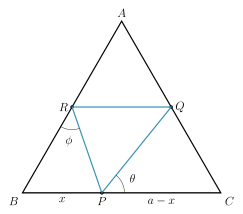
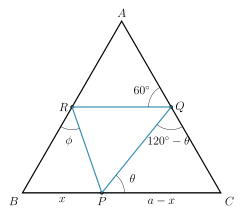
An equilateral triangle \(ABC\) has sides of length \(a\). The points \(P\), \(Q\) and \(R\) lie on the sides \(BC\), \(CA\) and \(AB\), respectively, such that the length \(BP\) is \(x\) and \(QR\) is parallel to \(CB\). Show that \[ (\sqrt{3}\cot\phi + 1)(\sqrt{3}\cot\theta + 1)x = 4(a - x), \] where \(\theta = \angle CPQ\) and \(\phi = \angle BRP\). A horizontal triangular frame with sides of length \(a\) and vertices \(A\), \(B\) and \(C\) is fixed on a smooth horizontal table. A small ball is placed at a point \(P\) inside the frame, in contact with side \(BC\) at a distance \(x\) from \(B\). It is struck so that it moves round the triangle \(PQR\) described above, bouncing off the frame at \(Q\) and then \(R\) before returning to point \(P\). The frame is smooth and the coefficient of restitution between the ball and the frame is \(e\). Show that \[ x = \frac{ae}{1 + e}. \] Show further that if the ball continues to move round \(PQR\) after returning to \(P\), then \(e = 1\).
Solution:
2020 Paper 3 Q4
The plane \(\Pi\) has equation \(\mathbf{r} \cdot \mathbf{n} = 0\) where \(\mathbf{n}\) is a unit vector. Let \(P\) be a point with position vector \(\mathbf{x}\) which does not lie on the plane \(\Pi\). Show that the point \(Q\) with position vector \(\mathbf{x} - (\mathbf{x} \cdot \mathbf{n})\mathbf{n}\) lies on \(\Pi\) and that \(PQ\) is perpendicular to \(\Pi\).
- Let transformation \(T\) be a reflection in the plane \(ax+by+cz=0\), where \(a^2+b^2+c^2=1\). Show that the image of \(\mathbf{i} = \begin{pmatrix} 1 \\ 0 \\ 0 \end{pmatrix}\) under \(T\) is \(\begin{pmatrix} b^2+c^2-a^2 \\ -2ab \\ -2ac \end{pmatrix}\), and find the images of \(\mathbf{j}\) and \(\mathbf{k}\) under \(T\). Write down the matrix \(\mathbf{M}\) which represents transformation \(T\).
- The matrix \[ \begin{pmatrix} 0.64 & 0.48 & 0.6 \\ 0.48 & 0.36 & -0.8 \\ 0.6 & -0.8 & 0 \end{pmatrix} \] represents a reflection in a plane. Find the cartesian equation of the plane.
- The matrix \(\mathbf{N}\) represents a rotation through angle \(\pi\) about the line through the origin parallel to \(\begin{pmatrix} a \\ b \\ c \end{pmatrix}\), where \(a^2+b^2+c^2=1\). Find the matrix \(\mathbf{N}\).
- Identify the single transformation which is represented by the matrix \(\mathbf{NM}\).
2011 Paper 2 Q5
The points \(A\) and \(B\) have position vectors \(\bf a \) and \(\bf b\) with respect to an origin \(O\), and \(O\), \(A\)~and~\(B\) are non-collinear. The point \(C\), with position vector \(\bf c\), is the reflection of \(B\) in the line through \(O\) and \(A\). Show that \(\bf c\) can be written in the form \[ \bf c = \lambda \bf a -\bf b \] where \(\displaystyle \lambda = \frac{2\,{\bf a .b}}{{\bf a.a}}\). The point \(D\), with position vector \(\bf d\), is the reflection of \(C\) in the line through \(O\) and \(B\). Show that \(\bf d\) can be written in the form \[ \bf d = \mu\bf b - \lambda \bf a \] for some scalar \(\mu\) to be determined. Given that \(A\), \(B\) and \(D\) are collinear, find the relationship between \(\lambda\) and \(\mu\). In the case \(\lambda = -\frac12\), determine the cosine of \(\angle AOB\) and describe the relative positions of \(A\), \(B\) and \(D\).
2008 Paper 2 Q10
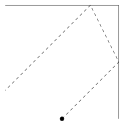
The lengths of the sides of a rectangular billiards table \(ABCD\) are given by \(AB = DC = a\) and \(AD=BC = 2b\). There are small pockets at the midpoints \(M\) and \(N\) of the sides \(AD\) and \(BC\), respectively. The sides of the table may be taken as smooth vertical walls. A small ball is projected along the table from the corner \(A\). It strikes the side \(BC\) at \(X\), then the side \(DC\) at \(Y\) and then goes directly into the pocket at \(M\). The angles \(BAX\), \(CXY\) and \(DY\!M\) are \(\alpha\), \(\beta\) and \(\gamma\) respectively. On each stage of its path, the ball moves with constant speed in a straight line, the speeds being \(u\), \(v\) and \(w\) respectively. The coefficient of restitution between the ball and the sides is \(e\), where \(e>0\).
- Show that \(\tan\alpha \tan \beta = e\) and find \(\gamma\) in terms of \(\alpha\).
- Show that \(\displaystyle \tan\alpha = \frac {(1+2e)b} {(1+e)a}\) and deduce that the shot is possible whatever the value of \(e\).
- Find an expression in terms of \(e\) for the fraction of the kinetic energy of the ball that is lost during the motion.
Solution:
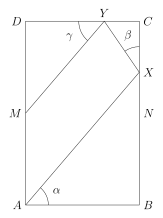
- The initial velocity is \(u = \binom{u \cos\alpha}{u \sin \alpha}\), therefore \(v = \binom{v_x}{u \sin \alpha}\). Newton's experimental law tells us \(v_x = -e u_x = -eu \cos\alpha\), therefore \(v = \binom{-eu \cos \alpha}{u \sin \alpha} = \binom{-v \sin \beta}{v\cos \beta} \Rightarrow -\tan \beta = -e \cot \alpha \Rightarrow \tan \alpha \tan \beta = e\). There is nothing special about the result here, and so it must also be the case that \(\tan \beta \tan \gamma = e \Rightarrow \tan \gamma = \tan \alpha\)
- \(\tan \alpha = \frac{XB}{BA}\) so the point \(X\) is at \((a, \tan \alpha a)\). The point \(Y\) satisfies \(\tan \beta = \frac{CY}{CX} = \frac{CY}{2b - \tan \alpha a}\) so the point \(Y\) is \((a-(2b - a \tan \alpha)\tan \beta,2b) = (a - 2b\tan \beta + ea, 2b) = ((1+e)a-2b\tan \beta, 2b)\). Finally, the point \(M\) is the midpoint, so \(\tan \gamma = \frac{DM}{DY}\) so \(M\) is the point \((0, 2b - ((1+e)a-2b\tan \beta)\tan \gamma) = (0, 2b - (1+e)a \tan \gamma - 2b e) = (0, (2b(1-e) - (1+e)a \tan \gamma)\), but \(M\) is the point \((0, b)\), ie \begin{align*} && b &= 2b(1-e) - (1+e)a \tan \gamma \\ \Rightarrow && b+2eb &= (1+e)a \tan \gamma \\ \Rightarrow && \tan \gamma &= \frac{(1+2e)b}{(1+e)a} \\ \Rightarrow && \tan \alpha &= \frac{(1+2e)b}{(1+e)a} \end{align*} Since \( \frac{(1+2e)b}{(1+e)a} = \frac{b}{a} + \frac{e}{1+e}b\) which is clearly an increasing function of \(e\) on \([0,1]\), so \(\tan \alpha \in \left [\frac{b}{a}, \frac{3b}{2a} \right]\) which are all all angles which place \(X\) in sensible places, therefore we can always hit the middle pocket. (Except \(e = 0\), where we would put the ball in \(N\), but we are given \(e > 0\)).
- After the first collision the velocity is \(\binom{-eu \cos \alpha}{u \sin \alpha}\) after the second collision the velocity is \(\binom{-eu \cos \alpha}{-eu \sin \alpha}\). Initial kinetic energy is therefore \(\frac12 m u^2\) and final kinetic energy is \(\frac12 m e^2u^2\) therefore the fraction lost is \(\frac{\frac12 m u^2 - \frac12 m e^2u^2}{\frac12 m u^2} = 1-e^2\)
2006 Paper 3 Q6
Show that in polar coordinates the gradient of any curve at the point \((r,\theta)\) is \[ \frac{ \ \ \dfrac{\d r }{\d\theta} \tan\theta + r \ \ } { \dfrac{\d r }{\d\theta} -r\tan\theta}\,. \] \noindent
1992 Paper 3 Q5
The tetrahedron \(ABCD\) has \(A\) at the point \((0,4,-2)\). It is symmetrical about the plane \(y+z=2,\) which passes through \(A\) and \(D\). The mid-point of \(BC\) is \(N\). The centre, \(Y\), of the sphere \(ABCD\) is at the point \((3,-2,4)\) and lies on \(AN\) such that \(\overrightarrow{AY}=3\overrightarrow{YN}.\) Show that \(BN=6\sqrt{2}\) and find the coordinates of \(B\) and \(C\). The angle \(AYD\) is \(\cos^{-1}\frac{1}{3}.\) Find the coordinates of \(D\). [There are two alternative answers for each point.]
Solution: Since \(B\) and \(C\) are reflections of each other in the plane \(y+z=2\) (since that's what it means to be symmetrical), we must have that \(N\) also lies on the plane \(y+z=2\). Since \(\overrightarrow{AY}=3\overrightarrow{YN}.\) we must have \(\overrightarrow{AN}=\overrightarrow{AY}+\overrightarrow{YN} = \frac43\overrightarrow{AY} = \frac43\begin{pmatrix} 3\\-6\\6\end{pmatrix} = \begin{pmatrix} 4\\-8\\8\end{pmatrix}\) and \(N\) is the point \((4,-4,6)\) (which fortunately is on our plane as expected). \(Y\) is the point \((3,-2,4)\) \(|\overrightarrow{AY}| = \sqrt{3^2+(-6)^2+6^2} = 3\sqrt{1+4+4} = 9\)

1989 Paper 2 Q5
- Show that in polar coordinates, the gradient of any curve at the point
\((r,\theta)\) is
\[
\left.\left(\frac{\mathrm{d}r}{\mathrm{d}\theta}\tan\theta+r\right)\right/\left(\frac{\mathrm{d}r}{\mathrm{d}\theta}-r\tan\theta\right).
\]

- A mirror is designed so that any ray of light which hits one side of the mirror and which is parallel to a certain fixed line \(L\) is reflected through a fixed point \(O\) on \(L\). For any ray hitting the mirror, the normal to the mirror at the point of reflection bisects the angle between the incident ray and the reflected ray, as shown in the figure. Prove that the mirror intersects any plane containing \(L\) in a parabola.
Solution:
- Suppose our curve is \(r(\theta)\), then \(y = r \sin \theta, x = r \cos \theta\) and \begin{align*} && \frac{\d y}{\d \theta} &= \frac{\d r}{\d \theta} \sin \theta + r \cos \theta \\ && \frac{\d x}{\d \theta} &= \frac{\d r}{\d \theta} \cos \theta - r \sin \theta \\ \Rightarrow && \frac{\d y}{\d x} &= \frac{\d y}{\d \theta} \Bigg / \frac{\d x}{\d \theta} \\ &&&= \frac{\frac{\d r}{\d \theta} \sin \theta + r \cos \theta}{\frac{\d r}{\d \theta} \cos \theta - r \sin \theta} \\ &&&= \frac{\frac{\d r}{\d \theta} \tan\theta + r }{\frac{\d r}{\d \theta} - r \tan\theta} \end{align*} as required.
- Set up a system of polar coordinates such that the origin is at \(O\) and all points in the plane containing \(L\) are represented by \((r, \theta)\). The constraint we have is that the angle of the normal, is \(\frac12 \theta\). Let \(\tan \tfrac12 \theta = t\), then \(\tan \theta = \frac{2t}{1-t^2}\) \begin{align*} && \tan \frac12 \theta &= -\frac{\frac{\d r}{\d \theta} - r \tan\theta}{\frac{\d r}{\d \theta} \tan\theta + r } \\ \Rightarrow && t &= -\frac{r'-r\frac{2t}{1-t^2}}{r' \frac{2t}{1-t^2}+r} \\ &&&= \frac{2tr-(1-t^2)r'}{2tr'+(1-t^2)r} \\ \Rightarrow && (2t^2+1-t^2)r' &= (2t-t+t^3)r \\ && (1+t^2)r' &= t(t^2+1) r \\ \Rightarrow && r' &= t r \\ \Rightarrow && \frac{\d r}{\d \theta} &= \tan \tfrac12 \theta r \\ \Rightarrow && \int \frac1r \d r &= \int \tan \frac12 \theta \d \theta \\ && \ln r &= -2\ln \cos \tfrac12 \theta+C \\ \Rightarrow && r\cos^2 \frac12 \theta &= C \\ \Rightarrow && r + r\cos \theta &= D \\ \Rightarrow && r &= D-x \\ \Rightarrow && x^2 + y^2 &= D^2 - 2Dx + x^2 \\ \Rightarrow && y^2 &= D^2-2Dx \end{align*} Therefore it is a parabola
1987 Paper 2 Q13
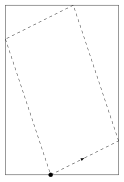
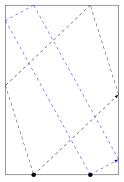
Ice snooker is played on a rectangular horizontal table, of length \(L\) and width \(B\), on which a small disc (the puck) slides without friction. The table is bounded by smooth vertical walls (the cushions) and the coefficient of restitution between the puck and any cushion is \(e\). If the puck is hit so that it bounces off two adjacent cushions, show that its final path (after two bounces) is parallel to its original path. The puck rests against the cushion at a point which divides the side of length \(L\) in the ratio \(z:1\). Show that it is possible, whatever \(z\), to hit the puck so that it bounces off the three other cushions in succession clockwise and returns to the spot at which it started. By considering these paths as \(z\) varies, explain briefly why there are two different ways in which, starting at any point away from the cushions, it is possible to perform a shot in which the puck bounces off all four cushions in succession clockwise and returns to its starting point.
Solution: