Problems
Filters
16 problems found
2021 Paper 2 Q9
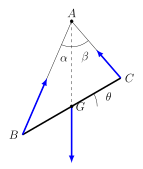
Two particles, of masses \(m_1\) and \(m_2\) where \(m_1 > m_2\), are attached to the ends of a light, inextensible string. A particle of mass \(M\) is fixed to a point \(P\) on the string. The string passes over two small, smooth pulleys at \(Q\) and \(R\), where \(QR\) is horizontal, so that the particle of mass \(m_1\) hangs vertically below \(Q\) and the particle of mass \(m_2\) hangs vertically below~\(R\). The particle of mass \(M\) hangs between the two pulleys with the section of the string \(PQ\) making an acute angle of \(\theta_1\) with the upward vertical and the section of the string \(PR\) making an acute angle of \(\theta_2\) with the upward vertical. \(S\) is the point on \(QR\) vertically above~\(P\). The system is in equilibrium.
- Using a triangle of forces, or otherwise, show that:
- \(\sqrt{m_1^2 - m_2^2} < M < m_1 + m_2\)\,;
- \(S\) divides \(QR\) in the ratio \(r : 1\), where \[ r = \frac{M^2 - m_1^2 + m_2^2}{M^2 - m_2^2 + m_1^2}. \]
- You are now given that \(M^2 = m_1^2 + m_2^2\). Show that \(\theta_1 + \theta_2 = 90^\circ\) and determine the ratio of \(QR\) to \(SP\) in terms of the masses only.
2018 Paper 2 Q7
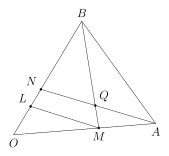
The points \(O\), \(A\) and \(B\) are the vertices of an acute-angled triangle. The points \(M\) and \(N\) lie on the sides \(OA\) and \(OB\) respectively, and the lines \(AN\) and \(BM\) intersect at \(Q\). The position vector of \(A\) with respect to \(O\) is \(\bf a\), and the position vectors of the other points are labelled similarly. Given that \(\vert MQ \vert = \mu \vert QB\vert \), and that \(\vert NQ \vert = \nu \vert QA\vert \), where \(\mu\) and \(\nu\) are positive and \(\mu \nu <1\), show that \[ {\bf m} = \frac {(1+\mu)\nu}{1+\nu} \, {\bf a} \,. \] The point \(L\) lies on the side \(OB\), and \(\vert OL \vert = \lambda \vert OB \vert \,\). Given that \(ML\) is parallel to \(AN\), express \(\lambda\) in terms of \(\mu\) and \(\nu\). What is the geometrical significance of the condition \(\mu\nu<1\,\)?
Solution:
2016 Paper 1 Q6
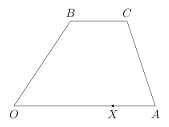
The sides \(OA\) and \(CB\) of the quadrilateral \(OABC\) are parallel. The point \(X\) lies on \(OA\), between \(O\) and \(A\). The position vectors of \(A\), \(B\), \(C\) and \(X\) relative to the origin \(O\) are \(\bf a\), \(\bf b\), \(\bf c\) and \(\bf x\), respectively. Explain why \(\bf c\) and \(\bf x\) can be written in the form \[ {\bf c} = k {\bf a} + {\bf b} \text{ and } {\bf x} = m {\bf a}\,, \] where \(k\) and \(m\) are scalars, and state the range of values that each of \(k\) and \(m\) can take. The lines \(OB\) and \(AC\) intersect at \(D\), the lines \(XD\) and \(BC\) intersect at \(Y\) and the lines \(OY\) and \(AB\) intersect at \(Z\). Show that the position vector of \(Z\) relative to \(O\) can be written as \[ \frac{ {\bf b} + mk {\bf a}}{mk+1}\,. \] The lines \(DZ\) and \(OA\) intersect at \(T\). Show that \[ OT \times OA = OX\times TA \text{ and } \frac 1 {OT} = \frac 1 {OX} + \frac 1 {OA} \,, \] where, for example, \(OT\) denotes the length of the line joining \(O\) and \(T\).
Solution:
2015 Paper 2 Q8
\noindent
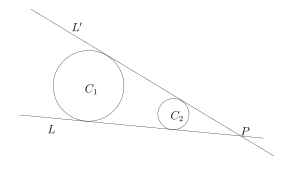
- Let \(\mathbf{x}_1\) and \(\mathbf{x}_2\) be the position vectors of the centres of \(C_1\) and \(C_2\), respectively. Show that the position vector of \(P\) is \[ \frac{r_1 \mathbf{x}_2- r_2 \mathbf{x}_1}{r_1-r_2} \,, \] where \(r_1\) and \(r_2\) are the radii of \(C_1\) and \(C_2\), respectively.
- The circle \(C_3\) does not overlap either \(C_1\) or \(C_2\) and its radius, \(r_3\), satisfies \(r_1 \ne r_3 \ne r_2\). The focus of \(C_1\) and \(C_3\) is \(Q\), and the focus of \(C_2\) and \(C_3\) is \(R\). Show that \(P\), \(Q\) and \(R\) lie on the same straight line.
- Find a condition on \(r_1\), \(r_2\) and \(r_3\) for \(Q\) to lie half-way between \(P\) and \(R\).
Solution:
- Notice that \(P\) lies on \(C_1C_2\), and that the triangles formed from \(C_iPT_i\) where \(T_i\) are the tangent points are similar, with ratios \(\frac{r_1}{r_2}\). Therefore \(\frac{C_1P}{r_1} = \frac{C_2P}{r_2}\), and hence \(\frac{C_1P}{C_1C_2} = \frac{C_1P}{C_1P-C_2P} = \frac{1}{1-\frac{r_2}{r_1}} = \frac{r_1}{r_1-r_2}\) So we have \(\mathbf{p} = \mathbf{x_1} + (\mathbf{x}_2 - \mathbf{x}_1)\cdot\frac{r_1}{r_1-r_2} = \frac{r_1\mathbf{x}_2 - r_2\mathbf{x}_1}{r_1-r_2}\)
- Suppose \(\mathbf{x}_3 = \binom{\alpha}{\beta}\) in the basis of \(\{ \mathbf{x}_1, \mathbf{x}_2 \}\), then we can see that \begin{align*} && \mathbf{p} &= \frac{1}{r_1-r_2}\binom{-r_2}{r_1} \\ && \mathbf{q} &= \frac{r_1(\alpha \mathbf{x}_1 +\beta \mathbf{x}_2) - r_3\mathbf{x}_1}{r_1-r_3} \\ &&&= \frac{1}{r_1-r_3} \binom{r_1\alpha -r_3}{r_1\beta} \\ && \mathbf{r} &=\frac{1}{r_2-r_3} \binom{r_2\alpha}{r_2\beta - r_3} \\ && \mathbf{p}-\mathbf{q} &= \frac{1}{r_1-r_2}\binom{-r_2}{r_1} - \frac{1}{r_1-r_3} \binom{r_1\alpha -r_3}{r_1\beta} \\ &&&= \frac{1}{(r_1-r_2)(r_1-r_3)} \binom{(r_1-r_3)(-r_2)-(r_1-r_2)(r_1\alpha-r_3)}{(r_1-r_3)r_1 - (r_1-r_2)r_1\beta} \\ &&&= \frac{r_1}{(r_1-r_2)(r_1-r_3)} \binom{(r_3-r_2)-\alpha(r_1-r_2)}{(r_1-r_3)-\beta(r_1-r_2)} \\ && \mathbf{q} - \mathbf{r} &= \frac{1}{r_1-r_3} \binom{r_1\alpha -r_3}{r_1\beta} - \frac{1}{r_2-r_3} \binom{r_2\alpha}{r_2\beta - r_3} \\ &&&= \frac{1}{(r_1-r_3)(r_2-r_3)}\binom{(r_2-r_3)(r_1\alpha-r_3) - (r_1-r_3)r_2\alpha)}{(r_2-r_3)r_1\beta - (r_1-r_3)(r_2\beta - r_3)} \\ &&&= \frac{1}{(r_1-r_3)(r_2-r_3)}\binom{(-r_2r_3+r_3^2) - \alpha(r_1r_3-r_3r_2)}{r_3(r_1-r_3)-\beta(r_1-r_2)} \\ &&&= \frac{r_3}{(r_1-r_3)(r_2-r_3)}\binom{(r_3-r_2)-\alpha(r_1-r_2)}{(r_1-r_3)-\beta(r_1-r_2)} \end{align*} Therefore they are clearly parallel, and hence lie on a line.
- \(Q\) is halfway between \(P\) and \(R\) if \begin{align*} && \frac{r_1}{(r_1-r_2)(r_1-r_3)} &= \frac{r_3}{(r_1-r_3)(r_2-r_3)} \\ \Leftrightarrow && r_1(r_2-r_3) &= r_3(r_1-r_2) \\ \Leftrightarrow && r_1r_2 - r_1r_3 &= r_1r_3 - r_2r_3 \\ \Leftrightarrow && r_2 &= \frac{2r_1r_3}{r_1+r_3} \end{align*}
2014 Paper 1 Q7
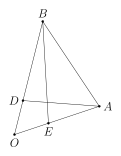
In the triangle \(OAB\), the point \(D\) divides the side \(BO\) in the ratio \(r:1\) (so that \(BD = rDO\)), and the point \(E\) divides the side \(OA\) in the ratio \(s:1\) (so that \(OE =s EA\)), where \(r\) and \(s\) are both positive.
- The lines \(AD\) and \(BE\) intersect at \(G\). Show that \[ \mathbf{g}= \frac{rs}{1+r+rs} \, \mathbf{a} + \frac 1 {1+r+rs} \, \mathbf{b} \,, \] where \(\mathbf{a}, \mathbf{b}\) and \(\mathbf{g}\) are the position vectors with respect to \(O\) of \(A\), \(B\) and \(G\), respectively.
- The line through \(G\) and \(O\) meets \(AB\) at \(F\). Given that \(F\) divides \(AB\) in the ratio \(t:1\), find an expression for \(t\) in terms of \(r\) and \(s\).
Solution:
2010 Paper 1 Q7
Relative to a fixed origin \(O\), the points \(A\) and \(B\) have position vectors \(\bf{a}\) and \(\bf{b}\), respectively. (The points \(O\), \(A\) and \(B\) are not collinear.) The point \(C\) has position vector \(\bf c\) given by \[ {\bf c} =\alpha {\bf a}+ \beta {\bf b}\,, \] where \(\alpha\) and \(\beta\) are positive constants with \(\alpha+\beta<1\,\). The lines \(OA\) and \(BC\) meet at the point \(P\) with position vector \(\bf p\) and the lines \(OB\) and \(AC\) meet at the point \(Q\) with position vector \(\bf q\). Show that \[ {\bf p} =\frac{\alpha {\bf a} }{1-\beta}\,, \] and write down \(\bf q\) in terms of \(\alpha,\ \beta\) and \(\bf {b}\). Show further that the point \(R\) with position vector \(\bf r\) given by \[ {\bf r} =\frac{\alpha {\bf a} + \beta {\bf b}}{\alpha + \beta}\,, \] lies on the lines \(OC\) and \(AB\). The lines \(OB\) and \(PR\) intersect at the point \(S\). Prove that $ \dfrac{OQ}{BQ} = \dfrac{OS}{BS}\,$.
2009 Paper 1 Q4
The sides of a triangle have lengths \(p-q\), \(p\) and \(p+q\), where \(p>q> 0\,\). The largest and smallest angles of the triangle are \(\alpha\) and \(\beta\), respectively. Show by means of the cosine rule that \[ 4(1-\cos\alpha)(1-\cos\beta) = \cos\alpha + \cos\beta \,. \] In the case \(\alpha = 2\beta\), show that \(\cos\beta=\frac34\) and hence find the ratio of the lengths of the sides of the triangle.
Solution: The largest angle will be opposite the side with length \(p+q\). Similarly the smallest angle will be opposite the side with length \(p-q\). The cosine rule tells us that: \begin{align*} && (p+q)^2 &= p^2 + (p-q)^2 - 2p(p-q) \cos \alpha \\ && 0 &= p(p-4q-2(p-q)\cos \alpha)\\ && 0 &= p(1-2\cos \alpha) + q(2\cos \alpha - 4)\\ \Rightarrow && \frac{p}{q} & = \frac{4-2 \cos \alpha}{1-2 \cos \alpha} \\ && (p-q)^2 &= p^2 + (p+q)^2 - 2p(p+q) \cos \beta \\ && 0 &= p(p+4q-2(p+q) \cos \beta) \\ && 0 &= p(1-2\cos \beta)+q(4-2\cos \beta) \\ \Rightarrow && \frac{p}{q} &= \frac{2\cos \beta - 4}{1-2\cos \beta} \\ \Rightarrow && \frac{4-2 \cos \alpha}{1-2 \cos \alpha} &= \frac{2\cos \beta - 4}{1-2\cos \beta} \\ \Rightarrow && (2-\cos \alpha)(1-2\cos \beta) &= (\cos \beta - 2)(1 - 2 \cos \alpha) \\ \Rightarrow && 2 - \cos \alpha -4\cos \beta+2\cos \alpha \cos \beta &= \cos \beta - 2-2\cos \alpha \cos \beta + 4 \cos \alpha \\ \Rightarrow && 4-4\cos \alpha - 4\cos \beta+4\cos \alpha\cos \beta &= \cos \alpha + \cos \beta \\ \Rightarrow && 4(1-\cos \alpha)(1-\cos \beta) &= \cos \alpha + \cos \beta \end{align*} If \(\alpha = 2 \beta\), and let \(c = \cos \beta\) \begin{align*} && 4 (1- \cos 2 \beta)(1-\cos \beta) &= \cos 2 \beta + \cos \beta \\ \Rightarrow && 4(1-(2c^2-1))(1-c) &= 2c^2-1+c\\ \Rightarrow && 8(1+c)(1-c)^2 &= (2c-1)(c+1) \\ \Rightarrow && 0 &= (c+1)(8(1-c)^2-(2c-1)) \\ &&&= (c+1)(8c^2-18c+9) \\ &&&= (c+1)(4c-3)(2c-3) \\ \end{align*} Therefore \(c = -1, \frac32, \frac34\). Clearly \(\cos \beta \neq -1, \frac32\), since they are not valid angles in a triangle (or valid values of \(\cos \beta\)). \(\frac{p}{q} = \frac{2 \cdot \frac34-4 }{1 - 2\cdot \frac34} = \frac{3-8}{2-3} = 5\) so \(4:5:6\)
2007 Paper 2 Q8
The points \(B\) and \(C\) have position vectors \(\mathbf{b}\) and \(\mathbf{c}\), respectively, relative to the origin \(A\), and \(A\), \(B\) and \(C\) are not collinear.
- The point \(X\) has position vector \(s \mathbf{b}+t\mathbf{c}\). Describe the locus of \(X\) when \(s+t=1\).
- The point \(P\) has position vector \(\beta \mathbf{b}+\gamma\mathbf{c}\), where \(\beta\) and \(\gamma\) are non-zero, and \(\beta+\gamma\ne1\). The line \(AP\) cuts the line \(BC\) at \(D\). Show that \(BD:DC=\gamma:\beta\).
- The line \(BP\) cuts the line \(CA\) at \(E\), and the line \(CP\) cuts the line \(AB\) at \(F\). Show that \[ \frac{AF}{FB} \times \frac{BD}{DC} \times \frac{CE}{EA}=1\,. \]
Solution:
- \(X\) lies on the line including \(B\) and \(C\).
- points on the line \(AP\) have the form \(\lambda(\beta \mathbf{b}+\gamma\mathbf{c})\), and the point \(D\) will be the point where \(\lambda\beta + \lambda \gamma = 1\). \begin{align*} && \frac{|BD|}{|DC|} &= \frac{|\mathbf{b} -\lambda(\beta \mathbf{b}+\gamma\mathbf{c})| }{|\lambda(\beta \mathbf{b}+\gamma\mathbf{c})- \mathbf{c}|} \\ &&&= \frac{|(1-\lambda \beta)\mathbf{b} - \lambda \gamma \mathbf{c}|}{|\lambda \beta \mathbf{b}+(\lambda \gamma -1)\mathbf{c}|}\\ &&&= \frac{|\lambda \gamma\mathbf{b} - \lambda \gamma \mathbf{c}|}{|\lambda \beta \mathbf{b}-(\lambda \beta)\mathbf{c}|} \\ &&&= \frac{\gamma}{\beta} \end{align*}
- The line \(BP\) is \(\mathbf{b} + \mu(\beta \mathbf{b}+\gamma\mathbf{c})\) and will meet \(CA\) when \(1+\mu\beta = 0\), ie \(\mu = -\frac{1}{\beta}\), therefore \(E\) is \(-\frac{\gamma}{\beta}\mathbf{c}\), and so \(\frac{|CE|}{|EA|} = \frac{1+\gamma/\beta}{\gamma/\beta} = \frac{\beta+\gamma}{\gamma}\). Similarly, \(F\) is \(-\frac{\beta}{\gamma}\mathbf{b}\) and \(\frac{|AF|}{|FB|} = \frac{\beta/\gamma}{1+\frac{\beta}{\gamma}} = \frac{\beta}{\gamma+\beta}\), and so \[\frac{AF}{FB} \times \frac{BD}{DC} \times \frac{CE}{EA} = \frac{\beta}{\gamma+\beta} \frac{\gamma}{\beta} \frac{\beta+\gamma}{\gamma} = 1 \]
2006 Paper 2 Q8
Show that the line through the points with position vectors \(\bf x\) and \(\bf y\) has equation \[{\bf r} = (1-\alpha){\bf x} +\alpha {\bf y}\,, \] where \(\alpha\) is a scalar parameter. The sides \(OA\) and \(CB\) of a trapezium \(OABC\) are parallel, and \(OA>CB\). The point \(E\) on \(OA\) is such that \(OE : EA = 1:2\), and \(F\) is the midpoint of \(CB\). The point \(D\) is the intersection of \(OC\) produced and \(AB\) produced; the point \(G\) is the intersection of \(OB\) and \(EF\); and the point \(H\) is the intersection of \(DG\) produced and \(OA\). Let \(\bf a\) and \(\bf c\) be the position vectors of the points \(A\) and \(C\), respectively, with respect to the origin \(O\).
- Show that \(B\) has position vector \(\lambda {\bf a} + {\bf c}\) for some scalar parameter \(\lambda\).
- Find, in terms of \(\bf a\), \(\bf c\) and \(\lambda\) only, the position vectors of \(D\), \(E\), \(F\), \(G\) and \(H\). Determine the ratio \(OH:HA\).
2005 Paper 3 Q4
The sequence \(u_n\) (\(n= 1, 2, \ldots\)) satisfies the recurrence relation \[ u_{n+2}= \frac{u_{n+1}}{u_n}(ku_n-u_{n+1}) \] where \(k\) is a constant. If \(u_1=a\) and \(u_2=b\,\), where \(a\) and \(b\) are non-zero and \(b \ne ka\,\), prove by induction that \[ u_{2n}=\Big(\frac b a \Big) u_{2n-1} \] \[ u_{2n+1}= c u_{2n} \] for \(n \ge 1\), where \(c\) is a constant to be found in terms of \(k\), \(a\) and \(b\). Hence express \(u_{2n}\) and \(u_{2n-1}\) in terms of \(a\), \(b\), \(c\) and \(n\). Find conditions on \(a\), \(b\) and \(k\) in the three cases:
- the sequence \(u_n\) is geometric;
- \(u_n\) has period 2;
- the sequence \(u_n\) has period 4.
2004 Paper 3 Q4
The triangle \(OAB\) is isosceles, with \(OA = OB\) and angle \(AOB = 2 \alpha\) where \(0< \alpha < {\pi \over 2}\,\). The semi-circle \(\mathrm{C}_0\) has its centre at the midpoint of the base \(AB\) of the triangle, and the sides \(OA\) and \(OB\) of the triangle are both tangent to the semi-circle. \(\mathrm{C}_1, \mathrm{C}_2, \mathrm{C}_3, \ldots\) are circles such that \(\mathrm{C}_n\) is tangent to \(\mathrm{C}_{n-1}\) and to sides \(OA\) and \(OB\) of the triangle. Let \(r_n\) be the radius of \(\mathrm{C}_n\,\). Show that \[ \frac{r_{n+1}}{r_n} = \frac{1-\sin\alpha}{1+\sin\alpha}\;. \] Let \(S\) be the total area of the semi-circle \(\mathrm{C}_0\) and the circles \(\mathrm{C}_1\), \(\mathrm{C}_2\), \(\mathrm{C}_3\), \(\ldots\;\). Show that \[ S = {1 + \sin^2 \alpha \over 4 \sin \alpha} \, \pi r_0^2 \;. \] Show that there are values of \(\alpha\) for which \(S\) is more than four fifths of the area of triangle~\(OAB\).
2000 Paper 3 Q5
Given two non-zero vectors $\mathbf{a}=\begin{pmatrix}a_{1}\\ a_{2} \end{pmatrix}\( and \)\mathbf{b}=\begin{pmatrix}b_{1}\\ b_{2} \end{pmatrix}\( define \)\Delta\!\! \left( \bf a, \bf b \right)\( by \)\Delta\!\! \left( \bf a, \bf b \right) = a_1 b_2 - a_2 b_1$. Let \(A\), \(B\) and \(C\) be points with position vectors \(\bf a\), \(\bf b\) and \(\bf c\), respectively, no two of which are parallel. Let \(P\), \(Q\) and \(R\) be points with position vectors \(\bf p\), \(\bf q\) and \(\bf r\), respectively, none of which are parallel.
- Show that there exists a \(2 \times 2\) matrix \(\bf M\) such that \(P\) and \(Q\) are the images of \(A\) and \(B\) under the transformation represented by \(\bf M\).
- Show that \( \Delta\!\! \left( \bf a, \bf b \right) \bf c + \Delta\!\! \left( \bf c, \bf a \right) \bf b + \Delta\!\! \left( \bf b, \bf c \right) \bf a = 0. \) Hence, or otherwise, prove that a necessary and sufficient condition for the points \(P\), \(Q\), and \(R\) to be the images of points \(A\), \(B\) and \(C\) under the transformation represented by some \(2 \times 2\) matrix \(\bf M\) is that \[ \Delta\!\! \left( \bf a, \bf b \right) : \Delta\!\! \left( \bf b, \bf c \right) : \Delta\!\! \left( \bf c, \bf a \right) = \Delta\!\! \left( \bf p, \bf q \right) : \Delta\!\! \left( \bf q, \bf r \right) : \Delta\!\! \left( \bf r, \bf p \right). \]
Solution:
- First notice that there is a matrix taking \((1,0)\) and \((0,1)\) to \(P\) and \(Q\). Notice there is also a matrix taking \((1,0)\) and \((0,1)\) to \(A\) and \(B\). Since \(A\) and \(B\) are not parallel, this map is invertible. Then we must be able to compose this inverse with the second map to obtain a matrix \(\mathbf{M}\) satisfying our conditions.
- \(\,\) \begin{align*} && LHS &= \Delta\!\! \left( \bf a, \bf b \right) \bf c + \Delta\!\! \left( \bf c, \bf a \right) \bf b + \Delta\!\! \left( \bf b, \bf c \right) \bf a \\ &&&= (a_1b_2-a_2b_1) \binom{c_1}{c_2} + (c_1a_2-c_2a_1)\binom{b_1}{b_2} + (b_1c_2-b_2c_1)\binom{a_1}{a_2} \\ &&&= \binom{a_1b_2c_1-a_2b_1c_1+c_1a_2b_1-c_2a_1b_1+b_1c_2a_1-b_2c_1a_1}{a_1b_2c_2-a_2b_1c_2+c_1a_2b_2-c_2a_1b_2+b_1c_1a_2-b_2c_1a_2} \\ &&&= \binom{0}{0} \\ &&&= \mathbf{0} \end{align*} First note that the matrix taking \(P\), \(Q\) to \(A\), \(B\) is unique. (\(\Rightarrow\)) Suppose \(\mathbf{Ma} = \mathbf{p}\) and \(\mathbf{Mb} = \mathbf{q}\) and \(\mathbf{Mc} = \mathbf{r}\). Then notice that \begin{align*} && \mathbf{0} &= \mathbf{M0} \\ &&&= \mathbf{M}\left ( \Delta\!\! \left( \bf a, \bf b \right) \bf c + \Delta\!\! \left( \bf c, \bf a \right) \bf b + \Delta\!\! \left( \bf b, \bf c \right) \bf a\right) \\ &&&= \Delta\!\! \left( \bf a, \bf b \right)\mathbf{M} \bf c + \Delta\!\! \left( \bf c, \bf a \right) \mathbf{M}\bf b + \Delta\!\! \left( \bf b, \bf c \right) \mathbf{M}\bf a\\ &&&= \Delta\!\! \left( \bf a, \bf b \right)\bf r + \Delta\!\! \left( \bf c, \bf a \right)\bf q + \Delta\!\! \left( \bf b, \bf c \right) \bf p\\ \end{align*} However, since \(\mathbf{p}, \mathbf{q}, \mathbf{r}\) are not parallel, then these coefficients must be a scalar multiples of \(\Delta(\mathbf{p}, \mathbf{q}), \cdots\) as required. \((\Leftarrow)\) Suppose we have this relationship, and \(\mathbf{Ma} = \mathbf{p}\) and \(\mathbf{Mb} = \mathbf{q}\), then \begin{align*} && \mathbf{0} &= \mathbf{M0} \\ &&&= \mathbf{M}\left ( \Delta\!\! \left( \bf a, \bf b \right) \bf c + \Delta\!\! \left( \bf c, \bf a \right) \bf b + \Delta\!\! \left( \bf b, \bf c \right) \bf a\right) \\ &&&= \Delta\!\! \left( \bf a, \bf b \right)\mathbf{M} \bf c + \Delta\!\! \left( \bf c, \bf a \right) \mathbf{M}\bf b + \Delta\!\! \left( \bf b, \bf c \right) \mathbf{M}\bf a\\ &&&= \Delta\!\! \left( \bf a, \bf b \right)\mathbf{Mc} + \Delta\!\! \left( \bf c, \bf a \right)\bf q + \Delta\!\! \left( \bf b, \bf c \right) \bf p\\ \end{align*} Since these are scalar multiples of \(\Delta(\mathbf{p}, \mathbf{q}), \cdots\) and we write this as \begin{align*} && \mathbf{0} &= \Delta(\mathbf{p}, \mathbf{q})\mathbf{Mc} + \Delta(\mathbf{r}, \mathbf{p})\mathbf{q} + \Delta (\mathbf{q}, \mathbf{r})\mathbf{p} \end{align*} But since \(\mathbf{p}, \mathbf{q}, \mathbf{r}\) are not parallel, this means that \(\mathbf{Mc}\) is uniquely defined to be \(\mathbf{r}\) as required.
1999 Paper 2 Q13
A stick is broken at a point, chosen at random, along its length. Find the probability that the ratio, \(R\), of the length of the shorter piece to the length of the longer piece is less than \(r\). Find the probability density function for \(R\), and calculate the mean and variance of \(R\).
Solution: Let \(X \sim U[0, \tfrac12]\) be the shorter piece, so \(R = \frac{X}{1-X}\), and \begin{align*} && \mathbb{P}(R \leq r) &= \mathbb{P}(\tfrac{X}{1-X} \leq r) \\ &&&= \mathbb{P}(X \leq r - rX) \\ &&&= \mathbb{P}((1+r)X \leq r) \\ &&&= \mathbb{P}(X \leq \tfrac{r}{1+r} ) \\ &&&= \begin{cases} 0 & r < 0 \\ \frac{2r}{1+r} & 0 \leq r \leq 1 \\ 1 & r > 1 \end{cases} \\ \\ && f_R(r) &= \begin{cases} \frac{2}{(1+r)^2} & 0 \leq r \leq 1 \\ 0 & \text{otherwise} \end{cases} \end{align*} Let \(Y \sim U[\tfrac12, 1]\) be the longer piece, then \(R = \frac{1-Y}{Y} = Y^{-1} - 1\) and \begin{align*} \E[R] &= \int_{\frac12}^1 (y^{-1}-1) 2 \d y \\ &= 2\left [\ln y - y \right]_{\frac12}^1 \\ &= -2 + 2\ln2 +2\frac12 \\ &= 2\ln2 -1 \\ \\ \E[R^2] &= \int_{\frac12}^1 (y^{-1}-1)^2 2 \d y\\ &= 2\left [-y^{-1} -2\ln y + 1 \right]_{\frac12}^1 \\ &= 2 \left ( 2 - 2\ln 2+\frac12\right) \\ &= 3-4\ln 2 \\ \var[R] &= 3 - 4 \ln 2 -(2\ln 2-1)^2 \\ &= 2 - 4(\ln 2)^2 \end{align*}
1997 Paper 3 Q5
Find the ratio, over one revolution, of the distance moved by a wheel rolling on a flat surface to the distance traced out by a point on its circumference.
Solution: The point on the circumference will have position \((a\cos t, a \sin t )\) relative to the circumference where \(t \in [0, 2\pi]\). the wheel will travel \(2\pi a\), therefore the position is \((a\cos t + at, a \sin t )\). The total distance travelled can be computed using the arc length: \begin{align*} && s &= \int_0^{2\pi} \sqrt{\left ( \frac{\d y}{\d t} \right)^2 +\left ( \frac{\d x}{\d t} \right)^2} \d t \\ &&&= \int_0^{2\pi} \sqrt{(a - a\sin t)^2 +(a \cos t)^2 } \d t \\ &&&= a \int_0^{2\pi} \sqrt{2 - 2 \sin t } \d t \\ &&&= \sqrt{2}a \int_0^{2 \pi} \sqrt{1 - \sin t} \d t \\ &&&= \sqrt{2}a \int_0^{2 \pi} \frac{|\cos t|}{\sqrt{1 + \sin t}} \d t \\ &&&= 2\sqrt{2} a \int_{-\pi/2}^{\pi/2} \frac{\cos t}{\sqrt{1+\sin t}} \d t \\ &&&= 2\sqrt{2} a \left [ 2\sqrt{1+\sin t} \right]_{-\pi/2}^{\pi/2} \\ &&& = 2\sqrt{2} a 2\sqrt{2} \\ &&&= 8a \end{align*} Therefore the ratio is \(\frac{4}{\pi}\)
1997 Paper 3 Q9
A uniform rigid rod \(BC\) is suspended from a fixed point \(A\) by light stretched springs \(AB,AC\). The springs are of different natural lengths but the ratio of tension to extension is the same constant \(\kappa\) for each. The rod is not hanging vertically. Show that the ratio of the lengths of the stretched springs is equal to the ratio of the natural lengths of the unstretched springs.
Solution: