Problems
Filters
35 problems found
2025 Paper 2 Q1
The function \(\mathrm{Min}\) is defined as \[ \mathrm{Min}(a, b) = \begin{cases} a & \text{if } a \leq b \\ b & \text{if } a > b \end{cases} \]
- Sketch the graph \(y = \mathrm{Min}(x^2, 2x)\).
- Solve the equation \(2\mathrm{Min}(x^2, 2x) = 5x - 3\).
- Solve the equation \(\mathrm{Min}(x^2, 2x) + \mathrm{Min}(x^3, 4x) = mx\) in the cases \(m = 2\) and \(m = 6\).
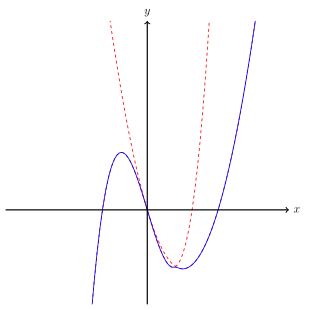
- Show that \((1, -3)\) is a local maximum point on the curve \(y = 2\mathrm{Min}(x^2, x^3) - 5x\) and find the other three local maxima and minima on this curve. Sketch the curve.
Solution:
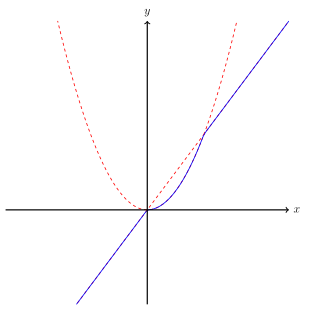
- \(2 \textrm{Min}(x^2,2x) = 5x-3\) tells us either \(2x^2 = 5x-3 \Rightarrow 2x^2 - 5x +3 = 0 \Rightarrow (2x-3)(x-1) \Rightarrow x = 1, \frac32\) and \(0 \leq x \leq 2\) or \(4x = 5x-3 \Rightarrow x= 3\) and \(x < 0\) or \(2 > x\), therefore our solutions are \(x = 1, \frac32, 3\)
- We have different cases based on \(x\) vs \(-2, 0, 2\), ie Case \(x \leq -2\): \begin{align*} && mx &= \mathrm{Min}(x^2, 2x) + \mathrm{Min}(x^3, 4x) \\ &&&= 2x + x^3 \end{align*} So \(2x = 2x + x^3 \Rightarrow x^3 = 0\), but \(x \leq -2\) so no solutions. or \(6x = 2x + x^3 \Rightarrow 0 = x(x^2-4) \Rightarrow x = 0, 2, -2\) so \(x = -2\). Case \(-2 < x \leq 0\): \begin{align*} && mx &= \mathrm{Min}(x^2, 2x) + \mathrm{Min}(x^3, 4x) \\ &&&= 2x + 4x \end{align*} So \(2x = 2x + 4x\) ie \(x = 0\) which is valid. Or \(6x = 2x + 4x\) ie valid for all values in \(-2 \leq x \leq 0\) Case \(0 < x \leq 2\): \begin{align*} && mx &= \mathrm{Min}(x^2, 2x) + \mathrm{Min}(x^3, 4x) \\ &&&= x^2 + x^3 \end{align*} So \(2x = x^2 + x^3 \Rightarrow 0 = x(x^2+x-2) = x(x-1)(x+2)\) so \(x = 0, 1, -2\), but the range means \(x = 0\) or \(x = 1\) Or \(6x = x^2 + x^3 \Rightarrow 0 = x(x^2+x-6) = x(x-2)(x+3)\) so \(x = 0, 2, -3\), but the range means \(x = 0\) or \(x = 2\) Case \(2 \leq x \): \begin{align*} && mx &= \mathrm{Min}(x^2, 2x) + \mathrm{Min}(x^3, 4x) \\ &&&=2x + 4x \end{align*} So \(2x = 2x + 4x \Rightarrow x = 0\) so no solutions. Or \(6x = 2x + 4x\) so a range of solutions. Therefore the final solutions for \(m = 2\) are \(x = 0, x = 1\) and for \(m = 2\) are \(x \in [-2,0] \cup [2, \infty)\)
- \(\mathrm{Min}(x^2, x^3)\) switches when \(x = 1\), so we must consider both limits:
\begin{align*}
&& \frac{\d y}{\d x}\vert_{x > 1} &= 4x - 5 \\
\\
&& \frac{\d y}{\d x}\vert_{x < 1} &= 6x^2 - 5 \\
\end{align*}
so when \(x = 1\) the sign of the derivative changes from positive to negative, hence a local maximum.
The other local maxima and minima will be when \(x = \frac54\) or \(x = \pm \sqrt{5/6}\)
2024 Paper 2 Q9
A long straight trench, with rectangular cross section, has been dug in otherwise horizontal ground. The width of the trench is \(d\) and its depth \(2d\). A particle is projected at speed \(v\), where \(v^2 = \lambda dg\), at an angle \(\alpha\) to the horizontal, from a point on the ground a distance \(d\) from the nearer edge of the trench. The vertical plane in which it moves is perpendicular to the trench.
- The particle lands on the base of the trench without first touching either of its sides.
- By considering the vertical displacement of the particle when its horizontal displacement is \(d\), show that \((\tan\alpha - \lambda)^2 < \lambda^2 - 1\) and deduce that \(\lambda > 1\).
- Show also that \((2\tan\alpha - \lambda)^2 > \lambda^2 + 4(\lambda - 1)\) and deduce that \(\alpha > 45^\circ\).
- Show that, provided \(\lambda > 1\), \(\alpha\) can always be chosen so that the particle lands on the base of the trench without first touching either of its sides.
2019 Paper 1 Q10
In this question, the \(x\)-axis is horizontal and the positive \(y\)-axis is vertically upwards. A particle is projected from the origin with speed \(u\) at an angle \(\alpha\) to the vertical. The particle passes through the fixed point \((h \tan \beta, h)\), where \(0 < \beta < 90^{\circ}\) and \(h > 0\).
- Show that
$$c^2 - ck \cot \beta + 1 + k \cot^2 \beta = 0, \quad (*)$$
where \(c = \cot \alpha\) and \(k = \frac{2u^2}{gh}\).
You are given that there are two distinct values of \(\alpha\) that satisfy equation \((*)\). Let \(\alpha_1\) and \(\alpha_2\) be these values.
- Show that $$\cot \alpha_1 + \cot \alpha_2 = k \cot \beta.$$ Show also that $$\alpha_1 + \alpha_2 = \beta.$$
- Show that $$k > 2(1 + \sec \beta).$$
- By considering the greatest height attained by the particle, show that \(k \geq 4 \sec^2 \alpha\).
Solution:
- The horizontal position of the particle at time \(t\) is \(u \sin\alpha t\), so \(T = \frac{h \tan \beta}{u \sin \alpha}\)
The vertical position of the particle at this time \(T\) satisifes:
\begin{align*}
&& h &= u \cos\alpha \frac{h \tan \beta}{u \sin\alpha} - \frac12 g \left ( \frac{h \tan \beta}{u \sin\alpha} \right)^2 \\
&&&= h\cot \alpha \tan \beta - \frac{gh^2}{2u^2} \tan^2 \beta \cosec^2 \beta \\
\Rightarrow && 1 &= c \tan \beta - \frac{1}{k} \tan^2 \beta (1 + c^2) \\
\Rightarrow && k \cot^2 \beta &= kc\cot \beta -1-c^2 \\
\Rightarrow && 0 &= c^2 -ck \cot \beta + 1 + k \cot^2 \beta
\end{align*}
- As a quadratic in \(c\) the sum of the roots is \(k \cot \beta\), therefore \(\cot \alpha_1 + \cot \alpha_2 = k \cot \beta\). We also have that \(\cot \alpha_1 \cot \alpha_2 = 1 + k \cot^2 \beta\), so \begin{align*} && \cot (\alpha_1 + \alpha_2) &= \frac{\cot \alpha_1 \cot \alpha_2-1}{\cot \alpha_1 + \cot \alpha_2} \\ &&&= \frac{1 + k \cot^2 \beta - 1}{k \cot \beta} \\ &&&= \cot \beta \\ \Rightarrow && \beta &= \alpha_1 + \alpha_2 \pmod{\pi} \end{align*} but since \(\alpha_i \in (0, \frac{\pi}{2})\) the equation must hold exactly.
- Since it has two real roots we must have \begin{align*} && 0 &<\Delta = k^2 \cot^2 \beta - 4 (1 + k \cot^2 \beta) \\ &&&= k^2 \cot^2 \beta-4k \cot^2 \beta -4 \\ &&&= \cot^2 \beta (k^2 - 4k - 4(\sec^2 \beta - 1)) \\ &&&= \cot^2 \beta ( (k-2)^2 -4\sec^2 \beta) \\ \Rightarrow && k &> 2 + 2\sec \beta = 2(1+\sec \beta) \end{align*}
- The greatest height will satisfy \(v^2 = u^2 + 2as\) so \(0 = u^2 \cos^2 \alpha - 2gh_{max} \Rightarrow 4\sec^2 \alpha = \frac{2u^2}{gh_{max}} = k_{max}\), but this decreases with \(h\), so the smallest \(k\) can be is \(4\sec^2 \alpha\), ie \(k \geq 4 \sec^2 \alpha\)
2019 Paper 2 Q1
Let \(f(x) = (x-p)g(x)\), where g is a polynomial. Show that the tangent to the curve \(y = f(x)\) at the point with \(x = a\), where \(a \neq p\), passes through the point \((p, 0)\) if and only if \(g'(a) = 0\). The curve \(C\) has equation $$y = A(x - p)(x - q)(x - r),$$ where \(p\), \(q\) and \(r\) are constants with \(p < q < r\), and \(A\) is a non-zero constant.
- The tangent to \(C\) at the point with \(x = a\), where \(a \neq p\), passes through the point \((p, 0)\). Show that \(2a = q + r\) and find an expression for the gradient of this tangent in terms of \(A\), \(q\) and \(r\).
- The tangent to \(C\) at the point with \(x = c\), where \(c \neq r\), passes through the point \((r, 0)\). Show that this tangent is parallel to the tangent in part (i) if and only if the tangent to \(C\) at the point with \(x = q\) does not meet the curve again.
Solution: The tangent to the curve \(y = f(x)\) at \(x = a\) has the equation \(\frac{y-f(a)}{x-a} = f'(a) = g(a)+(a-p)g'(a)\). This passes through \((p,0)\) iff \begin{align*} && \frac{-f(a)}{p-a} &= g(a)+(a-p)g'(a) \\ \Leftrightarrow && -f(a) &= (p-a)g(a) -(a-p)^2g'(a) \\ \Leftrightarrow && -f(a) &= -f(a) -(a-p)^2g'(a) \\ \Leftrightarrow && 0 &= g'(a) \\ \end{align*}
- In this case \(g(x) = A(x-q)(x-r) = A(x^2-(q+r)x+qr)\) and so we must have that \(g'(a) = 0\), ie \(A(2a-(q+r)) = 0 \Rightarrow 2a = q+r\) The gradient is \(g(a) +(a-p)g'(a) = g(a) = A(a-q)(a-r)\)
- By the same reasoning, but with \(g(x) = A(x-p)(x-q)\) we have the gradient is \(A(c-p)(c-r)\). This is parallel iff \begin{align*} && (c-p)(c-r) &= (a-q)(a-r) \end{align*} The tangent at \(x = q\) is \(\frac{y-0}{x-q} = A(q-p)(q-r)\) or \( y = A(q-p)(q-r)(x-q)\)
2019 Paper 2 Q5
The sequence \(u_0, u_1, \ldots\) is said to be a constant sequence if \(u_n = u_{n+1}\) for \(n = 0, 1, 2, \ldots\). The sequence is said to be a sequence of period 2 if \(u_n = u_{n+2}\) for \(n = 0, 1, 2, \ldots\) and the sequence is not constant.
- A sequence of real numbers is defined by \(u_0 = a\) and \(u_{n+1} = f(u_n)\) for \(n = 0, 1, 2, \ldots\), where $$f(x) = p + (x - p)x,$$ and \(p\) is a given real number. Find the values of \(a\) for which the sequence is constant. Show that the sequence has period 2 for some value of \(a\) if and only if \(p > 3\) or \(p < -1\).
- A sequence of real numbers is defined by \(u_0 = a\) and \(u_{n+1} = f(u_n)\) for \(n = 0, 1, 2, \ldots\), where $$f(x) = q + (x - p)x,$$ and \(p\) and \(q\) are given real numbers. Show that there is no value of \(a\) for which the sequence is constant if and only if \(f(x) > x\) for all \(x\). Deduce that, if there is no value of \(a\) for which the sequence is constant, then there is no value of \(a\) for which the sequence has period 2. Is it true that, if there is no value of \(a\) for which the sequence has period 2, then there is no value of \(a\) for which the sequence is constant?
Solution:
- If \(f(a) = a\) then the sequence is constant, ie \(a = p+a^2-pa \Rightarrow 0 = (a-p)(a-1)\). Therefore \(a = 1, p\) If there sequence has period \(2\) then there must be a solution to \(f(f(x)) = x\), ie \begin{align*} && x &= p+(f(x)-p)f(x) \\ &&&= p+(p+(x-p)x-p)(p+(x-p)x) \\ &&&= p + (x-p)x(p+(x-p)x) \\ &&&= p+(x^2-px)(x^2-px+p) \\ \Rightarrow && 0 &= x^4-2px^3+(p+p^2)x^2-(p^2+1)x+p \\ &&&= (x-1)(x-p)(x^2-(p-1)x+1) \end{align*} The first two roots (\(x = 1, p\)) are constant sequences, so we need the second quadratic to have a root, ie \((p-1)^2-4 \geq 0 \Rightarrow p \geq 3 , p \leq -1\). We also need this root not to be \(1\) or \(p\), ie \(1-(p-1)+1 = 3-p \neq 0\) and \(p^2-(p-1)p + 1 = 1+p \neq 0\) so \(p \neq -1, 3\). Therefore \(p > 3\) or \(p < -1\).
- There exists a constant sequence iff there is a solution to \(f(x) = x\), ie \begin{align*} && x &= f(x) \\ &&&= q + (x-p)x \\ \Leftrightarrow && 0 &= x^2-(p+1)x + q \tag{has a solution} \\ \end{align*} But if it doesn't have a solution, clearly the RHS is always larger, and if it does have a solution then there is some point where the inequality doesn't hold. Suppose \(f(x) > x\) for all \(x\) then \(f(f(x)) > f(x) > x\) therefore there is no value where \(f(f(x)) = x\) which is required for any sequence of period 2. No, consider \(p = q = 0\) so \(f(x) = x^2\) then there cannot be a period \(2\) sequence by the first part, but also clearly \(u_n = 1\) is a valid constant sequence.
2019 Paper 2 Q9
A particle \(P\) is projected from a point \(O\) on horizontal ground with speed \(u\) and angle of projection \(\alpha\), where \(0 < \alpha < \frac{1}{2}\pi\).
- Show that if \(\sin \alpha < \frac{2\sqrt{2}}{3}\), then the distance \(OP\) is increasing throughout the flight. Show also that if \(\sin \alpha > \frac{2\sqrt{2}}{3}\), then \(OP\) will be decreasing at some time before the particle lands.
- At the same time as \(P\) is projected, a particle \(Q\) is projected horizontally from \(O\) with speed \(v\) along the ground in the opposite direction from the trajectory of \(P\). The ground is smooth. Show that if $$2\sqrt{2}v > (\sin \alpha - 2\sqrt{2} \cos \alpha)u,$$ then \(QP\) is increasing throughout the flight of \(P\).
Solution:
- Notice that \(P = \begin{pmatrix} u \cos \alpha t\\ u \sin \alpha t - \frac12 g t^2 \end{pmatrix}\), so \begin{align*} && |OP|^2 &= u^2 \cos^2 \alpha t^2 + \left (u \sin \alpha t - \frac12 g t^2 \right)^2 \\ &&&= u^2 \cos^2 \alpha t^2 +u^2 \sin^2 \alpha t^2 - u \sin \alpha g t^3 +\frac14 g^2 t^4 \\ &&&= u^2 t^2 -u\sin \alpha g t^3 + \frac14g^2t^4 \\ && \frac{\d |OP|^2}{\d t} &= 2u^2 t - 3u \sin \alpha g t^2+g^2 t^3 \\ &&&= t \left (2u^2 - 3u \sin \alpha (gt)+(gt)^2\right) \\ && \Delta &= 9u^2 \sin^2 \alpha -4 \cdot 2u^2 \cdot 1 \\ &&&= u^2 (9\sin^2 \alpha -8) \\ \end{align*} Therefore if \(\sin \alpha < \frac{2\sqrt{2}}3\) the discriminant is negative, the quadratic factor is always positive and the distance \(|OP|\) is always increasing. Similarly, if \(\sin \alpha > \frac{2 \sqrt{2}}3\) then the derivative has a root. This means somewhere on its (possibly extended) trajectory \(OP\) is decreasing. This must be before it lands, since if it were after it 'landed' then both the \(x\) and \(y\) distances are increasing, therefore it cannot occur after it 'lands'.
- Note that \(Q = \begin{pmatrix} -v t \\0 \end{pmatrix}\) \begin{align*} && |QP|^2 &= (u \cos \alpha t+vt)^2 + \left (u \sin \alpha t - \frac12 g t^2 \right)^2 \\ &&&= u^2 \cos^2 \alpha t^2+2u\cos \alpha v t^2 + v^2 t^2 +u^2 \sin^2 \alpha t^2 - u \sin \alpha g t^3 +\frac14 g^2 t^4 \\ &&&= (u^2+2u v \cos \alpha+v^2) t^2 - u \sin \alpha g t^3 + \frac14 g^2 t^4 \\ \\ \Rightarrow && \frac{\d |QP|^2}{\d t} &= 2(u^2+u v \cos \alpha+v^2) t - 3u \sin \alpha g t^2 + g^2 t^3 \\ &&&= t \left ( 2(u^2+2u v \cos \alpha+v^2) - 3u \sin \alpha (g t) + (g t)^2\right) \\ && \Delta &= 9u^2 \sin^2 \alpha - 8(u^2+2u v \cos \alpha+v^2) \\ &&&= (9 \sin^2 \alpha -8)u^2 - 16v \cos \alpha u - 8v^2 \\ &&&= \left (( \sin \alpha-2\sqrt{2}\cos \alpha)u-2\sqrt{2} v \right) \left ( ( \sin \alpha+2\sqrt{2}\cos \alpha)u+2\sqrt{2} v \right) \end{align*} Since the second bracket is clearly positive, the first bracket must be negative (for \(\Delta < 0\) and our derivative to be positive), ie \(2\sqrt{2} v > ( \sin \alpha-2\sqrt{2}\cos \alpha)u\)
2017 Paper 1 Q4
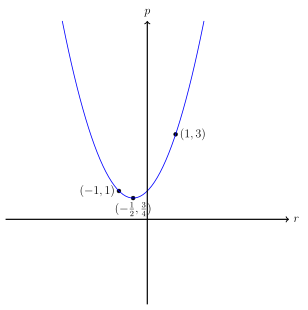
- Let \(r\) be a real number with \(\vert r \vert<1\) and let \[ S = \sum_{n=0}^\infty r^n\,. \] You may assume without proof that \(S = \displaystyle \frac{1}{1-r}\, \). Let \(p= 1 + r +r^2\). Sketch the graph of the function \(1+r+r^2\) and deduce that \(\frac{3}{4} \le p < 3\,\). Show that, if \(1 < p < 3\), then the value of \( p\) determines \(r\), and hence \(S\), uniquely. Show also that, if \(\frac{3}{4} < p < 1\), then there are two possible values of \(S\) and these values satisfy the equation \((3-p)S^2-3S+1=0\).
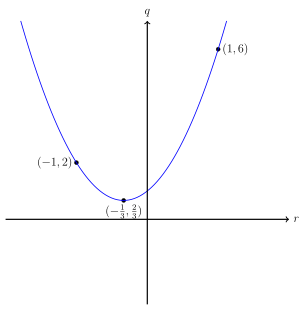
- Let \(r\) be a real number with \(\vert r \vert<1\) and let \[ T =\sum_{n=1}^\infty nr^{n-1}\,. \] You may assume without proof that \(T = \displaystyle \dfrac{1}{(1-r)^2}\,.\) Let \( q= 1+2r+3r^2\). Find the set of values of \( q\) that determine \(T\) uniquely. Find the set of values of \(q\) for which \(T\) has two possible values. Find also a quadratic equation, with coefficients depending on \( q\), that is satisfied by these two values.
Solution:
- \(\,\)
Notice that \(1+r+r^2\) ranges from \(\frac34\) to \(3\) over \((-1,1)\) therefore \(\frac34 \leq p < 3\) attaining its minimum but not its maximum. If \(p > 1\) we know we must be on the right branch and hence we can determine \(r\) and \(S\) uniquely. If \(\frac34 < p < 1\) then we must have two possible values for \(r\), satisfying \(r_i^2 + r+1 = p\) and so our two possible values for \(S_i = \frac{1}{1-r_i}\) or \(r_i = 1-\frac{1}{S_i}\) and so \begin{align*} && p &= \left ( 1 - \frac{1}{S} \right)^2 + 1 - \frac1S + 1 \\ \Rightarrow && pS^2 &= (S-1)^2 + S^2-S + S^2 \\ \Rightarrow && 0 &= (3-p)S^2 -3S + 1 \end{align*}
- \(\,\)
So \(\frac23 \leq q < 6\) and \(r\) and hence \(T\) is uniquely determined if \(2 \leq q < 6\). if \(\frac23
2017 Paper 2 Q11
Two thin vertical parallel walls, each of height \(2a\), stand a distance \(a\) apart on horizontal ground. The projectiles in this question move in a plane perpendicular to the walls.
- A particle is projected with speed \(\sqrt{5ag}\) towards the two walls from a point \( A\) at ground level. It just clears the first wall. By considering the energy of the particle, find its speed when it passes over the first wall. Given that it just clears the second wall, show that the angle its trajectory makes with the horizontal when it passes over the first wall is \(45^\circ\,\). Find the distance of \(A\) from the foot of the first wall.
- A second particle is projected with speed \(\sqrt{5ag}\) from a point \(B\) at ground level towards the two walls. It passes a distance \(h\) above the first wall, where \(h>0\). Show that it does not clear the second wall.
Solution:
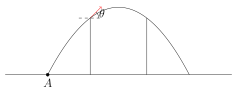
- \(\,\) \begin{align*} \bf{COE}: && \frac12 m \cdot 5ag &= mg\cdot 2a + \frac12 m v^2 \\ \Rightarrow && v^2 &= ag \\ && v &= \sqrt{ag} \end{align*} If it just clears the second wall, we must have: \begin{align*} && 0 &= \sqrt{ag} \sin \theta t - \frac12 gt^2 \\ \Rightarrow && t &= \frac{2\sqrt{ag}\sin \theta}{g} \\ && a &= \sqrt{ag} \cos \theta t \\ &&&=\sqrt{ag} \cos \theta \frac{2\sqrt{ag}\sin \theta}{g} \\ &&&= a \sin 2 \theta \\ \Rightarrow && \theta &= 45^{\circ} \end{align*} Imagine firing the particle backwards from the top of the wall at \(45^\circ\) then \begin{align*} && -2a &= \sqrt{ag}\cdot \left ( -\frac1{\sqrt{2}} \right) t - \frac12 g t^2 \\ \Rightarrow && 0 &= gt^2+\sqrt{2ag} t -4a \\ &&&= (\sqrt{g}t -\sqrt{2} \sqrt{a})(\sqrt{g}t +2\sqrt{2} \sqrt{a}) \\ \Rightarrow && t &= \sqrt{\frac{2a}{g}} \\ \Rightarrow && s &= \left ( -\frac1{\sqrt{2}} \right) \sqrt{ag} \sqrt{\frac{2a}{g}} \\ &&&= -a \end{align*} Therefore the \(A\) is \(a\) from the wall.
- When it passes over the first wall, \begin{align*} \bf{COE}: && \frac52amg &= (2a+h)mg + \frac12 m v^2 \\ \Rightarrow && v^2 &= (a-2h)g \end{align*} Now imagine firing a particle with this speed in any direction. The question is asking whether we can ever travel \(2a\) without descending more than \(h\). \begin{align*} && a &= \sqrt{(a-2h)g} \cos \beta t \\ \Rightarrow && t &= \frac{a}{\sqrt{(a-2h)g} \cos \beta}\\ && -h &= \sqrt{(a-2h)g} \sin \beta t - \frac12 g t^2 \\ &&&= a \tan \beta - \frac12 \frac{a^2}{(a-2h)} \sec^2 \beta \\ &&&= a \tan \beta - \frac{a^2}{2(a-2h)}(1+ \tan^2 \beta )\\ \Rightarrow && 0 &= \frac{a^2}{2(a-2h)} \tan^2 \beta-a \tan \beta + \frac{a^2-2ah+4h^2}{2(a-2h)} \\ && \Delta &= a^2 - \frac{a^2}{a-2h} \frac{a^2-2ah+4h^2}{a-2h} \\ &&&= \frac{a^2}{(a-2h)^2}\left ( a^2-4ah+4h^2-a^2+2ah-4h^2\right) \\ &&&= \frac{a^2}{(a-2h)^2}\left ( -2ah\right) < 0 \\ \end{align*} So there are no solutions if \(h > 0\)
2015 Paper 3 Q6
- Let \(w\) and \(z\) be complex numbers, and let \(u= w+z\) and \(v=w^2+z^2\). Prove that \(w\) and \(z\) are real if and only if \(u\) and \(v\) are real and \(u^2\le2v\).
- The complex numbers \(u\), \(w\) and \(z\) satisfy the equations \begin{align*} w+z-u&=0 \\ w^2+z^2 -u^2 &= - \tfrac 23 \\ w^3+z^3 -\lambda u &= -\lambda\, \end{align*} where \(\lambda \) is a positive real number. Show that for all values of \(\lambda\) except one (which you should find) there are three possible values of \(u\), all real. Are \(w\) and \(z\) necessarily real? Give a proof or counterexample.
Solution:
- Notice that \(u^2 = v+2wz\), so \(w,z\) are roots of the quadratic \(t^2 -ut+\frac{u^2-v}{2}\). Therefore they are both real if \(u^2 \geq 2(u^2-v) \Rightarrow 2v \geq u^2\).
- \begin{align*} && w+z &= u \\ && w^2+z^2 &= u^2 - \tfrac23 \\ && w^3+z^3 &= \lambda(u-1) \\ \\ && wz &= \frac{u^2 - (u^2-\tfrac23)}{2} = \tfrac13\\ \\ && (w+z)(w^2+z^2) &= w^3+z^3+wz(w+z) \\ &&u(u^2-\tfrac23)&= \lambda(u-1)+\frac13u \\ \Rightarrow && u^3-u&= \lambda (u-1) \\ \Rightarrow && 0 &= (u-1)(u(u+1) - \lambda) \\ \Rightarrow && 0 &= (u-1)(u^2+u - \lambda) \end{align*} Therefore there will be at most 3 values for \(u\), unless \(1\) is a root of \(u^2+u-\lambda\), ie \(\lambda = 2\). Suppose \(u = 1\), then we have: \(w+z = 1, wz = 1/3 \Rightarrow w,z = \frac{-1 \pm \sqrt{-1/3}}{2}\) which are clearly complex.
2012 Paper 2 Q2
If \(\p(x)\) and \(\q(x)\) are polynomials of degree \(m\) and \(n\), respectively, what is the degree of \(\p(\q(x))\)?
- The polynomial \(\p(x)\) satisfies \[ \p(\p(\p(x)))- 3 \p(x)= -2x\, \] for all \(x\). Explain carefully why \(\p(x)\) must be of degree 1, and find all polynomials that satisfy this equation.
- Find all polynomials that satisfy \[ 2\p(\p(x)) +3 [\p(x)]^2 -4\p(x) =x^4 \] for all \(x\).
Solution: If \(\p(x)\) and \(\q(x)\) are polynomials of degree \(m\) and \(n\), \(\p(\q(x))\) has degree \(mn\).
- Suppose \(\p(\p(\p(x)))- 3 \p(x)= -2x\), and suppose \(p(x)\) has degree \(n = \geq 2\), then \(\p(\p(\p(x)))\) has degree \(n^3\) and so the left hand side has degree higher than \(1\) and the right hand side is degree \(1\). Therefore \(\p(x)\) is degree \(1\) or \(0\). If \(p(x) = c\) then \(c^3-3c = -2x\) but the LHS doesn't depend on \(x\) which is also a contradiction. Therefore \(\p(x)\) is degree \(1\). Suppose \(\p(x) = ax+b\) then: \begin{align*} && -2x &= \p(\p(\p(x))) - 3\p(x) \\ &&&= \p(\p(ax+b)) - 3(ax+b) \\ &&&= \p(a(ax+b)+b) - 3ax -3b \\ &&&= a(a^2x+ab+b) + b - 3ax - 3b \\ &&&= (a^3-3a)x + b(a^2+a-2) \\ \Rightarrow &&& \begin{cases} a^3-3a&=-2 \\ b(a^2+a-2) &= 0\end{cases} \\ \Rightarrow &&& \begin{cases} a^3-3a+2 = 0 \\ b = 0, a = 1, a = -2\end{cases} \\ \Rightarrow &&& \begin{cases} (a-1)(a^2+a-2) = 0 \\ b = 0, a = 1, a = -2\end{cases} \\ \Rightarrow && (a,b) &= (1, b), (-2,b) \end{align*}
- Suppose \(2\p(\p(x)) +3 [\p(x)]^2 -4\p(x) =x^4\) and let \(\deg \p(x) = n\), then LHS has degree \(\max(n^2,2n,n)\) and the right hand side has degree \(4\). Therefore \(\p(x)\) must have degree \(2\). Let \(\p(x) = ax^2 + bx + c\), then, considering the coefficient of \(x^4\) in \(2\p(\p(x)) + 3[\p(x)]^2 -4\p(x)\) we will have \(2a^3+3a^2=1 \Rightarrow 2a^3+3a^2-1 = (a+1)^2(2a-1) \Rightarrow a = -1, a=\frac12\). Consider the coefficient of \(x^3\) in \(2\p(\p(x)) + 3[\p(x)]^2 -4\p(x)\) we have \(4a^2b+6ab = 0 \Rightarrow 2ab(2a+3) = 0\) Since \(a = -1, \frac12\) this means \(b = 0\). Consider the constant coefficient in \(2\p(\p(x)) + 3[\p(x)]^2 -4\p(x)\) (using \(b = 0\)). \(2ac^2+c+3c^2-4c = 0 \Rightarrow c(2ac+3c-3) = 0\). Therefore \(c = 0\) or \(a = -1, c = 3, a = \frac12, c = \frac34\), so our possible polynomials are: \(\p(x) = -x^2, \frac12x^2, -x^2+3, \frac12x^2+\frac34\)
2012 Paper 2 Q9
A tennis ball is projected from a height of \(2h\) above horizontal ground with speed \(u\) and at an angle of \(\alpha\) below the horizontal. It travels in a plane perpendicular to a vertical net of height \(h\) which is a horizontal distance of \(a\) from the point of projection. Given that the ball passes over the net, show that \[ \frac 1{u^2}< \frac {2(h-a\tan\alpha)}{ga^2\sec^2\alpha}\,. \] The ball lands before it has travelled a horizontal distance of \(b\) from the point of projection. Show that \[ \sqrt{u^2\sin^2\alpha +4gh \ } < \frac{bg}{u\cos\alpha} + u \sin\alpha\,. \] Hence show that \[ \tan\alpha < \frac{h(b^2-2a^2)}{ab(b-a)}\,. \]
Solution: \begin{align*} && s &= ut \\ \Rightarrow && a &= u \cos \alpha t\\ \Rightarrow && t &= \frac{a}{u \cos \alpha}\\ && s &= ut+ \frac12at^2 \\ \Rightarrow && -h &< -u\sin \alpha \frac{a}{u \cos \alpha}-\frac12 g \left (\frac{a}{u \cos \alpha} \right)^2 \\ &&&= -a \tan \alpha-\frac12 g a^2 \frac{1}{u^2} \sec^2 \alpha \\ \Rightarrow && \frac12 g a^2 \frac{1}{u^2} \sec^2 \alpha &< h -a\tan \alpha \\ \Rightarrow &&\frac{1}{u^2} &< \frac{2(h-a\tan \alpha)}{ga^2 \sec^2 \alpha} \end{align*} \begin{align*} && s &= ut + \frac12a t^2 \\ \Rightarrow && 2h &= u\sin \alpha t + \frac12 gt^2 \\ \Rightarrow && t &= \frac{-u\sin \alpha \pm \sqrt{u^2 \sin^2 \alpha+4hg}}{g}\\ && t &= \frac{-u\sin \alpha +\sqrt{u^2 \sin^2 \alpha+4hg}}{g}\\ && s &= ut \\ \Rightarrow && b &> u \cos \alpha t \\ \Rightarrow && \frac{b}{u \cos \alpha} &> \frac{-u\sin \alpha +\sqrt{u^2 \sin^2 \alpha+4hg}}{g} \\ \Rightarrow && \sqrt{u^2 \sin^2 \alpha+4hg} &< \frac{bg}{u \cos \alpha} + u \sin \alpha \\ \end{align*} \begin{align*} \Rightarrow && u^2 \sin^2 \alpha+4hg &< \frac{b^2g^2}{u^2 \cos^2 \alpha} +u^2 \sin^2 \alpha + 2bg \tan \alpha \\ \Rightarrow && 4hg - 2bg \tan \alpha &< \frac{b^2g^2}{u^2 \cos^2 \alpha} \\ &&&< \frac{b^2g^2}{\cos^2 \alpha} \frac{2(h-a\tan \alpha)}{ga^2 \sec^2 \alpha} \\ &&&= \frac{2b^2g(h-a\tan \alpha)}{a^2} \\ \Rightarrow && \tan \alpha \left (\frac{2b^2g}{a} - 2bg \right) &< \frac{2b^2gh}{a^2} - 4hg \\ \Leftrightarrow && \tan \alpha \left (\frac{2b^2g- 2abg}{a} \right) &< \frac{2b^2gh- 4hga^2}{a^2} \\ \Leftrightarrow && \tan \alpha \left (\frac{2bg(b- a)}{a} \right) &< \frac{2hg(b^2- 2a^2)}{a^2} \\ \Rightarrow && \tan \alpha &< \frac{h(b^2-2a^2)}{ab(b-a)} \end{align*}
2011 Paper 1 Q9
A particle is projected at an angle \(\theta\) above the horizontal from a point on a horizontal plane. The particle just passes over two walls that are at horizontal distances \(d_1\) and \(d_2\) from the point of projection and are of heights \(d_2\) and \(d_1\), respectively. Show that \[ \tan\theta = \frac{d_1^2+d_\subone d_\subtwo +d_2^2}{d_\subone d_\subtwo}\,. \] Find (and simplify) an expression in terms of \(d_1\) and \(d_2\) only for the range of the particle.
2010 Paper 1 Q1
Given that \[ 5x^{2}+2y^{2}-6xy+4x-4y\equiv a\left(x-y+2\right)^{2} +b\left(cx+y\right)^{2}+d\,, \] find the values of the constants \(a\), \(b\), \(c\) and \(d\). Solve the simultaneous equations \begin{align*} 5x^{2}+2y^{2}-6xy+4x-4y&=9\,, \\ 6x^{2}+3y^{2}-8xy+8x-8y&=14\,. \end{align*}
Solution: \(a\left(x-y+2\right)^{2} +b\left(cx+y\right)^{2}+d\, \equiv (a + bc^2)x^2 + (a+b)y^2 + (-2a+2bc)xy + (4a)x+(-4ay) + 4a+d\) so we want to solve \[ \begin{cases} a + bc^2 &= 5 \\ a+b &= 2 \\ 2bc - 2a &= -6 \\ 4a &= 4 \\ -4a &= 4 \\ 4a+d &= -9 \end{cases} \Rightarrow a = 1, b = 1, c = -2, d = -13 \] Therefore we have: \((x-y+2)^2 + (2x+y)^2-13 = 0\) and our simultaneous equations will be: \[ \begin{cases} (x-y+2)^2 + (-2x+y)^2 &= 13 \\ 2(x-y+2)^2 + (-2x+y)^2 &= 22 \end{cases} \] which are simultaneous equations in \((x-y+2)^2\) and \((-2x+y)^2\) which solve to \((x-y+2)^2 = 9, (-2x+y)^2 = 4 \) so we need to solve \(4\) sets of simultaneous equations: \begin{align*} &\begin{cases} x - y + 2 &= 3 \\ -2x + y &= 2 \end{cases} &&\Rightarrow (x,y) = (-3, -4) \\ &\begin{cases} x - y + 2 &= -3 \\ -2x + y &= 2 \end{cases} &&\Rightarrow (x,y) = (3, 8) \\ &\begin{cases} x - y + 2 &= 3 \\ -2x + y &= -2 \end{cases} &&\Rightarrow (x,y) = (1, 0) \\ &\begin{cases} x - y + 2 &= -3 \\ -2x + y &= -2 \end{cases} &&\Rightarrow (x,y) = (7, 12) \\ \end{align*} So \((x,y) = (-3, -4), (3, 8), (1, 0), (7,12)\)
2010 Paper 3 Q1
Let \(x_{\low1}\), \(x_{\low2}\), \ldots, \(x_n\) and \(x_{\vphantom {\dot A} n+1}\) be any fixed real numbers. The numbers \(A\) and \(B\) are defined by \[ A = \frac 1 n \sum_{k=1}^n x_{ \low k} \,, \ \ \ B= \frac 1 n \sum_{k=1}^n (x_{\low k}-A)^2 \,, \ \ \ \] and the numbers \(C\) and \(D\) are defined by \[ C = \frac 1 {n+1} \sum\limits_{k=1}^{n+1} x_{\low k} \,, \ \ \ D = \frac1{n+1} \sum_{k=1}^{n+1} (x_{\low k}-C)^2 \,. \]
- Express \( C\) in terms of \(A\), \(x_{\low n+1}\) and \(n\).
- Show that $ \displaystyle B= \frac 1 n \sum_{k=1}^n x_{\low k}^2 - A^2\,\(.
- Express \)D \( in terms of \)B\(, \)A\(, \)x_{\low n+1}\( and \)n$. Hence show that \((n + 1)D \ge nB\) for all values of \(x_{\low n+1}\), but that \(D < B\) if and only if \[ A-\sqrt{\frac{(n+1)B}{n}} < x_{\low n+1} < A+\sqrt{\frac{(n+1)B}{n}}\,. \]
2006 Paper 1 Q3
In this question \(b\), \(c\), \(p\) and \(q\) are real numbers.
- By considering the graph \(y=x^2 + bx + c\) show that \(c < 0\) is a sufficient condition for the equation \(\displaystyle x^2 + bx + c = 0\) to have distinct real roots. Determine whether \(c < 0\) is a necessary condition for the equation to have distinct real roots.
- Determine necessary and sufficient conditions for the equation \(\displaystyle x^2 + bx + c = 0\) to have distinct positive real roots.
- What can be deduced about the number and the nature of the roots of the equation \(x^3 + px + q = 0\) if \(p>0\) and \(q<0\)? What can be deduced if \(p<0\,\) and \(q<0\)? You should consider the different cases that arise according to the value of \(4p^3+ 27q^2\,\).
Solution:
- Since \(y(0) < 0\) and \(y(\pm \infty) > 0\) we must cross the axis twice. Therefore there are two distinct real roots. It is not necessary, for example \((x-2)(x-3)\) has distinct real roots by the constant term is \(6 > 0\)

- For \(x^2+bx+c=0\) to have distinct, positive real roots we need \(\Delta > 0\) and \(\frac{-b -\sqrt{\Delta}}{2a} > 0\) where \(\Delta = b^2-4ac\), ie \(b < 0\) and \(b^2 > \Delta = b^2-4ac\) or \(4ac > 0\). Therefore we need \(b^2-4ac > 0, b < 0, 4ac > 0\)
- Since \(q < 0\) at least one of the roots is positive. The gradient is \(3x^2+p > 0\) therefore there is exactly one positive root. If \(p < 0\) then there are turning points when \(3x^2+p = 0\) ie \(x = \pm \sqrt{\frac{-p}{3}}\). If the first turning point is above the \(x\)-axis then there will be 3 roots. If it is on the \(x\)-axis then 2, otherwise only 1. \begin{align*} y &= \left (-\sqrt{\frac{-p}{3}}\right)^3 + p\left (-\sqrt{\frac{-p}{3}}\right)+q \\ &= \sqrt{\frac{-p}{3}} \left (p - \frac{p}{3} \right) + q \\ &= \frac{2}{3} \sqrt{\frac{-p}{3}}p +q \\ \end{align*} Therefore it is positive if \(-\frac{4}{27}p^3 >q^2\) ie if \(4p^3+27q^2 < 0\)