Problems
Filters
16 problems found
2023 Paper 3 Q2
The polar curves \(C_1\) and \(C_2\) are defined for \(0 \leqslant \theta \leqslant \pi\) by \[r = k(1 + \sin\theta)\] \[r = k + \cos\theta\] respectively, where \(k\) is a constant greater than \(1\).
- Sketch the curves on the same diagram. Show that if \(\theta = \alpha\) at the point where the curves intersect, \(\tan\alpha = \dfrac{1}{k}\).
- The region A is defined by the inequalities \[0 \leqslant \theta \leqslant \alpha \quad \text{and} \quad r \leqslant k(1+\sin\theta)\,.\] Show that the area of A can be written as \[\frac{k^2}{4}(3\alpha - \sin\alpha\cos\alpha) + k^2(1 - \cos\alpha)\,.\]
- The region B is defined by the inequalities \[\alpha \leqslant \theta \leqslant \pi \quad \text{and} \quad r \leqslant k + \cos\theta\,.\] Find an expression in terms of \(k\) and \(\alpha\) for the area of B.
- The total area of regions A and B is denoted by \(R\). The area of the region enclosed by \(C_1\) and the lines \(\theta = 0\) and \(\theta = \pi\) is denoted by \(S\). The area of the region enclosed by \(C_2\) and the lines \(\theta = 0\) and \(\theta = \pi\) is denoted by \(T\). Show that as \(k \to \infty\), \[\frac{R}{T} \to 1\] and find the limit of \[\frac{R}{S}\] as \(k \to \infty\).
2022 Paper 3 Q4
You may assume that all infinite sums and products in this question converge.
- Prove by induction that for all positive integers \(n\), \[ \sinh x = 2^n \cosh\!\left(\frac{x}{2}\right) \cosh\!\left(\frac{x}{4}\right) \cdots \cosh\!\left(\frac{x}{2^n}\right) \sinh\!\left(\frac{x}{2^n}\right) \] and deduce that, for \(x \neq 0\), \[ \frac{\sinh x}{x} \cdot \frac{\dfrac{x}{2^n}}{\sinh\!\left(\dfrac{x}{2^n}\right)} = \cosh\!\left(\frac{x}{2}\right) \cosh\!\left(\frac{x}{4}\right) \cdots \cosh\!\left(\frac{x}{2^n}\right)\,. \]
- You are given that the Maclaurin series for \(\sinh x\) is \[ \sinh x = \sum_{r=0}^{\infty} \frac{x^{2r+1}}{(2r+1)!}\,. \] Use this result to show that, as \(y\) tends to \(0\), \(\dfrac{y}{\sinh y}\) tends to \(1\). Deduce that, for \(x \neq 0\), \[ \frac{\sinh x}{x} = \cosh\!\left(\frac{x}{2}\right) \cosh\!\left(\frac{x}{4}\right) \cdots \cosh\!\left(\frac{x}{2^n}\right) \cdots\,. \]
- Let \(x = \ln 2\). Evaluate \(\cosh\!\left(\dfrac{x}{2}\right)\) and show that \[ \cosh\!\left(\frac{x}{4}\right) = \frac{1 + 2^{\frac{1}{2}}}{2 \times 2^{\frac{1}{4}}}\,. \] Use part (ii) to show that \[ \frac{1}{\ln 2} = \frac{1 + 2^{\frac{1}{2}}}{2} \times \frac{1 + 2^{\frac{1}{4}}}{2} \times \frac{1 + 2^{\frac{1}{8}}}{2} \cdots\,. \]
- Show that \[ \frac{2}{\pi} = \frac{\sqrt{2}}{2} \times \frac{\sqrt{2+\sqrt{2}}}{2} \times \frac{\sqrt{2+\sqrt{2+\sqrt{2}}}}{2} \cdots\,. \]
2022 Paper 3 Q6
- Show that when \(\alpha\) is small, \(\cos(\theta + \alpha) - \cos\theta \approx -\alpha\sin\theta - \frac{1}{2}\alpha^2\cos\theta\). Find the limit as \(\alpha \to 0\) of \[ \frac{\sin(\theta+\alpha) - \sin\theta}{\cos(\theta+\alpha) - \cos\theta} \qquad (*) \] in the case \(\sin\theta \neq 0\). In the case \(\sin\theta = 0\), what happens to the value of expression \((*)\) when \(\alpha \to 0\)?
- A circle \(C_1\) of radius \(a\) rolls without slipping in an anti-clockwise direction on a fixed circle \(C_2\) with centre at the origin \(O\) and radius \((n-1)a\), where \(n\) is an integer greater than \(2\). The point \(P\) is fixed on \(C_1\). Initially the centre of \(C_1\) is at \((na, 0)\) and \(P\) is at \(\big((n+1)a, 0\big)\).
- Let \(Q\) be the point of contact of \(C_1\) and \(C_2\) at any time in the rolling motion. Show that when \(OQ\) makes an angle \(\theta\), measured anticlockwise, with the positive \(x\)-axis, the \(x\)-coordinate of \(P\) is \(x(\theta) = a(n\cos\theta + \cos n\theta)\), and find the corresponding expression for the \(y\)-coordinate, \(y(\theta)\), of \(P\).
- Find the values of \(\theta\) for which the distance \(OP\) is \((n-1)a\).
- Let \(\theta_0 = \dfrac{1}{n-1}\pi\). Find the limit as \(\alpha \to 0\) of \[ \frac{y(\theta_0 + \alpha) - y(\theta_0)}{x(\theta_0 + \alpha) - x(\theta_0)}\,. \] Hence show that, at the point \(\big(x(\theta_0),\, y(\theta_0)\big)\), the tangent to the curve traced out by \(P\) is parallel to \(OP\).
2019 Paper 2 Q4
You are not required to consider issues of convergence in this question. For any sequence of numbers \(a_1, a_2, \ldots, a_m, \ldots, a_n\), the notation \(\prod_{i=m}^{n} a_i\) denotes the product \(a_m a_{m+1} \cdots a_n\).
- Use the identity \(2 \cos x \sin x = \sin(2x)\) to evaluate the product \(\cos(\frac{\pi}{9}) \cos(\frac{2\pi}{9}) \cos(\frac{4\pi}{9})\).
- Simplify the expression $$\prod_{k=0}^{n} \cos\left(\frac{x}{2^k}\right) \quad (0 < x < \frac{1}{2}\pi).$$ Using differentiation, or otherwise, show that, for \(0 < x < \frac{1}{2}\pi\), $$\sum_{k=0}^{n} \frac{1}{2^k} \tan\left(\frac{x}{2^k}\right) = \frac{1}{2^n} \cot\left(\frac{x}{2^n}\right) - 2 \cot(2x).$$
- Using the results \(\lim_{\theta\to 0} \frac{\sin \theta}{\theta} = 1\) and \(\lim_{\theta\to 0} \frac{\tan \theta}{\theta} = 1\), show that $$\prod_{k=1}^{\infty} \cos\left(\frac{x}{2^k}\right) = \frac{\sin x}{x}$$ and evaluate $$\sum_{j=2}^{\infty} \frac{1}{2^{j-2}} \tan\left(\frac{\pi}{2^j}\right).$$
Solution:
- \begin{align*}\cos(\frac{\pi}{9}) \cos(\frac{2\pi}{9}) \cos(\frac{4\pi}{9}) &= \frac{\sin(\frac{2\pi}{9}) \cos(\frac{2\pi}{9}) \cos(\frac{4\pi}{9})}{2 \sin \frac{\pi}{9}} \\ &= \frac{\sin(\frac{4\pi}{9})\cos(\frac{4\pi}{9})}{4 \sin \frac{\pi}{9}} \\ &= \frac{\sin(\frac{8\pi}{9})}{8 \sin \frac{\pi}{9}} \\ &= \frac{1}{8} \end{align*}
- Let \(\displaystyle P_n = \prod_{k=0}^{n} \cos\left(\frac{x}{2^k}\right)\). Claim: \(P_n = \frac{\sin 2x}{2^{n+1} \sin \l \frac{x}{2^n} \r}\). Proof: This is true for \(n = 0\), assume true for \(n-1\) \begin{align*} \sin\l \frac{x}{2^{n}} \r P_n &= P_{n-1} \cos\l \frac{x}{2^{n}} \r \sin\l \frac{x}{2^{n}} \r \\ &= P_{n-1} \frac{1}{2} \sin\l \frac{x}{2^{n-1}} \r \\ &= \frac{\sin 2x}{2^{n} \sin \l \frac{x}{2^{n-1}}\r} \frac{1}{2} \sin\l \frac{x}{2^{n}} \r \\ &= \frac{\sin 2x}{2^{n+1}} \end{align*} Hence \(P_n = \frac{\sin 2x}{2^{n+1} \sin \l \frac{x}{2^n}\r}\) Taking logs, we determine that: \begin{align*} && \sum_{k=0}^n \ln \cos \l \frac{x}{2^k} \r &= \ln \sin 2x - \ln \sin \l \frac{x}{2^n} \r - (n+1) \ln 2 \\ \Rightarrow && \sum_{k=0}^n \frac{1}{2^k} \tan \l \frac{x}{2^k} \r &= -2 \cot 2x + \frac{1}{2^n} \cot \l \frac{x}{2^n} \r - 0 \\ \end{align*} as required.
- As \(n \to \infty\) \(\frac{x}{2^n} \to 0\), so \(\frac{\sin \frac{x}{2^n}}{\frac{x}{2^n}} = \frac{2^n \sin \frac{x}{2^n}}{x} \to 1\) \begin{align*}\prod_{k=1}^{\infty} \cos\left(\frac{x}{2^k}\right) &= \lim_{n \to \infty} \frac{\sin x}{2^n \sin \l \frac{x}{2^n} \r} \\ &= \lim_{n \to \infty} \frac{\sin x}{x \frac{2^n \sin \l \frac{x}{2^n} \r}{x} } \\ &= \lim_{n \to \infty} \frac{\sin x}{x} \\ \end{align*} \begin{align*} \sum_{j=2}^{\infty} \frac{1}{2^{j-2}} \tan\left(\frac{\pi}{2^j}\right) &= \sum_{j=0}^{\infty} \frac{1}{2^{j}} \tan\left(\frac{1}{2^j}\frac{\pi}{4}\right) \\ &= \lim_{n \to \infty} \l -2 \cot \frac{\pi}{2} + \frac{1}{2^n} \cot \l \frac{\pi}{4 \cdot 2^n} \r\r \\ &= \frac{4}{\pi} \lim_{n \to \infty} \l \frac{1}{2^n} \frac{\pi}{4} \cot \l \frac{\pi}{4 \cdot 2^n} \r\r \\ &\to \frac{\pi}{4} \end{align*}
2017 Paper 2 Q7
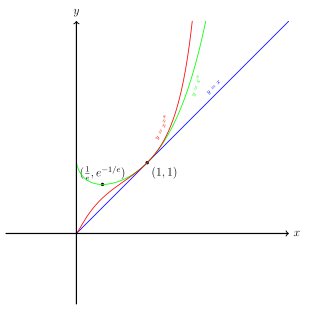
The functions \(\f\) and \(\g\) are defined, for \(x>0\), by \[ \f(x) = x^x\,, \ \ \ \ \ \g(x) = x^{\f(x)}\,. \]
- By taking logarithms, or otherwise, show that \(\f(x) > x\) for \(0 < x < 1\,\). Show further that \(x < \g(x) < \f(x)\) for \(0 < x < 1\,\). Write down the corresponding results for \(x > 1 \,\).
- Find the value of \(x\) for which \(\f'(x)=0\,\).
- Use the result \(x\ln x \to 0\) as \(x\to 0\) to find \(\lim\limits_{x\to0}\f(x)\), and write down \(\lim\limits_{x\to0}\g(x)\,\).
- Show that \( x^{-1}+\, \ln x \ge 1\,\) for \(x>0\). Using this result, or otherwise, show that \(\g'(x) > 0\,\).
Solution:
- \(\,\) \begin{align*} && \ln f(x) &= x \ln x \\ &&&> \ln x \quad (\text{if } 0 < x < 1)\\ \Rightarrow && f(x) &> x\quad\quad (\text{if } 0 < x < 1)\\ \Rightarrow && x^{f(x)} &< x^x \\ && g(x) &< f(x) \\ && 1&>f(x) \\ \Rightarrow && x &< x^{f(x)} = g(x) \end{align*}
- \(\,\) \begin{align*} && f(x) &= e^{x \ln x} \\ \Rightarrow && f'(x) &= (\ln x + 1)e^{x \ln x} \\ \Rightarrow && f'(x) = 0 &\Leftrightarrow x = \frac1e \end{align*}
- \(\,\) \begin{align*} && \lim_{x \to 0} f(x) &= \lim_{x \to 0} \exp \left ( x \ln x \right ) \\ &&&= \exp \left ( \lim_{x \to 0} \left ( x \ln x \right )\right) \\ &&&= \exp \left ( 0 \right) = 1\\ \\ && \lim_{x \to 0} g(x) &= \lim_{x \to 0} \exp \left ( f(x) \ln x\right) \\ &&&= \exp \left (\lim_{x \to 0} \ln x f(x)\right) \\ &&&= \exp \left (\lim_{x \to 0} \ln x \lim_{x \to 0}f(x)\right) \\ &&&= \exp \left (\lim_{x \to 0} \ln x\right) \\ &&&= 0 \end{align*}
- \(y = x^{-1} + \ln x \Rightarrow y' = -x^{-2} + x^{-1}\) which has roots at \(x =1\), therefore the minimum value is \(1\). (We can see it's a minimum by considering \(x \to 0, x \to \infty\). So \begin{align*} && g'(x) &= x^{f(x)} \cdot (f'(x) \ln x + f(x) x^{-1})\\ &&&= x^{f(x)} \cdot f(x) \cdot ((1+\ln x) \ln x + x^{-1}) \\ &&&= x^{f(x)} \cdot f(x) \cdot (\ln x + x^{-1} + (\ln x)^2) \\ &&&\geq x^{f(x)} \cdot f(x) > 0 \end{align*}
2014 Paper 1 Q8
Let \(L_a\) denote the line joining the points \((a,0)\) and \((0, 1-a)\), where \(0< a < 1\). The line \(L_b\) is defined similarly.
- Determine the point of intersection of \(L_a\) and \(L_b\), where \(a\ne b\).
- Show that this point of intersection, in the limit as \(b\to a\), lies on the curve \(C\) given by \[ y=(1-\sqrt x)^2\, \ \ \ \ (0< x < 1)\,. \]
- Show that every tangent to \(C\) is of the form \(L_a\) for some \(a\).
Solution:
- \(L_a : \frac{y}{x-a} = \frac{1-a-0}{0-a} = \frac{a-1}{a} \Rightarrow ay+(1-a)x = a(1-a)\) \begin{align*} && ay + (1-a)x &= a(1-a) \\ && by + (1-b)x &= b(1-b) \\ \Rightarrow && aby + b(1-a)x &= ba(1-a) \\ && aby + a(1-b)x &= ab(1-b) \\ \Rightarrow && (b-a)x &= ab(b-a) \\ \Rightarrow && x &= ab \\ && y &= \frac{a-1}{a} \cdot a(b-1) \\ &&&= (1-a)(1-b) \end{align*}
- As \(a \to b\), \(x \to a^2, y \to 1-2a+a^2 =(1-a)^2 = (1-\sqrt{x})^2\)
- \(\frac{\d y}{\d x} = 2(1-\sqrt{x})\cdot \left (-\tfrac12 \frac{1}{\sqrt{x}} \right) = 1 - \frac{1}{\sqrt{x}}\). Therefore the tangent when \(x = c^2, y = (1-c)^2\) is \begin{align*} && \frac{y-(1-c)^2}{x-c^2} &= 1 - \frac{1}{c} \\ \Rightarrow && cy + (1-c)x &= c(c-1)+c(1-c)^2 \\ &&&= c(1-c) \end{align*} Which is an equation of the form \(L_c\)
2012 Paper 2 Q4
In this question, you may assume that the infinite series \[ \ln(1+x) = x-\frac{x^2}2 + \frac{x^3}{3} -\frac {x^4}4 +\cdots + (-1)^{n+1} \frac {x^n}{n} + \cdots \] is valid for \(\vert x \vert <1\).
- Let \(n\) be an integer greater than 1. Show that, for any positive integer \(k\), \[ \frac1{(k+1)n^{k+1}} < \frac1{kn^{k}}\,. \] Hence show that \(\displaystyle \ln\! \left(1+\frac1n\right) <\frac1n\,\). Deduce that \[ \left(1+\frac1n\right)^{\!n}<\e\,. \]
- Show, using an expansion in powers of \(\dfrac1y\,\), that $ \displaystyle \ln \! \left(\frac{2y+1}{2y-1}\right) > \frac 1y %= \sum _{r=0}^\infty \frac 1{(2r+1)(2y)^{2r}}\,. \( for \)y>\frac12$. Deduce that, for any positive integer \(n\), \[ \e < \left(1+\frac1n\right)^{\! n+\frac12}\,. \]
- Use parts (i) and (ii) to show that as \(n\to\infty\) \[ \left(1+\frac1n\right)^{\!n} \to \e\,. \]
Solution:
- Since \(k \geq 1\) we have \(n^{k+1} > n^k\) and \((k+1) > k\), therefore \((k+1)n^{k+1} >kn^k \Rightarrow \frac{1}{(k+1)n^{k+1}} < \frac{1}{kn^k}\) \begin{align*} && \ln \left ( 1 + \frac1n \right) &= \frac1n -\frac{1}{2n^2} + \frac{1}{3n^3} - \frac{1}{4n^4} + \cdots \\ &&&= \frac1n - \underbrace{\left (\frac{1}{2n^2}-\frac{1}{3n^3} \right)}_{>0}- \underbrace{\left (\frac{1}{4n^4}-\frac{1}{5n^5} \right)}_{>0} - \cdot \\ &&&< \frac1n \\ \\ \Rightarrow && n \ln \left ( 1 + \frac1n \right) &< 1 \\ \Rightarrow && \ln \left ( \left ( 1 + \frac1n \right)^n \right) &< 1 \\ \Rightarrow && \left ( 1 + \frac1n \right)^n &< e \end{align*}
- \(\,\) \begin{align*} &&\ln \left(\frac{2y+1}{2y-1}\right) &= \ln \left (1 + \frac{1}{2y} \right)-\ln \left (1 - \frac{1}{2y} \right) \\ &&&= \frac{1}{2y} - \frac{1}{2(2y)^2} + \frac{1}{3(2y)^3} - \cdots - \left (-\frac{1}{2y} - \frac{1}{2(2y)^2} - \frac{1}{3(2y)^3} - \cdots \right) \\ &&&= \frac{1}{y} + \frac{2}{3(2y)^3} + \frac{2}{5(2y)^5} \\ &&&= \sum_{r=1}^{\infty} \frac{2}{(2r-1)(2y)^{2r-1}} \\ &&&> \frac1y \\ \\ \Rightarrow && \ln \left (1 + \frac{1}{y-\frac12} \right) &> \frac{1}{y} \\\Rightarrow && \ln \left (1 + \frac{1}{n} \right) &> \frac{1}{n+\frac12} \\ \Rightarrow &&(n+\tfrac12) \ln \left (1 + \frac{1}{n} \right) &> 1\\ \Rightarrow && \ln \left ( \left (1 + \frac{1}{n} \right)^{n+\tfrac12} \right) &> 1\\ \Rightarrow && \left (1 + \frac{1}{n} \right)^{n+\tfrac12} & > e \end{align*}
2009 Paper 3 Q3
The function \(\f(t)\) is defined, for \(t\ne0\), by \[ \f(t) = \frac t {\e^t-1}\,. \] \begin{questionparts} \item By expanding \(\e^t\), show that \(\displaystyle \lim _{t\to0} \f(t) = 1\,\). Find \(\f'(t)\) and evaluate \(\displaystyle \lim _{t\to0} \f'(t)\,\). \item Show that \(\f(t) +\frac12 t\) is an even function. [{\bf Note:} A function \(\g(t)\) is said to be {\em even} if \(\g(t) \equiv \g(-t)\).] \item Show with the aid of a sketch that \( \e^t( 1-t)\le 1\,\) and deduce that \(\f'(t)\ne 0\) for \(t\ne0\). \end{questionpart} Sketch the graph of \(\f(t)\).
Solution:
- Claim \(f(t) + \frac12 t\) is an even function. Proof: Consider \(f(-t) - \frac12t\), then \begin{align*} f(-t) - \frac12t &= \frac{-t}{e^{-t}-1} - \frac12t \\ &= \frac{-te^t}{1-e^t} - \frac12 t \\ &= \frac{t(1-e^t) -t}{1-e^t} - \frac12 t \\ &= t - \frac{t}{1-e^t} - \frac12 t \\ &= \frac{t}{e^t-1} + \frac12 t \end{align*} So it is even.
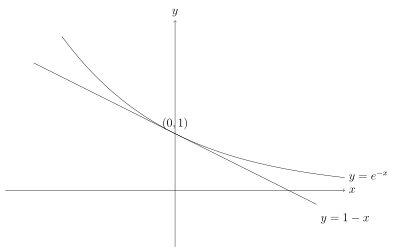
- Drawing the tangent to \(y = e^{-x}\) at \((0,1)\) we find that \(e^{-t} \geq (1-t)\) for all \(t\), in particular, \(e^t(1-t) \leq 1\) \(f'(t) = \frac{(e^t(1-t) -1}{(e^t-1)^2} \leq 0\) and \(f'(t) = -\frac12\) when \(t = 0\)

2009 Paper 3 Q8
Let \(m\) be a positive integer and let \(n\) be a non-negative integer.
- Use the result \(\displaystyle \lim_{t\to\infty}\e^{-mt} t^n=0\) to show that \[ \lim_{x\to0} x^m (\ln x)^n =0\,. \] By writing \(x^x\) as \(\e^{x\ln x}\) show that \[ \lim _{x\to0} x^x=1\,. \]
- Let \(\displaystyle I_{n} = \int_0^1 x^m (\ln x)^n \d x\,\). Show that \[ I_{n+1} = - \frac {n+1}{m+1} I_{n} \] and hence evaluate \(I_{n}\).
- Show that \[ \int_0^1 x^x \d x = 1 -\left(\tfrac12\right)^2 +\left(\tfrac13\right)^3 -\left(\tfrac14\right)^4 + \cdots \,. \]
Solution:
- \(\,\) \begin{align*} && \lim_{x \to 0} x^m(\ln x)^n &= \lim_{t \to \infty} (e^{-t})^m (\ln e^{-t})^n \\ &&&= \lim_{t \to \infty} e^{-mt} (-t)^n \\ &&&= (-1)^n \lim_{t \to \infty} e^{-mt} t^n = 0 \\ \\ && \lim_{x \to 0} x^x &= \lim_{x \to 0} e^{x \ln x} \\ &&&= \exp \left (\lim_{x \to 0} x \ln x \right) \\ &&&= \exp \left (0 \right) = 1 \end{align*}
- \(\,\) \begin{align*} && I_{n} &= \int_0^1 x^m (\ln x)^n \d x \\ && I_{n+1} &= \int_0^1 x^m (\ln x)^{n+1} \d x \\ &&&= \left [\frac{x^{m+1}}{m+1} (\ln x)^{n+1} \right]_0^1 - \frac{1}{m+1} \int_0^1 x^{m+1} (n+1) (\ln x)^n \cdot x^{-1} \d x \\ &&&= 0 - \frac{1}{m+1} \lim_{x \to 0} \left (x^{m+1} (\ln x)^{n+1} \right) - \frac{n+1}{m+1} \int_0^1 x^m (\ln x)^n \d x \\ &&&= - \frac{n+1}{m+1} I_n \\ \\ && I_0 &= \int_0^1 x^m \d x = \frac{1}{m+1} \\ && I_1 &= -\frac{1}{(m+1)^2} \\ && I_2 &= \frac{2}{(m+1)^3} \\ && I_n &= (-1)^n \frac{n!}{(m+1)^{n+1}} \end{align*}
- \(\,\) \begin{align*} && \int_0^1 x^x \d x &= \int_0^1 e^{x \ln x} \d x \\ &&&= \int_0^1 \sum_{k=0}^{\infty} \frac{x^k(\ln x)^k}{k!} \d x \\ &&&= \sum_{k=0}^{\infty} \int_0^1 \frac{x^k(\ln x)^k}{k!} \d x\\ &&&= \sum_{k=0}^{\infty} (-1)^k \frac{k!}{k!(k+1)^{k+1}}\\ &&&= \sum_{k=0}^{\infty} \frac{(-1)^k}{(k+1)^{k+1}}\\ &&&= 1 - \frac{1}{2^2} + \frac{1}{3^3} - \frac{1}{4^4} + \cdots \end{align*}
2001 Paper 2 Q2
Sketch the graph of the function \([x/N]\), for \(0 < x < 2N\), where the notation \([y]\) means the integer part of \(y\). (Thus \([2.9] = 2\), \ \([4]=4\).)
- Prove that \[ \sum_{k=1}^{2N} (-1)^{[k/N]} k = 2N-N^2. \]
- Let \[ S_N = \sum_{k=1}^{2N} (-1)^{[k/N]} 2^{-k}. \] Find \(S_N\) in terms of \(N\) and determine the limit of \(S_N\) as \(N\to\infty\).
1999 Paper 3 Q3
Justify, by means of a sketch, the formula $$ \lim_{n\rightarrow\infty}\left\{{1\over n}\sum_{m=1}^n \f(1+m/n)\right\} = \int_1^2 \f(x)\,\d x \,. $$ Show that $$ \lim_{n\rightarrow\infty}\left\{{1\over n+1} + {1\over n+2} + \cdots + {1\over n+n}\right\} = \ln 2 \,. $$ Evaluate $$ \lim_{n\rightarrow\infty}\left\{{n\over n^2+1} + {n\over n^2+4} + \cdots + {n\over n^2+n^2}\right\}\,. $$
Solution:

1995 Paper 2 Q4
Let \[ u_{n}=\int_{0}^{\frac{1}{2}\pi}\sin^{n}t\,\mathrm{d}t \] for each integer \(n\geqslant0\). By integrating \[ \int_{0}^{\frac{1}{2}\pi}\sin t\sin^{n-1}t\,\mathrm{d}t \] by parts, or otherwise, obtain a formula connecting \(u_{n}\) and \(u_{n-2}\) when \(n\geqslant2\) and deduce that \[ nu_{n}u_{n-1}=\left(n-1\right)u_{n-1}u_{n-2} \] for all \(n\geqslant2\). Deduce that \[ nu_{n}u_{n-1}=\tfrac{1}{2}\pi. \] Sketch graphs of \(\sin^{n}t\) and \(\sin^{n-1}t\), for \(0\leqslant t\leqslant\frac{1}{2}\pi,\) on the same diagram and explain why \(0 < u_{n} < u_{n-1}.\) By using the result of the previous paragraph show that \[ nu_{n}^{2} < \tfrac{1}{2}\pi < nu_{n-1}^{2} \] for all \(n\geqslant1\). Hence show that \[ \left(\frac{n}{n+1}\right)\tfrac{1}{2}\pi < nu_{n}^{2} < \tfrac{1}{2}\pi \] and deduce that \(nu_{n}^{2}\rightarrow\tfrac{1}{2}\pi\) as \(n\rightarrow\infty\).
Solution: \begin{align*} && u_n &= \int_0^{\tfrac12 \pi} \sin^{n} t \, \d t \\ && &= \int_0^{\tfrac12 \pi} \sin t \sin^{n-1} t \, \d t \\ && &= \left [ -\cos t \sin^{n-1} t \right]_0^{\tfrac12 \pi} + \int_0^{\tfrac12 \pi} \cos t (n-1) \sin^{n-2} t \cos t \d t \\ && &= 0 + (n-1)\int_0^{\tfrac12 \pi} \cos^2 t \sin^{n-2} t \d t \\ && &= (n-1) \int_0^{\tfrac12 \pi}(1-\sin^2 t) \sin^{n-2} t \d t \\ && &= (n-1)u_{n-2} - (n-1)u_n \\ \Rightarrow && n u_n &= (n-1)u_{n-2} \\ \end{align*} Mutplying both sides by \(u_{n-1}\) we obtain \(nu_{n}u_{n-1}=\left(n-1\right)u_{n-1}u_{n-2}\). Therefore \(nu_nu_{n-1}\) is constant, ie is equal to \(\displaystyle u_1u_0 = \int_0^{\tfrac12 \pi} \sin^{1} t \, \d t \int_0^{\tfrac12 \pi} \sin^{0} t \, \d t = 1 \cdot \frac{\pi}{2} = \frac{\pi}{2}\)

1994 Paper 2 Q6
Prove by induction, or otherwise, that, if \(0<\theta<\pi\), \[ \frac{1}{2}\tan\frac{\theta}{2}+\frac{1}{2^{2}}\tan\frac{\theta}{2^{2}}+\cdots+\frac{1}{2^{n}}\tan\frac{\theta}{2^{n}}=\frac{1}{2^{n}}\cot\frac{\theta}{2^{n}}-\cot\theta. \] Deduce that \[ \sum_{r=1}^{\infty}\frac{1}{2^{r}}\tan\frac{\theta}{2^{r}}=\frac{1}{\theta}-\cot\theta. \]
Solution: Claim: \(\displaystyle \sum_{r=1}^n \frac1{2^r} \tan \tfrac{\theta}{2^r} = \frac1{2^n}\cot \tfrac{\theta}{2^n} - \cot \theta\) Proof: (By Induction) Base case: \(n = 1\) \begin{align*} && LHS &= \sum_{r=1}^1 \frac1{2^r} \tan \frac{\theta}{2^r} \\ &&&= \frac1{2} \tan \frac{\theta}{2}\\ \\ && RHS &= \frac12 \cot \frac{\theta}{2} - \cot \theta \\ &&&= \frac12 \frac{1}{\tan \frac{\theta}{2}} - \frac{1-\tan^2 \frac{\theta}{2}}{2 \tan \frac{\theta}{2}} \\ &&&= \frac{1}{2} \tan \frac{\theta}{2} = LHS \end{align*} Therefore our base case is true. Assume our statement is true for some \(n=k\), then consider \(n = k+1\), ie \begin{align*} \sum_{r=1}^{k+1} \frac1{2^r} \tan \tfrac{\theta}{2^r} &= \sum_{r=1}^{k} \frac1{2^r} \tan \tfrac{\theta}{2^r} + \frac1{2^{k+1}} \tan \frac{\theta}{2^{k+1}} \\ &= \frac{1}{2^k} \cot \frac{\theta}{2^k} - \cot \theta + \frac{1}{2^{k+1}}\tan \frac{\theta}{2^{k+1}} \\ &= \frac{1}{2^{k+1}} \left (2 \cot \frac{\theta}{2^k} +\tan \frac{\theta}{2^{k+1}} \right) - \cot \theta \\ &= \frac{1}{2^{k+1}} \left (2\frac{1-\tan^2 \frac{\theta}{2^{k+1}}}{2 \tan \frac{\theta}{2^{k+1}}} + \tan \frac{\theta}{2^{k+1}} \right) - \cot \theta \\ &= \frac{1}{2^{k+1}} \cot \frac{\theta}{2^{k+1}} - \cot \theta \\ \end{align*} Therefore, since as \(x \to 0, x\cot x \to 1\) or \(x \cot \theta x \to \frac{1}{\theta}\) \begin{align*} \sum_{r=1}^{\infty}\frac{1}{2^{r}}\tan\frac{\theta}{2^{r}} &= \lim_{k\to \infty} \sum_{r=1}^{k}\frac{1}{2^{r}}\tan\frac{\theta}{2^{r}} \\ &= \lim_{k\to \infty} \left ( \frac{1}{2^{k+1}} \cot \frac{\theta}{2^{k+1}} - \cot \theta \right) \\ &= \lim_{k\to \infty}\frac{1}{2^{k+1}} \cot \frac{\theta}{2^{k+1}} - \cot \theta \\ &= \lim_{k\to \infty}\frac{1}{2^{k+1}} \cot \frac{\theta}{2^{k+1}} - \cot \theta \\ &= \lim_{k\to \infty}\frac{1}{2^{k+1}} \cot \frac{\theta}{2^{k+1}} - \cot \theta \\ &= \frac{1}{\theta} - \cot \theta \end{align*}
1993 Paper 1 Q14
When he sets out on a drive Mr Toad selects a speed \(V\) kilometres per minute where \(V\) is a random variable with probability density \[ \alpha v^{-2}\mathrm{e}^{-\alpha v^{-1}} \] and \(\alpha\) is a strictly positive constant. He then drives at constant speed, regardless of other drivers, road conditions and the Highway Code. The traffic lights at the Wild Wood cross-roads change from red to green when Mr Toad is exactly 1 kilometre away in his journey towards them. If the traffic light is green for \(g\) minutes, then red for \(r\) minutes, then green for \(g\) minutes, and so on, show that the probability that he passes them after \(n(g+r)\) minutes but before \(n(g+r)+g\) minutes, where \(n\) is a positive integer, is \[ \mathrm{e}^{-\alpha n(g+r)}-\mathrm{e}^{-\alpha\left(n(g+r)\right)+g}. \] Find the probability \(\mathrm{P}(\alpha)\) that he passes the traffic lights when they are green. Show that \(\mathrm{P}(\alpha)\rightarrow1\) as \(\alpha\rightarrow\infty\) and, by noting that \((\mathrm{e}^{x}-1)/x\rightarrow1\) as \(x\rightarrow0\), or otherwise, show that \[ \mathrm{P}(\alpha)\rightarrow\frac{g}{r+g}\quad\mbox{ as }\alpha\rightarrow0. \] {[}NB: the traffic light show only green and red - not amber.{]}
1992 Paper 2 Q1
Find the limit, as \(n\rightarrow\infty,\) of each of the following. You should explain your reasoning briefly. \begin{alignat*}{4} \mathbf{(i)\ \ } & \dfrac{n}{n+1}, & \qquad & \mathbf{(ii)\ \ } & \dfrac{5n+1}{n^{2}-3n+4}, & \qquad & \mathbf{(iii)\ \ } & \dfrac{\sin n}{n},\\ \\ \mathbf{(iv)\ \ } & \dfrac{\sin(1/n)}{(1/n)}, & & \mathbf{(v)}\ \ & (\arctan n)^{-1}, & & \mathbf{(vi)\ \ } & \dfrac{\sqrt{n+1}-\sqrt{n}}{\sqrt{n+2}-\sqrt{n}}. \end{alignat*}
Solution:
- \begin{align*} \lim_{n \to \infty} \frac{n}{n+1} &= \lim_{n \to \infty} \left (1 - \frac{1}{n+1} \right ) \\ &\underbrace{=}_{\text{sum of limits}} \lim_{n \to \infty} 1 - \lim_{n \to \infty} \frac{1}{n+1}\\ &= 1 \end{align*}
- \begin{align*} \lim_{n \to \infty} \frac{5n+1}{n^2-3n+4} &= \lim_{n \to \infty} \frac{5/n + 1/n^2}{1-3/n+ 4/n^2} \\ &\underbrace{=}_{\text{ratio of limits}} \frac{\displaystyle \lim_{n \to \infty}(5/n + 1/n^2)}{\displaystyle \lim_{n \to \infty}(1-3/n+ 4/n^2)} \\ &= \frac{0}{1} = 0 \end{align*}
- \begin{align*} && \lvert \frac{\sin n}{n} \rvert &\leq \frac{1}{n} \quad \quad (n \geq 1) \\ \Rightarrow && \lim_{n \to \infty} \lvert \frac{\sin n}{n} \rvert &\leq \lim_{n \to \infty}\frac{1}{n} \\ &&&= 0\\ \Rightarrow && \lim_{n \to \infty} \frac{\sin n}{n} &= 0 \end{align*}
- First note that \(\displaystyle \lim_{x \to 0} \frac{\sin x}{x} \to 1\), then \(\frac1n\) is a sequence converging to zero, therefore \(\frac{\sin 1/n}{1/n}\) also must tend to \(1\).
- Note that \(\lim_{x \to \infty} \tan^{-1} x = \frac{\pi}{2}\) and since \(n\) is a sequence tending to infinity we must have \(\lim_{n \to \infty} \tan^{-1} n = \frac{\pi}{2}\)
- \begin{align*} \lim_{n \to \infty} \dfrac{\sqrt{n+1}-\sqrt{n}}{\sqrt{n+2}-\sqrt{n}} &= \lim_{n \to \infty} \dfrac{\frac{1}{\sqrt{n+1}+\sqrt{n}}}{\frac{2}{\sqrt{n+2}+\sqrt{n}}} \\ &= \frac12 \lim_{n \to \infty} \dfrac{\sqrt{n+2}+\sqrt{n}}{\sqrt{n+1}+\sqrt{n}}\\ &= \frac12 \lim_{n \to \infty} \dfrac{\sqrt{1+2/n}+\sqrt{1}}{\sqrt{1+1/n}+\sqrt{1}}\\ &= \frac12 \end{align*}