Problems
Filters
26 problems found
2024 Paper 2 Q10
A triangular prism lies on a horizontal plane. One of the rectangular faces of the prism is vertical; the second is horizontal and in contact with the plane; the third, oblique rectangular face makes an angle \(\alpha\) with the horizontal. The two triangular faces of the prism are right angled triangles and are vertical. The prism has mass \(M\) and it can move without friction across the plane. A particle of mass \(m\) lies on the oblique surface of the prism. The contact between the particle and the plane is rough, with coefficient of friction \(\mu\).
- Show that if \(\mu < \tan\alpha\), then the system cannot be in equilibrium.
- Show that the magnitude, \(F\), of the frictional force between the particle and the prism is \[ F = \frac{m}{M+m}\left|(M+m)g\sin\alpha - P\cos\alpha\right|. \] Find a similar expression for the magnitude, \(N\), of the normal reaction between the particle and the prism.
- Hence show that the force \(P\) must satisfy \[ (M+m)g\tan(\alpha - \lambda) \leqslant P \leqslant (M+m)g\tan(\alpha + \lambda). \]
2023 Paper 2 Q9
A truck of mass \(M\) is connected by a light, rigid tow-bar, which is parallel to the ground, to a trailer of mass \(kM\). A constant driving force \(D\) which is parallel to the ground acts on the truck, and the only resistance to motion is a frictional force acting on the trailer, with coefficient of friction \(\mu\).
- When the truck pulls the trailer up a slope which makes an angle \(\alpha\) to the horizontal, the acceleration is \(a_1\) and there is a tension \(T_1\) in the tow-bar.
- When the truck pulls the trailer on horizontal ground, the acceleration is \(a_2\) and there is a tension \(T_2\) in the tow-bar.
- When the truck pulls the trailer down a slope which makes an angle \(\alpha\) to the horizontal, the acceleration is \(a_3\) and there is a tension \(T_3\) in the tow-bar.
- Show that \(T_1 = T_3\) and that \(M(a_1 + a_3 - 2a_2) = 2(T_2 - T_1)\).
- It is given that \(\mu < 1\).
- Show that \[a_2 < \tfrac{1}{2}(a_1 + a_3) < a_3\,.\]
- Show further that \[a_1 < a_2\,.\]
2020 Paper 3 Q9
Two inclined planes \(\Pi_1\) and \(\Pi_2\) meet in a horizontal line at the lowest points of both planes and lie on either side of this line. \(\Pi_1\) and \(\Pi_2\) make angles of \(\alpha\) and \(\beta\), respectively, to the horizontal, where \(0 < \beta < \alpha < \frac{1}{2}\pi\). A uniform rigid rod \(PQ\) of mass \(m\) rests with \(P\) lying on \(\Pi_1\) and \(Q\) lying on \(\Pi_2\) so that the rod lies in a vertical plane perpendicular to \(\Pi_1\) and \(\Pi_2\) with \(P\) higher than \(Q\).
- It is given that both planes are smooth and that the rod makes an angle \(\theta\) with the horizontal. Show that \(2\tan\theta = \cot\beta - \cot\alpha\).
- It is given instead that \(\Pi_1\) is smooth, that \(\Pi_2\) is rough with coefficient of friction \(\mu\) and that the rod makes an angle \(\phi\) with the horizontal. Given that the rod is in limiting equilibrium, with \(P\) about to slip down the plane \(\Pi_1\), show that \[ \tan\theta - \tan\phi = \frac{\mu}{(\mu + \tan\beta)\sin 2\beta} \] where \(\theta\) is the angle satisfying \(2\tan\theta = \cot\beta - \cot\alpha\).
2018 Paper 1 Q9
A straight road leading to my house consists of two sections. The first section is inclined downwards at a constant angle \(\alpha\) to the horizontal and ends in traffic lights; the second section is inclined upwards at an angle \(\beta\) to the horizontal and ends at my house. The distance between the traffic lights and my house is \(d\). I have a go-kart which I start from rest, pointing downhill, a distance \(x\) from the traffic lights on the downward-sloping section. The go-kart is not powered in any way, all resistance forces are negligible, and there is no sudden change of speed as I pass the traffic lights. Given that I reach my house, show that \(x \sin \alpha\ge d \sin\beta\,\). Let \(T\) be the total time taken to reach my house. Show that \[ \left(\frac{g\sin\alpha}2 \right)^{\!\frac12} T = (1+k) \sqrt{x} - \sqrt{k^2 x -kd\;} \,, \] where \(k = \dfrac{\sin\alpha}{\sin\beta}\,\). Hence determine, in terms of \(d\) and \(k\), the value of \(x\) which minimises \(T\). [You need not justify the fact that the stationary value is a minimum.]
Solution: Applying conservation of energy, since there are no external forces (other than gravity) the condition to reach the house (with any speed) is the initial GPE is larger than the final GPE, ie: \begin{align*} && m g x \sin \alpha &\geq m g d \sin \beta \\ \Rightarrow && x \sin \alpha &\geq d \sin \beta \end{align*} Let \(T_1\) be the time taken on the downward section, and \(T_2\) the time taken on the upward section, then: \begin{align*} && s &= ut + \frac12 a t^2 \\ \Rightarrow && x &= \frac12 g \sin \alpha T_1^2 \\ \Rightarrow && T_1^2 &= \frac{2x}{g \sin \alpha} \\ && v &= u + at \\ \Rightarrow && v &= T_1 g \sin \alpha \\ && mg x \sin \alpha &= mg d \sin \beta + \frac12 m w^2 \\ \Rightarrow && w &= \sqrt{2(x \sin \alpha - d \sin \beta)} \\ && w &= v - g \sin \beta T_2 \\ \Rightarrow && T_2 &= \frac{v - w}{g \sin \beta} \\ \Rightarrow && T &= T_1 + T_2 \\ &&&= \sqrt{\frac{2x}{g \sin \alpha}} + \frac{\sqrt{\frac{2x}{g \sin \alpha}} g \sin \alpha- \sqrt{2(x \sin \alpha - d \sin \beta)}}{g \sin \beta} \\ &&&= \left ( \frac{2}{g \sin \alpha} \right)^{\tfrac12} \left ( \sqrt{x} + \sqrt{x}k - \sqrt{k^2x-kd}\right) \end{align*} Differentiating wrt to \(x\), we obtain: \begin{align*} && \frac{\d T}{\d x} &= C(-(1+k)x^{-1/2}+k^2(k^2 x - kd)^{-1/2}) \\ \text{set to }0: && 0 &= k^2(k^2 x - kd)^{-1/2} - (1+k)x^{-1/2} \\ \Rightarrow && \sqrt{x} k^2 &= \sqrt{k^2x - kd} (1+k) \\ \Rightarrow && x k^4 &= (k^2x-kd)(1+k)^2 \\ \Rightarrow && x(k^4-k^2(1+k)^2) &= -kd(1+k)^2 \\ \Rightarrow && x(2k^2+k) &= d \\ \Rightarrow && x &= \frac{d}{(2k^2+k)} \end{align*}
2017 Paper 1 Q11
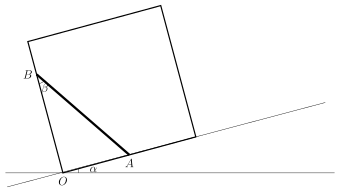
A plane makes an acute angle \(\alpha\) with the horizontal. A box in the shape of a cube is fixed onto the plane in such a way that four of its edges are horizontal and two of its sides are vertical. A uniform rod of length \(2L\) and weight \(W\) rests with its lower end at \(A\) on the bottom of the box and its upper end at \(B\) on a side of the box, as shown in the diagram below. The vertical plane containing the rod is parallel to the vertical sides of the box and cuts the lowest edge of the box at \(O\). The rod makes an acute angle~\(\beta\) with the side of the box at \(B\). The coefficients of friction between the rod and the box at the two points of contact are both \(\tan \gamma\), where \(0 < \gamma < \frac12\pi\). %The frictional force on the rod at \(A\) acts toward \(O\), %and the frictional force on the rod at~\(B\) %acts away from \(O\). The rod is in limiting equilibrium, with the end at \(A\) on the point of slipping in the direction away from \(O\) and the end at \(B\) on the point of slipping towards \(O\). Given that \(\alpha < \beta\), show that \(\beta = \alpha + 2\gamma\). [\(Hint\): You may find it helpful to take moments about the midpoint of the rod.]
Solution:

2016 Paper 3 Q10
A smooth plane is inclined at an angle \(\alpha\) to the horizontal. A particle \(P\) of mass \(m\) is attached to a fixed point \(A\) above the plane by a light inextensible string of length \(a\). The particle rests in equilibrium on the plane, and the string makes an angle \(\beta\) with the plane. The particle is given a horizontal impulse parallel to the plane so that it has an initial speed of \(u\). Show that the particle will not immediately leave the plane if \(ag\cos(\alpha + \beta)> u^2 \tan\beta\). Show further that a necessary condition for the particle to perform a complete circle whilst in contact with the plane is \(6\tan\alpha \tan \beta < 1\).
2015 Paper 1 Q11
Two long circular cylinders of equal radius lie in equilibrium on an inclined plane, in \mbox{contact} with one another and with their axes horizontal. The weights of the upper and lower \mbox{cylinders} are \(W_1\) and \(W_2\), respectively, where \(W_1>W_2\)\,. The coefficients of friction \mbox{between} the \mbox{inclined} plane and the upper and lower cylinders are \(\mu_1\) and \(\mu_2\), respectively, and the \mbox{coefficient} of friction \mbox{between} the two cylinders is \(\mu\). The angle of inclination of the plane is~\(\alpha\) (which is positive).
- Let \(F\) be the magnitude of the frictional force between the two cylinders, and let \(F_1\) and \(F_2\) be the magnitudes of the frictional forces between the upper cylinder and the plane, and the lower cylinder and the plane, respectively. Show that \(F=F_1=F_2\,\).
- Show that \[ \mu \ge \dfrac{W_1+W_2}{W_1-W_2} \,,\] and that \[ \tan\alpha \le \frac{ 2 \mu_1 W_1}{(1+\mu_1)(W_1+ W_2)}\,. \]
2012 Paper 1 Q11
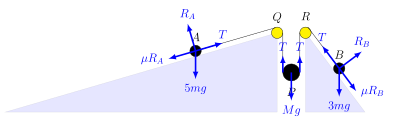
The diagram shows two particles, \(A\) of mass \(5m\) and \(B\) of mass \(3m\), connected by a light inextensible string which passes over two smooth, light, fixed pulleys, \(Q\) and \(R\), and under a smooth pulley \(P\) which has mass \(M\) and is free to move vertically. Particles \(A\) and \(B\) lie on fixed rough planes inclined to the horizontal at angles of \(\arctan \frac 7{24}\) and \(\arctan\frac43\) respectively. The segments \(AQ\) and \(RB\) of the string are parallel to their respective planes, and segments \(QP\) and \(PR\) are vertical. The coefficient of friction between each particle and its plane is \(\mu\).

- Given that the system is in equilibrium, with both \(A\) and \(B\) on the point of moving up their planes, determine the value of \(\mu\) and show that \(M = 6m\).
- In the case when \(M = 9m\), determine the initial accelerations of \(A\), \(B\) and \(P\) in terms of \(g\).
Solution:
2007 Paper 1 Q9
A particle of weight \(W\) is placed on a rough plane inclined at an angle of \(\theta\) to the horizontal. The coefficient of friction between the particle and the plane is \(\mu\). A horizontal force \(X\) acting on the particle is just sufficient to prevent the particle from sliding down the plane; when a horizontal force \(kX\) acts on the particle, the particle is about to slide up the plane. Both horizontal forces act in the vertical plane containing the line of greatest slope. Prove that \[ \left( k-1 \right) \left( 1 + \mu^2 \right) \sin \theta \cos \theta = \mu \left( k + 1 \right) \] and hence that $\displaystyle k \ge \frac{ \left( 1+ \mu \right)^2} { \left( 1 - \mu \right)^2}$ .
2007 Paper 3 Q10
A particle is projected from a point on a plane that is inclined at an angle~\(\phi\) to the horizontal. The position of the particle at time \(t\) after it is projected is \((x,y)\), where \((0,0)\) is the point of projection, \(x\) measures distance up the line of greatest slope and \(y\) measures perpendicular distance from the plane. Initially, the velocity of the particle is given by \((\dot x, \dot y) = (V\cos\theta, V\sin\theta)\), where \(V>0\) and \(\phi+\theta<\pi/2\,\). Write down expressions for \(x\) and \(y\). The particle bounces on the plane and returns along the same path to the point of projection. Show that \[2\tan\phi\tan\theta =1\] and that \[ R= \frac{V^2\cos^2\theta}{2g\sin\phi}\,, \] where \(R\) is the range along the plane. Show further that \[ \frac{2V^2}{gR} = 3\sin\phi + {\rm cosec}\,\phi \] and deduce that the largest possible value of \(R\) is \(V^2/ (\sqrt{3}\,g)\,\).
2005 Paper 2 Q9
Two particles, \(A\) and \(B\), of masses \(m\) and \(2m\), respectively, are placed on a line of greatest slope, \(\ell\), of a rough inclined plane which makes an angle of \(30^{\circ}\) with the horizontal. The coefficient of friction between \(A\) and the plane is \(\frac16\sqrt{3}\) and the coefficient of friction between \(B\) and the plane is \(\frac13 \sqrt{3}\). The particles are at rest with \(B\) higher up \(\ell\) than \(A\) and are connected by a light inextensible string which is taut. A force \(P\) is applied to \(B\).
- Show that the least magnitude of \(P\) for which the two particles move upwards along \(\ell\) is \(\frac{11}8 \sqrt{3}\, mg\) and give, in this case, the direction in which \(P\) acts.
- Find the least magnitude of \(P\) for which the particles do not slip downwards along~\(\ell\).
2005 Paper 2 Q11
A plane is inclined at an angle \(\arctan \frac34\) to the horizontal and a small, smooth, light pulley~\(P\) is fixed to the top of the plane. A string, \(APB\), passes over the pulley. A particle of mass~\(m_1\) is attached to the string at \(A\) and rests on the inclined plane with \(AP\) parallel to a line of greatest slope in the plane. A particle of mass \(m_2\), where \(m_2>m_1\), is attached to the string at \(B\) and hangs freely with \(BP\) vertical. The coefficient of friction between the particle at \(A\) and the plane is \( \frac{1}{2}\). The system is released from rest with the string taut. Show that the acceleration of the particles is \(\ds \frac{m_2-m_1}{m_2+m_1}g\). At a time \(T\) after release, the string breaks. Given that the particle at \(A\) does not reach the pulley at any point in its motion, find an expression in terms of \(T\) for the time after release at which the particle at \(A\) reaches its maximum height. It is found that, regardless of when the string broke, this time is equal to the time taken by the particle at \(A\) to descend from its point of maximum height to the point at which it was released. Find the ratio \(m_1 : m_2\). \noindent [Note that \(\arctan \frac34\) is another notation for \(\tan^{-1} \frac34\,\).]
2004 Paper 2 Q10
In this question take \(g = 10 ms^{-2}.\) The point \(A\) lies on a fixed rough plane inclined at \(30^{\circ}\) to the horizontal and \(\ell\) is the line of greatest slope through \(A\). A particle \(P\) is projected up \(\ell\) from \(A\) with initial speed \(6\)ms\(^{-1}\). A time \(T\) seconds later, a particle \(Q\) is projected from \(A\) up \(\ell\), also with speed \(6\)ms\(^{-1}\). The coefficient of friction between each particle and the plane is \(1/(5\sqrt{3})\,\) and the mass of each particle is \(4\)kg.
- Given that \(T<1+\sqrt{3/2}\), show that the particles collide at a time \((3-\sqrt6)T+1\) seconds after \(P\) is projected.
- In the case \(T=1+\sqrt{2/3}\,\), determine the energy lost due to friction from the instant at which \(P\) is projected to the time of the collision.
Solution: Since the particles are identical and are projected with the same speed, the only way they can reach the same point \(x\) at the same time, is if \(A\) has reached it's apex and started descending. Considering \(P\), we must have (setting the level of \(A\) to be the \(0\) G.P.E. level), suppose it travels a distance \(x\) before becoming stationary: \begin{align*} \text{N2}(\nwarrow): && R - 4g \cos(30^\circ) &= 0 \\ \Rightarrow && R &= 20\sqrt{3} \\ \Rightarrow && \mu R &= \frac1{5 \sqrt{3}} (20 \sqrt{3}) \\ &&&= 4 \\ \end{align*} Therefore in the two phases of the journey the particle is being accelerated down the slope by either \(6\) or \(4\). \(v^2 = u^2 + 2as \Rightarrow 0 = 36 - 12s \Rightarrow s = 3\). \(v = u + at \Rightarrow t = 1\). Therefore after \(1\) second \(P\) reaches its highest point having travelled \(3\) metres. It will pass back to the start in \(s = ut + \frac12 a t^2 \Rightarrow 3 = \frac12 4 t^2 \Rightarrow t = \sqrt{3/2}\) seconds, ie the constraint is that the particle hasn't already past \(Q\) before the collision. The collision will occur when \(s = 6t - \frac12 6 t^2\) and \(s =3 - \frac12 4 (t+T-1)^2\) coincide, ie: \begin{align*} && 6t - 3t^2 &= 3 - 2(t+T-1)^2 \\ && 0 &= 3 -2(T-1)^2 -(4(T-1)+6)t + t^2 \\ && 0 &= 3 -2(T-1)^2 -(4T+2)t + t^2 \\ \Rightarrow && t &= \frac{4T+2 \pm \sqrt{(4T+2)^2 - 4(3-2(T-1)^2)}}{2} \\ &&&= \frac{4T+2 \pm \sqrt{24T^2}}{2} \\ &&&= 2T + 1 \pm \sqrt{6} T \\ &&&= (2 \pm \sqrt{6})T + 1 \end{align*} we must take the smaller root, ie \((2-\sqrt{6})T + 1\). In the case the collision occurs exactly at the start, the particle \(P\) has traveled \(6\) meters, against a force of \(4\) newtons of friction, ie work done is \(24\) Joules.
2003 Paper 1 Q11
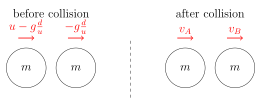
A smooth plane is inclined at an angle \(\alpha\) to the horizontal. \(A\) and \(B\) are two points a distance \(d\) apart on a line of greatest slope of the plane, with \(B\) higher than \(A\). A particle is projected up the plane from \(A\) towards \(B\) with initial speed \(u\), and simultaneously another particle is released from rest at \(B\,\). Show that they collide after a time \(\displaystyle {d /u}\,\). The coefficient of restitution between the two particles is \(e\) and both particles have mass \(m\,\). Show that the loss of kinetic energy in the collision is \(\frac14 {m u^2 \big( 1 - e^2 \big) }\,\).
Solution: We can `ignore' the fact that they are both accelerating, because the acceleration is the same for both object so it will "cancel" out. Therefore the time taken is the same as if the object has to travel distance \(d\) at speed \(u\), ie \(d/u\). \begin{align*} && u_A &= u - g \frac{d}{u} \\ && u_B &= -g\frac{d}{u} \end{align*}
2002 Paper 1 Q9
\(\,\) \vspace*{-0.5in}
- If the normal reactions on the lower and higher wheels of the lorry are equal, show that the sum of the frictional forces between the wheels and the ground is zero.
- If \(P\) is such that the lorry does not tip over (but the normal reactions on the lower and higher wheels of the lorry need not be equal), show that \[ W\tan(\alpha - \beta) \le P \le W\tan(\alpha+\beta)\;, \] where \(\tan\beta = d/h\,\).