Problems
Filters
9 problems found
2018 Paper 3 Q11
A particle is attached to one end of a light inextensible string of length \(b\). The other end of the string is attached to a fixed point \(O\). Initially the particle hangs vertically below \(O\). The particle then receives a horizontal impulse. The particle moves in a circular arc with the string taut until the acute angle between the string and the upward vertical is \(\alpha\), at which time it becomes slack. Express \(V\), the speed of the particle when the string becomes slack, in terms of \( b\), \(g\) and \(\alpha\). Show that the string becomes taut again a time \(T\) later, where \[ gT = 4V \sin\alpha \,,\] and that just before this time the trajectory of the particle makes an angle \(\beta \) with the horizontal where \(\tan\beta = 3\tan \alpha \,\). When the string becomes taut, the momentum of the particle in the direction of the string is destroyed. Show that the particle comes instantaneously to rest at this time if and only if \[ \sin^2\alpha = \dfrac {1+\sqrt3}4 \,. \]
Solution:

2015 Paper 2 Q11
Three particles, \(A\), \(B\) and \(C\), each of mass \(m\), lie on a smooth horizontal table. Particles \(A\) and \(C\) are attached to the two ends of a light inextensible string of length \(2a\) and particle \(B\) is attached to the midpoint of the string. Initially, \(A\), \(B\) and \(C\) are at rest at points \((0,a)\), \((0,0)\) and \((0,-a)\), respectively. An impulse is delivered to \(B\), imparting to it a speed \(u\) in the positive \(x\) direction. The string remains taut throughout the subsequent motion.
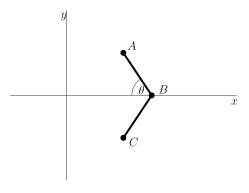
- At time \(t\), the angle between the \(x\)-axis and the string joining \(A\) and \(B\) is \(\theta\), as shown in the diagram, and \(B\) is at \((x,0)\). Write down the coordinates of \(A\) in terms of \(x,a\) and \(\theta\). Given that the velocity of \(B\) is \((v,0)\), show that the velocity of \(A\) is \((\dot x + a\sin\theta \,\dot \theta\,,\, a\cos\theta\, \dot\theta)\), where the dot denotes differentiation with respect to time.
- Show that, before particles \(A\) and \(C\) first collide, \[ 3\dot x + 2a \dot\theta \sin\theta =u \text{ and } \dot \theta^2 = \frac{u^2}{a^2(3-2\sin^2\theta)} \,. \]
- When \(A\) and \(C\) collide, the collision is elastic (no energy is lost). At what value of \(\theta\) does the second collision between particles \(A\) and \(C\) occur? (You should justify your answer.)
- When \(v=0\), what are the possible values of \(\theta\)? Is \(v =0\) whenever \(\theta\) takes these values?
Solution:
- \(A\) has coordinates \((x-a\cos \theta, a\sin \theta)\). Differentiating with respect to \(t\) the velocity of \(A\) is \((\dot{x}+a\sin \theta \cdot \dot{\theta}, a \cos \theta \cdot \dot{\theta})\)
- By considervation of momentum \(\rightarrow\) we must have \(mu = m(\dot{x}+a\dot{\theta}\sin \theta) + m\dot{x} + m(\dot{x}+a\dot{\theta}\sin \theta) = m(3\dot{x} + 2a \dot{\theta} \sin \theta)\) and the first equation follows. By conservation of energy, we must have \begin{align*} && \frac12 m u^2 &= \frac12 m \dot{x}^2 + \frac12m((\dot{x}+a\dot{\theta}\sin \theta)^2 + a^2 \dot{\theta}^2 \cos^2\theta ) + \frac12m((\dot{x}+a\dot{\theta}\sin \theta)^2 + a^2 \dot{\theta}^2 \cos^2\theta ) \\ &&&= \frac32m\dot{x}^2 + 2m a\dot{x}\dot{\theta}\sin \theta + ma^2\dot{\theta}^2(\sin^2\theta+\cos^2\theta) \\ \Rightarrow && u^2 &= \dot{x}(3\dot{x} + 4a \dot{\theta} \sin \theta) + 2a^2\dot{\theta}^2 \\ &&&= \left ( \frac{u-2a\dot{\theta}\sin \theta}{3}\right)\left ( 3\left ( \frac{u-2a\dot{\theta}\sin \theta}{3}\right)+ 4a \dot{x}\dot{\theta} \sin \theta \right) + 2a^2\dot{\theta}^2 \\ \Rightarrow && 3u^2 &= (u - 2a\dot{\theta} \sin \theta)^2 + 4a(u - 2 a \dot{\theta} \sin \theta) \dot{\theta}\sin \theta + 6a^2 \dot{\theta}^2 \\ &&&= u^2 + 4a^2\dot{\theta}^2 \sin^2 \theta - 8a^2\dot{\theta}^2\sin^2\theta + 6a^2 \dot{\theta}^2 \\ \Rightarrow && \dot{\theta}^2 &= \frac{u^2}{a^2(3-2\sin^2\theta)} \end{align*}
- Since \(\dot{\theta}^2 > 0\) \(\theta\) is strictly increasing or decreasing, therefore the first collision will be when \(\theta = 0\), the second when \(\theta = \pi\)
- If \(v = 0\), from our first equation we have \(2a \dot{\theta} \sin \theta = u \Rightarrow \dot{\theta}^2 = \frac{u^2}{4a^2 \sin^2 \theta} = \frac{u^2}{a^2(3-2\sin^2\theta)}\) so \(4\sin^2 \theta = 3 - 2\sin^2 \theta \Rightarrow \sin^2 \theta = \frac{1}{2}\) therefore the angles are all the multiples of \(\frac{\pi}{4}\).
2015 Paper 3 Q9
A particle \(P\) of mass \(m\) moves on a smooth fixed straight horizontal rail and is attached to a fixed peg \(Q\) by a light elastic string of natural length \(a\) and modulus \(\lambda\). The peg \(Q\) is a distance \(a\) from the rail. Initially \(P\) is at rest with \(PQ=a\). An impulse imparts to \(P\) a speed \(v\) along the rail. Let \(x\) be the displacement at time \(t\) of \(P\) from its initial position. Obtain the equation \[ \dot x^2 = v^2 - k^2 \left( \sqrt{x^2+a^2} -a\right)^{\!2} \] where \( k^2 = \lambda/(ma)\), \(k>0\) and the dot denotes differentiation with respect to \(t\). Find, in terms of \(k\), \(a\) and \(v\), the greatest value, \(x_0\), attained by \(x\). Find also the acceleration of \(P\) at \(x=x_0\). Obtain, in the form of an integral, an expression for the period of the motion. Show that in the case \(v\ll ka\) (that is, \(v\) is much less than \(ka\)), this is approximately \[ \sqrt {\frac {32a}{kv}} \int_0^1 \frac 1 {\sqrt{1-u^4}} \, \d u \, . \]
2013 Paper 3 Q10
A uniform rod \(AB\) has mass \(M\) and length \(2a\). The point \(P\) lies on the rod a distance \(a-x\) from~\(A\). Show that the moment of inertia of the rod about an axis through \(P\) and perpendicular to the rod is \[ \tfrac13 M(a^2 +3x^2)\,. \] The rod is free to rotate, in a horizontal plane, about a fixed vertical axis through \(P\). Initially the rod is at rest. The end \(B\) is struck by a particle of mass \(m\) moving horizontally with speed \(u\) in a direction perpendicular to the rod. The coefficient of restitution between the rod and the particle is \(e\). Show that the angular velocity of the rod immediately after impact is \[ \frac{3mu(1+e)(a+x)}{M(a^2+3x^2) +3m(a+x)^2}\,. \] In the case \(m=2M\), find the value of \(x\) for which the angular velocity is greatest and show that this angular velocity is \(u(1+e)/a\,\).
2011 Paper 3 Q10
Particles \(P\) and \(Q\), each of mass \(m\), lie initially at rest a distance \(a\) apart on a smooth horizontal plane. They are connected by a light elastic string of natural length \(a\) and modulus of elasticity \(\frac12 m a \omega^2\), where \(\omega\) is a constant. Then \(P\) receives an impulse which gives it a velocity \(u\) directly away from \(Q\). Show that when the string next returns to length \(a\), the particles have travelled a distance \(\frac12 \pi u/\omega\,\), and find the speed of each particle. Find also the total time between the impulse and the subsequent collision of the particles.
1999 Paper 3 Q10
A chain of mass \(m\) and length \(l\) is composed of \(n\) small smooth links. It is suspended vertically over a horizontal table with its end just touching the table, and released so that it collapses inelastically onto the table. Calculate the change in momentum of the \((k+1)\)th link from the bottom of the chain as it falls onto the table. Write down an expression for the total impulse sustained by the table in this way from the whole chain. By approximating the sum by an integral, show that this total impulse is approximately \[ {\textstyle \frac23} m \surd(2gl) \] when \(n\) is large.
1991 Paper 1 Q13
\(\ \)\vspace{-1.5cm} \noindent
1990 Paper 3 Q11
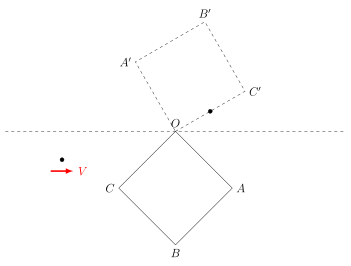
The points \(O,A,B\) and \(C\) are the vertices of a uniform square lamina of mass \(M.\) The lamina can turn freely under gravity about a horizontal axis perpendicular to the plane of the lamina through \(O\). The sides of the lamina are of length \(2a.\) When the lamina is haning at rest with the diagonal \(OB\) vertically downwards it is struck at the midpoint of \(OC\) by a particle of mass \(6M\) moving horizontally in the plane of the lamina with speed \(V\). The particle adheres to the lamina. Find, in terms of \(a,M\) and \(g\), the value which \(V^{2}\) must exceed for the lamina and particle to make complete revolutions about the axis.
Solution:
1989 Paper 3 Q14
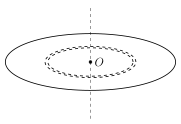
- A solid circular disc has radius \(a\) and mass \(m.\) The density is proportional to the distance from the centre \(O\). Show that the moment of inertia about an axis through \(C\) perpendicular to the plane of the disc is \(\frac{3}{5}ma^{2}.\)
- A light inelastic string has one end fixed at \(A\). It passes under and supports a smooth pulley \(B\) of mass \(m.\) It then passes over a rough pulley \(C\) which is a disc of the type described in (i), free to turn about its axis which is fixed and horizontal. The string carries a particle \(D\) of mass \(M\) at its other end. The sections of the string which are not in contact with the pulleys are vertical. The system is released from rest and moves under gravity for \(t\) seconds. At the end of this interval the pulley \(B\) is suddenly stopped. Given that \(m<2M\), find the resulting impulse on \(D\) in terms of \(m,M,g\) and \(t\). {[}You may assume that the string is long enough for there to be no collisions between the elements of the system, and that the pulley \(C\) is rough enough to prevent slipping throughout.{]}
Solution:
- \begin{align*} m &= \int_0^a \underbrace{(\rho r)}_{\text{mass per area}} \underbrace{\pi r^2}_{\text{area}} \d r \\ &= \rho \pi \frac{a^3}{3} \\ \\ I &= \sum m r^2 \\ &= \sum (\rho r) \pi r^2 \cdot r^2 \\ &\to \int_0^a \rho \pi r^4 \\ &= \frac15 \rho \pi a^5 \\ &= \frac35 m a^2 \end{align*}
- \begin{align*} \text{N2}(\downarrow, D): && Mg -T_C &= Mf \\ \overset{\curvearrowright}{C} && (T_C - T_B)a &= I \frac{f}{a} \\ &&&= \frac35 m a f \\ \text{N2}(\uparrow, B): && 2T_B-mg &= \frac12 m f \\ \\ \Rightarrow && Mg-T_B &= \left (M + \frac35 m \right)f \\ \Rightarrow && Mg - \frac12 mg &= \left (M + \frac35 m + \frac14 m \right)f \\ \Rightarrow && f &= \frac{(M-\frac12 m)g}{M + \frac{17}{20} m} \\ &&&= \frac{(2M-m)g}{2M +\frac{17}{10}m} \end{align*} Therefore the speed after a time \(t\) is \(\displaystyle \frac{(2M-m)g}{2M +\frac{17}{10}m} t\) and the impulse will be the change in momentum, ie \(\displaystyle \frac{(2M-m)g}{2M +\frac{17}{10}m} Mt\)
