Problems
Filters
6 problems found
2018 Paper 3 Q4
The point \(P(a\sec \theta, b\tan \theta )\) lies on the hyperbola \[ \dfrac{x^{2}}{a^{2}}-\dfrac{y^{2}}{b^{2}}=1\,, \] where \(a>b>0\,\). Show that the equation of the tangent to the hyperbola at \(P\) can be written as \[ bx- ay \sin\theta = ab \cos\theta \,. \]
- This tangent meets the lines \(\dfrac x a = \dfrac yb\) and \(\dfrac x a =- \dfrac y b\) at \(S\) and \(T\), respectively. How is the mid-point of \(ST\) related to \(P\)?
- The point \(Q(a\sec \phi, b\tan \phi)\) also lies on the hyperbola and the tangents to the hyperbola at \(P\) and \(Q\) are perpendicular. These two tangents intersect at \((x,y)\). Obtain expressions for \(x^2\) and \(y^2\) in terms of \(a\), \(\theta\) and \(\phi\). Hence, or otherwise, show that \(x^2+y^2 = a^2 -b^2\).
Solution: Note that \begin{align*} && \frac{\d a \sec \theta}{\d \theta} &= a \sec \theta \tan \theta \\ && \frac{\d b \tan \theta}{\d \theta} &= b \sec^2 \theta \\ \Rightarrow && \frac{\d y}{\d x} &= \frac{b \sec^2 \theta}{a \sec \theta \tan \theta} \\ &&&= \frac{b}{a} \frac{1}{\sin \theta} \\ \Rightarrow && \frac{y-b \tan \theta}{x - a \sec \theta} &= \frac{b}{a} \frac{1}{\sin \theta} \\ \Rightarrow && a \sin \theta y - ab \tan \theta \sin \theta &= bx -ab \sec \theta \\ \Rightarrow && bx-ay\sin \theta &= ab \sec x (1 - \sin ^2 \theta) \\ &&&= ab \cos \theta \end{align*}
- \begin{align*} S: &&& \begin{cases} bx-ay &= 0 \\ bx-ay \sin \theta &= ab \cos \theta \end{cases} \\ \Rightarrow && ay(1-\sin \theta) &= ab \cos \theta \\ \Rightarrow && y &= \frac{b \cos \theta}{1-\sin \theta} \\ &&x &=\frac{a\cos \theta}{1-\sin \theta} \\ T: &&& \begin{cases} bx+ay &= 0 \\ bx-ay \sin \theta &= ab \cos \theta \end{cases} \\ \Rightarrow && ay(1+\sin \theta) &= -ab \cos \theta \\ \Rightarrow && y &= \frac{-b \cos \theta}{1+\sin \theta} \\ &&x &=\frac{a\cos \theta}{1+\sin \theta} \\ M: && x &= \frac{a \cos \theta}{2} \frac{2}{1-\sin^2 \theta} \\ &&&= a \sec \theta \\ && y &= \frac{b \cos \theta}{2} \frac{2 \sin \theta}{1-\sin^2 \theta} \\ &&&= b \tan \theta \end{align*} The midpoint of \(ST\) is the same as \(P\).
- The tangents are perpendicular, therefore \(\frac{b}{a} \cosec \theta = - \frac{a}{b} \sin \phi\), ie \(b^2 = -a^2 \sin \phi \sin \theta\) The will intersect at: \begin{align*} &&& \begin{cases} bx - ay \sin \theta &= ab \cos \theta \\ bx - ay \sin \phi &= ab \cos \phi \end{cases} \\ \Rightarrow && ay ( \sin \theta - \sin \phi) &= ab(\cos \phi - \cos \theta) \\ \Rightarrow && y &= \frac{b(\cos \phi - \cos \theta)}{(\sin \theta - \sin \phi)} \\ && y^2 &= \frac{-a^2 \sin \phi \sin \theta (\cos\phi - \cos \theta)^2}{(\sin \theta - \sin \phi)^2} \\ \Rightarrow && bx(\sin \phi - \sin \theta) &= ab(\cos \theta \sin \phi - \cos \phi \sin \theta) \\ \Rightarrow && x &= \frac{a(\cos \theta \sin \phi - \cos \phi \sin \theta)}{\sin \phi - \sin \theta} \\ &&&= \frac{a^2(\cos \theta \sin \phi - \cos \phi \sin \theta)^2}{(\sin \phi - \sin \theta)^2} \end{align*} Therefore \begin{align*} && x^2+y^2 &= \frac{a^2}{(\sin \phi - \sin \theta)^2} \l (\cos \theta \sin \phi- \cos \phi \sin \theta)^2 - \sin \phi \sin \theta (\cos\phi - \cos \theta)^2 \r \\ &&&= \frac{a^2}{(\sin \phi - \sin \theta)^2} \l (\sin \phi - \sin \theta)(\cos^2 \theta \sin \phi - \sin \theta \cos^2 \phi) \r \\ &&&=a^2-b^2 \end{align*}
2012 Paper 3 Q5
- The point with coordinates \((a, b)\), where \(a\) and \(b\) are rational numbers,is called an integer rational point if both \(a\) and \(b\) are integers; a non-integer rational point if neither \(a\) nor \(b\) is an integer.
- \(\bf (a)\) Write down an integer rational point and a non-integer rational point on the circle \(x^2+y^2 =1\).
- [\bf (b)] Write down an integer rational point on the circle \(x^2+y^2=2\). Simplify \[ (\cos\theta + \sqrt m \sin\theta)^2 + (\sin\theta - \sqrt m \cos\theta)^2 \, \] and hence obtain a non-integer rational point on the circle \(x^2+y^2=2\,\).
- The point with coordinates \((p+\sqrt 2 \, q\,,\, r+\sqrt 2 \, s)\), where \(p\), \(q\), \(r\) and \(s\) are rational numbers, is called: an integer \(2\)-rational point if all of \(p\), \(q\), \(r\) and \(s\) are integers; a non-integer \(2\)-rational point if none of \(p\), \(q\), \(r\) and \(s\) is an integer.
- \(\bf (a)\) Write down an integer \(2\)-rational point, and obtain a non-integer \(2\)-rational point, on the circle \(x^2+y^2=3\,\).
- [\bf(b)] Obtain a non-integer \(2\)-rational point on the circle \(x^2+y^2=11\,\).
- [\bf(c)]Obtain a non-integer \(2\)-rational point on the hyperbola \(x^2-y^2 =7 \).
Solution:
- \(\bf (a)\) \((1, \sqrt2)\) is an integer \(2\)-rational point. \((\frac35 + \frac45\sqrt2, \frac45 - \frac{3}{5}\sqrt2)\) is a non-integer \(2\)-rational point.
- [\bf(b)] First notice that \((\sqrt2)^2 +3^2 = 11\) so then consider \((1 + \tfrac32\sqrt2, 1-\tfrac32\sqrt2)\) will work as \(\pi/4\) degree rotation.
- [\bf(c)] First notice \(3^2-(\sqrt2)^2 = 2\). Notice that \((k\sec \theta + \sqrt{m} \tan \theta)^2 - (k\tan \theta + \sqrt{m} \sec \theta)^2 = k^2-m\). Taking \(k= 3\) we have \((3 \cdot \frac{13}{5} + \frac{12}{5}\sqrt{2}, 3\cdot\frac{12}5+\frac{13}{5}\sqrt2)\)
2001 Paper 3 Q2
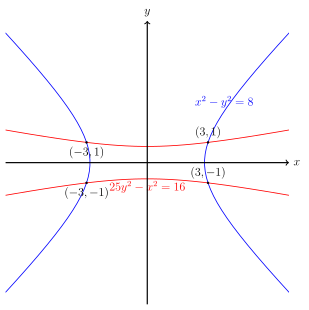
Show that \( \cosh^{-1} x = \ln ( x + \sqrt{x^2-1})\). Show that the area of the region defined by the inequalities \(\displaystyle y^2 \ge x^2-8\) and \(\displaystyle x^2\ge 25y^2 -16 \) is \((72/5) \ln 2\).
Solution: \begin{align*} && x &= \cosh y \\ \Rightarrow && x &= \tfrac12 (e^y + e^{-y} ) \\ \Rightarrow && 0 &= e^{2y} - 2xe^y + 1 \\ \Rightarrow && e^y &= \frac{2x \pm \sqrt{4x^2-4}}{2} \\ &&&= x \pm \sqrt{x^2-1} \\ \Rightarrow &&e^y &= x + \sqrt{x^2-1} \tag{by convention \(\cosh^{-1} > 0\)} \\ \Rightarrow && y &= \ln (x + \sqrt{x^2-1}) \end{align*}
1991 Paper 2 Q2
The equation of a hyperbola (with respect to axes which are displaced and rotated with respect to the standard axes) is \[ 3y^{2}-10xy+3x^{2}+16y-16x+15=0.\tag{\(\dagger\)} \] By differentiating \((\dagger)\), or otherwise, show that the equation of the tangent through the point \((s,t)\) on the curve is \[ y=\left(\frac{5t-3s+8}{3t-5s+8}\right)x-\left(\frac{8t-8s+15}{3t-5s+8}\right). \] Show that the equations of the asymptote (the limiting tangents as \(s\rightarrow\infty\)) are \[ y=3x-4\qquad\mbox{ and }\qquad3y=x-4. \] {[}Hint: You will need to find a relationship between \(s\) and \(t\) which is valid in the limit as \(s\rightarrow\infty.\){]} Show that the angle between one asymptote and the \(x\)-axis is the same as the angle between the other asymptote and the \(y\)-axis. Deduce the slopes of the lines that bisect the angles between the asymptotes and find the equations of the axes of the hyperbola.
Solution: \begin{align*} && 0 &= 3y^{2}-10xy+3x^{2}+16y-16x+15 \\ \Rightarrow && 0 &= 6y \frac{\d y}{\d x} - 10x \frac{\d y}{\d x} - 10y + 6x+ 16 \frac{\d y}{\d x } - 16 \\ &&&= \frac{\d y}{\d x} \left (6y - 10x +16 \right) - (10y-6x+16) \\ \Rightarrow && \frac{\d y}{\d x} &= \frac{5y-3x+8}{3y-5x+8} \\ \Rightarrow && \frac{y-t}{x-s} &= \frac{5t-3s+8}{3t-5s+8} \\ && y &= \left(\frac{5t-3s+8}{3t-5s+8}\right)x -\left(\frac{5t-3s+8}{3t-5s+8}\right)s + t \\ &&&= \left(\frac{5t-3s+8}{3t-5s+8}\right)x - \frac{(5ts-3s^2+8s)-(3t^2-5st+8t)}{3t-5s+8} \\ &&&= \left(\frac{5t-3s+8}{3t-5s+8}\right)x - \frac{(5ts-3s^2+8s)-(3t^2-5st+8t)}{3t-5s+8} \\ &&&= \left(\frac{5t-3s+8}{3t-5s+8}\right)x - \frac{8s-8t-(3s^2+3t^2-10st)}{3t-5s+8} \\ &&&= \left(\frac{5t-3s+8}{3t-5s+8}\right)x - \frac{8s-8t-(16s-16t-15)}{3t-5s+8} \\ &&&= \left(\frac{5t-3s+8}{3t-5s+8}\right)x - \frac{8t-8s+15}{3t-5s+8} \\ \end{align*} While \(x \to \infty\) we still have \(3 \frac{y^2}{x^2} - 10 \frac{y}{x} + 3 + 16 \frac{y}{x^2} - 16\frac{1}{x} + 15 \frac{1}{x^2} = 0\), ie if \(\frac{y}{x} = k\), then \(3k^2 - 10k + 3 \to 0 \Rightarrow k \to 3, \frac13\). Therefore, as \(s \to \infty\) we can write \begin{align*} && y &= \left(\frac{5\frac{t}{s}-3+8\frac{1}{s}}{3\frac{t}{s}-5+8\frac1{s}}\right)x - \frac{8\frac{t}s-8+15\frac{1}{s}}{3\frac{t}{s}-5+8\frac{1}{s}} \\ k \to 3: &&& \to \left(\frac{15-3}{9-5}\right)x - \frac{24-8}{9-5} \\ &&&= 3x - 4 \\ k \to \frac13: && &\to \left(\frac{\frac53-3}{1-5}\right)x - \frac{\frac83-8}{1-5} \\ &&&= \frac13 x - \frac43 \end{align*} Therefore the equations are \(y = 3x-4\) and \(3y=x-4\) The lines are parallel to \(y = 3x\) and \(y = \frac13x\), so by considering the triangles formed with the origin and a point \(1\) along the \(x\) or \(y\) axis we can see the angles are identical. This means the line \(y = x\) is parallel to one axis and \(y = -x\) is parallel to the other. They must meet where our two lines meet which is \((1,-1)\), so our lines are \(y = x-2\) and \(y = -x\)
1991 Paper 3 Q6
The transformation \(T\) from \(\binom{x}{y}\) to \(\binom{x'}{y'}\) in two-dimensional space is given by \[ \begin{pmatrix}x'\\ y' \end{pmatrix}=\begin{pmatrix}\cosh u & \sinh u\\ \sinh u & \cosh u \end{pmatrix}\begin{pmatrix}x\\ y \end{pmatrix}, \] where \(u\) is a positive real constant. Show that the curve with equation \(x^{2}-y^{2}=1\) is transformed into itself. Find the equations of two straight lines through the origin which transform into themselves. A line, not necessary through the origin, which has gradient \(\tanh v\) transforms under \(T\) into a line with gradient \(\tanh v'\). Show that \(v'=v+u\). The lines \(\ell_{1}\) and \(\ell_{2}\) with gradients \(\tanh v_{1}\) and \(\tanh v_{2}\) transform under \(T\) into lines with gradients \(\tanh v_{1}'\) and \(\tanh v_{2}'\) respectively. Find the relation satisfied by \(v_{1}\) and \(v_{2}\) that is the necessary and sufficient for \(\ell_{1}\) and \(\ell_{2}\) to intersect at the same angle as their transforms. In the case when \(\ell_{1}\) and \(\ell_{2}\) meet at the origin, illustrate in a diagram the relation between \(\ell_{1}\), \(\ell_{2}\) and their transforms.
1989 Paper 2 Q3
The real numbers \(x\) and \(y\) are related to the real numbers \(u\) and \(v\) by \[ 2(u+\mathrm{i}v)=\mathrm{e}^{x+\mathrm{i}y}-\mathrm{e}^{-x-\mathrm{i}y}. \] Show that the line in the \(x\)-\(y\) plane given by \(x=a\), where \(a\) is a positive constant, corresponds to the ellipse \[ \left(\frac{u}{\sinh a}\right)^{2}+\left(\frac{v}{\cosh a}\right)^{2}=1 \] in the \(u\)-\(v\) plane. Show also that the line given by \(y=b\), where \(b\) is a constant and \(0<\sin b<1,\) corresponds to one branch of a hyperbola in the \(u\)-\(v\) plane. Write down the \(u\) and \(v\) coordinates of one point of intersection of the ellipse and hyperbola branch, and show that the curves intersect at right-angles at this point. Make a sketch of the \(u\)-\(v\) plane showing the ellipse, the hyperbola branch and the line segments corresponding to:
- \(x=0\);
- \(y=\frac{1}{2}\pi,\) \(\quad 0\leqslant x\leqslant a.\)
Solution: \begin{align*} && 2(u+iv) &= e^{a+iy} - e^{-a-iy} \\ && &=(e^a \cos y - e^{-a} \cos y) + (e^a \sin y + e^{-a} \sin y)i \\ &&&= 2 \sinh a \cos y + 2\cosh a \sin y i\\ \Rightarrow && \frac{u}{\sinh a} &= \cos y \\ && \frac{v}{\cosh a} &= \sin y \\ \Rightarrow && 1 &= \left(\frac{u}{\sinh a}\right)^{2}+\left(\frac{v}{\cosh a}\right)^{2} \end{align*} \begin{align*} && 2(u+iv) &= e^{x+ib} - e^{-x-ib} \\ &&&= 2\sinh x \cos b + 2\cosh x \sin b i \\ \Rightarrow && \frac{u}{\cos b} &= \sinh x \\ && \frac{v}{\sin b} &= \cosh x \\ \Rightarrow && 1 &= \left (\frac{v}{\sin b} \right)^2 - \left (\frac{u}{\cos b} \right)^2 \end{align*} Therefore all the points lie of a hyperbola, and since \(\frac{v}{\sin b} > 0 \Rightarrow v > 0\) it's one branch of the hyperbola. (And all points on it are reachable as \(x\) varies from \(-\infty < x < \infty\). \begin{align*} 2(u+iv) &= e^{a+ib} - e^{-a-ib} \\ &= 2 \sinh a \cos b + 2 \cosh a \sin b i \end{align*} so we can take \(u = \sinh a \cos b, v = \cosh a \sin b\). \begin{align*} \frac{\d }{\d u} && 0 &= \frac{2 u}{\sinh^2 a} + \frac{2v}{\cosh^2 a} \frac{\d v}{\d u} \\ \Rightarrow && \frac{\d v}{\d u} &= -\frac{u}{v} \coth^2 a \\ \\ && \frac{\d v}{\d u} \rvert_{(u,v)} &= -\frac{\sinh a \cos b}{\cosh a \sin b} \coth^2 a \\ &&&= -\cot b \coth a \\ \frac{\d }{\d u} && 0 &= \frac{2 v}{\sin^2 b} \frac{\d v}{\d u} - \frac{2u}{\cos^2 b} \\ \Rightarrow && \frac{\d v}{\d u} &= \frac{u}{v} \tan^2 b \\ && \frac{\d v}{\d u} \rvert_{(u,v)} &= \frac{\sinh a \cos b}{\cosh a \sin b} \tan^2 b \\ &&&= \tanh a \tan b \end{align*} Therefore they are negative reciprocals and hence perpendicular.