Problems
Filters
11 problems found
2025 Paper 2 Q4
Let \(\lfloor x \rfloor\) denote the largest integer that satisfies \(\lfloor x \rfloor \leq x\). For example, if \(x = -4.2\), then \(\lfloor x \rfloor = -5\).
- Show that, if \(n\) is an integer, then \(\lfloor x + n \rfloor = \lfloor x \rfloor + n\).
- Let \(n\) be a positive integer and define function \(f_n\) by
\[f_n(x) = \lfloor x \rfloor + \left\lfloor x + \frac{1}{n} \right\rfloor + \left\lfloor x + \frac{2}{n} \right\rfloor + \ldots + \left\lfloor x + \frac{n-1}{n} \right\rfloor - \lfloor nx \rfloor\]
- Show that \(f_n\left(x + \frac{1}{n}\right) = f_n(x)\).
- Evaluate \(f_n(t)\) for \(0 \leq t < \frac{1}{n}\).
- Hence show that \(f_n(x) \equiv 0\).
- Show that \(\left\lfloor \frac{x}{2} \right\rfloor + \left\lfloor \frac{x+1}{2} \right\rfloor = \lfloor x \rfloor\).
- Hence, or otherwise, simplify \[\left\lfloor \frac{x+1}{2} \right\rfloor + \left\lfloor \frac{x+2}{2^2} \right\rfloor + \ldots + \left\lfloor \frac{x+2^k}{2^{k+1}} \right\rfloor + \ldots\]
Solution:
- Claim: If \(n \in \mathbb{Z}\) then \(\lfloor x + n \rfloor = \lfloor x \rfloor + n\) Proof: Since \(\lfloor x \rfloor \leq x\) then \(\lfloor x \rfloor + n \leq x + n\) and \(\lfloor x \rfloor + n \in \mathbb{Z}\) we must have that \(\lfloor x \rfloor +n \leq \lfloor x + n \rfloor\). However, since \(\lfloor x \rfloor + 1 > x\) we must also have that \(\lfloor x \rfloor + 1 + n > x + n\), therefore \(\lfloor x \rfloor + n\) is the largest integer less than \(x + n\) as required.
- Claim: \(f_n\left(x + \frac{1}{n}\right) = f_n(x)\) Proof: \begin{align*} f_n\left(x + \frac{1}{n}\right) &=\left \lfloor x+ \frac{1}{n} \right \rfloor + \left\lfloor x + \frac{1}{n}+ \frac{1}{n} \right\rfloor + \left\lfloor x+ \frac{1}{n} + \frac{2}{n} \right\rfloor + \ldots + \left\lfloor x+ \frac{1}{n} + \frac{n-1}{n} \right\rfloor - \left \lfloor n\left ( x + \frac{1}{n} \right) \right \rfloor \\ &= \left \lfloor x+ \frac{1}{n} \right \rfloor + \left\lfloor x + \frac{2}{n}\right\rfloor + \left\lfloor x+ \frac{3}{n} \right\rfloor + \ldots + \left\lfloor x+ \frac{n}{n} \right\rfloor - \left \lfloor nx + 1 \right \rfloor \\ &= \left \lfloor x+ \frac{1}{n} \right \rfloor + \left\lfloor x + \frac{2}{n}\right\rfloor + \left\lfloor x+ \frac{3}{n} \right\rfloor + \ldots + \left\lfloor x+ 1 \right\rfloor - \left \lfloor nx + 1 \right \rfloor \\ &= \left \lfloor x+ \frac{1}{n} \right \rfloor + \left\lfloor x + \frac{2}{n}\right\rfloor + \left\lfloor x+ \frac{3}{n} \right\rfloor + \ldots + \lfloor x \rfloor + 1 - \left ( \lfloor nx \rfloor + 1 \right) \\ &= \lfloor x \rfloor + \left\lfloor x + \frac{1}{n} \right\rfloor + \left\lfloor x + \frac{2}{n} \right\rfloor + \ldots + \left\lfloor x + \frac{n-1}{n} \right\rfloor - \lfloor nx \rfloor \\ &= f_n(x) \end{align*}
- Suppose \(0 \leq t < \frac1n\), then note that \(\left \lfloor t + \frac{k}{n} \right \rfloor = 0\) for \(0 \leq k \leq n - 1\) and \(\lfloor n t \rfloor = 0\) since \(nt < 1\)
- Since \(f_n(x)\) is zero on \([0, \tfrac1n)\) and periodic with period \(\tfrac1n\) it must be constantly zero
- Claim: \(\left\lfloor \frac{x}{2} \right\rfloor + \left\lfloor \frac{x+1}{2} \right\rfloor = \lfloor x \rfloor\) Proof: Suppose \(x = n + \epsilon\) where \(0 \leq \epsilon < 1\), ie \(n = \lfloor x \rfloor\), then consider two cases: Case 1: \(n = 2k\) \begin{align*} \left\lfloor \frac{x}{2} \right\rfloor + \left\lfloor \frac{x+1}{2} \right\rfloor &= \left\lfloor \frac{n + \epsilon}{2} \right\rfloor + \left\lfloor \frac{n + \epsilon+1}{2} \right\rfloor \\ &= \left\lfloor \frac{2k + \epsilon}{2} \right\rfloor + \left\lfloor \frac{2k + \epsilon+1}{2} \right\rfloor \\ &= k + \left\lfloor \frac{\epsilon}{2} \right\rfloor + k + \left\lfloor \frac{\epsilon+1}{2} \right\rfloor \\ &= 2k \\ &= n \end{align*} Case 2: \(n = 2k + 1\) \begin{align*} \left\lfloor \frac{x}{2} \right\rfloor + \left\lfloor \frac{x+1}{2} \right\rfloor &= \left\lfloor \frac{n + \epsilon}{2} \right\rfloor + \left\lfloor \frac{n + \epsilon+1}{2} \right\rfloor \\ &= \left\lfloor \frac{2k +1+ \epsilon}{2} \right\rfloor + \left\lfloor \frac{2k +1+ \epsilon+1}{2} \right\rfloor \\ &= k + \left\lfloor \frac{\epsilon+1}{2} \right\rfloor + k +1+ \left\lfloor \frac{\epsilon}{2} \right\rfloor \\ &= 2k +1\\ &= n \end{align*} as required.
- Since \(\left \lfloor \frac{x+1}{2} \right \rfloor = \lfloor x \rfloor - \lfloor \frac{x}{2} \rfloor\) and in general, \(\left \lfloor \frac{x+2^k}{2^{k+1}} \right \rfloor = \lfloor \frac{x}{2^k} \rfloor - \lfloor \frac{x}{2^{k+1}} \rfloor\) and so in general: \begin{align*} \sum_{k=0}^\infty \left \lfloor \frac{x+2^k}{2^{k+1}} \right \rfloor &= \sum_{k=0}^\infty \left ( \left \lfloor \frac{x}{2^k} \right \rfloor -\left \lfloor \frac{x}{2^{k+1}} \right \rfloor \right) \\ &= \lfloor x \rfloor \end{align*}
2021 Paper 2 Q3
In this question, \(x\), \(y\) and \(z\) are real numbers. Let \(\lfloor x \rfloor\) denote the largest integer that satisfies \(\lfloor x \rfloor \leqslant x\) and let \(\{x\}\) denote the fractional part of~\(x\), so that \(x = \lfloor x \rfloor + \{x\}\) and \(0 \leqslant \{x\} < 1\). For example, if \(x = 4.2\), then \(\lfloor x \rfloor = 4\) and \(\{x\} = 0.2\) and if \(x = -4.2\), then \(\lfloor x \rfloor = -5\) and \(\{x\} = 0.8\).
- Solve the simultaneous equations \begin{align*} \lfloor x \rfloor + \{y\} &= 4.9, \\ \{x\} + \lfloor y \rfloor &= -1.4. \end{align*}
- Given that \(x\), \(y\) and \(z\) satisfy the simultaneous equations \begin{align*} \lfloor x \rfloor + y + \{z\} &= 3.9, \\ \{x\} + \lfloor y \rfloor + z &= 5.3, \\ x + \{y\} + \lfloor z \rfloor &= 5, \end{align*} show that \(\{y\} + z = 3.2\) and solve the equations.
- Solve the simultaneous equations \begin{align*} \lfloor x \rfloor + 2y + \{z\} &= 3.9, \\ \{x\} + 2\lfloor y \rfloor + z &= 5.3, \\ x + 2\{y\} + \lfloor z \rfloor &= 5. \end{align*}
2021 Paper 3 Q11
The continuous random variable \(X\) has probability density function \[ f(x) = \begin{cases} \lambda e^{-\lambda x} & \text{for } x \geqslant 0, \\ 0 & \text{otherwise,} \end{cases} \] where \(\lambda\) is a positive constant. The random variable \(Y\) is the greatest integer less than or equal to \(X\), and \(Z = X - Y\).
- Show that, for any non-negative integer \(n\), \[ \mathrm{P}(Y = n) = (1 - e^{-\lambda})\,e^{-n\lambda}. \]
- Show that \[ \mathrm{P}(Z < z) = \frac{1 - e^{-\lambda z}}{1 - e^{-\lambda}} \qquad \text{for } 0 \leqslant z \leqslant 1. \]
- Evaluate \(\mathrm{E}(Z)\).
- Obtain an expression for \[ \mathrm{P}(Y = n \text{ and } z_1 < Z < z_2), \] where \(0 \leqslant z_1 < z_2 \leqslant 1\) and \(n\) is a non-negative integer. Determine whether \(Y\) and \(Z\) are independent.
Solution:
- \(\,\) \begin{align*} && \mathbb{P}(Y = n) &= \mathbb{P}(X \in [n, n+1)) \\ &&&= \int_n^{n+1} \lambda e^{-\lambda x} \d x \\ &&&= \left [-e^{-\lambda x} \right]_n^{n+1} \\ &&&= e^{-\lambda n} - e^{-\lambda(n+1)} \\ &&&= e^{-\lambda n}(1- e^{-\lambda}) \end{align*}
- \(,\) \begin{align*} && \mathbb{P}(Z < z) &= \sum_{i=0}^{\infty} \mathbb{P}(X \in (n, n+z)) \\ &&&= \sum_{i=0}^{\infty} \int_{n}^{n+z} \lambda e^{-\lambda x} \d x \\ &&&= \sum_{i=0}^{\infty} [-e^{-\lambda x}]_{n}^{n+z} \\ &&&= \sum_{i=0}^{\infty} (1-e^{-\lambda x})e^{-\lambda n} \\ &&&= \frac{1-e^{-\lambda x}}{1-e^{-\lambda}} \end{align*}
- Give the cdf of \(Z\), we see that \(f_Z(z) = \frac{\lambda e^{-\lambda z}}{1-e^{-\lambda}}\) so \begin{align*} && \E[Z] &= \int_0^1 z \frac{\lambda e^{-\lambda z}}{1-e^{-\lambda}} \d z \\ &&&= \frac{\lambda}{1-e^{-\lambda}} \int_0^1 ze^{-\lambda z} \d z \\ &&&= \frac{\lambda}{1-e^{-\lambda}} \left ( \left [-\frac{1}{\lambda} ze^{-\lambda z} \right]_0^1+\int_0^1 \frac{1}{\lambda} e^{-\lambda z} \d z \right) \\ &&&= \frac{\lambda}{1-e^{-\lambda}} \left ( -\frac{e^{-\lambda}}{\lambda} + \frac{1-e^{-\lambda}}{\lambda^2} \right) \\ &&&= \frac{1-e^{-\lambda}(1+\lambda)}{\lambda (1-e^{-\lambda})} \end{align*}
- \(\,\) \begin{align*} && \mathbb{P}(Y = n \text{ and }z_1 < Z < z_2)&= \mathbb{P}(X \in (n+z_1, n+z_2) ) \\ &&&= \int_{n+z_1}^{n+z_2} \lambda e^{-\lambda x} \d x \\ &&&= e^{-n\lambda}(e^{-\lambda z_1} - e^{-\lambda z_2}) \end{align*} Note that \(\mathbb{P}(z_1 < Z < z_2) = \mathbb{P}( Z < z_2) -\mathbb{P}(Z< z_1) =\frac{e^{-\lambda z_1} - e^{-\lambda z_2}}{1-e^{-\lambda}}\) Therefore \begin{align*} && \mathbb{P}(Y = n \text{ and }z_1 < Z < z_2) &= e^{-n\lambda}(e^{-\lambda z_1} - e^{-\lambda z_2}) \\ &&&= e^{-\lambda n}(1-e^{-\lambda}) \frac{e^{-\lambda z_1} - e^{-\lambda z_2}}{1-e^{-\lambda}} \\ &&&= \mathbb{P}(Y=n) \mathbb{P}(z_1 < Z < z_2) \end{align*} So they are independent, which is to be expected from the memorylessness property of the exponential distribution.
2018 Paper 3 Q8
In this question, you should ignore issues of convergence.
- Let \[ I = \int_0^1 \frac{\f(x^{-1}) } {1+x} \, \d x \,, \] where \(\f(x)\) is a function for which the integral exists. Show that \[ I = \sum_{n=1}^\infty \int_n^{n+1} \frac{\f(y) } {y(1+y)}\, \d y \] and deduce that, if \(\f(x) = \f(x+1)\) for all \(x\), then \[ I= \int_0^1 \frac{\f(x)} {1+x} \, \d x \,. \]
- The {\em fractional part}, \(\{x\}\), of a real number \(x\) is defined to be \(x-\lfloor x\rfloor\) where \(\lfloor x \rfloor\) is the largest integer less than or equal to \(x\). For example \(\{3.2\} = 0.2\) and \(\{3\}=0\,\). Use the result of part (i) to evaluate \[ \displaystyle \int _0^1 \frac { \{x^{-1}\}}{1+x}\, \d x \text{ and } \displaystyle \int _0^1 \frac { \{2x^{-1}\}}{1+x}\, \d x \,. \]
- (Bonus) Use the same method to evaluate \[ \int_0^1 \frac {x\{x^{-1}\}}{1-x^2} \, \d x \,. \]
- (Bonus - harder) Use the same method to evaluate \[ \int_0^1 \frac {x^2\{x^{-1}\}}{1-x^2} \, \d x \,. \]
Solution:
- \begin{align*} && I &= \int_0^1 \frac{f(x^{-1})}{1+x} \d x \\ u = x^{-1}, \d u = -x^{-2} \d x: &&&= \int_{\infty}^1 \frac{f(u)}{1+\frac{1}{u}} \frac{-1}{u^2} \d u \\ &&&= \int_1^{\infty} \frac{f(u)}{u(1+u)} \d u \\ &&&= \sum_{n=1}^{\infty} \int_n^{n+1} \frac{f(u)}{u(u+1)} \d u \\ \\ \text{if} f(x) = f(x+1)\, \forall x && &=\sum_{n=1}^{\infty} \int_{0}^1 \frac{f(x+n)}{(x+n)(x+n+1)} \d x \\ &&&= \sum_{n=1}^\infty \int_0^1 \frac{f(x)}{(x+n)(x+n+1)} \d x \\ &&&= \int_0^1 f(x) \l \sum_{n=1}^{\infty} \frac{1}{(x+n)(x+n+1)}\r \d x \\ &&&= \int_0^1 f(x) \l \sum_{n=1}^{\infty} \l \frac{1}{x+n} - \frac{1}{x+n+1} \r\r \d x \\ &&&= \int_0^1 f(x) \l \frac{1}{x+1} \r \d x \\ &&&= \int_0^1\frac{f(x)}{x+1} \d x \\ \end{align*}
- Since the fractional part is periodic with period \(1\), we can say \begin{align*} && \int_0^1 \frac{\{ x^{-1} \} }{1+x} \d x &= \int_0^1 \frac{\{ x\}}{x+1} \d x \\ &&&= \int_0^1 \frac{x}{x+1} \d x \\ &&&= \int_0^1 1-\frac{1}{x+1} \d x \\ &&&= [x - \ln (1+x) ]_0^1 \\ &&&= 1 - \ln 2 \end{align*} \begin{align*} && \int_0^1 \frac{\{ 2x^{-1}\}}{1+x} \d x &= \int_0^1 \frac{\{2x\}}{x+1} \d x \\ &&&= \int_0^{1/2} \frac{2x}{x+1} \d x +\int_{1/2}^{1} \frac{2x-1}{x+1} \d x \\ &&&= 2\int_0^1 \frac{x}{x+1} \d x + \int_{1/2}^1 \frac{-1}{x+1} \d x \\ &&&= 2 - 2\ln 2 - \l \ln 2 - \ln \tfrac32 \r \\ &&&= 2 - 4 \ln 2 + \ln 3 \\ &&&= 2 + \ln \tfrac {3}{16} \end{align*}
- \begin{align*} && \int_0^1 \frac{x \{ x^{-1} \} }{1-x^2} \d x &= \frac12 \l \int_0^1 \frac{ \{ x^{-1} \}}{1-x} - \frac{\{x^{-1} \}}{1+x} \d x\r \end{align*} Consider for \(f\) periodic with period \(1\) \begin{align*} \int_0^1 \frac{f(x^{-1})}{1-x} \d x &= \int_1^{\infty} \frac{f(u)}{u(u-1)} \d u \\ &= \sum_{n=1}^{\infty}\int_{n}^{n+1} \frac{f(u)}{u(u-1)} \d u \\ &= \sum_{n=1}^{\infty}\int_{0}^{1} \frac{f(u)}{(u+n)(u+n-1)} \d u \\ &= \int_{0}^{1} \sum_{n=1}^{\infty}\frac{f(u)}{(u+n)(u+n-1)} \d u \\ &= \int_{0}^{1} f(u) \sum_{n=1}^{\infty}\l\frac{1}{u+n-1} - \frac{1}{u+n} \r\d u \\ &= \int_0^1 \frac{f(u)}{u} \d u \end{align*} So we have \begin{align*} && \int_0^1 \frac{x \{ x^{-1} \} }{1-x^2} \d x &= \frac12 \l \int_0^1 \frac{ \{ x^{-1} \}}{1-x} - \frac{\{x^{-1} \}}{1+x} \d x \r \\ &&&= \frac12 \int_0^1 \frac{\{ x \}}{x} \d x - \frac12 (1 - \ln 2) \\ &&&= \frac12 - \frac12 + \frac12 \ln 2 \\ &&&= \frac12 \ln 2 \end{align*}
2016 Paper 1 Q3
In this question, \(\lfloor x \rfloor\) denotes the greatest integer that is less than or equal to \(x\), so that (for example) \(\lfloor 2.9 \rfloor = 2\), \(\lfloor 2\rfloor = 2\) and \(\lfloor -1.5 \rfloor = -2\). On separate diagrams draw the graphs, for \(-\pi \le x \le \pi\), of:
Solution:


2013 Paper 1 Q2
In this question, \(\lfloor x \rfloor\) denotes the greatest integer that is less than or equal to \(x\), so that \(\lfloor 2.9 \rfloor = 2 = \lfloor 2.0 \rfloor\) and \(\lfloor -1.5 \rfloor = -2\). The function \(\f\) is defined, for \(x\ne0\), by \(\f(x) = \dfrac{\lfloor x \rfloor}{x}\,\).
- Sketch the graph of \(y=\f(x)\) for \(-3\le x \le 3\) (with \(x\ne0\)).
- By considering the line \(y= \frac7{12}\) on your graph, or otherwise, solve the equation \(\f(x) = \frac7 {12}\,\). Solve also the equations \(\f(x) =\frac{17}{24}\) and \(\f(x) = \frac{4 }{3 }\,\).
- Find the largest root of the equation \(\f(x) =\frac9{10}\,\).
Solution:

- Notice that there are no solutions when \(x < 0\) since \(f(x) \geq 1\) in that region. Suppose \(x = n + \epsilon, 0 < \epsilon < 1\), then \(f(x) = \frac{n}{n+\epsilon}\), ie \(12n = 7n + 7 \epsilon \Rightarrow 5 n = 7\epsilon \Rightarrow \epsilon = \frac{5}{7}n \Rightarrow n < \frac75\), so \(n = 1 ,\epsilon = \frac57, x = \frac{12}5\). \begin{align*} && \frac{17}{24} &= f(x) \\ \Rightarrow && 17n + 17 \epsilon &= 24 n \\ \Rightarrow && 17 \epsilon &= 7 n \\ \Rightarrow && n &< \frac{17}{7} \\ \Rightarrow && n &= 1, 2 \\ \Rightarrow && x &= \frac{24}{17}, \frac{48}{17} \end{align*}. For \(f(x) = \frac{4}{3}\) we notice that \(x < 0\), so let \(x = -n +\epsilon\), ie \begin{align*} && \frac43 &= f(x) \\ \Rightarrow && \frac43 &= \frac{-n}{-n+\epsilon} \\ \Rightarrow && 4\epsilon &= n \\ \Rightarrow && n &= 1,2,3 \\ \Rightarrow && x &= -\frac{5}{4}, -\frac{3}{2}, -\frac{9}{4} \end{align*}
- \begin{align*} && \frac9{10} &= f(x) \\ \Rightarrow && 9n + 9 \epsilon &= 10 n \\ \Rightarrow && 9 \epsilon &= n \\ \Rightarrow && n < 9 \end{align} So largest will be when \(n = 8, \epsilon = \frac{8}{9}\), ie \(\frac{80}{9}\)
2011 Paper 3 Q13
In this question, the notation \(\lfloor x \rfloor\) denotes the greatest integer less than or equal to \(x\), so for example \(\lfloor \pi\rfloor = 3\) and \(\lfloor 3 \rfloor =3\).
- A bag contains \(n\) balls, of which \(b\) are black. A sample of \(k\) balls is drawn, one after another, at random with replacement. The random variable \(X\) denotes the number of black balls in the sample. By considering \[ \frac{\P(X=r+1)}{\P(X=r)}\,, \] show that, in the case that it is unique, the most probable number of black balls in the sample is \[ \left\lfloor \frac{(k+1)b}{n}\right\rfloor. \] Under what circumstances is the answer not unique?
- A bag contains \(n\) balls, of which \(b\) are black. A sample of \(k\) balls (where \(k\le b\)) is drawn, one after another, at random without replacement. Find, in the case that it is unique, the most probable number of black balls in the sample. Under what circumstances is the answer not unique?
Solution:
- \(\mathbb{P}(X = r) = \binom{k}{r}p^rq^{k-r}\) where \(p = \frac{b}{n}, q = 1-p\). Therefore \begin{align*} && \frac{\mathbb{P}(X=r+1)}{\mathbb{P}(X=r)} &= \frac{\binom{k}{r+1}p^{r+1}q^{k-r-1}}{\binom{k}{r}p^rq^{k-r}} \\ &&&= \frac{(k-r)p}{(r+1)q} \\ &&&= \frac{(k-r)b}{(r+1)(n-b)} \end{align*} Comparing this to \(1\) we find: \begin{align*} && 1 & < \frac{\mathbb{P}(X=r+1)}{\mathbb{P}(X=r)} \\ \Leftrightarrow && 1 &< \frac{(k-r)b}{(r+1)(n-b)} \\ \Leftrightarrow && (r+1)(n-b) &<(k-r)b \\ \Leftrightarrow && rn& < (k+1)b - n \\ \Leftrightarrow && r &< \frac{(k+1)b}{n} - 1\\ \end{align*} If this equation is true, then \(\mathbb{P}(X=r+1)\) is larger, so \(r_{max} = \left \lfloor \frac{(k+1)b}{n} \right \rfloor\)
- Let \(Y\) be the number of black balls in our sample, ie \(\mathbb{P}(Y = r) = \binom{b}{r}\binom{n-b}{k-r}/\binom{n}{k}\), so \begin{align*} && \frac{\mathbb{P}(Y = r+1)}{\mathbb{P}(Y=r)} &= \frac{\binom{b}{r+1}\binom{n-b}{k-(r+1)}/\binom{n}{k}}{\binom{b}{r}\binom{n-b}{k-r}/\binom{n}{k}} \\ &&&= \frac{b-r}{r+1} \frac{k-r}{n-b-k+r+1} \\ && 1 &< \frac{\mathbb{P}(Y = r+1)}{\mathbb{P}(Y=r)} \\ \Leftrightarrow && (r+1)(n-b-k+r+1) &< (b-r)(k-r) \\ \Leftrightarrow &&r(n-b-k+1)+(n-b-k+1) &< -r(b+k)+bk \\ \Leftrightarrow &&r(n+1) &< bk+b+k+1-n \\ \Leftrightarrow && r &< \frac{(b+1)(k+1)}{n+1} - \frac{n}{n+1} \end{align*} Therefore \(r = \left \lfloor \frac{ (b+1)(k+1)}{n+1}\right \rfloor\), it is not unique if \(n+1\) divides \((b+1)(k+1)\)
2006 Paper 2 Q5
The notation \({\lfloor } x \rfloor\) denotes the greatest integer less than or equal to the real number \(x\). Thus, for example, \(\lfloor \pi\rfloor =3\,\), \(\lfloor 18\rfloor =18\,\) and \(\lfloor-4.2\rfloor = -5\,\).
- Two curves are given by \(y= x^2+3x-1\) and \(y=x^2 +3\lfloor x\rfloor -1\,\). Sketch the curves, for \(1\le x \le 3\,\), on the same axes. Find the area between the two curves for \(1\le x \le n\), where \(n\) is a positive integer.
- Two curves are given by \(y= x^2+3x-1\) and \(y=\lfloor x\rfloor ^2+3\lfloor x\rfloor -1\,\). Sketch the curves, for \(1\le x \le 3\,\), on the same axes. Show that the area between the two curves for \(1\le x \le n\), where \(n\) is a positive integer, is \[ \tfrac 16 (n-1)(3n+11)\,. \]
Solution:
- \(\,\)
The difference between the curves is \(3x - 3\lfloor x \rfloor\), which has area \(\frac32\) for each step. Therefore the area between the curves from \(1 \leq x \leq n\) is \(\frac32 (n-1)\)

- \(\,\)
The area between the curves is \(x^2 - \lfloor x \rfloor ^2 + 3(x - \lfloor x \rfloor)\). Looking at \begin{align*} && A &= \int_1^n \left ( x^2 - \lfloor x \rfloor ^2 \right )\d x \\ &&&= \frac{n^3-1^3}{3} - \sum_{k=1}^{n-1} k^2 \\ &&&= \frac{(n-1)(n^2+n+1)}{3} - \frac{(n-1)n(2n-1)}{6} \\ &&&= \frac{(n-1) \left (2n^2+2n+2-2n^2+n \right)}{6} \\ &&&= \frac{(n-1)(3n+2)}{6} \end{align*} Therefore the total area is \(\frac{(n-1)(3n+2)}{6}+\frac32(n-1) = \frac{(n-1)}{6}\left ( 3n+2+9\right) =\frac{(n-1)(3n+11)}{6}\)

2004 Paper 1 Q2
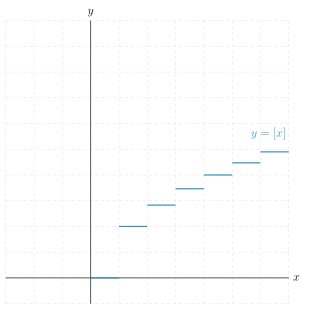
The square bracket notation \(\boldsymbol{[} x\boldsymbol{]}\) means the greatest integer less than or equal to \(x\,\). For example, \(\boldsymbol{[}\pi\boldsymbol{]} = 3\,\), \(\boldsymbol{[}\sqrt{24}\,\boldsymbol{]} = 4\,\) and \(\boldsymbol{[}5\boldsymbol{]}=5\,\).
- Sketch the graph of \(y = \sqrt{\boldsymbol{[}x\boldsymbol{]}}\) and show that \[ \displaystyle \int^a_0 \sqrt{\boldsymbol{[}x\boldsymbol{]}} \; \mathrm{d}x = \sum^{a-1}_{r=0} \sqrt{r} \] when \(a\) is a positive integer.
- Show that $\displaystyle \int^{a}_0 2_{\vphantom{A}}^{\pmb{\boldsymbol {[} } x \pmb{ \boldsymbol{]}} }\; \mathrm{d}x = 2^{a}-1\( when \)a\( is a positive integer.
- Determine an expression for \)\displaystyle \int^{a}_0 2_{\vphantom{\dot A}}^{\pmb{\boldsymbol{[} }x \pmb{ \boldsymbol{]}} } \; \mathrm{d}x\( when \)a$ is positive but not an integer.
Solution:
- \(\,\) \begin{align*} && \int_0^a \sqrt{\boldsymbol{[}x\boldsymbol{]}} \d x &= \sum_{r=0}^{a-1} \int_{x=r}^{x=r+1} \sqrt{\boldsymbol{[}x\boldsymbol{]}} \d x \\ &&&= \sum_{r=0}^{a-1} \int_r^{r+1} \sqrt{r} \d x \\ &&&= \sum_{r=0}^{a-1} \sqrt{r} \\ \end{align*}
- \(\,\) \begin{align*} && \int^{a}_0 2^{\boldsymbol {[} x \boldsymbol{]}} \d x &= \sum_{r=0}^{a-1} \int_{x=r}^{x=r+1} 2^{\boldsymbol {[} x \boldsymbol{]}} \d x \\ &&&= \sum_{r=0}^{a-1} \int_{x=r}^{x=r+1} 2^{r} \d x \\ &&&= \sum_{r=0}^{a-1} 2^{r}\\ &&&= 2^{a}-1 \end{align*}
- \(\,\) \begin{align*} && \int^{a}_0 2^{\boldsymbol {[} x \boldsymbol{]}} \d x &= \int_0^{\boldsymbol {[} a \boldsymbol{]}} 2^{\boldsymbol {[} x \boldsymbol{]}} \d x + \int_{\boldsymbol {[} a \boldsymbol{]}}^a 2^{\boldsymbol {[} x \boldsymbol{]}} \d x \\ &&&= 2^{ \boldsymbol {[} a \boldsymbol{]}}-1 + (a-\boldsymbol {[} a \boldsymbol{]})2^{\boldsymbol {[} a \boldsymbol{]}} \\ &&&= (a-\boldsymbol {[} a \boldsymbol{]}+1)2^{\boldsymbol {[} a \boldsymbol{]}} -1 \end{align*}
2001 Paper 2 Q2
Sketch the graph of the function \([x/N]\), for \(0 < x < 2N\), where the notation \([y]\) means the integer part of \(y\). (Thus \([2.9] = 2\), \ \([4]=4\).)
- Prove that \[ \sum_{k=1}^{2N} (-1)^{[k/N]} k = 2N-N^2. \]
- Let \[ S_N = \sum_{k=1}^{2N} (-1)^{[k/N]} 2^{-k}. \] Find \(S_N\) in terms of \(N\) and determine the limit of \(S_N\) as \(N\to\infty\).
2000 Paper 1 Q3
For any number \(x\), the largest integer less than or equal to \(x\) is denoted by \([x]\). For example, \([3.7]=3\) and \([4]=4\). Sketch the graph of \(y=[x]\) for \(0\le x<5\) and evaluate \[ \int_0^5 [x]\;\d x. \] Sketch the graph of \(y=[\e^{x}]\) for \(0\le x< \ln n\), where \(n\) is an integer, and show that \[ \int_{0}^{\ln n}[\e^{x}]\, \d x =n\ln n - \ln (n!). \]
Solution: