Problems
Filters
13 problems found
2020 Paper 2 Q10
A particle \(P\) of mass \(m\) moves freely and without friction on a wire circle of radius \(a\), whose axis is horizontal. The highest point of the circle is \(H\), the lowest point of the circle is \(L\) and angle \(PHL = \theta\). A light spring of modulus of elasticity \(\lambda\) is attached to \(P\) and to \(H\). The natural length of the spring is \(l\), which is less than the diameter of the circle.
- Show that, if there is an equilibrium position of the particle at \(\theta = \alpha\), where \(\alpha > 0\), then \(\cos\alpha = \dfrac{\lambda l}{2(a\lambda - mgl)}\). Show also that there will only be such an equilibrium position if \(\lambda > \dfrac{2mgl}{2a - l}\). When the particle is at the lowest point \(L\) of the circular wire, it has speed \(u\).
- Show that, if the particle comes to rest before reaching \(H\), it does so when \(\theta = \beta\), where \(\cos\beta\) satisfies \[(\cos\alpha - \cos\beta)^2 = (1 - \cos\alpha)^2 + \frac{mu^2}{2a\lambda}\cos\alpha,\] where \(\cos\alpha = \dfrac{\lambda l}{2(a\lambda - mgl)}\). Show also that this will only occur if \(u^2 < \dfrac{2a\lambda}{m}(2 - \sec\alpha)\).
2020 Paper 3 Q10
A light elastic spring \(AB\), of natural length \(a\) and modulus of elasticity \(kmg\), hangs vertically with one end \(A\) attached to a fixed point. A particle of mass \(m\) is attached to the other end \(B\). The particle is held at rest so that \(AB > a\) and is released. Find the equation of motion of the particle and deduce that the particle oscillates vertically. If the period of oscillation is \(\dfrac{2\pi}{\Omega}\), show that \(kg = a\Omega^2\). Suppose instead that the particle, still attached to \(B\), lies on a horizontal platform which performs simple harmonic motion vertically with amplitude \(b\) and period \(\dfrac{2\pi}{\omega}\). At the lowest point of its oscillation, the platform is a distance \(h\) below \(A\). Let \(x\) be the distance of the particle above the lowest point of the oscillation of the platform. When the particle is in contact with the platform, show that the upward force on the particle from the platform is \[ mg + m\Omega^2(a + x - h) + m\omega^2(b - x). \] Given that \(\omega < \Omega\), show that, if the particle remains in contact with the platform throughout its motion, \[ h \leqslant a\left(1 + \frac{1}{k}\right) + \frac{\omega^2 b}{\Omega^2}. \] Find the corresponding inequality if \(\omega > \Omega\). Hence show that, if the particle remains in contact with the platform throughout its motion, it is necessary that \[ h \leqslant a\left(1 + \frac{1}{k}\right) + b, \] whatever the value of \(\omega\).
2017 Paper 3 Q9
Two particles \(A\) and \(B\) of masses \(m\) and \(2 m\), respectively, are connected by a light spring of natural length \(a\) and modulus of elasticity \(\lambda\). They are placed on a smooth horizontal table with \(AB\) perpendicular to the edge of the table, and \(A\) is held on the edge of the table. Initially the spring is at its natural length. Particle \(A\) is released. At a time \(t\) later, particle \(A\) has dropped a distance \(y\) and particle \( B\) has moved a distance \(x\) from its initial position (where \(x < a\)). Show that \( y + 2x= \frac12 gt^2\). The value of \(\lambda\) is such that particle \(B\) reaches the edge of the table at a time \(T\) given by \(T= \sqrt{6a/g\,}\,\). By considering the total energy of the system (without solving any differential equations), show that the speed of particle \(B\) at this time is \(\sqrt{2ag/3\,}\,\).
Solution: \begin{align*} \text{N2}(\downarrow): && mg -T &= m\ddot{y} \\ \text{N2}(\rightarrow): && T &= 2m\ddot{x} \\ \Rightarrow && g &= \ddot{y}+2\ddot{x} \\ \Rightarrow && \tfrac12gt^2 &= y + 2x \end{align*} At time \(T = \sqrt{6a/g}\), we have \(y + 2x = 3a\), note also that \(\dot{y}+2\dot{x} = gt\) \begin{array}{ccc} & \text{KE} & \text{GPE} & \text{EPE} \\ \text{Initial} & 0 & 0 & 0 \\ \text{Final} & \frac12m\dot{y}^2 + \frac12(2m)\dot{x}^2 & -mgy & \frac{\lambda (y-x)^2}{2a} \end{array} Also note when we head over the table, \(x = a\) and \(y = a\) \begin{align*} \text{COE}: && 0 &= \frac12m(gT-2\dot{x})^2+m\dot{x}^2-mga+\frac{\lambda(0)^2}{2a} \\ \Rightarrow && 0 &= (gT-2\dot{x})^2+2\dot{x}^2-2ga \\ &&&= (\sqrt{6ag}-2\dot{x})^2+2\dot{x}^2-2ga \\ &&&= 6\dot{x}^2-4\sqrt{6ag}+4ag \\ \Rightarrow &&&= (\sqrt{6}\dot{x} - 2\sqrt{ag})^2 \\ \Rightarrow && \dot{x} &= \sqrt{2ag/3} \end{align*} as required.
2016 Paper 3 Q9
Three pegs \(P\), \(Q\) and \(R\) are fixed on a smooth horizontal table in such a way that they form the vertices of an equilateral triangle of side \(2a\). A particle \(X\) of mass \(m\) lies on the table. It is attached to the pegs by three springs, \(PX\), \(QX\) and \(RX\), each of modulus of elasticity \(\lambda\) and natural length \(l\), where \(l < \frac{ \ 2 }{\sqrt3}\, a\). Initially the particle is in equilibrium. Show that the extension in each spring is \(\frac{\ 2}{\sqrt3}\,a -l\,\). The particle is then pulled a small distance directly towards \(P\) and released. Show that the tension \(T\) in the spring \(RX\) is given by \[ T= \frac {\lambda} l \left( \sqrt{\frac {4a^2}3 + \frac{2ax}{\sqrt3} +x^2\; }\; -l\right) , \] where \(x\) is the displacement of \(X\) from its equilibrium position. Show further that the particle performs approximate simple harmonic motion with period \[ 2\pi \sqrt{ \frac{4mla}{3 (4a-\sqrt3 \, l)\lambda } \; }\,. \]
2014 Paper 3 Q10
Two particles \(X\) and \(Y\), of equal mass \(m\), lie on a smooth horizontal table and are connected by a light elastic spring of natural length \(a\) and modulus of elasticity \(\lambda\). Two more springs, identical to the first, connect \(X\) to a point \(P\) on the table and \(Y\) to a point \(Q\) on the table. The distance between \(P\) and \(Q\) is \(3a\). Initially, the particles are held so that \(XP=a\), \(YQ= \frac12 a\,\), and \(PXYQ\) is a straight line. The particles are then released. At time \(t\), the particle \(X\) is a distance \(a+x\) from \(P\) and the particle \(Y\) is a distance \(a+y\) from \(Q\). Show that \[ m \frac{\.d ^2 x}{\.d t^2} = -\frac\lambda a (2x+y) \] and find a similar expression involving \(\dfrac{\.d^2 y}{\.d t^2}\). Deduce that \[ x-y = A\cos \omega t +B \sin\omega t \] where \(A\) and \(B\) are constants to be determined and \(ma\omega^2=\lambda\). Find a similar expression for \(x+y\). Show that \(Y\) will never return to its initial position.
2013 Paper 3 Q11
An equilateral triangle, comprising three light rods each of length \(\sqrt3a\), has a particle of mass \(m\) attached to each of its vertices. The triangle is suspended horizontally from a point vertically above its centre by three identical springs, so that the springs and rods form a tetrahedron. Each spring has natural length \(a\) and modulus of elasticity \(kmg\), and is light. Show that when the springs make an angle \(\theta\) with the horizontal the tension in each spring is \[ \frac{ kmg(1-\cos\theta)}{\cos\theta}\,. \] Given that the triangle is in equilibrium when \(\theta = \frac16 \pi\), show that \(k=4\sqrt3 +6\). The triangle is released from rest from the position at which \(\theta=\frac13\pi\). Show that when it passes through the equilibrium position its speed \(V\) satisfies \[ V^2 = \frac{4ag}3(6+\sqrt3)\,. \]
2009 Paper 3 Q10
A light spring is fixed at its lower end and its axis is vertical. When a certain particle \(P\) rests on the top of the spring, the compression is \(d\). When, instead, \(P\) is dropped onto the top of the spring from a height \(h\) above it, the compression at time \(t\) after \(P\) hits the top of the spring is \(x\). Obtain a second-order differential equation relating \(x\) and \(t\) for \(0\le t \le T\), where \(T\) is the time at which \(P\) first loses contact with the spring. Find the solution of this equation in the form \[ x= A + B\cos (\omega t) + C\sin(\omega t)\,, \] where the constants \(A\), \(B\), \(C\) and \(\omega\) are to be given in terms of \(d\), \(g\) and \(h\) as appropriate. Show that \[ T = \sqrt{d/g\;} \left (2 \pi - 2 \arctan \sqrt{2h/d\;}\;\right)\,. \]
2007 Paper 3 Q9
Two small beads, \(A\) and \(B\), each of mass \(m\), are threaded on a smooth horizontal circular hoop of radius \(a\) and centre \(O\). The angle \(\theta\) is the acute angle determined by \(2\theta = \angle AOB\). The beads are connected by a light straight spring. The energy stored in the spring is \[ mk^2 a^2(\theta - \alpha)^2, \] where \(k\) and \(\alpha\) are constants satisfying \(k>0\) and \(\frac \pi 4< \alpha<\frac\pi2\). The spring is held in compression with \(\theta =\beta\) and then released. Find the period of oscillations in the two cases that arise according to the value of \(\beta\) and state the value of \(\beta\) for which oscillations do not occur.
1999 Paper 1 Q10
A particle is attached to a point \(P\) of an unstretched light uniform spring \(AB\) of modulus of elasticity \(\lambda\) in such a way that \(AP\) has length \(a\) and \(PB\) has length \(b\). The ends \(A\) and \(B\) of the spring are now fixed to points in a vertical line a distance \(l\) apart, The particle oscillates along this line. Show that the motion is simple harmonic. Show also that the period is the same whatever the value of \(l\) and whichever end of the string is uppermost.
1997 Paper 3 Q9
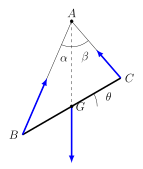
A uniform rigid rod \(BC\) is suspended from a fixed point \(A\) by light stretched springs \(AB,AC\). The springs are of different natural lengths but the ratio of tension to extension is the same constant \(\kappa\) for each. The rod is not hanging vertically. Show that the ratio of the lengths of the stretched springs is equal to the ratio of the natural lengths of the unstretched springs.
Solution:
1993 Paper 1 Q10
A small lamp of mass \(m\) is at the end \(A\) of a light rod \(AB\) of length \(2a\) attached at \(B\) to a vertical wall in such a way that the rod can rotate freely about \(B\) in a vertical plane perpendicular to the wall. A spring \(CD\) of natural length \(a\) and modulus of elasticity \(\lambda\) is joined to the rod at its mid-point \(C\) and to the wall at a point \(D\) a distance \(a\) vertically above \(B\). The arrangement is sketched below. \noindent
1991 Paper 3 Q14
1990 Paper 1 Q12
\(\,\)
Solution: