Problems
Filters
23 problems found
2023 Paper 2 Q2
- The real numbers \(x\), \(y\) and \(z\) satisfy the equations \[y = \frac{2x}{1-x^2}\,,\qquad z = \frac{2y}{1-y^2}\,,\qquad x = \frac{2z}{1-z^2}\,.\] Let \(x = \tan\alpha\). Deduce that \(y = \tan 2\alpha\) and show that \(\tan\alpha = \tan 8\alpha\). Find all solutions of the equations, giving each value of \(x\), \(y\) and \(z\) in the form \(\tan\theta\) where \(-\frac{1}{2}\pi < \theta < \frac{1}{2}\pi\).
- Determine the number of real solutions of the simultaneous equations \[y = \frac{3x - x^3}{1-3x^2}\,,\qquad z = \frac{3y - y^3}{1-3y^2}\,,\qquad x = \frac{3z - z^3}{1-3z^2}\,.\]
- Consider the simultaneous equations
\[y = 2x^2 - 1\,,\qquad z = 2y^2 - 1\,,\qquad x = 2z^2 - 1\,.\]
- Determine the number of real solutions of these simultaneous equations with \(|x| \leqslant 1\), \(|y| \leqslant 1\), \(|z| \leqslant 1\).
- By finding the degree of a single polynomial equation which is satisfied by \(x\), show that all solutions of these simultaneous equations have \(|x| \leqslant 1\), \(|y| \leqslant 1\), \(|z| \leqslant 1\).
2021 Paper 3 Q5
Two curves have polar equations \(r = a + 2\cos\theta\) and \(r = 2 + \cos 2\theta\), where \(r \geqslant 0\) and \(a\) is a constant.
- Show that these curves meet when \[ 2\cos^2\theta - 2\cos\theta + 1 - a = 0. \] Hence show that these curves touch if \(a = \tfrac{1}{2}\) and find the other two values of \(a\) for which the curves touch.
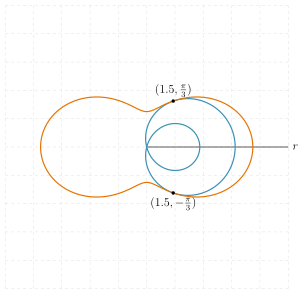
- Sketch the curves \(r = a + 2\cos\theta\) and \(r = 2 + \cos 2\theta\) on the same diagram in the case \(a = \tfrac{1}{2}\). Give the values of \(r\) and \(\theta\) at the points at which the curves touch and justify the other features you show on your sketch.
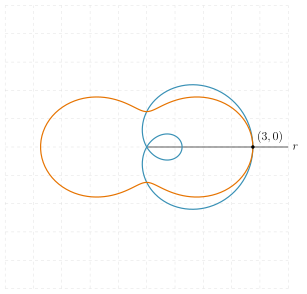
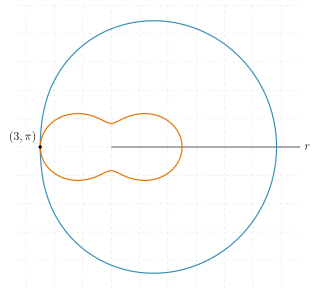
- On two further diagrams, one for each of the other two values of \(a\), sketch both the curves \(r = a + 2\cos\theta\) and \(r = 2 + \cos 2\theta\). Give the values of \(r\) and \(\theta\) at the points at which the curves touch and justify the other features you show on your sketch.
Solution:
- The curves meet when they have the same radius for a given \(\theta\) ie \begin{align*} && a + 2 \cos \theta &= 2 + \cos 2 \theta \\ &&&= 2 + 2\cos^2 \theta - 1 \\ \Rightarrow && 0 &= 2 \cos ^2 \theta - 2 \cos \theta + 1 - a \end{align*} The curves touch if this has a repeated root, ie \(0 = \Delta = 4 - 8(1-a) \Rightarrow a = \frac12\). The second way the curves can touch is if there is a single root, but it's at an extreme value of \(\cos \theta = \pm 1\) ie \(0 = 2 - 2\cdot(\pm1) + 1 - a \Rightarrow a = 3 \pm 2 = 1, 5\)
- Suppose \(a = \frac12\) then the curves touch when \(0 = 2\cos^2 \theta - 2 \cos \theta + \frac12 = (2 \cos \theta-1 )(\cos \theta -\frac12) \Rightarrow \theta = \pm \frac{\pi}{3}\)
- \(a = 1\)
\(a = 5\)
2019 Paper 2 Q4
You are not required to consider issues of convergence in this question. For any sequence of numbers \(a_1, a_2, \ldots, a_m, \ldots, a_n\), the notation \(\prod_{i=m}^{n} a_i\) denotes the product \(a_m a_{m+1} \cdots a_n\).
- Use the identity \(2 \cos x \sin x = \sin(2x)\) to evaluate the product \(\cos(\frac{\pi}{9}) \cos(\frac{2\pi}{9}) \cos(\frac{4\pi}{9})\).
- Simplify the expression $$\prod_{k=0}^{n} \cos\left(\frac{x}{2^k}\right) \quad (0 < x < \frac{1}{2}\pi).$$ Using differentiation, or otherwise, show that, for \(0 < x < \frac{1}{2}\pi\), $$\sum_{k=0}^{n} \frac{1}{2^k} \tan\left(\frac{x}{2^k}\right) = \frac{1}{2^n} \cot\left(\frac{x}{2^n}\right) - 2 \cot(2x).$$
- Using the results \(\lim_{\theta\to 0} \frac{\sin \theta}{\theta} = 1\) and \(\lim_{\theta\to 0} \frac{\tan \theta}{\theta} = 1\), show that $$\prod_{k=1}^{\infty} \cos\left(\frac{x}{2^k}\right) = \frac{\sin x}{x}$$ and evaluate $$\sum_{j=2}^{\infty} \frac{1}{2^{j-2}} \tan\left(\frac{\pi}{2^j}\right).$$
Solution:
- \begin{align*}\cos(\frac{\pi}{9}) \cos(\frac{2\pi}{9}) \cos(\frac{4\pi}{9}) &= \frac{\sin(\frac{2\pi}{9}) \cos(\frac{2\pi}{9}) \cos(\frac{4\pi}{9})}{2 \sin \frac{\pi}{9}} \\ &= \frac{\sin(\frac{4\pi}{9})\cos(\frac{4\pi}{9})}{4 \sin \frac{\pi}{9}} \\ &= \frac{\sin(\frac{8\pi}{9})}{8 \sin \frac{\pi}{9}} \\ &= \frac{1}{8} \end{align*}
- Let \(\displaystyle P_n = \prod_{k=0}^{n} \cos\left(\frac{x}{2^k}\right)\). Claim: \(P_n = \frac{\sin 2x}{2^{n+1} \sin \l \frac{x}{2^n} \r}\). Proof: This is true for \(n = 0\), assume true for \(n-1\) \begin{align*} \sin\l \frac{x}{2^{n}} \r P_n &= P_{n-1} \cos\l \frac{x}{2^{n}} \r \sin\l \frac{x}{2^{n}} \r \\ &= P_{n-1} \frac{1}{2} \sin\l \frac{x}{2^{n-1}} \r \\ &= \frac{\sin 2x}{2^{n} \sin \l \frac{x}{2^{n-1}}\r} \frac{1}{2} \sin\l \frac{x}{2^{n}} \r \\ &= \frac{\sin 2x}{2^{n+1}} \end{align*} Hence \(P_n = \frac{\sin 2x}{2^{n+1} \sin \l \frac{x}{2^n}\r}\) Taking logs, we determine that: \begin{align*} && \sum_{k=0}^n \ln \cos \l \frac{x}{2^k} \r &= \ln \sin 2x - \ln \sin \l \frac{x}{2^n} \r - (n+1) \ln 2 \\ \Rightarrow && \sum_{k=0}^n \frac{1}{2^k} \tan \l \frac{x}{2^k} \r &= -2 \cot 2x + \frac{1}{2^n} \cot \l \frac{x}{2^n} \r - 0 \\ \end{align*} as required.
- As \(n \to \infty\) \(\frac{x}{2^n} \to 0\), so \(\frac{\sin \frac{x}{2^n}}{\frac{x}{2^n}} = \frac{2^n \sin \frac{x}{2^n}}{x} \to 1\) \begin{align*}\prod_{k=1}^{\infty} \cos\left(\frac{x}{2^k}\right) &= \lim_{n \to \infty} \frac{\sin x}{2^n \sin \l \frac{x}{2^n} \r} \\ &= \lim_{n \to \infty} \frac{\sin x}{x \frac{2^n \sin \l \frac{x}{2^n} \r}{x} } \\ &= \lim_{n \to \infty} \frac{\sin x}{x} \\ \end{align*} \begin{align*} \sum_{j=2}^{\infty} \frac{1}{2^{j-2}} \tan\left(\frac{\pi}{2^j}\right) &= \sum_{j=0}^{\infty} \frac{1}{2^{j}} \tan\left(\frac{1}{2^j}\frac{\pi}{4}\right) \\ &= \lim_{n \to \infty} \l -2 \cot \frac{\pi}{2} + \frac{1}{2^n} \cot \l \frac{\pi}{4 \cdot 2^n} \r\r \\ &= \frac{4}{\pi} \lim_{n \to \infty} \l \frac{1}{2^n} \frac{\pi}{4} \cot \l \frac{\pi}{4 \cdot 2^n} \r\r \\ &\to \frac{\pi}{4} \end{align*}
2018 Paper 1 Q3
The points \(R\) and \(S\) have coordinates \((-a,\, 0)\) and \((2a,\, 0)\), respectively, where \(a > 0\,\). The point \(P\) has coordinates \((x,\, y)\) where \(y > 0\) and \(x < 2a\). Let \(\angle PRS = \alpha \) and \(\angle PSR = \beta\,\).
- Show that, if \(\beta = 2 \alpha\,\), then \(P\) lies on the curve \(y^2=3(x^2-a^2)\,\).
- Find the possible relationships between \(\alpha\) and \(\beta\) when \(0 < \alpha < \pi\,\) and \(P\) lies on the curve \(y^2=3(x^2-a^2)\,\).
Solution:

- \begin{align*} &&\tan \beta &= \frac{y}{2a - x} \\ &&\tan \alpha &= \frac{y}{x+a} \\ && \tan \beta &= \tan 2 \alpha \\ && &= \frac{\tan \alpha}{1 - \tan^2 (\alpha)} \\ \Leftrightarrow && \frac{y}{2a-x}&= \frac{\l \frac{y}{x+a} \r}{1 - \l \frac{y}{x+a} \r^2} \\ && &= \frac{2y(x+a)}{(x+a)^2 - y^2} \\ \Leftrightarrow && (x+a)^2 - y^2 &= 2(x+a)(2a-x) \tag{\(y \neq 0\)} \\ \Leftrightarrow && x^2 + 2ax + a^2 - y^2 &= -2x^2 + 2ax - 4a^2 \\ \Leftrightarrow && y^2 &= 3(x^2-a^2) \end{align*}
- Therefore if \(y^2 = 3(x^2-a^2)\) we know that \(\tan \beta = \tan 2\alpha\), so \(2\alpha = \beta + n \pi\). Since \(0 < \alpha + \beta < \pi\) (since they are angles in a triangle we must have that \(0 < \alpha + 2\alpha - n \pi = 3\alpha - n\pi < \pi\), so \(0 < \alpha - \frac{n\pi}{3} < \frac{\pi}3\), therefore we have \(3\) cases:
2018 Paper 2 Q3
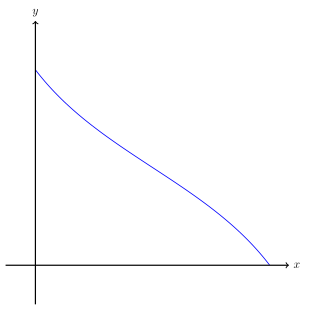
- Let \[ \f(x) = \frac 1 {1+\tan x} \] for \(0\le x < \frac12\pi\,\). Show that \(\f'(x)= -\dfrac{1}{1+\sin 2x}\) and hence find the range of \(\f'(x)\). Sketch the curve \(y=\f(x)\).
- The function \(\g(x)\) is continuous for \(-1\le x \le 1\,\). Show that the curve \(y=\g(x)\) has rotational symmetry of order 2 about the point \((a,b)\) on the curve if and only if \[ \g(x) + \g(2a-x) = 2b\,. \] Given that the curve \(y=\g(x)\) passes through the origin and has rotational symmetry of order 2 about the origin, write down the value of \[\displaystyle \int_{-1}^1 \g(x)\,\d x\,. \]
- Show that the curve \(y=\dfrac{1}{1+\tan^kx}\,\), where \(k\) is a positive constant and \(0 < x < \frac12\pi\,\), has rotational symmetry of order 2 about a certain point (which you should specify) and evaluate \[ \int_{\frac16\pi}^{\frac13\pi} \frac 1 {1+\tan^kx} \, \d x \,. \]
Solution:
- \(\,\) \begin{align*}
&& f(x) &= \frac1{1+\tan x} \\
&& f'(x) &=-(1+\tan x)^{-2} \cdot \sec^2 x \\
&&&= - (\cos x+ \sin x)^{-2} \\
&&&= - (1 + 2 \sin x \cos x)^{-1} \\
&&&= - \frac{1}{1+\sin 2x}
\end{align*}
\(\sin 2x \in [0, 1]\) so \(1+\sin 2x \in [1,2]\) and \(f'(x) \in [-1, -\tfrac12]\)
- \(\displaystyle \int_{-1}^1 g(x) \d x = 2g(0) \)
- Let \(g(x) = \frac{1}{1 + \tan^k x}\) then \(g(x)\) has rotational symmetry of order \(2\) about the point \((\frac{\pi}{4}, \frac12)\) which we can see since \begin{align*} g(x) + g(\tfrac12\pi - x) &= \frac{1}{1 + \tan^k x} + \frac{1}{1 + \tan^k(\tfrac12\pi - x)} \\ &= \frac{1}{1+\tan^k x} + \frac{1}{1+\cot^k x} \\ &= \frac{1}{1+\tan^k x} + \frac{\tan^k x}{\tan^k x + 1} \\ &= 1 = 2 \cdot \tfrac12 \end{align*} Therefore \[ \int_{\frac16\pi}^{\frac13\pi} \frac 1 {1+\tan^kx} \, \d x = \frac{\pi}{6} \cdot \frac12 = \frac{\pi}{12}\]
2016 Paper 1 Q11
The point \(O\) is at the top of a vertical tower of height \(h\) which stands in the middle of a large horizontal plain. A projectile \(P\) is fired from \(O\) at a fixed speed \(u\) and at an angle \(\alpha\) above the horizontal. Show that the distance \(x\) from the base of the tower when \(P\) hits the plain satisfies \[ \frac{gx^2}{u^2} = h(1+\cos 2\alpha) + x \sin 2\alpha \,. \] Show that the greatest value of \(x\) as \(\alpha\) varies occurs when \(x=h\tan2\alpha\) and find the corresponding value of \(\cos 2\alpha\) in terms of \(g\), \(h\) and \(u\). Show further that the greatest achievable distance between \(O\) and the landing point is \(\dfrac {u^2}g +h\,\).
Solution: \begin{align*} \rightarrow: && x &= u \cos \alpha t\\ \Rightarrow && t &= \frac{x}{u \cos \alpha}\\ \uparrow: && -h &= u\sin \alpha t- \frac12gt^2 \\ && - h &= x\tan \alpha - \frac12 g \frac{x^2}{u^2}\sec^2 \alpha \\ \Rightarrow && \frac{gx^2}{u^2} &= h(2\cos^2 \alpha) + x2 \tan \alpha \cos^2 \alpha \\ &&&= h(1 + \cos 2 \alpha) + x \sin 2\alpha \\ \frac{\d}{\d \alpha}: && \frac{g}{u^2} 2 x \frac{\d x}{\d \alpha} &= -2h \sin 2 \alpha + 2x \cos 2 \alpha +\frac{\d x}{\d \alpha} \sin 2 \alpha \\ \Rightarrow && \frac{\d x}{\d \alpha} \left ( \frac{2xg}{u^2} - \sin 2 \alpha \right) &= 2\cos 2 \alpha (x -h \tan 2 \alpha) \end{align*} Since the turning point will be a maximum must be \(x = h \tan 2 \alpha\). Therefore, let \(c = \cos 2 \alpha\) \begin{align*} && \frac{gh^2}{u^2} \tan^2 2 \alpha &= h(1 + \cos 2 \alpha) + h \tan 2 \alpha \sin 2 \alpha \\ \Rightarrow && \frac{gh}{u^2}(c^{-2}-1) &= 1+c+\frac{1-c^2}{c} \\ \Rightarrow && \frac{gh(1-c^2)}{u^2c^2} &= \frac{c+c^2+1-c^2}{c}\\ &&&= \frac{1+c}{c} \\ \Rightarrow && \frac{gh(1-c)}{u^2c} &= 1 \\ \Rightarrow && u^2c &= gh(1-c) \\ \Rightarrow && c(u^2+gh) &= gh \\ \Rightarrow && \cos 2 \alpha &= \frac{gh}{u^2+gh} \\ \\ \Rightarrow && d_{max}^2 &= h^2 + h^2 \tan^2 2 \alpha \\ &&&= h^2\sec^2 2 \alpha \\ &&&= h^2 \frac{(u^2+gh)^2}{g^2h^2} \\ &&&= \frac{(u^2+gh)^2}{g^2} \\ &&&= \left (\frac{u^2}{g}+h \right)^2 \\ \Rightarrow && d_{max} &= \frac{u^2}{g}+h \end{align*}
2015 Paper 1 Q9
A short-barrelled machine gun stands on horizontal ground. The gun fires bullets, from ground level, at speed \(u\) continuously from \(t=0\) to \(t= \dfrac{\pi}{ 6\lambda}\), where \(\lambda\) is a positive constant, but does not fire outside this time period. During this time period, the angle of elevation \(\alpha\) of the barrel decreases from \(\frac13\pi\) to \(\frac16\pi\) and is given at time \(t\) by \[ \alpha =\tfrac13 \pi - \lambda t\,. \] Let \(k = \dfrac{g}{2\lambda u}\). Show that, in the case \(\frac12 \le k \le \frac12 \sqrt3\), the last bullet to hit the ground does so\\[2pt] at a distance \[ \frac{ 2 k u^2 \sqrt{1-k^2}}{g} \] from the gun. What is the corresponding result if \(k<\frac12\)?
Solution: The bullet fired at time \(t\) will hit the ground at time \(t+\frac{2u \sin (\frac13\pi - \lambda t)}{g}\). To find the last time a bullet hits the ground, we can differentiate, noting that \begin{align*} && T(t) &= t + \frac{2u \sin \alpha}{g} \\ \Rightarrow && T'(t) &= 1 - \frac{2u\lambda}{g} \cos \alpha \\ && T''(t) &= \frac{2u \lambda^2}{g} \sin \alpha > 0 \end{align*} If \(k = \frac{g}{2\lambda u} \in [\frac12, \frac12\sqrt{3}]\) then notice that this turning point is always achieved, and will be a maximum. It will be when \(\cos \alpha = k, \sin \alpha = \sqrt{1-k^2}\). The distance will be \(u \cos \alpha \cdot \frac{2 u \sin \alpha}{g} = \frac{2ku^2\sqrt{1-k^2}}{g}\). If \(k < \frac12\) then the last bullet to hit the ground will be the last bullet fired, ie \(\frac{2u^2 \sin \frac16\pi \cos \frac16\pi}{g} = \frac{u^2 \sin \frac13 \pi}{g} = \frac{\sqrt{3}u^2}{2g}\)
2015 Paper 2 Q2
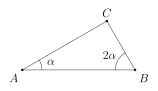
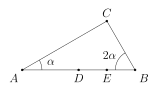
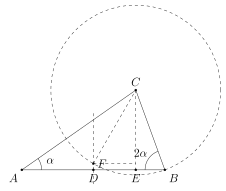
In the triangle \(ABC\), angle \(BAC = \alpha\) and angle \(CBA= 2\alpha\), where \(2\alpha\) is acute, and \(BC= x\). Show that \(AB = (3-4 \sin^2\alpha)x\). The point \(D\) is the midpoint of \(AB\) and the point \(E\) is the foot of the perpendicular from \(C\) to \(AB\). Find an expression for \(DE\) in terms of \(x\). The point \(F\) lies on the perpendicular bisector of \(AB\) and is a distance \(x\) from \(C\). The points \(F\) and \(B\) lie on the same side of the line through \(A\) and \(C\). Show that the line \(FC\) trisects the angle \(ACB\).
Solution:
2014 Paper 1 Q6
- The sequence of numbers \(u_0, u_1, \ldots \) is given by \(u_0=u\) and, for \(n\ge 0\), \begin{equation} u_{n+1} =4u_n(1- u_n)\,. \tag{\(*\)} \end{equation} In the case \(u= \sin^2\theta\) for some given angle \(\theta\), write down and simplify expressions for \(u_1\) and \(u_2\) in terms of \(\theta\). Conjecture an expression for \(u_n\) and prove your conjecture.
- The sequence of numbers \(v_0, v_1, \ldots\) is given by $v_0= v \text{ and, for }n\ge 0$, \[ v_{n+1} = -pv_n^2 +qv_n +r\,, \] where \(p\), \(q\) and \(r\) are given numbers, with \(p\ne0\). Show that a substitution of the form \(v_n =\alpha u_n +\beta\), where \(\alpha\) and \(\beta\) are suitably chosen, results in the sequence \((*)\) provided that \[ 4pr = 8 +2q -q^2 \,. \] Hence obtain the sequence satisfying \(v_0=1\) and, for \(n\ge0\), \(v_{n+1} = -v_n^2 +2 v_n +2 \,\).
Solution:
- Suppose \(u_0 = u = \sin^2 \theta\) then \begin{align*} && u_1 &= 4 u_0 (1-u_0) \\ &&&= 4 \sin^2 \theta ( 1- \sin^2 \theta) \\ &&&= 4 \sin^2 \theta \cos^2 \theta \\ &&&= (2 \sin \theta \cos \theta)^2 \\ &&&= (\sin 2 \theta)^2 = \sin^2 2 \theta \\ \\ && u_2 & = 4u_1 (1-u_1) \\ &&&= 4 \sin^2 2\theta \cos^2 2 \theta \\ &&&= \sin^2 4 \theta \end{align*} Claim: \(u_n = \sin^2 2^n \theta\). Proof: (By Induction) Base case is clear, suppose it's true for \(n=k\), then \begin{align*} && u_{k+1} &= 4u_k(1-u_k) \\ &&&= 4 \sin^2 2^k \theta(1-\sin^2 2^k \theta) \\ &&&= (2 \sin 2^k \theta \cos 2^k \theta)^2 \\ &&&= (\sin 2^{k+1} \theta)^2 \\ &&&= \sin^2 2^{k+1} \theta \end{align*} Therefore since it is true for \(n = 1\) and if it's true for \(n = k\) it is true for \(n=k+1\) it must be true for all \(k\).
- Suppose \(v_n = \alpha u_n + \beta\) then \begin{align*} && (\alpha u_{n+1}+\beta) &= -p(\alpha u_n + \beta)^2 + q(\alpha u_n + \beta) + r \\ &&&= -p\alpha^2u_n^2+\alpha(q-2p\beta) u_n -p \beta^2 +q \beta+r \\ \Rightarrow && u_{n+1} &= u_n(q-2p\beta -p \alpha u_n) -(p\beta^2-(q-1)\beta-r) \end{align*} So if \(\alpha = \frac{4}{p}\) and \(q-2p\beta = 4\) ie \(\beta = \frac{q-4}{2p}\) then we also need the constant term to vanish, ie \begin{align*} 0 &&&= p\beta^2-(q-1)\beta+r \\ &&&= p \left (\frac{q-4}{2p} \right)^2 - (q-1) \frac{q-4}{2p} - r \\ \Rightarrow && 0 &= p(q-4)^2 -(q-1)(q-4)2p - 4p^2r \\ \Rightarrow && 0 &= (q-4)^2-2(q-1)(q-4)-4pr \\ &&&= q^2-8q+16-2q^2+10q-8-4pr \\ \Rightarrow && 4pr &= -q^2+2q+8 \end{align*} Suppose \(v_{n+1} = -v_n^2 + 2v_n +2\) then since \(4\cdot 1 \cdot 2 = 8\) and \(8 + 4 -4 = 8\) we can apply our method. \(v_n = 4u_n + \frac{-2}{2} = 4u_n -1 = 4\sin^2 (2^{n-1} \pi)-1\)
2012 Paper 1 Q5
Show that \[ \int_0^{\frac14\pi} \sin (2x) \ln(\cos x)\, \d x = \frac14(\ln 2 -1)\,, \] and that \[ \int_0^{\frac14\pi} \cos (2x) \ln(\cos x)\, \d x = \frac18(\pi -\ln 4-2)\,. \] Hence evaluate \[ \int_{\frac14\pi}^{\frac12\pi} \big ( \cos(2x) + \sin (2x)\big) \, \ln \big( \cos x + \sin x\big)\, \d x\,. \]
Solution: \begin{align*} &&\int_0^{\frac14\pi} \sin (2x) \ln(\cos x)\, \d x &= \int_0^{\frac14 \pi} 2 \sin x \cos x \ln (\cos x) \d x \\ u = \cos \theta :&&&= \int_{u=1}^{u=\frac1{\sqrt2}} -2u \ln u \d u \\ &&&= \int_{\frac1{\sqrt{2}}}^1 2u \ln u \d u \\ &&&= \left [u^2 \ln u \right]_{\frac1{\sqrt{2}}}^1-\int_{\frac1{\sqrt{2}}}^1 u \d u \\ &&&= -\frac12 \ln \frac{1}{\sqrt{2}} - \l\frac12 - \frac14 \r \\ &&&= \frac14 (\ln 2 - 1) \end{align*} \begin{align*} && \int_0^{\frac14\pi} \cos (2x) \ln(\cos x)\, \d x &= \left [ \frac12 \sin 2x \ln (\cos x) \right]_0^{\frac14\pi}- \int_0^{\frac14\pi} \frac12 \sin 2x \frac{-\sin x}{\cos x} \d x \\ &&&=\frac12 \ln \frac{1}{\sqrt{2}}+\int_0^{\frac14\pi} \sin^2 x \d x \\ &&&= -\frac14 \ln 2 + \int_0^{\frac14\pi} \frac{1-\cos 2x }{2} \d x \\ &&&= -\frac14 \ln 2 +\frac{\pi}{8} -\frac{1}{4} \\ &&&= \frac18 (\pi - 2\ln 2 - 2) \\ &&&= \frac18 (\pi - \ln 4 - 2) \\ \end{align*} Notice that \(\cos x + \sin x = \sqrt{2} \cos (x -\frac{\pi}{4})\), so: \begin{align*} &&\int_{\frac14\pi}^{\frac12\pi} \big ( \cos(2x) + \sin (2x)\big) \ln \big( \cos x + \sin x\big)\d x &= \int_{\frac14\pi}^{\frac12\pi} \big ( \cos(2x) + \sin (2x)\big) \ln (\sqrt{2} \cos ( x - \frac{\pi}{4}) ) \d x \\ &&&= \int_{u=0}^{u=\frac{\pi}{4}} \l \cos(2u+\frac{\pi}{2})+\sin(2u+\frac{\pi}{2}) \r \cdot \l \frac12 \ln 2 +\ln (\cos u) \r \d x \\ &&&= \int_{0}^{\frac{\pi}{4}} \l -\sin 2u+\cos 2u \r \cdot \l \frac12 \ln 2 +\ln (\cos u) \r \d x \\ &&&= \frac14 \ln 2\left [ \cos 2u + \sin 2u \ \right]_{0}^{\frac{\pi}{4}} - \frac14(\ln2 - 1) + \frac18\pi - \frac14(\ln 2 +1) \\ &&&= \frac{\pi}{8}-\frac12 \ln 2 \end{align*}
2012 Paper 1 Q9
A tall shot-putter projects a small shot from a point \(2.5\,\)m above the ground, which is horizontal. The speed of projection is \(10\,\text{ms}^{- 1}\) and the angle of projection is \(\theta\) above the horizontal. Taking the acceleration due to gravity to be \(10\,\text{ms}^{-2}\), show that the time, in seconds, that elapses before the shot hits the ground is \[ \frac1{\sqrt2}\left ( \sqrt{1-c}+ \sqrt{2-c}\right), \] where \(c = \cos2\theta\). Find an expression for the range in terms of \(c\) and show that it is greatest when \(c= \frac15\,\). Show that the extra distance attained by projecting the shot at this angle rather than at an angle of \(45^\circ\) is \(5(\sqrt6 -\sqrt2 -1)\,\)m.
Solution: \begin{align*} && s &= ut + \frac12 gt^2 \\ \Rightarrow && -2.5 &= 10 \sin \theta \, T - 5 T^2 \\ \Rightarrow && T &= \frac{10\sin \theta \pm \sqrt{100\sin^2 \theta - 4 \cdot 5 \cdot (-2.5)}}{10} \\ &&&= \sin \theta +\sqrt{\sin^2 \theta + \frac12} \\ &&&= \frac1{\sqrt{2}} \left ( \sqrt{2} \sin \theta +\sqrt{2 \sin^2 \theta +1} \right) \\ &&&= \frac1{\sqrt{2}} \left ( \sqrt{2 (1-\cos^2 \theta)} + \sqrt{2-\cos 2\theta} \right) \\ &&&= \frac1{\sqrt{2}} \left ( \sqrt{1-\cos2 \theta} + \sqrt{2-\cos 2\theta} \right) \\ &&&= \frac{1}{\sqrt{2}}\left ( \sqrt{1-c}+\sqrt{2-c} \right)\\ \\ && s &= 10 \cos \theta T \\ &&&= 10 \sqrt{\frac{\cos 2 \theta +1}{2}}\frac{1}{\sqrt{2}}\left ( \sqrt{1-c}+\sqrt{2-c} \right) \\ &&&= 5 \sqrt{c+1}\left ( \sqrt{1-c}+\sqrt{2-c} \right) \\ \\ && \frac15\frac{\d s}{\d c} &= \frac12(c+1)^{-1/2}((1-c)^{1/2} + (2-c)^{1/2}) - \frac12(c+1)^{1/2}\left ((1-c)^{-1/2}+(2-c)^{-1/2} \right) \\ &&&= \frac{((1-c)(2-c)^{1/2}+(2-c)(1-c)^{1/2})-((c+1)(2-c)^{1/2}+(c+1)(1-c)^{1/2})}{2\sqrt{c+1}\sqrt{1-c}\sqrt{2-c}} \\ &&&= \frac{\sqrt{2-c}\left (1-c-c-1 \right)+\sqrt{1-c}\left(2-c-c-1) \right)}{2\sqrt{c+1}\sqrt{1-c}\sqrt{2-c}} \\ &&&= \frac{\sqrt{1-c}\left(1-2c\right)-2c\sqrt{2-c}}{2\sqrt{c+1}\sqrt{1-c}\sqrt{2-c}} \\ \\ \frac{\d s}{\d c} =0: && \sqrt{1-c}\left(1-2c\right)&=2c\sqrt{2-c} \\ \Rightarrow && (1-c)(1-2c)^2&=4c^2(2-c) \\ \Rightarrow && 1-5c+8c^2-4c^3 &= 8c^2-4c^3 \\ \Rightarrow && 0 &= -5c+1 \\ \Rightarrow && c &= \frac15 \end{align*} When \(\theta = 45^{\circ}, c = 0\), so \(s_{45^{\circ}} = 5(1+\sqrt{2})\) When \(c = \frac15\), \begin{align*} s &= 5 \sqrt{\frac15+1}\left ( \sqrt{1-\frac15}+\sqrt{2-\frac15} \right) \\ &= 5 \sqrt{\frac65} \left ( \sqrt{\frac45} + \sqrt{\frac95} \right) \\ &= 2\sqrt{6}+3\sqrt{6} = 5\sqrt{6} \end{align*} Therefore the additional distance is \(5(\sqrt{6}-\sqrt{2}-1)\)
2011 Paper 2 Q4
- Find all the values of \(\theta\), in the range \(0^\circ < \theta < 180^\circ\), for which \(\cos\theta=\sin 4\theta\). Hence show that \[ \sin 18^\circ = \frac14\left( \sqrt 5 -1\right). \]
- Given that \[ 4\sin^2 x + 1 = 4\sin^2 2x \,, \] find all possible values of \(\sin x\,\), giving your answers in the form \(p+q\sqrt5\) where \(p\) and \(q\) are rational numbers.
- Hence find two values of \(\alpha\) with \(0^\circ < \alpha < 90^\circ\) for which \[ \sin^23\alpha + \sin^25\alpha = \sin^2 6\alpha\,. \]
Solution:
- Note that \(\cos \theta = \sin (90^\circ - \theta)\) so \begin{align*} && \sin(90^\circ - \theta) &= \sin 4 \theta\\ && 90^\circ - \theta &= 4\theta +360^{\circ}k \\ && 90^\circ + \theta &= 4\theta +360^{\circ}k \\ \Rightarrow && 5\theta &= 90^\circ, 450^\circ, 810^\circ, \cdots \\ && 3 \theta &= 90^\circ, 450^\circ, \cdots \\ \Rightarrow && \theta &= 18^\circ, 90^\circ, 162^\circ, \ldots \\ && \theta &= 30^\circ, 150^\circ, \ldots \end{align*} Therefore \(\theta = 8^\circ, 30^\circ, 90^\circ, 150^\circ, 162^\circ\). Note also that: \begin{align*} && 0 &= \sin 4 \theta - \cos \theta \\ &&&= 2 \sin 2 \theta \cos 2 \theta- \cos \theta \\ &&&= 4 \sin \theta \cos \theta \cos 2 \theta - \cos \theta \\ &&&= \cos \theta \left (4 \sin \theta (1- 2\sin^2 \theta) - 1 \right) \\ &&&= \cos \theta \left (-8\sin^3 \theta +4\sin \theta - 1 \right) \\ &&&= \cos \theta (1 - 2 \sin \theta)(4 \sin^2 \theta+2\sin \theta -1)\\ \cos \theta = 0: && \theta &= 90^\circ \\ \sin \theta = \frac12: && \theta &= 30^{\circ} \\ && \theta &= \sin^{-1} \left ( \frac{-1\pm \sqrt5}{4} \right) \end{align*} Therefore \(\sin 18^{\circ} = \frac{\pm \sqrt{5}-1}{4}\), but since \(\sin 18^{\circ} > 0\) it must be the positive version.
- \(\,\) \begin{align*} && 4 \sin^2 x + 1 &= 4 \sin^2 2 x \\ &&&= 16 \sin^2 x \cos^2 x \\ &&&= 16 \sin^2 x (1- \sin^2 x) \\ \Rightarrow && 0 &= 16y^2 -12y+1 \\ \Rightarrow && \sin^2 x &= \frac{3\pm \sqrt5}{8} \\ &&&= \left ( \frac{1 \pm \sqrt5}{4} \right)^2 \\ \Rightarrow && \sin x &= \pm \frac{1 \pm \sqrt{5}}{4} \end{align*}
- \(\,\) \begin{align*} && \sin^2 x + \frac1{2^2} &= \sin^2 2x \end{align*} So if we can have \(\sin 5x = \pm \frac12\) and \(\sin 3x = \pm \frac{1 \pm \sqrt5}{4}\) then we are good, ie \begin{align*} && 5x &= 30^{\circ}, 150^{\circ}, 210^{\circ}, 330^{\circ}, 390^{\circ}, \cdots \\ \Rightarrow && x &= 6^{\circ}, 30^{\circ}, 42^{\circ}, 66^{\circ}, 78^{\circ} \\ \Rightarrow && 3x &= \boxed{18^{\circ}}, \cancel{90^{\circ}}, \boxed{126^{\circ}}, \boxed{198^{\circ}}, \boxed{78^{\circ}} \end{align*} So our solutions are \(x = 6^{\circ}, 42^{\circ}, 66^{\circ}, 78^{\circ}\) although it's interesting to note that \(x = 45^{\circ}\) is another solution
2009 Paper 1 Q8
- The equation of the circle \(C\) is \[ (x-2t)^2 +(y-t)^2 =t^2, \] where \(t\) is a positive number. Show that \(C\) touches the line \(y=0\,\). Let \(\alpha\) be the acute angle between the \(x\)-axis and the line joining the origin to the centre of \(C\). Show that \(\tan2\alpha=\frac43\) and deduce that \(C\) touches the line \(3y=4x\,\).
- Find the equation of the incircle of the triangle formed by the lines \(y=0\), \(3y=4x\) and \(4y+3x=15\,\). Note: The incircle of a triangle is the circle, lying totally inside the triangle, that touches all three sides.
Solution:
- This is a circle centre \((2t,t)\) with radius \(t\). Therefore it is exactly \(t\) away from the line \(y = 0\) so just touches that line. Not that \(\tan \alpha = \frac{t}{2t} = \frac12\) so \(\tan 2\alpha = \frac{2\tan \alpha}{1-\tan^2\alpha} = \frac{1}{1-\frac14} = \frac43\). Therefore the line \(y = \frac43x\) or \(3y = 4x\) is tangent to \(C\).
- Note that \(3y=4x\) and \(4y+3x=15\) are perpendicular, so this is a right-angled triangle with incenter \((2t,t)\) for some \(t\) and hypotenuse \(15\) We can find the third coordinate when \(3y-4x = 0\) and \(4y+3x = 15\) meet, ie \((\frac{9}{5}, \frac{12}5)\) The incentre lies on the bisector of the right angle at this point, which is the line through \((\frac{9}{5}, \frac{12}5)\) and \((\frac{15}{2}, 0)\), so \begin{align*} && \frac{2t-\frac{12}{5}}{t - \frac{9}{5}} &= \frac{-\frac{12}{5}}{\frac{15}2-\frac95} \\ \Rightarrow && \frac{10t-12}{5t-9} &= \frac{-24}{57} = -\frac{8}{19} \\ \Rightarrow && 190t - 12 \cdot 19 &= -40t + 72 \\ \Rightarrow && t &= 2 \end{align*} Therefore the center is \((4, 2)\) and the equation is \((x-4)^2+(y-2)^2=2^2\)
2007 Paper 1 Q3
Prove the identities \(\cos^4\theta -\sin^4\theta \equiv \cos 2\theta\) and $\cos^4 \theta + \sin^4 \theta \equiv 1 - {\frac12} \sin^2 2 \theta$. Hence or otherwise evaluate \[ \int_0^{\frac{1}{2}\pi} \cos^4 \theta \; \d \theta \;\;\;\; \mbox{and}\;\;\;\; \int_0^{\frac{1}{2}\pi} \sin^4 \theta \; \d \theta \,. \] Evaluate also \[ \int_0^{\frac{1}{2}\pi} \cos^6 \theta \; \d \theta \;\;\;\; \mbox{and}\;\;\;\; \int_0^{\frac{1}{2}\pi} \sin^6 \theta \; \d \theta \,. \]
Solution: \begin{align*} && \cos^4 \theta - \sin^4 \theta &= (\cos^2 \theta - \sin^2 \theta)(\cos^2 \theta + \sin^2 \theta) \\ &&&= \cos^2 \theta - \sin^2 \theta \\ &&&= \cos 2 \theta \\ \\ && 1&= (\cos^2 \theta + \sin^2 \theta)^2 \\ &&&= \cos^4 \theta + \sin^4 \theta + 2 \sin^2 \theta \cos^2 \theta \\ &&&= \cos^4 \theta + \sin^4 \theta + \frac12 ( \sin^2 2 \theta) \\ \Rightarrow && \cos^4 \theta + \sin^4 \theta &= 1 - \tfrac12 \sin^2 2 \theta \end{align*} \begin{align*} && I &= \int_{0}^{\pi/2} \cos^4 \theta \d \theta \\ && J &= \int_0^{\pi/2} \sin^4 \theta \d \theta \\ && I-J &= \int_0^{\pi/2} \cos 2 \theta \d \theta = 0 \\ && I+J &= \int_0^{\pi/2} (1- \frac12 \sin^2 2 \theta) \d \theta \\ &&&= \frac{\pi}{2} - \frac14 \int_0^{\pi} \sin^2 \theta \d \theta \\ &&&= \frac{\pi}{2} - \frac{\pi}{8} \\ &&&= \frac{3\pi}{8} \\ \Rightarrow && I=J &= \frac{3\pi}{16} \end{align*} \begin{align*} && \cos^6 \theta + \sin^6 \theta &= (\cos^2 \theta + \sin^2 \theta)(\cos^4 \theta - \cos^2 \theta \sin^2 \theta + \sin^4 \theta) \\ &&&= 1-\tfrac12 \sin^2 2\theta - \tfrac14 \sin^2 2 \theta \\ &&&= 1 - \tfrac34 \sin^2 2 \theta \\ %&& \cos^6 \theta - \sin^6 \theta &= (\cos^2 \theta - \sin^2 \theta)(\cos^4 \theta + \cos^2 \theta \sin^2 \theta + \sin^4 \theta) \\ %&&&= \cos 2 \theta (1 - \tfrac12 \sin^2 2 \theta + \tfrac14 \sin^2 2 \theta) \\ %&&&= \cos 2 \theta (1 - \tfrac14 \sin^2 2 \theta) \\ \end{align*} \begin{align*} && I &= \int_{0}^{\pi/2} \cos^6 \theta \d \theta \\ && J &= \int_0^{\pi/2} \sin^6 \theta \d \theta \\ && I-J &= 0 \\ && I+J &= \int_0^{\pi/2} (1 - \tfrac34 \sin^2 2 \theta) \d \theta \\ &&&= \frac{\pi}{2} - \frac{3\pi}{16} = \frac{5\pi}{16} \\ \Rightarrow && I = J &= \frac{5\pi}{32} \end{align*}
2007 Paper 3 Q1
In this question, do not consider the special cases in which the denominators of any of your expressions are zero. Express \(\tan(\theta_1+\theta_2+\theta_3+\theta_4)\) in terms of \(t_i\), where \(t_1=\tan\theta_1\,\), etc. Given that \(\tan\theta_1\), \(\tan\theta_2\), \(\tan\theta_3\) and \(\tan\theta_4\) are the four roots of the equation \[at^4+bt^3+ct^2+dt+e=0 \] (where \(a\ne0\)), find an expression in terms of \(a\), \(b\), \(c\), \(d\) and \(e\) for \(\tan(\theta_1+\theta_2+\theta_3+\theta_4)\). The four real numbers \(\theta_1\), \(\theta_2\), \(\theta_3\) and \(\theta_4\) lie in the range \(0\le \theta_i<2\pi\) and satisfy the equation \[ p\cos2\theta+\cos(\theta-\alpha)+p=0\,,\] where \(p\) and \(\alpha\) are independent of \(\theta\). Show that \(\theta_1+\theta_2+\theta_3+\theta_4=n\pi\) for some integer \(n\).
Solution: \begin{align*} \tan(\theta_1 + \theta_2 + \theta_3 + \theta_4) &= \frac{\tan(\theta_1 + \theta_2) + \tan(\theta_3 + \theta_4)}{1 - \tan(\theta_1 +\theta_2)\tan(\theta_3+\theta_4)} \\ &= \frac{\frac{t_1+t_2}{1-t_1t_2}+\frac{t_3+t_4}{1-t_3t_4}}{1-\frac{t_1+t_2}{1-t_1t_2}\frac{t_3+t_4}{1-t_3t_4}} \\ &= \frac{(t_1+t_2)(1-t_3t_4)+(t_3+t_4)(1-t_1t_2)}{(1-t_1t_2)(1-t_3t_4)-(t_1+t_2)(t_3+t_4)} \\ &= \frac{t_1 +t_2+t_3+t_4 - (t_1t_2t_3+t_1t_2t_4+t_1t_3t_4+t_2t_3t_4)}{1-t_1t_2-t_1t_3-t_1t_4-t_2t_3-t_2t_4-t_3t_4} \end{align*} If \(t_1, t_2, t_3, t_4\) are the roots of \(at^4+bt^3+ct^2+dt+e = 0\), then \(t_1+t_2+t_3+t_4 = -\frac{b}{a}, t_1t_2+t_1t_3+t_1t_4+t_2t_3+t_2t_4+t_3t_4 = \frac{c}{a}, t_1t_2t_3+t_1t_2t_4+t_1t_3t_4+t_2t_3t_4 = -\frac{d}{a}\), therefore the expression is: \begin{align*} \tan(\theta_1 + \theta_2 + \theta_3 + \theta_4) &= \frac{-\frac{b}{a}+\frac{d}{a}}{1 - \frac{c}{a}} \\ &= \frac{d-b}{a-c} \end{align*} \begin{align*} &&0 &= p \cos 2\theta + \cos (\theta - \alpha) + p \\ &&&= p (2\cos^2 \theta -1) + \cos \theta \cos \alpha - \sin \theta \sin \alpha + p \\ &&&= 2p \cos^2 \theta + \cos \theta \cos \alpha - \sin \theta \sin \alpha\\ \Rightarrow && 0 &=2p \cos \theta + \cos \alpha - \tan \theta \sin \alpha \\ \Rightarrow && -2p \cos \theta&= \cos \alpha - \tan \theta \sin \alpha \\ \Rightarrow && 4p^2 \cos^2 \theta &= \cos^2 \alpha - 2 \sin \alpha \cos \alpha \tan \theta + \sin^2 \alpha \tan^2 \theta \\ && 4p^2 \frac{1}{1 + \tan^2 \theta} &= \cos^2 \alpha - \sin 2\alpha \tan \theta + \sin^2 \alpha \tan^2 \theta \\ \Rightarrow && 4p^2 &= \cos^2 \alpha - \sin 2\alpha t+t^2-\sin2\alpha t^3+\sin^2 \alpha t^4 \\ \Rightarrow && \tan (\theta_1+\theta_2 + \theta_3+ \theta_4) &= \frac{0}{\sin^2 \alpha - 1} \\ &&&= 0 \\ \Rightarrow && \theta_1 + \theta_2 + \theta_3 + \theta_4 &= n\pi \end{align*}