Problems
Filters
74 problems found
2025 Paper 3 Q1
You need not consider the convergence of the improper integrals in this question. For \(p, q > 0\), define $$b(p,q) = \int_0^1 x^{p-1}(1-x)^{q-1} \, dx$$
- Show that \(b(p,q) = b(q,p)\).
- Show that \(b(p+1,q) = b(p,q) - b(p,q+1)\) and hence that \(b(p+1,p) = \frac{1}{2}b(p,p)\).
- Show that $$b(p,q) = 2\int_0^{\pi/2} (\sin\theta)^{2p-1}(\cos\theta)^{2q-1} \, d\theta$$ Hence show that \(b(p,p) = \frac{1}{2^{2p-1}}b(p,\frac{1}{2})\).
- Show that $$b(p,q) = \int_0^\infty \frac{t^{p-1}}{(1+t)^{p+q}} \, dt$$
- Evaluate $$\int_0^\infty \frac{t^{3/2}}{(1+t)^6} \, dt$$
Solution:
- \begin{align*} && b(p,q) &= \int_0^1 x^{p-1}(1-x)^{q-1}\, \d x \\ u = 1-x, \d u = -\d x && &= \int_{u=1}^{u = 0} (1-u)^{p-1}u^{q-1} (-1) \, \d u \\ &&&= \int_0^1 (1-u)^{p-1}u^{q-1} \d u \\ &&&= \int_0^1 u^{q-1}(1-u)^{p-1} \d u \\ &&&= b(q,p) \end{align*}
- \begin{align*} b(p+1,q) + b(p,q+1) &= \int_0^1 x^p(1-x)^{q-1} \d x + \int_0^1 x^{p-1}(1-x)^{q} \d x \\ &= \int_0^1 \left (x^p(1-x)^{q-1} + x^{p-1}(1-x)^{q}\right) \d x \\ &= \int_0^1 x^{p-1}(1-x)^{q-1} \left (x + (1-x) \right) \d x \\ &= \int_0^1 x^{p-1}(1-x)^{q-1} \d x \\ &= b(p,q) \end{align*} Therefore \(b(p+1,q) = b(p,q) - b(p,q+1)\), in particular \(2b(p+1,p) = b(p+1,p)+b(p,p+1) = b(p,p) \Rightarrow b(p+1,p) = \frac12 b(p,p)\) as required.
- \begin{align*} && b(p,q) &= \int_0^1 x^{p-1} (1-x)^{q-1} \d x \\ x = \sin^2 \theta, \d x = 2 \sin \theta \cos \theta \d \theta && &= \int_{u=0}^{u = \pi/2} \sin^{2p-2} \theta (1-\sin^2 \theta)^{q-1} \cdot 2 \sin \theta \cos \theta \d \theta \\ &&&= 2 \int_0^{\pi/2} \sin^{2p-1} \theta \cos^{2q-2} \cos \theta \d \theta \\ &&&= 2 \int_0^{\pi/2} \sin^{2p-1} \theta \cos^{2q-1} \theta \d \theta \end{align*} \begin{align*} b(p,p) &= 2\int_0^{\pi/2} (\sin \theta)^{2p-1}(\cos \theta)^{2p-1} \d \theta \\ &= 2 \int_0^{\pi/2} \left (\frac12 \sin 2\theta \right)^{2p-1} \d \theta \\ &= \frac1{2^{2p-1}} 2 \int_0^{\pi/2} (\sin 2 \theta)^{2p-1} \d \theta \\ &= \frac1{2^{2p-1}} 2 \int_{x=0}^{x=\pi} (\sin x)^{2p-1} 2 \d x\\ &= \frac1{2^{2p-1}} 2 \int_{x=0}^{x=\pi/2} (\sin x)^{2p-1} \d x\\ &= \frac1{2^{2p-1}} 2 \int_{0}^{\pi/2} (\sin x)^{2p-1} (\cos x)^{0} \d x\\ &= \frac1{2^{2p-1}} b(p,\tfrac12) \end{align*}
- \begin{align*} &&b(p,q) &= \int_0^1 x^{p-1}(1-x)^{q-1} \d x \\ t = \frac{x}{1-x}, \d t = (1-x)^{-2} \d x &&&= \int_{t=0}^{t = \infty} \left ( \frac{t}{1+t} \right)^{p-1} \left ( 1-\frac{t}{1+t} \right)^{q+1} \d t\\ x = \frac{t}{1+t} && &=\int_0^\infty t^{p-1} (1+t)^{-(p-1)-(q+1)} \d t \\ &&&= \int_0^{\infty} \frac{t^{p-1}}{(1+t)^{p+q}} \d t \end{align*}
- \begin{align*} I &= \int_0^\infty \frac{t^{3/2}}{(1+t)^6} \, dt \\ &= b( \tfrac52, \tfrac72) \\ &= b( \tfrac52, \tfrac52+1) \\ &= \tfrac12 b( \tfrac52, \tfrac52) \\ &= \frac12 \cdot \frac1{2^{4}} b(\tfrac52, \tfrac12) \\ &= \frac{1}{2^5} \cdot 2 \int_0^{\pi/2} (\sin \theta)^{4} \d \theta \\ &= \frac1{2^4} \int_0^{\pi/2}\left (\frac{1-\cos 2 \theta}{2} \right)^2 \d \theta \\ &= \frac1{2^6} \int_0^{\pi/2}\left (1 - 2 \cos 2 \theta + \cos^{2} 2 \theta \right) \d \theta \\ &= \frac1{2^6} \int_0^{\pi/2}\left (1 - 2 \cos 2 \theta + \frac{\cos 4 \theta + 1}{2} \right) \d \theta \\ &= \frac1{2^6} \left [\frac32 \theta - \sin 2 \theta + \frac18 \sin 4 \theta \right]_0^{\pi/2} \\ &= \frac1{2^6} \frac{3 \pi}{4} \\ &= \frac{3 \pi}{2^8} \end{align*}
2025 Paper 3 Q7
Let \(f(x) = \sqrt{x^2 + 1} - x\).
- Using a binomial series, or otherwise, show that, for large \(|x|\), \(\sqrt{x^2 + 1} \approx |x| + \frac{1}{2|x|}\). Sketch the graph \(y = f(x)\).
- Let \(g(x) = \tan^{-1} f(x)\) and, for \(x \neq 0\), let \(k(x) = \frac{1}{2}\tan^{-1}\frac{1}{x}\).
- Show that \(g(x) + g(-x) = \frac{1}{2}\pi\).
- Show that \(k(x) + k(-x) = 0\).
- Show that \(\tan k(x) = \tan g(x)\) for \(x > 0\).
- Sketch the graphs \(y = g(x)\) and \(y = k(x)\) on the same axes.
- Evaluate \(\int_0^1 k(x) \, dx\) and hence write down the value of \(\int_{-1}^0 g(x) \, dx\).
Solution:
- \begin{align*}
\sqrt{x^2+1} &= |x|\sqrt{1+\frac{1}{x^2}} \\
&=|x| \left (1 + \frac12 \frac{1}{x^2} + \cdots \right) & \text{if } \left (\frac{1}{x^2} < 1 \right) \\
&= |x| + \frac12 \frac{1}{|x|} + \cdots \\
&\approx |x| + \frac{1}{2|x|}
\end{align*}
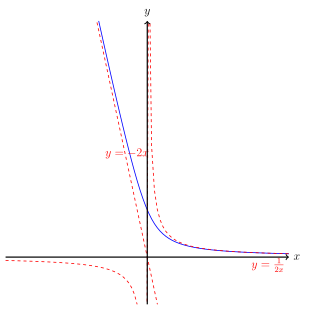
- \begin{align*} && \tan( g(x) + g(-x)) &= \tan \left ( \tan^{-1}(\sqrt{x^2+1}-x) + \tan^{-1}(\sqrt{x^2+1}+x) \right) \\ &&&= \frac{\sqrt{x^2+1}-x+\sqrt{x^2+1}+x}{1-1} \\ \Rightarrow && g(x) + g(-x) &\in \left \{\cdots, -\frac{\pi}{2}, \frac{\pi}{2}, \cdots \right\} \end{align*} But \(g(x), g(-x) > 0\) and \(g(x), g(-x) \in (-\frac{\pi}{2}, \frac{\pi}{2})\), therefore it must be \(\frac{\pi}{2}\).
- \begin{align*} && \tan(2(k(x) + k(-x))) &= \tan(\tan^{-1}x + \tan^{-1}(-x)) \\ &&&= 0 \\ \Rightarrow && k(x)+k(-x) &\in \left \{\cdots, -\frac{\pi}{2}, 0, \frac{\pi}{2}, \cdots \right\} \\ \end{align*} But \(k(x) \in (-\frac{\pi}{4}, \frac{\pi}{4})\), therefore \(k(x) + k(-x) = 0\).
- Let \(t = \tan k(x)\). \begin{align*} && \tan \left ( \tan^{-1} \frac{1}{x} \right) &= \frac{2 \tan\left ( \frac12 \tan^{-1} \frac1x \right)}{ 1-\tan^2\left ( \frac12 \tan^{-1} \frac1x \right)} \\ \Rightarrow && \frac1x &= \frac{2t}{1-t^2} \\ \Rightarrow && 1-t^2 &= 2tx \\ \Rightarrow && 0 &= t^2+2tx - 1 \\ \Rightarrow && 0 &= (t+x)^2 - 1-x^2 \\ \Rightarrow && t &= -x \pm \sqrt{1+x^2} \end{align*} Since \(t > 0\), \(t = \sqrt{1+x^2}-x = f(x) = \tan g(x)\)
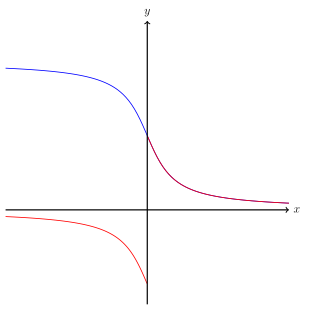
- \begin{align*} \int_0^1 k(x) \d x &= \int_0^1 \frac12 \tan^{-1} \left ( \frac1x \right) \d x \\ &= \left [ \frac{x}{2} \tan^{-1}\left ( \frac1x \right) \right]_0^1 - \int_0^1 \frac{x}{2} \frac{-1/x^2}{1+1/x^2} \d x \\ &= \left [ \frac{x}{2} \tan^{-1}\left ( \frac1x \right) \right]_0^1 + \frac14 \int_0^1 \frac{2x}{1+x^2} \d x \\ &= \frac12 \frac{\pi}{4} + \frac14 \ln(2) \\ &= \frac{\pi + \ln 4}{8}\end{align*} Therefore \(\displaystyle \int_{-1}^0 g(x) \d x = -\frac{\pi + \ln 4}{8}\)
2023 Paper 2 Q1
- Show that making the substitution \(x = \frac{1}{t}\) in the integral \[\int_a^b \frac{1}{(1+x^2)^{\frac{3}{2}}}\,\mathrm{d}x\,,\] where \(b > a > 0\), gives the integral \[\int_{b^{-1}}^{a^{-1}} \frac{-t}{(1+t^2)^{\frac{3}{2}}}\,\mathrm{d}t\,.\]
- Evaluate:
- \(\displaystyle\int_{\frac{1}{2}}^{2} \frac{1}{(1+x^2)^{\frac{3}{2}}}\,\mathrm{d}x\,;\)
- \(\displaystyle\int_{-2}^{2} \frac{1}{(1+x^2)^{\frac{3}{2}}}\,\mathrm{d}x\,.\)
- Show that \[\int_{\frac{1}{2}}^{2} \frac{1}{(1+x^2)^2}\,\mathrm{d}x = \int_{\frac{1}{2}}^{2} \frac{x^2}{(1+x^2)^2}\,\mathrm{d}x = \frac{1}{2}\int_{\frac{1}{2}}^{2} \frac{1}{1+x^2}\,\mathrm{d}x\,,\] and hence evaluate \[\int_{\frac{1}{2}}^{2} \frac{1}{(1+x^2)^2}\,\mathrm{d}x\,.\]
- Evaluate \[\int_{\frac{1}{2}}^{2} \frac{1-x}{x(1+x^2)^{\frac{1}{2}}}\,\mathrm{d}x\,.\]
2020 Paper 2 Q1
- Use the substitution \(x = \dfrac{1}{1-u}\), where \(0 < u < 1\), to find in terms of \(x\) the integral \[\int \frac{1}{x^{\frac{3}{2}}(x-1)^{\frac{1}{2}}}\,\mathrm{d}x \quad \text{(where } x > 1\text{).}\]
- Find in terms of \(x\) the integral \[\int \frac{1}{(x-2)^{\frac{3}{2}}(x+1)^{\frac{1}{2}}}\,\mathrm{d}x \quad \text{(where } x > 2\text{).}\]
- Show that \[\int_2^{\infty} \frac{1}{(x-1)(x-2)^{\frac{1}{2}}(3x-2)^{\frac{1}{2}}}\,\mathrm{d}x = \tfrac{1}{3}\pi.\]
Solution:
- \(\,\) \begin{align*} && x &= \frac1{1-u} \\ \Rightarrow && \d x &= \frac{1}{(1-u)^2} \d u \\ && I &= \int \frac{1}{x^{\frac32}(x-1)^{\frac12} } \d x \\ &&&= \int \frac1{(1-u)^{-\frac32}u^{\frac12}(1-u)^{-\frac12}} (1-u)^{-2} \d u \\ &&&= \int u^{-\frac12} \d u \\ &&&= 2\sqrt{u} + C \\ &&&= 2\sqrt{1-\frac{1}{x}} + C \end{align*}
- \(\,\) \begin{align*} && J &= \int \frac{1}{(x-2)^{\frac32}(x+1)^{\frac12}} \d x \\ y = x+1: &&&= \int \frac{1}{(y-3)^{\frac32}y^{\frac12}} \d y \\ y = 9(3-u)^{-1}: &&&= \int \frac1{\left (9(3-u)^{-1}-3 \right)^{\frac32}3(3-u)^{-\frac12}} \frac{9}{(3-u)^2} \d u \\ &&&= \int \frac1{\left (3u(3-u)^{-1} \right)^{\frac32}3(3-u)^{-\frac12}} \frac{9}{(3-u)^2} \d u \\ &&&= \frac{1}{\sqrt3} \int u^{-\frac32} \d u \\ &&&= -\frac2{\sqrt3} u^{-\frac12} + C \\ &&&= -\frac2{\sqrt3} \sqrt{\frac{y}{3(y-3)}} + C \\ &&&= -\frac2{3} \sqrt{\frac{x+1}{x-2}} + C \\ \end{align*}
- \(\,\) \begin{align*} && K &= \int_2^{\infty} \frac{1}{(x-1)(x-2)^{\frac12}(3x-2)^{\frac12}} \d x \\ y = x - 1: &&&=\int_{y=1}^{\infty} \frac{1}{y(y-1)^{\frac12}(3y+1)^{\frac12}} \d y \\ y = (1-u)^{-1}: &&&= \int_{u=0}^{u=1} \frac{1}{(1-u)^{-1}(u(1-u)^{-1})^{\frac12}((4-u)(1-u)^{-1})^{\frac12}} \frac{1}{(1-u)^2} \d u \\ &&&= \int_0^1 \frac{1}{u^{\frac12}(4-u)^{\frac12}} \d u \\ &&&= \int_0^1 \frac{1}{\sqrt{4-(u-2)^2}} \d u \\ &&&= \left [-\sin^{-1} \left ( \frac{2-u}{2} \right) \right]_0^1 \\ &&&= \sin^{-1} 1 - \sin^{-1} \tfrac12 \\ &&&= \frac{\pi}{2} - \frac{\pi}{6} = \frac{\pi}{3} \end{align*}
2020 Paper 3 Q1
For non-negative integers \(a\) and \(b\), let \[ \mathrm{I}(a,b) = \int_0^{\frac{\pi}{2}} \cos^a x \cos bx \; \mathrm{d}x. \]
- Show that for positive integers \(a\) and \(b\), \[ \mathrm{I}(a,b) = \frac{a}{a+b} \, \mathrm{I}(a-1, b-1). \]
- Prove by induction on \(n\) that for non-negative integers \(n\) and \(m\), \[ \int_0^{\frac{\pi}{2}} \cos^n x \cos(n+2m+1)x \; \mathrm{d}x = (-1)^m \frac{2^n \, n! \, (2m)! \, (n+m)!}{m! \, (2n+2m+1)!}. \]
2019 Paper 1 Q3
By first multiplying the numerator and the denominator of the integrand by \((1 - \sin x)\), evaluate $$\int_0^{\frac{1}{4}\pi} \frac{1}{1 + \sin x} dx.$$ Evaluate also: $$\int_{\frac{1}{4}\pi}^{\frac{1}{3}\pi} \frac{1}{1 + \sec x} dx \quad \text{and} \quad \int_0^{\frac{1}{3}\pi} \frac{1}{(1 + \sin x)^2} dx.$$
Solution: \begin{align*} \int_0^{\frac{1}{4}\pi} \frac{1}{1 + \sin x} dx &= \int_0^{\frac{1}{4}\pi} \frac{1-\sin x}{1 - \sin^2 x} dx \\ &= \int_0^{\frac{1}{4}\pi} \frac{1-\sin x}{\cos^2 x} dx \\ &= \int_0^{\frac{1}{4}\pi} \sec^2 x - \sec x \tan x dx \\ &= \left [\tan x-\sec x \right]_0^{\frac{1}{4}\pi} \\ &= 2 - \frac{1}{\sqrt{2}} \end{align*} \begin{align*} \int_{\frac{1}{4}\pi}^{\frac{1}{3}\pi} \frac{1}{1 + \sec x} \d x &= \int_{\frac{1}{4}\pi}^{\frac{1}{3}\pi} \frac{1-\sec x}{1 - \sec^2 x} \d x \\ &= \int_{\frac{1}{4}\pi}^{\frac{1}{3}\pi} \frac{\sec x-1}{\tan^2 x} \d x \\ &= \int_{\frac{1}{4}\pi}^{\frac{1}{3}\pi} \cot x \cosec x-\cot^2 x\d x \\ &= \left [ -\cosec x +x+\cot x\right]_{\frac{1}{4}\pi}^{\frac{1}{3}\pi} \\ &= \l -\frac{2}{\sqrt3}+\frac{\pi}{3}+\frac{1}{\sqrt{3}}\r - \l-\sqrt{2}+\frac{\pi}{4}+1 \r \\ &= \frac{\pi}{12}-\frac{1}{\sqrt{3}}+\sqrt{2}-1 \end{align*} \begin{align*} \int_0^{\frac{1}{3}\pi} \frac{1}{(1 + \sin x)^2} \d x &= \int_0^{\frac{1}{3}\pi} \frac{1-2\sin x+\sin^2x}{(1-\sin^2 x)^2} \d x \\ &= \int_0^{\frac{1}{3}\pi} \frac{1-2\sin x+\sin^2x}{\cos^4 x} \d x \\ \end{align*} Splitting this up into: \begin{align*} \int_0^{\frac{1}{3}\pi} \frac{-2\sin x}{\cos^4 x} \d x &= -\frac23 \left [ \frac{1}{\cos^3 x}\right]_0^{\frac{1}{3}\pi} \\ &= -\frac{16}3+\frac23 \\ &= -\frac{14}3 \end{align*} and \begin{align*} && \int_0^{\frac{1}{3}\pi} \frac{1+\sin^2x}{\cos^4 x} \d x &= \int_0^{\frac{1}{3}\pi} (\sec^2 x + \tan^2 x) \sec^2 x \d x \\ &&&= \int_0^{\frac{1}{3}\pi} (1+ 2\tan^2 x) \sec^2 x \d x \\ u = \tan x, \d u = \sec^2 x \d x&&&= \int_0^{\sqrt{3}}(1+2u^2) \d u \\ &&&= \left [u + \frac23 u^3 \right]_0^{\sqrt{3}} \\ &&&= \sqrt{3} + 2\sqrt{3} \\ &&&= 3\sqrt{3} \end{align*} And so our complete integral is: \[ \int_0^{\frac{1}{3}\pi} \frac{1}{(1 + \sin x)^2} \d x = 3\sqrt{3} - \frac{14}3\]
2019 Paper 2 Q2
The function f satisfies \(f(0) = 0\) and \(f'(t) > 0\) for \(t > 0\). Show by means of a sketch that, for \(x > 0\), $$\int_0^x f(t) \, dt + \int_0^{f(x)} f^{-1}(y) \, dy = xf(x).$$
- The (real) function g is defined, for all \(t\), by $$(g(t))^3 + g(t) = t.$$ Prove that \(g(0) = 0\), and that \(g'(t) > 0\) for all \(t\). Evaluate \(\int_0^2 g(t) \, dt\).
- The (real) function h is defined, for all \(t\), by $$(h(t))^3 + h(t) = t + 2.$$ Evaluate \(\int_0^8 h(t) \, dt\).
Solution:

- Suppose \((g(t))^3 + g(t) = t\). Notice that \((g(0))^3 + g(0) =0 \Rightarrow g(0)((g(0))^2 + 1) = 0 \Rightarrow g(0) = 0\).
\begin{align*}
&& t &= (g(t))^3 + g(t) \\
\Rightarrow && 1 &= 3(g(t))^2 g'(t) + g'(t) \\
\Rightarrow && g'(t) &= \frac{1}{1 + 3(g(t))^2} > 0
\end{align*}
From our sketch, we can see we are interested in: \begin{align*} && \int_0^2 g(t) \d t &= 2 - \int_0^1 (x^3 + x) \d x \\ &&&= 2 - \frac14 - \frac12 = \frac54 \end{align*}

- \(\,\)
From our second sketch, we can see that: \begin{align*} && \int_0^8 h(t) \d t &= 16 - \int_1^2 (x^3+x-2) \d x \\ &&&= 16 - \left ( \frac{8}{4} + \frac{2^2}{2} - 2 \cdot 2 \right)+ \left ( \frac{1}{4} + \frac{1}{2} - 2 \right) \\ &&&= \frac{59}{4} \end{align*}

2019 Paper 3 Q5
- Let $$f(x) = \frac{x}{\sqrt{x^2 + p}},$$ where \(p\) is a non-zero constant. Sketch the curve \(y = f(x)\) for \(x \geq 0\) in the case \(p > 0\).
- Let $$I = \int \frac{1}{(b^2 - y^2)\sqrt{c^2 - y^2}} \, dy,$$ where \(b\) and \(c\) are positive constants. Use the substitution \(y = \frac{cx}{\sqrt{x^2 + p}}\), where \(p\) is a suitably chosen constant, to show that $$I = \int \frac{1}{b^2 + (b^2 - c^2)x^2} \, dx.$$ Evaluate $$\int_1^{\sqrt{2}} \frac{1}{(3 - y^2)\sqrt{2 - y^2}} \, dy.$$ [ Note: \(\int \frac{1}{a^2 + x^2} \, dx = \frac{1}{a} \tan^{-1} \frac{x}{a} + \text{constant.}\) ] Hence evaluate $$\int_{\frac{1}{\sqrt{2}}}^1 \frac{y}{(3y^2 - 1)\sqrt{2y^2 - 1}} \, dy.$$
- By means of a suitable substitution, evaluate $$\int_{\frac{1}{\sqrt{2}}}^1 \frac{1}{(3y^2 - 1)\sqrt{2y^2 - 1}} \, dy.$$
Solution:
- \(\,\)
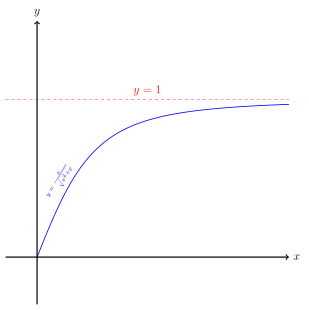
- \(\,\) \begin{align*} && y &= \frac{cx}{\sqrt{x^2+p}} \\ && \d y &= \frac{c(x^2+p)-cx^2}{(x^2+p)^{3/2}} \d x \\ &&&= \frac{cp^2}{(x^2+p)^{3/2}} \d x\\ && I &= \int \frac1{(b^2-y^2)\sqrt{c^2-y^2}} \d y \\ &&&= \int \frac{1}{\left ( b^2 - \frac{c^2x^2}{x^2+p} \right) \sqrt{c^2 - \frac{c^2x^2}{x^2+p} }} \d y \\ &&&= \int \frac{(x^2+p)^{3/2}}{((b^2-c^2)x^2+pb^2)\sqrt{c^2p}}\frac{cp}{(x^2+p)^{3/2}} \d x \\ &&&= \int \frac{\sqrt{p}}{((b^2-c^2)x^2+pb^2)} \d x \\ p=1: &&&= \int \frac{1}{(b^2-c^2)x^2+b^2} \d x \end{align*} When \(b = \sqrt{3}, c = \sqrt{2}\) \begin{align*} && I_1 &= \int_1^{\sqrt{2}} \frac{1}{(3 - y^2)\sqrt{2 - y^2}} \d y\\ &&&= \int_{x =1 }^{x=\infty} \frac{1}{3+x^2} \d x \\ &&&= \left [ \frac{1}{\sqrt{3}} \tan^{-1} \frac{x}{\sqrt{3}} \right]_1^\infty \\ &&&= \frac{\pi}{2\sqrt{3}} - \frac{1}{\sqrt{3}} \frac{\pi}{6} \\ &&&= \frac{\pi}{3\sqrt{3}} \end{align*} \begin{align*} && I_2 &= \int_{\frac{1}{\sqrt{2}}}^1 \frac{y}{(3y^2 - 1)\sqrt{2y^2 - 1}} \d y \\ x = \frac1y, \d x = -\frac1{y^2} \d y &&&= \int_{x=\sqrt{2}}^{x=1} \frac{x^2}{(3-x^2)\sqrt{2-x^2}}\cdot \left ( -\frac{1}{x^2} \right ) \d x \\ &&&= \int_1^{\sqrt{2}} \frac{1}{(3-x^2)\sqrt{2-x^2}} \d x \\ &&&= I_1 = \frac{\pi}{3\sqrt{3}} \end{align*}
- \(\,\) \begin{align*} && I_3 &= \int_{\frac{1}{\sqrt{2}}}^1 \frac{1}{(3y^2 - 1)\sqrt{2y^2 - 1}} \d y \\ x = 1/y, \d x = -1/y^2 \d y &&&= \int_{x=1}^{x=\sqrt{2}} \frac{x}{(3-x^2)\sqrt{2-x^2}} \d x \\ u = x^2, \d u = 2x \d x &&&= \int_{u=1}^{u=2} \frac{\frac12}{(3-u)\sqrt{2-u}} \d u \\ v=2-u, \d v = -\d u &&&= \frac12\int_{v=0}^{v=1} \frac{1}{(1+v)\sqrt{v}} \d v \\ &&&=\left [\tan^{-1}\sqrt{v}\right]_0^1 \\ &&&= \frac{\pi}{4} \end{align*}
2018 Paper 2 Q3
- Let \[ \f(x) = \frac 1 {1+\tan x} \] for \(0\le x < \frac12\pi\,\). Show that \(\f'(x)= -\dfrac{1}{1+\sin 2x}\) and hence find the range of \(\f'(x)\). Sketch the curve \(y=\f(x)\).
- The function \(\g(x)\) is continuous for \(-1\le x \le 1\,\). Show that the curve \(y=\g(x)\) has rotational symmetry of order 2 about the point \((a,b)\) on the curve if and only if \[ \g(x) + \g(2a-x) = 2b\,. \] Given that the curve \(y=\g(x)\) passes through the origin and has rotational symmetry of order 2 about the origin, write down the value of \[\displaystyle \int_{-1}^1 \g(x)\,\d x\,. \]
- Show that the curve \(y=\dfrac{1}{1+\tan^kx}\,\), where \(k\) is a positive constant and \(0 < x < \frac12\pi\,\), has rotational symmetry of order 2 about a certain point (which you should specify) and evaluate \[ \int_{\frac16\pi}^{\frac13\pi} \frac 1 {1+\tan^kx} \, \d x \,. \]
Solution:
- \(\,\) \begin{align*}
&& f(x) &= \frac1{1+\tan x} \\
&& f'(x) &=-(1+\tan x)^{-2} \cdot \sec^2 x \\
&&&= - (\cos x+ \sin x)^{-2} \\
&&&= - (1 + 2 \sin x \cos x)^{-1} \\
&&&= - \frac{1}{1+\sin 2x}
\end{align*}
\(\sin 2x \in [0, 1]\) so \(1+\sin 2x \in [1,2]\) and \(f'(x) \in [-1, -\tfrac12]\)
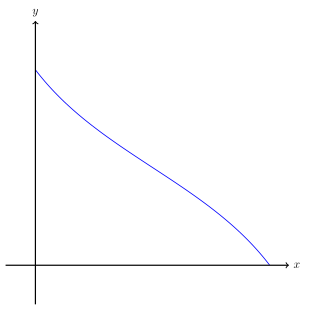
- \(\displaystyle \int_{-1}^1 g(x) \d x = 2g(0) \)
- Let \(g(x) = \frac{1}{1 + \tan^k x}\) then \(g(x)\) has rotational symmetry of order \(2\) about the point \((\frac{\pi}{4}, \frac12)\) which we can see since \begin{align*} g(x) + g(\tfrac12\pi - x) &= \frac{1}{1 + \tan^k x} + \frac{1}{1 + \tan^k(\tfrac12\pi - x)} \\ &= \frac{1}{1+\tan^k x} + \frac{1}{1+\cot^k x} \\ &= \frac{1}{1+\tan^k x} + \frac{\tan^k x}{\tan^k x + 1} \\ &= 1 = 2 \cdot \tfrac12 \end{align*} Therefore \[ \int_{\frac16\pi}^{\frac13\pi} \frac 1 {1+\tan^kx} \, \d x = \frac{\pi}{6} \cdot \frac12 = \frac{\pi}{12}\]
2018 Paper 2 Q5
In this question, you should ignore issues of convergence.
- Write down the binomial expansion, for \(\vert x \vert<1\,\), of \(\;\dfrac{1}{1+x}\,\) and deduce that %. By considering %$ %\displaystyle \int \frac 1 {1+x} \, \d x %\,, %$ %show that \[ \displaystyle \ln (1+x) = -\sum_{n=1}^\infty \frac {(-x)^n}n \, \] for \(\vert x \vert <1 \,\).
- Write down the series expansion in powers of \(x\) of \(\displaystyle \e^{-ax}\,\). Use this expansion to show that \[ \int_0^\infty \frac {\left(1- \e^{-ax}\right)\e^{-x}}x \,\d x = \ln(1+a) \ \ \ \ \ \ \ (\vert a \vert <1)\,. \]
- Deduce the value of \[ \int_0^1 \frac{x^p - x^q}{\ln x} \, \d x \ \ \ \ \ \ (\vert p\vert <1, \ \vert q\vert <1) \,. \]
Solution:
- \begin{align*} && \frac1{1+x} &= 1 - x+ x^2 - x^3+ \cdots \\ \Rightarrow && \int_0^x \frac{1}{1+t} \d t &= \int_0^x \sum_{n=0}^{\infty} (-t)^n \d t \\ &&&= \left [\sum_{n=0}^{\infty} -\frac{(-t)^{n+1}}{n+1} \right]_0^x \\ \Rightarrow &&\ln(1+x)&=- \sum_{n=1}^\infty \frac{(-x)^n}{n} \end{align*}
- \begin{align*} && e^{-ax} &= \sum_{n=0}^\infty \frac{(-a)^n}{n!} x^n \\ \Rightarrow && \int_0^{\infty} \frac{1}{x} \left (1-e^{-ax} \right)e^{-x} \d x &= \int_0^{\infty} \frac{1}{x} \left (-\sum_{n=1}^\infty \frac{(-a)^n}{n!}x^n \right)e^{-x} \d x \\ &&&= -\int_0^{\infty} \sum_{n=1}^\infty \frac{(-a)^n}{n!} x^{n-1} e^{-x} \d x \\ &&&= -\sum_{n=1}^\infty \frac{(-a)^n}{n!} \int_0^{\infty} x^{n-1} e^{-x} \d x \\ &&&= -\sum_{n=1}^\infty \frac{(-a)^n}{n!} (n-1)! \\ &&&= -\sum_{n=1}^\infty \frac{(-a)^n}{n} \\ &&&= \ln (1+a) \end{align*}
- \begin{align*} && \int_0^1 \frac{x^p - x^q}{\ln x} \, \d x &= \int_0^1 \frac{x^p(1 - x^{q-p})}{\ln x} \, \d x \\ e^{-u} = x, \d x = -e^{-u} \d u: &&&=\int_{u=\infty}^{0} \frac{e^{-pu}-e^{-qu}}{-u} (-e^{-u})\d u \\ &&&= \int_0^\infty \frac{e^{-u}(e^{-qu}-e^{-pu})}{u} \d u \\ &&&= \int_0^\infty \frac{e^{-(1+q)u}(1-e^{-(p-q)u})}{u} \d u \\ v = (1+q)u, \d v = (1+q) \d u: &&&=\int_0^{\infty} \frac{e^{-v}(1-e^{-\left(\frac{p-q}{1+q}\right)v}}{v}\d v \\ &&&= \ln \left(1 + \frac{p-q}{1+q} \right) \\ &&&= \ln \left ( \frac{1+p}{1+q} \right) \end{align*}
2017 Paper 1 Q2
- The inequality \(\dfrac 1 t \le 1\) holds for \(t\ge1\). By integrating both sides of this inequality over the interval \(1\le t \le x\), show that \[ \ln x \le x-1 \tag{\(*\)} \] for \(x \ge 1\). Show similarly that \((*)\) also holds for \(0 < x \le 1\).
- Starting from the inequality \(\dfrac{1}{t^2} \le \dfrac1 t \) for \(t \ge 1\), show that \[ \ln x \ge 1-\frac{1}{x} \tag{\(**\)} \] for \(x > 0\).
- Show, by integrating (\(*\)) and (\(**\)), that \[ \frac{2}{ y+1} \le \frac{\ln y}{ y-1} \le \frac{ y+1}{2 y} \] for \( y > 0\) and \( y\ne1\).
Solution:
- \(\,\) \begin{align*} (x \geq 1): && \int_1^x \frac{1}{t} \d t &\leq \int_1^x 1 \d t \\ \Rightarrow && \ln x - \ln 1 &\leq x - 1 \\ \Rightarrow && \ln x & \leq x - 1 \\ \\ (0 < x \leq 1):&& \int_x^1 1\d t &\leq \int_x^1 \frac{1}{t} \d t \\ \Rightarrow&& 1- x &\leq \ln 1 - \ln x \\ \Rightarrow&& \ln x &\leq x - 1 \end{align*}
- \(\,\) \begin{align*} (x \geq 1): && \int_1^x \frac{1}{t^2} \d t &\leq \int_1^x \frac{1}{t} \d t \\ \Rightarrow && -\frac1x+1 &\leq \ln x - \ln 1 \\ \Rightarrow && 1 - \frac1x &\leq \ln x \\ \\ (0 < x \leq 1): && \int_x^1 \frac{1}{t} \d t &\leq \int_x^1 \frac{1}{t^2} \d t \\ \Rightarrow && \ln 1 - \ln x & \leq -1 + \frac{1}{x} \\ \Rightarrow && 1 - \frac1x &\leq \ln x \\ \end{align*}
- \(\,\) \begin{align*} (1 < y): && \int_1^y \left (1 - \frac1{x} \right)\d x &\leq \int_1^y \ln x \d x \\ \Rightarrow && \left [x - \ln x \right]_1^y & \leq \left [ x \ln x - x\right]_1^y \\ \Rightarrow && y - \ln y - 1 &\leq y \ln y - y +1 \\ \Rightarrow && 2y-2 & \leq (y+1) \ln y \\ \Rightarrow && \frac{2}{y+1} & \leq \frac{\ln y}{y-1} \\ (0 < y < 1): && \int_y^1 \left (1 - \frac1{x} \right)\d x &\leq \int_y^1 \ln x \d x \\ \Rightarrow && \left [x - \ln x \right]_y^1 & \leq \left [ x \ln x - x\right]_y^1 \\ \Rightarrow && 1 - (y - \ln y) &\leq -1-(y \ln y-y) \\ \Rightarrow && 2-2y &\leq -(y+1)\ln y \\ \Rightarrow && \frac{2}{y+1} &\leq \frac{-\ln y}{1-y} \tag{\(1-y > 0\)} \\ \Rightarrow && \frac{2}{y+1} &\leq \frac{\ln y}{y-1} \\ \\ (1 < y): && \int_1^y \ln x \d x &\leq \int_1^y (x-1) \d x \\ \Rightarrow && \left [x \ln x -x \right]_1^y &\leq \left[ \frac12 x^2 - x \right]_1^y\\ \Rightarrow && y \ln y - y +1 &\leq \frac12y^2 - y+\frac12 \\ \Rightarrow && y \ln y &\leq \frac12 \left (y^2-1 \right) \\ \Rightarrow && \frac{\ln y}{y-1} &\leq \frac{y+1}{2y} \\ \\ (0 < y < 1) && \int_y^1 \ln x \d x &\leq \int_y^1 (x-1) \d x \\ \Rightarrow && \left [x \ln x -x \right]_y^1&\leq \left[ \frac12 x^2 - x \right]_y^1\\ \Rightarrow && -1-(y \ln y - y +1) &\leq-\frac12 - \left ( \frac12y^2 - y\right)\\ \Rightarrow && \frac12 \left (y^2-1 \right) &\leq y \ln y \\ \Rightarrow && \frac{\ln y}{y-1} & \leq \frac{y+1}{2y} \tag{\(y-1 < 0\)} \end{align*}
2017 Paper 2 Q1
Note: In this question you may use without proof the result \( \dfrac{\d \ }{\d x}\big(\!\arctan x \big) = \dfrac 1 {1+x^2}\,\). Let \[ I_n = \int_0^1 x^n \arctan x \, \d x \;, \] where \(n=0\), 1, 2, 3, \(\ldots\) .
- Show that, for \(n\ge0\,\), \[ (n+1) I_n = \frac \pi 4 - \int _0^1 \frac {x^{n+1}}{1+x^2} \, \d x \, \] and evaluate \(I_0\).
- Find an expression, in terms of \(n\), for \((n+3)I_{n+2}+(n+1)I_{n}\,\). Use this result to evaluate \(I_4\).
- Prove by induction that, for \(n\ge1\), \[ (4n+1) I_{4n} =A - \frac12 \sum_{r=1}^{2n} (-1)^r \frac 1 {r} \,, \] where \(A\) is a constant to be determined.
Solution:
- \(\,\) \begin{align*} && I_n &= \int_0^1 x^n \arctan x \d x \\ &&&= \left [ \frac{x^{n+1}}{n+1} \arctan x\right]_0^1 - \int_0^1 \frac{x^{n+1}}{n+1} \frac{1}{1+x^2} \d x \\ &&&= \frac{1}{n+1} \frac{\pi}{4} - \frac{1}{n+1} \int_0^1 \frac{x^{n+1}}{1+x^2}\d x \\ \Rightarrow && (n+1)I_n &= \frac{\pi}{4} - \int_0^1 \frac{x^{n+1}}{1+x^2}\d x \\ && I_0 &= \frac{\pi}{4} - \int_0^1 \frac{x}{1+x^2} \d x \\ &&&= \frac{\pi}{4} - \left [\frac12 \ln(1+x^2) \right]_0^1 \\ &&&= \frac{\pi}{4} - \frac12 \ln 2 \end{align*}
- \(\,\) \begin{align*} && (n+3)I_{n+2} + (n+1)I_n &=\left ( \frac{\pi}{4} - \int_0^1 \frac{x^{n+3}}{1+x^2} \d x \right)+ \left (\frac{\pi}{4} - \int_0^1 \frac{x^{n+1}}{1+x^2} \d x \right) \\ &&&=\frac{\pi}{2}+ \int_0^1 \frac{x^{n+1}+x^{n+3}}{1+x^2} \d x \\ &&&=\frac{\pi}{2}+ \int_0^1 x^{n+1} \d x \\ &&&= \frac{\pi}{2} + \frac{1}{n+2} \\ && 3I_2 + I_0 &= \frac{\pi}{2} + \frac{1}{2} \\ \Rightarrow && 3I_2 &=\frac{\pi}{4} + \frac12 \ln 2 + \frac12 \\ && 5I_4 + 3I_2 &= \frac{\pi}{2} + \frac14 \\ \Rightarrow && 5I_4 &= \frac{\pi}{2} + \frac14 - \left ( \frac{\pi}{4} + \frac12 \ln 2 + \frac12\right) \\ &&&= \frac{\pi}4-\frac12 \ln 2-\frac14 \\ \Rightarrow && I_4 &= \frac15 \left (\frac{\pi}4-\frac12 \ln 2-\frac14 \right) \\ &&&= \frac1{20} \left (\pi - 2\ln 2 -1 \right) \end{align*}
- Claim: \[ (4n+1) I_{4n} =\frac{\pi}4-\frac12 \ln 2 - \frac12 \sum_{r=1}^{2n} (-1)^r \frac 1 {r} \,, \] Proof: Base case we have just shown above Assume true for \(n = k\), consider \(n = k+1\), then \begin{align*} && (4(k+1)+1) I_{4(k+1)} &= \frac{\pi}{2} + \frac{1}{4(k+1)} - (4k+3)I_{4k+2} \\ &&&= \frac{\pi}{2} + \frac{1}{4(k+1)} - \left (\frac{\pi}{2} + \frac{1}{2(2k+1)} - (4k+1)I_{4k} \right)\\ &&&= (4k+1)I_{4k} - \frac12 \left ( \frac{1}{2k+2} - \frac{1}{2k+1}\right) \\ &&&= \frac{\pi}4-\frac12 \ln 2 - \frac12 \sum_{r=1}^{2k} (-1)^r \frac 1 {r} - \frac12 \left ( \frac{1}{2k+2} - \frac{1}{2k+1}\right)\\ &&&= \frac{\pi}4-\frac12 \ln 2 - \frac12 \sum_{r=1}^{2(k+1)} (-1)^r \frac 1 {r} \\ \end{align*} as required.
2017 Paper 3 Q6
In this question, you are not permitted to use any properties of trigonometric functions or inverse trigonometric functions. The function \(\T\) is defined for \(x>0\) by \[ \T(x) = \int_0^x \! \frac 1 {1+u^2} \, \d u\,, \] and $\displaystyle T_\infty = \int_0^\infty \!\! \frac 1 {1+u^2} \, \d u\,$ (which has a finite value).
- By making an appropriate substitution in the integral for \(\T(x)\), show that \[\T(x) = \T_\infty - \T(x^{-1})\,.\]
- Let \(v= \dfrac{u+a}{1-au}\), where \(a\) is a constant. Verify that, for \(u\ne a^{-1}\), \[ \frac{\d v}{\d u} = \frac{1+v^2}{1+u^2} \,. \] Hence show that, for \(a>0\) and \(x< \dfrac1a\,\), \[ \T(x) = \T\left(\frac{x+a}{1-ax}\right) -\T(a) \,. \] Deduce that \[ \T(x^{-1}) = 2\T_\infty -\T\left(\frac{x+a}{1-ax}\right) -\T(a^{-1}) \] and hence that, for \(b>0\) and \(y>\dfrac1b\,\), \[ \T(y) =2\T_\infty - \T\left(\frac{y+b}{by-1}\right) - \T(b) \,. \]
- Use the above results to show that \(\T(\sqrt3)= \tfrac23 \T_\infty \,\) and \(\T(\sqrt2 -1)= \frac14 \T_\infty\,\).
Solution:
- \(\,\) \begin{align*} && T(x) &= \int_0^x \! \frac 1 {1+u^2} \, \d u \\ &&&= \int_0^{\infty} \frac{1}{1+u^2} \d u - \int_x^\infty \frac{1}{1+u^2} \d u \\ &&&= T_\infty - \int_x^\infty \frac{1}{1+u^2} \d u \\ u = 1/v, \d u = -1/v^2 \d v: &&&= T_\infty - \int_{v=x^{-1}}^{v=0} \frac{1}{1+v^{-2}} \frac{-1}{v^2} \d v \\ &&&= T_\infty - \int_{0}^{x^{-1}} \frac{1}{1+v^2} \d v \\ &&&= T_\infty - T(x^{-1}) \end{align*}
- Let \(v = \frac{u+a}{1-au}\) then \begin{align*} && \frac{\d v}{\d u} &= \frac{(1-au) \cdot 1 - (u+a)\cdot(-a)}{(1-au)^2} \\ &&&= \frac{1-au+au+a^2}{(1-au)^2} \\ &&&= \frac{1+a^2}{(1-au)^2} \\ \\ && \frac{1+v^2}{1+u^2} &= \frac{1 + \left ( \frac{u+a}{1-ua} \right)^2}{1+u^2} \\ &&&= \frac{(1-ua)^2+(u+a)^2}{(1-ua)^2(1+u^2)} \\ &&&= \frac{1+u^2a^2+u^2+a^2}{(1-ua)^2(1+u^2)} \\ &&&= \frac{(1+u^2)(1+a^2)}{(1-ua)^2(1+u^2)} \\ &&&= \frac{1+a^2}{(1-ua)^2} \end{align*} if \(a > 0, x < \frac1a\) then \begin{align*} && T(x) &= \int_0^x \frac{1}{1+u^2} \d u \\ &&&= \int_{v=a}^{v=\frac{a+x}{1-ax}} \frac{1}{1+u^2} \frac{1+u^2}{1+v^2} \d v \\ &&&= T\left ( \frac{x+a}{1-ax} \right) - T(a) \\ \\ \Rightarrow && T(x^{-1}) &= T_\infty - T(x) \\ &&&= T_\infty - 2T\left ( \frac{x+a}{1-ax} \right) + T(a) \\ &&&= T_\infty - 2T\left ( \frac{x+a}{1-ax} \right) + T_\infty-T(a^{-1}) \\ &&&= 2T_\infty - 2T\left ( \frac{x+a}{1-ax} \right) -T(a^{-1}) \end{align*} \(b > 0, y > \frac1b\) then \(y> 0, b > \frac1y\) (same as letting \(x = \frac1y, a = \frac1b\) \begin{align*} && T(y) &= 2T_\infty - 2T \left ( \frac{\frac1y+\frac1b}{1-\frac1{by}} \right) + T(b) \\ \Rightarrow && T(y) &= 2T_\infty - 2T \left ( \frac{b+y}{by-1} \right) + T(b) \\ \end{align*}
- Letting \(y = b = \sqrt{3}\) in the final equation \begin{align*} && T(\sqrt{3}) &= 2T_{\infty} - T \left ( \frac{\sqrt{3}+\sqrt{3}}{\sqrt{3}\sqrt{3}-1} \right) -T (\sqrt{3}) \\ &&&= 2T_\infty - 2T(\sqrt{3}) \\ \Rightarrow && T(\sqrt{3}) &= \tfrac23 T_\infty \end{align*} Let \(x = \sqrt2 - 1, a = 1\) so, \begin{align*} && T(\sqrt2 -1) &= T \left ( \frac{\sqrt2-1+1}{1-\sqrt2+1} \right)-T(1) \\ &&&= T \left ( \frac{\sqrt{2}}{2-\sqrt{2}} \right) - T(1) \\ &&&= T(\frac{\sqrt{2}(2+\sqrt{2})}{2}) - T(1) \\ &&&= T(\sqrt{2}+1) - T(1) \\ &&&= T_\infty - T(\sqrt2-1)-T(1) \\ \Rightarrow && T(\sqrt{2}-1) &= \frac12T_\infty-\frac12T(1) \\ && T(1) &= T_\infty - T(1) \\ \Rightarrow && T(1) &= \frac12 T_\infty \\ \Rightarrow && T(\sqrt2-1) &= \frac12T_\infty - \frac14T_\infty \\ &&&= \frac14 T_\infty \end{align*}
2016 Paper 2 Q7
Show that \[ \int_0^a \f(x) \d x= \int _0^a \f(a-x) \d x\,, \tag{\(*\)} \] where f is any function for which the integrals exist.
- Use (\(*\)) to evaluate \[ \int_0^{\frac12\pi} \frac{\sin x}{\cos x + \sin x} \, \d x \,. \]
- Evaluate \[ \int_0^{\frac14\pi} \frac{\sin x}{\cos x + \sin x} \, \d x \,. \]
- Evaluate \[ \int_0^{\frac14\pi} \ln (1+\tan x) \, \d x \,. \]
- Evaluate \[ \int_0^{\frac14 \pi} \frac x {\cos x \, (\cos x + \sin x)}\, \d x \,. \]
Solution: \begin{align*} u = a-x, \d u = - \d x: && \int_0^a f(x) \d x &= \int_{u=a}^{u=0} f(a-u) (-1) \d u \\ &&&= \int_0^a f(a-u) \d u \\ &&&= \int_0^a f(a-x) \d x \end{align*}
- \begin{align*} && I &= \int_0^{\frac12 \pi} \frac{\sin x}{\cos x + \sin x } \d x\\ &&&= \int_0^{\frac12 \pi} \frac{\sin (\frac12 \pi - x)}{\cos (\frac12 \pi-x) + \sin (\frac12 \pi-x) } \d x\\ &&&= \int_0^{\frac12 \pi} \frac{\cos x}{\sin x + \cos x } \d x\\ \Rightarrow && 2I &= \int_0^{\frac12 \pi} 1 \d x \\ \Rightarrow && I &= \frac{\pi}{4} \end{align*}
- \begin{align*} && I &= \int_0^{\frac14 \pi} \frac{\sin x}{\cos x + \sin x } \d x\\ &&&= \int_0^{\frac14 \pi} \frac{\sin (\frac14 \pi - x)}{\cos (\frac14 \pi-x) + \sin (\frac14 \pi-x) } \d x\\ &&&= \int_0^{\frac14 \pi} \frac{\frac1{\sqrt{2}} \cos x - \frac{1}{\sqrt{2}} \sin x}{\frac1{\sqrt{2}} \cos x + \frac{1}{\sqrt{2}} \sin x + \frac1{\sqrt{2}} \cos x - \frac{1}{\sqrt{2}} \sin x} \d x \\ &&&= \int_0^{\frac14 \pi} \frac{\cos x - \sin x}{2 \cos x} \d x \\ &&&= \left [\frac12 x + \ln(\cos x) \right]_0^{\pi/4} \\ &&&= \frac{\pi}{8} -\frac12\ln2 - 1 \end{align*}
- \begin{align*} && I &= \int_0^{\frac14\pi} \ln (1+\tan x) \, \d x \\ &&&= \int_0^{\frac14 \pi} \ln \left (1 + \tan \left(\frac{\pi}{4} - x\right) \right) \, \d x\\ &&&= \int_0^{\frac14 \pi} \ln \left (1 +\frac{1 - \tan x}{1+ \tan x} \right) \, \d x\\ &&&= \int_0^{\frac14 \pi} \ln \left (\frac{2}{1+ \tan x} \right) \, \d x\\ &&&= \frac{\pi}{4} \ln 2 - I \\ \Rightarrow && I &= \frac{\pi}{8} \ln 2 \end{align*}
- \begin{align*} && I &= \int_0^{\frac14 \pi} \frac x {\cos x \, (\cos x + \sin x)}\, \d x \\ &&&= \int_0^{\frac14 \pi} \frac {\frac14 \pi - x} {(\frac1{\sqrt{2}} \cos x + \frac{1}{\sqrt{2}} \sin x) \, (\frac{2}{\sqrt{2}}\cos x)}\, \d x \\ &&&= \int_0^{\frac14 \pi} \frac {\frac14 \pi - x} {\cos x \, (\cos x + \sin x)}\, \d x \\ \\ \Rightarrow && I &= \frac{\pi}{8} \int_0^{\pi/4} \frac{\sec^2 x}{1 + \tan x} \d x\\ &&&= \frac{\pi}{8} \left [\ln (1 + \tan x) \right]_0^{\pi/4} \\ &&&= \frac{\pi}{8} \ln 2 \end{align*}
2015 Paper 1 Q5
- The function \(\f\) is defined, for \(x>0\), by \[ \f(x) =\int_{1}^3 (t-1)^{x-1} \, \d t \,. \] By evaluating the integral, sketch the curve \(y=\f(x)\).
- The function \(\g\) is defined, for \(-\infty < x < \infty\), by \[ \g(x)= \int_{-1}^1 \frac 1 {\sqrt{1-2xt +x^2} \ }\, \d t \,.\] By evaluating the integral, sketch the curve \(y=\g(x)\).
Solution:
- \(\,\)
\begin{align*}
&& f(x) &= \int_1^3 (t-1)^{x-1} \d t \\
&&&= \left [ \frac1x(t-1)^{x} \right]_1^3 \\
&&&= \frac{2^x}{x}
\end{align*}

- \(\,\)
\begin{align*}
&& g(x) &= \int_{-1}^1 \frac{1}{\sqrt{1-2xt+x^2}} \d t \\
&&&= \left [ -\frac{1}{x}(1 +x^2 - 2xt)^{\frac12} \right]_{-1}^1 \\
&&&= \frac1x \left ( \sqrt{1+x^2+2x}-\sqrt{1+x^2-2x}\right) \\
&&&= \frac1x \left ( |1+x|-|1-x| \right)
\end{align*}
