Problems
Filters
12 problems found
2021 Paper 2 Q6
A plane circular road is bounded by two concentric circles with centres at point~\(O\). The inner circle has radius \(R\) and the outer circle has radius \(R + w\). The points \(A\) and \(B\) lie on the outer circle, as shown in the diagram, with \(\angle AOB = 2\alpha\), \(\tfrac{1}{3}\pi \leqslant \alpha \leqslant \tfrac{1}{2}\pi\) and \(0 < w < R\).
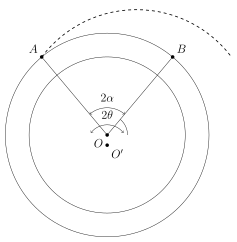
- Show that I cannot cycle from \(A\) to \(B\) in a straight line, while remaining on the road.
- I take a path from \(A\) to \(B\) that is an arc of a circle. This circle is tangent to the inner edge of the road, and has radius \(R + d\) (where \(d > w\)) and centre~\(O'\).
My path is represented by the dashed arc in the above diagram.
Let \(\angle AO'B = 2\theta\).
- Use the cosine rule to find \(d\) in terms of \(w\), \(R\) and \(\cos\alpha\).
- Find also an expression for \(\sin(\alpha - \theta)\) in terms of \(R\), \(d\) and \(\sin\alpha\).
- Show that \(\dfrac{d}{R}\) and \(\alpha - \theta\) are also both much less than \(1\).
- My friend cycles from \(A\) to \(B\) along the outer edge of the road. Let my path be shorter than my friend's path by distance~\(S\). Show that \[ S = 2(R+d)(\alpha - \theta) + 2\alpha(w - d). \] Hence show that \(S\) is approximately a fraction \[ \frac{\sin\alpha - \alpha\cos\alpha}{\alpha(1 - \cos\alpha)} \cdot \frac{w}{R} \] of the length of my friend's path.
2017 Paper 1 Q7
The triangle \(ABC\) has side lengths \(\left| BC \right| = a\), \(\left| CA \right| = b\) and \(\left| AB \right| = c\). Equilateral triangles \(BXC\), \(CYA\) and \(AZB\) are erected on the sides of the triangle \(ABC\), with \(X\) on the other side of \(BC\) from \(A\), and similarly for \(Y\) and \(Z\). Points \(L\), \(M\) and \(N\) are the centres of rotational symmetry of triangles \(BXC\), \(CY\!A\) and \(AZB\) respectively.
- Show that \(| CM| = \dfrac {\ b} {\sqrt3} \,\) and write down the corresponding expression for \(| CL|\).
- Use the cosine rule to show that \[ 6 \left| LM \right|^2 = a^2+b^2+c^2 + 4\sqrt3 \, \Delta \,, \] where \(\Delta\) is the area of triangle \(ABC\). Deduce that \(LMN\) is an equilateral triangle. Show further that the areas of triangles \(LMN\) and \(ABC\) are equal if and only if \[ a^2+b^2 +c^2 = 4\sqrt3 \, \Delta \,. \]
- Show that the conditions \[ (a -b)^2 = -2ab \big( 1 -\cos(C-60^\circ)\big) \,\] and \[ a^2+b^2 +c^2 = 4\sqrt3 \, \Delta \] are equivalent. Deduce that the areas of triangles \(LMN\) and \(ABC\) are equal if and only if \(ABC\) is equilateral.
Solution:
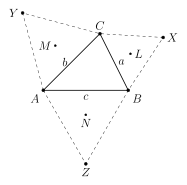
- Consider the equilateral triangle \(CYA\), notice that \(YM\) is a vertical line of symmetry, and \(\angle ACM = 30^\circ\) therefore \(\frac{AC/2}{CM} = \cos 30^\circ \Rightarrow |CM| = \frac{b}{2} \cdot \frac{2}{\sqrt{3}} = \frac{b}{\sqrt{3}}\). Similarly \(|CL| = \frac{a}{\sqrt{3}}\)
- \(\,\) \begin{align*} && |LM|^2 &= |CM|^2 + |CL|^2 - 2 \cdot |CM| \cdot |CL| \cdot \cos \angle MCL \\ &&&= \frac{b^2}{3} + \frac{a^2}{3} - 2 \frac{ab}{3} \cos \left (\angle CMA + \angle CAB + \angle BCL \right) \\ &&&= \frac13 \left (b^2 + a^2 - 2ab \cos \left ( \frac{\pi}{3} + \angle CAB \right) \right) \\ &&&= \frac13 \left (b^2 + a^2 - ab \cos \left ( \angle CAB \right) + \sqrt{3}ab \sin \angle CAB \right) \\ &&&= \frac13 \left (b^2 + a^2 - ab \cos \angle CAB + 2\sqrt{3} \Delta\right) \\ &&&= \frac13 \left (b^2 + a^2 - ab \left (\frac{a^2+b^2-c^2}{2ab} \right) + 2\sqrt{3} \Delta\right) \\ &&&= \frac13 \left ( \frac12(a^2+b^2+c^2) + 2\sqrt{3}\Delta \right) \\ \Rightarrow && 6|LM|^2 &= a^2 + b^2 + c^2 + 4\sqrt{3} \Delta \end{align*} However, nothing in our reasoning here was special about \(LM\), therefore \(LN\) and \(MN\) also equal this value, and we find that the triangle is equilateral. The area of equilateral triangle [LMN] is \(\frac{\sqrt{3}}4 |LM|^2\), ie \begin{align*} &&& \text{areas are equal} \\ \Leftrightarrow && \Delta &= \frac{\sqrt{3}}4 |LM|^2 \\ &&&= \frac{\sqrt{3}}4 \frac{a^2+b^2+c^2+4\sqrt{3}\Delta}{6} \\ &&&= \frac{\sqrt{3}}{24} (a^2+b^2+c^2) + \frac12 \Delta \\ \Leftrightarrow && \Delta &= \frac{\sqrt{3}}{12}(a^2+b^2+c^2)\\ \Leftrightarrow && 4\sqrt{3}\Delta &=a^2+b^2+c^2\\ \end{align*}
- \(\,\) \begin{align*} && (a-b)^2 &= -2ab(1 - \cos(C - 60^{\circ})) \\ \Leftrightarrow && a^2+b^2 - 2ab &=-2ab + 2ab \cos(C - 60^{\circ}) \\ \Leftrightarrow && a^2+b^2 &= ab \cos C+\sqrt{3}ab\sin C \\ \Leftrightarrow && a^2+b^2 &= ab \frac{a^2+b^2-c^2}{2ab} + 2\sqrt{3} \Delta \\ \Leftrightarrow && a^2+b^2+c^2 &= 4\sqrt{3}\Delta \end{align*} Since the LHS is non-positive, and the RHS is positive, the only way they can be equal is if they are both \(0\), ie \(a=b\) and \(C = 60^{\circ}\) ie \(ABC\) is equilateral.
2014 Paper 1 Q4
An accurate clock has an hour hand of length \(a\) and a minute hand of length \(b\) (where \(b>a\)), both measured from the pivot at the centre of the clock face. Let \(x\) be the distance between the ends of the hands when the angle between the hands is \(\theta\), where \(0\le\theta < \pi\). Show that the rate of increase of \(x\) is greatest when \(x=(b^2-a^2)^\frac12\). In the case when \(b=2a\) and the clock starts at mid-day (with both hands pointing vertically upwards), show that this occurs for the first time a little less than 11 minutes later.
Solution: The position of the hands are \(\begin{pmatrix} a\sin(-t) \\ a \cos(-t) \end{pmatrix}\) and \(\begin{pmatrix} b\sin(-60t) \\ b \cos(-60t) \end{pmatrix}\), the distance between the hands is \begin{align*} x &= \sqrt{\left ( a \sin t - b \sin 60t\right)^2+\left ( a \cos t - b \cos 60t\right)^2} \\ &= \sqrt{a^2+b^2-2ab\left (\sin t \sin 60t+\cos t \cos 60t \right)} \\ &= \sqrt{a^2+b^2-2ab \cos(59t)} = \sqrt{a^2+b^2-2ab \cos \theta} \\ \\ \frac{\d x}{\d \theta} &= \frac{ab \sin \theta}{ \sqrt{a^2+b^2-2ab \cos \theta}} \\ \frac{\d^2 x}{\d \theta^2} &= \frac{ab \cos \theta\sqrt{a^2+b^2-2ab \cos \theta} - \frac{a^2b^2 \sin^2 \theta}{\sqrt{a^2+b^2-2ab \cos \theta}} }{a^2+b^2-2ab \cos \theta} \\ &= \frac{ab \cos \theta(a^2+b^2-2ab \cos \theta) - a^2b^2 \sin^2 \theta }{(a^2+b^2-2ab \cos \theta)^{3/2}} \\ &= \frac{ab \cos \theta(a^2+b^2-2ab \cos \theta) - a^2b^2(1-\cos^2 \theta)}{(a^2+b^2-2ab \cos \theta)^{3/2}} \\ &= \frac{ab(a^2+b^2) \cos \theta-a^2b^2 \cos \theta- a^2b^2}{(a^2+b^2-2ab \cos \theta)^{3/2}} \\ &= \frac{-ab(a\cos \theta -b)(b \cos \theta - a)}{(a^2+b^2-2ab \cos \theta)^{3/2}} \\ \end{align*} So the rate of increase is largest when \(\cos \theta = \frac{a}{b}\) (since \(\frac{b}{a}\) is impossible. Therefore when \(x = \sqrt{a^2+b^2-2ab \frac{a}{b}} = \sqrt{a^2+b^2-2a^2} = \sqrt{b^2-a^2}\) If \(b = 2a\) then \(\cos \theta = \frac{a}{2a} = \frac12 = \frac{\pi}{3} = 60^\circ\) The relative speed of the hands is \(5.5^\circ\) per minute, so \(\frac{60}{5.5} = \frac{120}{11} \approx 11\) but clearly also less than since \(121 = 11^2\).
2014 Paper 2 Q1
In the triangle \(ABC\), the base \(AB\) is of length 1 unit and the angles at~\(A\) and~\(B\) are \(\alpha\) and~\(\beta\) respectively, where \(0<\alpha\le\beta\). The points \(P\) and~\(Q\) lie on the sides \(AC\) and \(BC\) respectively, with \(AP=PQ=QB=x\). The line \(PQ\) makes an angle of~\(\theta\) with the line through~\(P\) parallel to~\(AB\).
- Show that \(x\cos\theta = 1- x\cos\alpha - x\cos\beta\), and obtain an expression for \(x\sin\theta\) in terms of \(x\), \(\alpha\) and~\(\beta\). Hence show that \begin{equation} \label{eq:2*} \bigl(1+2\cos(\alpha+\beta)\bigr)x^2 - 2(\cos\alpha + \cos\beta)x + 1 = 0\,. \tag{\(*\)} \end{equation} Show that \((*)\) is also satisfied if \(P\) and \(Q\) lie on \(AC\) produced and \(BC\) produced, respectively. [By definition, \(P\) lies on \(AC\) produced if \(P\) lies on the line through \(A\) and~\(C\) and the points are in the order \(A\), \(C\), \(P\)\,.]
- State the condition on \(\alpha\) and \(\beta\) for \((*)\) to be linear in \(x\). If this condition does not hold (but the condition \(0<\alpha \le \beta\) still holds), show that \((*)\) has distinct real roots.
- Find the possible values of~\(x\) in the two cases (a) \(\alpha = \beta = 45^\circ\) and (b) \(\alpha = 30^\circ\), \(\beta = 90^\circ\), and illustrate each case with a sketch.
2012 Paper 2 Q6
A cyclic quadrilateral \(ABCD\) has sides \(AB\), \(BC\), \(CD\) and \(DA\) of lengths \(a\), \(b\), \(c\) and \(d\), respectively. The area of the quadrilateral is \(Q\), and angle \(DAB\) is \(\theta\). Find an expression for \(\cos\theta\) in terms of \(a\), \(b\), \(c\) and \(d\), and an expression for \(\sin\theta\) in terms of \(a\), \(b\), \(c\), \(d\) and \(Q\). Hence show that \[ 16Q^2 = 4(ad+bc)^2 - (a^2+d^2-b^2-c^2)^2 \,, \] and deduce that \[ Q^2 = (s-a)(s-b)(s-c)(s-d)\,, \] where \(s= \frac12(a+b+c+d)\). Deduce a formula for the area of a triangle with sides of length \(a\), \(b\) and \(c\).
Solution:

2009 Paper 1 Q4
The sides of a triangle have lengths \(p-q\), \(p\) and \(p+q\), where \(p>q> 0\,\). The largest and smallest angles of the triangle are \(\alpha\) and \(\beta\), respectively. Show by means of the cosine rule that \[ 4(1-\cos\alpha)(1-\cos\beta) = \cos\alpha + \cos\beta \,. \] In the case \(\alpha = 2\beta\), show that \(\cos\beta=\frac34\) and hence find the ratio of the lengths of the sides of the triangle.
Solution: The largest angle will be opposite the side with length \(p+q\). Similarly the smallest angle will be opposite the side with length \(p-q\). The cosine rule tells us that: \begin{align*} && (p+q)^2 &= p^2 + (p-q)^2 - 2p(p-q) \cos \alpha \\ && 0 &= p(p-4q-2(p-q)\cos \alpha)\\ && 0 &= p(1-2\cos \alpha) + q(2\cos \alpha - 4)\\ \Rightarrow && \frac{p}{q} & = \frac{4-2 \cos \alpha}{1-2 \cos \alpha} \\ && (p-q)^2 &= p^2 + (p+q)^2 - 2p(p+q) \cos \beta \\ && 0 &= p(p+4q-2(p+q) \cos \beta) \\ && 0 &= p(1-2\cos \beta)+q(4-2\cos \beta) \\ \Rightarrow && \frac{p}{q} &= \frac{2\cos \beta - 4}{1-2\cos \beta} \\ \Rightarrow && \frac{4-2 \cos \alpha}{1-2 \cos \alpha} &= \frac{2\cos \beta - 4}{1-2\cos \beta} \\ \Rightarrow && (2-\cos \alpha)(1-2\cos \beta) &= (\cos \beta - 2)(1 - 2 \cos \alpha) \\ \Rightarrow && 2 - \cos \alpha -4\cos \beta+2\cos \alpha \cos \beta &= \cos \beta - 2-2\cos \alpha \cos \beta + 4 \cos \alpha \\ \Rightarrow && 4-4\cos \alpha - 4\cos \beta+4\cos \alpha\cos \beta &= \cos \alpha + \cos \beta \\ \Rightarrow && 4(1-\cos \alpha)(1-\cos \beta) &= \cos \alpha + \cos \beta \end{align*} If \(\alpha = 2 \beta\), and let \(c = \cos \beta\) \begin{align*} && 4 (1- \cos 2 \beta)(1-\cos \beta) &= \cos 2 \beta + \cos \beta \\ \Rightarrow && 4(1-(2c^2-1))(1-c) &= 2c^2-1+c\\ \Rightarrow && 8(1+c)(1-c)^2 &= (2c-1)(c+1) \\ \Rightarrow && 0 &= (c+1)(8(1-c)^2-(2c-1)) \\ &&&= (c+1)(8c^2-18c+9) \\ &&&= (c+1)(4c-3)(2c-3) \\ \end{align*} Therefore \(c = -1, \frac32, \frac34\). Clearly \(\cos \beta \neq -1, \frac32\), since they are not valid angles in a triangle (or valid values of \(\cos \beta\)). \(\frac{p}{q} = \frac{2 \cdot \frac34-4 }{1 - 2\cdot \frac34} = \frac{3-8}{2-3} = 5\) so \(4:5:6\)
2006 Paper 1 Q8
{\it Note that the volume of a tetrahedron is equal to \(\frac1 3\) \(\times\) the area of the base \(\times\) the height.} The points \(O\), \(A\), \(B\) and \(C\) have coordinates \((0,0,0)\), \((a,0,0)\), \((0,b,0)\) and \((0,0,c)\), respectively, where \(a\), \(b\) and \(c\) are positive.
- Find, in terms of \(a\), \(b\) and \(c\), the volume of the tetrahedron \(OABC\).
- Let angle \(ACB = \theta\). Show that \[ \cos\theta = \frac {c^2} { { \sqrt{\vphantom{ \dot b} (a^2+c^2)(b^2+c^2)} } ^{\vphantom A} \ } \] and find, in terms of \(a\), \(b\) and \(c\), the area of triangle \(ABC\). % is %\(\displaystyle \tfrac12 \sqrt{ \vphantom{\dot A } a^2b^2 +b^2c^2 + c^2 a^2 \;} \;\).
2002 Paper 3 Q7
Given that \(\alpha\) and \(\beta\) are acute angles, show that \(\alpha + \beta = \tfrac{1}{2}\pi\) if and only if \(\cos^2 \alpha + \cos^2 \beta = 1\). In the \(x\)--\(y\) plane, the point \(A\) has coordinates \((0,s)\) and the point \(C\) has coordinates \((s,0)\), where \(s>0\). The point \(B\) lies in the first quadrant (\(x>0\), \(y>0\)). The lengths of \(AB\), \(OB\) and \(CB\) are respectively \(a\), \(b\) and \(c\). Show that \[ (s^2 +b^2 - a^2)^2 + (s^2 +b^2 -c^2)^2 = 4s^2b^2 \] and hence that \[ (2s^2 -a^2-c^2)^2 + (2b^2 -a^2-c^2)^2 =4a^2c^2\;. \] Deduce that $$ \l a - c \r^2 \le 2b^2 \le \l a + c \r^2\;. $$ %Show, %by considering the case \(a=1+\surd2\,\), \(b=c=1\,\), % that the condition \(\l \ast \r\,\) %is not sufficient to ensure that \(B\) lies in the first quadrant.
2000 Paper 1 Q5
Arthur and Bertha stand at a point \(O\) on an inclined plane. The steepest line in the plane through \(O\) makes an angle \(\theta\) with the horizontal. Arthur walks uphill at a steady pace in a straight line which makes an angle \(\alpha\) with the steepest line. Bertha walks uphill at the same speed in a straight line which makes an angle \(\beta\) with the steepest line (and is on the same side of the steepest line as Arthur). Show that, when Arthur has walked a distance \(d\), the distance between Arthur and Bertha is \(2d \vert\sin\frac12(\alpha-\beta)\vert\). Show also that, if \(\alpha\ne\beta\), the line joining Arthur and Bertha makes an angle \(\phi\) with the vertical, where \[ \cos\phi = \sin\theta \sin \frac12(\alpha+\beta). \]
2000 Paper 2 Q3
The lengths of the sides \(BC\), \(CA\), \(AB\) of the triangle \(ABC\) are denoted by \(a\), \(b\), \(c\), respectively. Given that $$ b = 8+{\epsilon}_1, \, c=3+{\epsilon}_2,\, A=\tfrac{1}{3}\pi + {\epsilon}_3, $$ where \({\epsilon}_1\), \({\epsilon}_2\), and \( {\epsilon}_3\) are small, show that \(a \approx 7 + {\eta}\), where ${\eta}= {\left(13 \, {{\epsilon}_1}-2\,{\epsilon}_2 + 24{\sqrt 3} \;{{\epsilon}_3}\right)}/14$. Given now that $$ {\vert {\epsilon}_1} \vert \le 2 \times 10^{-3}, \ \ \ {\vert {\epsilon}_2} \vert \le 4\cdot 9\times 10^{-2}, \ \ \ {\vert {\epsilon}_3} \vert \le \sqrt3 \times 10^{-3}, $$ find the range of possible values of \({\eta}\).
Solution: The cosine rule states that: \(a^2 = b^2 + c^2 - 2bc \cos (A)\) Therefore \begin{align*} a^2 &= (8 + \epsilon_1)^2 + (3 + \epsilon_2)^2 - 2(8 + \epsilon_1) (3 + \epsilon_2)\cos \l \frac{\pi}{3} + \epsilon_3 \r \\ &\approx 64 + 16\epsilon_1 + 9 + 6\epsilon_2- 2(24 + 3\epsilon_1+8\epsilon_2) \cos \l \frac{\pi}{3} + \epsilon_3 \r \\ &= 73 + 16\epsilon_1+ 6\epsilon_2 - 2(24 + 3\epsilon_1+8\epsilon_2) \l \cos \l \frac{\pi}{3} \r \cos \epsilon_3 - \sin \l \frac{\pi}{3} \r \sin \epsilon_3 \r \\ &\approx 73 + 16\epsilon_1+ 6\epsilon_2 - (24 + 3 \epsilon_1+8\epsilon_2) + 24\sqrt{3}\epsilon_3 \\ &= 49 + 13 \epsilon_1 - 2\epsilon_2+24\sqrt{3}\epsilon_3 \\ &= 7^2 + 2 \cdot 7 \cdot \frac{13 \epsilon_1 - 2\epsilon_2+24\sqrt{3}\epsilon_3}{14} \\ &\approx \l 7 + \frac{13 \epsilon_1 - 2\epsilon_2+24\sqrt{3}\epsilon_3}{14} \r^2 \end{align*} In this approximation, we are ignoring all terms of order \(2\), and using the approximations \(\cos \varepsilon \approx 1, \sin \varepsilon \approx \varepsilon\) Therefore \(a \approx 7 + \frac{ 13 \epsilon_1 - 2\epsilon_2+24\sqrt{3}\epsilon_3}{14}\). \(\eta\) is maximised if \(\epsilon_1, \epsilon_3\) are and \(\epsilon_2\) is minimized, ie: \begin{align*} \eta &\leq \frac{13 \cdot 2 \cdot 10^{-3} - 2 \cdot 4.9 \cdot 10^{-2} + 24 \sqrt{3} \cdot \sqrt{3} \cdot 10^{-3}}{14} \\ &= 10^{-3} \cdot \frac{26 - 98 + 74}{14} \\ &= 10^{-3} \cdot \frac{1}{7}\end{align*} Similarly, it is maximised when signs are reversed, ie: \(| \eta | \leq 10^{-3} \cdot \frac{1}{7}\)
1995 Paper 2 Q7
The diagram shows a circle, of radius \(r\) and centre \(I\), touching the three sides of a triangle \(ABC\). We write \(a\) for the length of \(BC\) and \(\alpha\) for the angle \(\angle BAC\) and so on. Let \(s=\frac{1}{2}\left(a+b+c\right)\) and let \(\triangle\) be the area of the triangle.

- By considering the area of the triangles \(AIB,\) \(BIC\) and \(CIA\), or otherwise, show that \(\Delta=rs\).
- By using the formula \(\Delta=\frac{1}{2}bc\sin\alpha\), show that \[ \Delta^{2}=\tfrac{1}{16}[4b^{2}c^{2}-\left(2bc\cos\alpha\right)^{2}]. \] Now use the formula \(a^{2}=b^{2}+c^{2}-2bc\cos\alpha\) to show that \[ \Delta^{2}=\tfrac{1}{16}[(a^{2}-\left(b-c\right)^{2})(\left(b+c\right)^{2}-a^{2})] \] and deduce that \[ \Delta=\sqrt{s\left(s-a\right)\left(s-b\right)\left(s-c\right)}. \]
- A hole in the shape of the triangle \(ABC\) is cut in the top of a level table. A sphere of radius \(R\) rests in the hole. Find the height of the centre of the sphere above the level of the table top, expressing your answer in terms of \(a,b,c,s\) and \(R\).
Solution:
- \([AIB] = \frac12br\), \([BIC] = \frac12ar\), \([CIA] = \frac12 rc\), therefore \(\Delta = [AIB] +[BIC] + [CIA] = \frac12r(a+b+c) = sr\)
- \(\,\) \begin{align*} && \Delta &= \frac12 bc \sin \alpha \\ \Rightarrow && \Delta^2 &= \frac14 b^2c^2 \sin^2 \alpha \\ &&&= \frac14 \left (b^2c^2 - b^2c^2\cos^2 \alpha \right) \\ &&&= \frac1{16} \left (4b^2c^2 - (2bc\cos \alpha )^2\right) \\ \\ \Rightarrow && \Delta^2 &= \frac1{16} \left (4b^2c^2 - (b^2+c^2-a^2 )^2\right) \\ &&&= \frac1{16} (2bc-b^2-c^2+a^2)(2bc+b^2+c^2-a^2) \\ &&&= \frac{1}{16}(a^2-(b-c)^2)((b+c)^2-a^2) \\ &&&= \frac1{16}(a-b+c)(a+b-c)(b+c-a)(b+c+a) \\ &&&= (s - b)(s-c)(s-a)s \\ \Rightarrow && \Delta &= \sqrt{s(s-a)(s-b)(s-c)} \end{align*}
- We have the setting like this,
so \begin{align*} && h & = \sqrt{R^2-r^2} \\ &&&= \sqrt{R^2-\frac{\Delta^2}{s^2}} \\ &&&= \sqrt{R^2 - \frac{(s-a)(s-b)(s-c)}{s}} \end{align*}

1993 Paper 1 Q8
- Prove that the intersection of the surface of a sphere with a plane is always a circle, a point or the empty set. Prove that the intersection of the surfaces of two spheres with distinct centres is always a circle, a point or the empty set. {[}If you use coordinate geometry, a careful choice of origin and axes may help.{]}
- The parish council of Little Fitton have just bought a modern sculpture entitled `Truth, Love and Justice pouring forth their blessings on Little Fitton.' It consists of three vertical poles \(AD,BE\) and \(CF\) of heights 2 metres, 3 metres and 4 metres respectively. Show that \(\angle DEF=\cos^{-1}\frac{1}{5}.\) Vandals now shift the pole \(AD\) so that \(A\) is unchanged and the pole is still straight but \(D\) is vertically above \(AB\) with \(\angle BAD=\frac{1}{4}\pi\) (in radians). Find the new angle \(\angle DEF\) in radians correct to four figures.