Problems

Filters
Clear Filters

7 problems found

2014 Paper 1 Q11
D: 1500.0 B: 1500.0

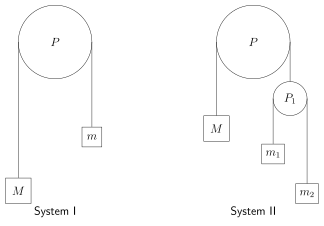
The diagrams below show two separate systems of particles, strings and pulleys.In both systems, the pulleys are smooth and light, the strings are light and inextensible, the particles move vertically and the pulleys labelled with \(P\) are fixed. The masses of the particles are as indicated on the diagrams.
TikZ diagram
  1. For system I show that the acceleration, \(a_1\), of the particle of mass \(M\), measured in the downwards direction, is given by \[ a_1= \frac{M-m}{M+m} \, g \,, \] where \(g\) is the acceleration due to gravity. Give an expression for the force on the pulley due to the tension in the string.
  2. For system II show that the acceleration, \(a_2\), of the particle of mass \(M\), measured in the downwards direction, is given by \[ a_2= \frac{ M - 4\mu}{M+4\mu}\,g \,, \] where \(\mu = \dfrac{m_1m_2}{m_1+m_2}\). In the case \(m= m_1+m_2\), show that \(a_1= a_2\) if and only if \(m_1=m_2\).


Solution:

  1. \(\,\)
    TikZ diagram
    \begin{align*} \text{N2}(\uparrow, m): && T - mg &= ma_1 \\ \text{N2}(\uparrow, M): && T-Mg &= -Ma_1 \\ \Rightarrow && (M-m)g &= a_1(m+M) \\ \Rightarrow && a_1 &= \frac{M-m}{M+m}g \\ && T &= mg + ma_1 \\ &&&= \frac{2mM}{M+m}g \end{align*}
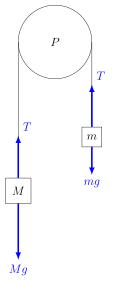
  2. System II is the same as system I, but with \(m\) replaced with \(2\frac{T}{g} = \frac{4mM}{M+m}\). In particular, this means that: \begin{align*} && a_2 &= \frac{M - \frac{4m_1m_2}{m_1+m_2}}{M + \frac{4m_1m_2}{m_1+m_2}} g \\ &&&= \frac{M-4\mu}{M+4\mu}g \end{align*} If \(m = m_1 + m_2\) then \begin{align*} && a_1 &= a_2 \\ \Leftrightarrow && \frac{M-m_1-m_2}{M+m_1+m_2} &= \frac{M - \frac{4m_1m_2}{m_1+m_2}}{M + \frac{4m_1m_2}{m_1+m_2}} \\ \Leftrightarrow && \frac{M-m_1-m_2}{M+m_1+m_2} &= \frac{M(m_1+m_2) -4m_1m_2}{M(m_1+m_2) + 4m_1m_2} \\ \Leftrightarrow && M^2(m_1+m_2)+4m_1m_2M &- M(m_1+m_2)^2 - 4m_1m_2(m_1+m_2) \\ &&\quad \quad = M^2(m_1+m_2) - 4m_1m_2M &+M(m_1+m_2)^2-4m_1m_2(m_1+m_2) \\ \Leftrightarrow && 8m_1m_2M&= 2M(m_1+m_2)^2 \\ \Leftrightarrow && 0 &= (m_1-m_2)^2 \\ \Leftrightarrow && m_1 &= m_2 \end{align*}

2012 Paper 1 Q11
D: 1516.0 B: 1500.0

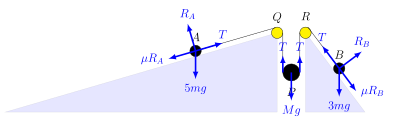
The diagram shows two particles, \(A\) of mass \(5m\) and \(B\) of mass \(3m\), connected by a light inextensible string which passes over two smooth, light, fixed pulleys, \(Q\) and \(R\), and under a smooth pulley \(P\) which has mass \(M\) and is free to move vertically. Particles \(A\) and \(B\) lie on fixed rough planes inclined to the horizontal at angles of \(\arctan \frac 7{24}\) and \(\arctan\frac43\) respectively. The segments \(AQ\) and \(RB\) of the string are parallel to their respective planes, and segments \(QP\) and \(PR\) are vertical. The coefficient of friction between each particle and its plane is \(\mu\).

TikZ diagram
  1. Given that the system is in equilibrium, with both \(A\) and \(B\) on the point of moving up their planes, determine the value of \(\mu\) and show that \(M = 6m\).
  2. In the case when \(M = 9m\), determine the initial accelerations of \(A\), \(B\) and \(P\) in terms of \(g\).


Solution:
TikZ diagram
First note our triangles are 7-24-25 and 3-4-5 triangles, so we can easily calculate \(\sin\) and \(\cos\) of our angles. \begin{questionparts} \item \begin{align*} \text{N2}(\uparrow, P): && 2T - Mg &= 0 \\ \\ \text{N2}(\perp AQ): && R_A - 5mg \cdot \frac{24}{25} &= 0 \\ \Rightarrow && R_A &= \frac{24}{5}mg \\ \text{N2}(\parallel AQ): && T - \mu R_A - 5mg \cdot \frac{7}{25} &= 0 \\ \Rightarrow && T &= \frac15 mg \l 7+24 \mu \r \\ \text{N2}(\perp BR): && R_B - 3mg \cdot \frac{3}{5}&= 0 \\ \Rightarrow && R_B &= \frac{9}{5}mg \\ \text{N2}(\parallel AQ): && T - \mu R_B - 3mg \cdot \frac{4}{5} &= 0 \\ \Rightarrow && T &= \frac15 mg \l 12+9 \mu \r \\ \\ \Rightarrow && 12 + 9 \mu &= 7 + 24 \mu \\ \Rightarrow && \mu &= \frac{5}{15} = \frac13 \\ \\ \Rightarrow && Mg &= 2 \cdot \frac15 \cdot mg \cdot (7 + 24 \cdot \frac13) \\ &&&= 6mg \\ \Rightarrow && M &= 6m \end{align*} \item Assuming \(\mu = \frac13\) \begin{align*} &&9m \ddot{p} &= 9mg - 2T \\ &&5m \ddot{a} &= T - 3mg \\ &&3m \ddot{b} &= T - 3mg \\ &&2\ddot{p} &= \ddot{a}+\ddot{b} \\ \Rightarrow &&30m\ddot{p} &= 8T - 24mg \\ &&9m\ddot{p} &= 9mg - 2T \\ \Rightarrow && 66m \ddot{p} &=12mg \\ \Rightarrow && \ddot{p} &= \frac{2}{11}g \\ && T &= 9mg - 9m \frac{2}{11} g = \frac{9^2}{11}mg\\ && \ddot{a} &= \frac{3}{22} g \\ && \ddot{b} &= \frac{5}{22}g \end{align*}

2009 Paper 2 Q10
D: 1600.0 B: 1500.0

\(\,\)

\psset{xunit=1.5cm,yunit=1.5cm,algebraic=true,dotstyle=o,dotsize=3pt 0,linewidth=0.3pt,arrowsize=3pt 2,arrowinset=0.25} \begin{pspicture*}(-2.73,-2.6)(3.4,1.82) \psline{->}(-2.73,0)(2.5,0) \psline{->}(0,-2.2)(0,1.5) \rput[tl](2.55,0.05){\(x\)} \rput[tl](-0.05,1.75){\(y\)} \rput[tl](-2.09,-0.3){\(P_1\)} \rput[tl](-1.11,-0.3){\(P_2\)} \rput[tl](-0.55,-0.6){\(P_3\)} \rput[tl](-0.55,-1.6){\(P_4\)} \rput[tl](0.07,0.3){\(O\)} \psline{->}(-2.1,0.4)(-1.6,0.4) \psline{->}(0.4,-1.9)(0.4,-1.4) \rput[tl](-1.55,0.45){\(u\)} \rput[tl](0.32,-1.2){\(u\)} \begin{scriptsize} \psdots[dotsize=18pt 0,dotstyle=*](-1,0) \psdots[dotsize=18pt 0,dotstyle=*](-2,0) \psdots[dotsize=18pt 0,dotstyle=*](0,-0.7) \psdots[dotsize=18pt 0,dotstyle=*](0,-1.7) \end{scriptsize} \end{pspicture*}
Four particles \(P_1\), \(P_2\), \(P_3\) and \(P_4\), of masses \(m_1\), \(m_2\), \(m_3\) and \(m_4\), respectively, are arranged on smooth horizontal axes as shown in the diagram. Initially, \(P_2\) and \(P_3\) are stationary, and both \(P_1\) and \(P_4\) are moving towards \(O\) with speed \(u\). Then \(P_1\) and \(P_2\) collide, at the same moment as \(P_4\) and \(P_3\) collide. Subsequently, \(P_2\) and \(P_3\) collide at \(O\), as do \(P_1\) and \(P_4\) some time later. The coefficient of restitution between each pair of particles is~\(e\), and \(e>0\). Show that initially \(P_2\) and \(P_3\) are equidistant from \(O\).

2006 Paper 3 Q9
D: 1700.0 B: 1484.0

A long, light, inextensible string passes through a small, smooth ring fixed at the point \(O\). One end of the string is attached to a particle \(P\) of mass \(m\) which hangs freely below \(O\). The other end is attached to a bead, \(B\), also of mass \(m\), which is threaded on a smooth rigid wire fixed in the same vertical plane as \(O\). The distance \(OB\) is \(r\), the distance \(OH\) is \(h\) and the height of the bead above the horizontal plane through~\(O\) is \(y\), as shown in the diagram.

\psset{xunit=0.8cm,yunit=0.8cm,algebraic=true,dimen=middle,dotstyle=o,dotsize=3pt 0,linewidth=0.5pt,arrowsize=3pt 2,arrowinset=0.25} \begin{pspicture*}(-3.93,-2.62)(3.97,4.92) \psplot[plotpoints=200]{-3.2}{3.2}{4-0.6*x^(2)} \rput{0}(0,0){\psellipse(0,0)(0.61,0.16)} \psline(0,0)(1.73,2.19) \psline[linestyle=dashed,dash=1pt 1pt](-5,0)(5,0) \rput[tl](0.46,0.58){\(\theta\)} \rput[tl](0.06,-0.27){\(O\)} \rput[tl](0.15,-1.35){\(P\)} \psline[linestyle=dashed,dash=1pt 1pt](1.73,2.19)(1.73,0) \rput[tl](1.85,1){\(y\)} \rput[tl](0.77,1.7){\(r\)} \rput[tl](1.84,2.68){\(B\)} \rput[tl](0.06,4.47){\(H\)} \rput[tl](-0.36,2.3){\(h\)} \psline[linestyle=dashed,dash=1pt 1pt](0,7)(0,0) \psline(0,0)(0,-2) \begin{scriptsize} \psdots[dotsize=5pt 0,dotstyle=*](1.73,2.19) \psdots[dotsize=5pt 0,dotstyle=*](0,-2) \psdots[dotstyle=*,linecolor=darkgray](0,0) \end{scriptsize} \end{pspicture*}
The shape of the wire is such that the system can be in static equilibrium for all positions of the bead. By considering potential energy, show that the equation of the wire is \(y+r =2h\). The bead is initially at \(H\). It is then projected along the wire with initial speed \(V\). Show that, in the subsequent motion, \[ \dot \theta = -\frac {h \dot r }{r \sqrt{rh -h^2}}\, \] where \(\theta\) is given by \(\theta = \arcsin(y/r)\). Hence show that the speed of the particle \(P\) is \(V \Big(\dfrac{r-h}{2r-h}\Big)^{\!\frac12}\,\). \noindent[{\it Note that \(\arcsin \theta\) is another notation for \(\sin^{-1}\theta\).}]

2003 Paper 2 Q10
D: 1600.0 B: 1500.0

A bead \(B\) of mass \(m\) can slide along a rough horizontal wire. A light inextensible string of length \(2\ell\) has one end attached to a fixed point \(A\) of the wire and the other to \(B\,\). A particle \(P\) of mass \(3m\) is attached to the mid-point of the string and \(B\) is held at a distance \(\ell\) from~\(A\,\). The bead is released from rest. Let \(a_1\) and \(a_2\) be the magnitudes of the horizontal and vertical components of the initial acceleration of \(P\,\). Show by considering the motion of \(P\) relative to \(A\,\), or otherwise, that \(a_1= \sqrt 3 a_2\,\). Show also that the magnitude of the initial acceleration of \(B\) is \(2a_1\,\). Given that the frictional force opposing the motion of \(B\) is equal to \(({\sqrt{3}}/6)R\), where \(R\) is the normal reaction between \(B\) and the wire, show that the magnitude of the initial acceleration of \(P\) is~\(g/18\,\).

2000 Paper 2 Q10
D: 1600.0 B: 1500.0

A long light inextensible string passes over a fixed smooth light pulley. A particle of mass 4~kg is attached to one end \(A\) of this string and the other end is attached to a second smooth light pulley. A long light inextensible string \(BC\) passes over the second pulley and has a particle of mass 2 kg attached at \(B\) and a particle of mass of 1 kg attached at \(C\). The system is held in equilibrium in a vertical plane. The string \(BC\) is then released from rest. Find the accelerations of the two moving particles. After \(T\) seconds, the end \(A\) is released so that all three particles are now moving in a vertical plane. Find the accelerations of \(A\), \(B\) and \(C\) in this second phase of the motion. Find also, in terms of \(g\) and \(T\), the speed of \(A\) when \(B\) has moved through a total distance of \(0.6gT^{2}\)~metres.

1992 Paper 2 Q14
D: 1600.0 B: 1500.0

\noindent

\psset{xunit=1.0cm,yunit=1.0cm,algebraic=true,dimen=middle,dotstyle=o,dotsize=3pt 0,linewidth=0.5pt,arrowsize=3pt 2,arrowinset=0.25} \begin{pspicture*}(-3.36,-3.71)(5.32,4.49) \pspolygon[linewidth=0pt,linecolor=white,hatchcolor=black,fillstyle=hlines,hatchangle=45.0,hatchsep=0.19](-3,4.22)(-3,4)(5,4)(5,4.22) \pscircle(-1,2){1} \pscircle(3,2){1} \pscircle(1,-1){1} \psline(0,2)(0,-1) \psline(2,2)(2,-1) \psline(-2,2)(-2,-1) \psline(4,2)(4,-1) \psline{->}(-2,-1.44)(-2,-2) \rput[tl](-2.25,-2.31){\(m_1g\)} \psline{->}(4,-1.44)(4,-2) \rput[tl](3.74,-2.25){\(m_2g\)} \psline{->}(1,-1)(1.02,-2.78) \rput[tl](0.72,-3.06){\(m_3g\)} \psline(-1,2)(-1,4) \psline(3,2)(3,4) \psline(-3,4)(5,4) \rput[tl](-1.19,1.67){\(P_1\)} \rput[tl](2.83,1.64){\(P_2\)} \rput[tl](0.83,-0.5){\(P_3\)} \begin{scriptsize} \psdots[dotstyle=*](-1,2) \psdots[dotstyle=*](3,2) \psdots[dotstyle=*](1,-1) \psdots[dotstyle=*](-2,-1) \psdots[dotstyle=*](4,-1) \end{scriptsize} \end{pspicture*} \par
\noindent In the diagram \(P_{1}\) and \(P_{2}\) are smooth light pulleys fixed at the same height, and \(P_{3}\) is a third smooth light pulley, freely suspended. A smooth light inextensible string runs over \(P_{1},\) under \(P_{3}\) and over \(P_{2},\) as shown: the parts of the string not in contact with any pulley are vertical. A particle of mass \(m_{3}\) is attached to \(P_{3}.\) There is a particle of mass \(m_{1}\) attached to the end of the string below \(P_{1}\) and a particle of mass \(m_{2}\) attached to the other end, below \(P_{2}.\) The system is released from rest. Find the tension in the string, and show that the pulley \(P_{3}\) will remain at rest if \[ 4m_{1}m_{2}=m_{3}(m_{1}+m_{2}). \]