Problems
Filters
8 problems found
2015 Paper 2 Q11
Three particles, \(A\), \(B\) and \(C\), each of mass \(m\), lie on a smooth horizontal table. Particles \(A\) and \(C\) are attached to the two ends of a light inextensible string of length \(2a\) and particle \(B\) is attached to the midpoint of the string. Initially, \(A\), \(B\) and \(C\) are at rest at points \((0,a)\), \((0,0)\) and \((0,-a)\), respectively. An impulse is delivered to \(B\), imparting to it a speed \(u\) in the positive \(x\) direction. The string remains taut throughout the subsequent motion.
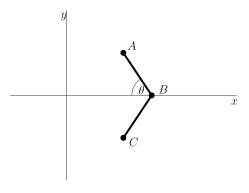
- At time \(t\), the angle between the \(x\)-axis and the string joining \(A\) and \(B\) is \(\theta\), as shown in the diagram, and \(B\) is at \((x,0)\). Write down the coordinates of \(A\) in terms of \(x,a\) and \(\theta\). Given that the velocity of \(B\) is \((v,0)\), show that the velocity of \(A\) is \((\dot x + a\sin\theta \,\dot \theta\,,\, a\cos\theta\, \dot\theta)\), where the dot denotes differentiation with respect to time.
- Show that, before particles \(A\) and \(C\) first collide, \[ 3\dot x + 2a \dot\theta \sin\theta =u \text{ and } \dot \theta^2 = \frac{u^2}{a^2(3-2\sin^2\theta)} \,. \]
- When \(A\) and \(C\) collide, the collision is elastic (no energy is lost). At what value of \(\theta\) does the second collision between particles \(A\) and \(C\) occur? (You should justify your answer.)
- When \(v=0\), what are the possible values of \(\theta\)? Is \(v =0\) whenever \(\theta\) takes these values?
Solution:
- \(A\) has coordinates \((x-a\cos \theta, a\sin \theta)\). Differentiating with respect to \(t\) the velocity of \(A\) is \((\dot{x}+a\sin \theta \cdot \dot{\theta}, a \cos \theta \cdot \dot{\theta})\)
- By considervation of momentum \(\rightarrow\) we must have \(mu = m(\dot{x}+a\dot{\theta}\sin \theta) + m\dot{x} + m(\dot{x}+a\dot{\theta}\sin \theta) = m(3\dot{x} + 2a \dot{\theta} \sin \theta)\) and the first equation follows. By conservation of energy, we must have \begin{align*} && \frac12 m u^2 &= \frac12 m \dot{x}^2 + \frac12m((\dot{x}+a\dot{\theta}\sin \theta)^2 + a^2 \dot{\theta}^2 \cos^2\theta ) + \frac12m((\dot{x}+a\dot{\theta}\sin \theta)^2 + a^2 \dot{\theta}^2 \cos^2\theta ) \\ &&&= \frac32m\dot{x}^2 + 2m a\dot{x}\dot{\theta}\sin \theta + ma^2\dot{\theta}^2(\sin^2\theta+\cos^2\theta) \\ \Rightarrow && u^2 &= \dot{x}(3\dot{x} + 4a \dot{\theta} \sin \theta) + 2a^2\dot{\theta}^2 \\ &&&= \left ( \frac{u-2a\dot{\theta}\sin \theta}{3}\right)\left ( 3\left ( \frac{u-2a\dot{\theta}\sin \theta}{3}\right)+ 4a \dot{x}\dot{\theta} \sin \theta \right) + 2a^2\dot{\theta}^2 \\ \Rightarrow && 3u^2 &= (u - 2a\dot{\theta} \sin \theta)^2 + 4a(u - 2 a \dot{\theta} \sin \theta) \dot{\theta}\sin \theta + 6a^2 \dot{\theta}^2 \\ &&&= u^2 + 4a^2\dot{\theta}^2 \sin^2 \theta - 8a^2\dot{\theta}^2\sin^2\theta + 6a^2 \dot{\theta}^2 \\ \Rightarrow && \dot{\theta}^2 &= \frac{u^2}{a^2(3-2\sin^2\theta)} \end{align*}
- Since \(\dot{\theta}^2 > 0\) \(\theta\) is strictly increasing or decreasing, therefore the first collision will be when \(\theta = 0\), the second when \(\theta = \pi\)
- If \(v = 0\), from our first equation we have \(2a \dot{\theta} \sin \theta = u \Rightarrow \dot{\theta}^2 = \frac{u^2}{4a^2 \sin^2 \theta} = \frac{u^2}{a^2(3-2\sin^2\theta)}\) so \(4\sin^2 \theta = 3 - 2\sin^2 \theta \Rightarrow \sin^2 \theta = \frac{1}{2}\) therefore the angles are all the multiples of \(\frac{\pi}{4}\).
2010 Paper 2 Q10
- In an experiment, a particle \(A\) of mass \(m\) is at rest on a smooth horizontal table. A particle \(B\) of mass \(bm\), where \(b >1\), is projected along the table directly towards \(A\) with speed \(u\). The collision is perfectly elastic. Find an expression for the speed of \(A\) after the collision in terms of \(b\) and \(u\), and show that, irrespective of the relative masses of the particles, \(A\) cannot be made to move at twice the initial speed of \(B\).
- In a second experiment, a particle \(B_1\) is projected along the table directly towards \(A\) with speed \(u\). This time, particles \(B_2\), \(B_3\), \(\ldots\,\), \(B_n\) are at rest in order on the line between \(B_1\) and \(A\). The mass of \(B_i\) (\(i=1\), \(2\), \(\ldots\,\), \(n\)) is \(\lambda^{n+1-i}m\), where \(\lambda>1\). All collisions are perfectly elastic. Show that, by choosing \(n\) sufficiently large, there is no upper limit on the speed at which \(A\) can be made to move. In the case \(\lambda=4\), determine the least value of \(n\) for which \(A\) moves at more than \(20u\). You may use the approximation \(\log_{10}2 \approx 0.30103\).
Solution:
- Since the collision is perfectly elastic, the speed of approach and separation are equal, ie \(v_B = v_A - u\) \begin{align*} \text{COM}: && bmu &= bm(v_A - u) + mv_A \\ \Rightarrow && (b+1)v_A &= 2bu \\ \Rightarrow && v_A &= \frac{2b}{b+1} u \end{align*} Since \(0 < \frac{b}{b+1} < 1\), the largest \(0 < v_A < 2u\)

- After the first collision with each \(B_i\) we will have \(\displaystyle v_{i+1} = \frac{2\lambda}{\lambda + 1}v_i\), ie \(\displaystyle v_{i+1} = \left (\frac{2\lambda}{\lambda + 1} \right)^i u\) and so \(\displaystyle v_A = \left (\frac{2\lambda}{\lambda + 1} \right)^n u\) which can be arbitrarily large. Suppose \(\lambda = 4\), then \begin{align*} && 20u &< v_A \\ &&&= \left (\frac{8}{5} \right)^n u \\ \Rightarrow && \log_{10} 20 < n \log_{10}(16/10) \\ && \log_{10} 2 + 1 < n 4\log_{10} 2 - n \\ \Rightarrow && n &> \frac{ \log_{10} 2 + 1}{ 4\log_{10} 2 - 1} \\ &&&\approx \frac{0.30103+1}{4 \times 0.30103 -1}\\ &&&= \frac{1.30103}{0.20412} \\ &&&>6 \end{align*} So \(n =7\) is the smallest possible
2006 Paper 3 Q9
A long, light, inextensible string passes through a small, smooth ring fixed at the point \(O\). One end of the string is attached to a particle \(P\) of mass \(m\) which hangs freely below \(O\). The other end is attached to a bead, \(B\), also of mass \(m\), which is threaded on a smooth rigid wire fixed in the same vertical plane as \(O\). The distance \(OB\) is \(r\), the distance \(OH\) is \(h\) and the height of the bead above the horizontal plane through~\(O\) is \(y\), as shown in the diagram.
2006 Paper 3 Q10
A disc rotates freely in a horizontal plane about a vertical axis through its centre. The moment of inertia of the disc about this axis is \(mk^2\) (where \(k>0\)). Along one diameter is a smooth narrow groove in which a particle of mass \(m\) slides freely. At time \(t=0\,\), the disc is rotating with angular speed \(\Omega\), and the particle is a distance \(a\) from the axis and is moving with speed~\(V\) along the groove, towards the axis, where \(k^2V^2 = \Omega^2a^2(k^2+a^2)\,\). Show that, at a later time \(t\), while the particle is still moving towards the axis, the angular speed \(\omega\) of the disc and the distance \(r\) of the particle from the axis are related by \[ \omega = \frac{\Omega(k^2+a^2)}{k^2+r^2} \text{ \ \ and \ \ } \left(\frac{\d r}{\d t}\right)^{\!2} = \frac{\Omega^2r^2(k^2+a^2)^2}{k^2(k^2+r^2)}\;. \] Deduce that \[ k\frac{\d r}{\d\theta} = -r(k^2+r^2)^{\frac12}\,, \] where \(\theta \) is the angle through which the disc has turned by time \(t\). By making the substitution \(u=k/r\), or otherwise, show that \(r\sinh (\theta+\alpha) = k\), where \(\sinh \alpha = k/a\,\). Deduce that the particle never reaches the axis.
2002 Paper 1 Q11
\(\,\)
2000 Paper 3 Q9
Two small discs of masses \(m\) and \(\mu m\) lie on a smooth horizontal surface. The disc of mass \(\mu m\) is at rest, and the disc of mass \(m\) is projected towards it with velocity \(\mathbf{u}\). After the collision, the disc of mass \(\mu m\) moves in the direction given by unit vector \(\mathbf{n}\). The collision is perfectly elastic.
- Show that the speed of the disc of mass \(\mu m\) after the collision is \ \ $ \dfrac {2\mathbf{u} \cdot \mathbf{n}}{1+\mu}. $
- Given that the two discs have equal kinetic energy after the collision, find an expression for the cosine of the angle between \(\bf n\) and \(\bf u\) and show that \(3-\sqrt8\le \mu \le 3+\sqrt8\).
Solution:
- In the direction of \(\mathbf{n}\), Conservation of momentum gives: \(m \mathbf{u} \cdot \mathbf{n} = m v_m + \mu m v_{\mu m}\) Newton's experimental law gives: \(\frac{\mathbf{u} \cdot \mathbf{n}}{v_{\mu m} - v_m} = 1\) Therefore \begin{align*} && \mathbf{u} \cdot \mathbf{n} &= v_m + \mu v_{\mu m} \\ && \mathbf{u} \cdot \mathbf{n} &= v_{\mu m} - v_m \\ \Rightarrow && 2 \mathbf{u} \cdot \mathbf{n} &= (1 + \mu)v_{\mu m} \\ \Rightarrow && v_{\mu m} &= \frac{2 \mathbf{u} \cdot \mathbf{n}}{1 + \mu} \\ \end{align*}
- Kinetic energy after the collision for the second mass is: \(\frac12 m \mu \frac{4 (\mathbf{u} \cdot \mathbf{n})^2 }{(1 + \mu)^2}\) For the first mass the final speed (in the direction \(\mathbf{n}\) is: \(\mathbf{u} \cdot \mathbf{n}- \frac{2 \mathbf{u} \cdot \mathbf{n}}{1 + \mu} = \frac{(\mu - 1) \mathbf{u} \cdot \mathbf{n}}{1 + \mu}\) It's velocity perpendicular to \(\mathbf{n}\) is unchanged, which is \(\mathbf{u} - (\mathbf{u} \cdot \mathbf{n}) \mathbf{n}\), so it's speed squared is \(\mathbf{u}\cdot \mathbf{u} - (\mathbf{u} \cdot \mathbf{n})^2\) Therefore the total kinetic energy is: \(\frac12 m \frac{(\mu - 1)^2 (\mathbf{u} \cdot \mathbf{n})^2}{(1 + \mu)} + \frac12 m (\mathbf{u}\cdot \mathbf{u} - (\mathbf{u} \cdot \mathbf{n})^2)\) Therefore since the kinetic energies are equal we have: \begin{align*} && \frac12 m \frac{(\mu - 1)^2 (\mathbf{u} \cdot \mathbf{n})^2}{(1 + \mu)} + \frac12 m (\mathbf{u}\cdot \mathbf{u} - (\mathbf{u} \cdot \mathbf{n})^2) &= \frac12 m \mu \frac{4 (\mathbf{u} \cdot \mathbf{n})^2 }{(1 + \mu)^2} \\ \Rightarrow && \frac{(\mu - 1)^2 (\mathbf{u} \cdot \mathbf{n})^2}{(1 + \mu)} + (\mathbf{u}\cdot \mathbf{u} - (\mathbf{u} \cdot \mathbf{n})^2) &= \mu \frac{4 (\mathbf{u} \cdot \mathbf{n})^2 }{(1 + \mu)^2} \\ \Rightarrow && (\mathbf{u} \cdot \mathbf{n})^2 \l 1 + \frac{4\mu}{(1+ \mu)^2} - \frac{(1-\mu)^2}{(1+ \mu)^2} \r &= (\mathbf{u} \cdot \mathbf{u}) \\ \Rightarrow && (\mathbf{u} \cdot \mathbf{n})^2 \l \frac{(1 + \mu)^2 + 4\mu - (1-\mu)^2}{(1+ \mu)^2} \r &= (\mathbf{u} \cdot \mathbf{u}) \\ \Rightarrow && (\mathbf{u} \cdot \mathbf{n})^2 \l \frac{8\mu}{(1+ \mu)^2} \r &= (\mathbf{u} \cdot \mathbf{u}) \\ \Rightarrow && \cos^2 \theta &=\frac{(1 + \mu)^2}{8\mu} \\ \end{align*} We need \begin{align*} && \frac{(1 + \mu)^2}{8\mu} & \leq 1 \\ \Rightarrow && 1 +2 \mu + \mu^2 \leq 8 \mu \\ \Rightarrow && 1 - 6 \mu + \mu^2 \leq 0 \end{align*} This quadratic has roots at \(3 \pm \sqrt{8}\) and therefore our quadratic inequality is satisfied if: \(\boxed{3 - \sqrt{8} \leq \mu \leq 3 + \sqrt{8}}\)
1990 Paper 2 Q14
The identical uniform smooth spherical marbles \(A_{1},A_{2},\ldots,A_{n},\) where \(n\geqslant3,\) each of mass \(m,\) lie in that order in a smooth straight trough, with each marble touching the next. The marble \(A_{n+1},\) which is similar to \(A_{n}\) but has mass \(\lambda m,\) is placed in the trough so that it touches \(A_{n}.\) Another marble \(A_{0},\) identical to \(A_{n},\) slides along the trough with speed \(u\) and hits \(A_{1}.\) It is given that kinetic energy is conserved throughout.
- Show that if \(\lambda<1,\) there is a possible subsequent motion in which only \(A_{n}\) and \(A_{n+1}\) move (and \(A_{0}\) is reduced to rest), but that if \(\lambda>1,\) such a motion is not possible.
- If \(\lambda>1,\) show that a subsequent motion in which only \(A_{n-1},A_{n}\) and \(A_{n+1}\) move is not possible.
- If \(\lambda>1,\) find a possible subsequent motion in which only two marbles move.
Solution: Without loss of generality, let \(m = u = 1\).
- \begin{align*} \text{COM}: && 1&= v_n + \lambda v_{n+1} \\ && &= v_n + \lambda v_{n+1}\\ \text{COE}: && \frac12 &= \frac12 v_n^2 + \frac12 \lambda v_{n+1}^2 \\ && 1 &= v_n^2 +\lambda v_{n+1}^2 \\ \\ \Rightarrow && v_n^2 + 2\lambda v_n v_{n+1} + \lambda^2 v_{n+1}^2 &= v_n^2 + \lambda v_{n+1}^2 \\ && \lambda v_{n+1}^2 &= v_{n+1}^2 - 2 v_n v_{n+1} \\ && \lambda v_{n+1} &= (v_{n+1} - 2v_n) \\ && (1-\lambda)v_{n+1} &= 2v_n \end{align*} Since \(v_{n+1} > v_n > 0\) this is only possible if \(\lambda < 1\)
- \begin{align*} \text{COM}: && 1&= v_{n-1}+v_n+\lambda v_{n+1} \\ && 1&= v_{n-1} + v_n + \lambda v_{n+1} \\ \text{COE}: && \frac12 &= \frac12 v_{n-1}^2+\frac12v_n^2+\frac12\lambda v_{n+1}^2 \\ && 1&= v_{n-1}^2 + v_n^2 + \lambda v_{n+1}^2 \\ \\ \Rightarrow && 1 &= v_{n-1}^2 + v_n^2 + \lambda \frac{(1-v_{n-1}-v_n)^2}{\lambda^2} \\ &&&= v_{n-1}^2 + v_n^2 + \frac{(1-v_{n-1}-v_n)^2}{\lambda} \\ \Rightarrow && 1 &< v_{n-1}^2 + v_n^2 + (1-v_{n-1}-v_n)^2 \\ &&&= 2v_{n-1}^2+2v_n^2 + 1-2v_{n-1}-2v_{n-2} +2v_{n-1}v_n\\ \Rightarrow && v_{n-1}+v_n & <(v_{n-1}+v_n)^2 - v_{n-1}v_n \end{align*} but this cannot be true since \(0 < v_{n-1}+v_n < 1\) and \(v_n v_{n-1} > 0\)
- The only way this is possible is if the first and last marble are moving. \begin{align*} \text{COM}: && 1 &= v_0 +\lambda v_{n+1} \\ \text{COE}: && \frac12 &= \frac12 v_0^2 + \frac12 \lambda^2 v_{n+1} \\ && 1 &= v_0^2 + \lambda v_{n+1}^2 \\ \Rightarrow && 2v_0 + \lambda v_{n+1} &= v_{n+1} \\ \Rightarrow && v_{n+1} &=\frac{2}{1-\lambda} v_0 \\ \Rightarrow && v_0 &= \frac{1-\lambda}{1+\lambda} \\ && v_{n+1} &= \frac{2}{1+\lambda} \end{align*} which will work since \(v_0\) can travel backwards.
1988 Paper 2 Q11
A heavy particle lies on a smooth horizontal table, and is attached to one end of a light inextensible string of length \(L\). The other end of the string is attached to a point \(P\) on the circumference of the base of a vertical post which is fixed into the table. The base of the post is a circle of radius \(a\) with its centre at a point \(O\) on the table. Initially, at time \(t=0\), the string is taut and perpendicular to the line \(OP.\) The particle is then struck in such a way that the string starts winding round the post and remains taut. At a later time \(t\), a length \(a\theta(t)\ (< L)\) of the string is in contact with the post. Using cartesian axes with origin \(O\), find the position and velocity vectors of the particle at time \(t\) in terms of \(a,L,\theta\) and \(\dot{\theta},\) and hence show that the speed of the particle is \((L-a\theta)\dot{\theta}.\) If the initial speed of the particle is \(v\), show that the particle hits the post at a time \(L^{2}/(2av).\)
Solution: