Problems
Filters
19 problems found
2024 Paper 2 Q10
A triangular prism lies on a horizontal plane. One of the rectangular faces of the prism is vertical; the second is horizontal and in contact with the plane; the third, oblique rectangular face makes an angle \(\alpha\) with the horizontal. The two triangular faces of the prism are right angled triangles and are vertical. The prism has mass \(M\) and it can move without friction across the plane. A particle of mass \(m\) lies on the oblique surface of the prism. The contact between the particle and the plane is rough, with coefficient of friction \(\mu\).
- Show that if \(\mu < \tan\alpha\), then the system cannot be in equilibrium.
- Show that the magnitude, \(F\), of the frictional force between the particle and the prism is \[ F = \frac{m}{M+m}\left|(M+m)g\sin\alpha - P\cos\alpha\right|. \] Find a similar expression for the magnitude, \(N\), of the normal reaction between the particle and the prism.
- Hence show that the force \(P\) must satisfy \[ (M+m)g\tan(\alpha - \lambda) \leqslant P \leqslant (M+m)g\tan(\alpha + \lambda). \]
2023 Paper 2 Q9
A truck of mass \(M\) is connected by a light, rigid tow-bar, which is parallel to the ground, to a trailer of mass \(kM\). A constant driving force \(D\) which is parallel to the ground acts on the truck, and the only resistance to motion is a frictional force acting on the trailer, with coefficient of friction \(\mu\).
- When the truck pulls the trailer up a slope which makes an angle \(\alpha\) to the horizontal, the acceleration is \(a_1\) and there is a tension \(T_1\) in the tow-bar.
- When the truck pulls the trailer on horizontal ground, the acceleration is \(a_2\) and there is a tension \(T_2\) in the tow-bar.
- When the truck pulls the trailer down a slope which makes an angle \(\alpha\) to the horizontal, the acceleration is \(a_3\) and there is a tension \(T_3\) in the tow-bar.
- Show that \(T_1 = T_3\) and that \(M(a_1 + a_3 - 2a_2) = 2(T_2 - T_1)\).
- It is given that \(\mu < 1\).
- Show that \[a_2 < \tfrac{1}{2}(a_1 + a_3) < a_3\,.\]
- Show further that \[a_1 < a_2\,.\]
2018 Paper 1 Q10
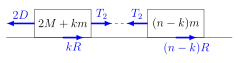
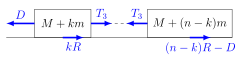
A train is made up of two engines, each of mass \(M\), and \(n\) carriages, each of mass \(m\). One of the engines is at the front of the train, and the other is coupled between the \(k\)th and \((k+1)\)th carriages. When the train is accelerating along a straight, horizontal track, the resistance to the motion of each carriage is \(R\) and the driving force on each engine is \(D\), where \(2D >nR\,\). The tension in the coupling between the engine at the front and the first carriage is \(T\).
- Show that \[ T = \frac{n(mD+MR)}{nm+2M}\,. \]
- Show that \(T\) is greater than the tension in any other coupling provided that \(k> \frac12n\,\).
- Show also that, if \(k> \frac12n\,\), then at least one of the couplings is in compression (that is, there is a negative tension in the coupling).
Solution:
- \(\,\)
\begin{align*} \text{N2}(\leftarrow, \text{first engine}): && D-T &= Ma \\ \text{N2}(\leftarrow, \text{rest of train}): && T-nR+D &= (M+nm)a \\ \Rightarrow && \frac{D-T}{M} &= \frac{T+D-nR}{M+nm} \\ \Rightarrow && T \left ( \frac{1}{M+nm}+\frac{1}{M} \right) &= \frac{D}{M} + \frac{nR-D}{M+nm} \\ \Rightarrow && T \left ( 2M+nm\right) &= DM +Dnm + nRM - DM \\ &&&= n(mD+MR) \\ \Rightarrow && T &= \frac{n(mD+MR)}{2M+nm} \end{align*}
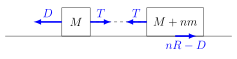
- The greatest coupling must occur behind an engine, because each carriage behind an engine acts as a drag.
Therefore we need only consider the couple between the second engine and the rest of the carriages:
\begin{align*} \text{N2}(\leftarrow, \text{up to second engine}): && 2D - T_2 - kR &= (2M+km)a \\ \text{N2}(\leftarrow, \text{everything else}): && T_2 - (n-k)R &= (n-k)ma \\ \Rightarrow && \frac{2D-T_2-kR}{2M+km} &= \frac{T_2-(n-k)R}{(n-k)m} \\ \Rightarrow && T_2 \left (\frac{1}{(n-k)m} + \frac{1}{2M+km} \right) &= \frac{2D-kR}{2M+km} + \frac{R}{m} \\ \Rightarrow && T_2 \left (2M+ nm \right) &= (2D-kR)m(n-k) + R(2M+km)(n-k) \\ \Rightarrow && T_2 &= \frac{(n-k)\left (2Dm+2RM \right)}{2M+nm} \\ &&&= \frac{2(n-k)(mD + MR)}{2M+nm} \end{align*} Therefore \(T > T_2\) provided \(2(n-k) < n \Leftrightarrow k > \frac12n\)
- If there is a coupling which is in negative tension, it must be between the two engines. In particular, if there is one, there must be one directly in front of the first engine.
\begin{align*} \text{N2}(\leftarrow, \text{before second engine}): && D - T_3 - kR &= (M+km)a \\ \text{N2}(\leftarrow, \text{everything else}): && T_3 +D- (n-k)R &= (M+(n-k)m)a \\ \Rightarrow && \frac{D-T_3-kR}{M+km} &= \frac{T_3+D-(n-k)R}{M+(n-k)m} \\ \Rightarrow && T_3 \left ( \frac{1}{M+(n-k)m} + \frac{1}{M+km} \right) &= \frac{D-(n-k)R}{M+(n-k)m}+\frac{kR-D}{M+km} \\ \Rightarrow && T_3 (2M+nm) &= (D-(n-k)R)(M+km)+(kR-D)(M+(n-k)m) \\ &&&= D(M+km-M-(n-k)m) + R(kM+k(n-k)m-(n-k)M-k(n-k)m) \\ &&&= D(n-2k)m+RM(2k-n)m \\ &&&= (n-2k)m(D-RM) \end{align*} Therefore \(T_3\) is negative if \(k > \frac12n\) so there are some connections in compression.
2017 Paper 3 Q9
Two particles \(A\) and \(B\) of masses \(m\) and \(2 m\), respectively, are connected by a light spring of natural length \(a\) and modulus of elasticity \(\lambda\). They are placed on a smooth horizontal table with \(AB\) perpendicular to the edge of the table, and \(A\) is held on the edge of the table. Initially the spring is at its natural length. Particle \(A\) is released. At a time \(t\) later, particle \(A\) has dropped a distance \(y\) and particle \( B\) has moved a distance \(x\) from its initial position (where \(x < a\)). Show that \( y + 2x= \frac12 gt^2\). The value of \(\lambda\) is such that particle \(B\) reaches the edge of the table at a time \(T\) given by \(T= \sqrt{6a/g\,}\,\). By considering the total energy of the system (without solving any differential equations), show that the speed of particle \(B\) at this time is \(\sqrt{2ag/3\,}\,\).
Solution: \begin{align*} \text{N2}(\downarrow): && mg -T &= m\ddot{y} \\ \text{N2}(\rightarrow): && T &= 2m\ddot{x} \\ \Rightarrow && g &= \ddot{y}+2\ddot{x} \\ \Rightarrow && \tfrac12gt^2 &= y + 2x \end{align*} At time \(T = \sqrt{6a/g}\), we have \(y + 2x = 3a\), note also that \(\dot{y}+2\dot{x} = gt\) \begin{array}{ccc} & \text{KE} & \text{GPE} & \text{EPE} \\ \text{Initial} & 0 & 0 & 0 \\ \text{Final} & \frac12m\dot{y}^2 + \frac12(2m)\dot{x}^2 & -mgy & \frac{\lambda (y-x)^2}{2a} \end{array} Also note when we head over the table, \(x = a\) and \(y = a\) \begin{align*} \text{COE}: && 0 &= \frac12m(gT-2\dot{x})^2+m\dot{x}^2-mga+\frac{\lambda(0)^2}{2a} \\ \Rightarrow && 0 &= (gT-2\dot{x})^2+2\dot{x}^2-2ga \\ &&&= (\sqrt{6ag}-2\dot{x})^2+2\dot{x}^2-2ga \\ &&&= 6\dot{x}^2-4\sqrt{6ag}+4ag \\ \Rightarrow &&&= (\sqrt{6}\dot{x} - 2\sqrt{ag})^2 \\ \Rightarrow && \dot{x} &= \sqrt{2ag/3} \end{align*} as required.
2015 Paper 2 Q10
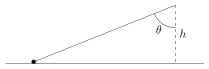
A particle of mass \(m\) is pulled along the floor of a room in a straight line by a light string which is pulled at constant speed \(V\) through a hole in the ceiling. The floor is smooth and horizontal, and the height of the room is \(h\). Find, in terms of \(V\) and \(\theta\), the speed of the particle when the string makes an angle of \(\theta\) with the vertical (and the particle is still in contact with the floor). Find also the acceleration, in terms of \(V\), \(h\) and \(\theta\). Find the tension in the string and hence show that the particle will leave the floor when \[ \tan^4\theta = \frac{V^2}{gh}\,. \]
Solution:
2012 Paper 1 Q11
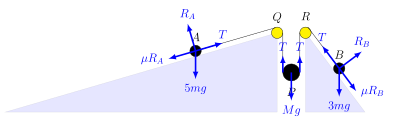
The diagram shows two particles, \(A\) of mass \(5m\) and \(B\) of mass \(3m\), connected by a light inextensible string which passes over two smooth, light, fixed pulleys, \(Q\) and \(R\), and under a smooth pulley \(P\) which has mass \(M\) and is free to move vertically. Particles \(A\) and \(B\) lie on fixed rough planes inclined to the horizontal at angles of \(\arctan \frac 7{24}\) and \(\arctan\frac43\) respectively. The segments \(AQ\) and \(RB\) of the string are parallel to their respective planes, and segments \(QP\) and \(PR\) are vertical. The coefficient of friction between each particle and its plane is \(\mu\).

- Given that the system is in equilibrium, with both \(A\) and \(B\) on the point of moving up their planes, determine the value of \(\mu\) and show that \(M = 6m\).
- In the case when \(M = 9m\), determine the initial accelerations of \(A\), \(B\) and \(P\) in terms of \(g\).
Solution:
2011 Paper 2 Q10
A particle is projected from a point on a horizontal plane, at speed \(u\) and at an angle~\(\theta\) above the horizontal. Let \(H\) be the maximum height of the particle above the plane. Derive an expression for \(H\) in terms of \(u\), \(g\) and \(\theta\). A particle \(P\) is projected from a point \(O\) on a smooth horizontal plane, at speed \(u\) and at an angle~\(\theta\) above the horizontal. At the same instant, a second particle \(R\) is projected horizontally from \(O\) in such a way that \(R\) is vertically below \(P\) in the ensuing motion. A light inextensible string of length \(\frac12 H\) connects \(P\) and \(R\). Show that the time that elapses before the string becomes taut is \[ (\sqrt2 -1)\sqrt{H/g\,}\,. \] When the string becomes taut, \(R\) leaves the plane, the string remaining taut. Given that \(P\) and \(R\) have equal masses, determine the total horizontal distance, \(D\), travelled by \(R\) from the moment its motion begins to the moment it lands on the plane again, giving your answer in terms of \(u\), \(g\) and \(\theta\). Given that \(D=H\), find the value of \(\tan\theta\).
2010 Paper 3 Q9
\(\,\)
2009 Paper 1 Q10
A triangular wedge is fixed to a horizontal surface. The base angles of the wedge are \(\alpha\) and \(\frac\pi 2-\alpha\). Two particles, of masses \(M\) and \(m\), lie on different faces of the wedge, and are connected by a light inextensible string which passes over a smooth pulley at the apex of the wedge, as shown in the diagram. The contacts between the particles and the wedge are smooth.
- Show that if \(\tan \alpha> \dfrac m M \) the particle of mass \(M\) will slide down the face of the wedge.
- Given that \(\tan \alpha = \dfrac{2m}M\), show that the magnitude of the acceleration of the particles is \[ \frac{g\sin\alpha}{\tan\alpha +2} \] and that this is maximised at \(4m^3=M^3\,\).
2006 Paper 1 Q9
A block of mass \(4\,\)kg is at rest on a smooth, horizontal table. A smooth pulley \(P\) is fixed to one edge of the table and a smooth pulley \(Q\) is fixed to the opposite edge. The two pulleys and the block lie in a straight line. Two horizontal strings are attached to the block. One string runs over pulley \(P\); a particle of mass \(x\,\)kg hangs at the end of this string. The other string runs over pulley \(Q\); a particle of mass \(y\,\)kg hangs at the end of this string, where \(x > y\) and \(x + y = 6\,\). The system is released from rest with the strings taut. When the \(4\,\)kg block has moved a distance \(d\), the string connecting it to the particle of mass \(x\,\)kg is cut. Show that the time taken by the block from the start of the motion until it first returns to rest (assuming that it does not reach the edge of the table) is \(\sqrt{d/(5g)\,} \,\f(y)\), where \[ \f(y)= \frac{10}{ \sqrt{6-2y}}+ \left(1 + \frac{4}{ y} \right) \sqrt {6 -2y}. \] Calculate the value of \(y\) for which \(\f'(y)=0\).
2006 Paper 3 Q11
A lift of mass \(M\) and its counterweight of mass \(M\) are connected by a light inextensible cable which passes over a fixed frictionless pulley. The lift is constrained to move vertically between smooth guides. The distance between the floor and the ceiling of the lift is \(h\). Initially, the lift is at rest, and the distance between the top of the lift and the pulley is greater than \(h\). A small tile of mass \(m\) becomes detached from the ceiling of the lift and falls to the floor of the lift. Show that the speed of the tile just before the impact is \[ \sqrt{\frac{(2M-m)gh \;}{M}}\;. \] The coefficient of restitution between the tile and the floor of the lift is \(e\). Given that the magnitude of the impulsive force on the lift due to tension in the cable is equal to the magnitude of the impulsive force on the counterweight due to tension in the cable, show that the loss of energy of the system due to the impact is \(mgh(1-e^2)\). Comment on this result.
2005 Paper 2 Q9
Two particles, \(A\) and \(B\), of masses \(m\) and \(2m\), respectively, are placed on a line of greatest slope, \(\ell\), of a rough inclined plane which makes an angle of \(30^{\circ}\) with the horizontal. The coefficient of friction between \(A\) and the plane is \(\frac16\sqrt{3}\) and the coefficient of friction between \(B\) and the plane is \(\frac13 \sqrt{3}\). The particles are at rest with \(B\) higher up \(\ell\) than \(A\) and are connected by a light inextensible string which is taut. A force \(P\) is applied to \(B\).
- Show that the least magnitude of \(P\) for which the two particles move upwards along \(\ell\) is \(\frac{11}8 \sqrt{3}\, mg\) and give, in this case, the direction in which \(P\) acts.
- Find the least magnitude of \(P\) for which the particles do not slip downwards along~\(\ell\).
1998 Paper 1 Q11
Hank's Gold Mine has a very long vertical shaft of height \(l\). A light chain of length \(l\) passes over a small smooth light fixed pulley at the top of the shaft. To one end of the chain is attached a bucket \(A\) of negligible mass and to the other a bucket \(B\) of mass \(m\). The system is used to raise ore from the mine as follows. When bucket \(A\) is at the top it is filled with mass \(2m\) of water and bucket \(B\) is filled with mass \(\lambda m\) of ore, where \(0<\lambda<1\). The buckets are then released, so that bucket \(A\) descends and bucket \(B\) ascends. When bucket \(B\) reaches the top both buckets are emptied and released, so that bucket \(B\) descends and bucket \(A\) ascends. The time to fill and empty the buckets is negligible. Find the time taken from the moment bucket \(A\) is released at the top until the first time it reaches the top again. This process goes on for a very long time. Show that, if the greatest amount of ore is to be raised in that time, then \(\lambda\) must satisfy the condition \(\mathrm{f}'(\lambda)=0\) where \[\mathrm{f}(\lambda)=\frac{\lambda(1-\lambda)^{1/2}} {(1-\lambda)^{1/2}+(3+\lambda)^{1/2}}.\]
1992 Paper 1 Q10
A projectile of mass \(m\) is fired horizontally from a toy cannon of mass \(M\) which slides freely on a horizontal floor. The length of the barrel is \(l\) and the force exerted on the projectile has the constant value \(P\) for so long as the projectile remains in the barrel. Initially the cannon is at rest. Show that the projectile emerges from the barrel at a speed relative to the ground of \[ \sqrt{\frac{2PMl}{m(M+m)}}. \]
1992 Paper 2 Q13
Two particles \(P_{1}\) and \(P_{2}\), each of mass \(m\), are joined by a light smooth inextensible string of length \(\ell.\) \(P_{1}\) lies on a table top a distance \(d\) from the edge, and \(P_{2}\) hangs over the edge of the table and is suspended a distance \(b\) above the ground. The coefficient of friction between \(P_{1}\) and the table top is \(\mu,\) and \(\mu<1\). The system is released from rest. Show that \(P_{1}\) will fall off the edge of the table if and only if \[ \mu<\frac{b}{2d-b}. \] Suppose that \(\mu>b/(2d-b)\) , so that \(P_{1}\) comes to rest on the table, and that the coefficient of restitution between \(P_{2}\) and the floor is \(e\). Show that, if \(e>1/(2\mu),\) then \(P_{1}\) comes to rest before \(P_{2}\) bounces a second time.