Problems
Filters
11 problems found
2024 Paper 2 Q4
In this question, if \(O\), \(C\) and \(D\) are non-collinear points in three dimensional space, we will call the non-zero vector \(\mathbf{v}\) a \emph{bisecting vector} for angle \(COD\) if \(\mathbf{v}\) lies in the plane \(COD\), the angle between \(\mathbf{v}\) and \(\overrightarrow{OC}\) is equal to the angle between \(\mathbf{v}\) and \(\overrightarrow{OD}\), and both angles are less than \(90^\circ\).
- Let \(O\), \(X\) and \(Y\) be non-collinear points in three-dimensional space, and define \(\mathbf{x} = \overrightarrow{OX}\) and \(\mathbf{y} = \overrightarrow{OY}\).
Let \(\mathbf{b} = |\mathbf{x}|\mathbf{y} + |\mathbf{y}|\mathbf{x}\).
- Show that \(\mathbf{b}\) is a bisecting vector for angle \(XOY\). Explain, using a diagram, why any other bisecting vector for angle \(XOY\) is a positive multiple of \(\mathbf{b}\).
- Find the value of \(\lambda\) such that the point \(B\), defined by \(\overrightarrow{OB} = \lambda\mathbf{b}\), lies on the line \(XY\). Find also the ratio in which the point \(B\) divides \(XY\).
- Show, in the case when \(OB\) is perpendicular to \(XY\), that the triangle \(XOY\) is isosceles.
- Let \(O\), \(P\), \(Q\) and \(R\) be points in three-dimensional space, no three of which are collinear. A bisecting vector is chosen for each of the angles \(POQ\), \(QOR\) and \(ROP\). Show that the three angles between them are either all acute, all obtuse or all right angles.
2018 Paper 3 Q6
- The distinct points \(A\), \(Q\) and \(C\) lie on a straight line in the Argand diagram, and represent the distinct complex numbers \(a\), \(q\) and \(c\), respectively. Show that \(\dfrac {q-a}{c-a}\) is real and hence that \((c-a)(q^*-a^*) = (c^*-a^*)(q-a)\,\). Given that \(aa^* = cc^* = 1\), show further that \[ q+ ac q^* = a+c \,. \]
- The distinct points \(A\), \(B\), \(C\) and \(D\) lie, in anticlockwise order, on the circle of unit radius with centre at the origin (so that, for example, \(aa^* =1\)). The lines \(AC\) and \(BD\) meet at \(Q\). Show that \[ (ac-bd)q^* = (a+c)-(b+d) \,, \] where \(b\) and \(d\) are complex numbers represented by the points \(B\) and \(D\) respectively, and show further that \[ (ac-bd) (q+q^*) = (a-b)(1+cd) +(c-d)(1+ab) \,. \]
- The lines \(AB\) and \(CD\) meet at \(P\), which represents the complex number \(p\). Given that \(p\) is real, show that \(p(1+ab)=a+b\,\). Given further that \(ac-bd \ne 0\,\), show that \[ p(q+q^*) = 2 \,. \]
Solution:
- \(A\), \(Q\), \(C\) lie on a straight line if \(q = \lambda a + (1-\lambda)c\) for some \(\lambda \in \mathbb{R}\), \begin{align*} && q &= \lambda a + (1-\lambda)c \\ \Leftrightarrow && q - a &= (\lambda - 1)a + (1-\lambda)c \\ \Leftrightarrow && q - a &= (\lambda - 1)(a-c) \\ \Leftrightarrow && \frac{q - a}{c-a} &= 1-\lambda \\ \end{align*} therefore \(\frac{q-a}{c-a} \in \mathbb{R}\) \begin{align*} && \frac{q-a}{c-a} & \in \mathbb{R} \\ \Leftrightarrow && \left (\frac{q-a}{c-a} \right)^* &= \frac{q-a}{c-a} \\ \Leftrightarrow && (q^*-a^*)(c-a) &= (q-a)(c^*-a^*) \\ \end{align*} Given \(aa^* = cc^* = 1\), \begin{align*} && (q^*-a^*)(c-a) &= (q-a)(c^*-a^*) \\ \Leftrightarrow && q^*(c-a) - \frac{c}{a}+1 &= q \frac{a-c}{ca} - \frac{a}{c}+1 \\ \Leftrightarrow && (c-a)\l q^* +\frac{q}{ca}\r &= \frac{c}{a} - \frac{a}{c} \\ &&&= \frac{c^2-a^2}{ac} \\ \Leftrightarrow && q^* +\frac{q}{ca} &= \frac{c+a}{ac} \\ \Leftrightarrow && q^*ac +q &= a+c \end{align*}
- Since \(Q\) lies on \(AC\) and \(BD\) we must have \begin{align*} &&& \begin{cases} q^*ac +q &= a+c \\ q^*bd +q &= b+d \\ \end{cases} \\ \Rightarrow && q^*(ac-bd) &= (a+c)-(b+d) \\ \Rightarrow && q(ac-bd) &= (b+d)ac-(a+c)bd \\ \Rightarrow && (q+q^*)(ac-bd) &= (a+c)(1-bd)+(b+d)(ac-1) \\ &&&=a-abd+c-bcd+abc-b+acd-d \\ &&&= a(1+cd)-b(1+cd)+c(1+ab)-d(1+ab) \\ &&&= (a-b)(1+cd)+(c-d)(1+ab) \end{align*}
- If \(AB\) and \(CD\) meet at \(p\) we must have \(p^*ab + p = a+b\), ie \(p(1+ab) = a+b\) amd \(p(1+cd) = c+d\), so \begin{align*} && (q+q^*)(ac-bd) &= (a-b) \frac{c+d}{p} + (c-d) \frac{a+b}{p} \\ \Leftrightarrow && p(q+q^*)(ac-bd) &= (a-b)(c+d)+(c-d)(a+b) \\ &&&= ac+ad-bc-bd+ac+bc-ad-bd \\ &&&= 2(ac-bd) \\ \Leftrightarrow && p(q+q^*) &= 2 \end{align*}
2016 Paper 1 Q6
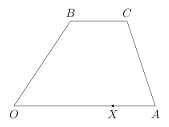
The sides \(OA\) and \(CB\) of the quadrilateral \(OABC\) are parallel. The point \(X\) lies on \(OA\), between \(O\) and \(A\). The position vectors of \(A\), \(B\), \(C\) and \(X\) relative to the origin \(O\) are \(\bf a\), \(\bf b\), \(\bf c\) and \(\bf x\), respectively. Explain why \(\bf c\) and \(\bf x\) can be written in the form \[ {\bf c} = k {\bf a} + {\bf b} \text{ and } {\bf x} = m {\bf a}\,, \] where \(k\) and \(m\) are scalars, and state the range of values that each of \(k\) and \(m\) can take. The lines \(OB\) and \(AC\) intersect at \(D\), the lines \(XD\) and \(BC\) intersect at \(Y\) and the lines \(OY\) and \(AB\) intersect at \(Z\). Show that the position vector of \(Z\) relative to \(O\) can be written as \[ \frac{ {\bf b} + mk {\bf a}}{mk+1}\,. \] The lines \(DZ\) and \(OA\) intersect at \(T\). Show that \[ OT \times OA = OX\times TA \text{ and } \frac 1 {OT} = \frac 1 {OX} + \frac 1 {OA} \,, \] where, for example, \(OT\) denotes the length of the line joining \(O\) and \(T\).
Solution:
2015 Paper 2 Q8
\noindent
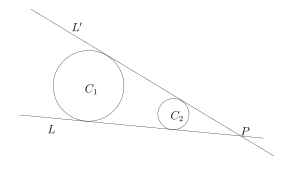
- Let \(\mathbf{x}_1\) and \(\mathbf{x}_2\) be the position vectors of the centres of \(C_1\) and \(C_2\), respectively. Show that the position vector of \(P\) is \[ \frac{r_1 \mathbf{x}_2- r_2 \mathbf{x}_1}{r_1-r_2} \,, \] where \(r_1\) and \(r_2\) are the radii of \(C_1\) and \(C_2\), respectively.
- The circle \(C_3\) does not overlap either \(C_1\) or \(C_2\) and its radius, \(r_3\), satisfies \(r_1 \ne r_3 \ne r_2\). The focus of \(C_1\) and \(C_3\) is \(Q\), and the focus of \(C_2\) and \(C_3\) is \(R\). Show that \(P\), \(Q\) and \(R\) lie on the same straight line.
- Find a condition on \(r_1\), \(r_2\) and \(r_3\) for \(Q\) to lie half-way between \(P\) and \(R\).
Solution:
- Notice that \(P\) lies on \(C_1C_2\), and that the triangles formed from \(C_iPT_i\) where \(T_i\) are the tangent points are similar, with ratios \(\frac{r_1}{r_2}\). Therefore \(\frac{C_1P}{r_1} = \frac{C_2P}{r_2}\), and hence \(\frac{C_1P}{C_1C_2} = \frac{C_1P}{C_1P-C_2P} = \frac{1}{1-\frac{r_2}{r_1}} = \frac{r_1}{r_1-r_2}\) So we have \(\mathbf{p} = \mathbf{x_1} + (\mathbf{x}_2 - \mathbf{x}_1)\cdot\frac{r_1}{r_1-r_2} = \frac{r_1\mathbf{x}_2 - r_2\mathbf{x}_1}{r_1-r_2}\)
- Suppose \(\mathbf{x}_3 = \binom{\alpha}{\beta}\) in the basis of \(\{ \mathbf{x}_1, \mathbf{x}_2 \}\), then we can see that \begin{align*} && \mathbf{p} &= \frac{1}{r_1-r_2}\binom{-r_2}{r_1} \\ && \mathbf{q} &= \frac{r_1(\alpha \mathbf{x}_1 +\beta \mathbf{x}_2) - r_3\mathbf{x}_1}{r_1-r_3} \\ &&&= \frac{1}{r_1-r_3} \binom{r_1\alpha -r_3}{r_1\beta} \\ && \mathbf{r} &=\frac{1}{r_2-r_3} \binom{r_2\alpha}{r_2\beta - r_3} \\ && \mathbf{p}-\mathbf{q} &= \frac{1}{r_1-r_2}\binom{-r_2}{r_1} - \frac{1}{r_1-r_3} \binom{r_1\alpha -r_3}{r_1\beta} \\ &&&= \frac{1}{(r_1-r_2)(r_1-r_3)} \binom{(r_1-r_3)(-r_2)-(r_1-r_2)(r_1\alpha-r_3)}{(r_1-r_3)r_1 - (r_1-r_2)r_1\beta} \\ &&&= \frac{r_1}{(r_1-r_2)(r_1-r_3)} \binom{(r_3-r_2)-\alpha(r_1-r_2)}{(r_1-r_3)-\beta(r_1-r_2)} \\ && \mathbf{q} - \mathbf{r} &= \frac{1}{r_1-r_3} \binom{r_1\alpha -r_3}{r_1\beta} - \frac{1}{r_2-r_3} \binom{r_2\alpha}{r_2\beta - r_3} \\ &&&= \frac{1}{(r_1-r_3)(r_2-r_3)}\binom{(r_2-r_3)(r_1\alpha-r_3) - (r_1-r_3)r_2\alpha)}{(r_2-r_3)r_1\beta - (r_1-r_3)(r_2\beta - r_3)} \\ &&&= \frac{1}{(r_1-r_3)(r_2-r_3)}\binom{(-r_2r_3+r_3^2) - \alpha(r_1r_3-r_3r_2)}{r_3(r_1-r_3)-\beta(r_1-r_2)} \\ &&&= \frac{r_3}{(r_1-r_3)(r_2-r_3)}\binom{(r_3-r_2)-\alpha(r_1-r_2)}{(r_1-r_3)-\beta(r_1-r_2)} \end{align*} Therefore they are clearly parallel, and hence lie on a line.
- \(Q\) is halfway between \(P\) and \(R\) if \begin{align*} && \frac{r_1}{(r_1-r_2)(r_1-r_3)} &= \frac{r_3}{(r_1-r_3)(r_2-r_3)} \\ \Leftrightarrow && r_1(r_2-r_3) &= r_3(r_1-r_2) \\ \Leftrightarrow && r_1r_2 - r_1r_3 &= r_1r_3 - r_2r_3 \\ \Leftrightarrow && r_2 &= \frac{2r_1r_3}{r_1+r_3} \end{align*}
2011 Paper 2 Q5
The points \(A\) and \(B\) have position vectors \(\bf a \) and \(\bf b\) with respect to an origin \(O\), and \(O\), \(A\)~and~\(B\) are non-collinear. The point \(C\), with position vector \(\bf c\), is the reflection of \(B\) in the line through \(O\) and \(A\). Show that \(\bf c\) can be written in the form \[ \bf c = \lambda \bf a -\bf b \] where \(\displaystyle \lambda = \frac{2\,{\bf a .b}}{{\bf a.a}}\). The point \(D\), with position vector \(\bf d\), is the reflection of \(C\) in the line through \(O\) and \(B\). Show that \(\bf d\) can be written in the form \[ \bf d = \mu\bf b - \lambda \bf a \] for some scalar \(\mu\) to be determined. Given that \(A\), \(B\) and \(D\) are collinear, find the relationship between \(\lambda\) and \(\mu\). In the case \(\lambda = -\frac12\), determine the cosine of \(\angle AOB\) and describe the relative positions of \(A\), \(B\) and \(D\).
2010 Paper 1 Q7
Relative to a fixed origin \(O\), the points \(A\) and \(B\) have position vectors \(\bf{a}\) and \(\bf{b}\), respectively. (The points \(O\), \(A\) and \(B\) are not collinear.) The point \(C\) has position vector \(\bf c\) given by \[ {\bf c} =\alpha {\bf a}+ \beta {\bf b}\,, \] where \(\alpha\) and \(\beta\) are positive constants with \(\alpha+\beta<1\,\). The lines \(OA\) and \(BC\) meet at the point \(P\) with position vector \(\bf p\) and the lines \(OB\) and \(AC\) meet at the point \(Q\) with position vector \(\bf q\). Show that \[ {\bf p} =\frac{\alpha {\bf a} }{1-\beta}\,, \] and write down \(\bf q\) in terms of \(\alpha,\ \beta\) and \(\bf {b}\). Show further that the point \(R\) with position vector \(\bf r\) given by \[ {\bf r} =\frac{\alpha {\bf a} + \beta {\bf b}}{\alpha + \beta}\,, \] lies on the lines \(OC\) and \(AB\). The lines \(OB\) and \(PR\) intersect at the point \(S\). Prove that $ \dfrac{OQ}{BQ} = \dfrac{OS}{BS}\,$.
2010 Paper 3 Q5
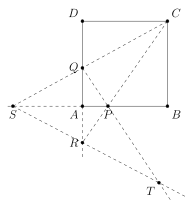
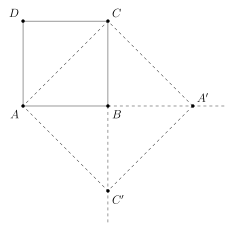
The vertices \(A\), \(B\), \(C\) and \(D\) of a square have coordinates \((0,0)\), \((a,0)\), \((a,a)\) and \((0,a)\), respectively. The points \(P\) and \(Q\) have coordinates \((an,0)\) and \((0,am)\) respectively, where \(0 < m < n < 1\). The line \(CP\) produced meets \(DA\) produced at \(R\) and the line \(CQ\) produced meets \(BA\) produced at \(S\). The line \(PQ\) produced meets the line \(RS\) produced at \(T\). Show that \(TA\) is perpendicular to \(AC\). Explain how, given a square of area \(a^2\), a square of area \(2a^2\) may be constructed using only a straight-edge. [Note: a straight-edge is a ruler with no markings on it; no measurements (and no use of compasses) are allowed in the construction.]
Solution:
2009 Paper 2 Q8
The non-collinear points \(A\), \(B\) and \(C\) have position vectors \(\bf a\), \(\bf b\) and \(\bf c\), respectively. The points \(P\) and \(Q\) have position vectors \(\bf p\) and \(\bf q\), respectively, given by \[ {\bf p}= \lambda {\bf a} +(1-\lambda){\bf b} \text{ \ \ \ and \ \ \ } {\bf q}= \mu {\bf a} +(1-\mu){\bf c} \] where \(0<\lambda<1\) and \(\mu>1\). Draw a diagram showing \(A\), \(B\), \(C\), \(P\) and \(Q\). Given that \(CQ\times BP = AB\times AC\), find \(\mu\) in terms of \(\lambda\), and show that, for all values of \(\lambda\), the the line \(PQ\) passes through the fixed point \(D\), with position vector \({\bf d}\) given by \({\bf d= -a +b +c}\,\). What can be said about the quadrilateral \(ABDC\)?
2007 Paper 2 Q8
The points \(B\) and \(C\) have position vectors \(\mathbf{b}\) and \(\mathbf{c}\), respectively, relative to the origin \(A\), and \(A\), \(B\) and \(C\) are not collinear.
- The point \(X\) has position vector \(s \mathbf{b}+t\mathbf{c}\). Describe the locus of \(X\) when \(s+t=1\).
- The point \(P\) has position vector \(\beta \mathbf{b}+\gamma\mathbf{c}\), where \(\beta\) and \(\gamma\) are non-zero, and \(\beta+\gamma\ne1\). The line \(AP\) cuts the line \(BC\) at \(D\). Show that \(BD:DC=\gamma:\beta\).
- The line \(BP\) cuts the line \(CA\) at \(E\), and the line \(CP\) cuts the line \(AB\) at \(F\). Show that \[ \frac{AF}{FB} \times \frac{BD}{DC} \times \frac{CE}{EA}=1\,. \]
Solution:
- \(X\) lies on the line including \(B\) and \(C\).
- points on the line \(AP\) have the form \(\lambda(\beta \mathbf{b}+\gamma\mathbf{c})\), and the point \(D\) will be the point where \(\lambda\beta + \lambda \gamma = 1\). \begin{align*} && \frac{|BD|}{|DC|} &= \frac{|\mathbf{b} -\lambda(\beta \mathbf{b}+\gamma\mathbf{c})| }{|\lambda(\beta \mathbf{b}+\gamma\mathbf{c})- \mathbf{c}|} \\ &&&= \frac{|(1-\lambda \beta)\mathbf{b} - \lambda \gamma \mathbf{c}|}{|\lambda \beta \mathbf{b}+(\lambda \gamma -1)\mathbf{c}|}\\ &&&= \frac{|\lambda \gamma\mathbf{b} - \lambda \gamma \mathbf{c}|}{|\lambda \beta \mathbf{b}-(\lambda \beta)\mathbf{c}|} \\ &&&= \frac{\gamma}{\beta} \end{align*}
- The line \(BP\) is \(\mathbf{b} + \mu(\beta \mathbf{b}+\gamma\mathbf{c})\) and will meet \(CA\) when \(1+\mu\beta = 0\), ie \(\mu = -\frac{1}{\beta}\), therefore \(E\) is \(-\frac{\gamma}{\beta}\mathbf{c}\), and so \(\frac{|CE|}{|EA|} = \frac{1+\gamma/\beta}{\gamma/\beta} = \frac{\beta+\gamma}{\gamma}\). Similarly, \(F\) is \(-\frac{\beta}{\gamma}\mathbf{b}\) and \(\frac{|AF|}{|FB|} = \frac{\beta/\gamma}{1+\frac{\beta}{\gamma}} = \frac{\beta}{\gamma+\beta}\), and so \[\frac{AF}{FB} \times \frac{BD}{DC} \times \frac{CE}{EA} = \frac{\beta}{\gamma+\beta} \frac{\gamma}{\beta} \frac{\beta+\gamma}{\gamma} = 1 \]
1994 Paper 2 Q7
Show that the equation \[ ax^{2}+ay^{2}+2gx+2fy+c=0 \] where \(a>0\) and \(f^{2}+g^{2}>ac\) represents a circle in Cartesian coordinates and find its centre. The smooth and level parade ground of the First Ruritanian Infantry Division is ornamented by two tall vertical flagpoles of heights \(h_{1}\) and \(h_{2}\) a distance \(d\) apart. As part of an initiative test a soldier has to march in such a way that he keeps the angles of elevation of the tops of the two flagpoles equal to one another. Show that if the two flagpoles are of different heights he will march in a circle. What happens if the two flagpoles have the same height? To celebrate the King's birthday a third flagpole is added. Soldiers are then assigned to each of the three different pairs of flagpoles and are told to march in such a way that they always keep the tops of their two assigned flagpoles at equal angles of elevation to one another. Show that, if the three flagpoles have different heights \(h_{1},h_{2}\) and \(h_{3}\) and the circles in which the soldiers march have centres of \((x_{ij},y_{ij})\) (for the flagpoles of height \(h_{i}\) and \(h_{j}\)) relative to Cartesian coordinates fixed in the parade ground, then the \(x_{ij}\) satisfy \[ h_{3}^{2}\left(h_{1}^{2}-h_{2}^{2}\right)x_{12}+h_{1}^{2}\left(h_{2}^{2}-h_{3}^{2}\right)x_{23}+h_{2}^{2}\left(h_{3}^{2}-h_{1}^{2}\right)x_{31}=0, \] and the same equation connects the \(y_{ij}\). Deduce that the three centres lie in a straight line.
1992 Paper 3 Q7
The points \(P\) and \(R\) lie on the sides \(AB\) and \(AD,\) respectively, of the parallelogram \(ABCD.\) The point \(Q\) is the fourth vertex of the parallelogram \(APQR.\) Prove that \(BR,CQ\) and \(DP\) meet in a point.
Solution: Let \(\overrightarrow{AX} = \mathbf{x}\) for all points, so: \begin{align*} \mathbf{p} &= p\mathbf{b}\\ \mathbf{r} &= r\mathbf{d}\\ \mathbf{q} &= \mathbf{p}+\mathbf{r} \\ &= p\mathbf{b} + r\mathbf{d} \end{align*} Therefore \begin{align*} BR: && \mathbf{b} + \lambda(\mathbf{r}-\mathbf{b}) \\ &&= (1-\lambda) \mathbf{b}+ \lambda r \mathbf{d} \\ CQ: && \mathbf{c} + \mu(\mathbf{q} - \mathbf{c}) \\ &&= \mathbf{b}+\mathbf{d} + \mu(p\mathbf{b}+r\mathbf{d} - (\mathbf{b}+\mathbf{d}) ) \\ &&= (1+\mu(p-1))\mathbf{b} + (1+\mu(r-1))\mathbf{d} \\ DP: && \mathbf{d} + \nu (\mathbf{p} - \mathbf{d}) \\ &&= \nu p\mathbf{b} +(1-\nu) \mathbf{d} \end{align*} So we need \(1-\nu = \lambda r, \nu p = 1-\lambda, \) so lets say \(1 = \nu + \lambda r, 1 = \lambda + \nu p \Rightarrow \lambda(pr-1) = p-1 \Rightarrow \lambda = \frac{p-1}{pr-1}\) so they intersect at \(\frac{rp-r}{pr-1} \mathbf{d} + \frac{pr-p}{pr-1}\mathbf{b}\). If we take \(\mu = -\frac{\lambda}{p-1} = 1-pr\) this is clearly also on \(CQ\) hence they all meet at a point