Problems
Filters
5 problems found
2016 Paper 1 Q5
- The diagram shows three touching circles \(A\), \(B\) and \(C\), with a common tangent \(PQR\). The radii of the circles are \(a\), \(b\) and \(c\), respectively. Show that \[ \frac 1 {\sqrt b} = \frac 1 {\sqrt{a}} + \frac1{\sqrt{c}} \tag{\(*\)} \] and deduce that \[ 2\left(\frac1{a^2} + \frac1 {b^2} + \frac1 {c^2} \right) = \left(\frac1 a + \frac1 {b} + \frac1 {c} \right)^{\!2} . \tag{\(**\)} \]
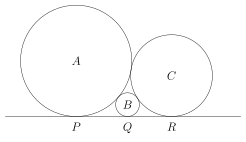
- Instead, let \(a\), \(b\) and \(c\) be positive numbers, with \(b < c < a\), which satisfy \((**)\). Show that they also satisfy \((*)\).
Solution:
- \(\,\)
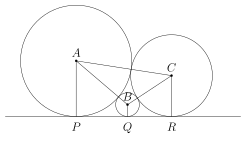
Notice that \begin{align*} && (a+b)^2 &= PQ^2 + (a-b)^2 \\ \Rightarrow && PQ^2 &= 4ab \\ && (b+c)^2 &= QR^2 + (c-b)^2 \\ \Rightarrow && QR^2 &= 4bc \\ && (a+c)^2 &= PR^2 + (a-c)^2 \\ \Rightarrow && PR^2 &= 4ac \\ \Rightarrow && 2\sqrt{ac} &= 2\sqrt{ab}+2\sqrt{bc} \\ \Rightarrow && \frac{1}{\sqrt{b}} &= \frac{1}{\sqrt{c}} + \frac1{\sqrt{a}} \\ \end{align*} Let \(x, y, z = \frac{1}{\sqrt{a}}, \frac1{\sqrt{b}}, \frac{1}{\sqrt{z}}\) so we would like to prove that \(2(x^4+y^4+z^4) = (x^2+y^2+z^2)^2\) or \(x^4+y^4+z^4 = 2x^2y^2+2y^2z^2+2z^2x^2\). We also have \begin{align*} && y &= x+z \\ \Rightarrow &&y^2 &= x^2+z^2+2xz \\ \Rightarrow && (y^2-x^2-z^2)^2 &= 4x^2z^2 \\ \Rightarrow && y^4+x^4+z^4 - 2x^2y^2-2y^2z^2+2x^2z^2 &= 4x^2z^2\\ \Rightarrow && y^4+x^4+z^4 &= 2x^2y^2+2y^2z^2+2z^2x^2 \end{align*}
- Notice that subject to \(y > z > x\) all these steps are reversible, so we must have the equality we desire
2015 Paper 2 Q7
A circle \(C\) is said to be bisected by a curve \(X\) if \(X\) meets \(C\) in exactly two points and these points are diametrically opposite each other on \(C\).
- Let \(C\) be the circle of radius \(a\) in the \(x\)-\(y\) plane with centre at the origin. Show, by giving its equation, that it is possible to find a circle of given radius \(r\) that bisects \(C\) provided \(r > a\). Show that no circle of radius \(r\) bisects \(C\) if \(r\le a\,\).
- Let \(C_1\) and \(C_2\) be circles with centres at \((-d,0)\) and \((d,0)\) and radii \(a_1\) and \(a_2\), respectively, where \(d > a_1\) and \(d > a_2\). Let \(D\) be a circle of radius \(r\) that bisects both \(C_1\) and \(C_2\). Show that the \(x\)-coordinate of the centre of \(D\) is \(\dfrac{a_2^2 - a_1^2}{4d}\). Obtain an expression in terms of \(d\), \(r\), \(a_1\) and \(a_2\) for the \(y\)-coordinate of the centre of \(D\), and deduce that \(r\) must satisfy \[ 16r^2d^2 \ge \big (4d^2 +(a_2-a_1)^2\big) \, \big (4d^2 +(a_2+a_1)^2\big) \,. \]
Solution:
- \(C\) has the equation \(x^2 + y^2 = a^2\). One suitable circle would ideally pass through \((0,a)\) and \((0,-a)\) have a centre on the positive \(x\)-axis, so we would need \(a^2+c^2 = r^2\) so \(c = \sqrt{r^2-a^2}\) and the equation would be \((x-\sqrt{r^2-a^2})^2 + y^2 = r^2\). Clearly a circle with radius \(r < a\) cannot pass through two diametrically opposed points of a circle radius \(a\), since the furthest two points can be on a circle is \(2r\), and diametrically opposed points are \(2a\) apart. Similarly if they are exactly the same radii, then if they pass through diametrically opposed points they must be the same circle.
- Let the centre of \(D\) be at \((x,y)\), then it must be a distance of \(\sqrt{r^2-a_i}\) from each circle centre, ie \begin{align*} && (x-d)^2+y^2 &= r^2-a_2^2 \\ && (x+d)^2 + y^2 &= r^2-a_1^2 \\ \Rightarrow && 4dx &= a_2^2 - a_1^2 \\ \Rightarrow && x &= \frac{a_2^2-a_1^2}{4d} \\ \Rightarrow && y^2 &= r^2-a_1^2 - \left (\frac{a_2^2-a_1^2}{4d}+d \right)^2 \\ &&&= r^2 - a_1^2 - \frac{(a_2^2-a_1^2+4d^2)^2}{16d^2} \\ &&&= \frac{16d^2r^2-16d^2a_1^2 - a_2^4-a_1^4-16d^4+2a_1^2a_2^2+8a_1^2d^2-8a_2^2d^2}{16d^2} \\ &&&= \frac{16d^2r^2-8d^2a_1^2 - a_2^4-a_1^4-16d^4+2a_1^2a_2^2-8a_2^2d^2}{16d^2} \\ \Rightarrow && y &= \pm \sqrt{ \frac{16d^2r^2-8d^2a_1^2 - a_2^4-a_1^4-16d^4+2a_1^2a_2^2-8a_2^2d^2}{16d^2}} \end{align*} and we need \begin{align*} && 0 &\leq 16d^2r^2-8d^2a_1^2 - a_2^4-a_1^4-16d^4+2a_1^2a_2^2-8a_2^2d^2 \\ \Rightarrow && 16d^2 d^2 &\geq 8d^2a_1^2 + a_2^4+a_1^4+16d^4+2a_1^2a_2^2+8a_2^2d^2 \\ &&&= (4d^2+(a_2-a_1)^2)(4d^2+(a_2+a_1)^2) \end{align*}
2015 Paper 2 Q8
\noindent
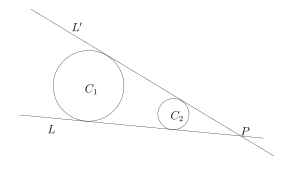
- Let \(\mathbf{x}_1\) and \(\mathbf{x}_2\) be the position vectors of the centres of \(C_1\) and \(C_2\), respectively. Show that the position vector of \(P\) is \[ \frac{r_1 \mathbf{x}_2- r_2 \mathbf{x}_1}{r_1-r_2} \,, \] where \(r_1\) and \(r_2\) are the radii of \(C_1\) and \(C_2\), respectively.
- The circle \(C_3\) does not overlap either \(C_1\) or \(C_2\) and its radius, \(r_3\), satisfies \(r_1 \ne r_3 \ne r_2\). The focus of \(C_1\) and \(C_3\) is \(Q\), and the focus of \(C_2\) and \(C_3\) is \(R\). Show that \(P\), \(Q\) and \(R\) lie on the same straight line.
- Find a condition on \(r_1\), \(r_2\) and \(r_3\) for \(Q\) to lie half-way between \(P\) and \(R\).
Solution:
- Notice that \(P\) lies on \(C_1C_2\), and that the triangles formed from \(C_iPT_i\) where \(T_i\) are the tangent points are similar, with ratios \(\frac{r_1}{r_2}\). Therefore \(\frac{C_1P}{r_1} = \frac{C_2P}{r_2}\), and hence \(\frac{C_1P}{C_1C_2} = \frac{C_1P}{C_1P-C_2P} = \frac{1}{1-\frac{r_2}{r_1}} = \frac{r_1}{r_1-r_2}\) So we have \(\mathbf{p} = \mathbf{x_1} + (\mathbf{x}_2 - \mathbf{x}_1)\cdot\frac{r_1}{r_1-r_2} = \frac{r_1\mathbf{x}_2 - r_2\mathbf{x}_1}{r_1-r_2}\)
- Suppose \(\mathbf{x}_3 = \binom{\alpha}{\beta}\) in the basis of \(\{ \mathbf{x}_1, \mathbf{x}_2 \}\), then we can see that \begin{align*} && \mathbf{p} &= \frac{1}{r_1-r_2}\binom{-r_2}{r_1} \\ && \mathbf{q} &= \frac{r_1(\alpha \mathbf{x}_1 +\beta \mathbf{x}_2) - r_3\mathbf{x}_1}{r_1-r_3} \\ &&&= \frac{1}{r_1-r_3} \binom{r_1\alpha -r_3}{r_1\beta} \\ && \mathbf{r} &=\frac{1}{r_2-r_3} \binom{r_2\alpha}{r_2\beta - r_3} \\ && \mathbf{p}-\mathbf{q} &= \frac{1}{r_1-r_2}\binom{-r_2}{r_1} - \frac{1}{r_1-r_3} \binom{r_1\alpha -r_3}{r_1\beta} \\ &&&= \frac{1}{(r_1-r_2)(r_1-r_3)} \binom{(r_1-r_3)(-r_2)-(r_1-r_2)(r_1\alpha-r_3)}{(r_1-r_3)r_1 - (r_1-r_2)r_1\beta} \\ &&&= \frac{r_1}{(r_1-r_2)(r_1-r_3)} \binom{(r_3-r_2)-\alpha(r_1-r_2)}{(r_1-r_3)-\beta(r_1-r_2)} \\ && \mathbf{q} - \mathbf{r} &= \frac{1}{r_1-r_3} \binom{r_1\alpha -r_3}{r_1\beta} - \frac{1}{r_2-r_3} \binom{r_2\alpha}{r_2\beta - r_3} \\ &&&= \frac{1}{(r_1-r_3)(r_2-r_3)}\binom{(r_2-r_3)(r_1\alpha-r_3) - (r_1-r_3)r_2\alpha)}{(r_2-r_3)r_1\beta - (r_1-r_3)(r_2\beta - r_3)} \\ &&&= \frac{1}{(r_1-r_3)(r_2-r_3)}\binom{(-r_2r_3+r_3^2) - \alpha(r_1r_3-r_3r_2)}{r_3(r_1-r_3)-\beta(r_1-r_2)} \\ &&&= \frac{r_3}{(r_1-r_3)(r_2-r_3)}\binom{(r_3-r_2)-\alpha(r_1-r_2)}{(r_1-r_3)-\beta(r_1-r_2)} \end{align*} Therefore they are clearly parallel, and hence lie on a line.
- \(Q\) is halfway between \(P\) and \(R\) if \begin{align*} && \frac{r_1}{(r_1-r_2)(r_1-r_3)} &= \frac{r_3}{(r_1-r_3)(r_2-r_3)} \\ \Leftrightarrow && r_1(r_2-r_3) &= r_3(r_1-r_2) \\ \Leftrightarrow && r_1r_2 - r_1r_3 &= r_1r_3 - r_2r_3 \\ \Leftrightarrow && r_2 &= \frac{2r_1r_3}{r_1+r_3} \end{align*}
1997 Paper 2 Q5
The complex numbers \(w=u+\mathrm{i}v\) and \(z=x+\mathrm{i}y\) are related by the equation $$z= (\cos v+\mathrm{i}\sin v)\mathrm{e}^u.$$ Find all \(w\) which correspond to \(z=\mathrm{i\,e}\). Find the loci in the \(x\)--\(y\) plane corresponding to the lines \(u=\) constant in the \(u\)--\(v\) plane. Find also the loci corresponding to the lines \(v=\) constant. Illustrate your answers with clearly labelled sketches. Identify two subsets \(W_1\) and \(W_2\) of the \(u\)--\(v\) plane each of which is in one-to-one correspondence with the first quadrant \(\{(x,\,y):\,x>0,\,y>0\}\) of the \(x\)--\(y\) plane. Identify also two subsets \(W_3\) and \(W_4\) each of which is in one-to-one correspondence with the set \(\{z\,:0<\,\vert z\vert\,<1\}\). \noindent[{\bf NB} `one-to-one' means here that to each value of \(w\) there is only one corresponding value of \(z\), and vice-versa.]
1987 Paper 1 Q2

Solution:
