Problems
Filters
22 problems found
2019 Paper 1 Q6
In both parts of this question, \(x\) is real and \(0 < \theta < \pi\).
- By completing the square, find in terms of \(\theta\) the minimum value as \(x\) varies of $$9x^2 - 12x \cos \theta + 4.$$ Find also the maximum value as \(x\) varies of \(12x^2 \sin \theta - 9x^4\). Hence determine the values of \(x\) and \(\theta\) that satisfy the equation $$9x^4 + (9 - 12 \sin \theta)x^2 - 12x \cos \theta + 4 = 0.$$
- Sketch the curve $$y = \frac{x^2}{x - \theta},$$ where \(\theta\) is a constant. Deduce that either \(\frac{x^2}{x - \theta} \leq 0\) or \(\frac{x^2}{x - \theta} \geq 4\theta\). By considering the numerator and denominator separately, or otherwise, show that $$\frac{\sin^2 \theta \cos^2 x}{1 + \cos^2 \theta \sin^2 x} \leq 1.$$ Hence determine the values of \(x\) and \(\theta\) that satisfy the equation $$\frac{x^2}{4\theta(x - \theta)} = \frac{\sin^2 \theta \cos^2 x}{1 + \cos^2 \theta \sin^2 x}.$$
Solution:
- \(\,\) \begin{align*} && y &= 9x^2 - 12x \cos \theta + 4 \\ &&&= (3x-2\cos \theta)^2+4-4\cos^2 \theta \\ &&&= (3x-2\cos \theta)^2 + 4 \sin^2 \theta \end{align*} Therefore the minimum is \(4\sin^2 \theta\) when \(x = \frac23 \cos \theta\). \begin{align*} && y &= 12x^2 \sin \theta - 9x^4 \\ &&&=4\sin^2 \theta -(3x^2-2\sin\theta)^2 \end{align*} Therefore the maximum is \(4\sin^2 \theta\) when \(x^2 = \frac23\sin \theta\) Therefore \begin{align*} && 0 &= 9x^4 + (9 - 12 \sin \theta)x^2 - 12x \cos \theta + 4 \\ && \underbrace{-9x^4+12x^2\sin \theta}_{\leq 4\sin^2 \theta } &= \underbrace{9x^2 - 12x \cos \theta + 4 }_{\geq 4 \sin^2 \theta} \end{align*} Therefore the equality cases must be achieved in both cases, ie \(x = \frac23 \cos \theta\) and \(x^2 = \frac23 \sin \theta\) \begin{align*} && x^2 &= \frac49\cos^2 \theta \\ &&&= \frac49(1-\sin^2 \theta) \\ &&&= \frac49(1-\frac94 x^2) \\ \Rightarrow && 2x^2 &= \frac49 \\ \Rightarrow && x &= \pm \frac{\sqrt{2}}3\\ \Rightarrow && \cos \theta &=\pm \frac32 \frac{\sqrt{2}}3 \\ &&&= \pm \frac{1}{\sqrt{2}} \\ \Rightarrow && \theta &= \frac{\pi}{4}, \frac{3\pi}{4} \\ \Rightarrow && (x, \theta) &= \left (\frac{\sqrt{2}}{3}, \frac{\pi}{4} \right), \left (-\frac{\sqrt{2}}{3}, \frac{3\pi}{4} \right) \end{align*}
- Sketching we obtain, noticing we can find the turning point by:
\begin{align*}
&& \frac{x^2}{x-\theta} &= \lambda \\
\Leftrightarrow && x^2 - \lambda x +\theta \lambda &= 0 \\
\Leftrightarrow && 0 &\leq \Delta = \lambda^2 -4\lambda \theta \\
\Leftrightarrow && \lambda &\geq 4 \theta, \lambda \leq 0
\end{align*}
Notice that \(\sin^2 \theta \cos^2 x \leq 1\) and \(1 + cos^2 \theta \sin^2 x \geq 1\) and therefore we must have the inequality desired. \begin{align*} && \underbrace{\frac{x^2}{4\theta(x - \theta)}}_{\geq 1 \text{ or } \leq 0} &= \underbrace{\frac{\sin^2 \theta \cos^2 x}{1 + \cos^2 \theta \sin^2 x}}_{\in [0,1]} \\ \text{both}=0: && x = 0 &, \sin \theta = 0 \\ \text{both}=1: && x = 2\theta &, \sin^2 \theta = 1,\cos^2 x = 1 \\ && 1 &= \cos^2 2 \theta \\ &&&= (1-2 \sin^2 \theta)^2 \\ &&&= 1 \\ \Rightarrow && (x, \theta) &= \left(\frac{\pi}{2}, \pi\right) \end{align*}

2018 Paper 3 Q1
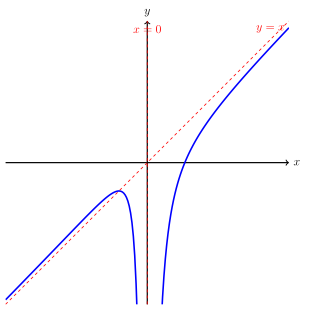
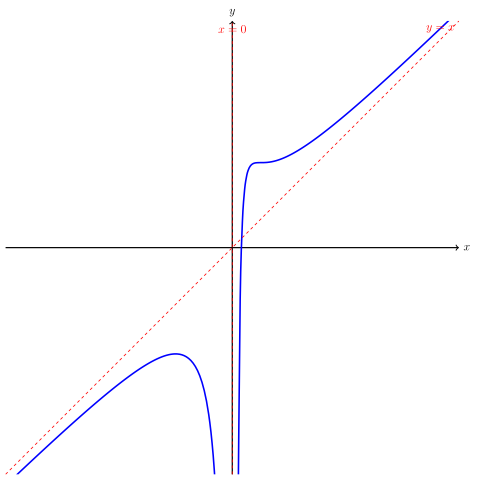
- The function \(\f\) is given by \[ \f(\beta)=\beta - \frac 1 \beta - \frac 1 {\beta^2} \ \ \ \ \ \ \ \ (\beta\ne0) \,. \] Find the stationary point of the curve \(y=\f(\beta)\,\) and sketch the curve. Sketch also the curve \(y=\g(\beta)\,\), where \[ \g(\beta) = \beta + \frac 3 \beta - \frac 1 {\beta^2} \ \ \ \ \ \ \ \ (\beta\ne0)\,. \]
- Let \(u\) and \(v\) be the roots of the equation \[ x^2 +\alpha x +\beta = 0 \,, \] where \(\beta\ne0\,\). Obtain expressions in terms of \(\alpha\) and \(\beta\) for \(\displaystyle u+v + \frac 1 {uv}\) and \( \displaystyle \frac 1 u + \frac 1 v + uv\,\).
- Given that \(\displaystyle u+v + \frac 1 {uv} = -1\,\), and that \(u\) and \(v\) are real, show that \(\displaystyle \frac 1 u+ \frac 1 v + {uv} \le -1\;\).
- Given instead that \(\displaystyle u+v + \frac 1 {uv} = 3 \;\), and that \(u\) and \(v\) are real, find the greatest value of \(\displaystyle \frac 1 u+ \frac 1v + {uv}\,\).
Solution:
- \begin{align*}
&& f(\beta) &= \beta - \frac1{\beta}-\frac1{\beta^2} \\
\Rightarrow && f'(\beta) &= 1 +\frac{1}{\beta^2}+\frac{2}{\beta^3} \\
\Rightarrow && 0 &= f'(\beta) \\
&&&= 1 + \frac1{\beta^2} + \frac{2}{\beta^3} \\
\Rightarrow && 0 &= \beta^3 + \beta + 2 \\
&&&= (\beta+1)(\beta^2-\beta+2)
\end{align*}
Therefore the only stationary point is at \(\beta = -1, f(-1) = -1\)
\begin{align*} && g(\beta) &= \beta + \frac3{\beta}-\frac1{\beta^2} \\ \Rightarrow && g'(\beta) &= 1 -\frac{3}{\beta^2}+\frac{2}{\beta^3} \\ \Rightarrow && 0 &= f'(\beta) \\ &&&= 1 - \frac3{\beta^2} + \frac{2}{\beta^3} \\ \Rightarrow && 0 &= \beta^3 - 3\beta + 2 \\ &&&= (\beta-1)^2(\beta+2) \end{align*} Therefore there are stationary points at \(\beta=1,f(1) = 3, \beta=-2, f(-2) = \frac14\)
- Let \(u,v\) be the roots of \(x^2 + \alpha x + \beta = 0\), then since \((x-u)(x-v) = 0\) we must have \(\alpha = -(u+v), \beta = uv\). Therefore: \begin{align*} && u+v +\frac{1}{uv} &= -\alpha + \frac{1}{\beta} \\ && \frac1u+\frac1v + uv &= \frac{u+v}{uv} + uv \\ &&&= -\frac{\alpha}{\beta} + \beta \end{align*} Given \(u+v + \frac 1 {uv} = -1\), ie \(-\alpha + \frac{1}{\beta} = -1\). Since the roots are real, we must also have that \(\alpha^2 - 4\beta \geq 0\), so \begin{align*} && -\alpha + \frac1\beta &= -1 \\ \Rightarrow && \alpha &= 1 +\frac1\beta \\ \Rightarrow && -\frac{\alpha}{\beta}+\beta &= -\frac{1}{\beta} \l1+\frac1{\beta}\r + \beta \\ &&&=\beta - \frac{1}{\beta}-\frac{1}{\beta^2} \end{align*} So we want to maximise \(f(\beta)\) subject to \(\alpha ^2 - 4\beta \geq 0\) \begin{align*} && 0 &\leq \alpha^2 -4 \beta \\ &&&= \l 1 + \frac1{\beta} \r^2 - 4\beta \\ &&&= 1+ \frac2{\beta} + \frac1{\beta^2} - 4\beta \\ \Leftrightarrow && 0 &\leq -4\beta^3+\beta^2 + 2\beta + 1 \\ &&&=-(\beta-1)(4\beta^2+3\beta+1)\\ \Leftrightarrow && \beta &\leq 1 \end{align*} But we know \(f(\beta) \leq -1\) on \((-\infty,1]\) so we're done.
- Given that \(-\alpha + \frac{1}{\beta} = 3\) we have \begin{align*} && -\alpha + \frac1\beta &= 3 \\ \Rightarrow && \alpha &= -3 +\frac1\beta \\ \Rightarrow && -\frac{\alpha}{\beta}+\beta &= -\frac{1}{\beta} \l-3+\frac1{\beta}\r + \beta \\ &&&=\beta + \frac{3}{\beta}-\frac{1}{\beta^2} \end{align*} which we want to maximise, subject to: \begin{align*} && 0 &\leq \alpha^2 -4 \beta \\ &&&= \l -3 + \frac1{\beta} \r^2 - 4\beta \\ &&&= 9- \frac6{\beta} + \frac1{\beta^2} - 4\beta \\ \Leftrightarrow && 0 &\leq -4\beta^3+9\beta^2 - 6\beta + 1 \\ &&&=-(\beta-1)^2(4\beta-1)\\ \Leftrightarrow && \beta &\leq \frac14 \end{align*} Therefore the maximum will either be \(f(-2) = \frac14\) or \(f(\frac14) = -\frac{15}4\). Therefore the maximum is \(\frac14\)
2015 Paper 2 Q4
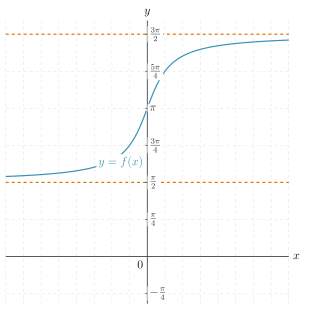
- The continuous function \(\f\) is defined by \[ \tan \f(x) = x \ \ \ \ \ (-\infty < x <\infty) \] and \(\f(0)=\pi\). Sketch the curve \(y=\f(x)\).
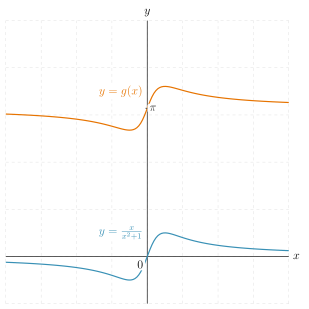
- The continuous function \(\g\) is defined by \[ \tan \g(x) = \frac x {1+x^2} \ \ \ \ \ \ (-\infty < x <\infty) \] and \(\g(0)=\pi\). Sketch the curves \(y= \dfrac x {1+x^2} \ \) and \(y=\g(x)\).
- The continuous function \(\h \) is defined by \(\h (0)=\pi\) and \[ \tan \h (x)= \frac x {1-x^2}\, \ \ \ \ \ (x \ne \pm 1) \,. \] (The values of \(\h (x)\) at \(x=\pm1\) are such that \(\h (x)\) is continuous at these points.) Sketch the curves \(y= \dfrac x {1-x^2} \ \) and \(y=\h (x)\).
- [Not on original exam] The continuous functions \(\h_1\) and \(\h_2\) are defined by: \(\h_1(0)=\h_2(0)=\pi \), \[ \tan \h_1(x) = \frac {x+x^4} {1+x^2+x^4} \ \ \ \ \ \text{and} \ \ \ \ \ \ \tan \h_2(x) = \frac {4x-x^3} {1-x^4} \,. \] for values of \(x\) at which the right hand sides are defined. Find \(\lim\limits_{x\to\infty}\h_1(x)\) and \(\lim\limits_{x\to\infty}\h_2(x)\,\).
Solution:
- \(\,\)
- \(\,\)
- \(\,\)
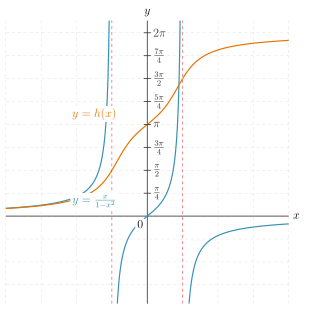
- Note that \(\frac{x+x^4}{1+x^2+x^4}\) is continuous, and nicely behaved on \((-\infty, \infty)\) so we can see that \(\lim_{x \to \infty} h_1(x) = \pi + \frac{\pi}{4} = \frac{5\pi}{4}\). \(\frac{4x-x^3}{1-x^4}\) on the other hand has asymptotes at \(\pm 1\). So as as \(x \to 1\), \(h_1(x) \to \pi + \frac{\pi}{2} = \frac{3\pi}{2}\). Then as \(x \to \infty\) we increase by another \(\frac{\pi}{2}\), so \(\lim_{x \to \infty} h_2(x) = 2\pi\)
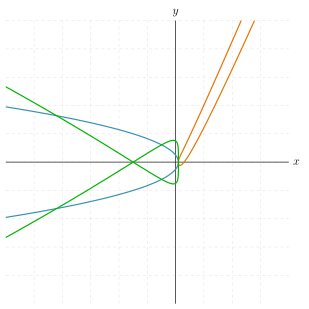
2014 Paper 1 Q2
- Show that \(\int \ln (2-x) \d x = -(2-x)\ln (2-x) + (2-x) + c \,,\ \) where \(x<2\).
- Sketch the curve \(A\) given by \(y= \ln \vert x^2-4\vert\).
- Show that the area of the finite region enclosed by the positive \(x\)-axis, the \(y\)-axis and the curve \(A\) is \(4\ln(2+\sqrt3)-2\sqrt3\,\).
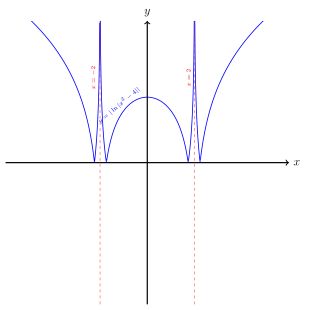
- The curve \(B\) is given by \(y= \vert \ln \vert x^2-4\vert \vert\,\). Find the area between the curve \(B\) and the \(x\)-axis with \(| x| <2\). Note: you may assume that \(t \ln t \to 0\) as \(t\to 0\).
Solution:
- \(\,\) \begin{align*} && \int \ln (2- x) \d x &= \left [ (x-2) \ln (2- x) \right] - \int -\frac{x-2}{2-x} \d x \\ && \int \ln (2- x) \d x &= \left [ (x-2) \ln (2- x) \right] + \int 1 \d x \\ &&&= -(2-x) \ln (2-x) +(2-x) + C \end{align*}
- \(\,\)
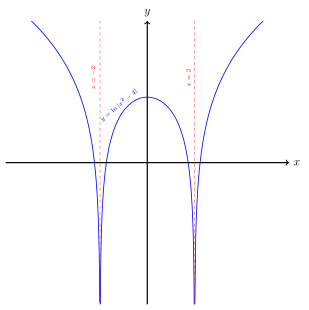
- \begin{align*} && \text{Area} &= \int_0^{\sqrt{3}} \ln | x^2 - 4 | \d x \\ &&&= \int_0^\sqrt{3} \ln(4-x^2) \d x \\ &&&= \int_0^\sqrt{3} \left ( \ln(2-x) + \ln (2+x) \right) \d x \\ &&&= \left [ -(2-x) \ln (2-x) +(2-x) +(2+x)\ln(2+x)-(2+x)\right]_0^{\sqrt{3}} \\ &&&= \left ( -(2-\sqrt{3}) \ln (2-\sqrt{3}) +(2-\sqrt{3}) +(2+\sqrt{3})\ln(2+\sqrt{3})-(2+\sqrt{3}) \right) - \\ &&&\quad \quad \left (- 2\ln (2)+2 +2\ln(2)-2 \right) \\ &&&=\left ( -(2-\sqrt{3}) \ln \left ( \frac{1}{2+\sqrt{3}} \right) -2\sqrt{3} +(2+\sqrt{3})\ln(2+\sqrt{3}) \right) \\ &&&= 4\ln(2 + \sqrt{3}) - 2 \sqrt{3} \end{align*}
- \begin{align*} && \text{Area} &= 2 \left ( \int_0^\sqrt{3} \ln (4-x^2) \d x - \lim_{t \to 2}\int_{\sqrt{3}}^t \ln(4-x^2) \d x \right) \\ &&&= 8\ln(2 + \sqrt{3})-4\sqrt{3} - 2 \lim_{t \to 2}\int_{\sqrt{3}}^t \left ( \ln (2-x) + \ln (2+x) \right) \d x \\ &&&= 8\ln(2 + \sqrt{3})-4\sqrt{3} - 2 \lim_{t \to 2} \left [ -(2-x) \ln (2-x) +(2-x) +(2+x)\ln(2+x)-(2+x)\right]_{\sqrt{3}}^{t} \\ &&&= 16 \ln(2+\sqrt{3})-8\sqrt{3} - 2 \lim_{t \to 2} \left(-(2-t) \ln (2-t) +(2-t) +(2+t)\ln(2+t)-(2+x) \right) \\ &&&= 16 \ln(2+\sqrt{3})-8\sqrt{3} -2(4 \ln4-4) \\ &&&= 16 \ln(2 + \sqrt{3}) - 16 \ln 2 +8(1-\sqrt{3}) \end{align*}
2013 Paper 1 Q8
- The functions \(\mathrm{a, b, c}\) and \(\mathrm{d}\) are defined by
- \({\rm a}(x) =x^2 \ \ \ \ (-\infty < x < \infty),\)
- \({\rm b}(x) = \ln x \ \ \ \ (x > 0),\)
- \({\rm c}(x) =2x \ \ \ \ (-\infty < x < \infty),\)
- \({\rm d}(x)= \sqrt x \ \ \ \ (x\ge0) \,.\)
- The functions \(\mathrm{f}\) and \(\mathrm{g}\) are defined by
- \(\f(x)= \sqrt{x^2-1\,} \ \ \ \ (\vert x \vert \ge 1),\)
- \(\g(x) = \sqrt{x^2+1\,} \ \ \ \ (-\infty < x < \infty).\)
- Sketch the graphs of the functions \(\h\) and \({\rm k}\) defined by
- \(\h(x) = x+\sqrt{x^2-1\,}\, \ \ \ \ ( x \ge1)\),
- \({\rm k}(x) = x-\sqrt{x^2-1\,}\, \ \ \ \ (\vert x\vert \ge1),\)
Solution:
- \begin{align*} cb(x) &= c(b(x)) \\ &= 2 \ln x \quad (x > 0) \\ ab(x) &= (b(x))^2 \\ &= (\ln x)^2 \quad (x > 0) \\ da(x) &= \sqrt{a(x)} \\ &= \sqrt{x^2} \\ &= |x| \quad (-\infty < x < \infty) \\ ad(x) &= (d(x))^2 \\ &= (\sqrt{x})^2 \\ &= x \quad (x \geq 0) \end{align*} The domains are specified above. The ranges are \(\mathbb{R}, \mathbb{R}_{\geq 0}, \mathbb{R}_{\geq 0}, \mathbb{R}_{\geq 0}\) respectively.
- \begin{align*} fg(x) &= \sqrt{g(x)^2-1} \quad (|g(x)| \geq 1) \\ &= \sqrt{x^2+1-1} \\ &= |x| \end{align*} So \(fg: \mathbb{R} \to \mathbb{R}_{\geq 0}\). \begin{align*} gf(x) &= \sqrt{f(x)^2 + 1} \\ &= \sqrt{\left ( \sqrt{x^2-1} \right)^2+1} \quad (|x| \geq 1) \\ &= |x| \end{align*} So \(gf: \mathbb{R}_{\geq 0} \to \mathbb{R}_{\geq 0}\)


2012 Paper 2 Q5
- Sketch the curve \(y=\f(x)\), where \[ \f(x) = \frac 1 {(x-a)^2 -1} \hspace{2cm}(x\ne a\pm1), \] and \(a\) is a constant.
- The function \(\g(x)\) is defined by \[ \g(x) = \frac 1 {\big( (x-a)^2-1 \big) \big( (x-b)^2 -1\big)} \hspace{1cm}(x\ne a\pm1, \ x\ne b\pm1), \] where \(a\) and \(b\) are constants, and \(b>a\). Sketch the curves \(y=\g(x)\) in the two cases \(b>a+2\) and \(b=a+2\), finding the values of \(x\) at the stationary points.
Solution:
- \(\,\)

- \(\,\) \begin{align*}
&& \frac{\d}{\d x} \left ( \frac{1}{g(x)} \right) &= \frac{\d }{\d x} \left ( \big( (x-a)^2-1 \big) \big( (x-b)^2 -1\big)\right) \\
&&&= ((x-a)^2-1)(2(x-b))+((x-b)^2-1)(2(x-a)) \\
&&&= 2(2x-a-b)(x^2-(a+b)x+ab-1) \\
\Rightarrow && x &= \frac{a+b}{2}, \frac{a+b \pm \sqrt{(a+b)^2-4ab+4}}{2} \\
&&&= \frac{a+b}{2}, \frac{a+b \pm \sqrt{(a-b)^2+4}}{2}
\end{align*}
If \(b > a+2\):
If \(b = a+2\):


2010 Paper 1 Q2
The curve \(\displaystyle y=\Bigl(\frac{x-a}{x-b}\Bigr)\e^{x}\), where \(a\) and \(b\) are constants, has two stationary points. Show that \[ a-b<0 \ \ \ \text{or} \ \ \ a-b>4 \,. \]
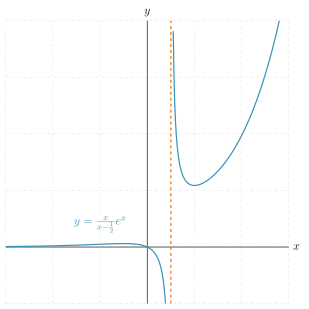
- Show that, in the case \(a=0\) and \(b= \frac12\), there is one stationary point on either side of the curve's vertical asymptote, and sketch the curve.
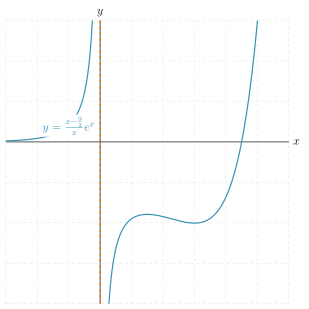
- Sketch the curve in the case \( a=\tfrac{9}{2}\) and \(b=0\,\).
Solution: \begin{align*} && y &= \left ( \frac{x-a}{x-b} \right )e^x \\ &&y'& = \left ( \frac{x-a}{x-b} \right )e^x + \left ( \frac{(x-b)-(x-a)}{(x-b)^2}\right )e^x \\ &&&= \left ( \frac{(x-b)(x-a) +a-b}{(x-b)^2} \right)e^x \\ &&&= \left ( \frac{x^2-(a+b)x+a-b+ab}{(x-b)^2} \right)e^x \\ && 0 &< \Delta = (a+b)^2 - 4 \cdot 1 \cdot (a-b+ab) \\ &&&= a^2+2ab+b^2-4a+4b-4ab \\ &&&= a^2-2ab+b^2-4a+4b\\ &&&= (a-b)^2-4(a-b) \\ &&&= (a-b)(a-b-4) \\ \end{align*} Considered as a quadratic in \(a-b\) we can see \(a-b < 0\) or \(a-b > 4\)
- If \(a = 0, b = \frac12\), we have \(x^2-\frac12x -\frac12 = 0 \Rightarrow (2x+1)(x-1) = 0 \Rightarrow x = -\frac12, x=1\). The asymptote is at \(x = \frac12\) so they are on either side.
- \(\,\)
2006 Paper 2 Q14
Sketch the graph of \[ y= \dfrac1 { x \ln x} \text{ for \(x>0\), \(x\ne1\)}.\] You may assume that \(x\ln x \to 0\) as \(x\to 0\). The continuous random variable \(X\) has probability density function \[ \f(x) = \begin{cases} \dfrac \lambda {x\ln x}& \text{for \(a\le x \le b\)}\;, \\[3mm] \ \ \ 0 & \text{otherwise }, \end{cases} \] where \(a\), \(b\) and \(\lambda\) are suitably chosen constants.
- In the case \(a=1/4\) and \(b=1/2\), find \(\lambda\,\).
- In the case \(\lambda=1\) and \(a>1\), show that \(b=a^\e\).
- In the case \(\lambda =1\) and \(a=\e\), show that \(\P(\e^{3/2}\le X \le \e^2)\approx \frac {31}{108}\,\).
- In the case \(\lambda =1\) and \(a=\e^{1/2}\), find \(\P(\e^{3/2}\le X \le \e^2)\;\).
Solution:
- \begin{align*} 1 &= \int_{1/4}^{1/2} \frac{\lambda}{x\ln x} \, dx \\ &= \lambda\left [ \ln |\ln x| \right ]_{1/4}^{1/2} \\ &= \lambda \l \ln |-\ln 2| - \ln |-2 \ln 2| \r \\ &= \lambda (-\ln 2) \end{align*} So \(\lambda = -\frac{1}{\ln 2} = \frac{1}{\ln \frac12}\)
- \begin{align*} 1 &= \int_{a}^{b} \frac{1}{x\ln x} \, dx \\ &= \left [ \ln |\ln x| \right ]_{a}^{b} \\ &= \l \ln \ln b - \ln \ln a \r \\ &= \ln \l \frac{\ln b}{\ln a} \r \\ \end{align*} So \(b = e^{a}\)
- If \(\lambda = 1, a = e, b = e^e\), then \begin{align*} \P(\e^{3/2}\le X \le \e^2) &= \int_{e^{3/2}}^{e^2} \frac{1}{x \ln x} \, dx \\ &= \left [ \ln \ln x \right]_{e^{3/2}}^{e^2} \\ &= \ln 2 - \ln \frac{3}{2} \\ &= \ln \frac{4}{3} \\ &= \ln \l 1 + \frac{1}{3} \r \\ &\approx \frac{1}{3} - \frac{1}{2 \cdot 3^2} + \frac{1}{3 \cdot 3^3} - \frac{1}{4 \cdot 3^4} \\ &= \frac{31}{108} \end{align*}
- Note that \(2 > e^{\frac12} > 1\) so \(a = e^{\frac12}, b = e^{\frac{e}2}\). Since \(3 > e \Rightarrow e^{3/2} > e^{\frac{e}{2}}\) this probability is out of range, therefore \(\P(\e^{3/2}\le X \le \e^2) = 0\)
2006 Paper 3 Q1
Sketch the curve with cartesian equation \[ y = \frac{2x(x^2-5)}{x^2-4} \] and give the equations of the asymptotes and of the tangent to the curve at the origin. Hence determine the number of real roots of the following equations:
- \(3x(x^2-5)= (x^2-4)(x+3)\,\);
- \(4x(x^2-5)= (x^2-4)(5x-2)\,\);
- \(4x^2(x^2-5)^2= (x^2-4)^2(x^2+1)\,\).
Solution: \begin{align*} && y &= \frac{2x(x^2-5)}{x^2-4} \\ &&&= 2x(x^2-5)(-\tfrac14)(1-\tfrac14x^2)^{-1} \\ &&&= \tfrac52x + \cdots \\ &&&= \frac{2x(x^2-4)-2x}{x^2-4} \\ &&&= 2x - \frac{2x}{x^2-4} \end{align*}

- We are looking for the intersections of \(y = \frac23(x+3)\) and \(y = f(x)\)
Therefore 3 real roots.

- We are looking for intersections of \(y = \frac12(5x-2)\) and \(y = f(x)\)
so one solution.

- We are looking for intersections of \(y = f(x)^2\) and \(y = x^2+1\), or \(y = \sqrt{x^2+1}\) and \(y = f(x)\) where \(f(x) \geq 0\)
So \(3\) solutions.

2006 Paper 3 Q7
- Solve the equation \(u^2+2u\sinh x -1=0\) giving \(u\) in terms of \(x\). Find the solution of the differential equation \[ \left( \frac{\d y}{\d x}\right)^{\!2} +2 \frac{\d y}{\d x} \sinh x -1 = 0 \] that satisfies \(y=0\) and \(\dfrac {\d y}{\d x} >0\) at \(x=0\).
- Find the solution, not identically zero, of the differential equation \[ \sinh y \left( \frac{\d y}{\d x}\right)^{\!2} +2 \frac{\d y}{\d x} -\sinh y = 0 \] that satisfies \(y=0\) at \(x=0\), expressing your solution in the form \(\cosh y=\f(x)\). Show that the asymptotes to the solution curve are \(y=\pm(-x+\ln 4)\).
2005 Paper 2 Q8
For \(x \ge 0\) the curve \(C\) is defined by $$ {\frac{\d y} {\d x}} = \frac{x^3y^2}{(1 + x^2)^{5/2}} $$ with \(y = 1\) when \(x=0\,\). Show that \[ \frac 1 y = \frac {2+3x^2}{3(1+x^2)^{3/2}} +\frac13 \] and hence that for large positive \(x\) $$ y \approx 3 - \frac 9 x\;. $$ Draw a sketch of \(C\). On a separate diagram, draw a sketch of the two curves defined for \(x \ge 0\) by $$ \frac {\d z} {\d x} = \frac{x^3z^3}{2(1 + x^2)^{5/2}} $$ with \(z = 1\) at \(x=0\) on one curve, and \(z = -1\) at \(x=0\) on the other.
Solution: \begin{align*} && {\frac{\d y} {\d x}} &= \frac{x^3y^2}{(1 + x^2)^{5/2}} \\ \Rightarrow &&\int \frac{1}{y^2} \d y &= \int \frac{x^3}{(1+x^2)^{5/2}} \d x \\ \Rightarrow && -\frac1y &= \int \frac{x^3+x-x}{(1+x^2)^{5/2}} \d x \\ &&&= \int \left ( \frac{x}{(1+x^2)^{3/2}}-\frac{x}{(1+x^2)^{5/2}} \right) \d x \\ &&&= \frac{-1}{(1+x^2)^{1/2}} + \frac{1}{3(1+x^2)^{3/2}} + C \\ &&&= \frac{1-3(1+x^2)}{3(1+x^2)^{3/2}} + C \\ &&&= \frac{-3x^2-2}{3(1+x^2)^{3/2}} + C \\ (x,y) = (0,1): &&-1 &= -\frac23 + C \\ \Rightarrow && C &= -\frac13 \\ \Rightarrow && \frac1y &= \frac{3x^2+2}{3(1+x^2)^{3/2}} + \frac13 \end{align*} \begin{align*} y &= \frac{1}{\frac13 +\frac{3x^2+2}{3(1+x^2)^{3/2}} } \\ &= \frac{3}{1+ \frac{3x^2+2}{3(1+x^2)^{3/2}}} \\ &= \frac{3}{1+ \frac{3}{x} + \cdots} \\ &\approx 3 - \frac{9}{x} \end{align*}


2004 Paper 3 Q2
The equation of a curve is \(y=\f ( x )\) where \[ \f ( x ) = x-4-\frac{16 \l 2x+1 \r^2}{x^2 \l x - 4 \r} \;. \]
- Write down the equations of the vertical and oblique asymptotes to the curve and show that the oblique asymptote is a tangent to the curve.
- Show that the equation \(\f ( x ) =0\) has a double root.
- Sketch the curve.
Solution:
- Clearly \(x = 0\) and \(x = 4\) are vertical asymptotes. Notice that \(\frac{16 \l 2x+1 \r^2}{x^2 \l x - 4 \r}\) tends to \(0\) as \(x \to \infty\). Therefore the oblique asymptote is \(y = x-4\).
- \begin{align*} && 0 &= \frac{x^2(x-4)^2-4^2(2x+1)^2}{x^2(x-4)} \\ &&&= \frac{(x(x-4)-4(2x+1))(x(x-4)+4(2x+1))}{x^2(x-4)} \\ &&&= \frac{(x^2-12x-4)(x^2+4x+4)}{x^2(x-4)}\\ &&&= \frac{(x^2-12x-4)(x+2)^2}{x^2(x-4)} \end{align*} Therefore \(f(x) = 0\) has a double root at \(x = -2\). Notice it also has roots at \(6 \pm 2\sqrt{10}\)

2003 Paper 3 Q3
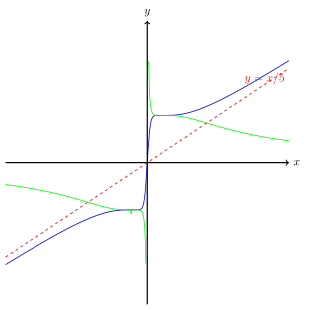
If \(m\) is a positive integer, show that \(\l 1+x \r^m + \l 1-x \r^m \ne 0\) for any real \(x\,\). The function \(\f\) is defined by \[ \f (x) = \frac{ (1+x )^m - ( 1-x )^m}{ (1+x )^m + (1-x )^m} \;. \] Find and simplify an expression for \(\f'(x)\). In the case \(m=5\,\), sketch the curves \(y = \f (x)\) and \(\displaystyle y = \frac1 { \f (x )}\;\).
Solution: If \(m\) is even, clearly that expression is positive since it's the sum of two (different) squares. If \(m\) is odd, then we can expand it as a sum of powers of \(x^2\) with a leading coefficient of \(1\) so it is also positive. \begin{align*} && f (x) = \frac{ (1+x )^m - ( 1-x )^m}{ (1+x )^m + (1-x )^m} \\ && f'(x) &= \frac{(m(1+x )^{m-1} + m( 1-x )^{m-1})((1+x)^m + (1-x)^m ) - ((1+x )^m - ( 1-x )^m)(m(1+x)^{m-1} - m(1-x)^{m-1} )}{\l (1+x)^m + (1-x)^m \r^2} \\ &&&= \frac{2m(1+x)^m(1-x)^{m-1}+2m(1+x)^{m-1}(1-x)^m}{\l (1+x)^m + (1-x)^m \r^2} \\ &&&= \frac{2m(1+x)^{m-1}(1-x)^{m-1}(1+x+1-x)}{\l (1+x)^m + (1-x)^m \r^2} \\ &&&= \frac{4m(1+x)^{m-1}(1-x)^{m-1}}{\l (1+x)^m + (1-x)^m \r^2} \\ \end{align*}
2000 Paper 3 Q4
The function \(\f(x)\) is defined by $$ \f(x) = \frac{x( x - 2 )(x-a)}{ x^2 - 1}. $$ Prove algebraically that the line \(y = x + c\) intersects the curve \(y = \f ( x )\) if \(\vert a \vert \ge1\), but there are values of \(c\) for which there are no points of intersection if \(\vert a \vert <1\). Find the equation of the oblique asymptote of the curve \(y=\f(x)\). Sketch the graph in the two cases
- \(a<-1\)
- \(-1 < a < -\frac12\)
Solution: \begin{align*} && x+ c &= f(x) \\ \Rightarrow && (x+c)(x^2-1) &= x(x-2)(x-a) \\ \Rightarrow && x^3 + cx^2-x-c &= x^3-(2+a)x^2+2ax \\ \Rightarrow && 0 &= (c+2+a)x^2-(1+2a)x-c \\ && 0 &\leq \Delta = (1+2a)^2 + 4(2+c+a)c \\ &&&= 4c^2+(4a+8)c + (1+2a)^2 \\ && \Delta_c &= 16(a+2)^2-16(1+2a)^2 \\ &&&= 16(1-a)(3a+3) \\ &&&= 48(1-a^2) \end{align*} Therefore if \(|a| \geq 1\) we must have \(\Delta_c \leq 0\) which means \(\Delta \geq 0\) and so there are always solutions. If \(|a| < 1\) there are values for \(c\) where \(\Delta < 0\) and there would be no solutions. \begin{align*} && y &= \frac{x^3-(2+a)x^2+2ax}{x^2-1} \\ &&&= \frac{(x^2-1)(x-(2+a))+(2a+1)x-(2+a)}{x^2-1} \\ &&&= x - (2+a) + \frac{(2a+1)x-(2+a)}{x^2-1} \end{align*} therefore the oblique asymptote has equation \(y = x - (2+a)\)


1999 Paper 2 Q7
The curve \(C\) has equation $$ y = \frac x {\sqrt{x^2-2x+a}}\; , $$ where the square root is positive. Show that, if \(a>1\), then \(C\) has exactly one stationary point. Sketch \(C\) when (i) \(a=2\) and (ii) \(a=1\).
Solution: \begin{align*} && y &= \frac x {\sqrt{x^2-2x+a}} \\ && y' &= \frac{\sqrt{x^2-2x+a} - \frac{x(x-1)}{\sqrt{x^2-2x+a}}}{x^2-2x+a} \\ &&&= \frac{-x+a}{(x^2-2x+a)^{3/2}} \end{align*} Since the denominator is always positive, the only stationary point is when \(x = a\)

