Problems
Filters
10 problems found
1999 Paper 1 Q5
For this question, you may use the following approximations, valid if \(\theta \) is small: \ \(\sin\theta \approx \theta\) and \(\cos\theta \approx 1-\theta^2/2\,\). A satellite \(X\) is directly above the point \(Y\) on the Earth's surface and can just be seen (on the horizon) from another point \(Z\) on the Earth's surface. The radius of the Earth is \(R\) and the height of the satellite above the Earth is \(h\).
- Find the distance \(d\) of \(Z\) from \(Y\) along the Earth's surface.
- If the satellite is in low orbit (so that \(h\) is small compared with \(R\)), show that $$d \approx k(Rh)^{1/2},$$ where \(k\) is to be found.
- If the satellite is very distant from the Earth (so that \(R\) is small compared with \(h\)), show that $$d\approx aR+b(R^2/h),$$ where \(a\) and \(b\) are to be found.
1997 Paper 3 Q5
Find the ratio, over one revolution, of the distance moved by a wheel rolling on a flat surface to the distance traced out by a point on its circumference.
Solution: The point on the circumference will have position \((a\cos t, a \sin t )\) relative to the circumference where \(t \in [0, 2\pi]\). the wheel will travel \(2\pi a\), therefore the position is \((a\cos t + at, a \sin t )\). The total distance travelled can be computed using the arc length: \begin{align*} && s &= \int_0^{2\pi} \sqrt{\left ( \frac{\d y}{\d t} \right)^2 +\left ( \frac{\d x}{\d t} \right)^2} \d t \\ &&&= \int_0^{2\pi} \sqrt{(a - a\sin t)^2 +(a \cos t)^2 } \d t \\ &&&= a \int_0^{2\pi} \sqrt{2 - 2 \sin t } \d t \\ &&&= \sqrt{2}a \int_0^{2 \pi} \sqrt{1 - \sin t} \d t \\ &&&= \sqrt{2}a \int_0^{2 \pi} \frac{|\cos t|}{\sqrt{1 + \sin t}} \d t \\ &&&= 2\sqrt{2} a \int_{-\pi/2}^{\pi/2} \frac{\cos t}{\sqrt{1+\sin t}} \d t \\ &&&= 2\sqrt{2} a \left [ 2\sqrt{1+\sin t} \right]_{-\pi/2}^{\pi/2} \\ &&& = 2\sqrt{2} a 2\sqrt{2} \\ &&&= 8a \end{align*} Therefore the ratio is \(\frac{4}{\pi}\)
1994 Paper 3 Q9
A smooth, axially symmetric bowl has its vertical cross-sections determined by \(s=2\sqrt{ky},\) where \(s\) is the arc-length measured from its lowest point \(V\), and \(y\) is the height above \(V\). A particle is released from rest at a point on the surface at a height \(h\) above \(V\). Explain why \[ \left(\frac{\mathrm{d}s}{\mathrm{d}t}\right)^{2}+2gy \] is constant. Show that the time for the particle to reach \(V\) is \[ \pi\sqrt{\frac{k}{2g}}. \] Two elastic particles of mass \(m\) and \(\alpha m,\) where \(\alpha<1,\) are released simultaneously from opposite sides of the bowl at heights \(\alpha^{2}h\) and \(h\) respectively. If the coefficient of restitution between the particles is \(\alpha,\) describe the subsequent motion.
1993 Paper 2 Q5
\noindent
1993 Paper 3 Q1
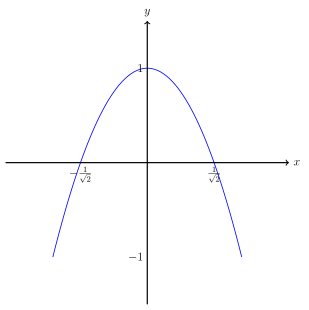
The curve \(P\) has the parametric equations $$ x= \sin\theta, \quad y=\cos2\theta \qquad\hbox{ for }-\pi/2 \le \theta \le \pi/2. $$ Show that \(P\) is part of the parabola \(y=1-2x^2\) and sketch \(P\). Show that the length of \(P\) is \(\surd (17) + {1\over 4} \sinh^{-1}4\). Obtain the volume of the solid enclosed when \(P\) is rotated through \(2\pi\) radians about the line \(y=-1\).
Solution: First notice that \(y = \cos 2 \theta = 1 - 2\sin^2 \theta = 1- 2x^2\), therefore \(P\) is lies on that parabola.
1992 Paper 3 Q10
Sketch the curve \(C\) whose polar equation is \[ r=4a\cos2\theta\qquad\mbox{ for }-\tfrac{1}{4}\pi<\theta<\tfrac{1}{4}\pi. \] The ellipse \(E\) has parametric equations \[ x=2a\cos\phi,\qquad y=a\sin\phi. \] Show, without evaluating the integrals, that the perimeters of \(C\) and \(E\) are equal. Show also that the areas of the regions enclosed by \(C\) and \(E\) are equal.
Solution:

1991 Paper 3 Q9
The parametric equations \(E_{1}\) and \(E_{2}\) define the same ellipse, in terms of the parameters \(\theta_{1}\) and \(\theta_{2}\), (though not referred to the same coordinate axes). \begin{alignat*}{2} E_{1}:\qquad & x=a\cos\theta_{1}, & \quad & y=b\sin\theta_{1},\\ E_{2}:\qquad & x=\dfrac{k\cos\theta_{2}}{1+e\cos\theta_{2}}, & \quad & y=\dfrac{k\sin\theta_{2}}{1+e\cos\theta_{2}}, \end{alignat*} where \(0< b< a,\) \(0< e< 1\) and \(0< k\). Find the position of the axes for \(E_{2}\) relative to the axes for \(E_{1}\) and show that \(k=a(1-e^{2})\) and \(b^{2}=a^{2}(1-e^{2}).\) {[}The standard polar equation of an ellipse is \(r=\dfrac{\ell}{1+e\cos\theta}.]\) By considering expressions for the length of the perimeter of the ellipse, or otherwise, prove that \[ \int_{0}^{\pi}\sqrt{1-e^{2}\cos^{2}\theta}\,\mathrm{d}\theta=\int_{0}^{\pi}\frac{1-e^{2}}{(1+e\cos\theta)^{2}}\sqrt{1+e^{2}+2e\cos\theta}\,\mathrm{d}\theta. \] Given that \(e\) is so small that \(e^{6}\) may be neglected, show that the value of either integral is \[ \tfrac{1}{64}\pi(64-16e^{2}-3e^{4}). \]
1990 Paper 2 Q9
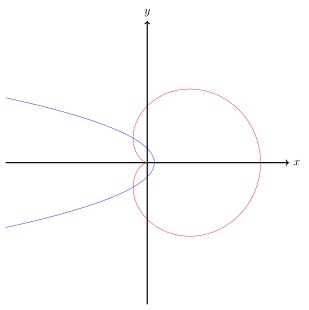
Show by means of a sketch that the parabola \(r(1+\cos\theta)=1\) cuts the interior of the cardioid \(r=4(1+\cos\theta)\) into two parts. Show that the total length of the boundary of the part that includes the point \(r=1,\theta=0\) is \(18\sqrt{3}+\ln(2+\sqrt{3}).\)
Solution:
1989 Paper 3 Q1
Prove that the area of the zone of the surface of a sphere between two parallel planes cutting the sphere is given by \[ 2\pi\times(\mbox{radius of sphere})\times(\mbox{perpendicular distance between the planes}). \] A tangent from the origin \(O\) to the curve with cartesian equation \[ (x-c)^{2}+y^{2}=a^{2}, \] where \(a\) and \(c\) are positive constants with \(c>a,\) touches the curve at \(P\). The \(x\)-axis cuts the curve at \(Q\) and \(R\), the points lying in the order \(OQR\) on the axis. The line \(OP\) and the arc \(PR\) are rotated through \(2\pi\) radians about the line \(OQR\) to form a surface. Find the area of this surface.
Solution:


1988 Paper 3 Q4
A kingdom consists of a vast plane with a central parabolic hill. In a vertical cross-section through the centre of the hill, with the \(x\)-axis horizontal and the \(z\)-axis vertical, the surface of the plane and hill is given by \[ z=\begin{cases} \dfrac{1}{2a}(a^{2}-x^{2}) & \mbox{ for }\left|x\right|\leqslant a,\\ 0 & \mbox{ for }\left|x\right|>a. \end{cases} \] The whole surface is formed by rotating this cross-section about the \(z\)-axis. In the \((x,z)\) plane through the centre of the hill, the king has a summer residence at \((-R,0)\) and a winter residence at \((R,0)\), where \(R>a.\) He wishes to connect them by a road, consisting of the following segments: \begin{itemize} \item a path in the \((x,z)\) plane joining \((-R,0)\) to \((-b,(a^{2}-b^{2})/2a),\) where \(0\leqslant b\leqslant a.\) \item a horizontal semicircular path joining the two points \((\pm b,(a^{2}-b^{2})/2a),\) if \(b\neq0;\) \item a path in the \((x,z)\) plane joining \((b,(a^{2}-b^{2})/2a)\) to \((R,0).\) \end{itemiz} The king wants the road to be as short as possible. Advise him on his choice of \(b.\)
Solution: The path can be broken down into \(5\) sections. 1. The section from \((-R,0)\) to \((-a,0)\) which will have distance \(R-a\) and is unchangeable. 2. The distance from \((-a,0)\) to \((-b, \frac{a^2-b^2}{2a})\) whose distance we will calculate shortly. 3. The distance from \((-b, \frac{a^2-b^2}{2a})\) to \((b, \frac{a^2-b^2}{2a})\) which will have distance \(\pi b\). 4. The distance from \((b, \frac{a^2-b^2}{2a})\) to \((a,0)\) which will have the same distance as 2. 5. The distance from \((a,0)\) to \((R,0)\) which will have distance \(R-a\) and we have no control over. \begin{align*} \text{distance 2.} &= \int_b^a \sqrt{1 + \left ( \frac{x}{a}\right)^2 } \d x \end{align*} We want to minimize the total, by varying \(b\), so it makes sense to differentiate and set to zero. \begin{align*} &&0&= -2\sqrt{1+\frac{b^2}{a^2}} + \pi \\ \Rightarrow && \frac{\pi^2}{4} &= 1 + \frac{b^2}{a^2} \\ \Rightarrow && b &= a \sqrt{\frac{\pi^2}{4}-1} \end{align*} Since \(\pi \approx 3\) this point is outside our range \(0 \leq b \leq a\), and our derivative is always positive. Therefore the distance is always increasing and the king would be better off going around the hill as soon as he arrives at it.