Problems
Filters
17 problems found
2022 Paper 2 Q4
- Show that the function \(\mathrm{f}\), given by the single formula \(\mathrm{f}(x) = |x| - |x-5| + 1\), can be written without using modulus signs as \[\mathrm{f}(x) = \begin{cases} -4 & x \leqslant 0\,,\\ 2x - 4 & 0 \leqslant x \leqslant 5\,,\\ 6 & 5 \leqslant x\,.\end{cases}\] Sketch the graph with equation \(y = \mathrm{f}(x)\).
- The function \(\mathrm{g}\) is given by: \[\mathrm{g}(x) = \begin{cases} -x & x \leqslant 0\,,\\ 3x & 0 \leqslant x \leqslant 5\,,\\ x + 10 & 5 \leqslant x\,.\end{cases}\] Use modulus signs to write \(\mathrm{g}(x)\) as a single formula.
- Sketch the graph with equation \(y = \mathrm{h}(x)\), where \(\mathrm{h}(x) = x^2 - x - 4|x| + |x(x-5)|\).
- The function \(\mathrm{k}\) is given by: \[\mathrm{k}(x) = \begin{cases} 10x & x \leqslant 0\,,\\ 2x^2 & 0 \leqslant x \leqslant 5\,,\\ 50 & 5 \leqslant x\,.\end{cases}\] Use modulus signs to write \(\mathrm{k}(x)\) as a single formula, explicitly verifying that your formula is correct.
2015 Paper 1 Q10
A bus has the shape of a cuboid of length \(a\) and height \(h\). It is travelling northwards on a journey of fixed distance at constant speed \(u\) (chosen by the driver). The maximum speed of the bus is \(w\). Rain is falling from the southerly direction at speed \(v\) in straight lines inclined to the horizontal at angle \(\theta\), where \(0<\theta<\frac12\pi\). By considering first the case \(u=0\), show that for \(u>0\) the total amount of rain that hits the roof and the back or front of the bus in unit time is proportional to \[ h\big \vert v\cos\theta - u \big\vert + av\sin\theta \,. \] Show that, in order to encounter as little rain as possible on the journey, the driver should choose \( u=w\) if either \(w< v\cos\theta\) or \( a\sin\theta > h\cos\theta\). How should the speed be chosen if \(w>v\cos\theta\) and \( a\sin\theta < h\cos\theta\)? Comment on the case \( a\sin\theta = h\cos\theta\). How should the driver choose \(u\) on the return journey?
2015 Paper 3 Q3
In this question, \(r\) and \(\theta\) are polar coordinates with \(r \ge0\) and \(- \pi < \theta\le \pi\), and \(a\) and \(b\) are positive constants. Let \(L\) be a fixed line and let \(A\) be a fixed point not lying on \(L\). Then the locus of points that are a fixed distance (call it \(d\)) from \(L\) measured along lines through \(A\) is called a conchoid of Nicomedes.
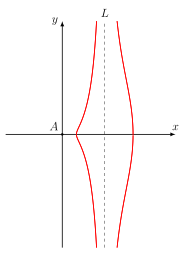
- Show that if \[ \vert r- a \sec\theta \vert = b\,, \tag{\(*\)} \] where \(a>b\), then \(\sec\theta >0\). Show that all points with coordinates satisfying (\(*\)) lie on a certain conchoid of Nicomedes (you should identify \(L\), \(d\) and \(A\)). Sketch the locus of these points.
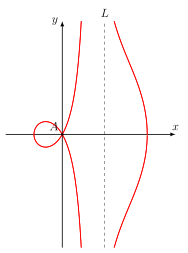
- In the case \(a < b\), sketch the curve (including the loop for which \(\sec\theta<0\)) given by \[ \vert r- a \sec\theta \vert = b\, . \] Find the area of the loop in the case \(a=1\) and \(b=2\). [Note: $ %\displaystyle \int \! \sec\theta \,\d \theta = \ln \vert \sec\theta + \tan\theta \vert + C \,. $]
Solution:
- \(r = a \sec \theta \pm b\). The points on \(r = a \sec \theta \Leftrightarrow r \cos \theta = a \Leftrightarrow x = a\) are points on the line \(x = a\). Therefore points on the curve \(r = a \sec \theta \pm b\) are points which are a distance \(b\) from the line \(x = a\) measured towards \(O\). So \(A\) is the origin and \(d = b\).
- The loop starts and ends when \(r = a \sec \theta - b = 0 \Rightarrow \cos \theta = \frac{a}{b}\), so when \(a = 1, b = 2\), this is \(-\frac{\pi}{3}\) to \(\frac{\pi}{3}\) \begin{align*} && A &= \frac12 \int r^2 \d \theta \\ &&&= \frac12 \int_{-\pi/3}^{\pi/3} \left ( \sec \theta - 2 \right)^2 \d \theta \\ &&&= \frac12 \int_{-\pi/3}^{\pi/3} \left (\sec^2 \theta - 4 \sec \theta + 4\right)\d \theta \\ &&&= \frac12 \left [ \tan \theta -4 \ln | \sec \theta + \tan \theta| + 4 \theta \right]_{-\pi/3}^{\pi/3} \\ &&&= \frac12 \left (\left (\tan \frac{\pi}3 - 4 \ln | \sec \frac{\pi}3 + \tan \frac{\pi}3 | + 4\left ( \frac{\pi}3 \right)\right) - \left (\tan \left (-\frac{\pi}3 \right) - 4 \ln | \sec \left (-\frac{\pi}3 \right)+ \tan\left ( -\frac{\pi}3 \right) | + 4\left ( -\frac{\pi}3 \right)\right) \right) \\ &&&= \frac12 \left ( 2\sqrt{3} - 4 \ln |2 + \sqrt{3}| + 4 \ln |2-\sqrt{3}| + \frac{8\pi}3 \right) \\ &&&= \sqrt{3} + 2\ln \frac{2-\sqrt{3}}{2+\sqrt{3}} + \frac{4\pi}3 \\ &&&= \sqrt{3} + 4 \ln (2 - \sqrt{3})+ \frac{4\pi}3 \end{align*}
2014 Paper 1 Q2
- Show that \(\int \ln (2-x) \d x = -(2-x)\ln (2-x) + (2-x) + c \,,\ \) where \(x<2\).
- Sketch the curve \(A\) given by \(y= \ln \vert x^2-4\vert\).
- Show that the area of the finite region enclosed by the positive \(x\)-axis, the \(y\)-axis and the curve \(A\) is \(4\ln(2+\sqrt3)-2\sqrt3\,\).
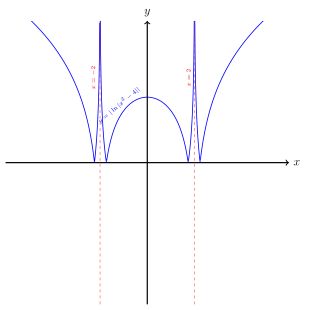
- The curve \(B\) is given by \(y= \vert \ln \vert x^2-4\vert \vert\,\). Find the area between the curve \(B\) and the \(x\)-axis with \(| x| <2\). Note: you may assume that \(t \ln t \to 0\) as \(t\to 0\).
Solution:
- \(\,\) \begin{align*} && \int \ln (2- x) \d x &= \left [ (x-2) \ln (2- x) \right] - \int -\frac{x-2}{2-x} \d x \\ && \int \ln (2- x) \d x &= \left [ (x-2) \ln (2- x) \right] + \int 1 \d x \\ &&&= -(2-x) \ln (2-x) +(2-x) + C \end{align*}
- \(\,\)
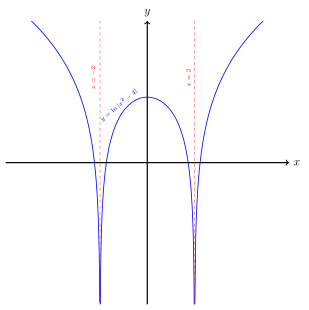
- \begin{align*} && \text{Area} &= \int_0^{\sqrt{3}} \ln | x^2 - 4 | \d x \\ &&&= \int_0^\sqrt{3} \ln(4-x^2) \d x \\ &&&= \int_0^\sqrt{3} \left ( \ln(2-x) + \ln (2+x) \right) \d x \\ &&&= \left [ -(2-x) \ln (2-x) +(2-x) +(2+x)\ln(2+x)-(2+x)\right]_0^{\sqrt{3}} \\ &&&= \left ( -(2-\sqrt{3}) \ln (2-\sqrt{3}) +(2-\sqrt{3}) +(2+\sqrt{3})\ln(2+\sqrt{3})-(2+\sqrt{3}) \right) - \\ &&&\quad \quad \left (- 2\ln (2)+2 +2\ln(2)-2 \right) \\ &&&=\left ( -(2-\sqrt{3}) \ln \left ( \frac{1}{2+\sqrt{3}} \right) -2\sqrt{3} +(2+\sqrt{3})\ln(2+\sqrt{3}) \right) \\ &&&= 4\ln(2 + \sqrt{3}) - 2 \sqrt{3} \end{align*}
- \begin{align*} && \text{Area} &= 2 \left ( \int_0^\sqrt{3} \ln (4-x^2) \d x - \lim_{t \to 2}\int_{\sqrt{3}}^t \ln(4-x^2) \d x \right) \\ &&&= 8\ln(2 + \sqrt{3})-4\sqrt{3} - 2 \lim_{t \to 2}\int_{\sqrt{3}}^t \left ( \ln (2-x) + \ln (2+x) \right) \d x \\ &&&= 8\ln(2 + \sqrt{3})-4\sqrt{3} - 2 \lim_{t \to 2} \left [ -(2-x) \ln (2-x) +(2-x) +(2+x)\ln(2+x)-(2+x)\right]_{\sqrt{3}}^{t} \\ &&&= 16 \ln(2+\sqrt{3})-8\sqrt{3} - 2 \lim_{t \to 2} \left(-(2-t) \ln (2-t) +(2-t) +(2+t)\ln(2+t)-(2+x) \right) \\ &&&= 16 \ln(2+\sqrt{3})-8\sqrt{3} -2(4 \ln4-4) \\ &&&= 16 \ln(2 + \sqrt{3}) - 16 \ln 2 +8(1-\sqrt{3}) \end{align*}
2014 Paper 1 Q12
A game in a casino is played with a fair coin and an unbiased cubical die whose faces are labelled \(1, 1, 1, 2, 2\) and \(3.\) In each round of the game, the die is rolled once and the coin is tossed once. The outcome of the round is a random variable \(X\). The value, \(x\), of \(X\) is determined as follows. If the result of the toss is heads then \(x= \vert ks -1\vert\), and if the result of the toss is tails then \(x=\vert k-s\vert\), where \(s\) is the number on the die and \(k\) is a given number. Show that \(\mathbb{E}(X^2) = k +13(k-1)^2 /6\). Given that both \(\mathbb{E}(X^2)\) and \(\mathbb{E}(X)\) are positive integers, and that \(k\) is a single-digit positive integer, determine the value of \(k\), and write down the probability distribution of \(X\). A gambler pays \(\pounds 1\) to play the game, which consists of two rounds. The gambler is paid:
- \(\pounds w\), where \(w\) is an integer, if the sum of the outcomes of the two rounds exceeds \(25\);
- \(\pounds 1\) if the sum of the outcomes equals \(25\);
- nothing if the sum of the outcomes is less that \(25\).
Solution: \begin{align*} && \mathbb{E}(X^2) &= \frac12 \left (\frac16 \left ( 3(k -1)^2+2(2k-1)^2+(3k-1)^2 \right) +\frac16 \left ( 3(k -1)^2+2(k-2)^2+(k-3)^2 \right) \right) \\ &&&= \frac12 \left (\frac16 \left (20k^2-20k+6 \right) + \frac16 \left ( 6k^2-20k+20\right) \right) \\ &&&= \frac1{12} \left (26k^2-40k+ 26\right) \\ &&&= \frac{13}{6} (k^2+1) - \frac{10}{3}k \\ &&&= \frac{13}{6}(k-1)^2+k \end{align*} Since \(k\) a single digit positive number and \(\mathbb{E}(X^2)\) is an integer, \(6 \mid k-1 \Rightarrow k = 1, 7\). \begin{align*} \mathbb{E}(X | k=1) &= \frac12 \left (\frac16 \left ( 2+2 \right) +\frac16 \left ( 2+2 \right) \right) = \frac23 \not \in \mathbb{Z}\\ \mathbb{E}(X | k=7) &= \frac12 \left (\frac16 \left ( 3\cdot6+2\cdot13+20 \right) +\frac16 \left ( 3\cdot6+2\cdot5+4 \right) \right) = 8 \end{align*} Therefore \(k = 7\) The probability distribution is \begin{align*} && \mathbb{P}(X=4) = \frac1{12} \\ && \mathbb{P}(X=5) = \frac1{6} \\ && \mathbb{P}(X=6) = \frac12 \\ && \mathbb{P}(X=13) = \frac1{6} \\ && \mathbb{P}(X=20)= \frac1{12} \\ \end{align*} The only ways to score more than \(25\) are: \(20+6, 20+13, 20+20, 13+13\) The only ways to score exactly \(25\) are \(20+5\) \begin{align*} \mathbb{P}(>25) &= \frac1{12} \cdot\left(2\cdot \frac12+2\cdot\frac16+\frac1{12}\right) + \frac{1}{6^2} \\ &= \frac{7}{48} \\ \mathbb{P}(=25) &= \frac{2}{12 \cdot 6} = \frac{1}{36} \\ \\ \mathbb{E}(\text{payout}) &= \frac{7}{48}w + \frac{1}{36} = \frac{21w+4}{144} \end{align*} The casino needs \(\frac{21w+4}{144} < 1 \Rightarrow 21w< 140 \Rightarrow w < \frac{20}{3}\)
2012 Paper 3 Q13
- The random variable \(Z\) has a Normal distribution with mean \(0\) and variance \(1\). Show that the expectation of \(Z\) given that \(a < Z < b\) is \[ \frac{\exp(- \frac12 a^2) - \exp(- \frac12 b^2) } {\sqrt{2\pi\,} \,\big(\Phi(b) - \Phi(a)\big)}, \] where \(\Phi\) denotes the cumulative distribution function for \(Z\).
- The random variable \(X\) has a Normal distribution with mean \(\mu\) and variance \(\sigma^2\). Show that \[ \E(X \,\vert\, X>0) = \mu + \sigma \E(Z \,\vert\,Z > -\mu/\sigma). \] Hence, or otherwise, show that the expectation, \(m\), of \(\vert X\vert \) is given by \[ m= \mu \big(1 - 2 \Phi(- \mu / \sigma)\big) + \sigma \sqrt{2 / \pi}\; \exp(- \tfrac12 \mu^2 / \sigma^2) \,. \] Obtain an expression for the variance of \(\vert X \vert\) in terms of \(\mu \), \(\sigma \) and \(m\).
Solution:
- \(\,\) \begin{align*} && \mathbb{E}(Z| a < Z < b) &= \mathbb{E}(Z\mathbb{1}_{(a,b)}) /\mathbb{E}(\mathbb{1}_{(a,b)}) \\ &&&= \int_a^b z \phi(z) \d z \Big / (\Phi(b) - \Phi(a)) \\ &&&= \frac{\int_a^b \frac{1}{\sqrt{2 \pi}}z e^{-\frac12 z^2} \d z}{\Phi(b) - \Phi(a)} \\ &&&= \frac{\frac1{\sqrt{2\pi}} \left [-e^{-\frac12 z^2} \right]_a^b}{\Phi(b) - \Phi(a)} \\ &&&= \frac{\frac1{\sqrt{2\pi}} \left (e^{-\frac12 a^2}-e^{-\frac12 b^2} \right)}{\Phi(b) - \Phi(a)} \\ \end{align*}
- \(\,\) \begin{align*} && \mathbb{E}(X |X > 0) &= \mathbb{E}(\mu + \sigma Z | \mu + \sigma Z > 0) \\ &&&= \mathbb{E}(\mu + \sigma Z | Z > -\tfrac{\mu}{\sigma}) \\ &&&= \mathbb{E}(\mu| Z > -\tfrac{\mu}{\sigma})+ \sigma \mathbb{E}(Z | Z > -\tfrac{\mu}{\sigma})\\ &&&= \mu+ \sigma \mathbb{E}(Z | Z > -\tfrac{\mu}{\sigma})\\ \end{align*} Hence \begin{align*} &&\mathbb{E}(|X|) &= \mathbb{E}(X | X > 0)\mathbb{P}(X > 0) - \mathbb{E}(X | X < 0)\mathbb{P}(X < 0) \\ &&&=\left ( \mu+ \sigma \mathbb{E}(Z | Z > -\mu /\sigma)\right)(1-\Phi(-\mu/\sigma)) - \left ( \mu+ \sigma \mathbb{E}(Z | Z < -\mu /\sigma)\right)\Phi(-\mu/\sigma) \\ &&&= \mu(1 - 2\Phi(-\mu/\sigma)) + \sigma \frac{e^{-\frac12\mu^2/\sigma^2}}{\sqrt{2\pi}(1-\Phi(-\mu/\sigma))}(1-\Phi(-\mu/\sigma)) + \sigma \frac{e^{-\frac12\mu^2/\sigma^2}}{\sqrt{2 \pi} \Phi(-\mu/\sigma)} \Phi(-\mu/\sigma) \\ &&&= \mu(1 - 2\Phi(-\mu/\sigma)) + \sigma \sqrt{\frac{2}{\pi}} \exp(-\tfrac12 \mu^2/\sigma^2) \end{align*} Finally, \begin{align*} && \textrm{Var}(|X|) &= \mathbb{E}(|X|^2) - [\mathbb{E}(|X|)]^2 \\ &&&= \mu^2 + \sigma^2 - m^2 \end{align*}
2006 Paper 1 Q7
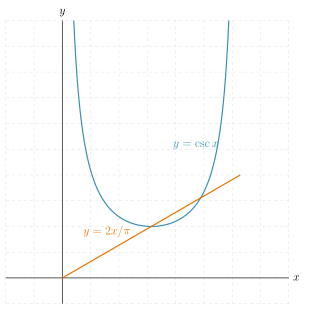
- Sketch on the same axes the functions \({\rm cosec}\, x\) and \(2x/ \pi\), for \(0 < x < \pi\,\). Deduce that the equation \(x\sin x = \pi/2 \) has exactly two roots in the interval \(0 < x < \pi\,\). Show that \[ \displaystyle \int_{\pi/2}^{\pi} \left \vert x\sin x - \frac{\pi} { 2} \right \vert \; \mathrm{d}x = 2\sin\alpha +\frac{3\pi^2} 4 - \alpha \pi -\pi -2\alpha \cos\alpha -1 \] where \(\alpha\) is the larger of the roots referred to above.
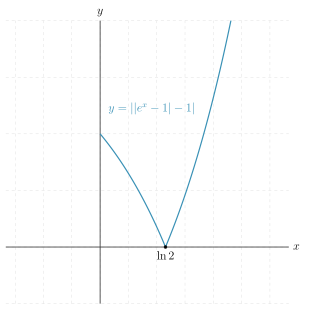
- Show that the region bounded by the positive \(x\)-axis, the \(y\)-axis and the curve \[y = \Bigl| \vert \e^x - 1 \vert - 1 \Bigr|\] has area \(\ln 4-1\).
Solution:
- \(\,\)
Notice that they are equal at \(1\) when \(x = \pi/2\), but this is a local minimum for \(\csc x\) whereas \(2x/\pi\) is increasing so there is a second intersection. Notice that \(\csc x = \frac{2x}{\pi} \Leftrightarrow x \sin x = \frac{\pi}{2}\) therefore our intersections are also the roots of \(x \sin x = \frac{\pi}{2}\) and the larger one is greater than \(\pi/2\) \begin{align*} && I &= \int_{\pi/2}^{\pi} \Bigl| x \sin x - \frac{\pi}{2} \Bigr| \d x \\ &&&= \int_{\pi/2}^{\alpha} \left ( x \sin x - \frac{\pi}{2} \right )\d x +\int_{\alpha}^{\pi} \left ( \frac{\pi}{2} -x \sin x \right) \d x \\ &&&= \left ( \pi - 2\alpha + \frac{\pi}{2}\right) \frac{\pi}{2} + \int_{\pi/2}^{\alpha} x \sin x\d x -\int_{\alpha}^{\pi} x \sin x \d x \\ &&&= \frac{3\pi^2}{4} - \alpha \pi + \left [-x \cos x \right]_{\pi/2}^{\alpha}+\left[x \cos x \right]_{\alpha}^{\pi} + \int_{\pi/2}^{\alpha} \cos x \d x - \int_{\alpha}^{\pi} \cos x \d x \\ &&&= \frac{3\pi^2}{4} - \alpha \pi -\alpha \cos \alpha -\pi -\alpha \cos \alpha+ \sin \alpha - 1+\sin \alpha \\ &&&= 2\sin \alpha + \frac{3\pi^2}{4} - \alpha \pi - 2\alpha \cos \alpha - 1 \end{align*}
- \(\,\)
\begin{align*} && A &= \int_0^{\ln 2} ||e^x-1|-1| \d x \\ &&&= \int_0^{\ln 2} |e^x-2| \d x \\ &&&=\int_0^{\ln 2} (2-e^x) \d x \\ &&&= 2 \ln 2 - \left [e^x \right]_0^{\ln 2} \\ &&&= \ln 4 - (2-1) = \ln 4 - 1 \end{align*}
2006 Paper 2 Q4
By making the substitution \(x=\pi-t\,\), show that \[ \! \int_0^\pi x\f(\sin x) \d x = \tfrac12 \pi \! \int_0^\pi \f(\sin x) \d x\,, \] where \(\f(\sin x)\) is a given function of \(\sin x\). Evaluate the following integrals:
- \(\displaystyle \int_0^\pi \frac {x \sin x}{3+\sin^2 x}\,\d x\,\);
- $\displaystyle \int_0^{2\pi} \frac {x \sin x}{3+\sin^2 x}\,\d x\,\(;
- \)\displaystyle \int_{0}^{\pi} \frac {x \big\vert\sin 2x\big\vert}{3+\sin^2 x}\,\d x\,$.
2005 Paper 1 Q14
The random variable \(X\) can take the value \(X=-1\), and also any value in the range \(0\le X <\infty\,\). The distribution of \(X\) is given by \[ \P(X=-1) =m \,, \ \ \ \ \ \ \ \P(0\le X\le x) = k(1-\e^{-x})\,, \] for any non-negative number \(x\), where \(k\) and \(m\) are constants, and \(m <\frac12\,\).
- Find \(k\) in terms of \(m\).
- Show that \(\E(X)= 1-2m\,\).
- Find, in terms of \(m\), \(\var (X)\) and the median value of \(X\).
- Given that \[ \int_0^\infty y^2 \e^{-y^2} \d y = \tfrac14 \sqrt{ \pi}\;,\] find \(\E\big(\vert X \vert^{\frac12}\big)\,\) in terms of \(m\).
Solution:
- We must have the total probability summing to \(1\), therefore \(1 =m + k\) (as \(x \to \infty\)) therefore \(k = 1-m\).
- \(\,\) \begin{align*} && \E[X] &= \mathbb{P}(X=-1) \cdot (-1) + \int_0^{\infty} kx e^{-x} \d x \\ &&&= -m + (1-m) = 1-2m \end{align*}
- \(\,\) \begin{align*} && \var[X] &= \E[X^2]-\E[X]^2 \\ &&&= \mathbb{P}(X=-1)\cdot(-1)^2 + (1-m)\int_0^{\infty} x^2e^{-x} \d x - (1-2m)^2 \\ &&&= m + (1-m)(1+1^2) - (1-2m)^2 \\ &&&= 3-4m - 1+4m -4m^2 \\ &&&= 2(1-m^2) \end{align*} To find the median \(q\), we need \begin{align*} && \frac12 &= \mathbb{P}(X \leq q) \\ &&&= m + (1-m)(1-e^{-q}) \\ \Rightarrow && e^{-q} &= 1-\frac{\frac12-m}{1-m} \\ &&&= \frac{1-m - \frac12+m}{1-m} \\ &&&= \frac{1}{2(1-m)} \\ \Rightarrow && q &= \ln 2(1-m) \end{align*}
- \(\,\) \begin{align*} && \E\left [|X|^{\frac12}\right] &= \mathbb{P}(X=-1) \cdot 1 + \int_0^{\infty} \sqrt{x} (1-m)e^{-x} \d x \\ &&&= m + (1-m)\int_0^\infty \sqrt{x} e^{-x} \d x \\ u^2 = x, \d x = 2u \d u : &&&= m + (1-m) \int_{u=0}^{u=\infty} u e^{-u^2} \cdot 2u \d u \\ &&&= m + 2(1-m) \int_0^{\infty} u^2 e^{-u^2} \d u \\ &&&= m + (1-m)\frac{\sqrt{\pi}}2 \end{align*}
2004 Paper 2 Q2
Prove that, if \(\vert \alpha\vert < 2\sqrt{2},\) then there is no value of \(x\) for which \begin{equation} x^2 -{\alpha}\vert x \vert + 2 < 0\;. \tag{\(*\)} \end{equation} Find the solution set of \((*)\) for \({\alpha}=3\,\). For \({\alpha} > 2\sqrt{2}\,\), the sum of the lengths of the intervals in which \(x\) satisfies \((*)\) is denoted by \(S\,\). Find \(S\) in terms of \({\alpha}\) and deduce that \(S < 2{\alpha}\,\). Sketch the graph of \(S\,\) against \(\alpha \,\).
Solution: There are two cases to consider by they are equivalent to \(x^2 \pm \alpha x + 2 < 0\), which has no solution solutions if \(\Delta < 0\), ie if \(\alpha^2 - 4\cdot1\cdot2 < 0 \Leftrightarrow |\alpha| < 2\sqrt{2}\). If \(\alpha = 3\), we have \begin{align*} && 0 & > x^2-3x+2 \\ &&&= (x-2)(x-1) \\ \Rightarrow && x & \in (1,2) \\ \\ && 0 &> x^2+3x+2 \\ &&& = (x+2)(x+1) \\ \Rightarrow && x &\in (-2,-1) \end{align*} Both cases work here, so \(x \in (-2, -1) \cup (1,2)\). \begin{align*} && 0 &> x^2 \pm \alpha x + 2 \\ &&&= (x \pm \tfrac{\alpha}{2})^2 -\frac{\alpha^2-8}{4} \end{align*} The potential intervals therefore are \((\frac{\alpha -\sqrt{\alpha^2-8}}{2}, \frac{\alpha +\sqrt{\alpha^2-8}}{2})\) and \((\frac{-\alpha -\sqrt{\alpha^2-8}}{2}, \frac{-\alpha +\sqrt{\alpha^2-8}}{2})\). Neither of these intervals overlap with \(0\), since \(\alpha^2 > \alpha^2-8\), and their lengths are both \(\sqrt{\alpha^2-8}\), therefore \(S = 2\sqrt{\alpha^2-8} < 2\alpha\)

2003 Paper 2 Q6
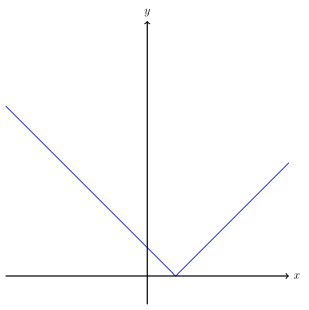
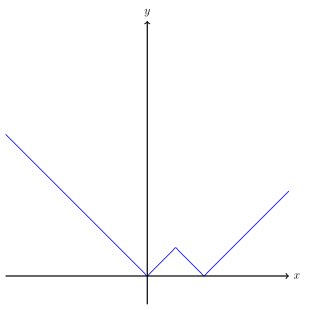
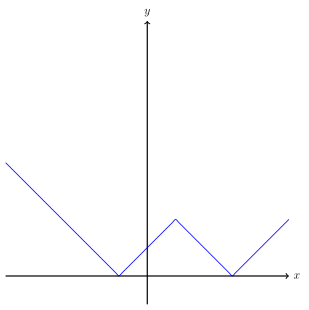
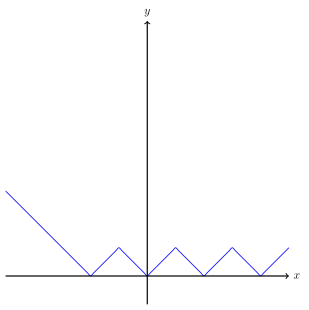
The function \(\f\) is defined by $$ \f(x)= \vert x-1 \vert\;, $$ where the domain is \({\bf R}\,\), the set of all real numbers. The function \(\g_n =\f^n\), with domain \({\bf R}\,\), so for example \(\g_3(x) = \f(\f(\f(x)))\,\). In separate diagrams, sketch graphs of \(\g_1\,\), \(\g_2\,\), \(\g_3\,\) and \(\g_4\,\). The function \(\h\) is defined by \[ \h(x) = |\sin {{{\pi}x} \over 2}|, \] where the domain is \({\bf R}\,\). Show that if \(n\) is even, \[ \int_0^n\,\big( \h(x)-\g_n(x)\big)\,\d x = \frac{2n}{\pi} -\frac{n}2\;. \]
Solution:
2002 Paper 2 Q8
Find \(y\) in terms of \(x\), given that: \begin{eqnarray*} \mbox{for \(x < 0\,\)}, && \frac{\d y}{\d x} = -y \mbox{ \ \ and \ \ } y = a \mbox{ when } x = -1\;; \\ \mbox{for \(x > 0\,\)}, && \frac{\d y}{\d x} = y \mbox{ \ \ \ \ and \ \ } y = b \ \mbox{ when } x = 1\;. \end{eqnarray*} Sketch a solution curve. Determine the condition on \(a\) and \(b\) for the solution curve to be continuous (that is, for there to be no `jump' in the value of \(y\)) at \(x = 0\). Solve the differential equation \[ \frac{\d y}{\d x} = \left\vert \e^x-1\right\vert y \] given that \(y=\e^{\e}\) when \(x=1\) and that \(y\) is continuous at \(x=0\,\). Write down the following limits: \ \[ \text{(i)} \ \ \lim_ {x \to +\infty} y\exp(-\e^x)\;; \ \ \ \ \ \ \ \ \ \text{(ii)} \ \ \lim_{x \to -\infty}y \e^{-x}\,. \]
2000 Paper 1 Q8
Show that \[ \int_{-1}^1 \vert \, x\e^x \,\vert \d x =- \int_{-1}^0 x\e^x \d x + \int_0^1 x\e^x \d x \] and hence evaluate the integral. Evaluate the following integrals:
- \(\displaystyle \int_0^4 \vert\, x^3-2x^2-x+2 \,\vert \, \d x\,;\)
- \(\displaystyle \int_{-\pi}^\pi \vert\, \sin x +\cos x \,\vert \; \d x\,.\)
Solution: \begin{align*} && \int_{-1}^1 |x e^x |\d x &= \int_{-1}^0 |xe^x| \d x + \int_0^1 |xe^x| \d x \\ &&&= \int_{-1}^0 -xe^x \d x + \int_0^1 x \e^x \d x \\ &&&= -\int_{-1}^0 xe^x \d x + \int_0^1 x \e^x \d x \\ \\ && \int xe^x \d x &= xe^x - \int e^x \d x \\ &&&= xe^x - e^x \\ \\ \Rightarrow && \int_{-1}^1 |x e^x |\d x &= \left [ xe^x - e^x \right]_0^{-1}+ \left [ xe^x - e^x \right]_0^{1} \\ &&&= -e^{-1}-e^{-1} +e^{0} + e^1 - e^1 +e^0 \\ &&&= 2-2e^{-1} \end{align*}
- \(\,\) \begin{align*} && I &= \int_0^4 | x^3-2x^2-x+2| \d x \\ &&&= \int_0^4 |(x-2)(x-1)(x+1)| \d x\\ &&&= \int_0^1( x^3-2x^2-x+2) \d x- \int_1^2 ( x^3-2x^2-x+2) \d x + \int_2^4 ( x^3-2x^2-x+2) \d x \\ &&&= \left [\frac14 x^4-\frac23 x^3- \frac12 x^2 +2x \right]_0^1 - \left [\frac14 x^4-\frac23 x^3- \frac12 x^2 +2x \right]_1^2 + \left [\frac14 x^4-\frac23 x^3- \frac12 x^2 +2x \right]_2^4 \\ &&&= 2 \left ( \frac14 - \frac23 -\frac12 + 2\right) - 2 \left ( \frac14 2^4 - \frac23 2^3 -\frac12 2^2 + 2 \cdot 2\right)+ \left ( \frac14 4^4 - \frac23 4^3 -\frac12 4^2 + 2 \cdot 4\right) \\ &&&= \frac{133}{6} \end{align*}
- \(\,\) \begin{align*} && J &= \int_{-\pi}^\pi | \sin x + \cos x | \d x \\ &&&= \int_{-\pi}^{\pi} | \sqrt{2} \sin(x + \tfrac{\pi}{4})| \d x \\ &&&= 2\sqrt{2}\int_0^\pi \sin x \d x \\ &&&= 4\sqrt{2} \end{align*}
1999 Paper 1 Q4
Sketch the following subsets of the \(x\)-\(y\) plane:
- \(|x|+|y|\le 1\) ;
- \(|x-1|+|y-1|\le 1 \) ;
- \(|x-1|-|y+1|\le 1 \) ;
- \(|x|\, |y-2|\le 1\) .
Solution:


1994 Paper 2 Q5
- Show that the equation \[ (x-1)^{4}+(x+1)^{4}=c \] has exactly two real roots if \(c>2,\) one root if \(c=2\) and no roots if \(c<2\).
- How many real roots does the equation \(\left(x-3\right)^{4}+\left(x-1\right)^{4}=c\) have?
- How many real roots does the equation \(\left|x-3\right|+\left|x-1\right|=c\) have?
- How many real roots does the equation \(\left(x-3\right)^{3}+\left(x-1\right)^{3}=c\) have?
Solution:
- \(\,\) \begin{align*} && c &= (x-1)^4+(x+1)^4 \\ &&&= 2x^4+12x^2+2 \\ \Rightarrow && 0 &= (x^2+6)^2-\frac{c}{2} - 35 \\ \Rightarrow && \underbrace{x^2+6}_{\geq 6} &= \pm \sqrt{35 + \frac{c}{2}}\\ \end{align*} Therefore there are two solutions if \(c > 2\), one solution if \(c = 2\) and no solutions otherwise.
- \(\,\) This equation is the same equation if \(y = x-2\), ie there are two solutions if \(c > 2\), one solution if \(c = 2\) and no solutions otherwise.
- Rewriting as \(|x-1|+|x+1| = c\) we have For \(x < -1\): \(1-x-1-x = -2x\) For \(-1 \leq x \leq 1\): \(1-x+x+1 = 2\) For \(x > 1\): \(x-1+x+1 = 2x\) Therefore there are infinitely many solutions if \(c = 2\) (the interval \([-3,-1]\)), two solutions if \(c > 2\) and none otherwise.
- Rewriting as \((x-1)^3+(x+1)^3\) we have \(x^3+6x = c\). Notice that \(3x^2+6 > 0\) so the function is increasing, ie there is one solution for all \(c\)