Problems
Filters
21 problems found
2022 Paper 3 Q1
Let \(C_1\) be the curve given by the parametric equations \[ x = ct\,, \quad y = \frac{c}{t}\,, \] where \(c > 0\) and \(t \neq 0\), and let \(C_2\) be the circle \[ (x-a)^2 + (y-b)^2 = r^2\,. \] \(C_1\) and \(C_2\) intersect at the four points \(P_i\) (\(i = 1,2,3,4\)), and the corresponding values of the parameter \(t\) at these points are \(t_i\).
- Show that \(t_i\) are the roots of the equation \[ c^2 t^4 - 2act^3 + (a^2 + b^2 - r^2)t^2 - 2bct + c^2 = 0\,. \qquad (*) \]
- Show that \[ \sum_{i=1}^{4} t_i^2 = \frac{2}{c^2}(a^2 - b^2 + r^2) \] and find a similar expression for \(\displaystyle\sum_{i=1}^{4} \frac{1}{t_i^2}\).
- Hence show that \(\displaystyle\sum_{i=1}^{4} OP_i^2 = 4r^2\), where \(OP_i\) denotes the distance of the point \(P_i\) from the origin.
- Suppose that the curves \(C_1\) and \(C_2\) touch at two distinct points. By considering the product of the roots of \((*)\), or otherwise, show that the centre of circle \(C_2\) must lie on either the line \(y = x\) or \(y = -x\).
Solution:
- Suppose \((ct, c/t)\) is on \(C_2\) then \begin{align*} && r^2 &= \left ( ct - a \right)^2 + \left ( \frac{c}{t} - b \right)^2 \\ &&&= c^2t^2 - 2cta + a^2 + \frac{c^2}{t^2} - \frac{2cb}{t} + b^2 \\ \Rightarrow && 0 &= c^2t^4 - 2act^3 + (a^2+b^2-r^2)t^2 - 2bct + c^2 \end{align*}
- Notice that \(\displaystyle \sum t_i = \frac{2a}{c}\) and \(\displaystyle \sum t_it_j = \frac{a^2+b^2-r^2}{c^2}\) so \begin{align*} && \sum t_i^2 &= \left ( \sum t_i \right)^2 - 2 \sum t_it_j \\ &&&= \frac{4a^2}{c^2} - \frac{2a^2+2b^2-2r^2}{c^2} \\ &&&= \frac{2}{c^2} \left (a^2 - b^2 + r^2 \right) \end{align*} Note that \(\frac{1}{t}\) are roots of the \(c^2 - 2act + (a^2+b^2-r^2)t^2 - 2bct^3 + c^2t^4 = 0\) which is the same equation but with \(a \leftrightarrow b\) so \(\displaystyle \sum \frac{1}{t_i^2} = \frac{2}{c^2} (b^2 - a^2 + r^2)\)
- Therefore \begin{align*} && \sum_{i=1}^4 OP_i^2 &= \sum_{i=1}^4 \left (c^2t_i^2 + \frac{c^2}{t_i^2} \right) \\ &&&= 2(a^2-b^2+r^2) + 2(b^2-a^2+r^2) \\ &&&= 4r^2 \end{align*}
- If they touch at two distinct points it must be the case that \(t_1 = t_2\) and \(t_3 = t_4\). We must also have \(t_1t_2t_3t_4 = t_1^2t_3^2 = 1\) so \(t_1t_3 = \pm 1\). Therefore our points are \((ct_1, \frac{c}{t_1})\) and \(\pm(\frac{c}{t_1}, ct_1)\) but these are reflections in \(y = \pm x\). But if these two points are reflections of one another the line of reflection is the perpendicular bisector, which must run through the centre of the circle.
2019 Paper 3 Q4
The \(n\)th degree polynomial P\((x)\) is said to be reflexive if:
- P\((x)\) is of the form \(x^n - a_1x^{n-1} + a_2x^{n-2} - \cdots + (-1)^na_n\) where \(n \geq 1\);
- \(a_1, a_2, \ldots, a_n\) are real;
- the \(n\) (not necessarily distinct) roots of the equation P\((x) = 0\) are \(a_1, a_2, \ldots, a_n\).
- Find all reflexive polynomials of degree less than or equal to 3.
- For a reflexive polynomial with \(n > 3\), show that $$2a_2 = -a_2^2 - a_3^2 - \cdots - a_n^2.$$ Deduce that, if all the coefficients of a reflexive polynomial of degree \(n\) are integers and \(a_n \neq 0\), then \(n \leq 3\).
- Determine all reflexive polynomials with integer coefficients.
Solution:
- Suppose \(n = 1\), then all polynomials are reflexive (since \(x - a_1\) has the root \(a_1\). Suppose \(n = 2\), then we want \begin{align*} && x^2-a_1x+a_2 &= (x-a_1)(x-a_2) \\ &&&= x^2-(a_1+a_2)x+a_1a_2 \\ \Rightarrow && a_2 &= 0 \\ \end{align*} So all polynomials of the form \(x^2-a_1x\) work and no others. Suppose \(n = 3\) then we want \begin{align*} && x^3-a_1x^2+a_2x-a_3 &= (x-a_1)(x-a_2)(x-a_3) \\ &&&= x^3-(a_1+a_2+a_3)x+(a_1a_2+a_1a_3+a_2a_3)x-a_1a_2a_3 \\ \Rightarrow && a_2+a_3 &= 0 \\ && a_2a_3 &= a_2 \\ \Rightarrow && -a_2^2 &= a_2 \\ \Rightarrow && a_2 &= 0, -1 \\ && -a_1a_2^2 &= -a_2 \\ \Rightarrow && a_2 &= 0, a_2 = 1/a_1 \end{align*} So we need either \(x^3-a_1x\) or \((x+1)^2(x-1) = x^3+x^2-x-1\)
- Suppose \(n > 3\) then \begin{align*} && \sum a_i^2 &= \left (\sum a_i \right)^2 - 2 \sum_{i < j} a_i a_j \\ && &= a_1^2 - 2a_2 \\ \Rightarrow && 2a_2 &= a_1^2 - \sum a_i^2 \\ &&&= -a_2^2 - a_3^2 - \cdots - a_n^2 \end{align*} So \((a_2+1)^2 = 1-a_3^2 -\cdots -a_n^2\) so if \(a_n > 0\) (or any other \(a_i, i > 2\) for that matter) then we must have \(a_n = \pm 1, a_{3}, \ldots a_{n-1} = 0\), but if \(a_n = \pm 1\) \(x = 0\) is not a root. Therefore we must have \(a_0\) and \(a_i = 0\) for all \(i > 3\)
- The only reflexive polynomials therefore must be \(x^n - kx^{n-1}\) and \(x^{n+3}+x^{n+2}-x^{n+1}-x^n\)
2018 Paper 3 Q1
- The function \(\f\) is given by \[ \f(\beta)=\beta - \frac 1 \beta - \frac 1 {\beta^2} \ \ \ \ \ \ \ \ (\beta\ne0) \,. \] Find the stationary point of the curve \(y=\f(\beta)\,\) and sketch the curve. Sketch also the curve \(y=\g(\beta)\,\), where \[ \g(\beta) = \beta + \frac 3 \beta - \frac 1 {\beta^2} \ \ \ \ \ \ \ \ (\beta\ne0)\,. \]
- Let \(u\) and \(v\) be the roots of the equation \[ x^2 +\alpha x +\beta = 0 \,, \] where \(\beta\ne0\,\). Obtain expressions in terms of \(\alpha\) and \(\beta\) for \(\displaystyle u+v + \frac 1 {uv}\) and \( \displaystyle \frac 1 u + \frac 1 v + uv\,\).
- Given that \(\displaystyle u+v + \frac 1 {uv} = -1\,\), and that \(u\) and \(v\) are real, show that \(\displaystyle \frac 1 u+ \frac 1 v + {uv} \le -1\;\).
- Given instead that \(\displaystyle u+v + \frac 1 {uv} = 3 \;\), and that \(u\) and \(v\) are real, find the greatest value of \(\displaystyle \frac 1 u+ \frac 1v + {uv}\,\).
Solution:
- \begin{align*}
&& f(\beta) &= \beta - \frac1{\beta}-\frac1{\beta^2} \\
\Rightarrow && f'(\beta) &= 1 +\frac{1}{\beta^2}+\frac{2}{\beta^3} \\
\Rightarrow && 0 &= f'(\beta) \\
&&&= 1 + \frac1{\beta^2} + \frac{2}{\beta^3} \\
\Rightarrow && 0 &= \beta^3 + \beta + 2 \\
&&&= (\beta+1)(\beta^2-\beta+2)
\end{align*}
Therefore the only stationary point is at \(\beta = -1, f(-1) = -1\)
\begin{align*} && g(\beta) &= \beta + \frac3{\beta}-\frac1{\beta^2} \\ \Rightarrow && g'(\beta) &= 1 -\frac{3}{\beta^2}+\frac{2}{\beta^3} \\ \Rightarrow && 0 &= f'(\beta) \\ &&&= 1 - \frac3{\beta^2} + \frac{2}{\beta^3} \\ \Rightarrow && 0 &= \beta^3 - 3\beta + 2 \\ &&&= (\beta-1)^2(\beta+2) \end{align*} Therefore there are stationary points at \(\beta=1,f(1) = 3, \beta=-2, f(-2) = \frac14\)
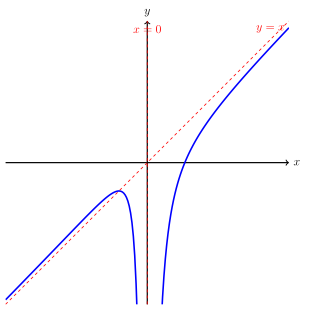
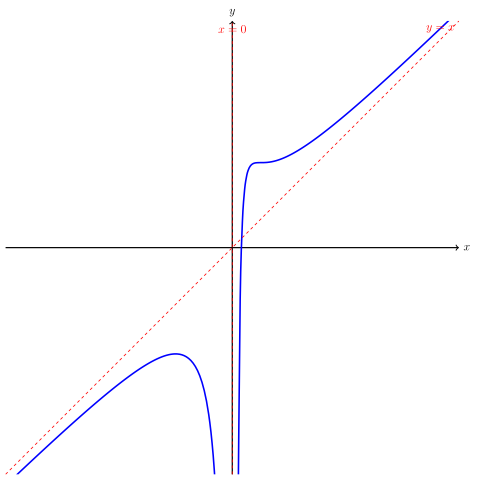
- Let \(u,v\) be the roots of \(x^2 + \alpha x + \beta = 0\), then since \((x-u)(x-v) = 0\) we must have \(\alpha = -(u+v), \beta = uv\). Therefore: \begin{align*} && u+v +\frac{1}{uv} &= -\alpha + \frac{1}{\beta} \\ && \frac1u+\frac1v + uv &= \frac{u+v}{uv} + uv \\ &&&= -\frac{\alpha}{\beta} + \beta \end{align*} Given \(u+v + \frac 1 {uv} = -1\), ie \(-\alpha + \frac{1}{\beta} = -1\). Since the roots are real, we must also have that \(\alpha^2 - 4\beta \geq 0\), so \begin{align*} && -\alpha + \frac1\beta &= -1 \\ \Rightarrow && \alpha &= 1 +\frac1\beta \\ \Rightarrow && -\frac{\alpha}{\beta}+\beta &= -\frac{1}{\beta} \l1+\frac1{\beta}\r + \beta \\ &&&=\beta - \frac{1}{\beta}-\frac{1}{\beta^2} \end{align*} So we want to maximise \(f(\beta)\) subject to \(\alpha ^2 - 4\beta \geq 0\) \begin{align*} && 0 &\leq \alpha^2 -4 \beta \\ &&&= \l 1 + \frac1{\beta} \r^2 - 4\beta \\ &&&= 1+ \frac2{\beta} + \frac1{\beta^2} - 4\beta \\ \Leftrightarrow && 0 &\leq -4\beta^3+\beta^2 + 2\beta + 1 \\ &&&=-(\beta-1)(4\beta^2+3\beta+1)\\ \Leftrightarrow && \beta &\leq 1 \end{align*} But we know \(f(\beta) \leq -1\) on \((-\infty,1]\) so we're done.
- Given that \(-\alpha + \frac{1}{\beta} = 3\) we have \begin{align*} && -\alpha + \frac1\beta &= 3 \\ \Rightarrow && \alpha &= -3 +\frac1\beta \\ \Rightarrow && -\frac{\alpha}{\beta}+\beta &= -\frac{1}{\beta} \l-3+\frac1{\beta}\r + \beta \\ &&&=\beta + \frac{3}{\beta}-\frac{1}{\beta^2} \end{align*} which we want to maximise, subject to: \begin{align*} && 0 &\leq \alpha^2 -4 \beta \\ &&&= \l -3 + \frac1{\beta} \r^2 - 4\beta \\ &&&= 9- \frac6{\beta} + \frac1{\beta^2} - 4\beta \\ \Leftrightarrow && 0 &\leq -4\beta^3+9\beta^2 - 6\beta + 1 \\ &&&=-(\beta-1)^2(4\beta-1)\\ \Leftrightarrow && \beta &\leq \frac14 \end{align*} Therefore the maximum will either be \(f(-2) = \frac14\) or \(f(\frac14) = -\frac{15}4\). Therefore the maximum is \(\frac14\)
2017 Paper 3 Q3
Let \(\alpha\), \(\beta\), \(\gamma\) and \(\delta\) be the roots of the quartic equation \[ x^4 +px^3 +qx^2 +r x +s =0 \,. \] You are given that, for any such equation, \(\,\alpha \beta + \gamma\delta\,\), \(\alpha\gamma+\beta\delta\,\) and \(\,\alpha \delta + \beta\gamma\,\) satisfy a cubic equation of the form \[ y^3+Ay^2+ (pr-4s)y+ (4qs-p^2s -r^2) =0 \,. \] Determine \(A\). Now consider the quartic equation given by \(p=0\,\), \(q= 3\,\), \(r=-6\,\) and \(s=10\,\).
- Find the value of \(\alpha\beta + \gamma \delta\), given that it is the largest root of the corresponding cubic equation.
- Hence, using the values of \(q\) and \(s\), find the value of \((\alpha +\beta)(\gamma+\delta)\,\) and the value of \(\alpha\beta\) given that \(\alpha\beta >\gamma\delta\,\).
- Using these results, and the values of \(p\) and \(r\), solve the quartic equation.
Solution: \begin{align*} A &= -(\alpha \beta + \gamma\delta + \alpha\gamma+\beta\delta+\alpha \delta + \beta\gamma) \\ &= -q \end{align*}
- The corresponding cubic equation is: \begin{align*} && 0 &= y^3 - 3y^2-40y+(120-36) \\ &&&= y^3 -3y^2 - 40y + 84 \\ &&&= (y-7)(y-2)(y+6) \end{align*} Therefore \(\alpha\beta + \gamma \delta = 7\)
- \begin{align*}(\alpha+\beta)(\gamma+\delta) &= \alpha \gamma + \alpha \delta + \beta \gamma + \beta \delta \\ &= 3 -(\alpha\beta + \gamma\delta) \\ &=3-7 = -4 \end{align*} Let \(\alpha\beta\) and \(\gamma\delta\) be the roots of a quadratic; then the quadratic will be \(t^2-7t+10 = 0 \Rightarrow t = 2,5\) so \(\alpha\beta = 5\)
- \(\alpha\beta = 5, \gamma\delta = 2\) Consider the quadratic with roots \(\alpha+\beta\) and \(\gamma+\delta\), then \(t^2-4 = 0 \Rightarrow t = \pm 2\). Suppose \(\alpha+\beta = 2, \gamma+\delta=-2\) then \(\alpha, \beta = 1 \pm 2i, \gamma,\delta = -1 \pm i\) \(\alpha \beta \gamma + \beta\gamma\delta + \gamma\delta\alpha + \delta\alpha\beta = 5\gamma + 2\beta + 2\alpha + 5\delta = -6 \neq 6\) Suppose \(\alpha+\beta = -2, \gamma+\delta=2\) then \(\alpha, \beta = -1 \pm 2i, \gamma,\delta = 1 \pm i\) \(\alpha \beta \gamma + \beta\gamma\delta + \gamma\delta\alpha + \delta\alpha\beta = 5\gamma + 2\beta + 2\alpha + 5\delta = 6\), therefore these are there roots. (In some order): \(1 \pm i, -1 \pm 2i\)
2017 Paper 3 Q7
Show that the point \(T\) with coordinates \[ \left( \frac{a(1-t^2)}{1+t^2} \; , \; \frac{2bt}{1+t^2}\right) \tag{\(*\)} \] (where \(a\) and \(b\) are non-zero) lies on the ellipse \[ \frac{x^2}{a^2} + \frac{y^2}{b^2} =1 \,. \]
- The line \(L\) is the tangent to the ellipse at \(T\). The point \((X,Y)\) lies on \(L\), and \(X^2\ne a^2\). Show that \[ (a+X)bt^2 -2aYt +b(a-X) =0 \,.\] Deduce that if \(a^2Y^2>(a^2-X^2)b^2\), then there are two distinct lines through \((X,Y)\) that are tangents to the ellipse. Interpret this result geometrically. Show, by means of a sketch, that the result holds also if \(X^2=a^2\,\).
- The distinct points \(P\) and \(Q\) are given by \((*)\), with \(t=p\) and \(t=q\), respectively. The tangents to the ellipse at \(P\) and \(Q\) meet at the point with coordinates \((X,Y)\), where \(X^2\ne a^2\,\). Show that \[ (a+X)pq = a-X\] and find an expression for \(p+q\) in terms of \(a\), \(b\), \(X\) and \(Y\). Given that the tangents meet the \(y\)-axis at points \((0,y_1)\) and \((0,y_2)\), where \(y_1+y_2 = 2b\,\), show that \[ \frac{X^2}{a^2} +\frac{Y}{b}= 1 \,. \]
Solution:
- The tangent has equation:
\begin{align*}
&& 0 &= \frac{Xx}{a^2} + \frac{Yy}{b^2} -1 \\
\Rightarrow &&&= \frac{Xa(1-t^2)}{a^2(1+t^2)} + \frac{Y2bt}{b^2(1+t^2)} - 1 \\
\Rightarrow &&0&= Xb(1-t^2) + Y2at - ab(1+t^2)\\
&&&= -(b(a+X)t^2 -2aYt +b(a-X)) \\
\Rightarrow && 0 &= (a+X)bt^2-2aYt+b(a-X) \\
\\
&& 0 <\Delta &= 4a^2Y^2 - 4(a+X)b(a-X)b \\
&&&= 4(a^2Y^2-b^2(a^2-X^2)) \\
\Leftrightarrow && a^2Y^2 &> (a^2-X^2)b^2
\end{align*}
Therefore there are two roots to the quadratic, ie two values of the parameter \(t\) which works. The condition is equivalent to \(\frac{X^2}{a^2} + \frac{Y^2}{b^2} > 1\). ie from any point outside the ellipse there are two tangent lies.
Clearly there are two tangents when \(X = \pm a\) (except \((X,Y) = (\pm a, 0)\).
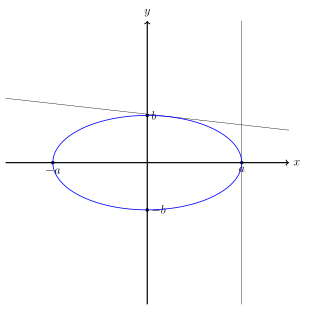
- We must have \(p\) and \(q\) are roots of \(0 = (a+X)bt^2-2aYt+b(a-X)\), ie \(pq = \frac{b(a-X)}{(a+X)b} \Rightarrow (a+X)pq = a-X\). Similarly \(p+q = \frac{2aY}{(a+X)b}\) Given that the tangents meet the \(y\)-axis at \((0, y_i)\) we must have \(abt^2-2ay_it + ab = 0\), so \begin{align*} && 0 &= abp^2-2ay_1p + ab \\ && 0 &= abq^2-2ay_2q + ab \\ \Rightarrow && y_1 &= \frac{ab(p^2+1)}{2ap} \\ && y_2 &= \frac{ab(q^2+1)}{2aq} \\ \Rightarrow && 2b &= \frac{ab(p^2+1)}{2ap} +\frac{ab(q^2+1)}{2aq} \\ &&&= \frac{ab(pq(p+q)+p+q)}{2apq} \\ \Rightarrow && 4pq &= pq(p+q)+p+q \\ \Rightarrow && 4 \frac{b(a-X)}{(a+X)b} &= \frac{2aY}{(a+X)b} \left ( \frac{b(a-X)}{(a+X)b} + 1 \right) \\ && &= \frac{2aY}{(a+X)b} \frac{2ab}{(a+X)b} \\ \Rightarrow && 4b^2(a^2-X^2) &= 4a^2bY \\ \Rightarrow && 1 &= \frac{Y}{b} + \frac{X^2}{a^2} \end{align*} as required.
2013 Paper 2 Q3
- Given that the cubic equation \(x^3+3ax^2 + 3bx +c=0\) has three distinct real roots and \(c<0\), show with the help of sketches that either exactly one of the roots is positive or all three of the roots are positive.
- Given that the equation \(x^3 +3ax^2+3bx+c=0\) has three distinct real positive roots show that \begin{equation*} a^2>b>0, \ \ \ \ a<0, \ \ \ \ c<0\,. \tag{\(*\)} \end{equation*} [Hint: Consider the turning points.]
- Given that the equation \(x^3 +3ax^2+3bx+c=0\) has three distinct real roots and that \begin{equation*} ab<0, \ \ \ \ c>0\,, \end{equation*} determine, with the help of sketches, the signs of the roots.
- Show by means of an explicit example (giving values for \(a\), \(b\) and \(c\)) that it is possible for the conditions (\(*\)) to be satisfied even though the corresponding cubic equation has only one real root.
Solution:
- First notice that this cubic has leading first term \(1\) and three real roots, so it must have the shape:
With the \(x\)-axis running somewhere between the dashed lines. Since \(c < 0\), the \(y\)-axis must meet the curve below the \(x\)-axis, ie somewhere on the blue section of this curve:
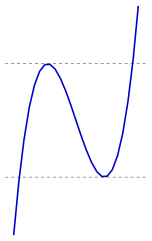 Therefore there will be either \(1\) (if it meets it in the \(\cup\) area) or \(3\) (if it meets it on the far left) positive roots.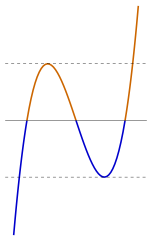
- First notice that if \(c > 0\) we cannot have three positive real roots since the function would need to pass \(0\) between \(0\) and \(-\infty\). Secondly, notice both turning points must be larger than zero, ie \begin{align*} && 0 &= 3x^2 + 6ax + 3b \\ \Leftrightarrow && 0 &= (x+a)^2 + b - a^2 \end{align*} has both roots larger than zero, (and it needs to have two roots, so \(a^2 > b\) and \(-a > 0\), ie \(a < 0\). If \(b < 0\), then just looking at \(x^2+2ax+b\) we can see that it is \(<0\) at \(0\) and one of the roots will be negative, therefore \(c < 0\), \(a^2 > b > 0\) and \(a < 0\)
- Since \(c > 0\) we can see that at least one root is negative.
ie the \(y\)-axis passes through an orange section of this curve. What now matters is where the larger turning point is. Considering \(x^2 + 2ax + b\), we notice that \(ab < 0\) means that \((x-\alpha)(x-\beta)\) we must have \((\alpha + \beta)\alpha \beta > 0\) which isn't possible if both roots are negative. Therefore the \(y\)-axis passes through the orange \(\cap\) and there are \(2\) positive real roots.
- If we take \(a = 1, b = -1, c = 1\) then we have \(x^3 + 3x^2-3x+1\). This has turning points when \(x^2+2x-1 = 0\), ie \(x = -1 \pm \sqrt{2}\) Notice that \begin{align*} && y(-1\pm \sqrt2) &= (-1 \pm \sqrt{2})^3 + 3(-1 \pm \sqrt{2})^2-3(-1 \pm \sqrt{2}) + 1 \\ &&&= (-1\pm \sqrt{2}) \cdot (3 \mp 2\sqrt2) + 3(3 \mp \sqrt2) -3(-1\pm \sqrt2) + 1 \\ &&&= (-7 \pm 5 \sqrt2) + (9 \mp 3\sqrt2) +(3 \mp 3\sqrt2) + 1 \\ &&&= 24 \mp 16\sqrt2 = 8(3 \mp 2 \sqrt2) >0 \end{align*} ie both turning points are above zero and hence only one real root
2010 Paper 2 Q7
- By considering the positions of its turning points, show that the curve with equation \[ y=x^3-3qx-q(1+q)\,, \] where \(q>0\) and \(q\ne1\), crosses the \(x\)-axis once only.
- Given that \(x\) satisfies the cubic equation \[ x^3-3qx-q(1+q)=0\,, \] and that \[ x=u+q/u\,, \] obtain a quadratic equation satisfied by \(u^3\). Hence find the real root of the cubic equation in the case \(q>0\), \(q\ne1\).
- The quadratic equation \[ t^2 -pt +q =0\, \] has roots \(\alpha \) and \(\beta\). Show that \[ \alpha^3+\beta^3 = p^3 -3qp\,. \] It is given that one of these roots is the square of the other. By considering the expression \((\alpha^2 -\beta)(\beta^2-\alpha)\), find a relationship between \(p\) and \(q\). Given further that \(q>0\), \(q\ne1\) and \(p\) is real, determine the value of \(p\) in terms of \(q\).
2009 Paper 3 Q1
The points \(S\), \(T\), \(U\) and \(V\) have coordinates \((s,ms)\), \((t,mt)\), \((u,nu)\) and \((v,nv)\), respectively. The lines \(SV\) and \(UT\) meet the line \(y=0\) at the points with coordinates \((p,0)\) and \((q,0)\), respectively. Show that \[ p = \frac{(m-n)sv}{ms-nv}\,, \] and write down a similar expression for \(q\). Given that \(S\) and \(T\) lie on the circle \(x^2 + (y-c)^2 = r^2\), find a quadratic equation satisfied by \(s\) and by \(t\), and hence determine \(st\) and \(s+t\) in terms of \(m\), \(c\) and \(r\). Given that \(S\), \(T\), \(U\) and \(V\) lie on the above circle, show that \(p+q=0\).
2007 Paper 3 Q1
In this question, do not consider the special cases in which the denominators of any of your expressions are zero. Express \(\tan(\theta_1+\theta_2+\theta_3+\theta_4)\) in terms of \(t_i\), where \(t_1=\tan\theta_1\,\), etc. Given that \(\tan\theta_1\), \(\tan\theta_2\), \(\tan\theta_3\) and \(\tan\theta_4\) are the four roots of the equation \[at^4+bt^3+ct^2+dt+e=0 \] (where \(a\ne0\)), find an expression in terms of \(a\), \(b\), \(c\), \(d\) and \(e\) for \(\tan(\theta_1+\theta_2+\theta_3+\theta_4)\). The four real numbers \(\theta_1\), \(\theta_2\), \(\theta_3\) and \(\theta_4\) lie in the range \(0\le \theta_i<2\pi\) and satisfy the equation \[ p\cos2\theta+\cos(\theta-\alpha)+p=0\,,\] where \(p\) and \(\alpha\) are independent of \(\theta\). Show that \(\theta_1+\theta_2+\theta_3+\theta_4=n\pi\) for some integer \(n\).
Solution: \begin{align*} \tan(\theta_1 + \theta_2 + \theta_3 + \theta_4) &= \frac{\tan(\theta_1 + \theta_2) + \tan(\theta_3 + \theta_4)}{1 - \tan(\theta_1 +\theta_2)\tan(\theta_3+\theta_4)} \\ &= \frac{\frac{t_1+t_2}{1-t_1t_2}+\frac{t_3+t_4}{1-t_3t_4}}{1-\frac{t_1+t_2}{1-t_1t_2}\frac{t_3+t_4}{1-t_3t_4}} \\ &= \frac{(t_1+t_2)(1-t_3t_4)+(t_3+t_4)(1-t_1t_2)}{(1-t_1t_2)(1-t_3t_4)-(t_1+t_2)(t_3+t_4)} \\ &= \frac{t_1 +t_2+t_3+t_4 - (t_1t_2t_3+t_1t_2t_4+t_1t_3t_4+t_2t_3t_4)}{1-t_1t_2-t_1t_3-t_1t_4-t_2t_3-t_2t_4-t_3t_4} \end{align*} If \(t_1, t_2, t_3, t_4\) are the roots of \(at^4+bt^3+ct^2+dt+e = 0\), then \(t_1+t_2+t_3+t_4 = -\frac{b}{a}, t_1t_2+t_1t_3+t_1t_4+t_2t_3+t_2t_4+t_3t_4 = \frac{c}{a}, t_1t_2t_3+t_1t_2t_4+t_1t_3t_4+t_2t_3t_4 = -\frac{d}{a}\), therefore the expression is: \begin{align*} \tan(\theta_1 + \theta_2 + \theta_3 + \theta_4) &= \frac{-\frac{b}{a}+\frac{d}{a}}{1 - \frac{c}{a}} \\ &= \frac{d-b}{a-c} \end{align*} \begin{align*} &&0 &= p \cos 2\theta + \cos (\theta - \alpha) + p \\ &&&= p (2\cos^2 \theta -1) + \cos \theta \cos \alpha - \sin \theta \sin \alpha + p \\ &&&= 2p \cos^2 \theta + \cos \theta \cos \alpha - \sin \theta \sin \alpha\\ \Rightarrow && 0 &=2p \cos \theta + \cos \alpha - \tan \theta \sin \alpha \\ \Rightarrow && -2p \cos \theta&= \cos \alpha - \tan \theta \sin \alpha \\ \Rightarrow && 4p^2 \cos^2 \theta &= \cos^2 \alpha - 2 \sin \alpha \cos \alpha \tan \theta + \sin^2 \alpha \tan^2 \theta \\ && 4p^2 \frac{1}{1 + \tan^2 \theta} &= \cos^2 \alpha - \sin 2\alpha \tan \theta + \sin^2 \alpha \tan^2 \theta \\ \Rightarrow && 4p^2 &= \cos^2 \alpha - \sin 2\alpha t+t^2-\sin2\alpha t^3+\sin^2 \alpha t^4 \\ \Rightarrow && \tan (\theta_1+\theta_2 + \theta_3+ \theta_4) &= \frac{0}{\sin^2 \alpha - 1} \\ &&&= 0 \\ \Rightarrow && \theta_1 + \theta_2 + \theta_3 + \theta_4 &= n\pi \end{align*}
2006 Paper 3 Q5
Show that the distinct complex numbers \(\alpha\), \(\beta\) and \(\gamma\) represent the vertices of an equilateral triangle (in clockwise or anti-clockwise order) if and only if \[ \alpha^2 + \beta^2 +\gamma^2 -\beta\gamma - \gamma \alpha -\alpha\beta =0\,. \] Show that the roots of the equation \begin{equation*} z^3 +az^2 +bz +c=0 \tag{\(*\)} \end{equation*} represent the vertices of an equilateral triangle if and only if \(a^2=3b\). Under the transformation \(z=pw+q\), where \(p\) and \(q\) are given complex numbers with \(p\ne0\), the equation (\(*\)) becomes \[ w^3 +Aw^2 +Bw +C=0\,. \tag{\(**\)} \] Show that if the roots of equation \((*)\) represent the vertices of an equilateral triangle, then the roots of equation \((**)\) also represent the vertices of an equilateral triangle.
Solution: The complex numbers represent an equilateral triangle iff \(\gamma\) is a \(\pm 60^\circ\) rotation of \(\beta\) around \(\alpha\), ie \begin{align*} && \gamma - \alpha &= \omega(\beta - \alpha) \\ \Leftrightarrow && \omega &= \frac{\gamma - \alpha}{\beta - \alpha} \\ \Leftrightarrow && -1 &= \left (\frac{\gamma - \alpha}{\beta - \alpha} \right)^3 \\ \Leftrightarrow && -(\beta - \alpha)^3 &=(\gamma - \alpha)^3 \\ \Leftrightarrow && 0 &= (\gamma-\alpha)^3+(\beta-\alpha)^3 \\ &&&= \gamma^3-3\gamma^2\alpha +3\gamma\alpha^2-\alpha^3 +\beta^3-3\beta^2\alpha+3\beta\alpha^2-\alpha^3 \\ &&&= (\beta + \gamma - 2\alpha)(\alpha^2+\beta^2+\gamma^2 - \alpha\beta - \beta\gamma - \gamma \delta) \\ \Leftrightarrow && 0 &= \alpha^2+\beta^2+\gamma^2 - \alpha\beta - \beta\gamma - \gamma \delta \end{align*} The roots of the equation \(z^3+az^2+bz+c = 0\) represents the vertices of an equilateral triangle iff \(a^2-3b = (\alpha+\beta+\gamma^2) - 3(\alpha\beta+\beta\gamma+\gamma\alpha) = \alpha^2+\beta^2+\gamma^2 - \alpha\beta - \beta\gamma - \gamma \delta = 0\) as erquired. Suppose \(a^2 = 3b\), then consider \(z = pw +q\), we must have \begin{align*} && 0 &= (pw+q)^3+a(pw+q)^2 + b(pw+q)+c \\ &&&= p^3w^3 +(3p^2q+ap^2)w^2+(3pq^2+2apq+bp)w+(q^3+aq^2+bq+c) \\ &&&= p^3w^3+p^2(3q+a)w^2+p(3q^2+2aq+b)w+(q^3+aq^2+bq+c) \\ \end{align*} We need to check if \(\left(\frac{3q+a}{p} \right)^2 = 3 \left (\frac{3q^2+2qa+b}{p^2} \right)\). Clearly the denominators match, so consider the numerators \begin{align*} && (3q+a)^2 &= 9q^2+6aq+a^2 \\ &&&= 9q^2+6aq+3b \\ &&&= 3(3q^2+2qa+b) \end{align*} as required
2002 Paper 1 Q5
Let \[ \f(x) = x^n + a_1 x^{n-1} + \cdots + a_n\;, \] where \(a_1\), \(a_2\), \(\ldots\), \(a_n\) are given numbers. It is given that \(\f(x)\) can be written in the form \[ \f(x) = (x+k_1)(x+k_2)\cdots(x+k_n)\;. \] By considering \(\f(0)\), or otherwise, show that \(k_1k_2 \ldots k_n =a_n\). Show also that $$(k_1+1)(k_2+1)\cdots(k_n+1)= 1+a_1+a_2+\cdots+a_n$$ and give a corresponding result for \((k_1-1)(k_2-1)\cdots(k_n-1)\). Find the roots of the equation \[ x^4 +22x^3 +172x^2 +552x+576=0\;, \] given that they are all integers.
Solution: \begin{align*} && f(0) &= 0^n + a_1\cdot 0^{n-1} + \cdots + a_n \\ &&&= a_n \\ && f(0) &= (0+k_1)(0+k_2) \cdots (0+k_n) \\ &&&= k_1 k_2 \cdots k_n \\ \Rightarrow && a_n &= k_1 k_2 \cdots k_n \\ \\ &&f(1) &= 1^n + a_1 \cdot 1^{n-1} + \cdots + a_n \\ &&&= 1 + a_1 + a_2 + \cdots + a_n \\ && f(1) &= (1 + k_1) (1 + k_2) \cdots (1+k_n) \\ \Rightarrow && (k_1+1)\cdots (k_n+1) &= 1 + a_1 + \cdots + a_n \\ \\ && f(-1) &= (-1)^{n} + a_1 \cdot (-1)^{n-1} + \cdots + a_n \\ &&&= a_n - a_{n-1} + \cdots + (-1)^{n-1} a_1 + (-1)^{n} \\ && f(-1) &= (-1+k_1)(-1+k_2) \cdots (-1+k_n) \\ &&&= (k_1-1)(k_2-1)\cdots(k_n-1) \\ \Rightarrow && (k_1-1)\cdots(k_n-1) &= a_n - a_{n-1} + \cdots + (-1)^{n-1} a_1 + (-1)^{n} \end{align*} \(576 = 2^6 \cdot 3^2\). Notice that \(1 - 22 + 172 -552 + 576 = 175 = 5^2 \cdot 7\) and \(1+22 + 172+552+576 = 1323 = 3^3 \cdot 7^2\). \(k_i = 2, 6, 6, 8\) therefore the roots are \(-2, -6, -6, -8\)
2001 Paper 3 Q3
Consider the equation \[ x^2 - b x + c = 0 \;, \] where \(b\) and \(c\) are real numbers.
- Show that the roots of the equation are real and positive if and only if \(b>0\) and \phantom{} \(b^2\ge4c>0\), and sketch the region of the \(b\,\)-\(c\) plane in which these conditions hold.
- Sketch the region of the \(b\,\)-\(c\) plane in which the roots of the equation are real and less than \(1\) in magnitude.
1999 Paper 3 Q1
Consider the cubic equation \[ x^3-px^2+qx-r=0\;, \] where \(p\ne0\) and \(r\ne 0\).
- If the three roots can be written in the form \(ak^{-1}\), \(a\) and \(ak\) for some constants \(a\) and \(k\), show that one root is \(q/p\) and that \(q^3 -rp^3=0\;.\)
- If \(r=q^3/p^3\;\), show that \(q/p\) is a root and that the product of the other two roots is \((q/p)^2\). Deduce that the roots are in geometric progression.
- Find a necessary and sufficient condition involving \(p\), \(q\) and \(r\) for the roots to be in arithmetic progression.
Solution:
- If the roots are \(ak^{-1}, a, ak\) then we must have that \(p = a(k^{-1}+1+k)\), \(q = a^2(k^{-1}+k+1)\) and \(r = a^3\), therefore \(a = \frac{q}{p}\) (ie one of the roots is \(\frac q p\) and \(r = \left ( \frac{q}{p} \right)^3 \Rightarrow q^3 =rp^3 \Rightarrow q^3-rp^3 = 0\)
- Suppose \(r = q^3/p^3\) then \(\left (\frac{q}{p} \right)^3 - p\left (\frac{q}{p} \right)^2+q\left (\frac{q}{p} \right) - r = \frac{--pq^2+pq^2}{p^2} =0 \), therefore \(q/p\) is a root by the factor theorem. We must also have the product of the three roots is \(q^3/p^3\) but one of the roots is \(q/p\) therefore the product of the other two roots is \(q^2/p^2\), but the condition \(ac = b^2\) is precisely the condition that \(a,b,c\) is a geometric progression.
- If the three roots are \(a-d, a, a+d\) then \(p = 3a\), \(q = a^2-da+a^2+da+a^2-d^2 = 3a^2-d^2\), \(r = a(a^2-q^2)\), therefore \(\frac{p}{3}\left (q-\frac{2p^2}9 \right) = r\) Similarly, suppose \(\frac{p}{3}\) is a root, then the other two roots must sum to twice this and therefore they are in arithmetic progression. The condition \(\frac{p}{3}\) is a root is equivalent to: \(\frac{p^3}{27} - \frac{p^3}{9} + \frac{qp}{3} - r = 0\), ie exactly \(\frac{p}{3}\left (q-\frac{2p^2}9 \right) = r\), therefore this condition is both necessary and sufficient.
1997 Paper 3 Q4
In this question, you may assume that if \(k_1,\dots,k_n\) are distinct positive real numbers, then \[\frac1n\sum_{r=1}^nk_r>\left({\prod\limits_{r=1}^n} k_r\right )^{\!\! \frac1n},\] i.e. their arithmetic mean is greater than their geometric mean. Suppose that \(a\), \(b\), \(c\) and \(d\) are positive real numbers such that the polynomial \[{\rm f}(x)=x^4-4ax^3+6b^2x^2-4c^3x+d^4\] has four distinct positive roots.
- Show that \(pqr,qrs,rsp\) and \(spq\) are distinct, where \(p,q,r\) and \(s\) are the roots of the polynomial \(\mathrm{f}\).
- By considering the relationship between the coefficients of \(\mathrm{f}\) and its roots, show that \(c > d\).
- Explain why the polynomial \(\mathrm{f}'(x)\) must have three distinct roots.
- By differentiating \(\mathrm{f}\), show that \(b > c\).
- Show that \(a > b\).
Solution:
- Suppose \(pqr = qrs\), since the roots are positive, we can divide by \(qr\) to obtain \(p=s\) (a contradiction. Therefore all those terms are distinct.
- \(4c^3 = pqr+qrs+rsp+spq\), \(d^4 = pqrs\). Applying AM-GM, we obtain: \begin{align*} && c^3 = \frac{ pqr+qrs+rsp+spq}{4} & > \sqrt[4]{p^3q^3r^3s^3} = d^{3} \\ \Rightarrow && c &> d \end{align*}
- There must be a turning point between each root (since there are no repeated roots).
- \(f'(x) = 4x^3-12ax^2+12b^2-4c^3 = 4(x^3-3ax^2+3b^2-c^3)\). Letting the roots of this polynomial be \(\alpha, \beta, \gamma\) and again applying AM-GM, we must have: \begin{align*} && b^2 = \frac{\alpha\beta + \beta \gamma+\gamma \alpha}{3} &> \sqrt[3]{\alpha^2\beta^2\gamma^2} = c^2 \\ \Rightarrow && b &> c \end{align*}
- Again, since there are turning points between the roots of \(f'(x)\) we must have distinct roots for \(f''(x)\), ie: \(f''(x) = 3x^2-6ax+6b^2 = 3(x^2-2ax+b^2)\) has distinct real roots. But for this to occur we must have that \((2a)^2-4b^2 = 4(a^2-b^2) > 0\), ie \(a>b\)
1996 Paper 3 Q5
Show, using de Moivre's theorem, or otherwise, that \[ \tan7\theta=\frac{t(t^{6}-21t^{4}+35t^{2}-7)}{7t^{6}-35t^{4}+21t^{2}-1}\,, \] where \(t=\tan\theta.\)
- By considering the equation \(\tan7\theta=0,\) or otherwise, obtain a cubic equation with integer coefficients whose roots are \[ \tan^{2}\left(\frac{\pi}{7}\right),\ \tan^{2}\left(\frac{2\pi}{7}\right)\ \mbox{ and }\tan^{2}\left(\frac{3\pi}{7}\right) \] and deduce the value of \[ \tan\left(\frac{\pi}{7}\right)\tan\left(\frac{2\pi}{7}\right)\tan\left(\frac{3\pi}{7}\right)\,. \]
- Find, without using a calculator, the value of \[ \tan^{2}\left(\frac{\pi}{14}\right)+\tan^{2}\left(\frac{3\pi}{14}\right)+\tan^{2}\left(\frac{5\pi}{14}\right)\,. \]