Problems
Filters
29 problems found
2025 Paper 3 Q10
A plank \(AB\) of length \(L\) initially lies horizontally at rest along the \(x\)-axis on a flat surface, with \(A\) at the origin. Point \(C\) on the plank is such that \(AC\) has length \(sL\), where \(0 < s < 1\). End \(A\) is then raised vertically along the \(y\)-axis so that its height above the horizontal surface at time \(t\) is \(h(t)\), while end \(B\) remains in contact with the flat surface and on the \(x\)-axis. The function \(h(t)\) satisfies the differential equation $$\frac{d^2h}{dt^2} = -\omega^2 h, \text{ with } h(0) = 0 \text{ and } \frac{dh}{dt} = \omega L \text{ at } t = 0$$ where \(\omega\) is a positive constant. A particle \(P\) of mass \(m\) remains in contact with the plank at point \(C\).
- Show that the \(x\)-coordinate of \(P\) is \(sL\cos\omega t\), and find a similar expression for its \(y\)-coordinate.
- Find expressions for the \(x\)- and \(y\)-components of the acceleration of the particle.
- \(N\) and \(F\) are the upward normal and frictional components, respectively, of the force of the plank on the particle. Show that $$N = mg(1 - k\sin\omega t)\cos\omega t$$ and that $$F = mgsk\frac{\omega^2}{g}\tan\omega t$$ where \(k = \frac{L\omega^2}{g}\).
- The coefficient of friction between the particle and the plank is \(\tan\alpha\), where \(\alpha\) is an acute angle.
Show that the particle will not slip initially, provided \(sk < \tan\alpha\).
Show further that, in this case, the particle will slip
- while \(N\) is still positive,
- when the plank makes an angle less than \(\alpha\) to the horizontal.
Solution:
- Since we have \(h'' + \omega^2 h = 0\) we must have that \(h(t) = A \cos \omega t + B \sin \omega t\). The initial conditions tell us that \(A = 0\) and \(B = L\), so \(h(t) = L \sin \omega t\).
Therefore we can see the angle at \(B\) is \(\omega t\) and so \(P\) has \(y\)-coordinate \((1-s)L \sin \omega t\) and \(x\)-coordinate \(sL \cos \omega t\)
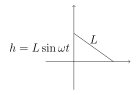
- If the position is \(\binom{sL \cos \omega t}{(1-s) L \sin \omega t}\) then the acceleration is \(-\omega^2 \binom{sL \cos \omega t}{(1-s) L \sin \omega t}\)
- \begin{align*} \text{N2}(\rightarrow): && - F\cos \omega t + N \sin \omega t &= -m\omega^2 sL \cos \omega t\\ \text{N2}(\uparrow): && -mg + F\sin \omega t + N \cos \omega t &= -m\omega^2 (1-s) L \sin \omega t \\ \Rightarrow && \begin{pmatrix} \cos \omega t & -\sin \omega t \\ \sin \omega t & \cos \omega t \end{pmatrix} \begin{pmatrix} F \\ N \end{pmatrix} &= \begin{pmatrix} m\omega^2 s L \cos \omega t \\ mg - m\omega^2(1-s)L \sin \omega t \end{pmatrix} \\ \Rightarrow && \begin{pmatrix}F \\ N \end{pmatrix} &= \begin{pmatrix} \cos \omega t & \sin \omega t \\ -\sin \omega t & \cos \omega t \end{pmatrix} \begin{pmatrix} m\omega^2 s L \cos \omega t \\ mg - m\omega^2(1-s)L \sin \omega t \end{pmatrix} \\ \Rightarrow && N &= m \omega^2 s L (-\sin \omega t \cos \omega t) + mg \cos \omega t - m \omega^2 (1-s)L \sin \omega t \cos \omega t \\ &&&=mg \cos \omega t - m \omega^2 L \sin \omega t \cos \omega t \\ &&&= mg \cos \omega t \left (1 - \frac{L \omega^2}{g} \sin \omega t \right) \\ &&&= mg (1 - k \sin \omega t) \cos \omega t \\ \Rightarrow && F &= m \omega^2 s L \cos^2 \omega t + mg \sin \omega t - m \omega^2 (1-s) L \sin ^2 \omega t \\ &&&= m \omega^2 s L + mg \sin \omega t - m \omega^2 L \sin^2 \omega t \\ &&&= mg \frac{\omega^2 L}{g} s + mg(1-\frac{\omega^2 L}{g} \sin \omega t)\sin \omega t \\ &&&= mg sk + mg(1-k \sin \omega t) \cos \omega t \tan \omega t \\ &&&= mgsk + N \tan \omega t \end{align*}
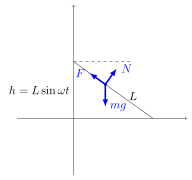
- The particle will not slip if \(F < \tan \alpha N\). When \(t = 0\), \(N = mg, F = mgsk\), but clearly \(sk < \tan \alpha \Rightarrow mgsk = F < \tan \alpha mg = \tan \alpha N\). The particle will slip when: \(F > \tan \alpha N\), but we have \(F = mgsk + N \tan \omega t\). Clearly when \(\omega t = \alpha\) we have reached a point where \(F > \tan \alpha N\). Therefore we must slip before we reach this point, ie at a point where the plank makes an angle of less than \(\alpha\) to the horizontal. Notice also that \(N\) changes sign when \(1-k \sin \omega t = 0\), however, to do this \(N\) must become very small, smaller than \(mgsk\), therefore we must slip before this point too. Since we slip before either condition occurs, we must be in a position when \(N\) is positive AND the plank still makes a shallow angle.
2016 Paper 3 Q9
Three pegs \(P\), \(Q\) and \(R\) are fixed on a smooth horizontal table in such a way that they form the vertices of an equilateral triangle of side \(2a\). A particle \(X\) of mass \(m\) lies on the table. It is attached to the pegs by three springs, \(PX\), \(QX\) and \(RX\), each of modulus of elasticity \(\lambda\) and natural length \(l\), where \(l < \frac{ \ 2 }{\sqrt3}\, a\). Initially the particle is in equilibrium. Show that the extension in each spring is \(\frac{\ 2}{\sqrt3}\,a -l\,\). The particle is then pulled a small distance directly towards \(P\) and released. Show that the tension \(T\) in the spring \(RX\) is given by \[ T= \frac {\lambda} l \left( \sqrt{\frac {4a^2}3 + \frac{2ax}{\sqrt3} +x^2\; }\; -l\right) , \] where \(x\) is the displacement of \(X\) from its equilibrium position. Show further that the particle performs approximate simple harmonic motion with period \[ 2\pi \sqrt{ \frac{4mla}{3 (4a-\sqrt3 \, l)\lambda } \; }\,. \]
2015 Paper 3 Q9
A particle \(P\) of mass \(m\) moves on a smooth fixed straight horizontal rail and is attached to a fixed peg \(Q\) by a light elastic string of natural length \(a\) and modulus \(\lambda\). The peg \(Q\) is a distance \(a\) from the rail. Initially \(P\) is at rest with \(PQ=a\). An impulse imparts to \(P\) a speed \(v\) along the rail. Let \(x\) be the displacement at time \(t\) of \(P\) from its initial position. Obtain the equation \[ \dot x^2 = v^2 - k^2 \left( \sqrt{x^2+a^2} -a\right)^{\!2} \] where \( k^2 = \lambda/(ma)\), \(k>0\) and the dot denotes differentiation with respect to \(t\). Find, in terms of \(k\), \(a\) and \(v\), the greatest value, \(x_0\), attained by \(x\). Find also the acceleration of \(P\) at \(x=x_0\). Obtain, in the form of an integral, an expression for the period of the motion. Show that in the case \(v\ll ka\) (that is, \(v\) is much less than \(ka\)), this is approximately \[ \sqrt {\frac {32a}{kv}} \int_0^1 \frac 1 {\sqrt{1-u^4}} \, \d u \, . \]
2014 Paper 3 Q10
Two particles \(X\) and \(Y\), of equal mass \(m\), lie on a smooth horizontal table and are connected by a light elastic spring of natural length \(a\) and modulus of elasticity \(\lambda\). Two more springs, identical to the first, connect \(X\) to a point \(P\) on the table and \(Y\) to a point \(Q\) on the table. The distance between \(P\) and \(Q\) is \(3a\). Initially, the particles are held so that \(XP=a\), \(YQ= \frac12 a\,\), and \(PXYQ\) is a straight line. The particles are then released. At time \(t\), the particle \(X\) is a distance \(a+x\) from \(P\) and the particle \(Y\) is a distance \(a+y\) from \(Q\). Show that \[ m \frac{\.d ^2 x}{\.d t^2} = -\frac\lambda a (2x+y) \] and find a similar expression involving \(\dfrac{\.d^2 y}{\.d t^2}\). Deduce that \[ x-y = A\cos \omega t +B \sin\omega t \] where \(A\) and \(B\) are constants to be determined and \(ma\omega^2=\lambda\). Find a similar expression for \(x+y\). Show that \(Y\) will never return to its initial position.
2013 Paper 3 Q9
A sphere of radius \(R\) and uniform density \(\rho_{\text{s}}\) is floating in a large tank of liquid of uniform density \(\rho\). Given that the centre of the sphere is a distance \(x\) above the level of the liquid, where \(x < R\), show that the volume of liquid displaced is \[ \frac \pi 3 (2R^3-3R^2x +x^3)\,. \] The sphere is acted upon by two forces only: its weight and an upward force equal in magnitude to the weight of the liquid it has displaced. Show that \[ 4 R^3\rho_{\text{s}} (g+\ddot x) = (2R^3 -3R^2x +x^3)\rho g\,. \] Given that the sphere is in equilibrium when \(x=\frac12 R\), find \(\rho_{\text{s}}\) in terms of \(\rho\). Find, in terms of \(R\) and \(g\), the period of small oscillations about this equilibrium position.
2011 Paper 3 Q10
Particles \(P\) and \(Q\), each of mass \(m\), lie initially at rest a distance \(a\) apart on a smooth horizontal plane. They are connected by a light elastic string of natural length \(a\) and modulus of elasticity \(\frac12 m a \omega^2\), where \(\omega\) is a constant. Then \(P\) receives an impulse which gives it a velocity \(u\) directly away from \(Q\). Show that when the string next returns to length \(a\), the particles have travelled a distance \(\frac12 \pi u/\omega\,\), and find the speed of each particle. Find also the total time between the impulse and the subsequent collision of the particles.
2010 Paper 3 Q10
A small bead \(B\), of mass \(m\), slides without friction on a fixed horizontal ring of radius \(a\). The centre of the ring is at \(O\). The bead is attached by a light elastic string to a fixed point \(P\) in the plane of the ring such that \(OP = b\), where \(b > a\). The natural length of the elastic string is \(c\), where \(c < b - a\), and its modulus of elasticity is \(\lambda\). Show that the equation of motion of the bead is \[ ma\ddot \phi = -\lambda\left( \frac{a\sin\phi}{c\sin\theta}-1\right)\sin(\theta+\phi) \,, \] where \(\theta=\angle BPO\) and \(\phi=\angle BOP\). Given that \(\theta\) and \(\phi\) are small, show that $a(\theta+\phi)\approx b\theta$. Hence find the period of small oscillations about the equilibrium position \(\theta=\phi =0\).
2009 Paper 3 Q10
A light spring is fixed at its lower end and its axis is vertical. When a certain particle \(P\) rests on the top of the spring, the compression is \(d\). When, instead, \(P\) is dropped onto the top of the spring from a height \(h\) above it, the compression at time \(t\) after \(P\) hits the top of the spring is \(x\). Obtain a second-order differential equation relating \(x\) and \(t\) for \(0\le t \le T\), where \(T\) is the time at which \(P\) first loses contact with the spring. Find the solution of this equation in the form \[ x= A + B\cos (\omega t) + C\sin(\omega t)\,, \] where the constants \(A\), \(B\), \(C\) and \(\omega\) are to be given in terms of \(d\), \(g\) and \(h\) as appropriate. Show that \[ T = \sqrt{d/g\;} \left (2 \pi - 2 \arctan \sqrt{2h/d\;}\;\right)\,. \]
2007 Paper 3 Q9
Two small beads, \(A\) and \(B\), each of mass \(m\), are threaded on a smooth horizontal circular hoop of radius \(a\) and centre \(O\). The angle \(\theta\) is the acute angle determined by \(2\theta = \angle AOB\). The beads are connected by a light straight spring. The energy stored in the spring is \[ mk^2 a^2(\theta - \alpha)^2, \] where \(k\) and \(\alpha\) are constants satisfying \(k>0\) and \(\frac \pi 4< \alpha<\frac\pi2\). The spring is held in compression with \(\theta =\beta\) and then released. Find the period of oscillations in the two cases that arise according to the value of \(\beta\) and state the value of \(\beta\) for which oscillations do not occur.
2004 Paper 3 Q10
A particle \(P\) of mass \(m\) is attached to points \(A\) and \(B\), where \(A\) is a distance \(9a\) vertically above \(B\), by elastic strings, each of which has modulus of elasticity \(6mg\). The string \(AP\) has natural length \(6a\) and the string \(BP\) has natural length \(2a\). Let \(x\) be the distance \(AP\). The system is released from rest with \(P\) on the vertical line \(AB\) and \(x = 6a\). Show that the acceleration \(\ddot{x}\) of \(P\) is \(\ds{4g \over a}(7a - x)\) for \(6a < x < 7a\) and \(\ds{g \over a}(7a - x)\) for \(7a < x < 9a\,\). Find the time taken for the particle to reach \(B\).
2003 Paper 3 Q9
A particle \(P\) of mass \(m\) is constrained to move on a vertical circle of smooth wire with centre~\(O\) and of radius \(a\). \(L\) is the lowest point of the circle and \(H\) the highest and \(\angle LOP = \theta\,\). The particle is attached to \(H\) by an elastic string of natural length \(a\) and modulus of elasticity~\(\alpha mg\,\), where \(\alpha > 1\,\). Show that, if \(\alpha>2\,\), there is an equilibrium position with \(0<\theta<\pi\,\). Given that \(\alpha =2+\sqrt 2\,\), and that \(\displaystyle \theta = \tfrac{1}{2}\pi + \phi\,\), show that \[ \ddot{\phi} \approx -\frac{g (\sqrt2+1)}{2a }\, \phi \] when \(\phi\) is small. For this value of \(\alpha\), explain briefly what happens to the particle if it is given a small displacement when \( \theta = \frac{1}{2}\pi\).
2001 Paper 3 Q9
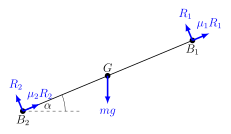
\(B_1\) and \(B_2\) are parallel, thin, horizontal fixed beams. \(B_1\) is a vertical distance \(d \sin \alpha \) above \(B_2\), and a horizontal distance \(d\cos\alpha \) from \(B_2\,\), where \(0<\alpha<\pi/2\,\). A long heavy plank is held so that it rests on the two beams, perpendicular to each, with its centre of gravity at \(B_1\,\). The coefficients of friction between the plank and \(B_1\) and \(B_2\) are \(\mu_1\) and \(\mu_2\,\), respectively, where \(\mu_1<\mu_2\) and \(\mu_1+\mu_2=2\tan\alpha\,\). The plank is released and slips over the beams experiencing a force of resistance from each beam equal to the limiting frictional force (i.e. the product of the appropriate coefficient of friction and the normal reaction). Show that it will come to rest with its centre of gravity over \(B_2\) in a time \[ \pi \left(\frac{d}{g(\mu_2-\mu_1)\cos\alpha }\right)^{\!\frac12}\;. \]
Solution:
2000 Paper 2 Q11
The string \(AP\) has a natural length of \(1\!\cdot5\!\) metres and modulus of elasticity equal to \(5g\) newtons. The end \(A\) is attached to the ceiling of a room of height \(2\!\cdot\!5\) metres and a particle of mass \mbox{\(0\!\cdot\!5\) kg} is attached to the end \(P\). The end \(P\) is released from rest at a point \(0\!\cdot\!5\) metres above the floor and vertically below \(A\). Show that the string becomes slack, but that \(P\) does not reach the ceiling. Show also that while the string is in tension, \(P\) executes simple harmonic motion, and that the time in seconds that elapses from the instant when \(P\) is released to the instant when \(P\) first returns to its original position is $$ \left(\frac8{3g}\right)^{\!\frac12}+ \left(\frac3 {5g}\right)^{\!\frac12} {\Big(\pi - \arccos (3/7)\Big)}. $$ \noindent [Note that \(\arccos x\) is another notation for \(\cos^{-1} x\).]
1999 Paper 1 Q10
A particle is attached to a point \(P\) of an unstretched light uniform spring \(AB\) of modulus of elasticity \(\lambda\) in such a way that \(AP\) has length \(a\) and \(PB\) has length \(b\). The ends \(A\) and \(B\) of the spring are now fixed to points in a vertical line a distance \(l\) apart, The particle oscillates along this line. Show that the motion is simple harmonic. Show also that the period is the same whatever the value of \(l\) and whichever end of the string is uppermost.
1999 Paper 3 Q8
The function \(y(x)\) is defined for \(x\ge0\) and satisfies the conditions \[ y=0 \mbox{ \ \ and \ \ } \frac{\d y}{\d x}=1 \mbox{ \ \ at \(x=0\)}. \] When \(x\) is in the range \(2(n-1)\pi< x <2n\pi\), where \(n\) is a positive integer, \(y(t)\) satisfies the differential equation $$ {\d^2y \over \d x^2} + n^2 y=0. $$ Both \(y\) and \(\displaystyle \frac{\d y}{\d x} \) are continuous at \(x=2n\pi\) for \(n=0,\; 1,\;2,\; \ldots\;\).
- Find \(y(x)\) for \(0\le x \le 2\pi\).
- Show that \(y(x) = \frac12 \sin 2x \) for \(2\pi\le x\le 4\pi\), and find \(y(x)\) for all \(x\ge0\).
- Show that $$ \int_0^\infty y^2 \,\d x = \pi \sum_{n=1}^\infty {1\over n^2} \,. $$