Problems
Filters
13 problems found
2018 Paper 3 Q1
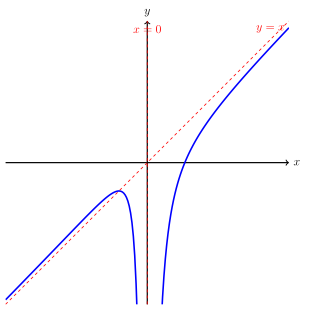
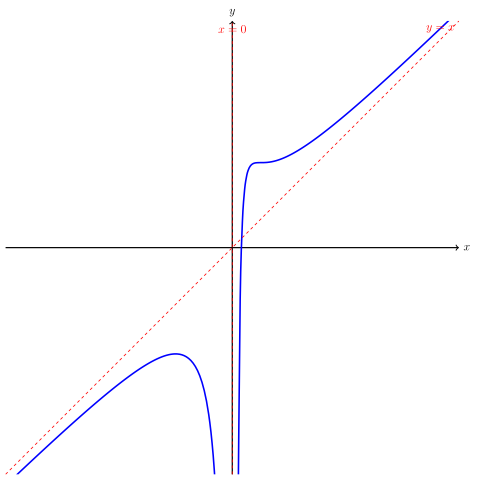
- The function \(\f\) is given by \[ \f(\beta)=\beta - \frac 1 \beta - \frac 1 {\beta^2} \ \ \ \ \ \ \ \ (\beta\ne0) \,. \] Find the stationary point of the curve \(y=\f(\beta)\,\) and sketch the curve. Sketch also the curve \(y=\g(\beta)\,\), where \[ \g(\beta) = \beta + \frac 3 \beta - \frac 1 {\beta^2} \ \ \ \ \ \ \ \ (\beta\ne0)\,. \]
- Let \(u\) and \(v\) be the roots of the equation \[ x^2 +\alpha x +\beta = 0 \,, \] where \(\beta\ne0\,\). Obtain expressions in terms of \(\alpha\) and \(\beta\) for \(\displaystyle u+v + \frac 1 {uv}\) and \( \displaystyle \frac 1 u + \frac 1 v + uv\,\).
- Given that \(\displaystyle u+v + \frac 1 {uv} = -1\,\), and that \(u\) and \(v\) are real, show that \(\displaystyle \frac 1 u+ \frac 1 v + {uv} \le -1\;\).
- Given instead that \(\displaystyle u+v + \frac 1 {uv} = 3 \;\), and that \(u\) and \(v\) are real, find the greatest value of \(\displaystyle \frac 1 u+ \frac 1v + {uv}\,\).
Solution:
- \begin{align*}
&& f(\beta) &= \beta - \frac1{\beta}-\frac1{\beta^2} \\
\Rightarrow && f'(\beta) &= 1 +\frac{1}{\beta^2}+\frac{2}{\beta^3} \\
\Rightarrow && 0 &= f'(\beta) \\
&&&= 1 + \frac1{\beta^2} + \frac{2}{\beta^3} \\
\Rightarrow && 0 &= \beta^3 + \beta + 2 \\
&&&= (\beta+1)(\beta^2-\beta+2)
\end{align*}
Therefore the only stationary point is at \(\beta = -1, f(-1) = -1\)
\begin{align*} && g(\beta) &= \beta + \frac3{\beta}-\frac1{\beta^2} \\ \Rightarrow && g'(\beta) &= 1 -\frac{3}{\beta^2}+\frac{2}{\beta^3} \\ \Rightarrow && 0 &= f'(\beta) \\ &&&= 1 - \frac3{\beta^2} + \frac{2}{\beta^3} \\ \Rightarrow && 0 &= \beta^3 - 3\beta + 2 \\ &&&= (\beta-1)^2(\beta+2) \end{align*} Therefore there are stationary points at \(\beta=1,f(1) = 3, \beta=-2, f(-2) = \frac14\)
- Let \(u,v\) be the roots of \(x^2 + \alpha x + \beta = 0\), then since \((x-u)(x-v) = 0\) we must have \(\alpha = -(u+v), \beta = uv\). Therefore: \begin{align*} && u+v +\frac{1}{uv} &= -\alpha + \frac{1}{\beta} \\ && \frac1u+\frac1v + uv &= \frac{u+v}{uv} + uv \\ &&&= -\frac{\alpha}{\beta} + \beta \end{align*} Given \(u+v + \frac 1 {uv} = -1\), ie \(-\alpha + \frac{1}{\beta} = -1\). Since the roots are real, we must also have that \(\alpha^2 - 4\beta \geq 0\), so \begin{align*} && -\alpha + \frac1\beta &= -1 \\ \Rightarrow && \alpha &= 1 +\frac1\beta \\ \Rightarrow && -\frac{\alpha}{\beta}+\beta &= -\frac{1}{\beta} \l1+\frac1{\beta}\r + \beta \\ &&&=\beta - \frac{1}{\beta}-\frac{1}{\beta^2} \end{align*} So we want to maximise \(f(\beta)\) subject to \(\alpha ^2 - 4\beta \geq 0\) \begin{align*} && 0 &\leq \alpha^2 -4 \beta \\ &&&= \l 1 + \frac1{\beta} \r^2 - 4\beta \\ &&&= 1+ \frac2{\beta} + \frac1{\beta^2} - 4\beta \\ \Leftrightarrow && 0 &\leq -4\beta^3+\beta^2 + 2\beta + 1 \\ &&&=-(\beta-1)(4\beta^2+3\beta+1)\\ \Leftrightarrow && \beta &\leq 1 \end{align*} But we know \(f(\beta) \leq -1\) on \((-\infty,1]\) so we're done.
- Given that \(-\alpha + \frac{1}{\beta} = 3\) we have \begin{align*} && -\alpha + \frac1\beta &= 3 \\ \Rightarrow && \alpha &= -3 +\frac1\beta \\ \Rightarrow && -\frac{\alpha}{\beta}+\beta &= -\frac{1}{\beta} \l-3+\frac1{\beta}\r + \beta \\ &&&=\beta + \frac{3}{\beta}-\frac{1}{\beta^2} \end{align*} which we want to maximise, subject to: \begin{align*} && 0 &\leq \alpha^2 -4 \beta \\ &&&= \l -3 + \frac1{\beta} \r^2 - 4\beta \\ &&&= 9- \frac6{\beta} + \frac1{\beta^2} - 4\beta \\ \Leftrightarrow && 0 &\leq -4\beta^3+9\beta^2 - 6\beta + 1 \\ &&&=-(\beta-1)^2(4\beta-1)\\ \Leftrightarrow && \beta &\leq \frac14 \end{align*} Therefore the maximum will either be \(f(-2) = \frac14\) or \(f(\frac14) = -\frac{15}4\). Therefore the maximum is \(\frac14\)
2018 Paper 3 Q2
The sequence of functions \(y_0\), \(y_1\), \(y_2\), \(\ldots\,\) is defined by \(y_0=1\) and, for \(n\ge1\,\), \[ y_n = (-1)^n \frac {1}{z} \, \frac{\d^{n} z}{\d x^n} \,, \] where \(z= \e^{-x^2}\!\).
- Show that \(\dfrac{\d y_n}{\hspace{-4.7pt}\d x} = 2x y_n -y_{n+1}\,\) for \(n\ge1\,\).
- Prove by induction that, for \(n\ge1\,\), \[ y_{n+1} = 2x y_n -2ny_{n-1} \,. \] Deduce that, for \(n\ge1\,\), \[ y_{n+1}^2 - {y}_n {y}_{n+2} = 2n (y_n^2 - y_{n-1}y_{n+1}) + 2 y_n^2 \,. \]
- Hence show that $y_{n}^2 - y^2_{n-1} y^2_{n+1} > 0\( for \)n \ge 1$.
Solution:
- \begin{align*} \frac{\d y_n}{\d x} &= \frac{\d}{\d x} \l (-1)^n e^{x^2} \frac{\d^n}{\d x^{n}} \l e^{-x^2}\r \r \\ &= (-1)^n 2xe^{x^2} \frac{\d^n}{\d x^{n}} \l e^{-x^2}\r + (-1)^n e^{x^2} \frac{\d^{n+1}}{\d x^{n+1}} \l e^{-x^2}\r \\ &= 2xy_n - (-1)^{n+1} e^{x^2} \frac{\d^{n+1}}{\d x^{n+1}} \l e^{-x^2}\r \\ &= 2xy_n - y_{n+1} \end{align*}
- \(y_0 = 1\), \(y_1 = (-1) e^{x^2} \cdot (-2x) \cdot e^{-x^2} = 2x\), \(y_2 = e^{x^2} \frac{\d^2}{\d x^2} \l e^{-x^2}\r = e^{x^2} \frac{\d }{\d x}\l -2xe^{-x^2} \r = e^{x^2} \l -2e^{-x^2}+4x^2e^{-x^2}\r = 4x^2-2\). Therefore \(2xy_1 - 2y_0 = 2x \cdot 2x - 2\cdot1 = 4x^2-2 = y_2\) so our statement is true for \(n=1\). Assume the statement is true for \(n=k\), then \begin{align*} && y_{k+1} &= 2xy_k - 2ky_{k-1} \\ \frac{\d }{\d x}: && \frac{\d y_{k+1}}{\d x} &= 2\frac{\d}{\d x}\l xy_k \r - 2k\frac{\d y_{k-1}}{\d x} \\ \Rightarrow && 2xy_{k+1}-y_{k+2} &= 2y_k+2x \l 2xy_k-y_{k+1}\r - 2k \l 2xy_{k-1}-y_k \r \\ \Rightarrow && y_{k+2} &=2y_k+ 4x \cdot y_{k+1}-(4x^2+2k)y_k+2x \cdot 2k y_{k-1} \\ &&&= 4x \cdot y_{k+1}-(4x^2+2(k+1))y_k+2x \l2xy_k - y_{k+1} \r \\ &&&= 2x \cdot y_{k+1} -2(k+1)y_k \end{align*} Therefore since our statement is true for \(n=1\) and if it is true for \(n=k\) it is true for \(n=k=1\), therefore by the principle of mathematical induction it is true for all \(n \geq 1\). Since \(2x = \frac{y_{n+1}+2ny_{n-1}}{y_n}\) for all \(n\), we must have \begin{align*} && \frac{y_{n+1}+2ny_{n-1}}{y_n} &= \frac{y_{n+2}+2(n+1)y_{n}}{y_{n+1}} \\ \Leftrightarrow && y_{n+1}^2+2ny_{n-1}y_{n+1} &= y_ny_{n+2}+2ny_n^2+2y_n^2 \\ \Leftrightarrow && y_{n+1}^2-y_ny_{n+2} &= 2n(y_n^2-y_{n-1}y_{n+1})+2y_n^2 \end{align*}
- Consider the functions \(f_n(x) = y_{n}^2-y_{n-1}y_{n+1}\) then clearly \(f_{n+1} = 2nf_{n} + 2y_n^2 \geq f_{n}\) so to prove \(f_n(x) > 0\) for \(n \geq 1\) it suffices to prove it for \(n = 1\). But \(f_1 = y_1^2 - y_0y_{2} = (2x)^2-(4x^2-2) = 2 > 0\) so we are done.
2018 Paper 3 Q3
Show that the second-order differential equation \[ x^2y''+(1-2p) x\, y' + (p^2-q^2) \, y= \f(x) \,, \] where \(p\) and \(q\) are constants, can be written in the form \[ x^a \big(x^b (x^cy)'\big)' = \f(x) \,, \tag{\(*\)} \] where \(a\), \(b\) and \(c\) are constants.
- Use \((*)\) to derive the general solution of the equation \[ x^{2}y''+(1-2p)xy'+(p^2-q^{2})y=0 \] in the different cases that arise according to the values of \(p\) and \(q\).
- Use \((*)\) to derive the general solution of the equation \[ x^{2}y''+(1-2p)xy'+p^2y=x^{n} \] in the different cases that arise according to the values of \(p\) and \(n\).
Solution: Consider $x^a \big(x^b (x^cy)'\big)'$ then \begin{align*} x^a \big(x^b (x^cy)'\big)' &= x^a \big (bx^{b-1}(x^c y)'+x^b(x^cy)'' \big ) \\ &= x^a \big (bx^{b-1} (cx^{c-1}y + x^c y') + x^b(c(c-1)x^{c-2}y + 2cx^{c-1}y' + x^cy'') \\ &= x^{a+b+c}y'' + (2cx^{c-1+b+a}+bx^{c+b-1+a})y'+(c(b+c-1))x^{a+b+c-2} y \end{align*} So we need: \begin{align*} &&& \begin{cases} a+b+c &= 2 \\ 2c+b &= 1-2p \\ c(b+c-1) &= p^2-q^2 \end{cases} \\ \Rightarrow && c((1-2p)-2c+c-1) &=p^2-q^2 \\ \Rightarrow && c^2+2pc &= q^2-p^2 \end{align*}
2018 Paper 3 Q4
The point \(P(a\sec \theta, b\tan \theta )\) lies on the hyperbola \[ \dfrac{x^{2}}{a^{2}}-\dfrac{y^{2}}{b^{2}}=1\,, \] where \(a>b>0\,\). Show that the equation of the tangent to the hyperbola at \(P\) can be written as \[ bx- ay \sin\theta = ab \cos\theta \,. \]
- This tangent meets the lines \(\dfrac x a = \dfrac yb\) and \(\dfrac x a =- \dfrac y b\) at \(S\) and \(T\), respectively. How is the mid-point of \(ST\) related to \(P\)?
- The point \(Q(a\sec \phi, b\tan \phi)\) also lies on the hyperbola and the tangents to the hyperbola at \(P\) and \(Q\) are perpendicular. These two tangents intersect at \((x,y)\). Obtain expressions for \(x^2\) and \(y^2\) in terms of \(a\), \(\theta\) and \(\phi\). Hence, or otherwise, show that \(x^2+y^2 = a^2 -b^2\).
Solution: Note that \begin{align*} && \frac{\d a \sec \theta}{\d \theta} &= a \sec \theta \tan \theta \\ && \frac{\d b \tan \theta}{\d \theta} &= b \sec^2 \theta \\ \Rightarrow && \frac{\d y}{\d x} &= \frac{b \sec^2 \theta}{a \sec \theta \tan \theta} \\ &&&= \frac{b}{a} \frac{1}{\sin \theta} \\ \Rightarrow && \frac{y-b \tan \theta}{x - a \sec \theta} &= \frac{b}{a} \frac{1}{\sin \theta} \\ \Rightarrow && a \sin \theta y - ab \tan \theta \sin \theta &= bx -ab \sec \theta \\ \Rightarrow && bx-ay\sin \theta &= ab \sec x (1 - \sin ^2 \theta) \\ &&&= ab \cos \theta \end{align*}
- \begin{align*} S: &&& \begin{cases} bx-ay &= 0 \\ bx-ay \sin \theta &= ab \cos \theta \end{cases} \\ \Rightarrow && ay(1-\sin \theta) &= ab \cos \theta \\ \Rightarrow && y &= \frac{b \cos \theta}{1-\sin \theta} \\ &&x &=\frac{a\cos \theta}{1-\sin \theta} \\ T: &&& \begin{cases} bx+ay &= 0 \\ bx-ay \sin \theta &= ab \cos \theta \end{cases} \\ \Rightarrow && ay(1+\sin \theta) &= -ab \cos \theta \\ \Rightarrow && y &= \frac{-b \cos \theta}{1+\sin \theta} \\ &&x &=\frac{a\cos \theta}{1+\sin \theta} \\ M: && x &= \frac{a \cos \theta}{2} \frac{2}{1-\sin^2 \theta} \\ &&&= a \sec \theta \\ && y &= \frac{b \cos \theta}{2} \frac{2 \sin \theta}{1-\sin^2 \theta} \\ &&&= b \tan \theta \end{align*} The midpoint of \(ST\) is the same as \(P\).
- The tangents are perpendicular, therefore \(\frac{b}{a} \cosec \theta = - \frac{a}{b} \sin \phi\), ie \(b^2 = -a^2 \sin \phi \sin \theta\) The will intersect at: \begin{align*} &&& \begin{cases} bx - ay \sin \theta &= ab \cos \theta \\ bx - ay \sin \phi &= ab \cos \phi \end{cases} \\ \Rightarrow && ay ( \sin \theta - \sin \phi) &= ab(\cos \phi - \cos \theta) \\ \Rightarrow && y &= \frac{b(\cos \phi - \cos \theta)}{(\sin \theta - \sin \phi)} \\ && y^2 &= \frac{-a^2 \sin \phi \sin \theta (\cos\phi - \cos \theta)^2}{(\sin \theta - \sin \phi)^2} \\ \Rightarrow && bx(\sin \phi - \sin \theta) &= ab(\cos \theta \sin \phi - \cos \phi \sin \theta) \\ \Rightarrow && x &= \frac{a(\cos \theta \sin \phi - \cos \phi \sin \theta)}{\sin \phi - \sin \theta} \\ &&&= \frac{a^2(\cos \theta \sin \phi - \cos \phi \sin \theta)^2}{(\sin \phi - \sin \theta)^2} \end{align*} Therefore \begin{align*} && x^2+y^2 &= \frac{a^2}{(\sin \phi - \sin \theta)^2} \l (\cos \theta \sin \phi- \cos \phi \sin \theta)^2 - \sin \phi \sin \theta (\cos\phi - \cos \theta)^2 \r \\ &&&= \frac{a^2}{(\sin \phi - \sin \theta)^2} \l (\sin \phi - \sin \theta)(\cos^2 \theta \sin \phi - \sin \theta \cos^2 \phi) \r \\ &&&=a^2-b^2 \end{align*}
2018 Paper 3 Q5
The real numbers \(a_1\), \(a_2\), \(a_3\), \(\ldots\) are all positive. For each positive integer \(n\), \(A_n\) and \(G_n\) are defined by \[ A_n = \frac{a_1+a_2 + \cdots + a_n}n \ \ \ \ \ \text{and } \ \ \ \ \ G_n = \big( a_1a_2\cdots a_n\big) ^{1/n} \,. \]
- Show that, for any given positive integer \(k\), \[ (k+1) ( A_{k+1} - G_{k+1}) \ge k (A_k-G_k) \] if and only if \[\lambda^{k+1}_k -(k+1)\lambda_{{k}} +k \ge 0\,, \] where \( \lambda_{{k}} = \left(\dfrac{a_{k+1}}{G_{k}}\right)^{\frac1 {k+1}}\,\).
- Let \[ \f(x)=x^{k+1} -(k+1)x +k \,, \] where \(x > 0\) and \(k\) is a positive integer. Show that \(\f(x)\ge0\) and that \(\f(x)=0\) if and only if \(x = 1\,\).
- Deduce that:
- \(A_n \ge G_n\) for all \(n\); \\
- if \(A_n=G_n\) for some \(n\), then \(a_1=a_2 = \cdots = a_n\,\).
Solution:
- \begin{align*} && (k+1) (A_{k+1} - G_{k+1}) & \geq k(A_k - G_k) \\ \Leftrightarrow && \sum_{i=1}^{k+1} a_i - (k+1)G_{k+1} &\geq \sum_{i=1}^k a_i - kG_k \\ \Leftrightarrow && a_{k+1} -(k+1)G_k^{k/(k+1)}a_{k+1}^{1/(k+1)} & \geq - k G_k \\ \Leftrightarrow && a_{k+1} -(k+1)G_k^{k/(k+1)}a_{k+1}^{1/(k+1)} + k G_k& \geq 0\\ \Leftrightarrow && \frac{a_{k+1}}{G_k} -(k+1)G_k^{k/(k+1)-1}a_{k+1}^{1/(k+1)} + k & \geq 0\\ \Leftrightarrow && \lambda_k^{k+1} -(k+1)\lambda_k+ k & \geq 0\\ \end{align*} as required.
- \begin{align*} && f'(x) &= (k+1)x^k - (k+1) \\ &&&= (k+1)(x^k-1) \end{align*} Therefore \(f(x)\) is strictly decreasing on \((0,1)\) and strictly increasing on \((1,\infty)\) and so the minimum will be \(f(1) = 1 - (k+1) + k = 0\), so \(f(x) \geq 0\) with equality only at \(x = 1\).
- We can proceed by induction to show since the inequality holds for \(n=1\) and since if it holds for \(n=k\) it will hold for \(n=k+1\) as \(A_{k+1}-G_{k+1}\) must have the same sign as \(A_k - G_k\).
- The only way for equality to hold is if \(\lambda_k = 1\) for \(k = 1, \cdots n\), ie \(a_{k+1} = G_k\), but this means \(a_2 = a_1, a_3 = a_1\) etc. Therefore all values are equal.
2018 Paper 3 Q6
- The distinct points \(A\), \(Q\) and \(C\) lie on a straight line in the Argand diagram, and represent the distinct complex numbers \(a\), \(q\) and \(c\), respectively. Show that \(\dfrac {q-a}{c-a}\) is real and hence that \((c-a)(q^*-a^*) = (c^*-a^*)(q-a)\,\). Given that \(aa^* = cc^* = 1\), show further that \[ q+ ac q^* = a+c \,. \]
- The distinct points \(A\), \(B\), \(C\) and \(D\) lie, in anticlockwise order, on the circle of unit radius with centre at the origin (so that, for example, \(aa^* =1\)). The lines \(AC\) and \(BD\) meet at \(Q\). Show that \[ (ac-bd)q^* = (a+c)-(b+d) \,, \] where \(b\) and \(d\) are complex numbers represented by the points \(B\) and \(D\) respectively, and show further that \[ (ac-bd) (q+q^*) = (a-b)(1+cd) +(c-d)(1+ab) \,. \]
- The lines \(AB\) and \(CD\) meet at \(P\), which represents the complex number \(p\). Given that \(p\) is real, show that \(p(1+ab)=a+b\,\). Given further that \(ac-bd \ne 0\,\), show that \[ p(q+q^*) = 2 \,. \]
Solution:
- \(A\), \(Q\), \(C\) lie on a straight line if \(q = \lambda a + (1-\lambda)c\) for some \(\lambda \in \mathbb{R}\), \begin{align*} && q &= \lambda a + (1-\lambda)c \\ \Leftrightarrow && q - a &= (\lambda - 1)a + (1-\lambda)c \\ \Leftrightarrow && q - a &= (\lambda - 1)(a-c) \\ \Leftrightarrow && \frac{q - a}{c-a} &= 1-\lambda \\ \end{align*} therefore \(\frac{q-a}{c-a} \in \mathbb{R}\) \begin{align*} && \frac{q-a}{c-a} & \in \mathbb{R} \\ \Leftrightarrow && \left (\frac{q-a}{c-a} \right)^* &= \frac{q-a}{c-a} \\ \Leftrightarrow && (q^*-a^*)(c-a) &= (q-a)(c^*-a^*) \\ \end{align*} Given \(aa^* = cc^* = 1\), \begin{align*} && (q^*-a^*)(c-a) &= (q-a)(c^*-a^*) \\ \Leftrightarrow && q^*(c-a) - \frac{c}{a}+1 &= q \frac{a-c}{ca} - \frac{a}{c}+1 \\ \Leftrightarrow && (c-a)\l q^* +\frac{q}{ca}\r &= \frac{c}{a} - \frac{a}{c} \\ &&&= \frac{c^2-a^2}{ac} \\ \Leftrightarrow && q^* +\frac{q}{ca} &= \frac{c+a}{ac} \\ \Leftrightarrow && q^*ac +q &= a+c \end{align*}
- Since \(Q\) lies on \(AC\) and \(BD\) we must have \begin{align*} &&& \begin{cases} q^*ac +q &= a+c \\ q^*bd +q &= b+d \\ \end{cases} \\ \Rightarrow && q^*(ac-bd) &= (a+c)-(b+d) \\ \Rightarrow && q(ac-bd) &= (b+d)ac-(a+c)bd \\ \Rightarrow && (q+q^*)(ac-bd) &= (a+c)(1-bd)+(b+d)(ac-1) \\ &&&=a-abd+c-bcd+abc-b+acd-d \\ &&&= a(1+cd)-b(1+cd)+c(1+ab)-d(1+ab) \\ &&&= (a-b)(1+cd)+(c-d)(1+ab) \end{align*}
- If \(AB\) and \(CD\) meet at \(p\) we must have \(p^*ab + p = a+b\), ie \(p(1+ab) = a+b\) amd \(p(1+cd) = c+d\), so \begin{align*} && (q+q^*)(ac-bd) &= (a-b) \frac{c+d}{p} + (c-d) \frac{a+b}{p} \\ \Leftrightarrow && p(q+q^*)(ac-bd) &= (a-b)(c+d)+(c-d)(a+b) \\ &&&= ac+ad-bc-bd+ac+bc-ad-bd \\ &&&= 2(ac-bd) \\ \Leftrightarrow && p(q+q^*) &= 2 \end{align*}
2018 Paper 3 Q7
- Use De Moivre's theorem to show that, if \(\sin\theta\ne0\)\,, then \[ \frac{ \left(\cot \theta + \rm{i}\right)^{2n+1} -\left(\cot \theta - \rm{i}\right)^{2n+1}}{2\rm{i}} = \frac{\sin \left(2n+1\right)\theta} {\sin^{2n+1}\theta} \,, \] for any positive integer \(n\). Deduce that the solutions of the equation \[ \binom{2n+1}{1}x^{n}-\binom{2n+1}{3}x^{n-1} +\cdots + \left(-1\right)^{n}=0 \] are \[x=\cot^{2}\left(\frac{m\pi}{2n+1}\right) \] where \( m=1\), \(2\), \(\ldots\) , \(n\,\).
- Hence show that \[ \sum_{m=1}^n \cot^{2}\left(\frac{m\pi}{2n+1}\right) =\frac{n\left(2n-1\right)}{3}. \]
- Given that \(0<\sin \theta <\theta <\tan \theta\) for \(0 < \theta < \frac{1}{2}\pi\), show that \[ \cot^{2}\theta<\frac{1}{\theta^{2}}<1+\cot^{2}\theta. \] Hence show that \[ \sum^\infty_{m=1} \frac{1}{m^2}= \frac{\pi^2}{6}\,.\]
Solution:
- \begin{align*} \frac{\left(\cot \theta + i\right)^{2n+1} -\left(\cot \theta - i\right)^{2n+1}}{2i} &= \frac{1}{\sin^{2n+1} \theta}\frac{\left(\cos \theta + i \sin \theta \right)^{2n+1} -\left(\cos\theta - i\sin \theta\right)^{2n+1}}{2i} \\ &= \frac{1}{\sin^{2n+1} \theta} \frac{e^{i(2n+1) \theta} - e^{-i(2n+1) \theta} }{2i} \\ &=\frac{\sin (2n+1) \theta}{\sin^{2n+1} \theta} \end{align*} Notice that: \begin{align*} (\cot \theta + i)^{2n+1} - (\cot \theta - i)^{2n+1} &= \sum_{k=0}^{2n+1} \binom{2n+1}{k}(i)^k \cdot \cot^{2n+1-k} \theta - \sum_{k=0}^{2n+1} \binom{2n+1}{k}(-i)^k \cdot \cot^{2n+1-k} \theta \\ &= \sum_{k=0}^{2n+1} \binom{2n+1}{k} \l i^k - (-i)^k \r \cdot \cot^{2n+1-k} \theta \\ &= \sum_{l=0}^{n} \binom{2n+1}{2l+1} \l i^{2l+1} - (-i)^{2l+1} \r \cdot \cot^{2n+1-(2l+1)} \theta \\ &= \sum_{l=0}^{n} \binom{2n+1}{2l+1} 2i \cdot \cot^{2(n-l)} \theta \\ &= 2i\sum_{l=0}^{n} \binom{2n+1}{2l+1} \cot^{2(n-l)} \theta \\ \end{align*} Therefore if \(\theta\) satisfies \(\frac{\sin (2n+1) \theta}{\sin^{2n+1} \theta} = 0\) then \(z = \cot^2 \theta\) satisfies the equation. But \(\theta = \frac{m \pi}{2n+1}, m = 1, 2, \ldots, n\) are \(n\) distinct all the roots must be \(\cot^2 \frac{m \pi}{2n+1}\).
- Notice that the sum of the roots will be \(\displaystyle \frac{\binom{2n+1}{3}}{\binom{2n+1}{1}} = \frac{(2n+1)\cdot 2n \cdot (2n-1)}{3! \cdot (2n+1)} = \frac{n \cdot (2n-1)}{3}\) and so \[ \sum_{m=1}^n \cot^{2}\left(\frac{m\pi}{2n+1}\right) =\frac{n\left(2n-1\right)}{3}. \]
- For \(0 < \theta < \frac{1}{2}\pi\), \begin{align*} && 0 < \sin \theta < \theta < \tan \theta \\ \Leftrightarrow && 0 < \cot \theta < \frac{1}{\theta} < \frac{1}{\sin \theta} \\ \Leftrightarrow && 0 < \cot^2 \theta < \frac{1}{\theta^2} < \cosec^2 \theta = 1 + \cot^2 \theta\\ \end{align*} Therefore \begin{align*} && \sum_{n=1}^N \cot^2 \frac{n \pi}{2N+1} < \sum_{n=1}^N \frac{(2N+1)^2}{n^2 \pi^2} < N + \sum_{n=1}^N \cot^2 \frac{n \pi}{2N+1} \\ \Rightarrow && \frac{1}{(2N+1)^2} \frac{N(2N-1)}{3} < \sum_{n=1}^N \frac{1}{n^2 \pi^2} < \frac{1}{(2N+1)^2} \l \frac{N(2N-1)}{3} + 1 \r \\ \Rightarrow && \lim_{N \to \infty}\frac{1}{(2N+1)^2} \frac{N(2N-1)}{3} < \lim_{N \to \infty}\sum_{n=1}^N \frac{1}{n^2 \pi^2} < \lim_{N \to \infty}\frac{1}{(2N+1)^2} \l \frac{N(2N-1)}{3} + 1 \r \\ \Rightarrow && \frac{1}{6} \leq \lim_{N \to \infty}\sum_{n=1}^N \frac{1}{n^2 \pi^2} \leq \frac16 \\ \Rightarrow && \sum_{n=1}^N \frac{1}{n^2} = \frac{\pi^2}{6} \end{align*}
2018 Paper 3 Q8
In this question, you should ignore issues of convergence.
- Let \[ I = \int_0^1 \frac{\f(x^{-1}) } {1+x} \, \d x \,, \] where \(\f(x)\) is a function for which the integral exists. Show that \[ I = \sum_{n=1}^\infty \int_n^{n+1} \frac{\f(y) } {y(1+y)}\, \d y \] and deduce that, if \(\f(x) = \f(x+1)\) for all \(x\), then \[ I= \int_0^1 \frac{\f(x)} {1+x} \, \d x \,. \]
- The {\em fractional part}, \(\{x\}\), of a real number \(x\) is defined to be \(x-\lfloor x\rfloor\) where \(\lfloor x \rfloor\) is the largest integer less than or equal to \(x\). For example \(\{3.2\} = 0.2\) and \(\{3\}=0\,\). Use the result of part (i) to evaluate \[ \displaystyle \int _0^1 \frac { \{x^{-1}\}}{1+x}\, \d x \text{ and } \displaystyle \int _0^1 \frac { \{2x^{-1}\}}{1+x}\, \d x \,. \]
- (Bonus) Use the same method to evaluate \[ \int_0^1 \frac {x\{x^{-1}\}}{1-x^2} \, \d x \,. \]
- (Bonus - harder) Use the same method to evaluate \[ \int_0^1 \frac {x^2\{x^{-1}\}}{1-x^2} \, \d x \,. \]
Solution:
- \begin{align*} && I &= \int_0^1 \frac{f(x^{-1})}{1+x} \d x \\ u = x^{-1}, \d u = -x^{-2} \d x: &&&= \int_{\infty}^1 \frac{f(u)}{1+\frac{1}{u}} \frac{-1}{u^2} \d u \\ &&&= \int_1^{\infty} \frac{f(u)}{u(1+u)} \d u \\ &&&= \sum_{n=1}^{\infty} \int_n^{n+1} \frac{f(u)}{u(u+1)} \d u \\ \\ \text{if} f(x) = f(x+1)\, \forall x && &=\sum_{n=1}^{\infty} \int_{0}^1 \frac{f(x+n)}{(x+n)(x+n+1)} \d x \\ &&&= \sum_{n=1}^\infty \int_0^1 \frac{f(x)}{(x+n)(x+n+1)} \d x \\ &&&= \int_0^1 f(x) \l \sum_{n=1}^{\infty} \frac{1}{(x+n)(x+n+1)}\r \d x \\ &&&= \int_0^1 f(x) \l \sum_{n=1}^{\infty} \l \frac{1}{x+n} - \frac{1}{x+n+1} \r\r \d x \\ &&&= \int_0^1 f(x) \l \frac{1}{x+1} \r \d x \\ &&&= \int_0^1\frac{f(x)}{x+1} \d x \\ \end{align*}
- Since the fractional part is periodic with period \(1\), we can say \begin{align*} && \int_0^1 \frac{\{ x^{-1} \} }{1+x} \d x &= \int_0^1 \frac{\{ x\}}{x+1} \d x \\ &&&= \int_0^1 \frac{x}{x+1} \d x \\ &&&= \int_0^1 1-\frac{1}{x+1} \d x \\ &&&= [x - \ln (1+x) ]_0^1 \\ &&&= 1 - \ln 2 \end{align*} \begin{align*} && \int_0^1 \frac{\{ 2x^{-1}\}}{1+x} \d x &= \int_0^1 \frac{\{2x\}}{x+1} \d x \\ &&&= \int_0^{1/2} \frac{2x}{x+1} \d x +\int_{1/2}^{1} \frac{2x-1}{x+1} \d x \\ &&&= 2\int_0^1 \frac{x}{x+1} \d x + \int_{1/2}^1 \frac{-1}{x+1} \d x \\ &&&= 2 - 2\ln 2 - \l \ln 2 - \ln \tfrac32 \r \\ &&&= 2 - 4 \ln 2 + \ln 3 \\ &&&= 2 + \ln \tfrac {3}{16} \end{align*}
- \begin{align*} && \int_0^1 \frac{x \{ x^{-1} \} }{1-x^2} \d x &= \frac12 \l \int_0^1 \frac{ \{ x^{-1} \}}{1-x} - \frac{\{x^{-1} \}}{1+x} \d x\r \end{align*} Consider for \(f\) periodic with period \(1\) \begin{align*} \int_0^1 \frac{f(x^{-1})}{1-x} \d x &= \int_1^{\infty} \frac{f(u)}{u(u-1)} \d u \\ &= \sum_{n=1}^{\infty}\int_{n}^{n+1} \frac{f(u)}{u(u-1)} \d u \\ &= \sum_{n=1}^{\infty}\int_{0}^{1} \frac{f(u)}{(u+n)(u+n-1)} \d u \\ &= \int_{0}^{1} \sum_{n=1}^{\infty}\frac{f(u)}{(u+n)(u+n-1)} \d u \\ &= \int_{0}^{1} f(u) \sum_{n=1}^{\infty}\l\frac{1}{u+n-1} - \frac{1}{u+n} \r\d u \\ &= \int_0^1 \frac{f(u)}{u} \d u \end{align*} So we have \begin{align*} && \int_0^1 \frac{x \{ x^{-1} \} }{1-x^2} \d x &= \frac12 \l \int_0^1 \frac{ \{ x^{-1} \}}{1-x} - \frac{\{x^{-1} \}}{1+x} \d x \r \\ &&&= \frac12 \int_0^1 \frac{\{ x \}}{x} \d x - \frac12 (1 - \ln 2) \\ &&&= \frac12 - \frac12 + \frac12 \ln 2 \\ &&&= \frac12 \ln 2 \end{align*}
2018 Paper 3 Q9
A particle \(P\) of mass \(m\) is projected with speed \(u_0\) along a smooth horizontal floor directly towards a wall. It collides with a particle \(Q\) of mass \(km\) which is moving directly away from the wall with speed \(v_0\). In the subsequent motion, \(Q\) collides alternately with the wall and with \(P\). The coefficient of restitution between \(Q\) and \(P\) is \(e\), and the coefficient of restitution between \(Q\) and the wall is 1. Let \(u_n\) and \(v_n\) be the velocities of \(P\) and \(Q\), respectively, towards the wall after the \(n\)th collision between \(P\) and \(Q\).
- Show that, for \(n\ge2\), \[ (1+k)u_{n} - (1-k)(1+e)u_{n-1} + e(1+k)u_{n-2} =0\,. \tag{\(*\)} \]
- You are now given that \(e=\frac12\) and \(k = \frac1{34}\), and that the solution of \((*)\) is of the form \[ \phantom{(n\ge0)} u_n= A\left( \tfrac 7{10}\right)^n + B\left( \tfrac 5{7 }\right)^n \ \ \ \ \ \ (n\ge0) \,, \] where \(A\) and \(B\) are independent of \(n\). Find expressions for \(A\) and \(B\) in terms of \(u_0\) and \(v_0\). Show that, if \(0 < 6u_0 < v_0\), then \(u_n\) will be negative for large \(n\).
Solution:
- Just before collision \(n-1\): Velocity of \(P\) is \(u_{n-2}\) Velocity of \(Q\) is \(-v_{n-2}\) \begin{align*} COM: && mu_{n-2}+km(-v_{n-2}) &= mu_{n-1}+kmv_{n-1} \\ \Rightarrow && u_{n-2}-kv_{n-2} &= u_{n-1}+kv_{n-1} \\ NEL: && v_{n-1}-u_{n-1} &= -e((-v_{n-2})-u_{n-2}) \\ \Rightarrow && v_{n-1}-u_{n-1} &= e(v_{n-2}+u_{n-2}) \end{align*} \begin{align*} &&kv_{n-1} &= u_{n-2} - kv_{n-2}-u_{n-1} \\ &&kv_{n-1}&= ku_{n-1}+kev_{n-2}+keu_{n-2} \\ \Rightarrow && kv_{n-2}(1+e) &= u_{n-2}(1-ke)-u_{n-1}(1+k) \\ \Rightarrow && kv_{n-1}(1+e) &= u_{n-1}(1-ke)-u_{n}(1+k) \\ && k(1+e)v_{n-1}-k(1+e)u_{n-1} &= k(1+e)e(v_{n-2}+u_{n-2}) \\ \Rightarrow && u_{n-1}(1-ke)-u_{n}(1+k)-k(1+e)u_{n-1} &= e(u_{n-2}(1-ke)-u_{n-1}(1+k))+k(1+e)eu_{n-2} \\ \Rightarrow && 0 &= (1+k)u_n + ((ke-1)+k(1+e)-e(1+k))u_{n-1} \\ &&& \quad \quad + (e(1-ke)+k(1+e)e)u_{n-2} \\ \Rightarrow && 0 &= (1+k)u_n- (1-k)(1+e)u_{n-1} +e(1+k)u_{n-2} \end{align*}
- \(u_0 = A + B\) \begin{align*} &&& \begin{cases}u_0 - kv_0 &= kv_1 + u_1 \\ \frac12 (u_0+v_0) &= v_1 - u_1 \\ \end{cases} \\ \Rightarrow && (1+k)u_1 &= u_0 - kv_0 - \frac{k}{2}(u_0 + v_0) \\ \Rightarrow && u_1 &= \frac{1}{k+1} \l u_0 (1-\frac{k}{2}) - \frac32 k v_0 \r \\ &&&= \frac{67}{70} u_0 - \frac{3}{70} v_0 \end{align*} Therefore \(A+B = u_0, \frac{49A+50B}{70} = \frac{67}{70} u_0 - \frac{3}{70} v_0\) \begin{align*} && A+B &= u_0 \\ && 49A+50B &= 67u_0 - 3v_0 \\ \Rightarrow && 50u_0 - A &= 67u_0 - 3v_0 \\ \Rightarrow && A &= -17u_0 + 3v_0 \\ && B &= 18u_0 - 3v_0 \end{align*} If \(0 < 6u_0 < v_0\), then \(B < 0\) and as \(n \to \infty\) we will find that \(\l \frac57 \r^n\) dominates \(\l \frac7{10} \r^n\) and so our velocity will be negative and the particle will change direction
2018 Paper 3 Q10
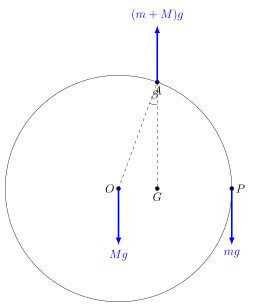
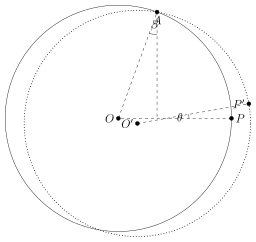
A uniform disc with centre \(O\) and radius \(a\) is suspended from a point \(A\) on its circumference, so that it can swing freely about a horizontal axis \(L\) through \(A\). The plane of the disc is perpendicular to \(L\). A particle \(P\) is attached to a point on the circumference of the disc. The mass of the disc is \(M\) and the mass of the particle is \(m\). In equilibrium, the disc hangs with \(OP\) horizontal, and the angle between \(AO\) and the downward vertical through \(A\) is \(\beta\). Find \(\sin\beta\) in terms of \(M\) and \(m\) and show that \[ \frac{AP}{a} = \sqrt{\frac{2M}{M+m}} \,. \] The disc is rotated about \(L\) and then released. At later time \(t\), the angle between \(OP\) and the horizontal is \(\theta\); when \(P\) is higher than \(O\), \(\theta\) is positive and when \(P\) is lower than \(O\), \(\theta\) is negative. Show that \[ \tfrac12 I \dot\theta^2 + (1-\sin\beta)ma^2 \dot \theta^2 + (m+M)g a\cos\beta \, (1- \cos\theta) \] is constant during the motion, where \(I\) is the moment of inertia of the disc about \(L\). Given that \(m= \frac 32 M\) and that \(I=\frac32Ma^2\), show that the period of small oscillations is \[ 3\pi \sqrt{\frac {3a}{5g}} \,. \]
Solution:

2018 Paper 3 Q11
A particle is attached to one end of a light inextensible string of length \(b\). The other end of the string is attached to a fixed point \(O\). Initially the particle hangs vertically below \(O\). The particle then receives a horizontal impulse. The particle moves in a circular arc with the string taut until the acute angle between the string and the upward vertical is \(\alpha\), at which time it becomes slack. Express \(V\), the speed of the particle when the string becomes slack, in terms of \( b\), \(g\) and \(\alpha\). Show that the string becomes taut again a time \(T\) later, where \[ gT = 4V \sin\alpha \,,\] and that just before this time the trajectory of the particle makes an angle \(\beta \) with the horizontal where \(\tan\beta = 3\tan \alpha \,\). When the string becomes taut, the momentum of the particle in the direction of the string is destroyed. Show that the particle comes instantaneously to rest at this time if and only if \[ \sin^2\alpha = \dfrac {1+\sqrt3}4 \,. \]
Solution:

2018 Paper 3 Q12
A random process generates, independently, \(n\) numbers each of which is drawn from a uniform (rectangular) distribution on the interval 0 to 1. The random variable \(Y_k\) is defined to be the \(k\)th smallest number (so there are \(k-1\) smaller numbers).
- Show that, for \(0\le y\le1\,\), \[ {\rm P}\big(Y_k\le y) =\sum^{n}_{m=k}\binom{n}{m}y^{m}\left(1-y\right)^{n-m} . \tag{\(*\)} \]
- Show that \[ m\binom n m = n \binom {n-1}{m-1} \] and obtain a similar expression for \(\displaystyle (n-m) \, \binom n m\,\). Starting from \((*)\), show that the probability density function of \(Y_k\) is \[ n\binom{ n-1}{k-1} y^{k-1}\left(1-y\right)^{ n-k} \,.\] Deduce an expression for \(\displaystyle \int_0^1 y^{k-1}(1-y)^{n-k} \, \d y \,\).
- Find \(\E(Y_k) \) in terms of \(n\) and \(k\).
Solution:
- \begin{align*} && \mathbb{P}(Y_k \leq y) &= \sum_{j=k}^n\mathbb{P}(\text{exactly }j \text{ values less than }y) \\ &&&= \sum_{j=k}^m \binom{m}{j} y^j(1-y)^{n-j} \end{align*}
- This is the number of ways to choose a committee of \(m\) people with the chair from those \(m\) people. This can be done in two ways. First: choose the committee in \(\binom{n}{m}\) ways and choose the chair in \(m\) ways so \(m \binom{n}{m}\). Alternatively, choose the chain in \(n\) ways and choose the remaining \(m-1\) committee members in \(\binom{n-1}{m-1}\) ways. Therefore \(m \binom{n}{m} = n \binom{n-1}{m-1}\) \begin{align*} (n-m) \binom{n}{m} &= (n-m) \binom{n}{n-m} \\ &= n \binom{n-1}{n-m-1} \\ &= n \binom{n-1}{m} \end{align*} \begin{align*} f_{Y_k}(y) &= \frac{\d }{\d y} \l \sum^{n}_{m=k}\binom{n}{m}y^{m}\left(1-y\right)^{n-m} \r \\ &= \sum^{n}_{m=k} \l \binom{n}{m}my^{m-1}\left(1-y\right)^{n-m} -\binom{n}{m}(n-m)y^{m}\left(1-y\right)^{n-m-1} \r \\ &= \sum^{n}_{m=k} \l n \binom{n-1}{m-1}y^{m-1}\left(1-y\right)^{n-m} -n \binom{n-1}{m} y^{m}\left(1-y\right)^{n-m-1} \r \\ &= n\sum^{n}_{m=k} \binom{n-1}{m-1}y^{m-1}\left(1-y\right)^{n-m} -n\sum^{n+1}_{m=k+1} \binom{n-1}{m-1} y^{m-1}\left(1-y\right)^{n-m} \\ &= n \binom{n-1}{k-1} y^{k-1}(1-y)^{n-k} \end{align*} \begin{align*} &&1 &= \int_0^1 f_{Y_k}(y) \d y \\ &&&= \int_0^1 n \binom{n-1}{k-1} y^{k-1}(1-y)^{n-k} \d y \\ &&&= n \binom{n-1}{k-1} \int_0^1 y^{k-1}(1-y)^{n-k} \d y \\ \Rightarrow && \frac{1}{n \binom{n-1}{k-1}} &= \int_0^1 y^{k-1}(1-y)^{n-k} \d y \\ \end{align*}
- \begin{align*} && \mathbb{E}(Y_k) &= \int_0^1 y f_{Y_k}(y) \d y \\ &&&= \int_0^1 n \binom{n-1}{k-1} y^{k}(1-y)^{n-k} \\ &&&= n \binom{n-1}{k-1}\int_0^1 y^{k}(1-y)^{n-k} \d y \\ &&&= n \binom{n-1}{k-1}\int_0^1 y^{k+1-1}(1-y)^{n+1-(k+1)} \d y \\ &&&= n \binom{n-1}{k-1} \frac{1}{(n+1) \binom{n}{k}}\\ &&&= \frac{n}{n+1} \cdot \frac{k}{n} \\ &&&= \frac{k}{n+1} \end{align*}
2018 Paper 3 Q13
The random variable \(X\) takes only non-negative integer values and has probability generating function \(\G(t)\). Show that \[ \P(X = 0 \text{ or } 2 \text{ or } 4 \text { or } 6 \ \ldots ) = \frac{1}{2}\big(\G\left(1\right)+\G\left(-1\right)\big). \] You are now given that \(X\) has a Poisson distribution with mean \(\lambda\). Show that \[ \G(t) = \e^{-\lambda(1-t)} \,. \]
- The random variable \(Y\) is defined by \[ \P(Y=r)= \begin{cases} k\P(X=r) & \text{if \(r=0, \ 2, \ 4, \ 6, \ \ldots\) \ }, \\[2mm] 0& \text{otherwise}, \end{cases} \] where \(k\) is an appropriate constant. Show that the probability generating function of \(Y\) is \(\dfrac{\cosh\lambda t}{\cosh\lambda}\,\). Deduce that \(\E(Y) < \lambda\) for \(\lambda > 0\,\).
- The random variable \(Z\) is defined by \[\P(Z=r)= \begin{cases} c \P(X=r) & \text{if \(r = 0, \ 4, \ 8, \ 12, \ \ldots \ \)}, \\[2mm] 0& \text{otherwise,} \end{cases} \] where \(c\) is an appropriate constant. Is \(\E(Z) < \lambda\) for all positive values of \(\lambda\,\)?
Solution: \begin{align*} &&G_X(t) &= \mathbb{E}(t^N) \\ &&&= \sum_{k=0}^{\infty} \mathbb{P}(X = k) t^k \\ \Rightarrow && G_X(1) &= \sum_{k=0}^{\infty} \mathbb{P}(X = k) \\ \Rightarrow && G_X(-1) &= \sum_{k=0}^{\infty} (-1)^k\mathbb{P}(X = k) \\ \Rightarrow && \frac12 (G_X(1) + G_X(-1) &= \sum_{k=0}^{\infty} \frac12 (1 + (-1)^k) \mathbb{P}(X = k) \\ &&&= \sum_{k=0}^{\infty} \mathbb{P}(X =2k) \end{align*}
- \begin{align*} 1 &= \sum_r \mathbb{P}(Y = r) \\ &= \sum_{k=0}^\infty k \cdot \mathbb{P}(X = 2k) \\ &= k \cdot \frac12 \l e^{-\lambda(1-1) } + e^{-\lambda(1+1) }\r \\ &= \frac{k}{2}(1+e^{-2\lambda}) \end{align*} Therefore \(k = \frac{2}{1+e^{-2\lambda}} = e^{\lambda} \frac{1}{\cosh \lambda}\) \begin{align*} && G_X(t) + G_X(-t) &= \sum_{k=0}^\infty \mathbb{P}(X = k)t^k(1^k + (-1)^k) \\ &&&= \sum_{k=0}^\infty \mathbb{P}(X = k)t^k(1^k + (-1)^k) \\ &&&= 2\sum_{k=0}^\infty \mathbb{P}(X = 2k)t^{2k} \\ &&&= 2\sum_{k=0}^\infty \frac{1}{k}\mathbb{P}(Y = 2k)t^{2k} \\ &&&= \frac{2}{k}G_Y(t) \\ \Rightarrow && G_Y(t) &= k \cdot \frac{G_X(t) + G_X(-t)}{2} \\ &&&= k\frac{e^{-\lambda(1-t)} + e^{-\lambda(1+t)}}{2} \\ &&&= \frac{e^\lambda}{\cosh \lambda} \frac{e^{-\lambda} (e^{\lambda t}+e^{-\lambda t}) }{2} \\ &&&= \frac{\cosh \lambda t}{\cosh \lambda} \end{align*} Since \(\mathbb{E}(Y) = G_Y'(1)\) and \begin{align*} && G_Y'(t) &= \frac{\lambda \sinh \lambda t}{\cosh \lambda t} \\ \Rightarrow && G_Y'(1) &= \lambda \tanh \lambda \\ &&&< \lambda \end{align*} since \(\tanh x < 1\)
- \begin{align*} && \frac14 \l G_X(t) + G_X(it) +G_X(-t) + G_X(-it) \r &= \sum_{k=0}^\infty \mathbb{P}(X=k)t^k (1 + i^k + (-1)^k + (-i)^k) \\ &&&= \sum_{k=0}^\infty \mathbb{P}(X = 4k)t^{4k} \\ &&&= \frac{G_Z(t)}{c} \end{align*} Since \(G_Z(1) = 1\) we must have \(c = \frac1{\frac14 \l G_X(1) + G_X(i) +G_X(-1) + G_X(-i) \r}\) \begin{align*} && c &= \frac{4e^{\lambda}}{e^{\lambda} + e^{-\lambda} + e^{i\lambda} + e^{-i\lambda}} \\ &&&= \frac{2e^{\lambda}}{\cosh \lambda + \cos \lambda} \\ && G_Z(t) &= c \cdot \frac14 \l e^{-\lambda(1-t)}+e^{-\lambda(1-it)}+e^{-\lambda(1+t)}+e^{-\lambda(1+it)} \r \\ &&&= \frac{ce^{-\lambda t}}{4} \l 2\cosh \lambda t + 2 \cos \lambda t\r \\ &&&= \frac{\cosh \lambda t + \cos \lambda t}{\cosh \lambda + \cos \lambda} \end{align*} We are interested in \(G_Z'(1)\) so: \begin{align*} && G_Z'(t) &= \frac{\lambda (\sinh \lambda t - \sin \lambda t)}{\cosh \lambda + \cos \lambda } \end{align*} Considering various values of \(\lambda\), it makes sense to look at \(\lambda = \pi\) (since \(\cos \lambda = -1\) and the denominator will be small). From this we can see: \begin{align*} G'_Z(1) &= \frac{\pi (\sinh \pi-0)}{\cosh \pi-1} \\ &= \frac{\pi}{\tanh \frac{\pi}{2}} > \pi \end{align*} So \(\mathbb{E}(Z)\) is larger than \(\lambda\) for \(\lambda = \pi\) (and probably many others)