Problems
Filters
13 problems found
2008 Paper 3 Q1
Find all values of \(a\), \(b\), \(x\) and \(y\) that satisfy the simultaneous equations \begin{alignat*}{3} a&+b & &=1 &\\ ax&+by & &= \tfrac13& \\ ax^2&+by^2& &=\tfrac15& \\ ax^3 &+by^3& &=\tfrac17\,.& \end{alignat*} \noindent{\bf [} {\bf Hint}: you may wish to start by multiplying the second equation by \(x+y\). {\bf ]}
Solution: This is a second order recurrence relation, so we need to find \(m\) and \(n\) such that; \begin{align*} &&\frac15 &= m\frac13 + n \\ &&\frac17 &= m \frac15 + n\frac13 \\ \Rightarrow && m,n &= \frac67, - \frac{3}{35} \end{align*} So we now need to solve the characteristic equation: \(\lambda^2 - \frac67 \lambda + \frac{3}{35} = 0\) So \(x,y = \frac{15 \pm 2 \sqrt{30}}{35}\). We need, \begin{align*} && 1 &= a+ b \\ && \frac13 &= a \frac{15 + 2 \sqrt{30}}{35} + b \frac{15 - 2 \sqrt{30}}{35} \\ && \frac13 &= \frac{15}{35} + \frac{2 \sqrt{30}}{35}(a-b) \\ \Rightarrow && -\frac{\sqrt{30}}{18} &= a-b \\ \Rightarrow && a &= \frac{18-\sqrt{30}}{36} \\ && b &= \frac{18+\sqrt{30}}{38} \end{align*} So our two answers are: \[ (a,b,x,y) = \left (\frac{18\pm\sqrt{30}}{36} ,\frac{18\mp\sqrt{30}}{36},\frac{15 \pm 2 \sqrt{30}}{35},\frac{15 \mp 2 \sqrt{30}}{35}, \right)\]
2008 Paper 3 Q2
Let \(S_k(n) \equiv \sum\limits_{r=0}^n r^k\,\), where \(k\) is a positive integer, so that \[ S_1(n) \equiv \tfrac12 n(n+1) \text{ and } S_2(n) \equiv \tfrac16 n(n+1)(2n+1)\,. \]
- By considering \(\sum\limits_{r=0}^n \left[ (r+1)^k-r^k\right]\, \), show that \[ kS_{k-1}(n)=(n+1)^k -(n+1) - \binom{k}{2} S_{k-2}(n) - \binom {k}{3} S_{k-3}(n) - \cdots - \binom{k}{k-1} S_{1}(n) \;. \tag{\(*\)} \] Obtain simplified expressions for \(S_3(n)\) and \(S_4(n)\).
- Explain, using \((*)\), why \(S_k(n)\) is a polynomial of degree \(k+1\) in \(n\). Show that in this polynomial the constant term is zero and the sum of the coefficients is 1.
Solution:
- \begin{align*} &&(n+1)^k &= \sum_{r=0}^n \left [ (r+1)^k - r^k \right] \\ &&&= \sum_{r=0}^n \left [ \left ( \binom{k}{0}r^k+\binom{k}1r^{k-1} + \binom{k}{2}r^{k-2} + \cdots + \binom{k}{k} 1 \right) - r^k\right] \\ &&&= \sum_{r=0}^n \left ( \binom{k}1r^{k-1} + \binom{k}{2}r^{k-2} + \cdots + \binom{k}{k} 1 \right) \\ &&&=k \sum_{r=0}^n r^{k-1} + \binom{k}{2}\sum_{r=0}^nr^{k-2} + \cdots + \binom{k}{k} \sum_{r=0}^n 1 \\ &&&= kS_{k-1}(n) + \binom{k}2 S_{k-2}(n) + \cdots +\binom{k}{k-1}S_1(n) + (n+1) \\ \Rightarrow && k S_{k-1}(n) &= (n+1)^k -(n+1) -\binom{k}2 S_{k-2}(n) - \cdots -\binom{k}{k-1}S_1(n) \\ && 4S_3(n) &= (n+1)^4-(n+1) - \binom{4}{2} \frac{n(n+1)(2n+1)}{6} - \binom{4}{3} \frac{n(n+1)}{2} \\ &&&= (n+1) \left ( (n+1)^3-1 - n(2n+1)-2n \right) \\ &&&= (n+1) \left ( n^3+3n^2+3n+1-1 - 2n^2-3n \right) \\ &&&= (n+1) \left ( n^3+n^2 \right) \\ &&&= n^2(n+1)^2 \\ \Rightarrow && S_3(n) &= \frac{n^2(n+1)^2}{4} \\ \\ &&5S_4(n) &=(n+1)^5-(n+1) - \binom{5}{2} \frac{n^2(n+1)^2}4 - \binom{5}{3} \frac{n(n+1)(2n+1)}{6} - \binom{5}{4} \frac{n(n+1)}{2} \\ &&&= (n+1) \left ((n+1)^4 - 1-\frac{5n^2(n+1)}{2} - \frac{5n(2n+1)}{3} -\frac{5n}{2}\right)\\ &&&= \frac{n+1}{6} \left (6(n+1)^4-6-15n^2(n+1)-10n(2n+1)-15n \right) \\ &&&= \frac{n+1}{6} \left (6n^4+24n^3+36n^2+24n+6 -6-15n^3-15n^2-20n^2-10n-15n\right) \\ &&&= \frac{n+1}{6} \left (6n^4+9n^3+n^2-n\right) \\ &&&= \frac{(n+1)n(2n+1)(3n^2+3n-1)}{6} \\ \Rightarrow && S_4(n) &= \frac{(n+1)n(2n+1)(3n^2+3n-1)}{30} \end{align*}
- Proceeding by induction, since \(S_k(n)\) is a polynomial of degree \(k+1\) for small \(k\), we can see that \[ (k+1)S_k(n) = \underbrace{(n+1)^{k+1}}_{\text{poly deg }=k+1} - \underbrace{(n+1)}_{\text{poly deg}=1} - \underbrace{\binom{k+1}{2}S_{k-1}(n)}_{\text{poly deg}=k} - \underbrace{\cdots}_{\text{polys deg}< k} - \underbrace{\binom{k+1}{k} S_1(n)}_{\text{poly deg}=1}\] therefore \(S_k(n)\) is a polynomial of degree \(k+1\) (in fact with leading coefficient \(\frac{1}{k+1}\). Since \(S_k(0) = \sum_{r=0}^{0} r^k = 0\) there is no constant term, and since \(S_k(1) = \sum_{r=0}^1 r^k = 1\) the sum of the coefficients is \(1\)
2008 Paper 3 Q3
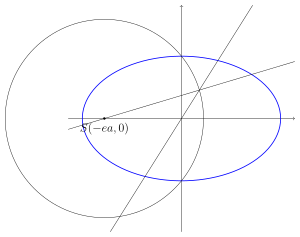
The point \(P(a\cos\theta\,,\, b\sin\theta)\), where \(a>b>0\), lies on the ellipse \[\dfrac {x^2}{a^2} + \dfrac {y^2}{b^2}=1\,.\] The point \(S(-ea\,,\,0)\), where \(b^2=a^2(1-e^2)\,\), is a focus of the ellipse. The point \(N\) is the foot of the perpendicular from the origin, \(O\), to the tangent to the ellipse at \(P\). The lines \(SP\) and \(ON\) intersect at \(T\). Show that the \(y\)-coordinate of \(T\) is \[\dfrac{b\sin\theta}{1+e\cos\theta}\,.\] Show that \(T\) lies on the circle with centre \(S\) and radius \(a\).
Solution: Find the gradient of the tangent of the ellipse at \(P\): \begin{align*} && \frac{2x}{a^2} + \frac{2y}{b^2} \frac{\d y}{\d x} &= 0 \\ \Rightarrow && \frac{\d y}{\d x} &= - \frac{2xb^2}{2ya^2} \\ &&&=- \frac{a \cos \theta b^2}{b \sin \theta a^2} \\ &&&=-\frac{b}{a} \cot \theta \end{align*} Therefore the gradient of \(ON\) is \(\frac{a}{b} \tan \theta\). \begin{align*} && y &= \frac{a}{b} \tan \theta x \\ && \frac{y-0}{x-(-ea)} &= \frac{b\sin \theta-0}{a\cos \theta -(-ea)} \\ && y &= \frac{b \sin \theta}{a(e+\cos \theta)}(x+ea) \\ \Rightarrow && y &= \frac{b \sin \theta}{a(\cos \theta+e)}\frac{b}{a} \cot \theta y+ \frac{eb \sin \theta}{\cos \theta + e} \\ &&&= \frac{b^2 \cos \theta}{a^2(\cos \theta +e)}y + \frac{eb \sin \theta}{\cos \theta + e} \\ \Rightarrow && (\cos \theta+e)y &= (1-e^2)\cos \theta y +eb \sin \theta\\ && e(1+e\cos \theta)y &= eb \sin \theta \\ \Rightarrow && y &= \frac{b \sin \theta}{1+e\cos \theta} \\ && x &= \frac{b \sin \theta}{1+e\cos \theta} \frac{b}{a} \cot \theta \\ &&&= \frac{b^2 \cos \theta}{a(1+e\cos \theta)} \end{align*} Therefore \(\displaystyle T\left (\frac{b^2 \cos \theta}{a(1+e\cos \theta)}, \frac{b \sin \theta}{1+e\cos \theta} \right)\). Finally, we can look at the distance of \(T\) from \(S\) \begin{align*} && d^2 &= \left (\frac{b^2 \cos \theta}{a(1+e\cos \theta)}-(-ea) \right)^2 + \left (\frac{b \sin \theta}{1+e\cos \theta} -0\right)^2 \\ &&&= \frac{\left (b^2 \cos \theta+ea^2(1+e\cos\theta)\right)^2 + \left ( ab \sin \theta\right)^2}{a^2(1+e\cos \theta)^2} \\ &&&= \frac{b^4\cos^2\theta+e^2a^4(1+e\cos\theta)^2+2ea^2b^2(1+e\cos\theta)+a^2b^2\sin^2\theta}{a^2(1+e\cos\theta)^2} \\ &&&= \frac{a^4(1-e^2)^2\cos^2\theta+e^2a^4(1+e\cos\theta)^2+2ea^2a^2(1-e^2)(1+e\cos\theta)+a^4(1-e^2)\sin^2\theta}{a^2(1+e\cos\theta)^2} \\ &&&= a^2 \left ( \frac{(1-e^2)^2\cos^2\theta+e^2(1+e\cos\theta)^2+2e(1-e^2)(1+e\cos\theta)+(1-e^2)(1-\cos^2\theta)}{(1+e\cos\theta)^2} \right) \\ &&&= a^2 \left ( \frac{e^2(1+e\cos\theta)^2+(1-e^2)((1-e^2)\cos^2\theta+2e(1+e\cos\theta)+(1-\cos^2\theta))}{(1+e\cos\theta)^2} \right) \\ &&&= a^2 \left ( \frac{e^2(1+e\cos\theta)^2+(1-e^2)(1+e\cos\theta)^2}{(1+e\cos\theta)^2} \right) \\ &&&= a^2 \end{align*} Therefore a circle radius \(a\) centre \(S\).
2008 Paper 3 Q4
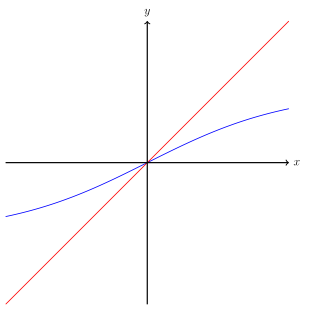
- Show, with the aid of a sketch, that \(y> \tanh (y/2)\) for \(y>0\) and deduce that \begin{equation} \textrm{arcosh} x > \dfrac{x-1}{\sqrt{x^2-1}} \text{ for } x>1. \tag{\(*\)} \end{equation}
- By integrating \((*)\), show that $\textrm{arcosh} x > 2 \dfrac{{x-1}}{\sqrt{x^2-1}} \( for \)x>1$.
- Show that $\textrm{arcosh} x >3 \dfrac{\sqrt{x^2-1}}{{x+2}} \( for \)x>1$.
Solution:
- If \(y = \textrm{arcosh} x \), then \(\tanh\textrm{arcosh} x/2 = \sqrt{\frac{\cosh \textrm{arcosh} x-1}{\cosh \textrm{arcosh} x+1}} = \sqrt{\frac{x-1}{x+1}} = \frac{x-1}{\sqrt{x^2-1}}\)
- \begin{align*} \int \textrm{arcosh} x \d x &= \left [x \textrm{arcosh} x \right] - \int \frac{x}{\sqrt{x^2-1}} \d x \\ &= x \textrm{arcosh} x - \sqrt{x^2-1}+C \\ \int \frac{x-1}{\sqrt{x^2-1}} &= \sqrt{x^2-1} - \textrm{arcosh} x +C \end{align*} Therefore \begin{align*} && \int_1^x \textrm{arcosh} t \d t &> \int_1^x \frac{t-1}{\sqrt{t^2-1}} \d t \\ \Rightarrow && x \textrm{arcosh} x - \sqrt{x^2-1} - 0 &> \sqrt{x^2-1} - \textrm{arcosh} x - 0 \\ \Rightarrow && (x+1) \textrm{arcosh} x &> 2\sqrt{x^2-1} \\ \Rightarrow && \textrm{arcosh} x & > 2\frac{\sqrt{x^2-1}}{x+1} \\ &&&= 2 \frac{\sqrt{x-1}}{\sqrt{x+1}} \\ &&&= 2 \frac{x-1}{\sqrt{x^2-1}} \end{align*}
- Integrating both sides again, \begin{align*} && \int_1^x \textrm{arcosh} t \d t &> 2 \int_1^x \frac{t-1}{\sqrt{t^2-1}} \d t \\ \Rightarrow && x \textrm{arcosh} x - \sqrt{x^2-1} &> 2\left (\sqrt{x^2-1} - \textrm{arcosh}x \right) \\ \Rightarrow && (x+2)\textrm{arcosh} x &> 3 \sqrt{x^2-1} \\ \Rightarrow && \textrm{arcosh} x &> 3 \frac{\sqrt{x^2-1}}{x+2} \end{align*}
2008 Paper 3 Q5
The functions \({\rm T}_n(x)\), for \(n=0\), 1, 2, \(\ldots\,\), satisfy the recurrence relation \[ {\rm T}_{n+1}(x) -2x {\rm T}_n(x) + {\rm T}_{n-1}(x) =0\, \ \ \ \ \ \ \ (n\ge1). \tag{\(*\)} \] Show by induction that \[ \left({\rm T}_n(x)\right)^2 - {\rm T}_{n-1}(x) {\rm T}_{n+1}(x) = \f(x)\,, \] where \(\f(x) = \left({\rm T}_1(x)\right)^2 - {\rm T}_0(x){\rm T}_2(x)\,\). In the case \(\f(x)\equiv 0\), determine (with proof) an expression for \({\rm T}_n(x)\) in terms of \({\rm T}_0(x)\) (assumed to be non-zero) and \({\rm r}(x)\), where \({\rm r}(x) = {\rm T}_1(x)/ {\rm T}_0(x)\). Find the two possible expressions for \({\rm r}(x)\) in terms of \(x\). %Conjecture (without proof) the general form of the solution of \((*)\).
2008 Paper 3 Q6
In this question, \(p\) denotes \(\dfrac{\d y}{\d x}\,\).
- Given that \[ y=p^2 +2 xp\,, \] show by differentiating with respect to \(x\) that \[ \frac{\d x}{\d p} = -2 - \frac {2x} p . \] Hence show that \(x = -\frac23p +Ap^{-2}\,,\) where \(A\) is an arbitrary constant. Find \(y\) in terms of \(x\) if \(p=-3\) when \(x=2\).
- Given instead that \[ y=2xp +p \ln p\,,\] and that \(p=1\) when \(x=-\frac14\), show that \(x=-\frac12 \ln p - \frac14\,\) and find \(y\) in terms of \(x\).
2008 Paper 3 Q7
The points \(A\), \(B\) and \(C\) in the Argand diagram are the vertices of an equilateral triangle described anticlockwise. Show that the complex numbers \(a\), \(b\) and \(c\) representing \(A\), \(B\) and \(C\) satisfy \[2c= (a+b) +\mathrm{i}\sqrt3(b-a).\] Find a similar relation in the case that \(A\), \(B\) and \(C\) are the vertices of an equilateral triangle described clockwise.
- The quadrilateral \(DEFG\) lies in the Argand diagram. Show that points \(P\), \(Q\), \(R\) and \(S\) can be chosen so that \(PDE\), \(QEF\), \(RFG\) and \(SGD\) are equilateral triangles and \(PQRS\) is a parallelogram.
- The triangle \(LMN\) lies in the Argand diagram. Show that the centroids \(U\), \(V\) and \(W\) of the equilateral triangles drawn externally on the sides of \(LMN\) are the vertices of an equilateral triangle. \noindent [{\bf Note:} The {\em centroid} of a triangle with vertices represented by the complex numbers \(x\),~\(y\) and~\(z\) is the point represented by \(\frac13(x+y+z)\,\).]
2008 Paper 3 Q8
- The coefficients in the series \[ S= \tfrac13 x + \tfrac 16 x^2 + \tfrac1{12} x^3 + \cdots + a_rx^r + \cdots \] satisfy a recurrence relation of the form \(a_{r+1} + p a_r =0\). Write down the value of \(p\). By considering \((1+px)S\), find an expression for the sum to infinity of \(S\) (assuming that it exists). Find also an expression for the sum of the first \(n+1\) terms of \(S\).
- The coefficients in the series \[ T=2 + 8x +18x^2+37 x^3 +\cdots + a_rx^r + \cdots \] satisfy a recurrence relation of the form \(a_{r+2}+pa_{r+1} +qa_r=0\). Find an expression for the sum to infinity of \(T\) (assuming that it exists). By expressing \(T\) in partial fractions, or otherwise, find an expression for the sum of the first \(n+1\) terms of \(T\).
2008 Paper 3 Q9
A particle of mass \(m\) is initially at rest on a rough horizontal surface. The particle experiences a force \(mg\sin \pi t\), where \(t\) is time, acting in a fixed horizontal direction. The coefficient of friction between the particle and the surface is \(\mu\). Given that the particle starts to move first at \(t=T_0\), state the relation between \(T_0\) and \(\mu\).
- For \(\mu = \mu_0\), the particle comes to rest for the first time at \(t=1\). Sketch the acceleration-time graph for \(0\le t \le 1\). Show that \[ 1+\left(1-\mu_0^2\right)^{\frac12} -\mu_0\pi +\mu_0 \arcsin \mu_0 =0\,. \]
- For \(\mu=\mu_0\) sketch the acceleration-time graph for \(0\le t\le 3\). Describe the motion of the particle in this case and in the case \(\mu=0\).
2008 Paper 3 Q10
A long string consists of \(n\) short light strings joined together, each of natural length \(\ell\) and modulus of elasticity \(\lambda\). It hangs vertically at rest, suspended from one end. Each of the short strings has a particle of mass \(m\) attached to its lower end. The short strings are numbered \(1\) to \(n\), the \(n\)th short string being at the top. By considering the tension in the \(r\)th short string, determine the length of the long string. Find also the elastic energy stored in the long string. A uniform heavy rope of mass \(M\) and natural length \(L_0\) has modulus of elasticity \(\lambda\). The rope hangs vertically at rest, suspended from one end. Show that the length, \(L\), of the rope is given by \[ L=L_0\biggl(1+ \frac{Mg}{2\lambda}\biggr), \] and find an expression in terms of \(L\), \(L_0\) and \(\lambda\) for the elastic energy stored in the rope.
2008 Paper 3 Q11
A circular wheel of radius \(r\) has moment of inertia \(I\) about its axle, which is fixed in a horizontal position. A light string is wrapped around the circumference of the wheel and a particle of mass \(m\) hangs from the free end. The system is released from rest and the particle descends. The string does not slip on the wheel. As the particle descends, the wheel turns through \(n_1\) revolutions, and the string then detaches from the wheel. At this moment, the angular speed of the wheel is \(\omega_0\). The wheel then turns through a further \(n_2\) revolutions, in time \(T\), before coming to rest. The couple on the wheel due to resistance is constant. Show that \[ \frac12 \omega_0 T = 2 \pi n_2\] and \[ I =\dfrac {mgrn_1T^2 -4\pi mr^2n_2^2}{4\pi n_2(n_1+n_2)}\;. \]
2008 Paper 3 Q12
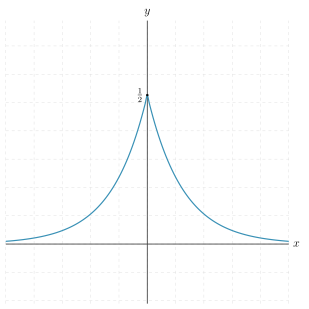
Let \(X\) be a random variable with a Laplace distribution, so that its probability density function is given by \[ \f(x) = \frac12 \e^{-\vert x \vert }\;, \text{ \(-\infty < x < \infty \)}. \tag{\(*\)} \] Sketch \(\f(x)\). Show that its moment generating function \({\rm M}_X(\theta)\) is given by \({\rm M}_X(\theta)= (1-\theta^2)^{-1}\) and hence find the variance of \(X\). A frog is jumping up and down, attempting to land on the same spot each time. In fact, in each of \(n\) successive jumps he always lands on a fixed straight line but when he lands from the \(i\)th jump (\(i=1\,,2\,,\ldots\,,n\)) his displacement from the point from which he jumped is \(X_i\,\)cm, where \(X_i\) has the distribution \((*)\). His displacement from his starting point after \(n\) jumps is \(Y\,\)cm (so that \(Y=\sum\limits_{i=1}^n X_i\)). Each jump is independent of the others. Obtain the moment generating function for \(Y/ \sqrt {2n}\) and, by considering its logarithm, show that this moment generating function tends to \(\exp(\frac12\theta^2)\) as \(n\to\infty\). Given that \(\exp(\frac12\theta^2)\) is the moment generating function of the standard Normal random variable, estimate the least number of jumps such that there is a \(5\%\) chance that the frog lands 25 cm or more from his starting point.
Solution:
2008 Paper 3 Q13
A box contains \(n\) pieces of string, each of which has two ends. I select two string ends at random and tie them together. This creates either a ring (if the two ends are from the same string) or a longer piece of string. I repeat the process of tying together string ends chosen at random until there are none left. Find the expected number of rings created at the first step and hence obtain an expression for the expected number of rings created by the end of the process. Find also an expression for the variance of the number of rings created. Given that \(\ln 20 \approx 3\) and that \(1+ \frac12 + \cdots + \frac 1n \approx \ln n\) for large \(n\), determine approximately the expected number of rings created in the case \(n=40\,000\).
Solution: Let \(X_i\) be the indicator variable a loop is formed when there are \(i\) strings in the bag, so \(\mathbb{P}(X_i = 1) = \frac{1}{2i-1}\). Therefore \begin{align*} && Y_n &= X_n + Y_{n-1} \\ && Y_n &= X_n + \cdots + X_1 \\ \Rightarrow && \E[Y_n] &= \frac{1}{2n-1} + \frac{1}{2n-3} + \cdots + \frac{1}{1} \\ && \var[Y_n] &= \sum_{i=1}^n \frac{1}{2i-1} \frac{2i-2}{2i-1} \\ &&&= 2\sum_{i=1}^n \frac{i-1}{(2i-1)^2} \end{align*} \begin{align*} && \E[Y_{n}] &= 1 + \frac13 + \cdots + \frac{1}{2n-1} \\ &&&= 1 + \frac12 + \cdots + \frac1{2n} - \frac12\left (1 + \frac12 + \cdots + \frac1n \right) \\ &&&\approx \ln 2n -\frac12 \ln n \\ &&&= \ln 2 \sqrt{n} \\ \\ && \E[Y_{40\,000}] &= \ln 2 \sqrt{40\,000} \\ &&&= \ln 400 \\ &&&= 2 \ln 20 \approx 6 \end{align*}