Problems
Filters
3 problems found
2002 Paper 2 Q1
Show that \[ \int_{\frac{1}{6}\pi}^{\frac{1}{4}\pi} \frac 1{1-\cos2\theta} \;\d\theta = \frac{\sqrt3}2 - \frac12\;. \] By using the substitution \(x=\sin2\theta\), or otherwise, show that \[ \int_{\sqrt3/2}^1 \frac 1 {1-\sqrt{1-x^2}} \, \d x = \sqrt 3 -1 -\frac\pi 6 \;. \] Hence evaluate the integral \[ \int_1^{2/\sqrt3} \frac 1{y ( y - \sqrt{y^2-1^2})} \, \d y \;. \]
Solution: \begin{align*} && I &= \int_{\frac{1}{6}\pi}^{\frac{1}{4}\pi} \frac 1{1-\cos2\theta} \;\d\theta \\ &&&= \int_{\frac{1}{6}\pi}^{\frac{1}{4}\pi} \frac 1{2\sin^2 \theta} \;\d\theta \\ &&&= \frac12\int_{\frac{1}{6}\pi}^{\frac{1}{4}\pi} \cosec^2 \theta \;\d\theta \\ &&&= \frac12\left [-\cot \theta \right]_{\frac{1}{6}\pi}^{\frac{1}{4}\pi} \\ &&&= \frac12 \left (\cot \frac{\pi}{6} - \cot \frac{\pi}{4} \right)\\ &&&= \frac{\sqrt{3} - 1}{2} \end{align*} \begin{align*} && J &= \int_{\sqrt3/2}^1 \frac 1 {1-\sqrt{1-x^2}} \, \d x \\ x = \sin 2 \theta, \d x = 2\cos 2\theta \d \theta &&&=\int_{\pi/6}^{\pi/4} \frac{2 \cos 2 \theta }{1-\cos 2 \theta} \d \theta \\ &&&=\int_{\pi/6}^{\pi/4} \frac{2 \cos 2 \theta -2+2}{1-\cos 2 \theta} \d \theta \\ &&&= -2\left (\frac{\pi}{4} - \frac{\pi}6 \right) + 2I \\ &&&= \sqrt{3}-1-\frac{\pi}{6} \end{align*} \begin{align*} && K &= \int_1^{2/\sqrt{3}} \frac{1}{y(y-\sqrt{y^2-1})} \d y \\ y = 1/x, \d x = -1/y^2 \d y &&&= \int_{x=1}^{x=\sqrt{3}/2} \frac{1}{1-\sqrt{1-x^2}} \d x\\ &&&= \sqrt{3}-1 -\frac{\pi}6 \end{align*}
1999 Paper 1 Q7
Show that \(\sin(k\sin^{-1} x)\), where \(k\) is a constant, satisfies the differential equation $$(1-x^{2})\frac {\d^2 y}{\d x^2} -x\frac{\d y}{\d x} +k^{2}y=0. \tag{*}$$ In the particular case when \(k=3\), find the solution of equation \((*)\) of the form \[ y=Ax^{3}+Bx^{2}+Cx+D, \] that satisfies \(y=0\) and \(\displaystyle \frac{\d y}{\d x}=3\) at \(x=0\). Use this result to express \(\sin 3\theta\) in terms of powers of \(\sin\theta\).
Solution: \begin{align*} && y &= \sin(k \sin^{-1} x ) \\ &&y' &= \cos (k \sin^{-1} x) \cdot k \frac{1}{\sqrt{1-x^2}} \\ && y'' &= -\sin (k \sin^{-1} x) \cdot k^2 \frac{1}{(1-x^2)} - \cos(k \sin^{-1} x) \cdot k \frac{x}{(1-x^2)\sqrt{1-x^2}} \\ && (1-x^2)y'' &= -k^2y -xy' \\ \Rightarrow && 0 &= (1-x^2)y''+xy' + k^2y \end{align*} \begin{align*} && y &= Ax^3 + Bx^2 + Cx + D \\ && y' &= 3Ax^2 + 2Bx + C \\ && y'' &= 6Ax+2B \\ && 0 &= (1-x^2)(6Ax+2B) - x( 3Ax^2 + 2Bx + C) + 9(Ax^3 + Bx^2 + Cx + D ) \\ &&&= x^3(-6A-3A+9A) + x^2(-2B-2B+9B) + x(6A-C+9C) + (2B +9D) \\ \Rightarrow && B &= 0 \\ \Rightarrow && D &= 0 \\ \Rightarrow && C &= -\frac34 A \\ \\ x = 0, y = 0, y' = 0: && y &= 3x-4x^3 \\ \end{align*} And so \(\sin 3 x = 3 \sin x - 4\sin^3 x\)
1999 Paper 3 Q2
- Let \(\f(x)=(1+x^2)\e^x\). Show that \(\f'(x)\ge 0\) and sketch the graph of \(\f(x)\). Hence, or otherwise, show that the equation \[ (1+x^2)\e^x = k, \] where \(k\) is a constant, has exactly one real root if \(k>0\) and no real roots if \(k\le 0\).
- Determine the number of real roots of the equation $$ (\e^x-1) - k \tan^{-1} x=0 $$ in the cases (a) \(0< k\le 2/\pi\) and (b) \(2/\pi < k < 1\).
Solution:
- \(\,\) \begin{align*}
&& f(x) &= (1+x^2)e^x \\
&& f'(x) &= 2xe^x + (1+x^2)e^x \\
&&&= (1+x)^2e^x \geq 0
\end{align*}
As \(x \to -\infty\), \(f(x) \to 0\) and as \(x \to \infty\), \(f(x) \to +\infty\) and since \(f\) is strictly increasing we have exactly one solution to \(f(x) = k\) on \((0,\infty)\). Since \(f(x) > 0\) there are no solutions if \(k \leq 0\).
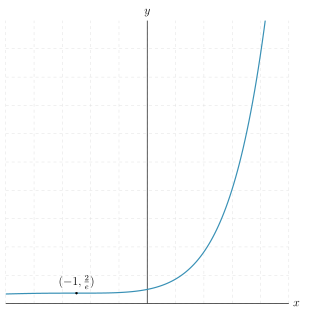
- Considering the function \(g(x) = (e^x-1)-k\tan^{-1} x \) then \(g'(x) = e^x - \frac{k}{1+x^2}\) therefore \(g'(x)\) has exactly one turning point when \(k > 0\) and \(0\) otherwise at the root of \(f(x) = k\) Notice also that \(g(0) = 0\) so we already have one solution, and \(g'(0) = 1 - k > 0\). Notice from our sketch that if \(0 < k < 1\) the root for \(f(x) = k\) has \(x \leq 0\), so our turning point is to the left of the origin and we are interested in the behaviour of \(g(x)\) as \(x \to -\infty\). (ie do we cross the axis again). \(\lim_{x \to -\infty} \left [ e^x - 1 - k \tan^{-1} x \right] = 0 - 1 +k \frac{\pi}{2} = k \frac{\pi}{2} - 1\). if this is positive, ie if \(k > \frac{2}{\pi}\) there are two solutions, otherwise there is only one real root.