Problems
Filters
62 problems found
2025 Paper 2 Q11
- By considering the sum of a geometric series, or otherwise, show that \[\sum_{r=1}^{\infty} rx^{r-1} = \frac{1}{(1-x)^2} \quad \text{for } |x| < 1.\]
- Ali plays a game with a fair \(2k\)-sided die. He rolls the die until the first \(2k\) appears. Ali wins if all the numbers he rolls are even.
- Find the probability that Ali wins the game. If Ali wins the game, he earns £1 for each roll, including the final one. If he loses, he earns nothing.
- Find Ali's expected earnings from playing the game.
- Find a simplified expression for \[1 + 2\binom{n}{1}x + 3\binom{n}{2}x^2 + \ldots + (n+1)x^n,\] where \(n\) is a positive integer.
- Zen plays a different game with a fair \(2k\)-sided die. She rolls the die until the first \(2k\) appears, and wins if the numbers rolled are strictly increasing in size. For example, if \(k = 3\), she wins if she rolls 2, 6 or 1, 4, 5, 6, but not if she rolls 1, 4, 2, 6 or 1, 3, 3, 6. If Zen wins the game, she earns £1 for each roll, including the final one. If she loses, she earns nothing. Find Zen's expected earnings from playing the game.
- Using the approximation \[\left(1 + \frac{1}{n}\right)^n \approx e \quad \text{for large } n,\] show that, when \(k\) is large, Zen's expected earnings are a little over 35\% more than Ali's expected earnings.
Solution:
- Note that, \begin{align*} && \sum_{r = 0}^\infty x^r &= \frac{1}{1-x} && |x| < 1\\ \underbrace{\Rightarrow}_{\frac{\d}{\d x}} && \sum_{r = 0}^\infty rx^{r-1} &= \frac{1}{(1-x)^2} && |x| < 1\\ && \sum_{r = 1}^\infty rx^{r-1} &= \frac{1}{(1-x)^2} && |x| < 1\\ \end{align*}
- \begin{align*} && \mathbb{P}(\text{Ali wins in }s\text{ rounds}) &= \left ( \frac{k-1}{2k} \right)^{s-1} \frac{1}{2k} \\ \Rightarrow && \mathbb{P}(\text{Ali wins}) &= \sum_{s=1}^\infty \mathbb{P}(\text{Ali wins in }s\text{ rounds}) \\ &&&=\sum_{s=1}^\infty \left ( \frac{k-1}{2k} \right)^{s-1} \frac{1}{2k} \\ &&&= \frac{1}{2k} \sum_{s=0}^\infty \left ( \frac{k-1}{2k} \right)^{s} \\ &&&= \frac{1}{2k} \frac{1}{1 - \frac{k-1}{2k}} \\ &&&= \frac{1}{2k - (k-1)} \\ &&&= \frac{1}{k+1} \end{align*}
- \begin{align*} \mathbb{E}(\text{Ali score}) &= \sum_{s=1}^{\infty} s \mathbb{P}(\text{Ali wins in }s\text{ rounds}) \\ &= \sum_{s=1}^{\infty} s \left ( \frac{k-1}{2k} \right)^{s-1} \frac{1}{2k} \\ &= \frac{1}{2k} \frac{1}{\left (1 - \frac{k-1}{2k} \right)^2} \\ &= \frac{2k}{(k+1)^2} \end{align*}
- \begin{align*} && (1+x)^{n} &= \sum_{k=0}^n \binom{n}{k} x^k \\ \Rightarrow && x(1+x)^n &= \sum_{k=0}^n \binom{n}{k} x^{k+1} \\ \Rightarrow && (1+x)^n + nx(1+x)^{n-1} &= \sum_{k=0}^n (k+1)\binom{n}{k} x^k \\ \Rightarrow && (1+x)^{n-1}(1+(n+1)x) &= 1 + 2\binom{n}{1}x + 3\binom{n}{2}x^2 + \ldots + (n+1)x^n \end{align*}
- \begin{align*} \mathbb{E}(\text{Zen score}) &= \sum_{s=1}^{2k} s \mathbb{P} \left ( \text{Zen gets }s\text{ numbers in increasing order ending with }2k \right) \\ &= \sum_{s=1}^{2k} s \binom{2k-1}{s-1} \frac{1}{(2k)^s} \\ &= \frac{1}{2k}\sum_{s=0}^{2k-1} (s+1) \binom{2k-1}{s} \frac{1}{(2k)^s} \\ &= \frac{1}{2k} \left ( 1 + \frac{1}{2k} \right)^{2k-2} \left ( 1 + (2k-1+1) \frac{1}{2k} \right) \\ &= \frac{1}{k}\left ( 1 + \frac{1}{2k} \right)^{2k-2} \end{align*}
- Therefore as \(k \to \infty\) \begin{align*} \frac{\mathbb{E}(\text{Zen score})}{\mathbb{E}(\text{Ali score}) } &= \frac{1}{k}\left ( 1 + \frac{1}{2k} \right)^{2k-2} \big / \frac{2k}{(k+1)^2} \\ &= \frac{(k+1)^2}{2k^2} \cdot \left ( 1 + \frac{1}{2k} \right)^{2k} \cdot \left ( 1 + \frac{1}{2k} \right)^{-2} \\ &\to \frac12 e \approx 2.7/2 = 1.35 \end{align*} ie Zen's expected earnings are \(\approx 35\%\) more.
2024 Paper 2 Q11
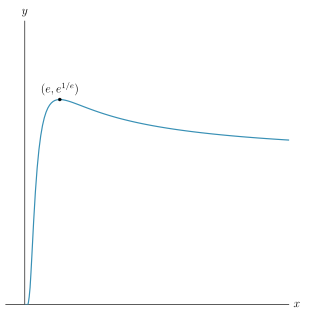
- Sketch a graph of \(y = x^{\frac{1}{x}}\) for \(x > 0\), showing the location of any turning points. Find the maximum value of \(n^{\frac{1}{n}}\), where \(n\) is a positive integer.
- The people to be tested are split into \(r\) groups of size \(k\), with \(k > 1\) and \(rk = N\).
- In every group, a sample from each person in that group is mixed into one large sample, which is then tested.
- If the enzyme is not present in the combined sample from a group, no further testing of the people in that group is needed.
- If the enzyme is present in the combined sample from a group, a second sample from each person in that group is tested separately.
- Find, in terms of \(N\), \(k\) and \(p\), the expected number of tests.
- Given that \(N\) is a multiple of \(3\), find the largest value of \(p\) for which it is possible to find an integer value of \(k\) such that \(k > 1\) and the expected number of tests is at most \(N\). Show that this value of \(p\) is greater than \(\frac{1}{4}\).
- Show that, if \(pk\) is sufficiently small, the expected number of tests is approximately \[ N\!\left(\frac{1}{k} + pk\right). \] In the case where \(p = 0.01\), show that choosing \(k = 10\) gives an expected number of tests which is only about \(20\%\) of \(N\).
Solution:
- \(\,\)
\begin{align*} && y & = x^{1/x} = \exp \left ( \tfrac1x \ln x \right ) \\ \Rightarrow && y' &= \exp \left ( \tfrac1x \ln x \right ) \cdot \left ( \frac{1}{x^2} - \frac{\ln x}{x^2} \right ) \\ &&&= \frac{\exp \left ( \tfrac1x \ln x \right ) }{x^2}(1 - \ln x) \\ y' =0: && x &= e \end{align*} Therefore the largest integer values will be \(2\) or \(3\). Comparing \((2^{\frac12})^6 = 8 < 9 = (3^{1/3})^6\) we see the maximum value of \(n^{1/n}\) where \(n\) is an integer is \(\sqrt[3]{3}\)
- The number of tests is \(r\) plus however many groups fail times \(k\). The probability of a group failing is \(g = 1-(1-p)^k\) and the number of failing groups is \(\sim B(r, g)\) so the expected number of additional groups is \(rg\) and the expected total number of tests is \[ \frac{N}{k} + N(1-(1-p)^k) \]
- \(\,\) \begin{align*} && N &\geq E = \frac{N}{k} + N(1-(1-p)^k) \\ \Rightarrow && 1 &\geq \frac{1}{k} + 1-(1-p)^k \\ \Rightarrow && (1-p)^k &\geq \frac1k \\ \Rightarrow && k \ln(1-p) &\geq - \ln k \\ \Rightarrow && \ln(1 - p) &\geq -\frac{1}{k} \ln k \geq -\frac13 \ln 3 \\ \Rightarrow && 1-p &\geq \frac{1}{\sqrt[3]{3}} \\ \Rightarrow && p &\leq 1-\frac{1}{\sqrt[3]{3}} \end{align*} (taking \(k=3\)) Claim: \(1 - \frac{1}{\sqrt[3]{3}} > \frac14\) Proof: This is equivalent to \(\sqrt[3]{3} > \frac43\) or \(81 > 4^3 = 64\) which is clearly true.
- If \(pk\) is small then \((1-p)^k \approx 1 - pk\) and so we obtain \(N \left ( \frac1k +pk \right)\) as required. If \(p = 0.01\) and \(k = 10\) then \(\frac{1}{10} + 0.01 \cdot 10 = 0.2\) so the expected number of tests is \(\sim 20\%\) of \(N\)
2024 Paper 3 Q12
- A point is chosen at random in the square \(0 \leqslant x \leqslant 1\), \(0 \leqslant y \leqslant 1\), so that the probability that a point lies in any region is equal to the area of that region. \(R\) is the random variable giving the distance of the point from the origin. Show that the cumulative distribution function of \(R\) is given by \[\mathrm{P}(R \leqslant r) = \sqrt{r^2 - 1} + \tfrac{1}{4}\pi r^2 - r^2 \cos^{-1}(r^{-1}),\] when \(1 \leqslant r \leqslant \sqrt{2}\). What is the cumulative distribution function when \(0 \leqslant r \leqslant 1\)?
- Show that \(\displaystyle\mathrm{E}(R) = \frac{2}{3}\int_1^{\sqrt{2}} \frac{r^2}{\sqrt{r^2-1}}\,\mathrm{d}r\).
- Show further that \(\mathrm{E}(R) = \frac{1}{3}\Bigl(\sqrt{2} + \ln\bigl(\sqrt{2}+1\bigr)\Bigr)\).
2023 Paper 3 Q12
A drawer contains \(n\) pairs of socks. The two socks in each pair are indistinguishable, but each pair of socks is a different colour from all the others. A set of \(2k\) socks, where \(k\) is an integer with \(2k \leqslant n\), is selected at random from this drawer: that is, every possible set of \(2k\) socks is equally likely to be selected.
- Find the probability that, among the socks selected, there is no pair of socks.
- Let \(X_{n,k}\) be the random variable whose value is the number of pairs of socks found amongst those selected. Show that \[\mathrm{P}(X_{n,k} = r) = \frac{\dbinom{n}{r}\dbinom{n-r}{2(k-r)}\, 2^{2(k-r)}}{\dbinom{2n}{2k}}\] for \(0 \leqslant r \leqslant k\).
- Show that \[r\,\mathrm{P}(X_{n,k} = r) = \frac{k(2k-1)}{2n-1}\,\mathrm{P}(X_{n-1,k-1} = r-1)\,,\] for \(1 \leqslant r \leqslant k\), and hence find \(\mathrm{E}(X_{n,k})\).
2022 Paper 2 Q11
A batch of \(N\) USB sticks is to be used on a network. Each stick has the same unknown probability \(p\) of being infected with a virus. Each stick is infected, or not, independently of the others. The network manager decides on an integer value of \(T\) with \(0 \leqslant T < N\). If \(T = 0\) no testing takes place and the \(N\) sticks are used on the network, but if \(T > 0\), the batch is subject to the following procedure.
- Each of \(T\) sticks, chosen at random from the batch, undergoes a test during which it is destroyed.
- If any of these \(T\) sticks is infected, all the remaining \(N - T\) sticks are destroyed.
- If none of the \(T\) sticks is infected, the remaining \(N - T\) sticks are used on the network.
- Find an expression in terms of \(N\), \(T\), \(D\) and \(q\), where \(q = 1 - p\), for the expected net loss.
- Let \(\alpha = \dfrac{DT}{N(N - T + D)}\). Show that \(0 \leqslant \alpha < 1\). Show that, for fixed values of \(N\), \(D\) and \(T\), the greatest value of the expected net loss occurs when \(q\) satisfies the equation \(q^{N-T} = \alpha\). Show further that this greatest value is \(\pounds\dfrac{D(N-T)\,\alpha^k}{N}\), where \(k = \dfrac{T}{N-T}\).
- For fixed values of \(N\) and \(D\), show that there is some \(\beta > 0\) so that for all \(p < \beta\), the expression for the expected loss found in part (i) is an increasing function of \(T\). Deduce that, for small enough values of \(p\), testing no sticks minimises the expected net loss.
2022 Paper 3 Q11
A fair coin is tossed \(N\) times and the random variable \(X\) records the number of heads. The mean deviation, \(\delta\), of \(X\) is defined by \[ \delta = \mathrm{E}\big(|X - \mu|\big) \] where \(\mu\) is the mean of \(X\).
- Let \(N = 2n\) where \(n\) is a positive integer.
- Show that \(\mathrm{P}(X \leqslant n-1) = \frac{1}{2}\big(1 - \mathrm{P}(X=n)\big)\).
- Show that \[ \delta = \sum_{r=0}^{n-1}(n-r)\binom{2n}{r}\frac{1}{2^{2n-1}}\,. \]
- Show that for \(r > 0\), \[ r\binom{2n}{r} = 2n\binom{2n-1}{r-1}\,. \] Hence show that \[ \delta = \frac{n}{2^{2n}}\binom{2n}{n}\,. \]
- Find a similar expression for \(\delta\) in the case \(N = 2n+1\).
Solution:
- When \(N = 2n+1\), \(\mu = n +\frac12\) and so \begin{align*} && \delta &= \E[|X-\mu|] \\ &&&= \sum_{i=0}^n (n + \tfrac12 - i) \frac{1}{2^{2n+1}} \binom{2n+1}{i} + \sum_{i=n+1}^{2n+1} (i-n - \tfrac12) \frac{1}{2^{2n+1}} \binom{2n+1}{i} \\ &&&= 2\sum_{i=0}^n (n + \tfrac12 - i) \frac{1}{2^{2n+1}} \binom{2n+1}{i} \\ &&&= \frac{(2n +1)}{2^{2n+1}}\sum_{i=0}^n \binom{2n+1}i - \frac{2}{2^{2n+1}}\sum_{i=0}^n i \binom{2n+1}{i} \\ &&&= \frac{(2n +1)}{2^{2n+1}}\sum_{i=0}^n \binom{2n+1}i - \frac{2}{2^{2n+1}}\sum_{i=1}^n (2n+1) \binom{2n}{i-1} \\ &&&= \frac{(2n +1)}{2^{2n+1}}2^{2n} - \frac{2(2n+1)}{2^{2n+1}}\sum_{i=0}^{n-1} \binom{2n}{i} \\ &&&= \frac{(2n +1)}{2} - \frac{2(2n+1)}{2^{2n+1}} \frac12\left (2^{2n} - \binom{2n}{n} \right) \\ &&&= \frac{2n+1}{2^{2n+1}}\binom{2n}{n} \end{align*}
2022 Paper 3 Q12
- The point \(A\) lies on the circumference of a circle of radius \(a\) and centre \(O\). The point \(B\) is chosen at random on the circumference, so that the angle \(AOB\) has a uniform distribution on \([0, 2\pi]\). Find the expected length of the chord \(AB\).
- The point \(C\) is chosen at random in the interior of a circle of radius \(a\) and centre \(O\), so that the probability that it lies in any given region is proportional to the area of the region. The random variable \(R\) is defined as the distance between \(C\) and \(O\). Find the probability density function of \(R\). Obtain a formula in terms of \(a\), \(R\) and \(t\) for the length of a chord through \(C\) that makes an acute angle of \(t\) with \(OC\). Show that as \(C\) varies (with \(t\) fixed), the expected length \(\mathrm{L}(t)\) of such chords is given by \[ \mathrm{L}(t) = \frac{4a(1-\cos^3 t)}{3\sin^2 t}\,. \] Show further that \[ \mathrm{L}(t) = \frac{4a}{3}\left(\cos t + \tfrac{1}{2}\sec^2(\tfrac{1}{2}t)\right). \]
- The random variable \(T\) is uniformly distributed on \([0, \frac{1}{2}\pi]\). Find the expected value of \(\mathrm{L}(T)\).
2021 Paper 3 Q12
- In a game, each member of a team of \(n\) players rolls a fair six-sided die. The total score of the team is the number of pairs of players rolling the same number. For example, if \(7\) players roll \(3, 3, 3, 3, 6, 6, 2\) the total score is \(7\), as six different pairs of players both score \(3\) and one pair of players both score \(6\). Let \(X_{ij}\), for \(1 \leqslant i < j \leqslant n\), be the random variable that takes the value \(1\) if players \(i\) and \(j\) roll the same number and the value \(0\) otherwise. Show that \(X_{12}\) is independent of \(X_{23}\). Hence find the mean and variance of the team's total score.
- Show that, if \(Y_i\), for \(1 \leqslant i \leqslant m\), are random variables with mean zero, then \[ \mathrm{Var}(Y_1 + Y_2 + \cdots + Y_m) = \sum_{i=1}^{m} \mathrm{E}(Y_i^2) + 2\sum_{i=1}^{m-1}\sum_{j=i+1}^{m} \mathrm{E}(Y_i Y_j). \]
- In a different game, each member of a team of \(n\) players rolls a fair six-sided die. The total score of the team is the number of pairs of players rolling the same even number minus the number of pairs of players rolling the same odd number. For example, if \(7\) players roll \(3, 3, 3, 3, 6, 6, 2\) the total score is \(-5\). Let \(Z_{ij}\), for \(1 \leqslant i < j \leqslant n\), be the random variable that takes the value \(1\) if players \(i\) and \(j\) roll the same even number, the value \(-1\) if players \(i\) and \(j\) roll the same odd number and the value \(0\) otherwise. Show that \(Z_{12}\) is not independent of \(Z_{23}\). Find the mean of the team's total score and show that the variance of the team's total score is \(\dfrac{1}{36}n(n^2 - 1)\).
Solution:
- First note that \(\mathbb{P}(X_{ij} = 1) = \frac16\) since it doesn't matter what \(i\) rolls, it only matters that \(j\) rolls the same thing, which happens \(1/6\) of the time. \begin{align*} && \mathbb{P}(X_{12} = 1, X_{23} = 1) &= \mathbb{P}(1, 2\text{ and }3\text{ all roll the same})\\ &&&= \frac{6}{6^3}= \frac1{6^2} \\ &&&= \mathbb{P}(X_{12} = 1)\mathbb{P}(X_{23} = 1) \\ && \mathbb{P}(X_{12} = 1, X_{23} = 0) &= \mathbb{P}(1, 2\text{ roll the same and }3\text{ rolls different}) \\ &&&= \frac{6 \cdot 1 \cdot 5}{6^3} = \frac{5}{6^2} \\ &&&= \mathbb{P}(X_{12} = 1)\mathbb{P}(X_{23} = 0) \\ && \mathbb{P}(X_{12} = 0, X_{23} = 0) &= \mathbb{P}(2, 3 \text{ roll different to} 2)\\ &&&= \frac{6 \cdot 5 \cdot 5}{6^3}= \frac{5^2}{6^2} \\ &&&= \mathbb{P}(X_{12} = 0)\mathbb{P}(X_{23} = 0) \end{align*} Therefore they are independent (the final case is clear by symmetry from case 2). Note that the score is \(S = \sum_{i \neq j} X_{ij}\) so \begin{align*} && \E[S] &= \E \left [ \sum_{i \neq j} X_{ij} \right] \\ &&&= \sum_{i \neq j} \E \left [ X_{ij} \right] \\ &&&= \sum_{i \neq j} \frac16 \\ &&&= \binom{n}{2} \frac16 = \frac{n(n-1)}{12} \\ \\ && \var[S] &= \var \left [ \sum_{i \neq j} X_{ij} \right] \\ &&& \sum_{i \neq j} \var \left [X_{ij} \right] \tag{pairwise ind.} \\ &&&= \binom{n}{2} \frac{5}{36} = \frac{5n(n-1)}{72} \end{align*}
- Note that \(\mathbb{P}(Z_{ij} = 1)=\mathbb{P}(Z_{ij} = -1) = \frac{3}{6^2} = \frac{1}{12}\) but that \(\mathbb{P}(Z_{12} = 1, Z_{23} = -1) = 0\). Notice that \(Z_{12}Z_{23}\) is either \(1\) or \(0\) (since \(2\) can't be both odd and even). \(\mathbb{P}(Z_{12}Z_{23} = 1) = \frac{1}{36}\). Notice that \(Z_{ij}, Z_{kl}\) are independent if \(i \neq j \neq k \neq l\) and so \begin{align*} && \E[T] &= \E \left [ \sum_{i \neq j} Z_{ij} \right] \\ &&&= \sum_{i \neq j}\E \left [ Z_{ij} \right] \\ &&&= 0 \\ \\ && \E[T^2] &= \E \left [ \left ( \sum_{i \neq j} Z_{ij} \right)^2 \right] \\ &&&= \E \left [ \sum_{i \neq j} Z_{ij}^2 + \sum_{i \neq j \neq k} Z_{ij}Z_{jk} + \sum_{i \neq j \neq k \neq l} Z_{ij}Z_{kl}\right] \\ &&&= \binom{n}{2} \frac{1}{6} + 2\frac{n(n-1)(n-2)}{2} \frac{1}{36} + 0 \\ &&&= \frac{n(n-1)}{12} + \frac{n(n-1)(n-2)}{6} \\ &&&= \frac{n(n-1)[3 + (n-2)]}{36} \\ &&&= \frac{n(n^2-1)}{36} \end{align*}
2020 Paper 2 Q12
The score shown on a biased \(n\)-sided die is represented by the random variable \(X\) which has distribution \(\mathrm{P}(X = i) = \dfrac{1}{n} + \varepsilon_i\) for \(i = 1, 2, \ldots, n\), where not all the \(\varepsilon_i\) are equal to \(0\).
- Find the probability that, when the die is rolled twice, the same score is shown on both rolls. Hence determine whether it is more likely for a fair die or a biased die to show the same score on two successive rolls.
- Use part (i) to prove that, for any set of \(n\) positive numbers \(x_i\) (\(i = 1, 2, \ldots, n\)), \[\sum_{i=2}^{n}\sum_{j=1}^{i-1} x_i x_j \leqslant \frac{n-1}{2n}\left(\sum_{i=1}^{n} x_i\right)^2.\]
- Determine, with justification, whether it is more likely for a fair die or a biased die to show the same score on three successive rolls.
2019 Paper 3 Q11
The number of customers arriving at a builders' merchants each day follows a Poisson distribution with mean \(\lambda\). Each customer is offered some free sand. The probability of any given customer taking the free sand is \(p\).
- Show that the number of customers each day who take sand follows a Poisson distribution with mean \(p\lambda\).
- The merchant has a mass \(S\) of sand at the beginning of the day. Each customer who takes the free sand gets a proportion \(k\) of the remaining sand, where \(0 \leq k < 1\). Show that by the end of the day the expected mass of sand taken is $$\left(1 - e^{-kp\lambda}\right)S.$$
- At the beginning of the day, the merchant's bag of sand contains a large number of grains, exactly one of which is made from solid gold. At the end of the day, the merchant's assistant takes a proportion \(k\) of the remaining sand. Find the probability that the assistant takes the golden grain. Comment on the case \(k = 0\) and on the limit \(k \to 1\). In the case \(p\lambda > 1\) find the value of \(k\) which maximises the probability that the assistant takes the golden grain.
Solution:
- Let \(X\) be the number of people arriving on a given day, and \(Y\) be the number taking sand, then \begin{align*} && \mathbb{P}(Y = k) &= \sum_{x=k}^{\infty} \mathbb{P}(x \text{ arrive and }k\text{ of them take sand}) \\ &&&= \sum_{x=k}^{\infty} \mathbb{P}(X=x)\mathbb{P}(k \text{ out of }x\text{ of them take sand})\\ &&&= \sum_{x=k}^{\infty} e^{-\lambda} \frac{\lambda^x}{x!}\binom{x}{k}p^k(1-p)^{x-k}\\ &&&= e^{-\lambda} \left ( \frac{p}{1-p} \right)^k \sum_{x=k}^{\infty} \frac{((1-p)\lambda)^x}{k!(x-k)!} \\ &&&= e^{-\lambda} \left ( \frac{p}{1-p} \right)^k \frac{((1-p)\lambda)^k}{k!} \sum_{x=0}^{\infty} \frac{((1-p)\lambda)^x}{x!} \\ &&&= e^{-\lambda} \left ( \frac{p}{1-p} \right)^k \frac{((1-p)\lambda)^k}{k!}e^{(1-p)\lambda)} \\ &&&= e^{-p\lambda} \frac{(p\lambda)^k}{k!} \end{align*} which is precisely a Poisson with parameter \(p\lambda\). Alternatively, \(Y = B_1 + B_2 + \cdots + B_X\) where \(B_i \sim Bernoulli(p)\) so \(G_Y(t) = G_X(G_B(t)) = G_X(1-p+pt) = e^{-\lambda(1-(1-p+pt))} = e^{-p\lambda(1-t)}\) so \(Y \sim Po(\lambda)\) Alternatively, alternatively, let \(Z\) be the number of people not taking sand, so \begin{align*} && \mathbb{P}(Y = y, Z= z) &= \mathbb{P}(X=y+z) \cdot \binom{y+z}{y} p^y(1-p)^z \\ &&&= e^{-\lambda} \frac{\lambda^{y+z}}{(y+z)!} \frac{(y+z)!}{y!z!} p^y(1-p)^z \\ &&&=\left ( e^{-p\lambda} \frac{(p\lambda)^y}{y!} \right) \cdot \left ( e^{-(1-p)\lambda} \frac{((1-p)\lambda)^z}{z!}\right) \end{align*} So clearly \(Y\) and \(Z\) are both (independent!) Poisson with parameters \(p\lambda \) and \((1-p)\lambda\)
- The amount taken is \(Sk + S(1-k)k + \cdots +Sk(1-k)^{Y-1} = Sk\cdot \frac{1-(1-k)^Y}{k} = S(1-(1-k)^Y)\) so \begin{align*} \E[\text{taken sand}] &= \E \left [ S(1-(1-k)^Y)\right] \\ &= S-S\E\left [(1-k)^Y \right] \\ &= S - SG_Y(1-k)\\ &=S - Se^{-p\lambda(1-(1-k))} \tag{pgf for Poisson} \\ &= S\left (1-e^{-kp\lambda} \right) \end{align*}
- The fraction of grains the assistant takes home is: \((1-k)^Yk\), which has expected value \(ke^{-kp\lambda}\). This the the probability he takes home the golden grain. When \(k = 0\) the probability is \(0\) which makes sense (no-one takes home any sand, including the merchant's assistant). As \(k \to 1\) we get \(e^{-p\lambda}\) which is the probability that no-one gets any sand other than him. \begin{align*} && \frac{\d }{\d k} \left ( ke^{-kp\lambda} \right) &= e^{-kp\lambda} - (p\lambda)ke^{-kp\lambda} \\ &&&= e^{-kp\lambda}(1 - (p\lambda)k) \end{align*} Therefore maximised at \(k = \frac{1}{p\lambda}\). (Clearly this is a maximum just by sketching the function)
2018 Paper 2 Q12
In a game, I toss a coin repeatedly. The probability, \(p\), that the coin shows Heads on any given toss is given by \[ p= \frac N{N+1} \,, \] where \(N\) is a positive integer. The outcomes of any two tosses are independent. The game has two versions. In each version, I can choose to stop playing after any number of tosses, in which case I win £\(H\), where \(H\) is the number of Heads I have tossed. However, the game may end before that, in which case I win nothing.
- In version 1, the game ends when the coin first shows Tails (if I haven't stopped playing before that). I decide from the start to toss the coin until a total of \(h\) Heads have been shown, unless the game ends before then. Find, in terms of \(h\) and \(p\), an expression for my expected winnings and show that I can maximise my expected winnings by choosing \(h=N\).
- In version 2, the game ends when the coin shows Tails on two consecutive tosses (if I haven't stopped playing before that). I decide from the start to toss the coin until a total of \(h\) Heads have been shown, unless the game ends before then. Show that my expected winnings are \[ \frac{ hN^h (N+2)^h}{(N+1)^{2h}} \,.\] In the case \(N=2\,\), use the approximation \(\log_3 2 \approx 0.63\) to show that the maximum value of my expected winnings is approximately £3.
Solution:
- Since we either win \(h\) or \(0\), to calculate the expected winnings we just need to calculate the probability that we get \(h\) consecutive heads, therefore: \begin{align*} && \mathbb{E}(\text{winnings}) &= E_h \\ &&&= h \cdot \left ( \frac{N}{N+1} \right)^h \\ && \frac{E_{h+1}}{E_h} &= \frac{h+1}{h }\left ( \frac{N}{N+1} \right) \end{align*} Therefore \(E_h\) is increasing if \(h \leq N\), so we can maximise our winnings by taking \(h = N\). (In fact, we could take \(h = N\) or \(h = N+1\), but arguably \(h = N\) is better as we have the same expected value but lower variance).
- We can have up to \(h\) tails appearing (if we imagine slots for tails of the form \(\underbrace{\_H\_H\_H\_\cdots\_H}_{h\text{ spaces and }h\, H}\) so, we have \begin{align*} && \mathbb{P}(\text{wins}) &= \sum_{t = 0}^h \mathbb{P}(\text{wins and } t\text{ tails}) \\ &&&= \sum_{t = 0}^h\binom{h}{t} \left ( \frac{N}{N+1} \right)^h\left ( \frac{1}{N+1} \right)^t \\ &&&= \left ( \frac{N}{N+1} \right)^h \sum_{t = 0}^h\binom{h}{t}\left ( \frac{1}{N+1} \right)^t \cdot 1^{h-t} \\ &&&= \left ( \frac{N}{N+1} \right)^h \left ( 1 + \left ( \frac{1}{N+1} \right) \right)^h \\ &&&= \left ( \frac{N}{N+1} \right)^h \left ( \frac{N+2}{N+1}\right)^h \\ &&&= \frac{N^h(N+2)^h}{(N+1)^{2h}} \\ \Rightarrow && \E(\text{winnings}) &= h \cdot \frac{N^h(N+2)^h}{(N+1)^{2h}} \end{align*} If \(N = 2\), we have \begin{align*} && \E(\text{winnings}) &= E_h \\ &&&= h \cdot \frac{2^h\cdot2^{2h}}{3^{2h}}\\ &&&= h \cdot \frac{2^{3h}}{3^{2h}} \\ \Rightarrow && \frac{E_{h+1}}{E_h} &= \frac{h+1}{h} \frac{8}{9} \\ \end{align*} Therefore to maximise the winnings we should take \(h = 8\), and the expected winnings will be: \begin{align*} && E_8 &= 8 \cdot \frac{2^{24}}{3^{16}} \\ \Rightarrow && \log_3 E_8 &= 27 \log_3 2 - 16 \\ &&&\approx 24 \cdot 0.63 - 16 \\ &&&\approx 17 - 16 \\ &&&\approx 1 \\ \Rightarrow && E_8 &\approx 3 \end{align*}
2017 Paper 1 Q12
In a lottery, each of the \(N\) participants pays \(\pounds c\) to the organiser and picks a number from \(1\) to \(N\). The organiser picks at random the winning number from \(1\) to \(N\) and all those participants who picked this number receive an equal share of the prize, \(\pounds J\).
- The participants pick their numbers independently and with equal probability. Obtain an expression for the probability that no participant picks the winning number, and hence determine the organiser's expected profit. Use the approximation \[ \left( 1 - \frac{a}{N} \right)^N \approx \e^{-a} \tag{\(*\)} \] to show that if \(2Nc = J\) then the organiser will expect to make a loss. Note: \(\e > 2\).
- Instead of the numbers being equally popular, a fraction \(\gamma\) of the numbers are popular and the rest are unpopular. For each participant, the probability of picking any given popular number is \(\dfrac{a}{N}\) and the probability of picking any given unpopular number is \(\dfrac{b}{N}\,\). Find a relationship between \(a\), \(b\) and \(\gamma\). Show that, using the approximation \((*)\), the organiser's expected profit can be expressed in the form \[ A\e^{-a} + B\e^{-b} +C \,, \] where \(A\), \(B\) and \(C\) can be written in terms of \(J\), \(c\), \(N\) and \(\gamma\). In the case \(\gamma = \frac18\) and \(a=9b\), find \(a\) and \(b\). Show that, if \(2Nc = J\), then the organiser will expect to make a profit. Note: \(\e < 3\).
Solution:
- The probability no-one picks the winning number is \(\left ( 1 - \frac{1}{N}\right)^N \approx \frac1e\). \begin{align*} && \mathbb{E}(\text{profit}) &= Nc - (1-e^{-1})J \\ &&& < Nc -(1- \tfrac12 )J \\ &&& < Nc - \frac12 J \\ &&&= \frac{2Nc-J}{2} \end{align*} Therefore if \(J = 2Nc\) the expected profit is negative.
- \(\,\) \begin{align*} && 1 &= \sum_{\text{all numbers}} \mathbb{P}(\text{pick }i) \\ &&&= \sum_{\text{popular numbers}} \mathbb{P}(\text{pick }i)+\sum_{\text{unpopular numbers}} \mathbb{P}(\text{pick }i) \\ &&&=\gamma N \frac{a}{N} + (1-\gamma)N \frac{b}{N} \\ &&&= \gamma a + (1-\gamma)b \end{align*} \begin{align*} && \mathbb{P}(\text{no-one picks winning number}) &= \mathbb{P}(\text{no-one picks winning number} | \text{winning number is popular})\mathbb{P})(\text{winning number is popular}) + \\ &&&\quad + \mathbb{P}(\text{no-one picks} | \text{unpopular})\mathbb{P}(\text{unpopular}) \\ &&&= \left (1 - \frac{a}{N} \right)^N \gamma + \left (1 - \frac{b}{N} \right)^N (1-\gamma) \\ &&&\approx \gamma e^{-a} + (1-\gamma)e^{-b} \\ \\ && \mathbb{E}(\text{profit}) &= Nc - (1-\gamma e^{-a} - (1-\gamma)e^{-b})J \\ &&&= Nc-J+J\gamma e^{-a} +J(1-\gamma)e^{-b} \end{align*} If \(\gamma = \frac18\) and \(a=9b\), then \(1=\frac18 a + \frac78b = 2b \Rightarrow b = \frac12, a = \frac92\) and \begin{align*} && \mathbb{E}(\text{profit}) &= Nc-J +J\tfrac18e^{-9/2}+J\tfrac78e^{-1/2} \\ &&&= Nc-J+\tfrac18Je^{-1/2}(e^{-4}+7) \end{align*} If we can show \(e^{-1/2}\frac{e^{-4}+7}{8} > \frac12\) we'd be done, so \begin{align*} && e^{-1/2}\frac{e^{-4}+7}{8} &> \frac12 \\ \Leftrightarrow && e^{-4}+7 &>4e^{1/2} \\ \Leftrightarrow && 49+14e^{-4}+e^{-8} &>16e \\ \end{align*} But clearly the LHS \(>49\) and the RHS \(<48\) so we're done
2017 Paper 2 Q12
Adam and Eve are catching fish. The number of fish, \(X\), that Adam catches in any time interval is Poisson distributed with parameter \(\lambda t\), where \(\lambda\) is a constant and \(t\) is the length of the time interval. The number of fish, \(Y\), that Eve catches in any time interval is Poisson distributed with parameter \(\mu t\), where \(\mu\) is a constant and \(t\) is the length of the time interval The two Poisson variables are independent. You may assume that the expected time between Adam catching a fish and Adam catching his next fish is \(\lambda^{-1}\), and similarly for Eve.
- By considering \(\P( X + Y = r)\), show that the total number of fish caught by Adam and Eve in time \(T\) also has a Poisson distribution.
- Given that Adam and Eve catch a total of \(k\) fish in time \(T\), where \(k\) is fixed, show that the number caught by Adam has a binomial distribution.
- Given that Adam and Eve start fishing at the same time, find the probability that the first fish is caught by Adam.
- Find the expected time from the moment Adam and Eve start fishing until they have each caught at least one fish.
Solution:
- \(\,\) \begin{align*} && \mathbb{P}(X+Y=r) &= \sum_{k=0}^r \mathbb{P}(X = k, Y = r-k) \\ &&&= \sum_{k=0}^r \mathbb{P}(X = k)\mathbb{P}( Y = r-k) \\ &&&= \sum_{k=0}^r \frac{e^{-\lambda T} (\lambda T)^k}{k!}\frac{e^{-\mu T} (\mu T)^{r-k}}{(r-k)!}\\ &&&= \frac{e^{-(\mu+\lambda)T}}{r!}\sum_{k=0}^r \binom{r}{k}(\lambda T)^k (\mu T)^{r-k}\\ &&&= \frac{e^{-(\mu+\lambda)T}((\mu+\lambda)T)^r}{r!} \end{align*} Therefore \(X+Y \sim Po \left ( (\mu+\lambda)T \right)\)
- \(\,\) \begin{align*} && \mathbb{P}(X = r | X+Y = k) &= \frac{\mathbb{P}(X=r, Y = k-r)}{\mathbb{P}(X+Y=k)} \\ &&&= \frac{\frac{e^{-\lambda T} (\lambda T)^r}{r!}\frac{e^{-\mu T} (\mu T)^{k-r}}{(k-r)!}}{\frac{e^{-(\mu+\lambda)T}((\mu+\lambda)T)^k}{k!}} \\ &&&= \binom{k}{r} \left ( \frac{\lambda}{\lambda + \mu} \right)^r \left ( \frac{\mu}{\lambda + \mu} \right)^{k-r} \end{align*} Therefore \(X|X+Y=k \sim B(k, \frac{\lambda}{\lambda + \mu})\)
- \(P(X=1|X+Y = 1) = \frac{\lambda}{\lambda + \mu}\)
- Let \(X_1, Y_1\) be the time to the first fish are caught by Adam and Eve, then \begin{align*} && \mathbb{P}(X_1, Y_1 > t) &= \mathbb{P}(X_1> t) \mathbb{P}( Y_1 > t) \\ &&&= e^{-\lambda t}e^{-\mu t} \\ &&&= e^{-(\lambda+\mu)t} \\ \Rightarrow && f_{\max(X_1,Y_1)}(t) &= (\lambda+\mu)e^{-(\lambda+\mu)} \end{align*} Therefore the expected time is \(\frac1{\mu+\lambda}\)
2017 Paper 2 Q13
In a television game show, a contestant has to open a door using a key. The contestant is given a bag containing \(n\) keys, where \(n\ge2\). Only one key in the bag will open the door. There are three versions of the game. In each version, the contestant starts by choosing a key at random from the bag.
- In version 1, after each failed attempt at opening the door the key that has been tried is put back into the bag and the contestant again selects a key at random from the bag. By considering the binomial expansion of \(( 1 - q)^{-2}\), or otherwise, find the expected number of attempts required to open the door.
- In version 2, after each failed attempt at opening the door the key that has been tried is put aside and the contestant selects another key at random from the bag. Find the expected number of attempts required to open the door.
- In version 3, after each failed attempt at opening the door the key that has been tried is put back into the bag and another incorrect key is added to the bag. The contestant then selects a key at random from the bag. Show that the probability that the contestant draws the correct key at the \(k\)th attempt is \[ \frac{n-1}{(n+k-1)(n+k-2)} \,.\] Show also, using partial fractions, that the expected number of attempts required to open the door is infinite. You may use without proof the result that \(\displaystyle\sum_{m=1}^N \dfrac 1 m \to \infty \,\) as \(N\to \infty\,\).
Solution:
- The probability they pull the key out on the \(k\)th attempt will be \(\left ( \frac{n-1}{n} \right)^{k-1} \frac1n\), so we want: \begin{align*} \E[G_1] &= \sum_{k=1}^{\infty} k \cdot \left ( \frac{n-1}{n} \right)^{k-1} \frac1n \\ &= \frac{1}n \sum_{k=1}^{\infty} k \cdot \left ( \frac{n-1}{n} \right)^{k-1} \\ &= \frac1n \frac{1}{\left (1 - \frac{n-1}{n} \right)^2} \\ &= \frac{1}{n} \frac{n^2}{1^2} = n \end{align*}
- In version 2, the probability the correct key comes out at the \(k\)th attempt is \(\frac1n\) (assume we take out all the keys, then the correct key is equally likely to appear in all of the space). Therefore \(\E[G_2] = \frac1n (1 + 2 + \cdots + n) = \frac{n+1}{2}\)
- The probability the key comes out on the correct attempt is: \begin{align*} && \mathbb{P}(G_3 = k) &= \frac{n-1}{n} \cdot \frac{n}{n+1} \cdot \frac{n+1}{n+2} \cdots \frac{n+k-3}{n+k-2} \cdot \frac{1}{n+k-1} \\ &&&= \frac{n-1}{(n+k-2)(n+k-1)} \\ \\ &&k \cdot \mathbb{P}(G_3 = k) &= \frac{k(n-1)}{(n+k-2)(n+k-1)} \\ &&&= \frac{(n-1)(2-n)}{n+k-2} + \frac{(n-1)^2}{n+k-1} \\ &&&= \frac{(n-1)^2}{n+k-1} - \frac{(n-1)^2}{n+k-2} + \frac{n-1}{n-k+2} \\ \Rightarrow && \E[G_3] &= \sum_{k=1}^{\infty} k \cdot \mathbb{P}(G_3 = k) \\ &&&= \sum_{k=1}^{\infty} \left ( \frac{(n-1)^2}{n+k-1} - \frac{(n-1)^2}{n+k-2} + \frac{n-1}{n+k-2} \right) \\ &&&= \sum_{k=1}^{\infty} \left ( \frac{(n-1)^2}{n+k-1} - \frac{(n-1)^2}{n+k-2} \right) +\underbrace{\sum_{k=1}^{\infty} \frac{n-1}{n-k+2}}_{\to \infty} \\ \end{align*}
2016 Paper 1 Q13
An internet tester sends \(n\) e-mails simultaneously at time \(t=0\). Their arrival times at their destinations are independent random variables each having probability density function \(\lambda \e^{-\lambda t}\) (\(0\le t<\infty\), \( \lambda >0\)).
- The random variable \(T\) is the time of arrival of the e-mail that arrives first at its destination. Show that the probability density function of \(T\) is \[ n \lambda \e^{-n\lambda t}\,,\] and find the expected value of \(T\).
- Write down the probability that the second e-mail to arrive at its destination arrives later than time \(t\) and hence derive the density function for the time of arrival of the second e-mail. Show that the expected time of arrival of the second e-mail is \[ \frac{1}{\lambda} \left( \frac1{n-1} + \frac 1 n \right) \]
Solution:
- \(\,\) \begin{align*} && \mathbb{P}(T > t) &= \mathbb{P}(\text{all emails slower than }t) \\ &&&= \left ( \int_t^{\infty} \lambda e^{-\lambda x} \d x \right)^n \\ &&&= \left ( [- e^{-\lambda x}]_t^\infty\right)^n\\ &&&= e^{-n\lambda t} \\ \Rightarrow && f_T(t) &= n \lambda e^{-n\lambda t} \\ \end{align*} Therefore \(T \sim \text{Exp}(n \lambda)\) and \(\E[T] = \frac{1}{n \lambda}\)
- Let \(T_2\) be the time until the second email arrives, then. \begin{align*} && \P(T_2 > t) &= \P(\text{all emails} > t) + \P(\text{all but 1 emails} > t) \\ &&&= e^{-n\lambda t} + n \cdot e^{-(n-1)\lambda t}(1-e^{-\lambda t}) \\ &&&= (1-n)e^{-n\lambda t} + n \cdot e^{-(n-1)\lambda t} \\ \Rightarrow && f_{T_2}(t) &= - \left ( (1-n) n \lambda e^{-n \lambda t} -n(n-1)\lambda e^{-(n-1)\lambda t} \right) \\ &&&= n(n-1) \lambda \left (e^{-(n-1)\lambda t} - e^{-n\lambda t} \right) \\ \Rightarrow && \E[T_2] &= \int_0^{\infty} t \cdot n(n-1) \lambda \left (e^{-(n-1)\lambda t} - e^{-n\lambda t} \right) \d t \\ &&&= \int_0^{\infty} \left (n \cdot t (n-1) \lambda e^{-(n-1)\lambda t} -(n-1)\cdot tn \lambda e^{-n\lambda t} \right) \d t \\ &&&= \frac{n}{\lambda(n-1)} - \frac{n-1}{\lambda n} \\ &&&= \frac{1}{\lambda} \left (1+\frac{1}{n-1}- \left (1 - \frac{1}{n} \right) \right) \\ &&&= \frac{1}{\lambda} \left ( \frac{1}{n-1} + \frac{1}{n} \right) \end{align*} (We can also view this second expectation as expected time for first email + expected time (of the remaining \(n-1\) emails) for the first email, and we can see that will have that form by the memorilessness property of exponentials)