Problems
Filters
22 problems found
2025 Paper 2 Q11
- By considering the sum of a geometric series, or otherwise, show that \[\sum_{r=1}^{\infty} rx^{r-1} = \frac{1}{(1-x)^2} \quad \text{for } |x| < 1.\]
- Ali plays a game with a fair \(2k\)-sided die. He rolls the die until the first \(2k\) appears. Ali wins if all the numbers he rolls are even.
- Find the probability that Ali wins the game. If Ali wins the game, he earns £1 for each roll, including the final one. If he loses, he earns nothing.
- Find Ali's expected earnings from playing the game.
- Find a simplified expression for \[1 + 2\binom{n}{1}x + 3\binom{n}{2}x^2 + \ldots + (n+1)x^n,\] where \(n\) is a positive integer.
- Zen plays a different game with a fair \(2k\)-sided die. She rolls the die until the first \(2k\) appears, and wins if the numbers rolled are strictly increasing in size. For example, if \(k = 3\), she wins if she rolls 2, 6 or 1, 4, 5, 6, but not if she rolls 1, 4, 2, 6 or 1, 3, 3, 6. If Zen wins the game, she earns £1 for each roll, including the final one. If she loses, she earns nothing. Find Zen's expected earnings from playing the game.
- Using the approximation \[\left(1 + \frac{1}{n}\right)^n \approx e \quad \text{for large } n,\] show that, when \(k\) is large, Zen's expected earnings are a little over 35\% more than Ali's expected earnings.
Solution:
- Note that, \begin{align*} && \sum_{r = 0}^\infty x^r &= \frac{1}{1-x} && |x| < 1\\ \underbrace{\Rightarrow}_{\frac{\d}{\d x}} && \sum_{r = 0}^\infty rx^{r-1} &= \frac{1}{(1-x)^2} && |x| < 1\\ && \sum_{r = 1}^\infty rx^{r-1} &= \frac{1}{(1-x)^2} && |x| < 1\\ \end{align*}
- \begin{align*} && \mathbb{P}(\text{Ali wins in }s\text{ rounds}) &= \left ( \frac{k-1}{2k} \right)^{s-1} \frac{1}{2k} \\ \Rightarrow && \mathbb{P}(\text{Ali wins}) &= \sum_{s=1}^\infty \mathbb{P}(\text{Ali wins in }s\text{ rounds}) \\ &&&=\sum_{s=1}^\infty \left ( \frac{k-1}{2k} \right)^{s-1} \frac{1}{2k} \\ &&&= \frac{1}{2k} \sum_{s=0}^\infty \left ( \frac{k-1}{2k} \right)^{s} \\ &&&= \frac{1}{2k} \frac{1}{1 - \frac{k-1}{2k}} \\ &&&= \frac{1}{2k - (k-1)} \\ &&&= \frac{1}{k+1} \end{align*}
- \begin{align*} \mathbb{E}(\text{Ali score}) &= \sum_{s=1}^{\infty} s \mathbb{P}(\text{Ali wins in }s\text{ rounds}) \\ &= \sum_{s=1}^{\infty} s \left ( \frac{k-1}{2k} \right)^{s-1} \frac{1}{2k} \\ &= \frac{1}{2k} \frac{1}{\left (1 - \frac{k-1}{2k} \right)^2} \\ &= \frac{2k}{(k+1)^2} \end{align*}
- \begin{align*} && (1+x)^{n} &= \sum_{k=0}^n \binom{n}{k} x^k \\ \Rightarrow && x(1+x)^n &= \sum_{k=0}^n \binom{n}{k} x^{k+1} \\ \Rightarrow && (1+x)^n + nx(1+x)^{n-1} &= \sum_{k=0}^n (k+1)\binom{n}{k} x^k \\ \Rightarrow && (1+x)^{n-1}(1+(n+1)x) &= 1 + 2\binom{n}{1}x + 3\binom{n}{2}x^2 + \ldots + (n+1)x^n \end{align*}
- \begin{align*} \mathbb{E}(\text{Zen score}) &= \sum_{s=1}^{2k} s \mathbb{P} \left ( \text{Zen gets }s\text{ numbers in increasing order ending with }2k \right) \\ &= \sum_{s=1}^{2k} s \binom{2k-1}{s-1} \frac{1}{(2k)^s} \\ &= \frac{1}{2k}\sum_{s=0}^{2k-1} (s+1) \binom{2k-1}{s} \frac{1}{(2k)^s} \\ &= \frac{1}{2k} \left ( 1 + \frac{1}{2k} \right)^{2k-2} \left ( 1 + (2k-1+1) \frac{1}{2k} \right) \\ &= \frac{1}{k}\left ( 1 + \frac{1}{2k} \right)^{2k-2} \end{align*}
- Therefore as \(k \to \infty\) \begin{align*} \frac{\mathbb{E}(\text{Zen score})}{\mathbb{E}(\text{Ali score}) } &= \frac{1}{k}\left ( 1 + \frac{1}{2k} \right)^{2k-2} \big / \frac{2k}{(k+1)^2} \\ &= \frac{(k+1)^2}{2k^2} \cdot \left ( 1 + \frac{1}{2k} \right)^{2k} \cdot \left ( 1 + \frac{1}{2k} \right)^{-2} \\ &\to \frac12 e \approx 2.7/2 = 1.35 \end{align*} ie Zen's expected earnings are \(\approx 35\%\) more.
2024 Paper 2 Q11
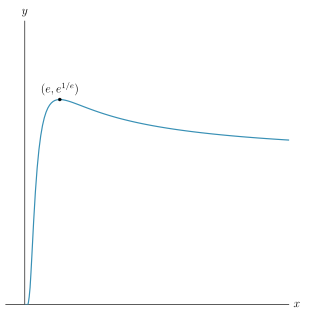
- Sketch a graph of \(y = x^{\frac{1}{x}}\) for \(x > 0\), showing the location of any turning points. Find the maximum value of \(n^{\frac{1}{n}}\), where \(n\) is a positive integer.
- The people to be tested are split into \(r\) groups of size \(k\), with \(k > 1\) and \(rk = N\).
- In every group, a sample from each person in that group is mixed into one large sample, which is then tested.
- If the enzyme is not present in the combined sample from a group, no further testing of the people in that group is needed.
- If the enzyme is present in the combined sample from a group, a second sample from each person in that group is tested separately.
- Find, in terms of \(N\), \(k\) and \(p\), the expected number of tests.
- Given that \(N\) is a multiple of \(3\), find the largest value of \(p\) for which it is possible to find an integer value of \(k\) such that \(k > 1\) and the expected number of tests is at most \(N\). Show that this value of \(p\) is greater than \(\frac{1}{4}\).
- Show that, if \(pk\) is sufficiently small, the expected number of tests is approximately \[ N\!\left(\frac{1}{k} + pk\right). \] In the case where \(p = 0.01\), show that choosing \(k = 10\) gives an expected number of tests which is only about \(20\%\) of \(N\).
Solution:
- \(\,\)
\begin{align*} && y & = x^{1/x} = \exp \left ( \tfrac1x \ln x \right ) \\ \Rightarrow && y' &= \exp \left ( \tfrac1x \ln x \right ) \cdot \left ( \frac{1}{x^2} - \frac{\ln x}{x^2} \right ) \\ &&&= \frac{\exp \left ( \tfrac1x \ln x \right ) }{x^2}(1 - \ln x) \\ y' =0: && x &= e \end{align*} Therefore the largest integer values will be \(2\) or \(3\). Comparing \((2^{\frac12})^6 = 8 < 9 = (3^{1/3})^6\) we see the maximum value of \(n^{1/n}\) where \(n\) is an integer is \(\sqrt[3]{3}\)
- The number of tests is \(r\) plus however many groups fail times \(k\). The probability of a group failing is \(g = 1-(1-p)^k\) and the number of failing groups is \(\sim B(r, g)\) so the expected number of additional groups is \(rg\) and the expected total number of tests is \[ \frac{N}{k} + N(1-(1-p)^k) \]
- \(\,\) \begin{align*} && N &\geq E = \frac{N}{k} + N(1-(1-p)^k) \\ \Rightarrow && 1 &\geq \frac{1}{k} + 1-(1-p)^k \\ \Rightarrow && (1-p)^k &\geq \frac1k \\ \Rightarrow && k \ln(1-p) &\geq - \ln k \\ \Rightarrow && \ln(1 - p) &\geq -\frac{1}{k} \ln k \geq -\frac13 \ln 3 \\ \Rightarrow && 1-p &\geq \frac{1}{\sqrt[3]{3}} \\ \Rightarrow && p &\leq 1-\frac{1}{\sqrt[3]{3}} \end{align*} (taking \(k=3\)) Claim: \(1 - \frac{1}{\sqrt[3]{3}} > \frac14\) Proof: This is equivalent to \(\sqrt[3]{3} > \frac43\) or \(81 > 4^3 = 64\) which is clearly true.
- If \(pk\) is small then \((1-p)^k \approx 1 - pk\) and so we obtain \(N \left ( \frac1k +pk \right)\) as required. If \(p = 0.01\) and \(k = 10\) then \(\frac{1}{10} + 0.01 \cdot 10 = 0.2\) so the expected number of tests is \(\sim 20\%\) of \(N\)
2021 Paper 2 Q6
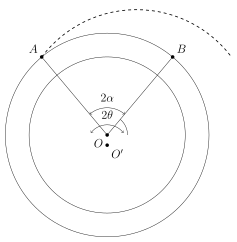
A plane circular road is bounded by two concentric circles with centres at point~\(O\). The inner circle has radius \(R\) and the outer circle has radius \(R + w\). The points \(A\) and \(B\) lie on the outer circle, as shown in the diagram, with \(\angle AOB = 2\alpha\), \(\tfrac{1}{3}\pi \leqslant \alpha \leqslant \tfrac{1}{2}\pi\) and \(0 < w < R\).
- Show that I cannot cycle from \(A\) to \(B\) in a straight line, while remaining on the road.
- I take a path from \(A\) to \(B\) that is an arc of a circle. This circle is tangent to the inner edge of the road, and has radius \(R + d\) (where \(d > w\)) and centre~\(O'\).
My path is represented by the dashed arc in the above diagram.
Let \(\angle AO'B = 2\theta\).
- Use the cosine rule to find \(d\) in terms of \(w\), \(R\) and \(\cos\alpha\).
- Find also an expression for \(\sin(\alpha - \theta)\) in terms of \(R\), \(d\) and \(\sin\alpha\).
- Show that \(\dfrac{d}{R}\) and \(\alpha - \theta\) are also both much less than \(1\).
- My friend cycles from \(A\) to \(B\) along the outer edge of the road. Let my path be shorter than my friend's path by distance~\(S\). Show that \[ S = 2(R+d)(\alpha - \theta) + 2\alpha(w - d). \] Hence show that \(S\) is approximately a fraction \[ \frac{\sin\alpha - \alpha\cos\alpha}{\alpha(1 - \cos\alpha)} \cdot \frac{w}{R} \] of the length of my friend's path.
2017 Paper 1 Q12
In a lottery, each of the \(N\) participants pays \(\pounds c\) to the organiser and picks a number from \(1\) to \(N\). The organiser picks at random the winning number from \(1\) to \(N\) and all those participants who picked this number receive an equal share of the prize, \(\pounds J\).
- The participants pick their numbers independently and with equal probability. Obtain an expression for the probability that no participant picks the winning number, and hence determine the organiser's expected profit. Use the approximation \[ \left( 1 - \frac{a}{N} \right)^N \approx \e^{-a} \tag{\(*\)} \] to show that if \(2Nc = J\) then the organiser will expect to make a loss. Note: \(\e > 2\).
- Instead of the numbers being equally popular, a fraction \(\gamma\) of the numbers are popular and the rest are unpopular. For each participant, the probability of picking any given popular number is \(\dfrac{a}{N}\) and the probability of picking any given unpopular number is \(\dfrac{b}{N}\,\). Find a relationship between \(a\), \(b\) and \(\gamma\). Show that, using the approximation \((*)\), the organiser's expected profit can be expressed in the form \[ A\e^{-a} + B\e^{-b} +C \,, \] where \(A\), \(B\) and \(C\) can be written in terms of \(J\), \(c\), \(N\) and \(\gamma\). In the case \(\gamma = \frac18\) and \(a=9b\), find \(a\) and \(b\). Show that, if \(2Nc = J\), then the organiser will expect to make a profit. Note: \(\e < 3\).
Solution:
- The probability no-one picks the winning number is \(\left ( 1 - \frac{1}{N}\right)^N \approx \frac1e\). \begin{align*} && \mathbb{E}(\text{profit}) &= Nc - (1-e^{-1})J \\ &&& < Nc -(1- \tfrac12 )J \\ &&& < Nc - \frac12 J \\ &&&= \frac{2Nc-J}{2} \end{align*} Therefore if \(J = 2Nc\) the expected profit is negative.
- \(\,\) \begin{align*} && 1 &= \sum_{\text{all numbers}} \mathbb{P}(\text{pick }i) \\ &&&= \sum_{\text{popular numbers}} \mathbb{P}(\text{pick }i)+\sum_{\text{unpopular numbers}} \mathbb{P}(\text{pick }i) \\ &&&=\gamma N \frac{a}{N} + (1-\gamma)N \frac{b}{N} \\ &&&= \gamma a + (1-\gamma)b \end{align*} \begin{align*} && \mathbb{P}(\text{no-one picks winning number}) &= \mathbb{P}(\text{no-one picks winning number} | \text{winning number is popular})\mathbb{P})(\text{winning number is popular}) + \\ &&&\quad + \mathbb{P}(\text{no-one picks} | \text{unpopular})\mathbb{P}(\text{unpopular}) \\ &&&= \left (1 - \frac{a}{N} \right)^N \gamma + \left (1 - \frac{b}{N} \right)^N (1-\gamma) \\ &&&\approx \gamma e^{-a} + (1-\gamma)e^{-b} \\ \\ && \mathbb{E}(\text{profit}) &= Nc - (1-\gamma e^{-a} - (1-\gamma)e^{-b})J \\ &&&= Nc-J+J\gamma e^{-a} +J(1-\gamma)e^{-b} \end{align*} If \(\gamma = \frac18\) and \(a=9b\), then \(1=\frac18 a + \frac78b = 2b \Rightarrow b = \frac12, a = \frac92\) and \begin{align*} && \mathbb{E}(\text{profit}) &= Nc-J +J\tfrac18e^{-9/2}+J\tfrac78e^{-1/2} \\ &&&= Nc-J+\tfrac18Je^{-1/2}(e^{-4}+7) \end{align*} If we can show \(e^{-1/2}\frac{e^{-4}+7}{8} > \frac12\) we'd be done, so \begin{align*} && e^{-1/2}\frac{e^{-4}+7}{8} &> \frac12 \\ \Leftrightarrow && e^{-4}+7 &>4e^{1/2} \\ \Leftrightarrow && 49+14e^{-4}+e^{-8} &>16e \\ \end{align*} But clearly the LHS \(>49\) and the RHS \(<48\) so we're done
2016 Paper 2 Q8
Evaluate the integral \[ \hphantom{ \ \ \ \ \ \ \ \ \ (m> \tfrac12)\,.} \int_{m-\frac12} ^\infty \frac 1{x^2}\, \d x { \ \ \ \ \ \ \ \ \ (m > \tfrac12)\,.} \] Show by means of a sketch that \[ \sum_{r=m}^n \frac 1 {r^2} \approx \int_{m-\frac12}^{n+\frac12} \frac1 {x^2} \, \d x \,, \tag{\(*\)} \] where \(m\) and \(n\) are positive integers with \(m < n\).
- You are given that the infinite series \(\displaystyle \sum_{r=1}^\infty \frac 1 {r^2}\) converges to a value denoted by \(E\). Use \((*)\) to obtain the following approximations for \(E\): \[ E\approx 2\,; \ \ \ \ E\approx \frac53\,; \ \ \ \ E\approx \frac{33}{20} \,.\]
- Show that, when \(r\) is large, the error in approximating \(\dfrac 1{r^2}\) by \(\displaystyle \int_{r-\frac12}^{r+\frac12} \frac 1 {x^2} \, \d x\) is approximately \(\dfrac 1{4r^4}\,\). Given that \(E \approx 1.645\), show that \(\displaystyle \sum_{r=1}^\infty \frac1{r^4} \approx 1.08\, \).
Solution: \begin{align*} && \int_{m-\frac12}^\infty \frac{1}{x^2} \d x &= \lim_{K \to \infty} \left [ -x^{-1} \right]_{m-\frac12}^K \\ &&&= \frac{1}{m-\frac12} - \lim_{K \to \infty }\frac{1}K \\ &&&= \frac{1}{m-\frac12} \end{align*}

- \(\,\) \begin{align*} E &\approx \int_{1-\frac12}^\infty \frac1{x^2} \d x = \frac{1}{1-\frac12} = 2 \\ E &\approx 1 + \int_{2-\frac12}^\infty \frac1{x^2} \d x= 1 + \frac{1}{2 - \frac12} = \frac53 \\ E &\approx 1 +\frac14 + \int_{3-\frac12}^\infty \frac1{x^2} \d x= \frac54 + \frac{1}{3-\frac12} \\ &= \frac54+\frac{2}{5} = \frac{33}{20} \end{align*}
- The error is \begin{align*} && \epsilon &= \int_{r-\frac12}^{r+\frac12} \frac 1 {x^2} \, \d x - \frac1{r^2} \\ &&&= \frac{1}{r-\frac12} - \frac{1}{r + \frac12} - \frac1{r^2} \\ &&&= \frac{1}{r^2 - \frac14} - \frac1{r^2} \\ &&&= \frac{\frac14}{r^2(r^2-\frac14)} \\ &&&\approx \frac{1}{4r^4} \end{align*} Therefore \begin{align*} && \sum_{n=1}^\infty \frac1{r^4} &\approx 4 \left ( 1 +\frac14 + \int_{3-\frac12}^\infty \frac1{x^2} \d x-\sum_{r=1}^\infty \frac{1}{r^2} \right) + 1 + \frac{1}{2^4}\\ &&&= 4 \left ( \frac{33}{20}-1.645 \right) + 1 + \frac{1}{2^4} \\ &&&= 4 \left ( 1.65-1.645 \right) + 1 + \frac{1}{2^4} \\ &&&= 1.0825 \approx 1.08 \end{align*}
2015 Paper 3 Q9
A particle \(P\) of mass \(m\) moves on a smooth fixed straight horizontal rail and is attached to a fixed peg \(Q\) by a light elastic string of natural length \(a\) and modulus \(\lambda\). The peg \(Q\) is a distance \(a\) from the rail. Initially \(P\) is at rest with \(PQ=a\). An impulse imparts to \(P\) a speed \(v\) along the rail. Let \(x\) be the displacement at time \(t\) of \(P\) from its initial position. Obtain the equation \[ \dot x^2 = v^2 - k^2 \left( \sqrt{x^2+a^2} -a\right)^{\!2} \] where \( k^2 = \lambda/(ma)\), \(k>0\) and the dot denotes differentiation with respect to \(t\). Find, in terms of \(k\), \(a\) and \(v\), the greatest value, \(x_0\), attained by \(x\). Find also the acceleration of \(P\) at \(x=x_0\). Obtain, in the form of an integral, an expression for the period of the motion. Show that in the case \(v\ll ka\) (that is, \(v\) is much less than \(ka\)), this is approximately \[ \sqrt {\frac {32a}{kv}} \int_0^1 \frac 1 {\sqrt{1-u^4}} \, \d u \, . \]
2012 Paper 1 Q10
I stand at the top of a vertical well. The depth of the well, from the top to the surface of the water, is \(D\). I drop a stone from the top of the well and measure the time that elapses between the release of the stone and the moment when I hear the splash of the stone entering the water. In order to gauge the depth of the well, I climb a distance \(\delta\) down into the well and drop a stone from my new position. The time until I hear the splash is \(t\) less than the previous time. Show that \[ t = \sqrt{\frac{2D}g} - \sqrt{\frac{2(D-\delta)}g} + \frac \delta u\,, \] where \(u\) is the (constant) speed of sound. Hence show that \[ D = \tfrac12 gT^2\,, \] where \(T= \dfrac12 \beta + \dfrac \delta{\beta g}\) and \(\beta = t - \dfrac \delta u\,\). Taking \(u=300\,\)m\,s\(^{-1}\) and \(g=10\,\)m\,s\(^{-2}\), show that if \(t= \frac 15\,\)s and \(\delta=10\,\)m, the well is approximately \(185\,\)m deep.
Solution: \begin{align*} && s &= ut + \frac12at^2 \\ && D &= \frac12gt_D^2 \\ \Rightarrow && t_D &= \sqrt{\frac{2D}{g}} \\ \Rightarrow && t_{D-\delta} &= \sqrt{\frac{2(D-\delta}{g}} \end{align*} Therefore the difference in times of what I hear will be: \begin{align*} t &= \underbrace{\sqrt{\frac{2D}{g}}}_{\text{time for first stone to hit water}} + \underbrace{\frac{D}{u}}_{\text{time to hear about it}} - \left (\underbrace{\sqrt{\frac{2(D-\delta)}{g}}}_{\text{time for second stone to hit water}} + \underbrace{\frac{D-\delta}{u}}_{\text{time to hear about it}} \right) \\ &= \sqrt{\frac{2D}g} - \sqrt{\frac{2(D-\delta)}g} + \frac \delta u \end{align*} \begin{align*} && t &= \sqrt{\frac{2D}g} - \sqrt{\frac{2(D-\delta)}g} + \frac \delta u \\ \Rightarrow && \beta &= \sqrt{\frac{2D}g} - \sqrt{\frac{2(D-\delta)}g} \\ && \beta^2 &= \frac{2D}{g} + \frac{2(D-\delta)}{g} - \frac{4}{g}\sqrt{D(D-g)} \\ &&&= \frac{4D}{g} - \frac{2\delta}{g} - \frac{4}{g} \sqrt{D(D-\delta)}\\ \Rightarrow && g\beta^2 &= 4D-2\delta -4\sqrt{D(D-\delta)}\\ \Rightarrow && (g \beta^2-4D+2\delta)^2 &= 16D(D-\delta) \\ \Rightarrow && g^2\beta^4 + 16D^2 + 4\delta^2 -8g\beta^2D+4g\beta^2 \delta -16D\delta &= 16D^2-16D\delta \\ \Rightarrow && 8g\beta^2D &= g\beta^4 +4\delta^2 +4g\beta^2 \delta \\ \Rightarrow && D &= \frac1{8g\beta^2} \left ( g^2\beta^4 +4\delta^2 +4g\beta^2 \delta\right) \\ &&&= \frac1{8g\beta^2} \left ( g\beta^2 +2\delta \right)^2 \\ &&&= \frac12g \left ( \frac{\beta}{2} + \frac{\delta}{g\beta} \right)^2 \end{align*} If \(u = 300, g = 10, t = \frac15, \delta = 10\), then \begin{align*} && \beta &= \frac15-\frac{10}{300}\\ &&&= \frac15 - \frac1{30} \\ &&&= \frac{1}{6}\\ && D &= \frac12 \cdot 10 \left ( \frac1{12} + 6 \right)^2 \\ &&&= 5\cdot (36 + 1 + \frac{1}{12^2}) \\ &&&\approx 37 \cdot 5 = 185 \end{align*}
2008 Paper 1 Q12
In this question, you may use without proof the results: \[ \sum_{r=1}^n r = \tfrac12 n(n+1) \qquad\text{and}\qquad \sum_{r=1}^n r^2 = \tfrac1 6 n(n+1)(2n+1)\,. \] The independent random variables \(X_1\) and \(X_2\) each take values \(1\), \(2\), \(\ldots\), \(N\), each value being equally likely. The random variable \(X\) is defined by \[ X= \begin{cases} X_1 & \text { if } X_1\ge X_2\\ X_2 & \text { if } X_2\ge X_1\;. \end{cases} \]
- Show that \(\P(X=r) = \dfrac{2r-1}{N^2}\,\) for \(r=1\), \(2\), \(\ldots\), \(N\).
- Find an expression for the expectation, \(\mu\), of \(X\) and show that \(\mu=67.165\) in the case \(N=100\).
- The median, \(m\), of \(X\) is defined to be the integer such that \(\P(X\ge m) \ge \frac 12\) and \(\P(X\le m)\ge \frac12\). Find an expression for \(m\) in terms of \(N\) and give an explicit value for \(m\) in the case \(N=100\).
- Show that when \(N\) is very large, \[ \frac \mu m \approx \frac {2\sqrt2}3\,. \]
Solution: \begin{align*} \P(X = r) &= \P(X_1 = r, X_2 \leq r) + \P(X_2 = r, X_1 < r) \\ &= \P(X_1 = r) \P(X_2 \leq r) + \P(X_2 = r)\P( X_1 < r) \\ &= \frac{1}{N} \frac{r}{N} + \frac{1}{N} \frac{r-1}{N} \\ &= \frac{2r-1}{N^2} \end{align*} \begin{align*} \E(X) &= \sum_{r=1}^N r \P(X = r) \\ &= \sum_{r=1}^N \frac{2r^2 - r}{N^2} \\ &= \frac{1}{N^2} \l \frac{N(N+1)(2N+1)}{3} - \frac{N(N+1)}{2} \r \\ &= \frac{N+1}{N} \l \frac{4N-1}{6} \r \end{align*} When \(N = 100\), this is equal to \(\frac{101 \cdot 399}{6 \cdot 100} = \frac{101 \cdot 133}{200} = 67.165\) \begin{align*} &&\frac12 &\leq \P(X \leq m) \\ &&&=\sum_{r=1}^m \P(X=r) \\ &&&=\sum_{r=1}^m \frac{2r-1}{N^2} \\ &&&= \frac{1}{N^2} \l m(m+1) - m \r \\ &&&= \frac{m^2}{N^2} \\ \Rightarrow && m^2 &\geq \frac{N^2}{2} \\ \Rightarrow && m &\geq \frac{N}{\sqrt{2}} \\ \Rightarrow && m &= \left \lceil \frac{N}{\sqrt{2}} \right \rceil \end{align*} When \(N = 100\), \(100/\sqrt{2} = \sqrt{2}50\). \(\sqrt{2} > 1.4 \Rightarrow 50\sqrt{2} > 70\) \(\sqrt{2} < 1.42 \Rightarrow 50 \sqrt{2} < 71\), therefore \(\displaystyle \left \lceil \frac{100}{\sqrt{2}} \right \rceil = 71\) \begin{align*} \lim_{N \to \infty} \frac{\frac{(N+1)(4N-1)}{6N}}{ \left \lceil\frac{N}{\sqrt{2}} \right \rceil} &= \lim_{N \to \infty} \frac{\sqrt{2}}{3}\l \frac{4N^2 +3N - 1}{2N^2} \r \tag{since the floor will be irrelevant}\\ &= \lim_{N \to \infty} \frac{\sqrt{2}}{3}\l 2 + \frac{3}{2N} - \frac{1}{N^2} \r \\ &= \lim_{N \to \infty} \frac{2\sqrt{2}}{3} \end{align*}
2006 Paper 2 Q12
A cricket team has only three bowlers, Arthur, Betty and Cuba, each of whom bowls 30 balls in any match. Past performance reveals that, on average, Arthur takes one wicket for every 36 balls bowled, Betty takes one wicket for every 25 balls bowled, and Cuba takes one wicket for every 41 balls bowled.
- In one match, the team took exactly one wicket, but the name of the bowler was not recorded. Using a binomial model, find the probability that Arthur was the bowler.
- Show that the average number of wickets taken by the team in a match is approximately 3. Give with brief justification a suitable model for the number of wickets taken by the team in a match and show that the probability of the team taking at least five wickets in a given match is approximately \(\frac15\). [You may use the approximation \(\e^3 = 20\).]
Solution:
- \(\,\) \begin{align*} && \mathbb{P}(\text{Arthur took wicket and exactly one wicket}) &= \binom{30}{1} \frac{1}{36} \left ( \frac{35}{36} \right)^{29} \binom{30}{0} \left ( \frac{24}{25} \right)^{30} \binom{30}{0} \left ( \frac{40}{41} \right)^{30}\\ &&&= \frac{30 \cdot 35^{29} \cdot 24^{30} \cdot 40^{30}}{36^{30} \cdot 25^{30} \cdot {41}^{30}}\\ &&&= \frac{1}{35} N\\ && \mathbb{P}(\text{B took wicket and exactly one wicket}) &= \binom{30}{0}\left ( \frac{35}{36} \right)^{30} \binom{30}{1} \frac{1}{25} \left ( \frac{24}{25} \right)^{29} \binom{30}{0} \left ( \frac{40}{41} \right)^{30}\\ &&&= \frac{1}{24} N \\ && \mathbb{P}(\text{C took wicket and exactly one wicket}) &= \binom{30}{0}\left ( \frac{35}{36} \right)^{30} \binom{30}{0}\left ( \frac{24}{25} \right)^{30} \binom{30}{1} \frac{1}{41} \left ( \frac{40}{41} \right)^{29}\\ &&&= \frac{1}{40} N \\ && \mathbb{P}(\text{Arthur took wicket} | \text{exactly one wicket}) &= \frac{ \mathbb{P}(\text{Arthur took wicket and exactly one wicket}) }{ \mathbb{P}(\text{exactly one wicket}) } \\ &&&= \frac{ \frac{1}{35} N}{\frac1{35} N + \frac{1}{24}N + \frac{1}{40} N} \\ &&&= \frac{3}{10} \end{align*} Alternatively, we could look at: \begin{align*} && \mathbb{P}(X_A = 1 | X_A + X_B + X_C =1) &= \frac{\mathbb{P}(X_A = 1, X_B = 0,X_C = 0)}{\mathbb{P}(X_A = 1, X_B = 0,X_C = 0)+\mathbb{P}(X_A = 0, X_B = 1,X_C = 0)+\mathbb{P}(X_A = 0, X_B = 0,X_C = 1)} \\ &&&= \frac{\frac{\mathbb{P}(X_A = 1)}{\mathbb{P}(X_A=0)}}{\frac{\mathbb{P}(X_A = 1)}{\mathbb{P}(X_A=0)}+\frac{\mathbb{P}(X_B = 1)}{\mathbb{P}(X_B=0)}+\frac{\mathbb{P}(X_C = 1)}{\mathbb{P}(X_C=0)}} \end{align*} and we can calculate these relatively likelihoods in a similar way to above.
- \(\,\) \begin{align*} && \mathbb{E}(\text{number of wickets}) &= \mathbb{E} \left ( \sum_{i=1}^{90} \mathbb{1}_{i\text{th ball is a wicket}} \right) \\ &&&= \sum_{i=1}^{90} \mathbb{E} \left (\mathbb{1}_{i\text{th ball is a wicket}} \right) \\ &&&= 30 \cdot \frac{1}{36} + 30 \cdot \frac{1}{25} + 30 \cdot \frac{1}{41} \\ &&&\approx 1 + 1 + 1 = 3 \end{align*} We might model the number of wickets taken as \(Po(\lambda)\), where \(\lambda\) is the average number of wickets taken. We can think of this roughly as the Poisson approximation to the binomial where \(N\) is large and \(Np\) is small. Assuming we use \(Po(3)\) we have \begin{align*} && \mathbb{P}(\text{at least 5 wickets}) &= 1-\mathbb{P}(\text{4 or fewer wickets}) \\ &&&= 1- e^{-3} \left (1 + \frac{3}{1} + \frac{3^2}{2} + \frac{3^3}{6} + \frac{3^4}{24} \right) \\ &&&= 1 - \frac{1}{20} \left ( 1 + 3 + \frac{9}{2} + \frac{9}{2} + \frac{27}{8} \right) \\ &&&= 1 - \frac{1}{20} \left (13 + 3\tfrac38 \right) \\ &&&\approx 1 - \frac{16}{20} = \frac15 \end{align*}
2005 Paper 1 Q5
- Evaluate the integral \[ \int_0^1 \l x + 1 \r ^{k-1} \; \mathrm{d}x \] in the cases \(k\ne0\) and \(k = 0\,\). Deduce that \(\displaystyle \frac{2^k - 1}{k} \approx \ln 2\) when \(k \approx 0\,\).
- Evaluate the integral \[ \int_0^1 x \l x + 1 \r ^m \; \mathrm{d}x \; \] in the different cases that arise according to the value of \(m\).
Solution:
- Case \(k \neq 0\): \begin{align*} && \int_0^1 (x+1)^{k-1} \d x &= \left [\frac{1}{k}(x+1)^k \right]_0^1 \\ &&&= \frac{2^k-1}{k} \\ \end{align*} Case \(k = 0\): \begin{align*} && \int_0^1 (x+1)^{k-1} \d x &= \int_0^1 (x+1)^{-1} \d x \\ &&&= \left [\ln(x+1) \right]_0^1 \\ &&&= \ln 2 \end{align*} Therefore for \(k \approx 0\), we must have both integrals being close to each other, since the function is nice on this interval, ie \(\frac{2^k-1}{k} \approx \ln 2\)
- Case \(m = 0\). \(I = \frac12\) Case \(m \neq 0, -1, -2\) \begin{align*} u = x+1, \d u = \d x && \int_0^1 x(x+1)^m \d x &= \int_{u=1}^{u=2} (u-1)u^m \d u \\ &&&=\left[ \frac{u^{m+2}}{m+2} - \frac{u^{m+1}}{m+1} \right]_1^2 \\ &&&= 2^{m+1}\left ( \frac{2}{m+2} - \frac1{m+1} \right) - \frac{1}{m+2} + \frac{1}{m+1} \\ &&&= 2^{m+1} \frac{m}{(m+1)(m+2)} + \frac{1}{(m+1)(m+2)} \\ &&&= \frac{m2^{m+1}+1}{(m+1)(m+2)} \\ \end{align*} Case \(m = -1\). \begin{align*} && \int_0^1 \frac{x}{x+1} \d x &= \int_0^1 1 - \frac{1}{x+1} \d x \\ &&&= 1 - \ln2 \\ \end{align*} Case \(m = -2\): \begin{align*} && \int_0^1 \frac{x}{(x+1)^2} \d x &= \int_0^1\frac{x+1-1}{(x+1)^2} \d x \\ &&&= \left [ \ln (x+1) +(1+x)^{-1} \right]_0^1 \\ &&&= \ln 2 + \frac12 - 1 \\ &&&= \ln 2 - \frac12 \end{align*}
2005 Paper 2 Q13
The number of printing errors on any page of a large book of \(N\) pages is modelled by a Poisson variate with parameter \(\lambda\) and is statistically independent of the number of printing errors on any other page. The number of pages in a random sample of \(n\) pages (where \(n\) is much smaller than \(N\) and \(n\ge2\)) which contain fewer than two errors is denoted by \(Y\). Show that \(\P(Y=k) = \binom n k p^kq^{n-k}\) where \(p=(1+\lambda)e^{-\lambda}\) and \(q=1-p\,\). Show also that, if \(\lambda\) is sufficiently small,
- \(q\approx \frac12 \lambda^2\,\);
- the largest value of \(n\) for which \(\P(Y=n)\ge 1-\lambda\) is approximately \(2/\lambda\,\);
- \(\P(Y>1 \;\vert\; Y>0) \approx 1-n(\lambda^2/2)^{n-1}\;.\)
Solution: First notice that the the probability a page contains fewer than two errors is \(\mathbb{P}(X < 2)\) where \(X \sim Po(\lambda)\), ie \(\mathbb{P}(X<2) = e^{-\lambda} + \lambda e^{-\lambda} = (1+\lambda)e^{-\lambda}\). Therefore the number of pages \(Y\) with fewer than two errors out of our sample of \(n\) is \(Bin(n, p)\) where \(p\) is as before. ie \(\mathbb{P}(Y = k) = \binom{n}{k} p^kq^{n-k}\).
- \(\,\) \begin{align*} && q &= 1- p = 1-(1+\lambda)e^{-\lambda} \\ &&&= 1 - (1+ \lambda)(1 - \lambda + \tfrac12 \lambda^2 + o(\lambda^3)) \\ &&&= 1 - 1+ \lambda - \lambda+\lambda^2 - \tfrac12 \lambda^2 + o(\lambda^3) \\ &&&= \tfrac12 \lambda^2 + o(\lambda^3) \end{align*}
- \(\,\) \begin{align*} && \mathbb{P}(Y = n) &= p^n \\ &&&= (1+\lambda)^ne^{-\lambda n} \\ &&&= (1 + n \lambda + \frac{n(n-1)}{2} \lambda^2 + \cdots)(1 - \lambda n + \frac{\lambda^2 n^2}{2} + \cdots) \\ &&&= 1 + 0 \lambda + \left ( \frac{n(n-1)}{2} + \frac{n^2}{2} - n^2 \right) \lambda^2 + o(\lambda^3) \\ &&&= 1 - \frac{n}{2} \lambda^2 + o(\lambda^3) \end{align*} So if \(\frac{n}{2} \lambda \leq 1\) or \(n \leq \frac{2}{\lambda}\) \(\mathbb{P}(Y = n) \leq 1- \lambda\).
- \(\,\) \begin{align*} && \mathbb{P}(Y > 1 | Y > 0) &= \frac{1-(q^n + npq^{n-1})}{1-q^n} \\ &&&= 1 - \frac{npq^{n-1}}{1-q^n} \\ &&&= 1 -n \frac{(1+ \lambda)e^{-\lambda} (\tfrac12 \lambda^2 + o(\lambda^3))^{n-1}}{1-(\tfrac12 \lambda^2 + o(\lambda^3))^n} \\ &&&= 1 - n \left (\frac{\lambda^2}{2} \right)^{n-1} \frac{(1+ \lambda)(1-\lambda + \lambda^2/2 - \cdots)(1+o(\lambda)^{n-1}}{1-(\tfrac12 \lambda^2 + o(\lambda^3))^n} \\ &&&= 1 - n \left (\frac{\lambda^2}{2} \right)^{n-1} (1 + o(\lambda)) \\ &&&\approx 1 - n \left (\frac{\lambda^2}{2} \right)^{n-1} \end{align*}
2000 Paper 3 Q12
In a lottery, any one of \(N\) numbers, where \(N\) is large, is chosen at random and independently for each player by machine. Each week there are \(2N\) players and one winning number is drawn. Write down an exact expression for the probability that there are three or fewer winners in a week, given that you hold a winning ticket that week. Using the fact that $$ {\biggl( 1 - {a \over n} \biggr) ^n \approx \e^{-a}}$$ for \(n\) much larger than \(a\), or otherwise, show that this probability is approximately \({2 \over 3}\) . Discuss briefly whether this probability would increase or decrease if the numbers were chosen by the players. Show that the expected number of winners in a week, given that you hold a winning ticket that week, is \( 3-N^{-1}\).
1998 Paper 2 Q2
Use the first four terms of the binomial expansion of \((1-1/50)^{1/2}\), writing \(1/50 = 2/100\) to simplify the calculation, to derive the approximation \(\sqrt 2 \approx 1.414214\). Calculate similarly an approximation to the cube root of 2 to six decimal places by considering \((1+N/125)^a\), where \(a\) and \(N\) are suitable numbers. [You need not justify the accuracy of your approximations.]
Solution: \begin{align*} && (1-1/50)^{1/2} &= 1 + \frac12 \cdot \left ( -\frac1{50} \right) + \frac1{2!} \frac12 \cdot \left ( -\frac12 \right)\cdot \left ( -\frac1{50} \right)^2 + \frac1{3!} \frac12 \cdot \left ( -\frac12 \right) \cdot \left ( -\frac32 \right)\cdot \left ( -\frac1{50} \right)^3 + \cdots \\ &&&=1-\frac{1}{100} - \frac12 \frac1{10000} -\frac12 \frac1{1000000} +\cdots \\ &&&= 0.9899495 + \cdots \\ \Rightarrow && \frac{7\sqrt{2}}{10} &\approx 0.9899495 \\ \Rightarrow && \sqrt{2} &\approx \frac{9.899495}{7} \\ &&&\approx 1.414214 \end{align*} \begin{align*} && (1 + 3/125)^{1/3} &= \frac{\sqrt[3]{125+3}}{5} \\ &&& = \frac{8\sqrt[3]{2}}{10} \\ && (1 + 3/125)^{1/3} &= 1 + \frac13 \left ( \frac{3}{125} \right) + \frac1{2!} \cdot \frac{1}{3} \cdot \left ( -\frac23\right) \left ( \frac{3}{125}\right)^2 +\cdots \\ &&&= 1+ \frac{8}{1000} - \frac{64}{1000000} \\ &&&= 1.007936 \\ \Rightarrow && \sqrt[3]{2} &= \frac{10.07936}{8} \\ &&&= 1.259920 \end{align*}
1998 Paper 3 Q7
Sketch the graph of \({\rm f}(s)={ \e}^s(s-3)+3\) for \(0\le s < \infty\). Taking \({\e\approx 2.7}\), find the smallest positive integer, \(m\), such that \({\rm f}(m) > 0\). Now let $$ {\rm b}(x) = {x^3 \over \e^{x/T} -1} \, $$ where \(T\) is a positive constant. Show that \({\rm b}(x)\) has a single turning point in \(0 < x < \infty\). By considering the behaviour for small \(x\) and for large \(x\), sketch \({\rm b}(x)\) for \(0\le x < \infty\). Let $$ \int_0^\infty {\rm b}(x)\,\d x =B, $$ which may be assumed to be finite. Show that \(B = K T^n\) where \(K\) is a constant, and \(n\) is an integer which you should determine. Given that \(\displaystyle{B \approx 2 \int_0^{Tm} {\rm b}(x) {\,\rm d }x}\), use your graph of \({\rm b}(x)\) to find a rough estimate for \(K\).
1998 Paper 3 Q11
Consider a simple pendulum of length \(l\) and angular displacement \(\theta\), which is {\bf not} assumed to be small. Show that $$ {1\over 2}l \left({\d\theta\over \d t}\right)^2 = g(\cos\theta -\cos\gamma)\,, $$ where \(\gamma\) is the maximum value of \(\theta\). Show also that the period \(P\) is given by $$ P= 2 \sqrt{l\over g} \int_0^\gamma \left( \sin^2(\gamma/2)-\sin^2(\theta/2) \right)^{-{1\over 2}} \,\d\theta \,. $$ By using the substitution \(\sin(\theta/2)=\sin(\gamma/2) \sin\phi\), and then finding an approximate expression for the integrand using the binomial expansion, show that for small values of \(\gamma\) the period is approximately $$ 2\pi \sqrt{l\over g} \left(1+{\gamma^2\over 16}\right) \,. $$