Problems
Filters
5 problems found
2025 Paper 2 Q6
- The circle \(x^2 + (y-a)^2 = r^2\) touches the parabola \(2ky = x^2\), where \(k > 0\), tangentially at two points. Show that \(r^2 = k(2a - k)\). Show further that if \(r^2 = k(2a - k)\) and \(a > k > 0\), then the circle \(x^2 + (y-a)^2 = r^2\) touches the parabola \(2ky = x^2\) tangentially at two points.
- The lines \(y = c \pm x\) are tangents to the circle \(x^2 + (y-a)^2 = r^2\). Find \(r^2\), and the coordinates of the points of contact, in terms of \(a\) and \(c\).
- \(C_1\) and \(C_2\) are circles with equations \(x^2 + (y-a_1)^2 = r_1^2\) and \(x^2 + (y-a_2)^2 = r_2^2\) respectively, where \(a_1 \neq a_2\) and \(r_1 \neq r_2\).
Each circle touches the parabola \(2ky = x^2\) tangentially at two points and the lines \(y = c \pm x\) are tangents to both circles.
- Show that \(a_1 + a_2 = 2c + 4k\) and that \(a_1^2 + a_2^2 = 2c^2 + 16kc + 12k^2\).
- The circle \(x^2 + (y-d)^2 = p^2\) passes through the four points of tangency of the lines \(y = c \pm x\) to the two circles, \(C_1\) and \(C_2\). Find \(d\) and \(p^2\) in terms of \(k\) and \(c\).
- Show that the circle \(x^2 + (y-d)^2 = p^2\) also touches the parabola \(2ky = x^2\) tangentially at two points.
Solution:
- By symmetry we can observe that the parabola and circle will intersect \(0, 1\) (at the base), \(2, 4\) times. So setting up our system of equations we have: \begin{align*} &&& \begin{cases} x^2 + (y-a)^2 &= r^2 \\ 2ky &= x^2 \end{cases} \\ \Rightarrow && r^2 &= x^2 + \left (\frac{x^2}{2k} - a \right )^2 \\ \Rightarrow &&r^2 &= x^2 + a^2 - \frac{ax^2}{k} + \frac{x^4}{4k^2} \\ \Rightarrow &&0 &= \frac{1}{4k^2} x^4 + \left ( 1 - \frac{a}{k} \right) x^2 + a^2 - r^2 \\ \Rightarrow && \Delta &= \left ( 1 - \frac{a}{k} \right)^2-4 \cdot \frac{1}{4k^2} (a^2 - r^2) \\ &&&= 1 - \frac{2a}{k} + \frac{a^2}{k^2} - \frac{a^2}{k^2} + \frac{r^2}{k^2} \\ &&&= \frac{k^2-2ka+r^2}{k^2} \end{align*} Since there will be (at most) two solutions if \(\Delta = 0\) we must have if the circle and parabola are tangent \(r^2 - 2ka + k^2 = 0 \Rightarrow r^2 = k(2a-k)\). So long as there is a solution \(x^2 > 0\) there will be two tangent points, so if \(-\left(1 - \frac{a}{k}\right) > 0\) or \(a > k > 0\)

- Since \(y = c \pm x\) are tangent to the circle with radius \(r\) and centre \((0,a)\) we have the following equations: \begin{align*} &&& \begin{cases} x^2 + (y-a)^2 &= r^2 \\ c \pm x &= y \end{cases} \\ \Rightarrow && r^2 &= x^2 + (c -a\pm x)^2 \\ &&&= 2x^2+(c-a)^2 \pm 2x(c-a) \\ \Rightarrow && \Delta &= 4(c-a)^2 -4 \cdot 2 \left ( (c-a)^2 -r^2 \right)\\ &&&= 8r^2-4(c-a)^2 \\ \Rightarrow && x &= \frac{\mp 2(c-a) \pm \sqrt{\Delta}}{4} \\ &&&= \mp \frac12 (c-a) \\ && y &= \pm \frac12 (c+a) \\ && (x,y) &= \left (\frac12 (c-a), \frac12 (c+a)\right), \left (-\frac12 (c-a), -\frac12 (c+a)\right) \end{align*}
2021 Paper 3 Q5
Two curves have polar equations \(r = a + 2\cos\theta\) and \(r = 2 + \cos 2\theta\), where \(r \geqslant 0\) and \(a\) is a constant.
- Show that these curves meet when \[ 2\cos^2\theta - 2\cos\theta + 1 - a = 0. \] Hence show that these curves touch if \(a = \tfrac{1}{2}\) and find the other two values of \(a\) for which the curves touch.
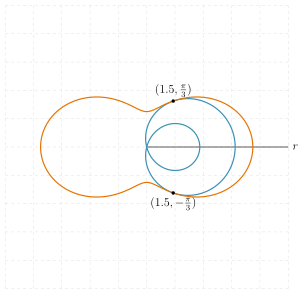
- Sketch the curves \(r = a + 2\cos\theta\) and \(r = 2 + \cos 2\theta\) on the same diagram in the case \(a = \tfrac{1}{2}\). Give the values of \(r\) and \(\theta\) at the points at which the curves touch and justify the other features you show on your sketch.
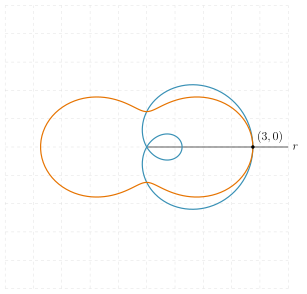
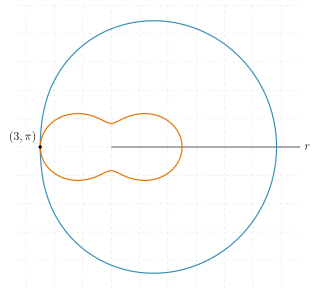
- On two further diagrams, one for each of the other two values of \(a\), sketch both the curves \(r = a + 2\cos\theta\) and \(r = 2 + \cos 2\theta\). Give the values of \(r\) and \(\theta\) at the points at which the curves touch and justify the other features you show on your sketch.
Solution:
- The curves meet when they have the same radius for a given \(\theta\) ie \begin{align*} && a + 2 \cos \theta &= 2 + \cos 2 \theta \\ &&&= 2 + 2\cos^2 \theta - 1 \\ \Rightarrow && 0 &= 2 \cos ^2 \theta - 2 \cos \theta + 1 - a \end{align*} The curves touch if this has a repeated root, ie \(0 = \Delta = 4 - 8(1-a) \Rightarrow a = \frac12\). The second way the curves can touch is if there is a single root, but it's at an extreme value of \(\cos \theta = \pm 1\) ie \(0 = 2 - 2\cdot(\pm1) + 1 - a \Rightarrow a = 3 \pm 2 = 1, 5\)
- Suppose \(a = \frac12\) then the curves touch when \(0 = 2\cos^2 \theta - 2 \cos \theta + \frac12 = (2 \cos \theta-1 )(\cos \theta -\frac12) \Rightarrow \theta = \pm \frac{\pi}{3}\)
- \(a = 1\)
\(a = 5\)
2016 Paper 3 Q6
Show, by finding \(R\) and \(\gamma\), that \(A \sinh x + B\cosh x \) can be written in the form \(R\cosh (x+\gamma)\) if \(B>A>0\). Determine the corresponding forms in the other cases that arise, for \(A>0\), according to the value of \(B\). Two curves have equations \(y = \textrm{sech} x\) and \(y = a\tanh x + b\,\), where \(a>0\).
- In the case \(b>a\), show that if the curves intersect then the \(x\)-coordinates of the points of intersection can be written in the form \[ \pm\textrm{arcosh} \left( \frac 1 {\sqrt{b^2-a^2}}\right) - {\rm artanh \,} \frac a b .\]
- Find the corresponding result in the case \(a>b>0\,\).
- Find necessary and sufficient conditions on \(a\) and \(b\) for the curves to intersect at two distinct points.
- Find necessary and sufficient conditions on \(a\) and \(b\) for the curves to touch and, given that they touch, express the \(y\)-coordinate of the point of contact in terms of \(a\).
Solution: \begin{align*} && R\cosh(x + \gamma) &=R \cosh x \cosh \gamma + R \sinh x \sinh \gamma \\ \Rightarrow && R \cosh \gamma &= B \\ && R \sinh \gamma &= A \\ \Rightarrow && R^2 &= B^2 - A^2 \\ \Rightarrow && \tanh \gamma &= \frac{A}{B} \\ \end{align*} Therefore it is possible, by writing \(R = \sqrt{B^2-A^2}\) and \(\gamma = \textrm{artanh} \left ( \frac{A}{B} \right)\). This works as long as \(|B| > A > 0\). Supposing \(A >|B| \), try \(S \sinh (x + \delta) = S \sinh x \cosh \delta +S \cosh x \sinh \delta\) \begin{align*} && S \cosh \delta &= A \\ && -S \sinh \delta &= B \\ \Rightarrow && S^2 &= A^2 - B^2 \\ \Rightarrow && \tanh \delta &= \frac{B}{A} \\ \end{align*} Therefore in this case we can write \(\sqrt{A^2-B^2} \sinh \left (x + \tanh^{-1} \left ( \frac{B}{A} \right) \right)\) If \(A = \pm B > 0\) we can we have \(A \sinh x + B \cosh x = \pm Ae^{\pm x}\)
- Suppose \(y \cosh x = 1\) and \(y \cosh x = a \sinh x +b \cosh x\) so \begin{align*} && 1 & = a \sinh x + b \cosh x \\ &&&= \sqrt{b^2-a^2} \cosh(x + \textrm{artanh} \frac{a}{b} ) \\ \Rightarrow && x + \textrm{artanh} \frac{a}{b} &= \pm \textrm{arcosh} \left ( \frac{1}{\sqrt{b^2-a^2}} \right) \\ \Rightarrow && x &= \pm \textrm{arcosh} \left ( \frac{1}{\sqrt{b^2-a^2}} \right) -\textrm{artanh} \frac{a}{b} \end{align*}
- If \( a > b > 0\) we have \begin{align*} && 1 & = \sqrt{a^2-b^2} \sinh \left ( x - \textrm{artanh} \frac{b}{a} \right) \\ \Rightarrow && x &= \textrm{arsinh} \left ( \frac{1}{\sqrt{a^2-b^2}} \right) + \textrm{artanh} \left ( \frac{b}{a} \right) \end{align*}
- To intersect at distinct points we must have \(b > a\) and \(\textrm{arcosh} \left ( \frac{1}{\sqrt{b^2-a^2}} \right) \neq 0\) which is always true.
- For the curves to touch, we need them to intersect and have matching derivatives, ie \begin{align*} && -\tanh x \cdot \textrm{sech}x &= a\textrm{sech}^2 x \\ \Rightarrow && 0 &= \textrm{sech}^2 x (a + \sinh x) \\ \Rightarrow && x &= -\textrm{arsinh} \, a\\ \Rightarrow && \sinh x &= - a\\ \Rightarrow &&\cosh x &= \sqrt{1 + a^2} \\ \end{align*} So if the curves touch, we must have \(1 = -a^2+b\sqrt{1+a^2} \Rightarrow b = \sqrt{1+a^2}\) and since this does work it is a necessary and sufficient condition. We will also have the \(y\) coordinate is \(\frac{1}{\sqrt{1+a^2}}\)
2012 Paper 3 Q3
It is given that the two curves \[ y=4-x^2 \text{ and } m x = k-y^2\,, \] where \(m > 0\), touch exactly once.
- In each of the following four cases, sketch the two curves on a single diagram, noting the coordinates of any intersections with the axes:
- \(k < 0\, \);
- \(0 < k < 16\), \(k/m < 2\,\);
- \(k > 16\), \(k/m > 2\,\);
- \(k > 16\), \(k/m < 2\,\).
- Now set \(m=12\). Show that the \(x\)-coordinate of any point at which the two curves meet satisfies \[ x^4-8x^2 +12x +16-k=0\,. \] Let \(a\) be the value of \(x\) at the point where the curves touch. Show that \(a\) satisfies \[ a^3 -4a +3 =0 \] and hence find the three possible values of \(a\). Derive also the equation \[ k= -4a^2 +9a +16\,. \] Which of the four sketches in part (i) arise?
Solution:
- \(\,\)

- \(\,\)

- \(\,\)

- \(\,\)

- \(\,\)
- Suppose \(m = 12\) \begin{align*} && y &= 4-x^2 \\ && 12x &= k-y^2 \\ \Rightarrow && 12 x&=k-(4-x^2)^2 \\ &&&= k-16+8x^2-x^4 \\ \Rightarrow && 0 &= x^4- 8x^2+12x+16-k \end{align*} When the curves touch, we will have repeated root, ie \(a\) is a root of \(4x^3-16x+12 \Rightarrow a^3-4a+3 =0\). \begin{align*} &&0 &= a^3-4a+3 \\ &&&= (a-1)(a^2+a-3) \\ \Rightarrow &&a &= 1, \frac{-1 \pm \sqrt{13}}{2} \end{align*} \begin{align*} && 0 &= a^4-8a^2+12a+16-k \\ \Rightarrow && k &= a(a^3-8a+12)+16 \\ &&&= a(4a-3-8a+12)+16 \\ &&&= -4a^2+9a+16 \\ \\ \Rightarrow && a = 1& \quad k = 21 \\ && k &= -4(3-a)+9a+16 = 13a+4\\ && a = \frac{-1-\sqrt{13}}2& \quad k = \frac{-5 - 13\sqrt{13}}{2} < 0 \\ && a = \frac{-1+\sqrt{13}}2& \quad k = \frac{-5 + 13\sqrt{13}}{2} \\ \end{align*} So we have type (a), and (d).
2007 Paper 1 Q8
A curve is given by the equation \[ y = ax^3 - 6ax^2+ \left( 12a + 12 \right)x - \left( 8a + 16 \right)\,, \tag{\(*\)} \] where \(a\) is a real number. Show that this curve touches the curve with equation \[ y=x^3 \tag{\(**\)} \] at \(\left( 2 \, , \, 8 \right)\). Determine the coordinates of any other point of intersection of the two curves.
- Sketch on the same axes the curves \((*)\) and \((**)\) when \(a = 2\).
- Sketch on the same axes the curves \((*)\) and \((**)\) when \(a = 1\).
- Sketch on the same axes the curves \((*)\) and \((**)\) when \(a = -2\).
Solution: \begin{align*} && y &= ax^3 - 6ax^2+ \left( 12a + 12 \right)x - \left( 8a + 16 \right) \\ && y(2) &= 8a-24a+24a+24-8a-16 \\ &&&= 8 \\ && y'(x) &= 3ax^2-12ax+(12a+12) \\ && y'(0) &= 12a-24a+12a+12 \\ &&&= 12 \end{align*} Therefore since our curve has the same value and gradient at \((2,8)\) as \(y = x^3\) they must touch at this point. Therefore \begin{align*} && ax^3 - 6ax^2+ \left( 12a + 12 \right)x - \left( 8a + 16 \right) - x^3 &= (x-2)^2((a-1)x-(2a+4)) \end{align*} Therefore if \(a \neq 1\), they touch again when \(x = \frac{2a+4}{a-1}\).


