Problems
Filters
39 problems found
2024 Paper 2 Q2
In this question, you need not consider issues of convergence.
- Find the binomial series expansion of \((8 + x^3)^{-1}\), valid for \(|x| < 2\). Hence show that, for each integer \(m \geqslant 0\), \[ \int_0^1 \frac{x^m}{8 + x^3}\,\mathrm{d}x = \sum_{k=0}^{\infty} \left( \frac{(-1)^k}{2^{3(k+1)}} \cdot \frac{1}{3k + m + 1} \right). \]
- Show that \[ \sum_{k=0}^{\infty} \frac{(-1)^k}{2^{3(k+1)}} \left( \frac{1}{3k+3} - \frac{2}{3k+2} + \frac{4}{3k+1} \right) = \int_0^1 \frac{1}{x+2}\,\mathrm{d}x\,, \] and evaluate the integral.
- Show that \[ \sum_{k=0}^{\infty} \frac{(-1)^k}{2^{3(k+1)}} \left( \frac{72(2k+1)}{(3k+1)(3k+2)} \right) = \pi\sqrt{a} - \ln b\,, \] where \(a\) and \(b\) are integers which you should determine.
Solution:
- Note that \(\,\) \begin{align*} && (8+x^3)^{-1} &= \tfrac18(1 + \tfrac18x^3)^{-1} \\ &&&= \tfrac18( 1 - \left (\tfrac{x}{2} \right)^3 + \left (\tfrac{x}{2} \right)^6 -\left (\tfrac{x}{2} \right)^9 + \cdots ) \end{align*} So \begin{align*} && \int_0^1 \frac{x^m}{8+x^3} \d x &= \int_0^1 x^m \sum_{k=0}^{\infty} \frac{1}{2^3} \left ( - \frac{x}{2} \right)^{3k} \d x \\ &&&= \sum_{k=0}^{\infty} (-1)^k \frac{1}{2^{3(k+1)}} \int_0^1 x^{m+3k} \d x \\ &&&= \sum_{k=0}^{\infty} \frac{(-1)^k}{2^{3(k+1)}} \frac{1}{3k+m+1} \\ \end{align*}
- Notice that \begin{align*} && S &= \sum_{k=0}^{\infty} \frac{(-1)^k}{2^{3(k+1)}} \left( \frac{1}{3k+3} - \frac{2}{3k+2} + \frac{4}{3k+1} \right) \\ &&&= \int_0^1 \frac{x^2}{8+x^3} \d x - 2\int_0^1 \frac{x^1}{8+x^3}+4\int_0^1 \frac{x^0}{8+x^3} \d x \\ &&&= \int_0^1 \frac{x^2-2x+4}{x^3+8} \d x \\ &&&= \int_0^1 \frac{1}{x+2} \d x = \left[ \ln(x+2)\right]_0^1 \\ &&&= \ln 3 - \ln 2 = \ln \tfrac32 \end{align*}
- Firstly, note that \begin{align*} && \frac{2k+1}{(3k+1)(3k+2)} &= \frac13 \left ( \frac{1}{3k+1} +\frac{1}{3k+2} \right) \end{align*} so \begin{align*} && S_2 &= \sum_{k=0}^{\infty} \frac{(-1)^k}{2^{3(k+1)}} \left( \frac{72(2k+1)}{(3k+1)(3k+2)} \right) \\ &&&= \sum_{k=0}^{\infty} \frac{(-1)^k}{2^{3(k+1)}} 24 \left ( \frac{1}{3k+1} +\frac{1}{3k+2} \right) \\ &&&= 24 \left [ \int_0^1 \frac{x^0}{8+x^3} \d x + \int_0^1 \frac{x^1}{8+x^3} \d x \right] \\ &&&= 24 \left [ \int_0^1 \frac{1+x}{(x+2)(x^2-2x+4)} \d x \right] \\ &&&= 24 \left [ \int_0^1 \frac{x+8}{12(x^2-2x+4)}-\frac{1}{12(x+2)} \d x \right] \\ &&&= 2\left [ \int_0^1 \frac{x+8}{x^2-2x+4}-\frac{1}{x+2} \d x \right] \\ &&&= 2\left [ \int_0^1 \frac{x-1}{x^2-2x+4}+ \frac{9}{(x-1)^2+3}-\frac{1}{x+2} \d x \right] \\ &&&=2 \left [ \int_0^1 \frac12\ln(x^2-2x+4)+3\sqrt{3}\arctan \frac{x-1}{\sqrt{3}} -\ln(x+2) \right]_0^1 \\ &&&=2 \left ( \frac12 \ln3+3\sqrt3 \arctan 0 - \ln 3 \right) - 2\left (\frac12 \ln 4-3\sqrt3 \arctan \frac{1}{\sqrt3} - \ln 2 \right) \\ &&&=\sqrt3 \pi - \ln3 \end{align*}
2024 Paper 2 Q3
The unit circle is the circle with radius 1 and centre the origin, \(O\). \(N\) and \(P\) are distinct points on the unit circle. \(N\) has coordinates \((-1, 0)\), and \(P\) has coordinates \((\cos\theta, \sin\theta)\), where \(-\pi < \theta < \pi\). The line \(NP\) intersects the \(y\)-axis at \(Q\), which has coordinates \((0, q)\).
- Show that \(q = \tan\frac{1}{2}\theta\).
- In this part, \(q \neq 1\).
- Let \(\mathrm{f}_1(q) = \dfrac{1+q}{1-q}\). Show that \(\mathrm{f}_1(q) = \tan\frac{1}{2}\!\left(\theta + \frac{1}{2}\pi\right)\).
- Let \(Q_1\) be the point with coordinates \((0, \mathrm{f}_1(q))\) and \(P_1\) be the point of intersection (other than \(N\)) of the line \(NQ_1\) and the unit circle. Describe geometrically the relationship between \(P\) and \(P_1\).
- \(P_2\) is the image of \(P\) under an anti-clockwise rotation about \(O\) through angle \(\frac{1}{3}\pi\). The line \(NP_2\) intersects the \(y\)-axis at the point \(Q_2\) with co-ordinates \((0, \mathrm{f}_2(q))\). Find \(\mathrm{f}_2(q)\) in terms of \(q\), for \(q \neq \sqrt{3}\).
- In this part, \(q \neq -1\). Let \(\mathrm{f}_3(q) = \dfrac{1-q}{1+q}\), let \(Q_3\) be the point with coordinates \((0, \mathrm{f}_3(q))\) and let \(P_3\) be the point of intersection (other than \(N\)) of the line \(NQ_3\) and the unit circle. Describe geometrically the relationship between \(P\) and \(P_3\).
- In this part, \(0 < q < 1\). Let \(\mathrm{f}_4(q) = \mathrm{f}_2^{-1}\!\Big(\mathrm{f}_3\!\big(\mathrm{f}_2(q)\big)\Big)\), let \(Q_4\) be the point with coordinates \((0, \mathrm{f}_4(q))\) and let \(P_4\) be the point of intersection (other than \(N\)) of the line \(NQ_4\) and the unit circle. Describe geometrically the relationship between \(P\) and \(P_4\).
Solution:
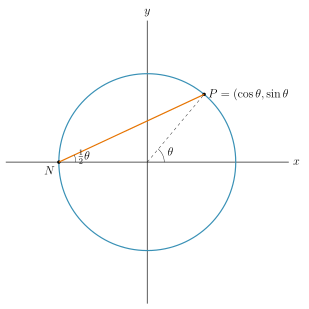
- \(\,\) \begin{align*} && \frac{y-0}{x-(-1)} &= \frac{\sin \theta }{\cos \theta + 1} \\ \Rightarrow && y_0 &= \frac{\sin \theta}{\cos \theta + 1} \\ &&&= \frac{\frac{2t}{1+t^2}}{\frac{1-t^2}{1+t^2}+1} \\ &&&= t = \tan \tfrac{\theta}{2} \end{align*} Alternatively, it is straightforward to see from the angles.
- \(f_1(q) = \frac{1+q}{1-q}\) so \begin{align*} && f_1(\tan\tfrac12\theta) &= \frac{1+\tan\tfrac12\theta}{1-\tan\tfrac12\theta} \\ &&&= \frac{\cos \tfrac12 \theta + \sin \tfrac12 \theta}{\cos \tfrac12 \theta - \sin \tfrac12 \theta} \\ &&&= \frac{\sin(\tfrac14 \pi + \tfrac12 \theta)}{\cos(\tfrac14 \pi + \tfrac12 \theta)} \\ &&&= \tan \tfrac12(\theta + \tfrac{\pi}{2}) \end{align*}
- \(Q_1\) is the point \((0, f_1(q))\) so \(P_1\) will be the point \((\cos (\theta + \tfrac{\pi}{2}), \sin (\theta + \tfrac{\pi}{2}))\) which is a rotation anticlockwise by \(\frac{\pi}{2}\)
- \(P_2 = (\cos(\theta + \tfrac{\pi}{3}), \sin( \theta + \tfrac{\pi}{3})\) and so \(f_2(q) = \tan (\tfrac12(\theta + \tfrac{\pi}{3}))\) so \begin{align*} && f_2(q) &= \tan (\tfrac12(\theta + \tfrac{\pi}{3})) \\ &&&= \frac{q + \tan \frac{\pi}{3}}{1 - \tan \frac{\pi}{3} \cdot q} \\ &&&= \frac{q + \frac{1}{\sqrt3}}{1 - \frac{q}{\sqrt{3}}} \\ &&&= \frac{\sqrt3 q + 1}{\sqrt3-q} \end{align*}
- Since \(q \to -q\) reflects \((0,q)\) in the \(x\)-axis, \(f_3(q) = f_1(-q)\) so \(P_3\) is the reflection of \(P_1\) so it's rotation by \(\frac{\pi}{2}\) followed by reflection in the \(x\)-axis, which is reflection in \(y=x\). [ie \(\theta \to -\theta + \frac{\pi}{2} \to \frac{\pi}{2}-\theta\)]
- We are rotating by \(\frac{\pi}{3}\) then reflecting in \(y=x\) and then rotating by \(-\frac{\pi}{3}\), ie \(\theta \to \theta + \frac{\pi}{3} \to \frac{\pi}{6}-\theta \to -\theta -\frac{\pi}{6} \)
2024 Paper 2 Q10
A triangular prism lies on a horizontal plane. One of the rectangular faces of the prism is vertical; the second is horizontal and in contact with the plane; the third, oblique rectangular face makes an angle \(\alpha\) with the horizontal. The two triangular faces of the prism are right angled triangles and are vertical. The prism has mass \(M\) and it can move without friction across the plane. A particle of mass \(m\) lies on the oblique surface of the prism. The contact between the particle and the plane is rough, with coefficient of friction \(\mu\).
- Show that if \(\mu < \tan\alpha\), then the system cannot be in equilibrium.
- Show that the magnitude, \(F\), of the frictional force between the particle and the prism is \[ F = \frac{m}{M+m}\left|(M+m)g\sin\alpha - P\cos\alpha\right|. \] Find a similar expression for the magnitude, \(N\), of the normal reaction between the particle and the prism.
- Hence show that the force \(P\) must satisfy \[ (M+m)g\tan(\alpha - \lambda) \leqslant P \leqslant (M+m)g\tan(\alpha + \lambda). \]
2024 Paper 3 Q4
- Show that if the acute angle between straight lines with gradients \(m_1\) and \(m_2\) is \(45^\circ\), then \[\frac{m_1 - m_2}{1 + m_1 m_2} = \pm 1.\]
- If \(p \neq q\), show that the tangents to the curve \(C\) at the points with \(x\)-coordinates \(p\) and \(q\) meet at a point with \(x\)-coordinate \(\frac{1}{2}(p+q)\). Find the \(y\)-coordinate of this point in terms of \(p\) and \(q\). Show further that any two tangents to the curve \(C\) which are at \(45^\circ\) to each other meet on the curve \((y+3a)^2 = 8a^2 + x^2\).
- Show that the acute angle between any two tangents to the curve \(C\) which meet on the curve \((y+7a)^2 = 48a^2 + 3x^2\) is constant. Find this acute angle.
2024 Paper 3 Q9
The origin \(O\) of coordinates lies on a smooth horizontal table and the \(x\)- and \(y\)-axes lie in the plane of the table. A smooth sphere \(A\) of mass \(m\) and radius \(r\) is at rest on the table with its lowest point at the origin. A second smooth sphere \(B\) has the same mass and radius and also lies on the table. Its lowest point has \(y\)-coordinate \(2r\sin\alpha\), where \(\alpha\) is an acute angle, and large positive \(x\)-coordinate. Sphere \(B\) is now projected parallel to the \(x\)-axis, with speed \(u\), so that it strikes sphere \(A\). The coefficient of restitution in this collision is \(\frac{1}{3}\).
- Show that, after the collision, sphere \(B\) moves with velocity \[\begin{pmatrix} -\frac{1}{3}u\bigl(1 + 2\sin^2\alpha\bigr) \\ \frac{2}{3}u\sin\alpha\cos\alpha \end{pmatrix}.\]
- Show further that the lowest point of sphere \(B\) crosses the \(y\)-axis at the point \((0, Y)\), where \(Y = 2r(\cos\alpha\tan\beta + \sin\alpha)\) and \[\tan\beta = \frac{2\sin\alpha\cos\alpha}{1 + 2\sin^2\alpha}.\]
- Show that, if \(h > Y + 2r\sec\beta\), sphere \(B\) will not strike sphere \(C\) in its motion after the collision with sphere \(A\).
- Show that \(Y < 2r\sec\beta\). Hence show that sphere \(B\) will not strike sphere \(C\) for any value of \(\alpha\), if \(h > \dfrac{8r}{\sqrt{3}}\).
2023 Paper 2 Q2
- The real numbers \(x\), \(y\) and \(z\) satisfy the equations \[y = \frac{2x}{1-x^2}\,,\qquad z = \frac{2y}{1-y^2}\,,\qquad x = \frac{2z}{1-z^2}\,.\] Let \(x = \tan\alpha\). Deduce that \(y = \tan 2\alpha\) and show that \(\tan\alpha = \tan 8\alpha\). Find all solutions of the equations, giving each value of \(x\), \(y\) and \(z\) in the form \(\tan\theta\) where \(-\frac{1}{2}\pi < \theta < \frac{1}{2}\pi\).
- Determine the number of real solutions of the simultaneous equations \[y = \frac{3x - x^3}{1-3x^2}\,,\qquad z = \frac{3y - y^3}{1-3y^2}\,,\qquad x = \frac{3z - z^3}{1-3z^2}\,.\]
- Consider the simultaneous equations
\[y = 2x^2 - 1\,,\qquad z = 2y^2 - 1\,,\qquad x = 2z^2 - 1\,.\]
- Determine the number of real solutions of these simultaneous equations with \(|x| \leqslant 1\), \(|y| \leqslant 1\), \(|z| \leqslant 1\).
- By finding the degree of a single polynomial equation which is satisfied by \(x\), show that all solutions of these simultaneous equations have \(|x| \leqslant 1\), \(|y| \leqslant 1\), \(|z| \leqslant 1\).
2023 Paper 3 Q2
The polar curves \(C_1\) and \(C_2\) are defined for \(0 \leqslant \theta \leqslant \pi\) by \[r = k(1 + \sin\theta)\] \[r = k + \cos\theta\] respectively, where \(k\) is a constant greater than \(1\).
- Sketch the curves on the same diagram. Show that if \(\theta = \alpha\) at the point where the curves intersect, \(\tan\alpha = \dfrac{1}{k}\).
- The region A is defined by the inequalities \[0 \leqslant \theta \leqslant \alpha \quad \text{and} \quad r \leqslant k(1+\sin\theta)\,.\] Show that the area of A can be written as \[\frac{k^2}{4}(3\alpha - \sin\alpha\cos\alpha) + k^2(1 - \cos\alpha)\,.\]
- The region B is defined by the inequalities \[\alpha \leqslant \theta \leqslant \pi \quad \text{and} \quad r \leqslant k + \cos\theta\,.\] Find an expression in terms of \(k\) and \(\alpha\) for the area of B.
- The total area of regions A and B is denoted by \(R\). The area of the region enclosed by \(C_1\) and the lines \(\theta = 0\) and \(\theta = \pi\) is denoted by \(S\). The area of the region enclosed by \(C_2\) and the lines \(\theta = 0\) and \(\theta = \pi\) is denoted by \(T\). Show that as \(k \to \infty\), \[\frac{R}{T} \to 1\] and find the limit of \[\frac{R}{S}\] as \(k \to \infty\).
2023 Paper 3 Q4
Let \(n\) be a positive integer. The polynomial \(\mathrm{p}\) is defined by the identity \[\mathrm{p}(\cos\theta) \equiv \cos\big((2n+1)\theta\big) + 1\,.\]
- Show that \[\cos\big((2n+1)\theta\big) = \sum_{r=0}^{n} \binom{2n+1}{2r} \cos^{2n+1-2r}\theta\,(\cos^2\theta - 1)^r\,.\]
- By considering the expansion of \((1+t)^{2n+1}\) for suitable values of \(t\), show that the coefficient of \(x^{2n+1}\) in the polynomial \(\mathrm{p}(x)\) is \(2^{2n}\).
- Show that the coefficient of \(x^{2n-1}\) in the polynomial \(\mathrm{p}(x)\) is \(-(2n+1)2^{2n-2}\).
- It is given that there exists a polynomial \(\mathrm{q}\) such that \[\mathrm{p}(x) = (x+1)\,[\mathrm{q}(x)]^2\] and the coefficient of \(x^n\) in \(\mathrm{q}(x)\) is greater than \(0\). Write down the coefficient of \(x^n\) in the polynomial \(\mathrm{q}(x)\) and, for \(n \geqslant 2\), show that the coefficient of \(x^{n-2}\) in the polynomial \(\mathrm{q}(x)\) is \[2^{n-2}(1-n)\,.\]
2022 Paper 2 Q8
Let \(\mathbf{M} = \begin{pmatrix} a & b \\ c & d \end{pmatrix}\) be a real matrix with \(a \neq d\). The transformation represented by \(\mathbf{M}\) has exactly two distinct invariant lines through the origin.
- Show that, if neither invariant line is the \(y\)-axis, then the gradients of the invariant lines are the roots of the equation \[bm^2 + (a-d)m - c = 0.\] If one invariant line is the \(y\)-axis, what is the gradient of the other?
- Show that, if the angle between the two invariant lines is \(45^\circ\), then \[(a-d)^2 = (b-c)^2 - 4bc.\]
- Find a necessary and sufficient condition, on some or all of \(a\), \(b\), \(c\) and \(d\), for the two invariant lines to make equal angles with the line \(y = x\).
- Give an example of a matrix which satisfies both the conditions in parts (ii) and (iii).
2022 Paper 2 Q9
A rectangular prism is fixed on a horizontal surface. A vertical wall, parallel to a vertical face of the prism, stands at a distance \(d\) from it. A light plank, making an acute angle \(\theta\) with the horizontal, rests on an upper edge of the prism and is in contact with the wall below the level of that edge of the prism and above the level of the horizontal plane. You may assume that the plank is long enough and the prism high enough to make this possible. The contact between the plank and the prism is smooth, and the coefficient of friction at the contact between the plank and the wall is \(\mu\). When a heavy point mass is fixed to the plank at a distance \(x\), along the plank, from its point of contact with the wall, the system is in equilibrium.
- Show that, if \(x = d\sec^3\theta\), then there is no frictional force acting between the plank and the wall.
- Show that, if \(x > d\sec^3\theta\), it is necessary that \[\mu \geqslant \frac{x - d\sec^3\theta}{x\tan\theta}\] and give the corresponding inequality if \(x < d\sec^3\theta\).
- Show that \[\frac{x}{d} \geqslant \frac{\sec^3\theta}{1 + \mu\tan\theta}\,.\] Show also that, if \(\mu < \cot\theta\), then \[\frac{x}{d} \leqslant \frac{\sec^3\theta}{1 - \mu\tan\theta}\,.\]
- Show that if \(x\) is such that the point mass is fixed to the plank somewhere between the edge of the prism and the wall, then \(\tan\theta < \mu\).
2022 Paper 2 Q10
- Show that, if a particle is projected at an angle \(\alpha\) above the horizontal with speed \(u\), it will reach height \(h\) at a horizontal distance \(s\) from the point of projection where \[h = s\tan\alpha - \frac{gs^2}{2u^2\cos^2\alpha}\,.\]
- Let a point \(P\) on the plane have coordinates \((x,\, y,\, y\tan\theta)\). Show that the condition for it to be possible for a projectile from the cannon to land at point \(P\) is \[x^2 + \left(y + \frac{u^2\tan\theta}{g}\right)^2 \leqslant \frac{u^4\sec^2\theta}{g^2}\,.\]
- Show that the furthest point directly up the plane that can be reached by a projectile from the cannon is a distance \[\frac{u^2}{g(1+\sin\theta)}\] from the cannon. How far from the cannon is the furthest point directly down the plane that can be reached by a projectile from it?
- Find the length of road which can be reached by projectiles from the cannon. The cannon is now moved to a point on the plane vertically above the \(y\)-axis, and a distance \(r\) from the road. Find the value of \(r\) which maximises the length of road which can be reached by projectiles from the cannon. What is this maximum length?
2022 Paper 3 Q4
You may assume that all infinite sums and products in this question converge.
- Prove by induction that for all positive integers \(n\), \[ \sinh x = 2^n \cosh\!\left(\frac{x}{2}\right) \cosh\!\left(\frac{x}{4}\right) \cdots \cosh\!\left(\frac{x}{2^n}\right) \sinh\!\left(\frac{x}{2^n}\right) \] and deduce that, for \(x \neq 0\), \[ \frac{\sinh x}{x} \cdot \frac{\dfrac{x}{2^n}}{\sinh\!\left(\dfrac{x}{2^n}\right)} = \cosh\!\left(\frac{x}{2}\right) \cosh\!\left(\frac{x}{4}\right) \cdots \cosh\!\left(\frac{x}{2^n}\right)\,. \]
- You are given that the Maclaurin series for \(\sinh x\) is \[ \sinh x = \sum_{r=0}^{\infty} \frac{x^{2r+1}}{(2r+1)!}\,. \] Use this result to show that, as \(y\) tends to \(0\), \(\dfrac{y}{\sinh y}\) tends to \(1\). Deduce that, for \(x \neq 0\), \[ \frac{\sinh x}{x} = \cosh\!\left(\frac{x}{2}\right) \cosh\!\left(\frac{x}{4}\right) \cdots \cosh\!\left(\frac{x}{2^n}\right) \cdots\,. \]
- Let \(x = \ln 2\). Evaluate \(\cosh\!\left(\dfrac{x}{2}\right)\) and show that \[ \cosh\!\left(\frac{x}{4}\right) = \frac{1 + 2^{\frac{1}{2}}}{2 \times 2^{\frac{1}{4}}}\,. \] Use part (ii) to show that \[ \frac{1}{\ln 2} = \frac{1 + 2^{\frac{1}{2}}}{2} \times \frac{1 + 2^{\frac{1}{4}}}{2} \times \frac{1 + 2^{\frac{1}{8}}}{2} \cdots\,. \]
- Show that \[ \frac{2}{\pi} = \frac{\sqrt{2}}{2} \times \frac{\sqrt{2+\sqrt{2}}}{2} \times \frac{\sqrt{2+\sqrt{2+\sqrt{2}}}}{2} \cdots\,. \]
2022 Paper 3 Q6
- Show that when \(\alpha\) is small, \(\cos(\theta + \alpha) - \cos\theta \approx -\alpha\sin\theta - \frac{1}{2}\alpha^2\cos\theta\). Find the limit as \(\alpha \to 0\) of \[ \frac{\sin(\theta+\alpha) - \sin\theta}{\cos(\theta+\alpha) - \cos\theta} \qquad (*) \] in the case \(\sin\theta \neq 0\). In the case \(\sin\theta = 0\), what happens to the value of expression \((*)\) when \(\alpha \to 0\)?
- A circle \(C_1\) of radius \(a\) rolls without slipping in an anti-clockwise direction on a fixed circle \(C_2\) with centre at the origin \(O\) and radius \((n-1)a\), where \(n\) is an integer greater than \(2\). The point \(P\) is fixed on \(C_1\). Initially the centre of \(C_1\) is at \((na, 0)\) and \(P\) is at \(\big((n+1)a, 0\big)\).
- Let \(Q\) be the point of contact of \(C_1\) and \(C_2\) at any time in the rolling motion. Show that when \(OQ\) makes an angle \(\theta\), measured anticlockwise, with the positive \(x\)-axis, the \(x\)-coordinate of \(P\) is \(x(\theta) = a(n\cos\theta + \cos n\theta)\), and find the corresponding expression for the \(y\)-coordinate, \(y(\theta)\), of \(P\).
- Find the values of \(\theta\) for which the distance \(OP\) is \((n-1)a\).
- Let \(\theta_0 = \dfrac{1}{n-1}\pi\). Find the limit as \(\alpha \to 0\) of \[ \frac{y(\theta_0 + \alpha) - y(\theta_0)}{x(\theta_0 + \alpha) - x(\theta_0)}\,. \] Hence show that, at the point \(\big(x(\theta_0),\, y(\theta_0)\big)\), the tangent to the curve traced out by \(P\) is parallel to \(OP\).
2022 Paper 3 Q8
- Use De Moivre's theorem to prove that for any positive integer \(k > 1\), \[ \sin(k\theta) = \sin\theta\cos^{k-1}\theta \left( k - \binom{k}{3}(\sec^2\theta - 1) + \binom{k}{5}(\sec^2\theta - 1)^2 - \cdots \right) \] and find a similar expression for \(\cos(k\theta)\).
- Let \(\theta = \cos^{-1}(\frac{1}{a})\), where \(\theta\) is measured in degrees, and \(a\) is an odd integer greater than \(1\). Suppose that there is a positive integer \(k\) such that \(\sin(k\theta) = 0\) and \(\sin(m\theta) \neq 0\) for all integers \(m\) with \(0 < m < k\). Show that it would be necessary to have \(k\) even and \(\cos(\frac{1}{2}k\theta) = 0\). Deduce that \(\theta\) is irrational.
- Show that if \(\phi = \cot^{-1}(\frac{1}{b})\), where \(\phi\) is measured in degrees, and \(b\) is an even integer greater than \(1\), then \(\phi\) is irrational.
2022 Paper 3 Q12
- The point \(A\) lies on the circumference of a circle of radius \(a\) and centre \(O\). The point \(B\) is chosen at random on the circumference, so that the angle \(AOB\) has a uniform distribution on \([0, 2\pi]\). Find the expected length of the chord \(AB\).
- The point \(C\) is chosen at random in the interior of a circle of radius \(a\) and centre \(O\), so that the probability that it lies in any given region is proportional to the area of the region. The random variable \(R\) is defined as the distance between \(C\) and \(O\). Find the probability density function of \(R\). Obtain a formula in terms of \(a\), \(R\) and \(t\) for the length of a chord through \(C\) that makes an acute angle of \(t\) with \(OC\). Show that as \(C\) varies (with \(t\) fixed), the expected length \(\mathrm{L}(t)\) of such chords is given by \[ \mathrm{L}(t) = \frac{4a(1-\cos^3 t)}{3\sin^2 t}\,. \] Show further that \[ \mathrm{L}(t) = \frac{4a}{3}\left(\cos t + \tfrac{1}{2}\sec^2(\tfrac{1}{2}t)\right). \]
- The random variable \(T\) is uniformly distributed on \([0, \frac{1}{2}\pi]\). Find the expected value of \(\mathrm{L}(T)\).