Problems
Filters
1 problem found
2017 Paper 2 Q7
D: 1600.0
B: 1500.0
differentiation
logarithmic differentiation
inequality
curve sketching
limits
x^x
power tower
stationary points
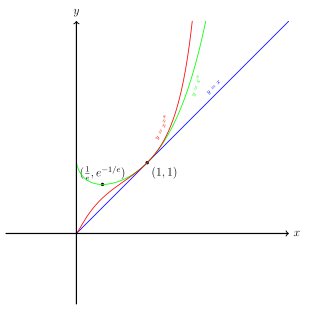
The functions \(\f\) and \(\g\) are defined, for \(x>0\), by \[ \f(x) = x^x\,, \ \ \ \ \ \g(x) = x^{\f(x)}\,. \]
- By taking logarithms, or otherwise, show that \(\f(x) > x\) for \(0 < x < 1\,\). Show further that \(x < \g(x) < \f(x)\) for \(0 < x < 1\,\). Write down the corresponding results for \(x > 1 \,\).
- Find the value of \(x\) for which \(\f'(x)=0\,\).
- Use the result \(x\ln x \to 0\) as \(x\to 0\) to find \(\lim\limits_{x\to0}\f(x)\), and write down \(\lim\limits_{x\to0}\g(x)\,\).
- Show that \( x^{-1}+\, \ln x \ge 1\,\) for \(x>0\). Using this result, or otherwise, show that \(\g'(x) > 0\,\).
Solution:
- \(\,\) \begin{align*} && \ln f(x) &= x \ln x \\ &&&> \ln x \quad (\text{if } 0 < x < 1)\\ \Rightarrow && f(x) &> x\quad\quad (\text{if } 0 < x < 1)\\ \Rightarrow && x^{f(x)} &< x^x \\ && g(x) &< f(x) \\ && 1&>f(x) \\ \Rightarrow && x &< x^{f(x)} = g(x) \end{align*}
- \(\,\) \begin{align*} && f(x) &= e^{x \ln x} \\ \Rightarrow && f'(x) &= (\ln x + 1)e^{x \ln x} \\ \Rightarrow && f'(x) = 0 &\Leftrightarrow x = \frac1e \end{align*}
- \(\,\) \begin{align*} && \lim_{x \to 0} f(x) &= \lim_{x \to 0} \exp \left ( x \ln x \right ) \\ &&&= \exp \left ( \lim_{x \to 0} \left ( x \ln x \right )\right) \\ &&&= \exp \left ( 0 \right) = 1\\ \\ && \lim_{x \to 0} g(x) &= \lim_{x \to 0} \exp \left ( f(x) \ln x\right) \\ &&&= \exp \left (\lim_{x \to 0} \ln x f(x)\right) \\ &&&= \exp \left (\lim_{x \to 0} \ln x \lim_{x \to 0}f(x)\right) \\ &&&= \exp \left (\lim_{x \to 0} \ln x\right) \\ &&&= 0 \end{align*}
- \(y = x^{-1} + \ln x \Rightarrow y' = -x^{-2} + x^{-1}\) which has roots at \(x =1\), therefore the minimum value is \(1\). (We can see it's a minimum by considering \(x \to 0, x \to \infty\). So \begin{align*} && g'(x) &= x^{f(x)} \cdot (f'(x) \ln x + f(x) x^{-1})\\ &&&= x^{f(x)} \cdot f(x) \cdot ((1+\ln x) \ln x + x^{-1}) \\ &&&= x^{f(x)} \cdot f(x) \cdot (\ln x + x^{-1} + (\ln x)^2) \\ &&&\geq x^{f(x)} \cdot f(x) > 0 \end{align*}