Problems
Filters
34 problems found
2025 Paper 2 Q2
- Show that if the complex number \(z\) satisfies the equation \[z^2 + |z + b| = a,\] where \(a\) and \(b\) are real numbers, then \(z\) must be either purely real or purely imaginary.
- Show that the equation \[z^2 + \left|z + \frac{5}{2}\right| = \frac{7}{2}\] has no purely imaginary roots.
- Show that the equation \[z^2 + \left|z + \frac{7}{2}\right| = \frac{5}{2}\] has no purely real roots.
- Show that, when \(\frac{1}{2} < b < \frac{3}{4}\), the equation \[z^2 + |z + b| = \frac{1}{2}\] will have at least one purely imaginary root and at least one purely real root.
- Solve the equation \[z^3 + |z + 2|^2 = 4.\]
Solution:
- Suppose \(z^2 + |z + b| = a\), then \(z^2 = a- |z + b| \in \mathbb{R}\), since \(a \in \mathbb{R}\). Since the square root of a real number is either purely real or purely imaginary, \(z\) is purely real or purely imaginary.
- Suppose \(z = it\) for some \(t \in \mathbb{R}\), then \begin{align*} && \frac72 &= -t^2 +\sqrt{t^2 + \frac{25}{4}} \\ \Rightarrow && \left ( \frac72 + t^2\right)^2 &= t^2 + \frac{25}{4} \\ \Rightarrow && t^4 + 7t^2 + \frac{49}{4} &= t^2 + \frac{25}{4} \\ \Rightarrow && t^4 + 6t^2 + 6 &= 0 \end{align*} but since \(\Delta = 6^2 - 4 \cdot 1 \cdot 6 < 0\) there are no real solutions.
- Suppose \(z = t\) for some \(t \in \mathbb{R}\), then either \(t^2 + t + \frac72 = \frac52 \Rightarrow t^2 + t + 1 = 0\) (no solutions) or \(t^2 - t - \frac72 = \frac52 \Rightarrow t^2 - t - 6 = (t-3)(t+2) = 0\). When \(t = 3\) then we must take the positive part for \(|z + \frac72|\) so this cannot work. When \(t = -2\) we also have \(\frac72-2 > 0\) so we are still taking the positive part. Hence no solutions
- Suppose \(\frac{1}{2} < b < \frac{3}{4}\), the equation then consider \(z^2 + |z + b| = \frac{1}{2}\). Case 1: \(z = t \in \mathbb{R}\), then we have two cases: Case 1a: \(z+b > 0\). \(z^2 + z + b = \frac12 \Rightarrow z = \frac{-1 \pm \sqrt{1-4b+2}}{2}\) which clearly is a valid real number an \(z + b > 0\). Case 1b: \(z+b < 0\) \(z^2 - z - b = \frac12 \Rightarrow z = \frac{1 \pm \sqrt{1+4b-2}}{2}\)
- Let \(\omega\) be a (primitive) cube root of unity. \begin{align*} && z^3 &= 4 - |z+2|^2 \\ \Rightarrow && z &\in \mathbb{R} \cup \omega \mathbb{R} \cup \omega^2 \mathbb{R} \end{align*} Case 1:
2023 Paper 3 Q1
The distinct points \(P(2ap,\, ap^2)\) and \(Q(2aq,\, aq^2)\) lie on the curve \(x^2 = 4ay\), where \(a > 0\).
- Given that \[(p+q)^2 = p^2q^2 + 6pq + 5\,,\tag{\(*\)}\] show that the line through \(P\) and \(Q\) is a tangent to the circle with centre \((0,\, 3a)\) and radius \(2a\).
- Show that, for any given value of \(p\) with \(p^2 \neq 1\), there are two distinct real values of \(q\) that satisfy equation \((*)\). Let these values be \(q_1\) and \(q_2\). Find expressions, in terms of \(p\), for \(q_1 + q_2\) and \(q_1 q_2\).
- Show that, for any given value of \(p\) with \(p^2 \neq 1\), there is a triangle with one vertex at \(P\) such that all three vertices lie on the curve \(x^2 = 4ay\) and all three sides are tangents to the circle with centre \((0,\, 3a)\) and radius \(2a\).
2022 Paper 2 Q8
Let \(\mathbf{M} = \begin{pmatrix} a & b \\ c & d \end{pmatrix}\) be a real matrix with \(a \neq d\). The transformation represented by \(\mathbf{M}\) has exactly two distinct invariant lines through the origin.
- Show that, if neither invariant line is the \(y\)-axis, then the gradients of the invariant lines are the roots of the equation \[bm^2 + (a-d)m - c = 0.\] If one invariant line is the \(y\)-axis, what is the gradient of the other?
- Show that, if the angle between the two invariant lines is \(45^\circ\), then \[(a-d)^2 = (b-c)^2 - 4bc.\]
- Find a necessary and sufficient condition, on some or all of \(a\), \(b\), \(c\) and \(d\), for the two invariant lines to make equal angles with the line \(y = x\).
- Give an example of a matrix which satisfies both the conditions in parts (ii) and (iii).
2014 Paper 2 Q1
In the triangle \(ABC\), the base \(AB\) is of length 1 unit and the angles at~\(A\) and~\(B\) are \(\alpha\) and~\(\beta\) respectively, where \(0<\alpha\le\beta\). The points \(P\) and~\(Q\) lie on the sides \(AC\) and \(BC\) respectively, with \(AP=PQ=QB=x\). The line \(PQ\) makes an angle of~\(\theta\) with the line through~\(P\) parallel to~\(AB\).
- Show that \(x\cos\theta = 1- x\cos\alpha - x\cos\beta\), and obtain an expression for \(x\sin\theta\) in terms of \(x\), \(\alpha\) and~\(\beta\). Hence show that \begin{equation} \label{eq:2*} \bigl(1+2\cos(\alpha+\beta)\bigr)x^2 - 2(\cos\alpha + \cos\beta)x + 1 = 0\,. \tag{\(*\)} \end{equation} Show that \((*)\) is also satisfied if \(P\) and \(Q\) lie on \(AC\) produced and \(BC\) produced, respectively. [By definition, \(P\) lies on \(AC\) produced if \(P\) lies on the line through \(A\) and~\(C\) and the points are in the order \(A\), \(C\), \(P\)\,.]
- State the condition on \(\alpha\) and \(\beta\) for \((*)\) to be linear in \(x\). If this condition does not hold (but the condition \(0<\alpha \le \beta\) still holds), show that \((*)\) has distinct real roots.
- Find the possible values of~\(x\) in the two cases (a) \(\alpha = \beta = 45^\circ\) and (b) \(\alpha = 30^\circ\), \(\beta = 90^\circ\), and illustrate each case with a sketch.
2013 Paper 2 Q4
The line passing through the point \((a,0)\) with gradient \(b\) intersects the circle of unit radius centred at the origin at \(P\) and \(Q\), and \(M\) is the midpoint of the chord \(PQ\). Find the coordinates of \(M\) in terms of \(a\) and \(b\).
- Suppose \(b\) is fixed and positive. As \(a\) varies, \(M\) traces out a curve (the locus of \(M\)). Show that \(x=- by\) on this curve. Given that \(a\) varies with \(-1\le a \le 1\), show that the locus is a line segment of length \(2b/(1+b^2)^\frac12\). Give a sketch showing the locus and the unit circle.
- Find the locus of \(M\) in the following cases, giving in each case its cartesian equation, describing it geometrically and sketching it in relation to the unit circle:
- \(a\) is fixed with \(0 < a < 1\), and \(b\) varies with \(-\infty < b < \infty\);
- \(ab=1\), and \(b\) varies with \(0< b\le1\).
Solution: \begin{align*} && y &= bx-ba \\ && 1 &= x^2 + y^2 \\ \Rightarrow && 1 &= x^2 + b^2(x-a)^2 \\ \Rightarrow && 0 &= (1+b^2)x^2-2ab^2x+b^2a^2-1 \end{align*} This will have roots which sum to \(\frac{2ab^2}{1+b^2}\), therefore \(M = \left ( \frac{ab^2}{1+b^2}, \frac{ab^3}{1+b^2}-ba \right)=\left ( \frac{ab^2}{1+b^2}, \frac{-ba}{1+b^2} \right)\)
- Since \(b\) is fixed so is \(\frac{b}{1+b^2} = t\) and all the points are \((bta, -ta)\), ie \(x = -by\). If \(a \in [-1,1]\) we are ranging on the points \((bt, -t)\) to \((-bt, t)\) which is a distance of \begin{align*}
&& d &= \sqrt{(bt+bt)^2+(-2t)^2} \\
&&&= \sqrt{4(b^2+1)t^2} \\
&&&=2 \sqrt{(b^2+1)\frac{b^2}{(b^2+1)^2}} \\
&&&= \frac{2b}{\sqrt{b^2+1}}
\end{align*}

- If \(a\) is fixed we have \(\left ( \frac{ab^2}{1+b^2}, -\frac{ba}{1+b^2} \right)\)
\begin{align*}
&& \frac{x}{y} &= - b \\
\Rightarrow && y &= \frac{a\frac{x}{y}}{1 + \frac{x^2}{y^2}} \\
\Rightarrow && y^2 \left ( 1 + \frac{x^2}{y^2} \right) &= ax \\
\Rightarrow && x^2-ax + y^2 &= 0 \\
\Rightarrow && \left (x - \frac{a}{2} \right)^2 + y^2 &= \frac{a^2}{4}
\end{align*}
Therefore we will end up with a circle centre \((\tfrac{a}{2}, 0)\) going through the origin.

- If \(ab = 1\), we have \(\left ( \frac{b}{1+b^2}, -\frac{1}{1+b^2} \right)\)
\begin{align*}
&& \frac{x}{y} &= -b \\
\Rightarrow && y &= -\frac{1}{1+\frac{x^2}{y^2}} \\
\Rightarrow && y + \frac{x^2}{y} &= - 1 \\
\Rightarrow && y^2 +y+ x^2 &= 0 \\
\Rightarrow && \left ( y + \frac12 \right)^2 + x^2 &= \frac14
\end{align*}

- If \(a\) is fixed we have \(\left ( \frac{ab^2}{1+b^2}, -\frac{ba}{1+b^2} \right)\)
\begin{align*}
&& \frac{x}{y} &= - b \\
\Rightarrow && y &= \frac{a\frac{x}{y}}{1 + \frac{x^2}{y^2}} \\
\Rightarrow && y^2 \left ( 1 + \frac{x^2}{y^2} \right) &= ax \\
\Rightarrow && x^2-ax + y^2 &= 0 \\
\Rightarrow && \left (x - \frac{a}{2} \right)^2 + y^2 &= \frac{a^2}{4}
\end{align*}
Therefore we will end up with a circle centre \((\tfrac{a}{2}, 0)\) going through the origin.
2012 Paper 1 Q9
A tall shot-putter projects a small shot from a point \(2.5\,\)m above the ground, which is horizontal. The speed of projection is \(10\,\text{ms}^{- 1}\) and the angle of projection is \(\theta\) above the horizontal. Taking the acceleration due to gravity to be \(10\,\text{ms}^{-2}\), show that the time, in seconds, that elapses before the shot hits the ground is \[ \frac1{\sqrt2}\left ( \sqrt{1-c}+ \sqrt{2-c}\right), \] where \(c = \cos2\theta\). Find an expression for the range in terms of \(c\) and show that it is greatest when \(c= \frac15\,\). Show that the extra distance attained by projecting the shot at this angle rather than at an angle of \(45^\circ\) is \(5(\sqrt6 -\sqrt2 -1)\,\)m.
Solution: \begin{align*} && s &= ut + \frac12 gt^2 \\ \Rightarrow && -2.5 &= 10 \sin \theta \, T - 5 T^2 \\ \Rightarrow && T &= \frac{10\sin \theta \pm \sqrt{100\sin^2 \theta - 4 \cdot 5 \cdot (-2.5)}}{10} \\ &&&= \sin \theta +\sqrt{\sin^2 \theta + \frac12} \\ &&&= \frac1{\sqrt{2}} \left ( \sqrt{2} \sin \theta +\sqrt{2 \sin^2 \theta +1} \right) \\ &&&= \frac1{\sqrt{2}} \left ( \sqrt{2 (1-\cos^2 \theta)} + \sqrt{2-\cos 2\theta} \right) \\ &&&= \frac1{\sqrt{2}} \left ( \sqrt{1-\cos2 \theta} + \sqrt{2-\cos 2\theta} \right) \\ &&&= \frac{1}{\sqrt{2}}\left ( \sqrt{1-c}+\sqrt{2-c} \right)\\ \\ && s &= 10 \cos \theta T \\ &&&= 10 \sqrt{\frac{\cos 2 \theta +1}{2}}\frac{1}{\sqrt{2}}\left ( \sqrt{1-c}+\sqrt{2-c} \right) \\ &&&= 5 \sqrt{c+1}\left ( \sqrt{1-c}+\sqrt{2-c} \right) \\ \\ && \frac15\frac{\d s}{\d c} &= \frac12(c+1)^{-1/2}((1-c)^{1/2} + (2-c)^{1/2}) - \frac12(c+1)^{1/2}\left ((1-c)^{-1/2}+(2-c)^{-1/2} \right) \\ &&&= \frac{((1-c)(2-c)^{1/2}+(2-c)(1-c)^{1/2})-((c+1)(2-c)^{1/2}+(c+1)(1-c)^{1/2})}{2\sqrt{c+1}\sqrt{1-c}\sqrt{2-c}} \\ &&&= \frac{\sqrt{2-c}\left (1-c-c-1 \right)+\sqrt{1-c}\left(2-c-c-1) \right)}{2\sqrt{c+1}\sqrt{1-c}\sqrt{2-c}} \\ &&&= \frac{\sqrt{1-c}\left(1-2c\right)-2c\sqrt{2-c}}{2\sqrt{c+1}\sqrt{1-c}\sqrt{2-c}} \\ \\ \frac{\d s}{\d c} =0: && \sqrt{1-c}\left(1-2c\right)&=2c\sqrt{2-c} \\ \Rightarrow && (1-c)(1-2c)^2&=4c^2(2-c) \\ \Rightarrow && 1-5c+8c^2-4c^3 &= 8c^2-4c^3 \\ \Rightarrow && 0 &= -5c+1 \\ \Rightarrow && c &= \frac15 \end{align*} When \(\theta = 45^{\circ}, c = 0\), so \(s_{45^{\circ}} = 5(1+\sqrt{2})\) When \(c = \frac15\), \begin{align*} s &= 5 \sqrt{\frac15+1}\left ( \sqrt{1-\frac15}+\sqrt{2-\frac15} \right) \\ &= 5 \sqrt{\frac65} \left ( \sqrt{\frac45} + \sqrt{\frac95} \right) \\ &= 2\sqrt{6}+3\sqrt{6} = 5\sqrt{6} \end{align*} Therefore the additional distance is \(5(\sqrt{6}-\sqrt{2}-1)\)
2012 Paper 3 Q6
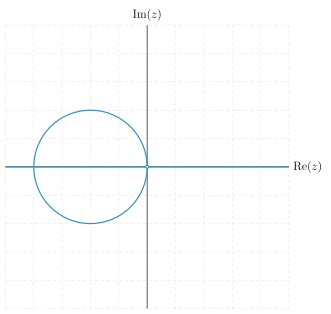
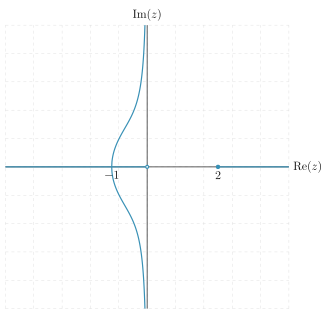
Let \(x+{\rm i} y\) be a root of the quadratic equation \(z^2 + pz +1=0\), where \(p\) is a real number. Show that \(x^2-y^2 +px+1=0\) and \((2x+p)y=0\). Show further that either \(p=-2x\) or \(p=-(x^2+1)/x\) with \(x\ne0\). Hence show that the set of points in the Argand diagram that can (as \(p\) varies) represent roots of the quadratic equation consists of the real axis with one point missing and a circle. This set of points is called the root locus of the quadratic equation. Obtain and sketch in the Argand diagram the root locus of the equation \[ pz^2 +z+1=0\, \] and the root locus of the equation \[ pz^2 + p^2z +2=0\,.\]
Solution: \begin{align*} && 0 &= z^2 + pz + 1\\ &&&= (x+iy)^2 + (x+iy)p + 1 \\ &&& = (x^2-y^2+px+1) + (2xy+py)i \\ \Rightarrow && 0 &= x^2 - y^2 + px + 1 \\ && 0 &= (2x+p)y \\ \Rightarrow && p &= -2x \\ \text{ or } && y &= 0 \\ \Rightarrow && p &= -(x^2+1)/x \end{align*} Therefore as \(p\) varies with either have \(y = 0\) and \(x\) taking any real value except \(0\) ie the real axis minus the origin. Or \(p = -2x\) and \(-y^2-x^2+1 = 0 \Rightarrow x^2 + y^2 = 1\) which is a circle. Suppose \(pz^2 + z + 1 = 0\) \begin{align*} && 0 &= pz^2 + z +1\\ &&&= p(x+iy)^2 + (x+iy) + 1\\ &&&= (px^2-py^2+x+1) + (2xyp + y) i \\ \Rightarrow && 0 &= (2xp+1)y \\ \Rightarrow && y & = 0, p = \frac{-(x+1)}{x^2}, x \neq 0 \\ \text{ or } && p &= -\frac{1}{2x}\\ \Rightarrow && 0 &= -\frac{1}{2}x + \frac{y^2}{2x} + x + 1 \\ &&&= \frac{y^2 - x^2 +2x^2 + 2x}{2x} \\ &&&= \frac{(x+1)^2+y^2-1}{2x} \end{align*} So we either have the real axis (except \(0\)) or a circle radius \(1\) centre \((-1, 0)\) (excluding \(x = 0\)).
2011 Paper 3 Q3
Show that, provided \(q^2\ne 4p^3\), the polynomial \[ \hphantom{(p\ne0, \ q\ne0)\hspace{2cm}} x^3-3px +q \hspace {2cm} (p\ne0, \ q\ne0) \] can be written in the form \[ a(x-\alpha)^3 + b(x-\beta)^3\,, \] where \(\alpha\) and \(\beta\) are the roots of the quadratic equation \(pt^2 -qt +p^2=0\), and \(a\) and \(b\) are constants which you should express in terms of \(\alpha\) and \(\beta\). Hence show that one solution of the equation \(x^3-24x+48=0\,\) is \[ x= \frac{2 (2-2^{\frac13})}{1-2^{\frac13}} \] and obtain similar expressions for the other two solutions in terms of \(\omega\), where \(\omega = \mathrm{e}^{2\pi\mathrm{i}/3}\,\). Find also the roots of \(x^3-3px +q=0\) when \(p=r^2\) and \(q= 2r^3\) for some non-zero constant \(r\).
2010 Paper 2 Q7
- By considering the positions of its turning points, show that the curve with equation \[ y=x^3-3qx-q(1+q)\,, \] where \(q>0\) and \(q\ne1\), crosses the \(x\)-axis once only.
- Given that \(x\) satisfies the cubic equation \[ x^3-3qx-q(1+q)=0\,, \] and that \[ x=u+q/u\,, \] obtain a quadratic equation satisfied by \(u^3\). Hence find the real root of the cubic equation in the case \(q>0\), \(q\ne1\).
- The quadratic equation \[ t^2 -pt +q =0\, \] has roots \(\alpha \) and \(\beta\). Show that \[ \alpha^3+\beta^3 = p^3 -3qp\,. \] It is given that one of these roots is the square of the other. By considering the expression \((\alpha^2 -\beta)(\beta^2-\alpha)\), find a relationship between \(p\) and \(q\). Given further that \(q>0\), \(q\ne1\) and \(p\) is real, determine the value of \(p\) in terms of \(q\).
2009 Paper 1 Q9
Two particles \(P\) and \(Q\) are projected simultaneously from points \(O\) and \(D\), respectively, where~\(D\) is a distance \(d\) directly above \(O\). The initial speed of \(P\) is \(V\) and its angle of projection {\em above} the horizontal is \(\alpha\). The initial speed of \(Q\) is \(kV\), where \(k>1\), and its angle of projection {\em below} the horizontal is \(\beta\). The particles collide at time \(T\) after projection. Show that \(\cos\alpha = k\cos\beta\) and that \(T\) satisfies the equation \[ (k^2-1)V^2T^2 +2dVT\sin\alpha -d^2 =0\,. \] Given that the particles collide when \(P\) reaches its maximum height, find an expression for~\(\sin^2\alpha\) in terms of \(g\), \(d\), \(k\) and \(V\), and deduce that \[ gd\le (1+k)V^2\,. \]
2009 Paper 3 Q1
The points \(S\), \(T\), \(U\) and \(V\) have coordinates \((s,ms)\), \((t,mt)\), \((u,nu)\) and \((v,nv)\), respectively. The lines \(SV\) and \(UT\) meet the line \(y=0\) at the points with coordinates \((p,0)\) and \((q,0)\), respectively. Show that \[ p = \frac{(m-n)sv}{ms-nv}\,, \] and write down a similar expression for \(q\). Given that \(S\) and \(T\) lie on the circle \(x^2 + (y-c)^2 = r^2\), find a quadratic equation satisfied by \(s\) and by \(t\), and hence determine \(st\) and \(s+t\) in terms of \(m\), \(c\) and \(r\). Given that \(S\), \(T\), \(U\) and \(V\) lie on the above circle, show that \(p+q=0\).
2009 Paper 3 Q9
A particle is projected under gravity from a point \(P\) and passes through a point \(Q\). The angles of the trajectory with the positive horizontal direction at \(P\) and at \(Q\) are \(\theta\) and \(\phi\), respectively. The angle of elevation of \(Q\) from \(P\) is \(\alpha\).
- Show that \(\tan\theta +\tan\phi = 2\tan\alpha\).
- It is given that there is a second trajectory from \(P\) to \(Q\) with the same speed of projection. The angles of this trajectory with the positive horizontal direction at \(P\) and at \(Q\) are \(\theta'\) and \(\phi'\), respectively. By considering a quadratic equation satisfied by \(\tan\theta\), show that \(\tan(\theta+\theta') = -\cot\alpha\). Show also that \(\theta+\theta'=\pi+\phi+\phi'\,\).
2008 Paper 2 Q9
In this question, use \(g=10\,\)m\,s\(^{-2}\). In cricket, a fast bowler projects a ball at \(40\,\)m\,s\(^{-1}\) from a point \(h\,\)m above the ground, which is horizontal, and at an angle \(\alpha\) above the horizontal. The trajectory is such that the ball will strike the stumps at ground level a horizontal distance of \(20\,\)m from the point of projection.
- Determine, in terms of \(h\), the two possible values of \(\tan\alpha\). Explain which of these two values is the more appropriate one, and deduce that the ball hits the stumps after approximately half a second.
- State the range of values of \(h\) for which the bowler projects the ball below the horizontal.
- In the case \(h=2.5\), give an approximate value in degrees, correct to two significant figures, for \(\alpha\). You need not justify the accuracy of your approximation.
2008 Paper 2 Q12
In the High Court of Farnia, the outcome of each case is determined by three judges: the ass, the beaver and the centaur. Each judge decides its verdict independently. Being simple creatures, they make their decisions entirely at random. Past verdicts show that the ass gives a guilty verdict with probability \(p\), the beaver gives a guilty verdict with probability \(p/3\) and the centaur gives a guilty verdict with probability \(p^2\). Let \(X\) be the number of guilty verdicts given by the three judges in a case. Given that \(\E(X)= 4/3\), find the value of \(p\). The probability that a defendant brought to trial is guilty is \(t\). The King pronounces that the defendant is guilty if at least two of the judges give a guilty verdict; otherwise, he pronounces the defendant not guilty. Find the value of \(t\) such that the probability that the King pronounces correctly is \(1/2\).
Solution: \begin{align*} && \mathbb{E}(X) &= p + \frac{p}{3} + p^2 = \frac43p+p^2 \\ \Rightarrow && \frac43 &= \frac43p+p^2 \\ \Rightarrow && 0 &= 3p^2+4p-4 \\ &&&= (3p-2)(p+2) \\ \Rightarrow && p &= \frac23, -2 \end{align*} Since \(p \in [0,1]\) we must have \(p = \frac23\). \begin{align*} && \mathbb{P}(\text{correct verdict}) &= t p+ (1-t) (1-p) \\ &&&= t(2p-1)+(1-p)\\ \Rightarrow && \frac12 &= t(2p-1)+(1-p) \\ \Rightarrow && t &= \frac{\frac12-(1-p)}{2p-1} \\ &&&= \frac{2p-1}{2(2p-1)} = \frac12 \end{align*} (so it doesn't depend at all on what the judges are doing, the only way to be fair is if the trials happen at random!)
2008 Paper 3 Q5
The functions \({\rm T}_n(x)\), for \(n=0\), 1, 2, \(\ldots\,\), satisfy the recurrence relation \[ {\rm T}_{n+1}(x) -2x {\rm T}_n(x) + {\rm T}_{n-1}(x) =0\, \ \ \ \ \ \ \ (n\ge1). \tag{\(*\)} \] Show by induction that \[ \left({\rm T}_n(x)\right)^2 - {\rm T}_{n-1}(x) {\rm T}_{n+1}(x) = \f(x)\,, \] where \(\f(x) = \left({\rm T}_1(x)\right)^2 - {\rm T}_0(x){\rm T}_2(x)\,\). In the case \(\f(x)\equiv 0\), determine (with proof) an expression for \({\rm T}_n(x)\) in terms of \({\rm T}_0(x)\) (assumed to be non-zero) and \({\rm r}(x)\), where \({\rm r}(x) = {\rm T}_1(x)/ {\rm T}_0(x)\). Find the two possible expressions for \({\rm r}(x)\) in terms of \(x\). %Conjecture (without proof) the general form of the solution of \((*)\).