Problems
Filters
9 problems found
2025 Paper 2 Q2
- Show that if the complex number \(z\) satisfies the equation \[z^2 + |z + b| = a,\] where \(a\) and \(b\) are real numbers, then \(z\) must be either purely real or purely imaginary.
- Show that the equation \[z^2 + \left|z + \frac{5}{2}\right| = \frac{7}{2}\] has no purely imaginary roots.
- Show that the equation \[z^2 + \left|z + \frac{7}{2}\right| = \frac{5}{2}\] has no purely real roots.
- Show that, when \(\frac{1}{2} < b < \frac{3}{4}\), the equation \[z^2 + |z + b| = \frac{1}{2}\] will have at least one purely imaginary root and at least one purely real root.
- Solve the equation \[z^3 + |z + 2|^2 = 4.\]
Solution:
- Suppose \(z^2 + |z + b| = a\), then \(z^2 = a- |z + b| \in \mathbb{R}\), since \(a \in \mathbb{R}\). Since the square root of a real number is either purely real or purely imaginary, \(z\) is purely real or purely imaginary.
- Suppose \(z = it\) for some \(t \in \mathbb{R}\), then \begin{align*} && \frac72 &= -t^2 +\sqrt{t^2 + \frac{25}{4}} \\ \Rightarrow && \left ( \frac72 + t^2\right)^2 &= t^2 + \frac{25}{4} \\ \Rightarrow && t^4 + 7t^2 + \frac{49}{4} &= t^2 + \frac{25}{4} \\ \Rightarrow && t^4 + 6t^2 + 6 &= 0 \end{align*} but since \(\Delta = 6^2 - 4 \cdot 1 \cdot 6 < 0\) there are no real solutions.
- Suppose \(z = t\) for some \(t \in \mathbb{R}\), then either \(t^2 + t + \frac72 = \frac52 \Rightarrow t^2 + t + 1 = 0\) (no solutions) or \(t^2 - t - \frac72 = \frac52 \Rightarrow t^2 - t - 6 = (t-3)(t+2) = 0\). When \(t = 3\) then we must take the positive part for \(|z + \frac72|\) so this cannot work. When \(t = -2\) we also have \(\frac72-2 > 0\) so we are still taking the positive part. Hence no solutions
- Suppose \(\frac{1}{2} < b < \frac{3}{4}\), the equation then consider \(z^2 + |z + b| = \frac{1}{2}\). Case 1: \(z = t \in \mathbb{R}\), then we have two cases: Case 1a: \(z+b > 0\). \(z^2 + z + b = \frac12 \Rightarrow z = \frac{-1 \pm \sqrt{1-4b+2}}{2}\) which clearly is a valid real number an \(z + b > 0\). Case 1b: \(z+b < 0\) \(z^2 - z - b = \frac12 \Rightarrow z = \frac{1 \pm \sqrt{1+4b-2}}{2}\)
- Let \(\omega\) be a (primitive) cube root of unity. \begin{align*} && z^3 &= 4 - |z+2|^2 \\ \Rightarrow && z &\in \mathbb{R} \cup \omega \mathbb{R} \cup \omega^2 \mathbb{R} \end{align*} Case 1:
2018 Paper 3 Q6
- The distinct points \(A\), \(Q\) and \(C\) lie on a straight line in the Argand diagram, and represent the distinct complex numbers \(a\), \(q\) and \(c\), respectively. Show that \(\dfrac {q-a}{c-a}\) is real and hence that \((c-a)(q^*-a^*) = (c^*-a^*)(q-a)\,\). Given that \(aa^* = cc^* = 1\), show further that \[ q+ ac q^* = a+c \,. \]
- The distinct points \(A\), \(B\), \(C\) and \(D\) lie, in anticlockwise order, on the circle of unit radius with centre at the origin (so that, for example, \(aa^* =1\)). The lines \(AC\) and \(BD\) meet at \(Q\). Show that \[ (ac-bd)q^* = (a+c)-(b+d) \,, \] where \(b\) and \(d\) are complex numbers represented by the points \(B\) and \(D\) respectively, and show further that \[ (ac-bd) (q+q^*) = (a-b)(1+cd) +(c-d)(1+ab) \,. \]
- The lines \(AB\) and \(CD\) meet at \(P\), which represents the complex number \(p\). Given that \(p\) is real, show that \(p(1+ab)=a+b\,\). Given further that \(ac-bd \ne 0\,\), show that \[ p(q+q^*) = 2 \,. \]
Solution:
- \(A\), \(Q\), \(C\) lie on a straight line if \(q = \lambda a + (1-\lambda)c\) for some \(\lambda \in \mathbb{R}\), \begin{align*} && q &= \lambda a + (1-\lambda)c \\ \Leftrightarrow && q - a &= (\lambda - 1)a + (1-\lambda)c \\ \Leftrightarrow && q - a &= (\lambda - 1)(a-c) \\ \Leftrightarrow && \frac{q - a}{c-a} &= 1-\lambda \\ \end{align*} therefore \(\frac{q-a}{c-a} \in \mathbb{R}\) \begin{align*} && \frac{q-a}{c-a} & \in \mathbb{R} \\ \Leftrightarrow && \left (\frac{q-a}{c-a} \right)^* &= \frac{q-a}{c-a} \\ \Leftrightarrow && (q^*-a^*)(c-a) &= (q-a)(c^*-a^*) \\ \end{align*} Given \(aa^* = cc^* = 1\), \begin{align*} && (q^*-a^*)(c-a) &= (q-a)(c^*-a^*) \\ \Leftrightarrow && q^*(c-a) - \frac{c}{a}+1 &= q \frac{a-c}{ca} - \frac{a}{c}+1 \\ \Leftrightarrow && (c-a)\l q^* +\frac{q}{ca}\r &= \frac{c}{a} - \frac{a}{c} \\ &&&= \frac{c^2-a^2}{ac} \\ \Leftrightarrow && q^* +\frac{q}{ca} &= \frac{c+a}{ac} \\ \Leftrightarrow && q^*ac +q &= a+c \end{align*}
- Since \(Q\) lies on \(AC\) and \(BD\) we must have \begin{align*} &&& \begin{cases} q^*ac +q &= a+c \\ q^*bd +q &= b+d \\ \end{cases} \\ \Rightarrow && q^*(ac-bd) &= (a+c)-(b+d) \\ \Rightarrow && q(ac-bd) &= (b+d)ac-(a+c)bd \\ \Rightarrow && (q+q^*)(ac-bd) &= (a+c)(1-bd)+(b+d)(ac-1) \\ &&&=a-abd+c-bcd+abc-b+acd-d \\ &&&= a(1+cd)-b(1+cd)+c(1+ab)-d(1+ab) \\ &&&= (a-b)(1+cd)+(c-d)(1+ab) \end{align*}
- If \(AB\) and \(CD\) meet at \(p\) we must have \(p^*ab + p = a+b\), ie \(p(1+ab) = a+b\) amd \(p(1+cd) = c+d\), so \begin{align*} && (q+q^*)(ac-bd) &= (a-b) \frac{c+d}{p} + (c-d) \frac{a+b}{p} \\ \Leftrightarrow && p(q+q^*)(ac-bd) &= (a-b)(c+d)+(c-d)(a+b) \\ &&&= ac+ad-bc-bd+ac+bc-ad-bd \\ &&&= 2(ac-bd) \\ \Leftrightarrow && p(q+q^*) &= 2 \end{align*}
2012 Paper 3 Q6
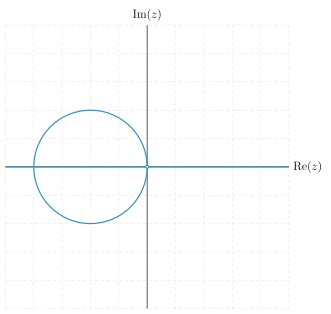
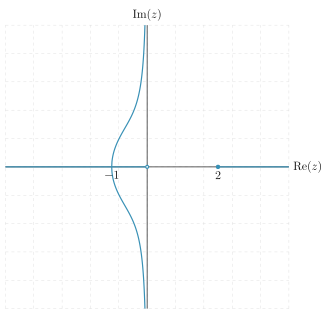
Let \(x+{\rm i} y\) be a root of the quadratic equation \(z^2 + pz +1=0\), where \(p\) is a real number. Show that \(x^2-y^2 +px+1=0\) and \((2x+p)y=0\). Show further that either \(p=-2x\) or \(p=-(x^2+1)/x\) with \(x\ne0\). Hence show that the set of points in the Argand diagram that can (as \(p\) varies) represent roots of the quadratic equation consists of the real axis with one point missing and a circle. This set of points is called the root locus of the quadratic equation. Obtain and sketch in the Argand diagram the root locus of the equation \[ pz^2 +z+1=0\, \] and the root locus of the equation \[ pz^2 + p^2z +2=0\,.\]
Solution: \begin{align*} && 0 &= z^2 + pz + 1\\ &&&= (x+iy)^2 + (x+iy)p + 1 \\ &&& = (x^2-y^2+px+1) + (2xy+py)i \\ \Rightarrow && 0 &= x^2 - y^2 + px + 1 \\ && 0 &= (2x+p)y \\ \Rightarrow && p &= -2x \\ \text{ or } && y &= 0 \\ \Rightarrow && p &= -(x^2+1)/x \end{align*} Therefore as \(p\) varies with either have \(y = 0\) and \(x\) taking any real value except \(0\) ie the real axis minus the origin. Or \(p = -2x\) and \(-y^2-x^2+1 = 0 \Rightarrow x^2 + y^2 = 1\) which is a circle. Suppose \(pz^2 + z + 1 = 0\) \begin{align*} && 0 &= pz^2 + z +1\\ &&&= p(x+iy)^2 + (x+iy) + 1\\ &&&= (px^2-py^2+x+1) + (2xyp + y) i \\ \Rightarrow && 0 &= (2xp+1)y \\ \Rightarrow && y & = 0, p = \frac{-(x+1)}{x^2}, x \neq 0 \\ \text{ or } && p &= -\frac{1}{2x}\\ \Rightarrow && 0 &= -\frac{1}{2}x + \frac{y^2}{2x} + x + 1 \\ &&&= \frac{y^2 - x^2 +2x^2 + 2x}{2x} \\ &&&= \frac{(x+1)^2+y^2-1}{2x} \end{align*} So we either have the real axis (except \(0\)) or a circle radius \(1\) centre \((-1, 0)\) (excluding \(x = 0\)).
2011 Paper 3 Q8
The complex numbers \(z\) and \(w\) are related by \[ w= \frac{1+\mathrm{i}z}{\mathrm{i}+z}\,. \] Let \(z=x+\mathrm{i}y\) and \(w=u+\mathrm{i}v\), where \(x\), \(y\), \(u\) and \(v\) are real. Express \(u\) and \(v\) in terms of \(x\) and \(y\).
- By setting \(x=\tan(\theta/2)\), or otherwise, show that if the locus of \(z\) is the real axis \(y=0\), \(-\infty < x < \infty\), then the locus of \(w\) is the circle \(u^2+v^2=1\) with one point omitted.
- Find the locus of \(w\) when the locus of \(z\) is the line segment \(y=0\), \(-1 < x < 1\,\).
- Find the locus of \(w\) when the locus of \(z\) is the line segment \(x=0\), \(-1 < y < 1\,\).
- Find the locus of \(w\) when the locus of \(z\) is the line \(y=1\), \(-\infty < x < \infty\,\).
Solution: \begin{align*} w &= \frac{1+iz}{i+z} \\ &= \frac{1-y+ix}{x+i(1+y)} \\ &= \frac{((1-y)+ix)(x-i(1+y))}{x^2+(1+y)^2} \\ &= \frac{x(1-y)+x(1+y)}{x^2+(1+y)^2}+\frac{x^2+y^2-1}{x^2+(1+y)^2}i \\ &= \frac{2x}{x^2+(y+1)^2}+\frac{x^2+y^2-1}{x^2+(1+y)^2}i \end{align*} Therefore \(u = \frac{2x}{x^2+(y+1)^2}, v = \frac{x^2+y^2-1}{x^2+(1+y)^2}\)
- Suppose \(z = \tan(\theta/2) = t\) then \(u = \frac{2t}{t^2+1} = \sin \theta, v = \frac{t^2-1}{t^2+1} = \cos \theta\), ie \(u+iv\) is the unit circle, where \(-\frac{\pi}{2} < \theta/2 < \frac{\pi}{2}\) or \(-\pi < \theta < \pi\), ie excluding the point \((\sin \pi, \cos \pi) = (0,1)\).
- When \(-1 < x < 1\) we have \(-\frac{\pi}{4} < \frac{\theta}{2} < \frac{\pi}{4}\) ie \(-\frac{\pi}{2} < \theta < \frac{\pi}{2}\), ie the lower half of the unit circle.
- When \(x = 0, -1 < y < 1\) we have \(u = 0, v = \frac{y^2-1}{(1+y)^2}\) which is the negative imaginary axis.
- We have \(u = \frac{2t}{t^2+4}, v = \frac{t^2}{t^2+4}\), ie \(u^2 + v^2 = v\), ie \(u^2+(v-\frac12)^2 = \frac12^2\), so a circle centre \(\frac12i\) radius \(\frac12\), missing out \((0,1)\)
1998 Paper 1 Q5
- In the Argand diagram, the points \(Q\) and \(A\) represent the complex numbers \(4+6i\) and \(10+2i\). If \(A\), \(B\), \(C\), \(D\), \(E\), \(F\) are the vertices, taken in clockwise order, of a regular hexagon (regular six-sided polygon) with centre \(Q\), find the complex number which represents \(B\).
- Let \(a\), \(b\) and \(c\) be real numbers. Find a condition of the form \(Aa+Bb+Cc=0\), where \(A\), \(B\) and \(C\) are integers, which ensures that \[\frac{a}{1+i}+\frac{b}{1+2i}+\frac{c}{1+3i}\] is real.
Solution:
- We are looking for \((10+2i) - (4+6i) = 6 - 4i\) rotated by \(\frac{\pi}{3}\) and then added to \(4+6i\), which is \begin{align*} (6-4i)(\cos \frac{\pi}{3} + i \sin \frac{\pi}{3}) &= (6-4i)\left(\tfrac12 +\tfrac{\sqrt{3}}2i\right) \\ &= 3+2\sqrt{3} + (3\sqrt{3}-2)i \end{align*}

- \begin{align*} &&& \frac{a}{1+i}+\frac{b}{1+2i}+\frac{c}{1+3i} &\in \mathbb{R} \\ \Longleftrightarrow && \frac{a}{1+i}+\frac{b}{1+2i}+\frac{c}{1+3i} &= \frac{a}{1-i}+\frac{b}{1-2i}+\frac{c}{1-3i} \\ && 0 &= a\left ( \frac{1}{1+i} - \frac{1}{1-i} \right)+ b\left ( \frac{1}{1+2i} - \frac{1}{1-2i} \right)+ c\left ( \frac{1}{1+3i} - \frac{1}{1-3i} \right) \\ &&&= a\left ( \frac{(1-i)-(1+i)}{1^2+1^2} \right) + b\left ( \frac{(1-2i)-(1+2i)}{1^2+2^2} \right) + c\left ( \frac{(1-3i)-(1+3i)}{1^2+3^2} \right) \\ &&&= -\frac{2i}{2}a-\frac{4i}{5}b-\frac{-6i}{10}c \\ \Longleftrightarrow && 0 &= a+\tfrac45b+\tfrac35c \end{align*}
1994 Paper 1 Q6
The function \(\mathrm{f}\) is defined, for any complex number \(z\), by \[ \mathrm{f}(z)=\frac{\mathrm{i}z-1}{\mathrm{i}z+1}. \] Suppose throughout that \(x\) is a real number.
- Show that \[ \mathrm{Re}\,\mathrm{f}(x)=\frac{x^{2}-1}{x^{2}+1}\qquad\mbox{ and }\qquad\mathrm{Im}\,\mathrm{f}(x)=\frac{2x}{x^{2}+1}. \]
- Show that \(\mathrm{f}(x)\mathrm{f}(x)^{*}=1,\) where \(\mathrm{f}(x)^{*}\) is the complex conjugate of \(\mathrm{f}(x)\).
- Find expressions for \(\mathrm{Re}\,\mathrm{f}(\mathrm{f}(x))\) and \(\mathrm{Im}\,\mathrm{f}(\mathrm{f}(x)).\)
- Find \(\mathrm{f}(\mathrm{f}(\mathrm{f}(x))).\)
Solution:
- \begin{align*} && f(x) &= \frac{ix-1}{ix+1} \\ &&&= \frac{ix-1}{ix+1} \frac{1-ix}{1-ix} \\ &&&= \frac{ix-1+x^2+ix}{1^2+x^2} \\ &&&= \frac{x^2-1}{x^2+1} + i \frac{2x}{x^2+1} \\ \Rightarrow && \textrm{Re}(f(x)) &= \frac{x^2-1}{x^2+1} \\ && \textrm{Im}(f(x)) &= \frac{2x}{x^2+1} \end{align*}
- \begin{align*} && f(x)f(x)^* &= \frac{ix-1}{ix+1} \frac{(ix-1)^*}{(ix+1)^*} \\ &&&= \frac{ix-1}{ix+1} \frac{-ix-1}{-ix+1} \\ &&&= \frac{ix-1}{ix+1} \frac{-(ix+1)}{-(ix-1)} \\ &&&= 1
- \begin{align*} && \begin{pmatrix} i & -1 \\ i & 1 \end{pmatrix}^2 &= \begin{pmatrix} -1-i & -i-1 \\ -1+i & -i+1 \end{pmatrix} \\ \Rightarrow && f(f(z)) &= \frac{-(1+i)(z+1)}{(-1+i)(z-1)} \\ &&&= \frac{2i}{2} \frac{z+1}{z-1} \\ &&&= i \frac{z+1}{z-1} \\ \Rightarrow && \textrm{Re}(f(f(x))) &= 0 \\ && \textrm{Im}(f(f(x))) &= \frac{x+1}{x-1} \end{align*}
- \begin{align*} && \begin{pmatrix} i & -1 \\ i & 1 \end{pmatrix} \begin{pmatrix} i & i \\ 1 & -1 \end{pmatrix} &= \begin{pmatrix} -2 & 0 \\ 0 & -2 \end{pmatrix} \\ \Rightarrow && f(f(f(z))) &= z \end{align*}
1992 Paper 1 Q4
Sketch the following subsets of the complex plane using Argand diagrams. Give reasons for your answers.
- \(\{z:\mathrm{Re}((1+\mathrm{i})z)\geqslant0\}.\)
- \(\{z: |z^{2}| \leqslant2,\mathrm{Re}(z^{2})\geqslant0\}.\)
- \(\{z=z_{1}+z_{2}:\left|z_{1}\right|=2,\left|z_{2}\right|=1\}.\)
Solution:
- Multiplication by \(1+i\) rotates by \(45^{\circ}\) anticlockwise

- \(|z| \leq \sqrt{2}\), \(\textrm{Re}(z^2) \geq 0\) means \(\textrm{Re}{z} \geq \textrm{Im}{z}\)

- These are all points within \(1\) unit from a circle radius \(2\) units.

1990 Paper 3 Q4
Given that \(\sin\beta\neq0,\) sum the series \[ \cos\alpha+\cos(\alpha+2\beta)+\cdots+\cos(\alpha+2r\beta)+\cdots+\cos(\alpha+2n\beta) \] and \[ \cos\alpha+\binom{n}{1}\cos(\alpha+2\beta)+\cdots+\binom{n}{r}\cos(\alpha+2r\beta)+\cdots+\cos(\alpha+2n\beta). \] Given that \(\sin\theta\neq0,\) prove that \[ 1+\cos\theta\sec\theta+\cos2\theta\sec^{2}\theta+\cdots+\cos r\theta\sec^{r}\theta+\cdots+\cos n\theta\sec^{n}\theta=\frac{\sin(n+1)\theta\sec^{n}\theta}{\sin\theta}. \]
Solution: \begin{align*} \sum_{r = 0}^n \cos (\alpha + 2r \beta) &= \sum_{r = 0}^n \textrm{Re} \left ( \exp(i(\alpha + 2r \beta)) \right) \\ &= \textrm{Re} \left (\sum_{r = 0}^n \exp(i(\alpha + 2r \beta)) \right) \\ &= \textrm{Re} \left (e^{i \alpha} \sum_{r = 0}^n \ (e^{i 2 \beta})^r\right) \\ &= \textrm{Re} \left (e^{i \alpha} \frac{e^{2(n+1)\beta i}-1}{e^{2\beta i}-1} \right) \\ &= \textrm{Re} \left (e^{i \alpha} \frac{e^{(n+1)\beta i} (e^{(n+1)\beta i}-e^{-(n+1)\beta i})}{e^{\beta i}(e^{\beta i}-e^{-\beta i})} \right) \\ &= \textrm{Re} \left (\frac{e^{i \alpha} e^{(n+1)\beta i}}{e^{\beta i}} \frac{\sin (n+1) \beta}{\sin \beta} \right) \\ &= \textrm{Re} \left ( e^{i(\alpha + n \beta)}\frac{\sin (n+1) \beta}{\sin \beta} \right) \\ &= \frac{\cos (\alpha + n \beta)\sin (n+1) \beta}{\sin \beta} \end{align*} \begin{align*} \sum_{r = 0}^n \binom{n}{r} \cos (\alpha + 2r \beta) &= \sum_{r = 0}^n \textrm{Re} \left ( \binom{n}{r}\exp(i(\alpha + 2r \beta)) \right) \\ &= \textrm{Re} \left (\sum_{r = 0}^n \binom{n}{r} \exp(i(\alpha + 2r \beta)) \right) \\ &= \textrm{Re} \left (e^{i \alpha}(e^{2\beta i}+1)^n \right) \\ &= \textrm{Re} \left (e^{i \alpha}e^{n\beta i}(e^{\beta i}+e^{-\beta i})^n \right) \\ &= \textrm{Re} \left (e^{i \alpha}e^{n\beta i}2^n \cos^n \beta \right) \\ &= 2^n \cos(\alpha + n \beta) \cos ^n \beta \end{align*} \begin{align*} \sum_{r = 0}^n \cos r \theta \sec^r \theta &= \sum_{r = 0}^n \textrm{Re} ( e^{i r \theta})\sec^r \theta \\ &= \textrm{Re} \left ( \sum_{r=0}^n e^{i r \theta} \sec^r \theta\right) \\ &= \textrm{Re} \left ( \frac{e^{i (n+1) \theta}\sec^{n+1} \theta -1}{e^{i \theta}\sec \theta -1} \right) \\ &= \textrm{Re} \left ( \frac{e^{i (n+1) \theta}\sec^{n} \theta -\cos \theta}{e^{i \theta} -\cos \theta} \right) \\ &= \textrm{Re} \left ( \frac{e^{i (n+1) \theta}\sec^{n} \theta -\cos \theta}{i \sin \theta} \right) \\ &= \frac{1}{\sin \theta} \textrm{Im} \left ( e^{i (n+1) \theta}\sec^{n} \theta -\cos \theta \right) \\ &= \frac{\sin(n+1) \theta \sec^{n} \theta}{\sin \theta} \end{align*}
1988 Paper 2 Q4
The complex number \(w\) is such that \(w^{2}-2w\) is real.
- Sketch the locus of \(w\) in the Argand diagram.
- If \(w^{2}=x+\mathrm{i}y,\) describe fully and sketch the locus of points \((x,y)\) in the \(x\)-\(y\) plane.
Solution:
- Suppose \(w = u+ vi\) then \(w^2 - 2w = u^2-v^2-2u+(2uv-2v)i\) so to be purely real we must have \(2uv-2v = 2v(u-1) = 0\) ie either \(v = 0\) or \(u = 1\). Therefore the locus is the real axis and the line \(1 + ti\):

- If \(w^2 = x+yi\) then we must have \(x = u^2-v^2\) and \(y = 2uv\), so either \(v = 0, y = 0, x = u^2-2u \geq -1\) or \(u = 1, x = 1-v^2, y = 2v\) which is a parabola:

