Problems
Filters
7 problems found
2025 Paper 2 Q10
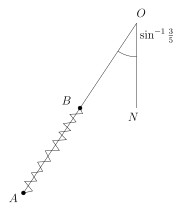
The lower end of a rigid uniform rod of mass \(m\) and length \(a\) rests at point \(M\) on rough horizontal ground. Each of two elastic strings, of natural length \(\ell\) and modulus of elasticity \(\lambda\), is attached at one end to the top of the rod. Their lower ends are attached to points \(A\) and \(B\) on the ground, which are a distance \(2a\) apart. \(M\) is the midpoint of \(AB\). \(P\) is the point at the top of the rod and lies in the vertical plane through \(AMB\). Suppose that the rod is in equilibrium with angle \(PMB = 2\theta\), where \(\theta < 45°\) and \(\theta\) is such that both strings are in tension.
- Show that angle \(APB\) is a right angle.
Show that the force exerted on the rod by the elastic strings can be written as the sum of
- a force of magnitude \(\frac{2a\lambda}{\ell}\) parallel to the rod
- and a force of magnitude \(\sqrt{2}\lambda\) acting along the bisector of angle \(APB\).
- By taking moments about point \(M\), or otherwise, show that \(\cos\theta + \sin\theta = \frac{2\lambda}{mg}\). Deduce that it is necessary that \(\frac{1}{2}mg < \lambda < \frac{1}{2}\sqrt{2}mg\).
- \(N\) and \(F\) are the magnitudes of the normal and frictional forces, respectively, exerted on the rod by the ground at \(M\). Show, by taking moments about an appropriate point, or otherwise, that \[N - F\tan 2\theta = \frac{1}{2}mg.\]
Solution:

- Notice that \(AM = MB = MP\) in particular \(P\) lies on a semi-circle of radius \(a\) and therefore by Thales' theorem \(\angle APB = 90^{\circ}\). Notice that by angles in a triangle and the angles adding to \(90^{\circ}\), \(\angle APM = \theta\). Therefore, \begin{align*} && |PB| &= 2a \sin \theta \\ && |PA| &= 2a \cos \theta \\ && T_A &= \frac{\lambda}{l} \left (2a \cos \theta -l \right) \\ && T_B &= \frac{\lambda}{l} \left (2a \sin\theta -l \right) \\ \end{align*} Since \(T_A\) and \(T_B\) are perpendicular, we can consider the forces as having vector \(\frac{\lambda}{l}\binom{2a\cos \theta-l}{2a\sin \theta - l}\) in this coordinate system, ie the sum of a vector \(\frac{2\lambda a}{l}\binom{\cos \theta}{\sin \theta}\) and \(\displaystyle -\sqrt{2}\lambda \binom{\frac1{\sqrt{2}}}{\frac1{\sqrt{2}}}\) which are unit vectors parallel to the rod and along the bisector of \(APB\) respectively.
- \begin{align*} \overset{\curvearrowright}{M}: && 0 &= \frac{a}{2} \cdot mg \cos 2 \theta - a\cdot \sqrt{2}\lambda \cos (90-(45-\theta))\\ \Rightarrow && \cos 2 \theta &= \frac{\lambda}{mg} 2 \sqrt{2} \cos (45 + \theta) \\ \Rightarrow && \cos^2 \theta - \sin^2 \theta &= \frac{2\lambda}{mg} (\cos \theta - \sin \theta) \\ \underbrace{\Rightarrow}_{\theta < 45^{\circ}} && \cos \theta + \sin \theta &= \frac{2\lambda}{mg} \end{align*} Over \((0, 45^{\circ})\), \(\cos \theta + \sin \theta\) ranges from \(1\) to \(\sqrt{2}\), therefore \(1 < \frac{2 \lambda}{mg} < \sqrt{2} \Rightarrow \frac12 mg < \lambda < \frac12 \sqrt{2} mg\) as required.
- \begin{align*} \overset{\curvearrowright}{P}: && 0 &=- \frac{a}{2} \cdot \left ( mg \cos 2\theta \right) - a \cdot F \sin 2 \theta + a \cdot N \cos 2 \theta \\ \Rightarrow && \frac12 mg &= N - F \tan 2 \theta \end{align*} as required.
2015 Paper 3 Q10
A light rod of length \(2a\) has a particle of mass \(m\) attached to each end and it moves in a vertical plane. The midpoint of the rod has coordinates \((x,y)\), where the \(x\)-axis is horizontal (within the plane of motion) and \(y\) is the height above a horizontal table. Initially, the rod is vertical, and at time \(t\) later it is inclined at an angle \(\theta\) to the vertical. Show that the velocity of one particle can be written in the form \[ \begin{pmatrix} \dot x + a \dot\theta \cos\theta \\ \dot y - a \dot\theta \sin\theta \end{pmatrix} \] and that \[ m\begin{pmatrix} \ddot x + a\ddot\theta \cos\theta - a \dot\theta^2 \sin\theta \\ \ddot y- a\ddot\theta \sin\theta - a \dot\theta^2 \cos\theta \end{pmatrix} =-T\begin{pmatrix} \sin\theta \\ \cos\theta \end{pmatrix} -mg \begin{pmatrix} 0 \\ 1 \end{pmatrix} \] where the dots denote differentiation with respect to time \(t\) and \(T\) is the tension in the rod. Obtain the corresponding equations for the other particle. Deduce that \(\ddot x =0\), \(\ddot y = -g\) and \(\ddot\theta =0\). Initially, the midpoint of the rod is a height \(h\) above the table, the velocity of the higher particle is \(\Big(\begin{matrix} \, u \, \\ v \end{matrix}\Big)\), and the velocity of the lower particle is \(\Big(\begin{matrix}\, 0 \, \\ v\end{matrix}\Big)\). Given that the two particles hit the table for the first time simultaneously, when the rod has rotated by \(\frac12\pi\), show that \[ 2hu^2 = \pi^2a^2 g - 2\pi uva \,. \]
2012 Paper 2 Q10
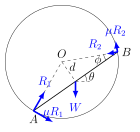
A hollow circular cylinder of internal radius \(r\) is held fixed with its axis horizontal. A uniform rod of length \(2a\) (where \(a < r\)) rests in equilibrium inside the cylinder inclined at an angle of \(\theta\) to the horizontal, where \(\theta\ne0\). The vertical plane containing the rod is perpendicular to the axis of the cylinder. The coefficient of friction between the cylinder and each end of the rod is \(\mu\), where \(\mu > 0\). Show that, if the rod is on the point of slipping, then the normal reactions \(R_1\) and \(R_2\) of the lower and higher ends of the rod, respectively, on the cylinder are related by \[ \mu(R_1+R_2) = (R_1-R_2)\tan\phi \] where \(\phi\) is the angle between the rod and the radius to an end of the rod. Show further that \[ \tan\theta = \frac {\mu r^2}{r^2 -a^2(1+\mu^2)}\,. \] Deduce that \(\lambda <\phi \), where \(\tan\lambda =\mu\).
Solution:
2003 Paper 2 Q9
\(AB\) is a uniform rod of weight \(W\,\). The point \(C\) on \(AB\) is such that \(AC>CB\,\). The rod is in contact with a rough horizontal floor at \(A\,\) and with a cylinder at \(C\,\). The cylinder is fixed to the floor with its axis horizontal. The rod makes an angle \({\alpha}\) with the horizontal and lies in a vertical plane perpendicular to the axis of the cylinder. The coefficient of friction between the rod and the floor is \(\tan \lambda_1\) and the coefficient of friction between the rod and the cylinder is \(\tan \lambda_2\,\). Show that if friction is limiting both at \(A\) and at \(C\), and \({\alpha} \ne {\lambda}_2 - {\lambda}_1\,\), then the frictional force acting on the rod at \(A\) has magnitude $$ \frac{ W\sin {\lambda}_1 \, \sin({\alpha}-{\lambda}_2)} {\sin ({\alpha}+{\lambda}_1-{\lambda}_2)} \;.$$ %and that %$$ %p=\frac{\cos{\alpha} \, \sin({\alpha}+{\lambda}_1-{\lambda}_2)} %{2\cos{\lambda}_1 \, \sin {\lambda}_2}\;. %$$
2000 Paper 1 Q11
A rod \(AB\) of length 0.81 m and mass 5 kg is in equilibrium with the end \(A\) on a rough floor and the end \(B\) against a very rough vertical wall. The rod is in a vertical plane perpendicular to the wall and is inclined at \(45^{\circ}\) to the horizontal. The centre of gravity of the rod is at \(G\), where \(AG = 0.21\) m. The coefficient of friction between the rod and the floor is 0.2, and the coefficient of friction between the rod and the wall is 1.0. Show that the friction cannot be limiting at both \(A\) and \(B\). A mass of 5 kg is attached to the rod at the point \(P\) such that now the friction is limiting at both \(A\) and \(B\). Determine the length of \(AP\).
1993 Paper 1 Q10
A small lamp of mass \(m\) is at the end \(A\) of a light rod \(AB\) of length \(2a\) attached at \(B\) to a vertical wall in such a way that the rod can rotate freely about \(B\) in a vertical plane perpendicular to the wall. A spring \(CD\) of natural length \(a\) and modulus of elasticity \(\lambda\) is joined to the rod at its mid-point \(C\) and to the wall at a point \(D\) a distance \(a\) vertically above \(B\). The arrangement is sketched below. \noindent
1991 Paper 3 Q14