Taylor series
In this question, you should ignore issues of convergence.
- Write down the binomial expansion, for \(\vert x \vert<1\,\), of \(\;\dfrac{1}{1+x}\,\) and deduce that %. By considering %$ %\displaystyle \int \frac 1 {1+x} \, \d x %\,, %$ %show that \[ \displaystyle \ln (1+x) = -\sum_{n=1}^\infty \frac {(-x)^n}n \, \] for \(\vert x \vert <1 \,\).
- Write down the series expansion in powers of \(x\) of \(\displaystyle \e^{-ax}\,\). Use this expansion to show that \[ \int_0^\infty \frac {\left(1- \e^{-ax}\right)\e^{-x}}x \,\d x = \ln(1+a) \ \ \ \ \ \ \ (\vert a \vert <1)\,. \]
- Deduce the value of \[ \int_0^1 \frac{x^p - x^q}{\ln x} \, \d x \ \ \ \ \ \ (\vert p\vert <1, \ \vert q\vert <1) \,. \]
- \begin{align*} && \frac1{1+x} &= 1 - x+ x^2 - x^3+ \cdots \\ \Rightarrow && \int_0^x \frac{1}{1+t} \d t &= \int_0^x \sum_{n=0}^{\infty} (-t)^n \d t \\ &&&= \left [\sum_{n=0}^{\infty} -\frac{(-t)^{n+1}}{n+1} \right]_0^x \\ \Rightarrow &&\ln(1+x)&=- \sum_{n=1}^\infty \frac{(-x)^n}{n} \end{align*}
- \begin{align*} && e^{-ax} &= \sum_{n=0}^\infty \frac{(-a)^n}{n!} x^n \\ \Rightarrow && \int_0^{\infty} \frac{1}{x} \left (1-e^{-ax} \right)e^{-x} \d x &= \int_0^{\infty} \frac{1}{x} \left (-\sum_{n=1}^\infty \frac{(-a)^n}{n!}x^n \right)e^{-x} \d x \\ &&&= -\int_0^{\infty} \sum_{n=1}^\infty \frac{(-a)^n}{n!} x^{n-1} e^{-x} \d x \\ &&&= -\sum_{n=1}^\infty \frac{(-a)^n}{n!} \int_0^{\infty} x^{n-1} e^{-x} \d x \\ &&&= -\sum_{n=1}^\infty \frac{(-a)^n}{n!} (n-1)! \\ &&&= -\sum_{n=1}^\infty \frac{(-a)^n}{n} \\ &&&= \ln (1+a) \end{align*}
- \begin{align*} && \int_0^1 \frac{x^p - x^q}{\ln x} \, \d x &= \int_0^1 \frac{x^p(1 - x^{q-p})}{\ln x} \, \d x \\ e^{-u} = x, \d x = -e^{-u} \d u: &&&=\int_{u=\infty}^{0} \frac{e^{-pu}-e^{-qu}}{-u} (-e^{-u})\d u \\ &&&= \int_0^\infty \frac{e^{-u}(e^{-qu}-e^{-pu})}{u} \d u \\ &&&= \int_0^\infty \frac{e^{-(1+q)u}(1-e^{-(p-q)u})}{u} \d u \\ v = (1+q)u, \d v = (1+q) \d u: &&&=\int_0^{\infty} \frac{e^{-v}(1-e^{-\left(\frac{p-q}{1+q}\right)v}}{v}\d v \\ &&&= \ln \left(1 + \frac{p-q}{1+q} \right) \\ &&&= \ln \left ( \frac{1+p}{1+q} \right) \end{align*}
In this question, you should ignore issues of convergence.
- Let \[ I = \int_0^1 \frac{\f(x^{-1}) } {1+x} \, \d x \,, \] where \(\f(x)\) is a function for which the integral exists. Show that \[ I = \sum_{n=1}^\infty \int_n^{n+1} \frac{\f(y) } {y(1+y)}\, \d y \] and deduce that, if \(\f(x) = \f(x+1)\) for all \(x\), then \[ I= \int_0^1 \frac{\f(x)} {1+x} \, \d x \,. \]
- The {\em fractional part}, \(\{x\}\), of a real number \(x\) is defined to be \(x-\lfloor x\rfloor\) where \(\lfloor x \rfloor\) is the largest integer less than or equal to \(x\). For example \(\{3.2\} = 0.2\) and \(\{3\}=0\,\). Use the result of part (i) to evaluate \[ \displaystyle \int _0^1 \frac { \{x^{-1}\}}{1+x}\, \d x \text{ and } \displaystyle \int _0^1 \frac { \{2x^{-1}\}}{1+x}\, \d x \,. \]
- (Bonus) Use the same method to evaluate \[ \int_0^1 \frac {x\{x^{-1}\}}{1-x^2} \, \d x \,. \]
- (Bonus - harder) Use the same method to evaluate \[ \int_0^1 \frac {x^2\{x^{-1}\}}{1-x^2} \, \d x \,. \]
- \begin{align*} && I &= \int_0^1 \frac{f(x^{-1})}{1+x} \d x \\ u = x^{-1}, \d u = -x^{-2} \d x: &&&= \int_{\infty}^1 \frac{f(u)}{1+\frac{1}{u}} \frac{-1}{u^2} \d u \\ &&&= \int_1^{\infty} \frac{f(u)}{u(1+u)} \d u \\ &&&= \sum_{n=1}^{\infty} \int_n^{n+1} \frac{f(u)}{u(u+1)} \d u \\ \\ \text{if} f(x) = f(x+1)\, \forall x && &=\sum_{n=1}^{\infty} \int_{0}^1 \frac{f(x+n)}{(x+n)(x+n+1)} \d x \\ &&&= \sum_{n=1}^\infty \int_0^1 \frac{f(x)}{(x+n)(x+n+1)} \d x \\ &&&= \int_0^1 f(x) \l \sum_{n=1}^{\infty} \frac{1}{(x+n)(x+n+1)}\r \d x \\ &&&= \int_0^1 f(x) \l \sum_{n=1}^{\infty} \l \frac{1}{x+n} - \frac{1}{x+n+1} \r\r \d x \\ &&&= \int_0^1 f(x) \l \frac{1}{x+1} \r \d x \\ &&&= \int_0^1\frac{f(x)}{x+1} \d x \\ \end{align*}
- Since the fractional part is periodic with period \(1\), we can say \begin{align*} && \int_0^1 \frac{\{ x^{-1} \} }{1+x} \d x &= \int_0^1 \frac{\{ x\}}{x+1} \d x \\ &&&= \int_0^1 \frac{x}{x+1} \d x \\ &&&= \int_0^1 1-\frac{1}{x+1} \d x \\ &&&= [x - \ln (1+x) ]_0^1 \\ &&&= 1 - \ln 2 \end{align*} \begin{align*} && \int_0^1 \frac{\{ 2x^{-1}\}}{1+x} \d x &= \int_0^1 \frac{\{2x\}}{x+1} \d x \\ &&&= \int_0^{1/2} \frac{2x}{x+1} \d x +\int_{1/2}^{1} \frac{2x-1}{x+1} \d x \\ &&&= 2\int_0^1 \frac{x}{x+1} \d x + \int_{1/2}^1 \frac{-1}{x+1} \d x \\ &&&= 2 - 2\ln 2 - \l \ln 2 - \ln \tfrac32 \r \\ &&&= 2 - 4 \ln 2 + \ln 3 \\ &&&= 2 + \ln \tfrac {3}{16} \end{align*}
- \begin{align*} && \int_0^1 \frac{x \{ x^{-1} \} }{1-x^2} \d x &= \frac12 \l \int_0^1 \frac{ \{ x^{-1} \}}{1-x} - \frac{\{x^{-1} \}}{1+x} \d x\r \end{align*} Consider for \(f\) periodic with period \(1\) \begin{align*} \int_0^1 \frac{f(x^{-1})}{1-x} \d x &= \int_1^{\infty} \frac{f(u)}{u(u-1)} \d u \\ &= \sum_{n=1}^{\infty}\int_{n}^{n+1} \frac{f(u)}{u(u-1)} \d u \\ &= \sum_{n=1}^{\infty}\int_{0}^{1} \frac{f(u)}{(u+n)(u+n-1)} \d u \\ &= \int_{0}^{1} \sum_{n=1}^{\infty}\frac{f(u)}{(u+n)(u+n-1)} \d u \\ &= \int_{0}^{1} f(u) \sum_{n=1}^{\infty}\l\frac{1}{u+n-1} - \frac{1}{u+n} \r\d u \\ &= \int_0^1 \frac{f(u)}{u} \d u \end{align*} So we have \begin{align*} && \int_0^1 \frac{x \{ x^{-1} \} }{1-x^2} \d x &= \frac12 \l \int_0^1 \frac{ \{ x^{-1} \}}{1-x} - \frac{\{x^{-1} \}}{1+x} \d x \r \\ &&&= \frac12 \int_0^1 \frac{\{ x \}}{x} \d x - \frac12 (1 - \ln 2) \\ &&&= \frac12 - \frac12 + \frac12 \ln 2 \\ &&&= \frac12 \ln 2 \end{align*}
- By use of calculus, show that \(x- \ln(1+x)\) is positive for all positive \(x\). Use this result to show that \[ \sum_{k=1}^n \frac 1 k > \ln (n+1) \,. \]
- By considering \( x+\ln (1-x)\), show that \[ \sum_{k=1}^\infty \frac 1 {k^2} <1+ \ln 2 \,. \]
- Consider \(f(x) = x - \ln (1+ x)\), then \(f'(x) = 1 - \frac{1}{1+x} = \frac{x}{1+x} > 0\) if \(x >0\). Therefore \(f(x)\) is strictly increasing on the positive reals. Since \(f(0) = 0\) we must have \(f(x) > 0\) for all positive \(x\), ie \(x - \ln(1+x)\) is positive for all positive \(x\). \begin{align*} \sum_{k=1}^n \frac1k &\underbrace{>}_{x > \ln(1+x)} \sum_{k=1}^n \ln \left (1 + \frac1k \right ) \\ &= \sum_{k=1}^n \ln \left ( \frac{k+1}{k} \right ) \\ &= \sum_{k=1}^n \left ( \ln (k+1) - \ln (k) \right) \\ &= \ln (n+1) - \ln 1 \\ &= \ln (n+1) \end{align*}
- Let \(g(x) = x + \ln (1-x)\) ,then \(g'(x) = 1 - \frac{1}{1-x} = \frac{-x}{1-x} < 0\) if \(0 < x < 1\) and \(g(0) = 0\). Therefore \(g(x)\) is decreasing and hence negative on \(0 < x < 1\), in particular \(x < -\ln(1-x) \) \begin{align*} \sum_{k=2}^n \frac1{k^2} &\underbrace{<}_{x < -\ln(1+x)} \sum_{k=2}^n - \ln \left (1-\frac1{k^2} \right) \\ &= -\sum_{k=2}^n \ln \left ( \frac{k^2-1}{k^2}\right) \\ &= \sum_{k=2}^n \l 2 \ln k - \ln(k-1) - \ln(k+1) \r \\ &= \ln n - \ln(n+1) - \ln 0+\ln 2 \\ &= \ln 2 + \ln \frac{n}{n+1} \end{align*} as \(n \to \infty\) we must have \(\displaystyle \sum_{k=2}^{\infty} \frac1{k^2} < \ln 2\) ie \[ \sum_{k=1}^\infty \frac 1 {k^2} <1+ \ln 2\]
In this question, you may ignore questions of convergence. Let \(y= \dfrac {\arcsin x}{\sqrt{1-x^2}}\,\). Show that \[ (1-x^2)\frac {\d y}{\d x} -xy -1 =0 \] and prove that, for any positive integer \(n\), \[ (1-x^2) \frac{\d^{n+2}y}{\d x^{n+2}} - (2n+3)x \frac{\d ^{n+1}y}{\d x ^{n+1}} -(n+1)^2 \frac{\d^ny}{\d x^n}=0\, . \] Hence obtain the Maclaurin series for \( \dfrac {\arcsin x}{\sqrt{1-x^2}}\,\), giving the general term for odd and for even powers of \(x\). Evaluate the infinite sum \[ 1 + \frac 1 {3!} + \frac{2^2}{5!} + \frac {2^2\times 3^2}{7!}+\cdots + \frac {2^2\times 3^2\times \cdots \times n^2}{(2n+1)!} + \cdots\,. \]
Show SolutionIn this question, you may assume that the infinite series \[ \ln(1+x) = x-\frac{x^2}2 + \frac{x^3}{3} -\frac {x^4}4 +\cdots + (-1)^{n+1} \frac {x^n}{n} + \cdots \] is valid for \(\vert x \vert <1\).
- Let \(n\) be an integer greater than 1. Show that, for any positive integer \(k\), \[ \frac1{(k+1)n^{k+1}} < \frac1{kn^{k}}\,. \] Hence show that \(\displaystyle \ln\! \left(1+\frac1n\right) <\frac1n\,\). Deduce that \[ \left(1+\frac1n\right)^{\!n}<\e\,. \]
- Show, using an expansion in powers of \(\dfrac1y\,\), that $ \displaystyle \ln \! \left(\frac{2y+1}{2y-1}\right) > \frac 1y %= \sum _{r=0}^\infty \frac 1{(2r+1)(2y)^{2r}}\,. \( for \)y>\frac12$. Deduce that, for any positive integer \(n\), \[ \e < \left(1+\frac1n\right)^{\! n+\frac12}\,. \]
- Use parts (i) and (ii) to show that as \(n\to\infty\) \[ \left(1+\frac1n\right)^{\!n} \to \e\,. \]
- Since \(k \geq 1\) we have \(n^{k+1} > n^k\) and \((k+1) > k\), therefore \((k+1)n^{k+1} >kn^k \Rightarrow \frac{1}{(k+1)n^{k+1}} < \frac{1}{kn^k}\) \begin{align*} && \ln \left ( 1 + \frac1n \right) &= \frac1n -\frac{1}{2n^2} + \frac{1}{3n^3} - \frac{1}{4n^4} + \cdots \\ &&&= \frac1n - \underbrace{\left (\frac{1}{2n^2}-\frac{1}{3n^3} \right)}_{>0}- \underbrace{\left (\frac{1}{4n^4}-\frac{1}{5n^5} \right)}_{>0} - \cdot \\ &&&< \frac1n \\ \\ \Rightarrow && n \ln \left ( 1 + \frac1n \right) &< 1 \\ \Rightarrow && \ln \left ( \left ( 1 + \frac1n \right)^n \right) &< 1 \\ \Rightarrow && \left ( 1 + \frac1n \right)^n &< e \end{align*}
- \(\,\) \begin{align*} &&\ln \left(\frac{2y+1}{2y-1}\right) &= \ln \left (1 + \frac{1}{2y} \right)-\ln \left (1 - \frac{1}{2y} \right) \\ &&&= \frac{1}{2y} - \frac{1}{2(2y)^2} + \frac{1}{3(2y)^3} - \cdots - \left (-\frac{1}{2y} - \frac{1}{2(2y)^2} - \frac{1}{3(2y)^3} - \cdots \right) \\ &&&= \frac{1}{y} + \frac{2}{3(2y)^3} + \frac{2}{5(2y)^5} \\ &&&= \sum_{r=1}^{\infty} \frac{2}{(2r-1)(2y)^{2r-1}} \\ &&&> \frac1y \\ \\ \Rightarrow && \ln \left (1 + \frac{1}{y-\frac12} \right) &> \frac{1}{y} \\\Rightarrow && \ln \left (1 + \frac{1}{n} \right) &> \frac{1}{n+\frac12} \\ \Rightarrow &&(n+\tfrac12) \ln \left (1 + \frac{1}{n} \right) &> 1\\ \Rightarrow && \ln \left ( \left (1 + \frac{1}{n} \right)^{n+\tfrac12} \right) &> 1\\ \Rightarrow && \left (1 + \frac{1}{n} \right)^{n+\tfrac12} & > e \end{align*}
- Show that \[ \sum_{n=1} ^\infty \frac{n+1}{n!} = 2\e - 1 \] and \[ \sum _{n=1}^\infty \frac {(n+1)^2}{n!} = 5\e-1\,. \] Sum the series $\displaystyle \sum _{n=1}^\infty \frac {(2n-1)^3}{n!} \,.$
- Sum the series $\displaystyle \sum_{n=0}^\infty \frac{(n^2+1)2^{-n}}{(n+1)(n+2)}\,$, giving your answer in terms of natural logarithms.
- \begin{align*} \sum_{n=1}^{\infty} \frac{n+1}{n!} &= \sum_{n=1}^\infty \left ( \frac{1}{(n-1)!} + \frac{1}{n!} \right) \\ &= \sum_{n=0}^\infty \frac{1}{n!} + \sum_{n=1}^\infty \frac{1}{n!} \\ &= \sum_{n=0}^\infty \frac{1}{n!} + \sum_{n=0}^\infty \frac{1}{n!} - 1 \\ &= e + e - 1 \\ &= 2e-1 \end{align*} \begin{align*} \sum_{n=1}^{\infty} \frac{(n+1)^2}{n!} &= \sum_{n=1}^{\infty} \frac{n(n-1) + 3n + 1}{n!} \\ &= \sum_{n=2}^{\infty} \frac{1}{(n-2)!} + 3 \sum_{n=1}^\infty \frac1{(n-1)!} + \sum_{n=1}^\infty \frac{1}{n!} \\ &= \sum_{n=0}^{\infty} \frac{1}{n!} + 3 \sum_{n=0}^\infty \frac1{n!} + \sum_{n=0}^\infty \frac{1}{n!} -1 \\ &= 5e-1 \end{align*} \begin{align*} \sum_{n=1}^\infty \frac{(2n-1)^3}{n!} &= \sum_{n=1}^\infty \frac{8n^3-12n^2+6n-1}{n!} \\ &= \sum_{n=1}^\infty \frac{8n(n-1)(n-2)+12n^2-10n-1}{n!} \\ &= \sum_{n=1}^\infty \frac{8n(n-1)(n-2)+12n(n-1)+2n-1}{n!} \\ &= 8 e+12e+2e-(e-1) \\ &=21e+1 \end{align*}
- \begin{align*} \frac{n^2+1}{(n+1)(n+2)} &= \frac{n^2+3n+2-3n-1}{(n+1)(n+2)}\\ &= 1 - \frac{3n+1}{(n+1)(n+2)} \\ &= 1 + \frac{2}{n+1} - \frac{5}{n+2} \\ -\log(1-x) &= \sum_{n=1}^\infty \frac1{n}x^{n} \\ \log(2) &= \sum_{n=1}^\infty \frac{2^{-n}}{n} \\ \sum_{n=0}^\infty \frac{(n^2+1)2^{-n}}{(n+1)(n+2)} &= \sum_{n=0}^{\infty} 2^{-n} + 2 \sum_{n=0}^\infty \frac{2^{-n}}{n+1}-5 \sum_{n=0}^\infty \frac{2^{-n}}{n+2} \\ &= 2 + 2\log2-5 \sum_{n=2}^\infty \frac{2^{-n+2}}{n} \\ &= 2 + 2 \log 2 - 5 \left (2\log 2 - 2 \right) \\ &= 12-8\log2 \end{align*}
The function \(\f(t)\) is defined, for \(t\ne0\), by \[ \f(t) = \frac t {\e^t-1}\,. \] \begin{questionparts} \item By expanding \(\e^t\), show that \(\displaystyle \lim _{t\to0} \f(t) = 1\,\). Find \(\f'(t)\) and evaluate \(\displaystyle \lim _{t\to0} \f'(t)\,\). \item Show that \(\f(t) +\frac12 t\) is an even function. [{\bf Note:} A function \(\g(t)\) is said to be {\em even} if \(\g(t) \equiv \g(-t)\).] \item Show with the aid of a sketch that \( \e^t( 1-t)\le 1\,\) and deduce that \(\f'(t)\ne 0\) for \(t\ne0\). \end{questionpart} Sketch the graph of \(\f(t)\).
Show Solution- Claim \(f(t) + \frac12 t\) is an even function. Proof: Consider \(f(-t) - \frac12t\), then \begin{align*} f(-t) - \frac12t &= \frac{-t}{e^{-t}-1} - \frac12t \\ &= \frac{-te^t}{1-e^t} - \frac12 t \\ &= \frac{t(1-e^t) -t}{1-e^t} - \frac12 t \\ &= t - \frac{t}{1-e^t} - \frac12 t \\ &= \frac{t}{e^t-1} + \frac12 t \end{align*} So it is even.
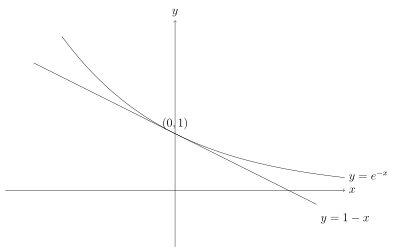
- Drawing the tangent to \(y = e^{-x}\) at \((0,1)\) we find that \(e^{-t} \geq (1-t)\) for all \(t\), in particular, \(e^t(1-t) \leq 1\) \(f'(t) = \frac{(e^t(1-t) -1}{(e^t-1)^2} \leq 0\) and \(f'(t) = -\frac12\) when \(t = 0\)

- Let \[ \tan x = \sum\limits_{n=0}^\infty a_n x^n \text{ and } \cot x = \dfrac 1 x +\sum\limits_{n=0}^\infty b_nx^n \] for \(0< x < \frac12\pi\,\). Explain why \(a_n=0\) for even \(n\). Prove the identity \[ \cot x - \tan x \equiv 2 \cot 2x\, \] and show that \[a_{n} = (1-2^{n+1})b_n\,.\]
- Let $ \displaystyle {\rm cosec}\, x = \frac1x +\sum\limits _{n=0}^\infty c_n x^n\,$ for \(0< x < \frac12\pi\,\). By considering \(\cot x + \tan x\), or otherwise, show that \[ c_n = (2^{-n} -1)b_n \,. \]
- Show that \[ \left(1+x{ \sum\limits_{n=0}^\infty} b_n x^n \right)^2 +x^2 = \left(1+x{ \sum\limits_{n=0} ^\infty} c_n x^n \right)^2\,. \] Deduce from this and the previous results that \(a_1=1\), and find \(a_3\).
- Since \(\tan (-x) = -\tan x\), \(\tan\) is an odd function, and in particular all it's even coefficients are zero. \begin{align*} && 2 \cot 2x &\equiv \frac{2 cos 2x}{\sin 2 x} \\ &&&\equiv \frac{2(\cos^2 x- \sin^2 x)}{2 \sin x \cos x} \\ &&&\equiv \frac{\cos x}{\sin x} - \frac{\sin x}{ \cos x} \\ &&&\equiv \cot x - \tan x \end{align*} Therefore \begin{align*} && \underbrace{\frac1x + \sum_{n=0}^\infty b_nx^n}_{\cot x} - \underbrace{\sum_{n=0}^\infty a_n x^n}_{\tan x} &= 2 \left (\underbrace{\frac{1}{2x} + \sum_{n=0}^\infty b_n(2x)^n}_{\cot 2x} \right) \\ \Rightarrow && \sum_{n=0}^\infty a_n x^n &= \sum_{n=0}^\infty b_nx^n - 2\sum_{n=0}^\infty b_n(2x)^n \\ &&&= \sum_{n=0}^{\infty}b_n(1-2^{n+1})x^n \\ [x^n]: && a_n &= (1-2^{n+1})b_n \end{align*}
- \(\,\) \begin{align*} && \cot x + \tan x &= \frac{\cos x}{\sin x} + \frac{\sin x}{\cos x} \\ &&&= \frac{1}{\sin x \cos x} \\ &&&=2\cosec 2x \\ \\ \Rightarrow && \underbrace{\frac1x + \sum_{n=0}^\infty b_nx^n}_{\cot x} + \underbrace{\sum_{n=0}^\infty a_n x^n}_{\tan x} &= 2\left (\underbrace{ \frac1{2x} +\sum\limits _{n=0}^\infty c_n (2x)^n}_{\cosec 2x} \right) \\ \Rightarrow && \sum_{n=0}^\infty 2^{n+1}c_n x^n &= \sum_{n=0}^{\infty}(a_n+b_n)x^n \\ &&&= \sum_{n=0}^{\infty}\left((1-2^{n+1})b_n+ b_n\right)x^n \\ &&&= \sum_{n=0}^{\infty}\left(2-2^{n+1}\right)b_nx^n \\ [x^n]: && c_n &= (2^{-n}-1)b_n \end{align*}
- \(\,\) \begin{align*} && \cot^2 x + 1 &= \cosec^2 x \\ \Rightarrow && x^2 \cot^2 x + x^2 &= x^2 \cosec^2 x \\ \Rightarrow && x^2 \left ( \underbrace{\frac1x + \sum_{n=0}^\infty b_nx^n}_{\cot x} \right)^2 + x^2 &= x^2 \left (\underbrace{ \frac1{x} +\sum\limits _{n=0}^\infty c_n x^n}_{\cosec x} \right)^2 \\ \Rightarrow && \left ( 1 + x\sum_{n=0}^\infty b_nx^{n} \right)^2 + x^2 &= \left ( 1 +x\sum\limits _{n=0}^\infty c_n x^{n} \right)^2 \\ \\ \Rightarrow && \left ( 1 + x(b_1x + b_3 x^3 + \cdots) \right)^2 + x^2 &= \left ( 1 + x(c_1x + c_3 x^3 + \cdots) \right)^2 \\ \Rightarrow && 1 + (1+2b_1)x^2+(2b_3+b_1^2)x^4 + \cdots &= 1 + 2c_1x^2 + (2c_3+c_1^2)x^4 + \cdots \\ \Rightarrow && 1 + 2b_1 &= 2(2^{-1}-1)b_1 \\ \Rightarrow && b_1 &= -\frac13 \\ \Rightarrow && a_1 &= (1-2^{2})(-\tfrac13) = 1 \\ && c_1 &= \frac16\\ \Rightarrow && 2b_3+\frac19&= 2c_3+\frac1{36} \\ \Rightarrow && 2b_3 -2(2^{-3}-1)b_3 &= -\frac{1}{12} \\ \Rightarrow && \frac{15}{4}b_3 &= -\frac{1}{12} \\ \Rightarrow && b_3 &= -\frac{1}{45} \\ \Rightarrow && a_3 &= -(1-2^4)\frac{1}{45} = \frac13 \end{align*}
The function \(f\) satisfies the identity \begin{equation} f(x) +f(y) \equiv f(x+y) \tag{\(*\)} \end{equation} for all \(x\) and \(y\). Show that \(2\f(x)\equiv \f(2x)\) and deduce that \(f''(0)=0\). By considering the Maclaurin series for \(\f(x)\), find the most general function that satisfies \((*)\). [{\it Do not consider issues of existence or convergence of Maclaurin series in this question.}]
- By considering the function \(\G\), defined by \(\ln\big(\g(x)\big) =\G(x)\), find the most general function that, for all \(x\) and \(y\), satisfies the identity \[ \g(x) \g(y) \equiv \g(x+y)\,. \]
- By considering the function \(H\), defined by \(\h(\e^u) =H(u)\), find the most general function that satisfies, for all positive \(x\) and \(y\), the identity \[ \h(x) +\h(y) \equiv \h(xy) \,. \]
- Find the most general function \(t\) that, for all \(x\) and \(y\), satisfies the identity \begin{equation*} t(x) + t(y) \equiv t(z)\,, \end{equation*} where \(z= \dfrac{x+y}{1-xy}\,\).
- Suppose \(g(x)g(y) \equiv g(x+y)\), then if \(G(x) = \ln g(x)\) we must have \(G(x)+G(y) \equiv G(x+y)\), ie \(G(x) = cx \Rightarrow g(x) = e^{cx}\)
- Suppose \(h(x)+h(y) \equiv h(xy)\), then if \(h(e^u) = H(u)\) we must have that \(H(u)+H(v) \equiv h(e^u) + h(e^v) \equiv h(e^{u+v}) \equiv H(u+v)\).Therefore \(H(u) = cu\), ie \(h(e^u) = cu\) or \(h(x) = h(e^{\ln x}) = c \ln x\).
- Finally if \(t(x) + t(y) \equiv t(z)\), the considering \(T(w) = t(\tan w)\) then \(T(x) + T(y) \equiv t(\tan x) + t(\tan y) \equiv t( \frac{\tan x + \tan y}{1- \tan x \tan y}) \equiv t (\tan (x+y)) \equiv T(x+y)\). Therefore \(T(x) = cx\) Therefore \(t(\tan w) = c w \Rightarrow t(x) = c \tan^{-1} x\)
Given that \(y = \ln ( x + \sqrt{x^2 + 1})\), show that \( \displaystyle \frac{\d y}{\d x} = \frac1 {\sqrt{x^2 + 1} }\;\). Prove by induction that, for \(n \ge 0\,\), \[ \l x^2 + 1 \r y^{\l n + 2 \r} + \l 2n + 1 \r x y^{\l n + 1 \r} + n^2 y^{\l n \r} = 0\;, \] where \(\displaystyle y^{(n)} = \frac{\d^n y}{\d x^n}\) and \(y^{(0)} =y\,\). Using this result in the case \(x = 0\,\), or otherwise, show that the Maclaurin series for \(y\) begins \[ x - {x^3 \over 6} +{3 x^5 \over 40} \] and find the next non-zero term.
Show SolutionThe exponential of a square matrix \({\bf A}\) is defined to be $$ \exp ({\bf A}) = \sum_{r=0}^\infty {1\over r!} {\bf A}^r \,, $$ where \({\bf A}^0={\bf I}\) and \(\bf I\) is the identity matrix. Let $$ {\bf M}=\left(\begin{array}{cc} 0 & -1 \\ 1 & \phantom{-} 0 \end{array} \right) \,. $$ Show that \({\bf M}^2=-{\bf I}\) and hence express \(\exp({\theta {\bf M}})\) as a single \(2\times 2\) matrix, where \(\theta\) is a real number. Explain the geometrical significance of \(\exp({\theta {\bf M}})\). Let $$ {\bf N}=\left(\begin{array}{rr} 0 & 1 \\ 0 & 0 \end{array}\right) \,. $$ Express similarly \(\exp({s{\bf N}})\), where \(s\) is a real number, and explain the geometrical significance of \(\exp({s{\bf N}})\). For which values of \(\theta\) does $$ \exp({s{\bf N}})\; \exp({\theta {\bf M}})\, = \, \exp({\theta {\bf M}})\;\exp({s{\bf N}}) $$ for all \(s\)? Interpret this fact geometrically.
Show SolutionSketch the graph of \({\rm f}(s)={ \e}^s(s-3)+3\) for \(0\le s < \infty\). Taking \({\e\approx 2.7}\), find the smallest positive integer, \(m\), such that \({\rm f}(m) > 0\). Now let $$ {\rm b}(x) = {x^3 \over \e^{x/T} -1} \, $$ where \(T\) is a positive constant. Show that \({\rm b}(x)\) has a single turning point in \(0 < x < \infty\). By considering the behaviour for small \(x\) and for large \(x\), sketch \({\rm b}(x)\) for \(0\le x < \infty\). Let $$ \int_0^\infty {\rm b}(x)\,\d x =B, $$ which may be assumed to be finite. Show that \(B = K T^n\) where \(K\) is a constant, and \(n\) is an integer which you should determine. Given that \(\displaystyle{B \approx 2 \int_0^{Tm} {\rm b}(x) {\,\rm d }x}\), use your graph of \({\rm b}(x)\) to find a rough estimate for \(K\).
- By considering the series expansion of \((x^2+5x+4){\rm \; e}^x\) show that \[10{\rm\, e}=4+\frac{3^2}{1!}+\frac{4^2}{2!}+\frac{5^2}{3!}+\cdots\;.\]
- Show that \[5{\rm\, e}=1+\frac{2^2}{1!}+\frac{3^2}{2!}+\frac{4^2}{3!}+\cdots\;.\]
- Evaluate \[1+\frac{2^3}{1!}+\frac{3^3}{2!}+\frac{4^3}{3!}+\cdots\;.\]
- \begin{align*} (x^2+5x+4)e^x &= \sum_{k=0}^\infty \frac{1}{k!} x^{k+2}+\sum_{k=0}^\infty \frac{5}{k!} x^{k+1}+\sum_{k=0}^\infty \frac{4}{k!} x^{k} \\ &= \sum_{k=0}^{\infty} \l \frac{1}{k!}+\frac{5}{(k+1)!}+\frac{4}{(k+2)!} \r x^{k+2} + 5x+4+4x \\ &= 4 + 9x + \sum_{k=0}^{\infty} \l \frac{(k+2)(k+1)}{(k+2)!}+\frac{5(k+2)}{(k+2)!}+\frac{4}{(k+2)!} \r x^{k+2}\\ &= 4 + 9x + \sum_{k=0}^{\infty} \l \frac{k^2+3k+2+5k+10+4}{(k+2)!} \r x^{k+2}\\ &= 4 + 9x + \sum_{k=0}^{\infty} \frac{(k+4)^2}{(k+2)!} x^{k+2}\\ &= 4 + 9x + \sum_{k=2}^{\infty} \frac{(k+2)^2}{k!} x^{k}\\ \end{align*} So when \(x = 1\) we have \[10e = 4 + \frac{3^2}{1!} + \frac{4^2}{2!} + \frac{5^2}{3!} + \cdots \]
- \begin{align*} (x^2+3x+1)e^x &= \sum_{k=0}^\infty \frac{1}{k!}x^{k+2}+\sum_{k=0}^\infty 3\frac{1}{k!}x^{k+1} + \sum_{k=0}^{\infty} \frac{1}{k!} x^k \\ &= 1+3x+\sum_{k=1}^{\infty} \l \frac1{(k-1)!}+\frac{3}{k!} + \frac{1}{(k+1)!} \r x^{k+1} \\ &= 1+3x+\sum_{k=1}^{\infty} \frac{(k+1)k + 3(k+1)+1}{(k+1)!}x^{k+1} \\ &= 1+3x+\sum_{k=1}^{\infty} \frac{k^2+4k+4}{(k+1)!}x^{k+1} \\ &= 1+3x+\sum_{k=0}^{\infty} \frac{(k+2)^2}{(k+1)!}x^{k+1} \\ &=1+3x+ \sum_{k=1}^{\infty} \frac{(k+1)^2}{k!}x^k \end{align*} Plugging in \(x=1\) we get the desired result.
- \begin{align*} && xe^x &= \sum_{k=0}^{\infty} \frac{x^{k+1}}{k!} \\ x\frac{\d}{\d x} : && x(1+x)e^x &= \sum_{k=0}^{\infty} \frac{(k+1)x^{k+1}}{k!} \\ x\frac{\d}{\d x} : && x(x(1+x)+1+2x)e^x &= \sum_{k=0}^{\infty} \frac{(k+1)^2x^{k+1}}{k!} \\ &&(x^3+3x^2+x)e^x &= \sum_{k=0}^{\infty} \frac{(k+1)^2x^{k+1}}{k!} \\ \frac{\d}{\d x} : && e^x(x^3+3x^2+x+3x^2+6x+1) &=\sum_{k=0}^{\infty} \frac{(k+1)^3x^{k}}{k!} \\ \Rightarrow && 15e &= 1 + \frac{2^3}{1!} + \frac{3^3}{2!} + \cdots \end{align*}
The function \(\mathrm{f}\) is given by \(\mathrm{f}(x)=\sin^{-1}x\) for \(-1 < x < 1.\) Prove that \[ (1-x^{2})\mathrm{f}''(x)-x\mathrm{f}'(x)=0. \] Prove also that \[ (1-x^{2})\mathrm{f}^{(n+2)}(x)-(2n+1)x\mathrm{f}^{(n+1)}(x)-n^{2}\mathrm{f}^{(n)}(x)=0, \] for all \(n>0\), where \(\mathrm{f}^{(n)}\) denotes the \(n\)th derivative of \(\mathrm{f}\). Hence express \(\mathrm{f}(x)\) as a Maclaurin series. The function \(\mathrm{g}\) is given by \[ \mathrm{g}(x)=\ln\sqrt{\frac{1+x}{1-x}}, \] for \(-1 < x < 1.\) Write down a power series expression for \(\mathrm{g}(x),\) and show that the coefficient of \(x^{2n+1}\) is greater than that in the expansion of \(\mathrm{f},\) for each \(n > 0\).
- Evaluate \[ \sum_{r=1}^{n}\frac{6}{r(r+1)(r+3)}. \]
- Expand \(\ln(1+x+x^{2}+x^{3})\) as a series in powers of \(x\), where \(\left|x\right|<1\), giving the first five non-zero terms and the general term.
- Expand \(\mathrm{e}^{x\ln(1+x)}\) as a series in powers of \(x\), where \(-1 < x\leqslant1\), as far as the term in \(x^{4}\).
- \begin{align*} && \frac{6}{r(r+1)(r+3)} &= \frac{2}{r} - \frac{3}{r+1} + \frac{1}{r+3} \\ \Rightarrow && \sum_{r=1}^n \frac{6}{r(r+1)(r+3)} &= \sum_{r=1}^n \l \frac{2}{r} - \frac{3}{r+1} + \frac{1}{r+3} \r \\ &&&= \sum_{r=1}^n \frac{2}{r} - \sum_{r=1}^n \frac{3}{r+1} + \sum_{r=1}^n \frac{1}{r+3} \\ &&&= \sum_{r=1}^n \frac{2}{r} - \sum_{r=2}^{n+1} \frac{3}{r} + \sum_{r=3}^{n+2} \frac{1}{r} \\ &&& = \frac{2}{1} + \frac{2}{2} - \frac{3}{2} - \frac{3}{n+1} + \frac{1}{n+1} + \frac{1}{n+2} \\ &&& = \frac{3}{2} - \frac{2}{n+1} + \frac{1}{n+2} \end{align*}
- \begin{align*} && \ln (1 + x+ x^2 + x^3) &= \ln \l \frac{1-x^4}{1-x} \r \\ &&&= \ln (1-x^4) - \ln(1-x) \\ &&&= \sum_{k=1}^{\infty} -\frac{x^{4k}}{k} - \sum_{k=1}^{\infty} - \frac{x^k}{k} \\ &&&= x + \frac12x^2+\frac13x^3-\frac34x^4+\frac15x^5 + \cdots \\ &&&= \sum_{k=1}^{\infty}a_k x^k \end{align*} Where \(a_k = \frac{1}{k}\) if \(k \neq 0 \pmod{4}\) otherwise \(a_k = -\frac{3}{k}\) if \(k \equiv 0 \pmod{4}\)
- \begin{align*} \exp(x \ln (1+x) ) &= \exp\l x \l x-\frac12x^2+\frac13x^3-\cdots \r \r \\ &= \exp\l x^2-\frac12x^3+\frac13x^4 \r \\ &= 1 + \l x^2-\frac12x^3+\frac13x^4 \r + \frac12 \l x^2-\frac12x^3+\frac13x^4 \r^2 + \cdots \\ &= 1 + x^2-\frac12x^3+\frac13x^4 + \frac12x^4 + \cdots \\ &= 1 + x^2 -\frac12x^3+\frac56x^4+\cdots \end{align*}
The points \(P\,(0,a),\) \(Q\,(a,0)\) and \(R\,(a,-a)\) lie on the curve \(C\) with cartesian equation \[ xy^{2}+x^{3}+a^{2}y-a^{3}=0,\qquad\mbox{ where }a>0. \] At each of \(P,Q\) and \(R\), express \(y\) as a Taylor series in \(h\), where \(h\) is a small increment in \(x\), as far as the term in \(h^{2}.\) Hence, or otherwise, sketch the shape of \(C\) near each of these points. Show that, if \((x,y)\) lies on \(C\), then \[ 4x^{4}-4a^{3}x-a^{4}\leqslant0. \] Sketch the graph of \(y=4x^{4}-4a^{3}x-a^{4}.\) Given that the \(y\)-axis is an asymptote to \(C\), sketch the curve \(C\).
Show Solution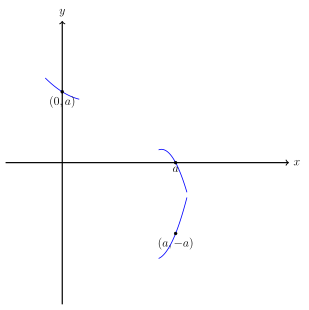

Let \begin{alignat*}{2} \tan x & =\ \ \, \quad{\displaystyle \sum_{n=0}^{\infty}a_{n}x^{n}} & & \text{ for small }x,\\ x\cot x & =1+\sum_{n=1}^{\infty}b_{n}x^{n}\quad & & \text{ for small }x\text{ and not zero}. \end{alignat*} Using the relation \[ \cot x-\tan x=2\cot2x,\tag{*} \] or otherwise, prove that \(a_{n-1}=(1-2^{n})b_{n}\), for \(n\geqslant1\). Let \[ x\mathrm{cosec}x=1+{\displaystyle \sum_{n=1}^{\infty}c_{n}x^{n}\quad\text{ for small }x\neq0. \qquad \qquad \, } \] Using a relation similar to \((*)\) involving \(2\mathrm{cosec}2x\), or otherwise, prove that \[ c_{n}=\frac{2^{n-1}-1}{2^{n}-1}\frac{1}{2^{n-1}}a_{n-1}\qquad(n\geqslant1). \]
Show Solution