Conic sections
The distinct points \(P(2ap,\, ap^2)\) and \(Q(2aq,\, aq^2)\) lie on the curve \(x^2 = 4ay\), where \(a > 0\).
- Given that \[(p+q)^2 = p^2q^2 + 6pq + 5\,,\tag{\(*\)}\] show that the line through \(P\) and \(Q\) is a tangent to the circle with centre \((0,\, 3a)\) and radius \(2a\).
- Show that, for any given value of \(p\) with \(p^2 \neq 1\), there are two distinct real values of \(q\) that satisfy equation \((*)\). Let these values be \(q_1\) and \(q_2\). Find expressions, in terms of \(p\), for \(q_1 + q_2\) and \(q_1 q_2\).
- Show that, for any given value of \(p\) with \(p^2 \neq 1\), there is a triangle with one vertex at \(P\) such that all three vertices lie on the curve \(x^2 = 4ay\) and all three sides are tangents to the circle with centre \((0,\, 3a)\) and radius \(2a\).
The distinct points \(P(ap^2 , 2ap)\), \(Q(aq^2 , 2aq)\) and \(R(ar^2,2ar)\) lie on the parabola \(y^2 = 4ax\), where \(a>0\). The points are such that the normal to the parabola at \(Q\) and the normal to the parabola at \(R\) both pass through \(P\).
- Show that \(q^2 +qp + 2 = 0\).
- Show that \(QR\) passes through a certain point that is independent of the choice of \(P\).
- Let \(T\) be the point of intersection of \(OP\) and \(QR\), where \(O\) is the coordinate origin. Show that \(T\) lies on a line that is independent of the choice of \(P\). Show further that the distance from the \(x\)-axis to \(T\) is less than \(\dfrac {\;a}{\sqrt2}\,\).
- \begin{align*} && 2y \frac{\d y}{\d x} &= 4a \\ \Rightarrow && \frac{\d y}{\d x} &= \frac{2a}{y} \end{align*} Therefore we must have \begin{align*} && \underbrace{-\frac{2aq}{2a}}_{\text{gradient of normal}} &= \underbrace{\frac{2ap-2aq}{ap^2-aq^2}}_{\Delta y / \Delta x} \\ \Rightarrow && -q &= \frac{2}{p+q} \\ && 0 &= 2 + pq+q^2 \end{align*}
- We must have that \(q,r\) are the two roots of \(x^2+px+2 = 0\) \(QR\) has the equation: \begin{align*} && \frac{y-2aq}{x-aq^2} &= \frac{2ar-2aq}{ar^2-aq^2} \\ \Rightarrow && \frac{y-2aq}{x-aq^2} &= \frac{2}{r+q} \\ \Rightarrow && y &= \frac{2}{q+r}(x-aq^2) +2aq \\ && y &= -\frac{2}{p}x+2a\left(q-\frac{q^2}{q+r} \right) \\ &&y&= -\frac{2}{p}x+2a \frac{qr}{q+r} \\ && y &= -\frac{2}{p}x - 2a \frac{2}{p} \\ && y & = -\frac{2}{p}(x+2a) \end{align*} Therefore the point \((-2a,0)\) lies on all such lines.
- \(OP\) has equation \(y = \frac{2}{p} x\) \begin{align*} && y &= \frac{2}{p} x \\ && y & = -\frac{2}{p}(x+2a) \\ && 2y &= -\frac{4a}{p} \\ \Rightarrow && y &= -\frac{2a}{p} \\ && x &= -a \end{align*} Therefore \(T\left (-a, -\frac{2a}{p} \right)\) always lies on the line \(x = -a\) The distance to the \(x\)-axis from \(T\) is \(\frac{2a}{|p|}\). We need to show that \(p\) can't be too small. Specifically \(x^2+px+2 = 0\) must have \(2\) real roots, ie \(\Delta = p^2-8 \geq 0 \Rightarrow |p| \geq 2\sqrt{2}\), ie \(\frac{2a}{|p|} \leq \frac{2a}{2\sqrt{2}} = \frac{a}{\sqrt{2}}\) as required.
- The line \(L\) has equation \(y=mx+c\), where \(m > 0\) and \(c > 0\). Show that, in the case \(mc > a > 0\), the shortest distance between \(L\) and the parabola \(y^2=4ax\) is \[ \frac{mc-a}{m\sqrt{m^2+1}}\,.\] What is the shortest distance in the case that \(mc\le a\)?
- Find the shortest distance between the point \((p,0)\), where \(p > 0\), and the parabola \(y^2=4ax\), where \(a > 0\), in the different cases that arise according to the value of \(p/a\). [You may wish to use the parametric coordinates \((at^2, 2at)\) of points on the parabola.] Hence find the shortest distance between the circle \((x-p)^2 + y^2 =b^2\), where \(p > 0\) and \(b > 0\), and the parabola \(y^2=4ax\), where \(a > 0\), in the different cases that arise according to the values of \(p\), \(a\) and \(b\).
- Suppose we have the shortest distance between the two curves, and the path between the points is not a normal to both curves. Then we could shift the endpoints to reduce the distance. (Assuming we're not at a point of intersection). Therefore, the normal to the curves must be the same (or in other words) the gradients of the curves must be the same. ie we are at a point where \(2y y' = 4a\) we must have \(y' = m\), so \(y = \frac{2a}{m}\) and \(x = \frac{a}{m^2}\) and the distance from this point to the line \(y=mx+c\) is \(\frac{|m \frac{a}{m^2} - \frac{2a}{m}+c|}{\sqrt{m^2+1}} = \frac{|mc-a|}{m\sqrt{m^2+1}} = \frac{mc-a}{m\sqrt{m^2+1}}\). If \(mc \leq a\) then we find \(\frac{a-mc}{m\sqrt{m^2+1}}\) However, we must check that the two curves do not intersect (otherwise the closest distace is \(0\)). ie we need to check if \((mx+c)^2 = 4ax\) has any solutions, this quadratic has discriminant \((2mc-4a)^2 - 4 \cdot m^2 \cdot c^2 = 16a^2-16amc = 16a(a-mc)\) which is clearly greater than \(0\) when \(a \geq mc\). Therefore the shortest distance in this case is \(0\).
- The distance squared between the point \((p,0)\) and a point of the form \((at^2,2at)\) is \(D^2 = (at^2-p)^2+4a^2t^2 = a^2t^4+(4a^2-2ap)t^2+p^2\) \begin{align*} && \frac{D^2}{a^2} &= t^4 + 2\left(2-\frac{p}{a}\right)t^2 + \frac{p^2}{a^2} \\ &&&= \left (t^2 - \left (\frac{p}{a}-2 \right)\right)^2 + \frac{p^2}{a^2} - \left (2-\frac{p}{a} \right)^2 \\ &&&= \left (t^2 - \left (\frac{p}{a}-2 \right)\right)^2 +\frac{4p}{a} -4 \\ \end{align*} Therefore if \(2 \leq \frac{p}{a}\) then we can find a \(t\) such that we attain the minimum for \(D^2/a^2\) of \(\frac{4p}{a}-4\) and so \(D = \sqrt{4pa-4a^2} = 2\sqrt{a(p-a)}\) . If not the smallest value will be when \(t = 0\) and we will have \(|p|\) Now consider all the lines joining points on the parabola to the centre of the circle. The shortest distance from the parabola to the circle will be normal to the circle and therefore will also be a line through the center. Therefore we need only consider the shortest distance from \((p,0)\) to the parabola \(-b\). Case 1: If \(p \geq 2a\) we have \(2\sqrt{a(p-a)} - b\) or \(0\) if \(b \geq 2\sqrt{a(p-a)}\) Case 2: If \(p < 2a\) we have \(p-b\) or \(0\) if \(b \geq p\)
The point \(P(a\cos\theta\,,\, b\sin\theta)\), where \(a>b>0\), lies on the ellipse \[\dfrac {x^2}{a^2} + \dfrac {y^2}{b^2}=1\,.\] The point \(S(-ea\,,\,0)\), where \(b^2=a^2(1-e^2)\,\), is a focus of the ellipse. The point \(N\) is the foot of the perpendicular from the origin, \(O\), to the tangent to the ellipse at \(P\). The lines \(SP\) and \(ON\) intersect at \(T\). Show that the \(y\)-coordinate of \(T\) is \[\dfrac{b\sin\theta}{1+e\cos\theta}\,.\] Show that \(T\) lies on the circle with centre \(S\) and radius \(a\).
Show Solution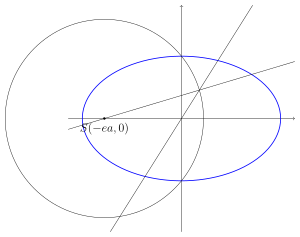
Let \(P\) be the point on the curve \(y=ax^2+bx+c\) (where \(a\) is non-zero) at which the gradient is \(m\). Show that the equation of the tangent at \(P\) is \[ y-mx=c-\frac{(m-b)^2}{4a}\;. \] Show that the curves \(y=a_1 x^2+b_1 x+c_1\) and \(y=a_2 x^2+b_2 x+c_2\) (where \(a_1\) and \(a_2\) are non-zero) have a common tangent with gradient \(m\) if and only if \[ (a_2 -a_1 )m^2 + 2(a_1 b_2-a_2 b_1)m + 4a_1 a_2(c_2-c_1)+ a_2 b_1^2-a_1 b_2 ^2=0\;. \] Show that, in the case \(a_1 \ne a_2 \,\), the two curves have exactly one common tangent if and only if they touch each other. In the case \(a_1 =a_2\,\), find a necessary and sufficient condition for the two curves to have exactly one common tangent.
Show SolutionIn the \(x\)--\(y\) plane, the point \(A\) has coordinates \((a\,,0)\) and the point \(B\) has coordinates \((0\,,b)\,\), where \(a\) and \(b\) are positive. The point \(P\,\), which is distinct from \(A\) and \(B\), has coordinates~\((s,t)\,\). \(X\) and \(Y\) are the feet of the perpendiculars from \(P\) to the \(x\)--axis and \(y\)--axis respectively, and \(N\) is the foot of the perpendicular from \(P\) to the line \(AB\,\). Show that the coordinates \((x\,,y)\) of \(N\) are given by \[ x= \frac {ab^2 -a(bt-as)}{a^2+b^2} \;, \ \ \ y = \frac{a^2b +b(bt-as)}{a^2+b^2} \;. \] Show that, if $\ds \ \left( \frac{t-b} s\right)\left( \frac t {s-a}\right) = -1\;\(, then \)N$ lies on the line \(XY\,\). Give a geometrical interpretation of this result.
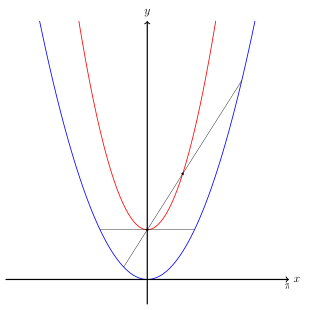
A parabola has the equation \(y=x^{2}.\) The points \(P\) and \(Q\) with coordinates \((p,p^{2})\) and \((q,q^{2})\) respectively move on the parabola in such a way that \(\angle POQ\) is always a right angle.
- Find and sketch the locus of the midpoint \(R\) of the chord \(PQ.\)
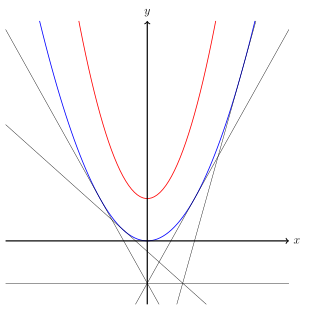
- Find and sketch the locus of the point \(T\) where the tangents to the parabola at \(P\) and \(Q\) intersect.
- The line \(PO\) has gradient \(\frac{p^2}{p} = p\) and teh line \(QO\) has gradient \(q\), therefore we must have that \(pq = -1\). Therefore, \(R\) is the point
\begin{align*}
&& R &= \left ( \frac{p-\frac{1}{p}}{2}, \frac{p^2+\frac{1}{p^2}}{2} \right) \\
&&&= \left ( \frac12\left ( p - \frac{1}{p} \right),2\left (\frac12 \left(p-\frac{1}{p}\right) \right)^2+1 \right) \\
&&&= \left ( t, 2t^2+1\right)
\end{align*}
So we are looking at another parabola.
- The tangents are \(y = 2px+c\), ie \(p^2 = 2p^2+c\), ie \(y = 2px -p^2\) so we have
\begin{align*}
&& y - 2px &= -p^2 \\
&& y - 2qx &= -q^2 \\
\Rightarrow && (2p-2q)x &= p^2-q^2 \\
\Rightarrow && x &= \frac12 (p+q)\\
&& y &= p(p+q)-p^2 \\
&& y &= pq = -1
\end{align*}
Therefore \(x = \frac12(p - \frac1p), y= -1\), so we have the line \(y = -1\) (the directrix)
The straight line \(OSA,\) where \(O\) is the origin, bisects the angle between the positive \(x\) and \(y\) axes. The ellipse \(E\) has \(S\) as focus. In polar coordinates with \(S\) as pole and \(SA\) as the initial line, \(E\) has equation \(\ell=r(1+e\cos\theta).\) Show that, at the point on \(E\) given by \(\theta=\alpha,\) the gradient of the tangent to the ellipse is given by \[ \frac{\mathrm{d}y}{\mathrm{d}x}=\frac{\sin\alpha-\cos\alpha-e}{\sin\alpha+\cos\alpha+e}. \] The points on \(E\) given by \(\theta=\alpha\) and \(\theta=\beta\) are the ends of a diameter of \(E\). Show that \[ \tan(\alpha/2)\tan(\beta/2)=-\frac{1+e}{1-e}. \] [Hint. A diameter of an ellipse is a chord through its centre.]
Show Solution
Find the equations of the tangent and normal to the parabola \(y^{2}=4ax\) at the point \((at^{2},2at).\) For \(i=1,2,\) and 3, let \(P_{i}\) be the point \((at_{i}^{2},2at_{i}),\) where \(t_{1},t_{2}\) and \(t_{3}\) are all distinct. Let \(A_{1}\) be the area of the triangle formed by the tangents at \(P_{1},P_{2}\) and \(P_{3},\) and let \(A_{2}\) be the area of the triangle formed by the normals at \(P_{1},P_{2}\) and \(P_{3}.\) Using the fact that the area of the triangle with vertices at \((x_{1},y_{1}),(x_{2},y_{2})\) and \((x_{3},y_{3})\) is the absolute value of \[ \tfrac{1}{2}\det\begin{pmatrix}x_{1} & y_{1} & 1\\ x_{2} & y_{2} & 1\\ x_{3} & y_{3} & 1 \end{pmatrix}, \] show that \(A_{3}=(t_{1}+t_{2}+t_{3})^{2}A_{1}.\) Deduce a necessary and sufficient condition in terms of \(t_{1},t_{2}\) and \(t_{3}\) for the normals at \(P_{1},P_{2}\) and \(P_{3}\) to be concurrent.
Show Solution