Implicit equations and differentiation
In this question, you should consider only points lying in the first quadrant, that is with \(x > 0\) and \(y > 0\).
- The equation \(x^2 + y^2 = 2ax\) defines a \emph{family} of curves in the first quadrant, one curve for each positive value of \(a\). A second family of curves in the first quadrant is defined by the equation \(x^2 + y^2 = 2by\), where \(b > 0\).
- Differentiate the equation \(x^2 + y^2 = 2ax\) implicitly with respect to \(x\), and hence show that every curve in the first family satisfies the differential equation \[2xy\frac{\mathrm{d}y}{\mathrm{d}x} = y^2 - x^2.\] Find similarly a differential equation, independent of \(b\), for the second family of curves.
- Hence, or otherwise, show that, at every point with \(y \neq x\) where a curve in the first family meets a curve in the second family, the tangents to the two curves are perpendicular. A curve in the first family meets a curve in the second family at \((c,\,c)\), where \(c > 0\). Find the equations of the tangents to the two curves at this point. Is it true that where a curve in the first family meets a curve in the second family on the line \(y = x\), the tangents to the two curves are perpendicular?
- Given the family of curves in the first quadrant \(y = c\ln x\), where \(c\) takes any non-zero value, find, by solving an appropriate differential equation, a second family of curves with the property that at every point where a curve in the first family meets a curve in the second family, the tangents to the two curves are perpendicular.
- A family of curves in the first quadrant is defined by the equation \(y^2 = 4k(x + k)\), where \(k\) takes any non-zero value. Show that, at every point where one curve in this family meets a second curve in the family, the tangents to the two curves are perpendicular.
- The curve \(C_1\) has equation \[ ax^2 + bxy + cy^2 = 1 \] where \(abc \neq 0\) and \(a > 0\). Show that, if the curve has two stationary points, then \(b^2 < 4ac\).
- The curve \(C_2\) has equation \[ ay^3 + bx^2y + cx = 1 \] where \(abc \neq 0\) and \(b > 0\). Show that the \(x\)-coordinates of stationary points on this curve satisfy \[ 4cb^3 x^4 - 8b^3 x^3 - ac^3 = 0\,. \] Show that, if the curve has two stationary points, then \(4ac^6 + 27b^3 > 0\).
- Consider the simultaneous equations \begin{align*} ay^3 + bx^2 y + cx &= 1 \\ 2bxy + c &= 0 \\ 3ay^2 + bx^2 &= 0 \end{align*} where \(abc \neq 0\) and \(b > 0\). Show that, if these simultaneous equations have a solution, then \(4ac^6 + 27b^3 = 0\).
The curve \(C\) is given parametrically by the equations \(x = 3t^2\), \(y = 2t^3\). Show that the equation of the tangent to \(C\) at the point \((3p^2 , 2p^3)\) is \(y = px - p^3\). Find the point of intersection of the tangents to \(C\) at the distinct points \((3p^2 , 2p^3)\) and \((3q^2 , 2q^3)\). Hence show that, if these two tangents are perpendicular, their point of intersection is \((u^2 + 1 , -u)\), where \(u = p + q\). The curve \(\tilde{C}\) is given parametrically by the equations \(x = u^2 + 1\), \(y = -u\). Find the coordinates of the points that lie on both \(C\) and \(\tilde{C}\). Sketch \(C\) and \(\tilde{C}\) on the same axes.
Show Solution
- Sketch, on \(x\)-\(y\) axes, the set of all points satisfying \(\sin y = \sin x\), for \(-\pi \le x \le \pi\) and \(-\pi \le y \le \pi\). You should give the equations of all the lines on your sketch.
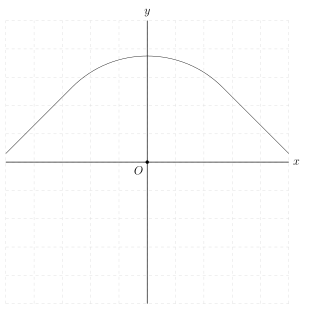
- Given that \[ \sin y = \tfrac12 \sin x \] obtain an expression, in terms of \(x\), for \(y'\) when \(0\le x \le \frac12 \pi\) and \(0\le y \le \frac12 \pi\), and show that \[ y'' = - \frac {3\sin x}{(4-\sin^2 x)^{\frac32}} \;. \] Use these results to sketch the set of all points satisfying \(\sin y = \tfrac12 \sin x\) for \(0 \le x \le \frac12 \pi\) and \(0 \le y \le \frac12 \pi\). Hence sketch the set of all points satisfying \(\sin y = \tfrac12 \sin x\) for \(-\pi\! \le \! x \! \le \! \pi\) and \mbox{\( -\pi \, \le\, y\, \le\, \pi\,\)}.
- Without further calculation, sketch the set of all points satisfying \(\cos y = \tfrac12 \sin x\) for \(- \pi \le x \le \pi\) and \( -\pi \le y \le \pi\).
- \(\,\)
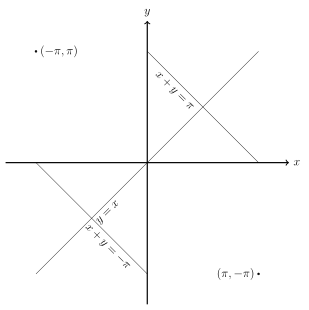
- \(\,\) \begin{align*}
&& \sin y &= \tfrac12 \sin x \\
\Rightarrow && \frac{\d y}{\d x} \cos y &= \tfrac12 \cos x \\
\Rightarrow && \frac{\d y}{\d x} &= \frac{\cos x}{2 \cos y} \\
&&&= \frac{\cos x}{2 \sqrt{1-\sin^2 y}} \\
&&&= \frac{\cos x}{2 \sqrt{1-\frac14 \sin^2 x}} \\
&&&= \frac{\cos x}{\sqrt{4-\sin^2 x}} \\
\\
&& y'' &= \frac{-\sin x \cdot (4-\sin^2 x)^{\frac12} - \cos x \cdot (4-\sin^2 x)^{-\frac12} \cdot 2 \sin x \cos x}{(4-\sin^2 x)} \\
&&&= \frac{-\sin x \cdot (4-\sin^2 x) - \cos x \cdot 2 \sin x \cos x}{(4-\sin^2x)^{\frac32}} \\
&&&= \frac{-\sin x \cdot (4-\sin^2 x) - \sin x (1-\sin^2x)}{(4-\sin^2x)^{\frac32}} \\
&&&= \frac{-3\sin x }{(4-\sin^2x)^{\frac32}} \\
\end{align*}
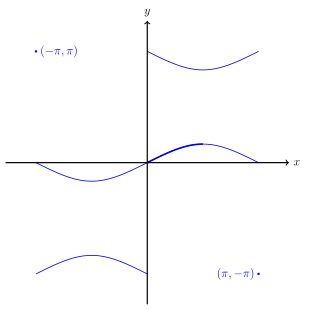
- \(\,\)
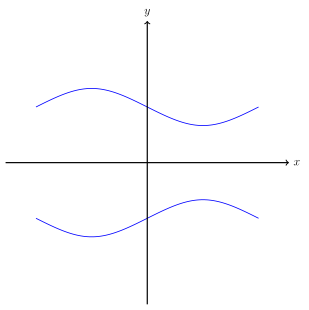
- Show, geometrically or otherwise, that the shortest distance between the origin and the line \(y= mx+c\), where \(c\ge0\), is \(c(m^2+1)^{-\frac12}\).
- The curve \(C\) lies in the \(x\)-\(y\) plane. Let the line \(L\) be tangent to \(C\) at a point \(P\) on \(C\), and let \(a\) be the shortest distance between the origin and \(L\). The curve \(C\) has the property that the distance \(a\) is the same for all points \(P\) on \(C\). Let \(P\) be the point on \(C\) with coordinates \((x,y(x))\). Given that the tangent to \(C\) at \(P\) is not vertical, show that \begin{equation} (y-xy')^2 = a^2\big (1+(y')^2 \big) \,. \tag{\(*\)} \end{equation} By first differentiating \((*)\) with respect to \(x\), show that either \(y= mx \pm a(1+m^2)^{\frac12}\) for some \(m\) or \(x^2+y^2 =a^2\).
- Now suppose that \(C\) (as defined above) is a continuous curve for \(-\infty < x < \infty\), consisting of the arc of a circle and two straight lines. Sketch an example of such a curve which has a non-vertical tangent at each point.
- \(\,\)
Note that we have a right angled triangle, with the sides in a ratio of \(m\). So if our target length is \(x\) we have \(x^2 + (mx)^2 = c^2\) and so \(x = c(m^2+1)^{-\frac12}\)
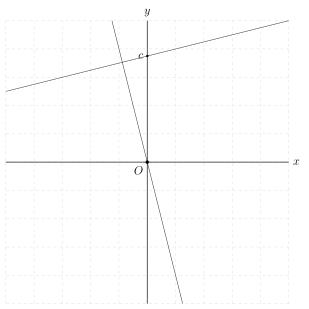
- The distance from the origin to \(L\) is \(a = c(m^2+1)^{-\frac12}\) so \begin{align*} && a^2(m^2+1) &= c^2 \\ && \frac{c-y(x)}{0-x} &= y' \\ \Rightarrow && c-y &= -xy' \\ \Rightarrow && a^2((y')^2+1) &= (y-xy')^2 \\ \\ && 2a^2y'y'' &= 2(y-xy')(y'-xy''-y') \\ &&&= 2(xy'-y)xy'' \\ \Rightarrow && y'' &= 0 \\ \text{ or } && 2a^2y' &= 2(xy'-y)x \end{align*} If \(y'' = 0\) then \(y = mx + c\) and the result follows immediately. \begin{align*} && 0 &= (a^2-x^2)y' + yx \\ \Rightarrow &&\frac1{y} y' &= -\frac{x}{a^2-x^2} \\ \Rightarrow && \ln y &= \frac12\ln (a^2-x^2) + K \\ \Rightarrow && y^2 &= M(a^2-x^2) \\ \Rightarrow && x^2 + y^2 &= a^2 \end{align*} Where in the last step we know the tangents from an ellipse are not all equidistant to the origin.
- Show that the gradient of the curve \(\; \dfrac a x + \dfrac by =1\), where \(b\ne0\), is \(\; -\dfrac{ay^2}{bx^2}\,\). The point \((p,q)\) lies on both the straight line \(ax+by=1\) and the curve \(\dfrac a x + \dfrac by =1\,\), where \(ab\ne0\). Given that, at this point, the line and the curve have the same gradient, show that \( p=\pm q\,\). Show further that either \((a-b)^2 =1\,\) or \((a+b)^2 =1\,\).
- Show that if the straight line \(ax+by=1\), where \(ab\ne0\), is a normal to the curve \(\dfrac a x - \dfrac by =1\), then \(a^2-b^2 = \frac12\,\).
- \(\,\) \begin{align*} && 1 &= \frac{a}{x} + \frac{b}{y} \\ \frac{\d}{\d x}: && 0 &= -\frac{a}{x^2} - \frac{b}{y^2} \frac{\d y}{\d x} \\ \Rightarrow && \frac{\d y}{\d x} &= -\frac{ay^2}{bx^2} \\ \\ (p,q): && -\frac{aq^2}{bp^2} &= -\frac{a}{b} \\ \Rightarrow && p^2 &= q^2 \\ \Rightarrow && p &= \pm q \\ \\ \Rightarrow && ap \pm b p &= 1 \\ \Rightarrow && (a\pm b)p &= 1 \\ \Rightarrow && \frac{a}{p} \pm \frac{b}{p} &= 1 \\ \Rightarrow && (a \pm b)\frac{1}{p} &= 1 \\ \Rightarrow && (a \pm b)^2 &= 1 \end{align*}
- \(\,\) \begin{align*} && 1 &= \frac{a}{x} - \frac{b}{y} \\ \Rightarrow && \frac{\d y}{\d x} &= \frac{ay^2}{bx^2} \\ \Rightarrow && \frac{aq^2}{bp^2} &= \frac{b}{a} \\ \Rightarrow && aq &= \pm bp \\ \Rightarrow && 1 &= \frac{a}{p} - \frac{b}{q} \\ &&&= \frac{aq-bp}{pq} \\ \Rightarrow && aq &= -bp \\ \Rightarrow && 1 &= \frac{2aq}{pq} \\ \Rightarrow && p &= 2a \\ \Rightarrow && q &= -2b \\ \Rightarrow && 1 &= 2a^2-2b^2 \\ \Rightarrow && \frac12 &= a^2-b^2 \end{align*}
A curve has the equation \[ y^3 = x^3 +a^3+b^3\,, \] where \(a\) and \(b\) are positive constants. Show that the tangent to the curve at the point \((-a,b)\) is \[ b^2y-a^2x = a^3+b^3\,. \] In the case \(a=1\) and \(b=2\), show that the \(x\)-coordinates of the points where the tangent meets the curve satisfy \[ 7x^3 -3x^2 -27x-17 =0\,. \] Hence find positive integers \(p\), \(q\), \(r\) and \(s\) such that \[ p^3 = q^3 +r^3 +s^3\,. \]
Show SolutionA right circular cone has base radius \(r\), height \(h\) and slant length \(\ell\). Its volume \(V\), and the area \(A\) of its curved surface, are given by \[ V= \tfrac13 \pi r^2 h \,, \ \ \ \ \ \ \ A = \pi r\ell\,. \]
- Given that \(A\) is fixed and \(r\) is chosen so that \(V\) is at its stationary value, show that \(A^2 = 3\pi^2r^4\) and that \(\ell =\sqrt3\,r\).
- Given, instead, that \(V\) is fixed and \(r\) is chosen so that \(A\) is at its stationary value, find \(h\) in terms of \(r\).
- Given \(A\) is fixed, and \(h^2 + r^2 = \ell^2\), we can look at \begin{align*} && V^2 &= \frac19 \pi^2 r^4 h^2 \\ &&&= \frac19\pi^2r^4(\ell^2 - r^2) \\ &&&= \frac19\pi^2 r^4\left (\frac{A^2}{\pi^2r^2} - r^2 \right) \\ &&&= \frac{A^2r^2 - \pi^2r^6}{9} \end{align*} Differentiating wrt to \(r\) we find that \(2rA^2-6\pi^2 r^5 = 0\) or hence \(A^2 = 3\pi^2 r^4 \Rightarrow A = \sqrt{3}\pi r^2\). Therefore \(\sqrt{3}\pi r^2 = \pi r \ell \Rightarrow \ell = \sqrt{3}r\).
- Supposing \(V\) is fixed, then \begin{align*} && A^2 &= \pi^2 r^2\ell^2 \\ &&&= \pi^2 r^2 (h^2+r^2) \\ &&&= \pi^2 r^2 \left ( \frac{9V^2}{\pi^2r^4} + r^2 \right) \\ &&&= 9V^2r^{-2} + \pi^2r^4 \\ \end{align*} Differentiating wrt to \(r\) we find \(-18V^2r^{-3} + 4\pi^2 r^3 = 0\) so \(V^2 = \frac{2\pi^2}{9}r^6\) or \(V = \frac{\sqrt{2}\pi}{3}r^3\), from which it follows: \(\frac{\sqrt{2}\pi}{3}r^3 = \frac13\pi r^2 h \Rightarrow h = \sqrt{2}r\)
The variables \(t\) and \(x\) are related by \(t=x+ \sqrt{x^2+2bx+c\;} \,\), where \(b\) and \(c\) are constants and \(b^2 < c\). Show that \[ \frac{\d x}{\d t} = \frac{t-x}{t+b}\;, \] and hence integrate \(\displaystyle \frac1 {\sqrt{x^2+2bx+c}}\,\). Verify by direct integration that your result holds also in the case \(b^2=c\) if \(x+b > 0\) but that your result does not hold in the case \(b^2=c\) if \(x+b < 0\,\).
Show SolutionA curve is given by \[x^2+y^2 +2axy = 1,\] where \(a\) is a constant satisfying \(0 < a < 1\). Show that the gradient of the curve at the point \(P\) with coordinates \((x,y)\) is \[\displaystyle - \frac {x+ay}{ax+y}\,,\] provided \(ax+y \ne0\). Show that \(\theta\), the acute angle between \(OP\) and the normal to the curve at \(P\), satisfies \[ \tan\theta = a\vert y^2-x^2\vert\;. \] Show further that, if \(\ \displaystyle \frac{\d \theta}{\d x}=0\) at \(P\), then:
- \(a(x^2+y^2)+2xy=0\,\);
- \((1+a)(x^2+y^2+2xy)=1\,\);
- \(\displaystyle \tan\theta = \frac a{\sqrt{1-a^2}}\,\).
- \(\,\) \begin{align*} && \sec^2 \theta \frac{\d \theta}{\d x} &= \pm a \left (2y \frac{\d y}{\d x} - 2 x\right) \\ \Rightarrow && 0 &= a \left (y \cdot \frac{x+ay}{ax+y} + x \right) \\ &&&=a \left ( \frac{xy+ay^2+ax^2+xy}{ax+y} \right) \\ \Rightarrow && 0 &= a(x^2+y^2)+2xy \end{align*}
- \(\,\) \begin{align*} && 0 &=a(x^2+y^2)+2xy \\ && 1 &= x^2+y^2 + 2axy \\ \Rightarrow && 1 &= (a+1)(x^2+y^2) + (a+1)(2xy) \\ &&&= (a+1)(x^2+y^2+2xy) \end{align*}
- \(\,\) \begin{align*} && 1 &= (a+1)(x+y)^2 \\ \Rightarrow && x +y &= \pm \frac{1}{\sqrt{1+a}} \\ && 0 &=a(x^2+y^2)+2xy \\ && 1 &= x^2+y^2 + 2axy \\ \Rightarrow && 1 &= (1-a)(x^2+y^2) + (a-1)(2xy) \\ &&&= (1-a)(x^2+y^2-2xy)\\ \Rightarrow && x-y &= \pm \frac{1}{\sqrt{1-a}} \\ \Rightarrow && \frac{\d \theta}{\d x} &= a|y^2-x^2| \\ &&&= a|(y-x)(x+y)| \\ &&&= \frac{a}{\sqrt{1-a^2}} \end{align*}
- If \[{\mathrm f}(x)=\tan^{-1}x+\tan^{-1}\left(\frac{1-x}{1+x}\right),\] find \({\mathrm f}'(x)\). Hence, or otherwise, find a simple expression for \({\mathrm f}(x)\).
- Suppose that \(y\) is a function of \(x\) with \(0 < y < (\pi/2)^{1/2}\) and \[x=y\sin y^{2}\] for \(0 < x < (\pi/2)^{1/2}\). Show that (for this range of \(x\)) \[\frac{{\mathrm d}y}{{\mathrm d}x}= \frac{y}{x+2y^2\sqrt{y^{2}-x^{2}}}.\]
- \begin{align*} && f(x)&=\tan^{-1}x+\tan^{-1}\left(\frac{1-x}{1+x}\right) \\ \Rightarrow && f'(x) &= \frac{1}{1+x^2} + \frac{1}{1+\l \frac{1-x}{1+x} \r^2} \cdot \l \frac{-2}{(1+x)^2}\r \\ &&&= \frac1{1+x^2}- \frac{2}{(1+x)^2+(1-x)^2} \\ &&&= \frac1{1+x^2} - \frac{2}{2+2x^2} \\ &&&= 0 \end{align*} Therefore $f(x) = \begin{cases} c_1 & \text{if } x < -1 \\ c_2 & \text{if } x > -1 \end{cases}$ \(f(0) = \tan^{-1} 0 + \tan^{-1} 1 = \frac{\pi}{4}\) \(\lim_{x \to \infty} f(x) = -\frac{\pi}{2} + \tan^{-1} -1 = -\frac{3\pi}{4}\) therefore $f(x) = \begin{cases} -\frac{3\pi}{4}& \text{if } x < -1 \\ \frac{\pi}{4} & \text{if } x > -1 \end{cases}$
- \begin{align*} && x &= y \sin y^2 \\ \Rightarrow && \frac{\d x}{\d y} &= \sin y^2 + 2y^2 \cos y^2 \\ \Rightarrow && \frac{\d y}{\d x} &= \frac{1}{\sin y^2+2y^2 \cos y^2} \\ &&&=\frac{1}{\frac{x}{y}+2y^2 \sqrt{1-\sin^2y^2}} \\ &&&= \frac{y}{x + 2y^3 \sqrt{1-\frac{x^2}{y^2}}} \\ &&&= \frac{y}{x+2y^2 \sqrt{y^2-x^2}} \end{align*}
The equation of a hyperbola (with respect to axes which are displaced and rotated with respect to the standard axes) is \[ 3y^{2}-10xy+3x^{2}+16y-16x+15=0.\tag{\(\dagger\)} \] By differentiating \((\dagger)\), or otherwise, show that the equation of the tangent through the point \((s,t)\) on the curve is \[ y=\left(\frac{5t-3s+8}{3t-5s+8}\right)x-\left(\frac{8t-8s+15}{3t-5s+8}\right). \] Show that the equations of the asymptote (the limiting tangents as \(s\rightarrow\infty\)) are \[ y=3x-4\qquad\mbox{ and }\qquad3y=x-4. \] {[}Hint: You will need to find a relationship between \(s\) and \(t\) which is valid in the limit as \(s\rightarrow\infty.\){]} Show that the angle between one asymptote and the \(x\)-axis is the same as the angle between the other asymptote and the \(y\)-axis. Deduce the slopes of the lines that bisect the angles between the asymptotes and find the equations of the axes of the hyperbola.
Show SolutionThe function \(\mathrm{g}\) satisfies, for all positive \(x\) and \(y\), \[ \mathrm{g}(x)+\mathrm{g}(y)=\mathrm{g}(z),\tag{*} \] where \(z=xy/(x+y+1).\) By treating \(y\) as a constant, show that \[ \mathrm{g}'(x)=\frac{y^{2}+y}{(x+y+1)^{2}}\mathrm{g}'(z)=\frac{z(z+1)}{x(x+1)}\mathrm{g}'(z), \] and deduce that \(2\mathrm{g}'(1)=(u^{2}+u)\mathrm{g}'(u)\) for all \(u\) satisfying \(0 < u < 1.\) Now by treating \(u\) as a variable, show that \[ \mathrm{g}(u)=A\ln\left(\frac{u}{u+1}\right)+B, \] where \(A\) and \(B\) are constants. Verify that \(\mathrm{g}\) satisfies \((*)\) for a suitable value of \(B\). Can \(A\) be determined from \((*)\)? The function \(\mathrm{f}\) satisfies, for all positive \(x\) and \(y\), \[ \mathrm{f}(x)+\mathrm{f}(y)=\mathrm{f}(z) \] where \(z=xy.\) Show that \(\mathrm{f}(x)=C\ln x\) where \(C\) is a constant.
Show SolutionSketch the curve \(y^{2}=1-\left|x\right|\). A rectangle, with sides parallel to the axes, is inscribed within this curve. Show that the largest possible area of the rectangle is \(8/\sqrt{27}\). Find the maximum area of a rectangle similarly inscribed within the curve given by \(y^{2m}=\left(1-\left|x\right|\right)^{n}\), where \(m\) and \(n\) are positive integers, with \(n\) odd.
Show Solution